Munich in 2–3 days: inside the old town, across the museum quarter, out to Dachau

Last updated 4 August 2026
Overview
Almost everything worth seeing in Munich is inside something else. From the sidewalk the old town’s churches are plain walls with doors in them, the Residenz is a long gray front you could walk the length of without noticing, and the great picture collections are not in the old town at all but in a grid of quiet streets a quarter of an hour north. A single day here is spent outdoors, looking up. Two is when you start going in.
These two divide on exactly that. Day one is the Altstadt read as interiors — a Jesuit church with a royal crypt under it, two brothers’ private chapel, and the Residenz taken as all three of its parts instead of sampled — walked east from the station and finishing south of the old walls. Day two is Maxvorstadt, where the Kunstareal, a museum quarter, grew around the square the Nazi party used as its ceremonial forum, so a morning of history and an afternoon of painting stand four hundred meters apart; it ends at the lake at the top of the southern half of the Englischer Garten. The two days share no streets, and apart from a stop or two on the U-Bahn on the second day, both are walked.
Day one

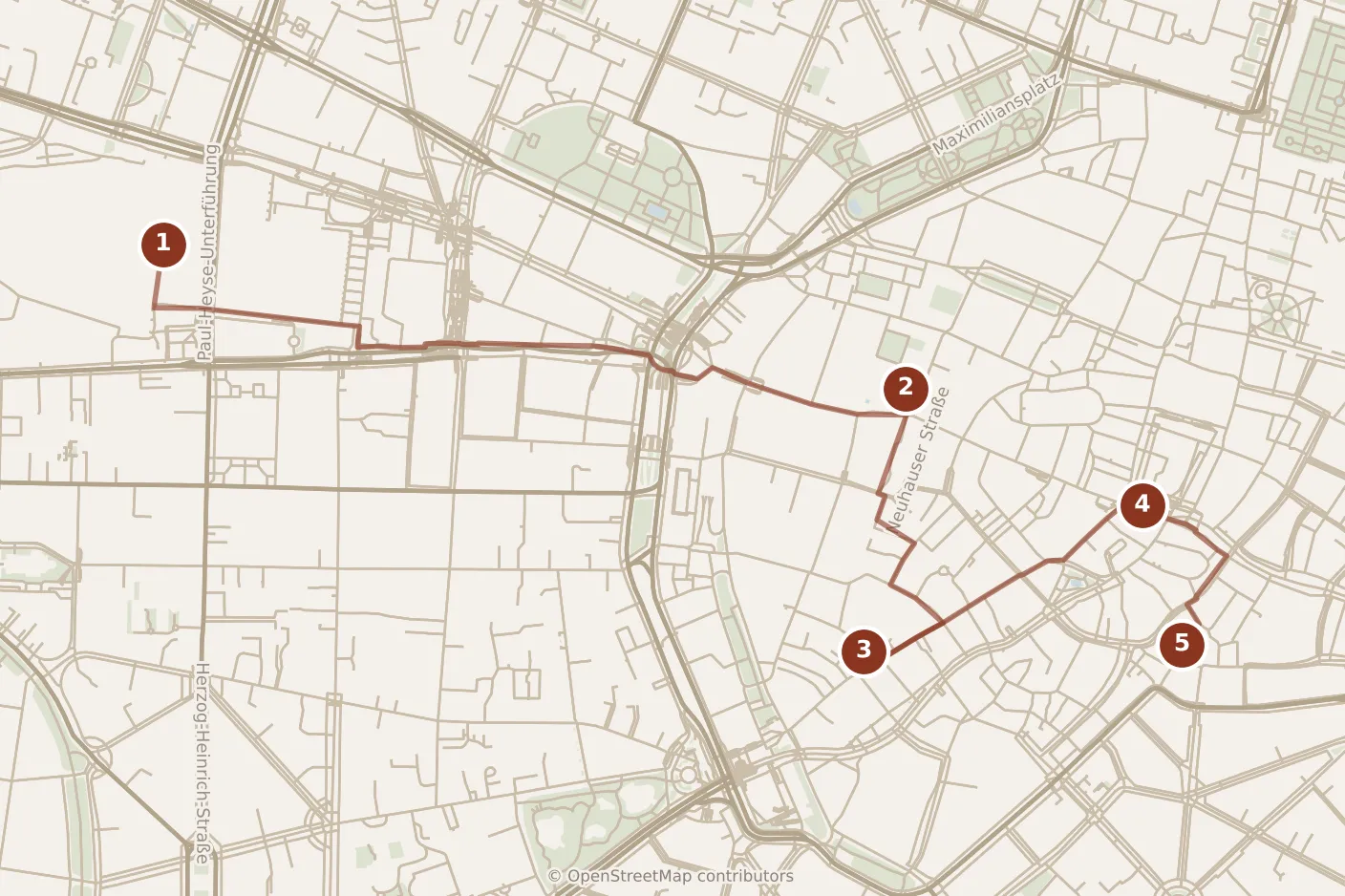
- Morning
- 1Hauptbahnhof
- 2St. Michael's Church
- 3Asamkirche
- 4Marienplatz
- 5Viktualienmarkt
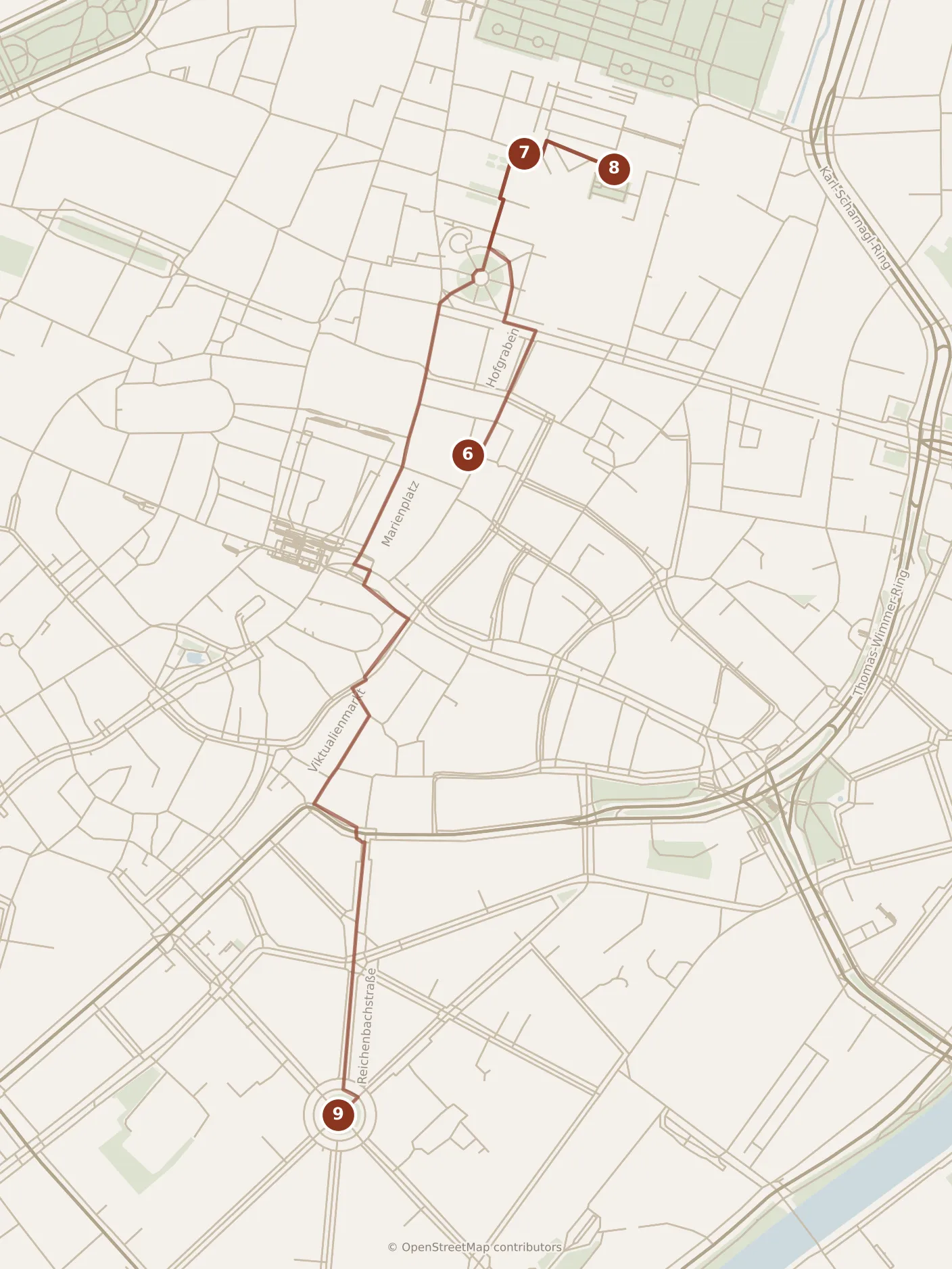
- Afternoon and evening
- 6Alter Hof
- 7Residenz
- 8Cuvilliés Theatre
- 9Gärtnerplatz
Everything today sits in a rectangle a kilometer and a half long, and the day crosses it once, west to east, then turns south. The fixed point is the little court theater inside the Residenz: in 2026 it did not open until two in the afternoon from Monday to Saturday for most of the year, and it stops admitting an hour before the complex closes. That is why it sits in the middle of the afternoon rather than at the end of it, and if you find a different hour the rule survives the change — the theater is the one part of the Residenz that cannot open your visit, so build the morning forwards from wherever it now starts. Everything above the Residenz comes to about two and a half hours of recommendations and something under an hour of walking, so a nine o’clock start brings you to its gate before the theater opens; the museum and the treasury come after the theater, not before it.
Morning
You will almost certainly arrive at the Hauptbahnhof: the fast trains end there and the airport S-Bahn calls there without ending — it runs on through the center in a tunnel, so get off here rather than waiting for the end of the line. It has been a building site since 2018, the front hall is gone and a second S-Bahn tunnel is being dug underneath, so there is no grand entrance to walk out of — you leave by a side exit into a concourse narrower than any plan shows. Turn east. It is a little over twenty minutes on foot through Karlsplatz and along the pedestrian street to the first stop, and the alternative is a wash rather than a saving: two stops on any S-Bahn to Marienplatz, then seven minutes back west, comes to the same twenty once you have found the platform.
St. Michael’s Church stands on the right of that street and looks like a palace, which is the point — built between 1583 and 1597 as the Jesuit headquarters of the Counter-Reformation in southern Germany, and the largest Renaissance church north of the Alps. Inside, stand still under the barrel vault: twenty meters across with nothing holding it up in the middle, the second widest of its kind anywhere after St Peter’s in Rome. Down the stairs is the Wittelsbach crypt, where some forty of the family that ruled Bavaria for seven centuries are buried, Ludwig II among them — the king who built the castles and drowned in a lake at forty. Most of the kings and electors of the line are in other churches in the city, so this is a part of the dynasty and not all of it. It carries a small separate charge and its own hours, shorter than the church’s, and the parish publishes both: that is the one thing on this morning worth reading before you set out. Forty minutes for church and crypt together. It is a working church, so if you walk into a service, sit at the back or come back later; the same goes for everything else this morning.
From its door cut south through the lanes, eight minutes, to Sendlinger Straße. The Asamkirche is a shopfront-width gap in the terrace and the most concentrated interior in the city. Egid Quirin Asam, a sculptor, and his brother Cosmas Damian, a painter, built it in the 1730s beside their own house, for themselves, with nobody to please — about eight meters wide, dark, gold from floor to vault, and without the flatness money usually imposes. Egid Quirin cut a window in his house wall so he could see the altar from home. Twenty minutes, and there is nothing to buy. Two hundred meters further down the same street stands Sendlinger Tor, one of the three medieval city gates still standing and the least intact of them: its central tower came down in 1808 and its three original arches were replaced in 1906 by the single big one you now walk under. Five minutes there and back if you like a gate, and no loss at all if you do not.
One warning that will not rot: the church is the only stop on these two days with a weekday of its own — day two’s museums share a Monday between them, and the market shares Germany’s Sunday. In 2026 it did not open until the early afternoon on Fridays, every week of the year, against the morning on the other six days. If yours is a Friday the morning cannot have it, so take it on the walk south at the end of the day instead — eighteen minutes down from the Residenz to the church and twelve more to Gärtnerplatz, against twenty-one going direct, so the whole detour costs nine minutes. Leave the Residenz by five to be sure of the door.
Ten minutes back up the street brings you into Marienplatz, a crossing today rather than a destination — except for the mechanical clock on the town hall front, which turns at eleven and again at midday, takes about a quarter of an hour, and is the only thing in the old town that will not wait. From March to October it turns a third time at five, and that is the escape: the walk south at the end of the day comes back through this square towards that hour, so in those months you can let the morning turns go and take the late one on the way through. Outside them, if the arithmetic has held you get here at about twenty to eleven, so either stand about for the twenty minutes or go down to the market first and come back up for the midday turn, which is two minutes each way and the better use of the gap.
Two minutes downhill is the Viktualienmarkt, permanent stalls on the city’s food market square since 1807, and this order gets you there before noon — which matters for the one thing Munich will tell you it invented, because Weißwurst is a morning food here, eaten before midday and never with the skin on. Any later in the day and the question does not arise. Give the market an hour.
Afternoon
Three hundred meters north-east, through a passage off the market lanes, is the Alter Hof — the original ducal castle, begun in the 1250s, before there was a Residenz to move into. What survives is a small irregular courtyard with a corner oriel on a tower: free, ten minutes, and worth them only because you are about to see what the same family were building five hundred years later.
Five minutes north up Residenzstraße is the Residenz. The single-day version of this city tells you to take the Antiquarium and leave; the second day is what buys the rest, and the rest is where the surprises are. See the Antiquarium anyway — sixty-six meters of frescoed barrel vault built in 1568 for a collection of ancient busts, the largest Renaissance room north of the Alps — then the Ancestral Gallery, a gilded corridor of family portraits, and then stop. A hundred and thirty rooms are on offer and trying to see them is the mistake. Ninety minutes.
The treasury next door holds a thousand years of Wittelsbach inheritance and plunder, and the object to find is a small gold crown of about 1370–80: the oldest surviving royal crown known to have been in England, brought here in a marriage dowry and in Munich since 1782. Forty-five minutes. And the Cuvilliés Theatre, which is why the afternoon is shaped as it is — a four-tier rococo auditorium built for the court by François de Cuvilliés between 1751 and 1753, where Mozart’s Idomeneo had its first performance in 1781. The carved boxes were taken out and stored before the bombing, so what you walk into is the actual eighteenth-century woodwork, re-erected in a different wing in 1958. You stand in the stalls and look up. Twenty minutes, and no other room in Munich does that.
The three parts are sold singly and as one combination ticket, and the combination is sold at the theater’s own desk rather than the museum’s — which is the second reason to start at the theater — or online if you would rather not wait in line at all. It was in the twenty-euro range for an adult in 2026, against roughly half that for the museum alone.
Local tip. Of the three, the museum is the one you can shorten and the theater is the one you cannot postpone. Take the theater when it opens, then go back into the museum for as long as you have left. The reverse order is how people miss it.
If the afternoon is short, the Alter Hof goes first — ten minutes and a comparison you can make from a photograph. Cut the Residenz museum second, down to the Antiquarium alone. Never cut the theater: it is the only thing here you cannot come back for on a whim.
Evening
Walk south, twenty minutes down through the old town and out the other side, to Gärtnerplatz — a round green square where six streets meet, at the top of the Glockenbachviertel. This is the eating and drinking quarter of Isarvorstadt: small, flat, entirely walkable, and where the city goes when it is not performing Bavaria for anybody. That contrast is the point of ending here, after a day in rooms built to impress foreigners.
Day two

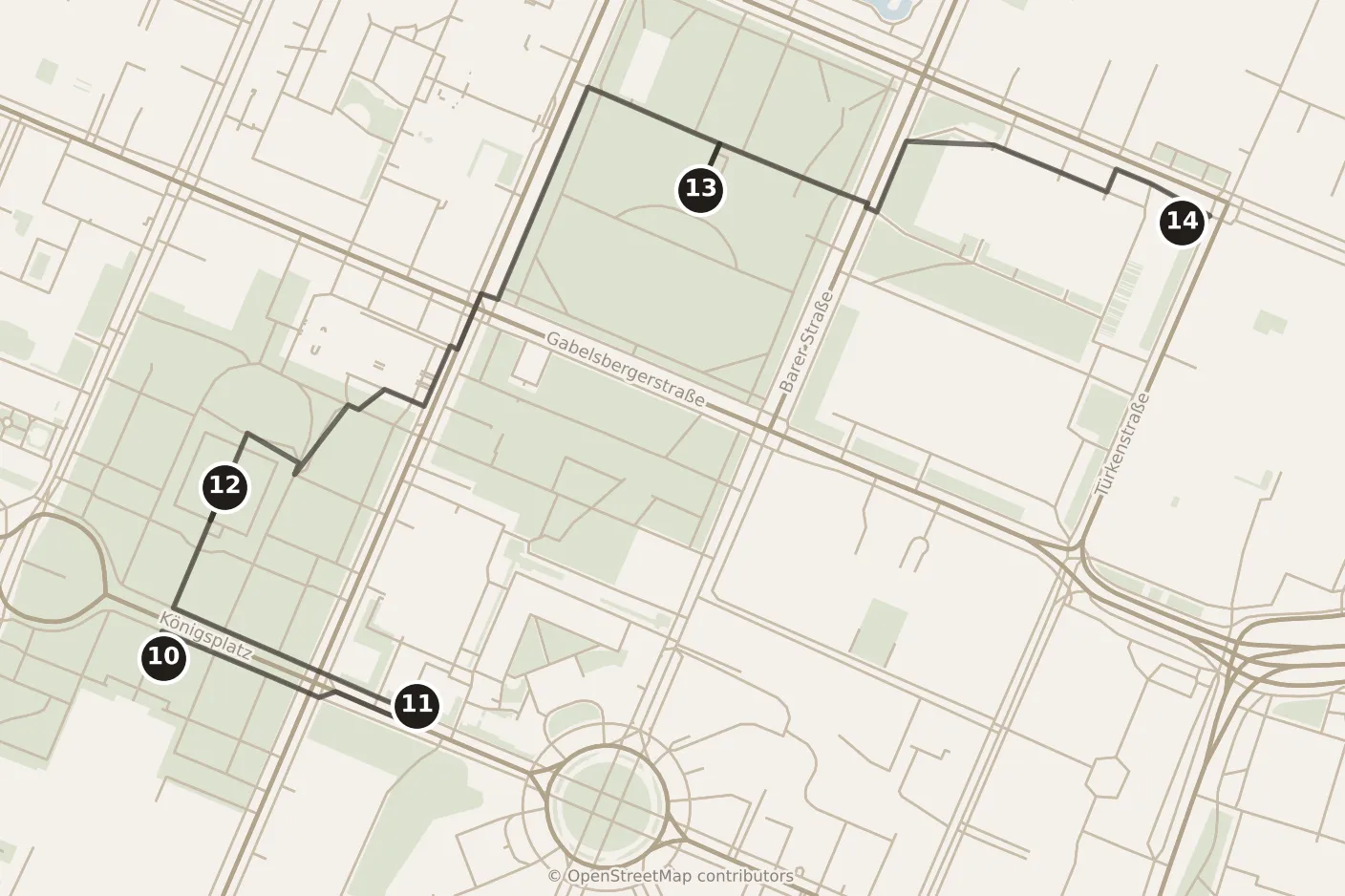
- Morning and afternoon
- 10Königsplatz
- 11NS-Dokumentationszentrum
- 12Glyptothek
- 13Alte Pinakothek
- 14Museum Brandhorst
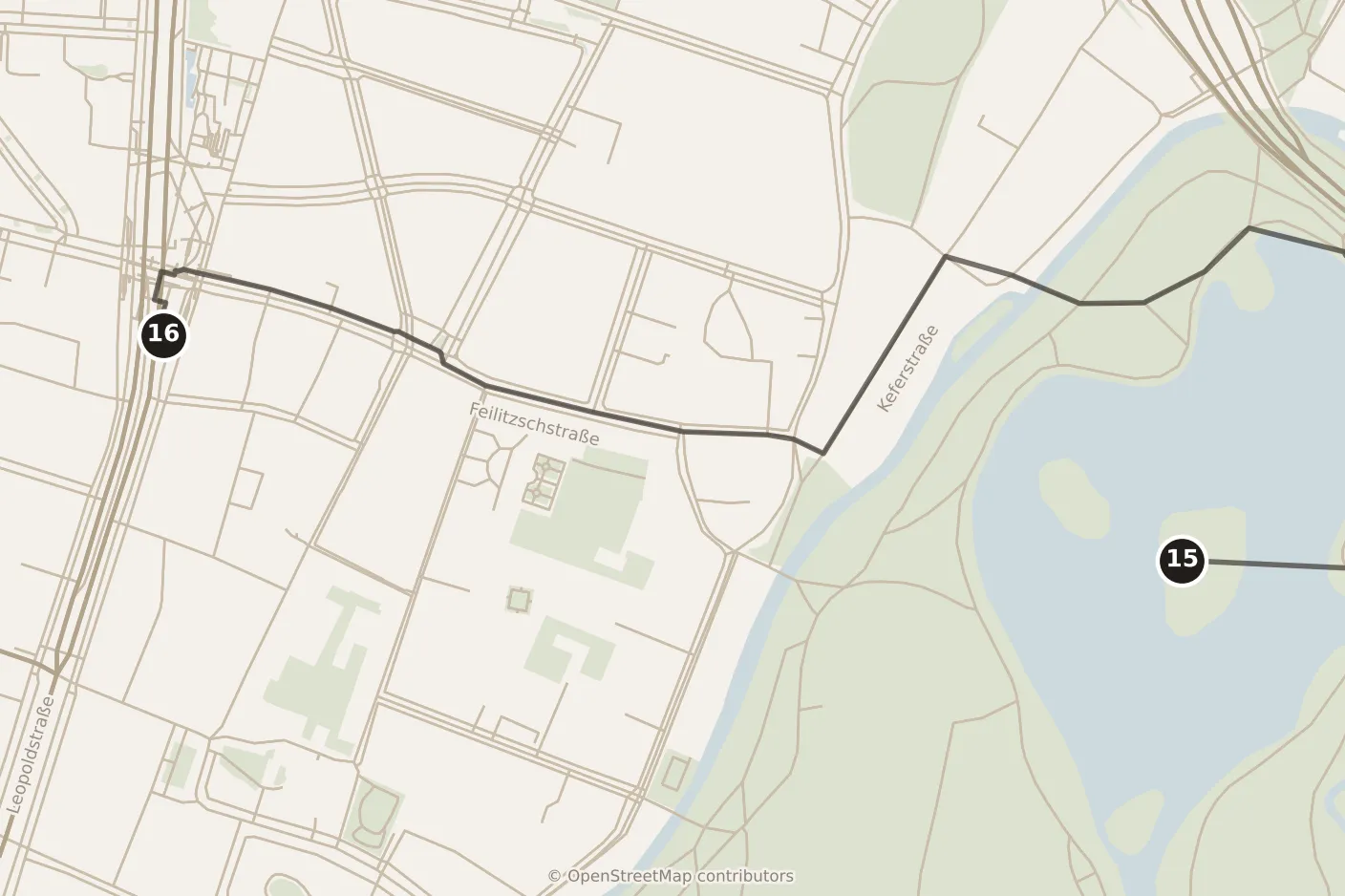
- Evening
- 15Kleinhesseloher See
- 16Münchner Freiheit
The light decides one thing on this trip, and it decides it today. The sun sets here from around twenty past four in the first week of December to around twenty past nine at midsummer, and today’s contents — two hours in the documentation center, an hour of Greek sculpture, lunch, two hours of painting, an hour of Cy Twombly — come to about seven hours of recommendations plus something under an hour of moving, with none of those doors opening before ten. Add that up and you reach the lake at the top of the park at around six: daylight from roughly the weekend the clocks go forward to the weekend they go back, and darkness the rest of the year. In the dark half the evening changes, and the evening below says how.
Those eight hours are the time you spend inside the places and on the sidewalk between them, and nothing else. They do not include the cloakrooms, which here is not a trivial omission — the state museums take your coat and anything larger than a handbag before you go up, and that is a line at both ends of both buildings. The same goes for the Residenz on day one, where the walk from the ticket desk to the room you came for is real walking. If a day runs late, it will have run late in a lobby.
Today is one square with two museums on it, two more a few minutes north-east, and then the park. Nothing is more than four hundred meters from the last thing, and the whole day happens inside one quarter — which is exactly what a single day in Munich has to give up. Start at Königsplatz, which has a U-Bahn station of its own, so the day opens from wherever you slept: from the Hauptbahnhof it is one stop north on the U2, or twenty minutes on foot up through Maxvorstadt.
Morning
Königsplatz is a Greek forum in Bavaria, laid out for Ludwig I from the 1810s by Leo von Klenze, with a Doric gateway at one end and a colonnaded museum on either side. Then read it a second way. From 1935 the party founded in this city paved the whole square with twenty thousand granite slabs for its rallies, built two open temples on the Brienner Straße side to hold the dead of its failed 1923 putsch, and put up two office buildings behind them — in one of which, in 1938, four governments signed away Czechoslovakia. The slabs came up in 1987 and 1988 and the lawns went back; the American army blew up the temples in 1947 and left the platforms, still there under grass and trees, marked only by a small plaque put up in 2007 and easy to walk across without noticing. The two office buildings are a music conservatory and an art-history institute now. Twenty minutes to walk the square and find the platforms, and do it before you go into anything.
Two minutes away, on the ground where the party’s headquarters stood, is the NS-Dokumentationszentrum, a white cube with no windows on the street. It is Munich’s account of itself: how the movement started here, who joined, who profited, who was deported, and what the city did about the memory afterwards. Admission is free. Two hours, and do not try to read every panel — take the floors covering the years you know least and let the rest go.
Then the Glyptothek across the square, which is the antidote and was built to be one: Ludwig I’s Greek and Roman sculpture in a purpose-built temple of 1816–1830, rebuilt after the war as bare brick and white plaster with no ornament at all, which suits marble better than the gilding did. Two things justify the hour — the pediment figures from the temple at Aegina, and the Barberini Faun, a life-size sleeping satyr of the third century BC and the most alarming object in the city. Lunch after it in the student streets north of the square, which are the cheap ones.
Afternoon
Seven minutes north-east is the Alte Pinakothek, and look at the outside before you go in. A forty-five-meter hole was blown through the middle of Klenze’s 1836 building in the war; rebuilding it in the 1950s, Hans Döllgast filled the gap with plain salvaged brick and did not match it, so the wound is still legible from the street. Inside are old masters of the fourteenth to eighteenth centuries, and the reason to come is the Rubens: seventy-two of them, the largest holding anywhere, in rooms proportioned around the biggest. Beside them two German pictures worth crossing a city for — Dürer’s self-portrait of 1500, which looks like a Christ and was meant to, and Altdorfer’s Battle of Alexander at Issus of 1529, a whole cosmos painted with a needle. Two hours, and give them to the upper floor; the first floor’s east wing holds nineteenth-century pictures displaced from the Neue Pinakothek, closed for renovation since 2019 and not expected back before the end of this decade, and it is a consolation rather than a destination.
Five minutes further, past a striped building of thirty-six thousand colored ceramic rods, is the Museum Brandhorst. Go for one room. Cy Twombly’s Lepanto is twelve enormous canvases of the 1571 sea battle, hung together in a top-lit space built for them, running from yellow to blood along the wall. An hour covers it and the rose paintings upstairs. If the day is short this is the stop that goes, and it goes without much regret — one room, in a quarter you would come back to, which is more than day one can say for anything on it.
Everything named above except the square itself closes on Mondays — documentation center, Glyptothek, Alte Pinakothek and Brandhorst together — so if your second day lands on one, swap it with day one, which nothing closes on a Monday.
Evening
From the Brandhorst walk ten minutes north-east to Universität and take the U3 or U6 one stop to Giselastraße, then twelve minutes east into the park. The Kleinhesseloher See is a lake with three islands at the top of the southern half of the Englischer Garten, where the ring road cuts the park in two, with a beer garden along its eastern shore where you buy the beer and may bring your own food. Obatzda and a pretzel from the counter, and the last of the light off the water. An hour, or two. Then ten minutes north-west out of the park to Münchner Freiheit, the square at the middle of Schwabing, with the U-Bahn under it and dinner in every direction.
That is the warm-half version, and it should be said plainly rather than assumed: between roughly the weekend the clocks go forward and the weekend they go back you reach the lake with light to spare; outside that the museums turn you out at six into full darkness, and a lake you cannot see is not an evening. In the dark months, skip the park. From the Brandhorst walk the same ten minutes to Universität and ride two stops to Münchner Freiheit instead of one to Giselastraße, and give the hour you saved to Schwabing’s streets, which are lit and are the reason people move to this part of town. You lose the lake and the walk to it, and nothing else.
With a third day

- With a third day
- 17Dachau concentration camp memorial
- 18Museumsinsel
- 19Flaucher
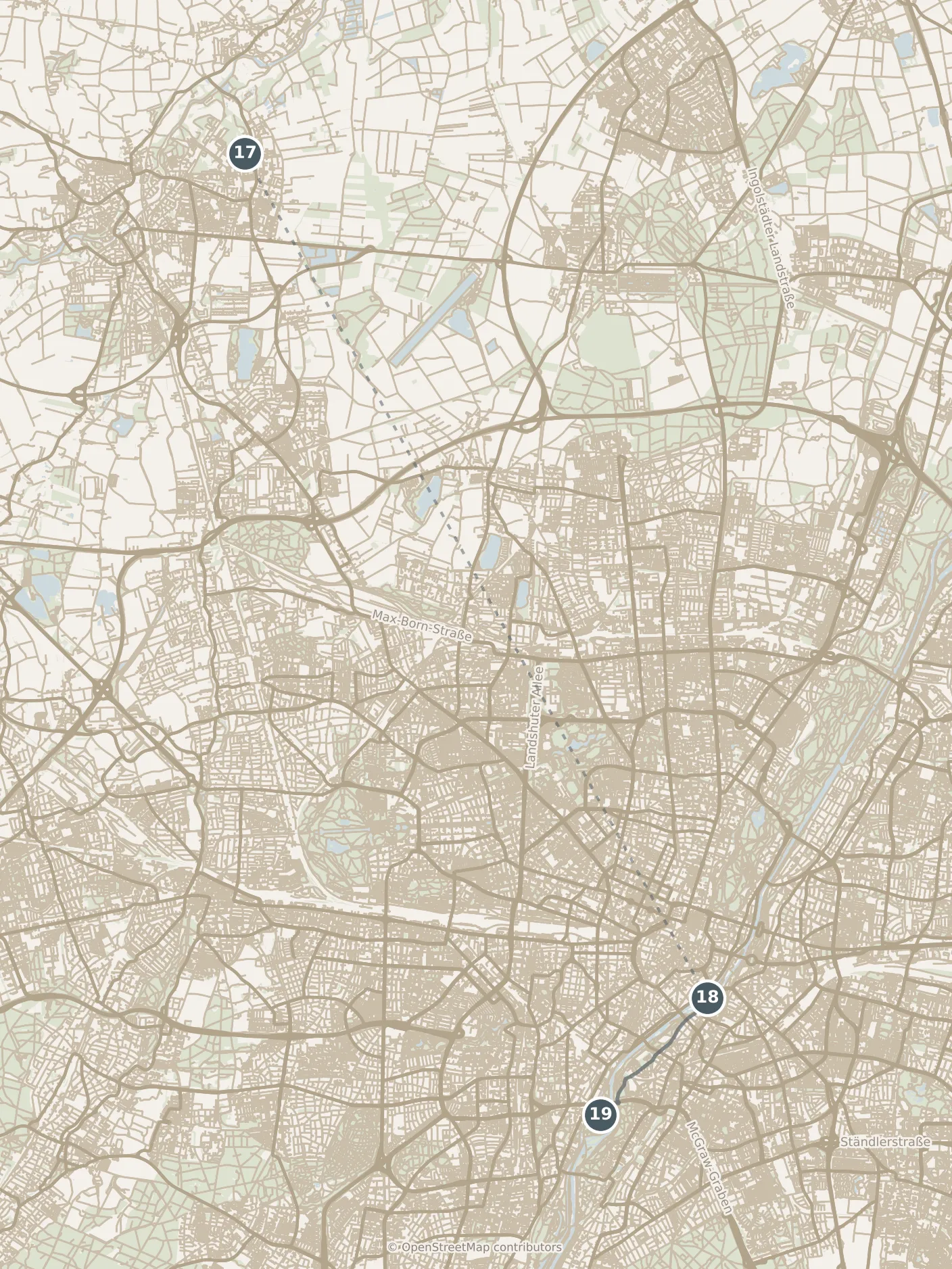
The third day is appended, not inserted, and it leaves the city. Give it to the Dachau concentration camp memorial, sixteen kilometers north-west of the center: the first camp the regime built, opened in March 1933, the model the others were made from, and the place where the morning on Königsplatz stops being about architecture.
It goes last for one reason, and it is not squeamishness. It takes the best part of a day and cannot be shortened below about three hours, so it will not fit beside anything, and a half-visit is worse than none. If your dates force it into the middle — a flight home on the third evening — it inserts cleanly and nothing moves except the arithmetic, because day two must still miss Monday and that is the only closure here that can cost you a whole day. Dachau itself opens every day of the year but one.
Getting there is two legs and no ambiguity. From the Hauptbahnhof or Marienplatz take the S2 westbound and get off at Dachau station, about twenty-five minutes — the train is signed by its terminus rather than by Dachau, and both of the line’s western branches call there, so either of them will do. Outside the station, bus 726 in the direction of Saubachsiedlung runs to the stop called KZ-Gedenkstätte, ten minutes more. It lies outside the city’s inner fare zone, which is the one thing this whole route asks of the transport network; the parent city guide explains how the fares are bought.
Admission is free and nothing is reserved. There is a guided tour in English, two and a half hours long, for a small fee, its tickets sold only at the visitor center — and they have to be bought at least forty-five minutes before it leaves, which is a cut-off and not the hour a window opens. It walks the roll-call square, a reconstructed barrack, the camp road, the memorials at the far end and the crematorium area, which closes half an hour before the rest of the site. The permanent exhibition, in the old maintenance building, takes another hour or more on its own.
How to behave here is not a matter of taste, and the gate will not tell you. The site is a cemetery and a place of mourning; thousands are buried in and around it, and the memorial publishes rules of conduct it expects visitors to have read. Photographs for your own use are allowed outdoors and in the exhibitions, but not with a tripod and not where they disturb anyone. Dogs and bicycles are not admitted at all. The memorial says itself that the content is unsuitable for children under about thirteen and takes nobody younger on its own programs — worth knowing before you plan a family day around it. Its own luggage storage is small, and it tells visitors to use the station lockers in Munich instead.
Local tip. The English tour cannot be reserved, and its ticket has to be bought at the visitor center at least forty-five minutes before the tour leaves — a cut-off, not an opening bell — so buying it is the first thing you do on arrival, not the second. The exhibition waits all day; the tour does not.
You are back in the city by mid-afternoon, and the honest advice is not to put a museum on top of it. What both other days leave out is the river, so take that. From Isartor, five minutes from the old town, cross to the Museumsinsel, the island in the Isar with the science museum on it, and walk south along the west side of the river: about three kilometers of gravel path, roughly an hour, past weirs — which are the part of this river to stay well out of — and gravel bars and the widened channel the city dug in the 2000s to let the river braid again. It brings you to the Flaucher, a stretch of shingle where people swim, barbecue and lie about within sight of the ring road — flat, free, no hours, and where a Munich weekend actually happens. Parts of it are among the city’s designated nude-bathing stretches, which nobody here makes any fuss about and which is worth knowing before you arrive with children. Walk up to the road bridge at the top of it and the U3 from Brudermühlstraße is ten minutes back to Marienplatz.
That walk is a fair-weather plan and it ends in the dark for half the year. The substitution, from where you are standing on the island: cross the Ludwigsbrücke on foot, five minutes, to the Müllersches Volksbad, a public swimming bath of 1901 with a barrel-vaulted pool hall and a Roman steam room — a municipal pool you pay to swim in, and one of the handsomest interiors in the city. It replaces the walk and costs an hour instead of two. The other substitution is the Deutsches Museum on the island you are already standing on, enormous and open daily; it replaces not an hour but the whole afternoon, and it is the wrong thing to do on the same day as Dachau.
And if Dachau is not your third day at all — a real decision, and not everybody should make it the other way — the replacement is Nymphenburg, the summer palace, and it deserves the same detail. Tram 17 from outside the Hauptbahnhof runs to a stop called Schloss Nymphenburg in a little under half an hour. The palace is open daily; the Marstallmuseum in the south wing holds the state coaches and Ludwig II’s night sleighs, the best half-hour on the site; the park behind it is free and enormous. The one thing to check is the season, because the four pavilions in that park — of which the rococo hunting lodge Amalienburg is the reason people come — close from mid-October until spring, and without them the park is a long handsome walk and little else.
Practicalities
No ticket on these three days needs booking ahead. Every one named here is sold at the door on the day, the Residenz combination and the Dachau tour included, and the two lines this route reliably produces are the Residenz ticket desk in the middle of the day and the Dachau visitor center, where the tour ticket has to be in your hand forty-five minutes before the tour leaves. What the route does ask of the transport network is a ticket that reaches Dachau, outside the inner fare zone; days one and two need no more than a stop or two on the U-Bahn inside the center, and the parent city guide covers how fares are bought.
The closures, and the rule the answer comes from. Day two is the constrained day: documentation center, Glyptothek, Alte Pinakothek and Brandhorst all close on Mondays, and losing them loses the day. Day one is constrained twice, more mildly — the market is shut on a Sunday like every other shop in Germany, which takes the point out of the late morning, and both churches are at their busiest on a Sunday morning; and the Asamkirche opens only from the early afternoon on a Friday. The third day is free, since Dachau and Nymphenburg both open daily. So the arrangement that satisfies all of it without thinking is Saturday, Sunday, Monday: day one on the Saturday with the market working, day two on the Sunday, when the state collections charge a nominal admission and the whole quarter costs next to nothing, and Dachau on the Monday that would have wrecked day two. Days one and three trade places freely; day two is the one that will not move. The arrival that quietly breaks this is a Sunday, which lands day one on the day the market is shut and day two on the Monday everything closes — if that is your arrival, run the days in the order two, one, three, and open with the museum quarter on the Sunday itself.
The bag. Left luggage at the Hauptbahnhof is coin-operated lockers in the rooms opposite platform 24 near the north exit, with a smaller bank opposite platform 11 on the south side; the rebuilding under way since 2018 has squeezed the space, so treat availability as uncertain rather than assured. It matters on two mornings, and the first is the one nobody plans for. If you have come straight off a train, day one begins where the lockers are, so the case goes in before you turn east — the day’s arithmetic has no room in it for a return trip to the station. If nothing is free, check in at your room first and pick the day up at the Asamkirche or at Marienplatz instead: the morning stops are what give way, and the two o’clock theater is what does not. The other morning is the third, when people check out and go straight to Dachau, and the memorial’s own storage is small enough that it says so and points at the station. If the lockers defeat you then, reverse the third day — the river walk first, the memorial after lunch — rather than carry a case around a memorial site, which is the one place on this page where it would be genuinely wrong. Know what that reversal costs, though: the English tour will have gone, and what is left is barely the three hours the memorial needs before it closes.
On foot, and how far. Day one comes to about five kilometers of real walking, none of it steep; the longest stretch is the twenty-odd minutes from the station to the first church, and after that the longest is the twenty from the Residenz down to Gärtnerplatz at the end. Day two is a kilometer and a half before the evening and a little over two and a half in it. Only the third day needs more than a stop or two on the U-Bahn, and what it needs is a train, a bus, and the U3 back at the end.


.jpg)
