Munich in one day: the old town on foot, then north into the Englischer Garten

Last updated 3 August 2026
Overview
The difficulty with one day in Munich is not that there is too little. It is that the famous things are scattered to the compass points: the summer palace out west, the Olympic grounds and the car museum north, the science museum on its island in the Isar, the three great picture galleries in the university quarter, the camp memorial at Dachau beyond the city and the mountains beyond that. Any two of them are half an hour apart on the trams and trains, and a single day that tries to join two spends most of itself on the way.
So this day gives all of them up, and what is left is better than that sounds. The old town is small — fifteen minutes across on foot — and running north out of the top of it is a park bigger than Central Park, which is the comparison the city likes to make and it is true. The route below is one line north, a little under four kilometers end to end, walked. It does not double back at any point.
The day has no hinge at its close. Nothing on it needs a particular light, no tide comes in, and the last stop is a park with no gate. What it has instead is a fixed point at the very beginning: the mechanical clock on the town hall performs to a schedule, at eleven and at midday, with a third turn at five in the afternoon between March and October. That is the one thing on this page worth confirming before you set out, because everything else on the route is walk-up.
Working forward from it: the cathedral wants fifteen minutes ahead of the show and stands five minutes away, so be in the old town half an hour before the clock. Everything after it — the tower, the market and lunch, the palace, the garden, the wave — comes to just under four hours of recommendations, and the walking between them to something under an hour. Call it five hours from the cathedral door to a beer garden table.
That total is the time you spend inside the places and on the sidewalk between them, and it is nothing else. It does not include the ticket desk at the palace, and it does not include the stairs: the half hour given to the tower is the time at the top, not the time on a single-file staircase with people coming down it. The palace is the larger of the two omissions by far. It is ten courtyards, and the distance from the entrance to the one room you came for is real walking that the ninety minutes does not cover. If the day runs short, that is the stop to give up, and it is why the park comes after it rather than before.
The day

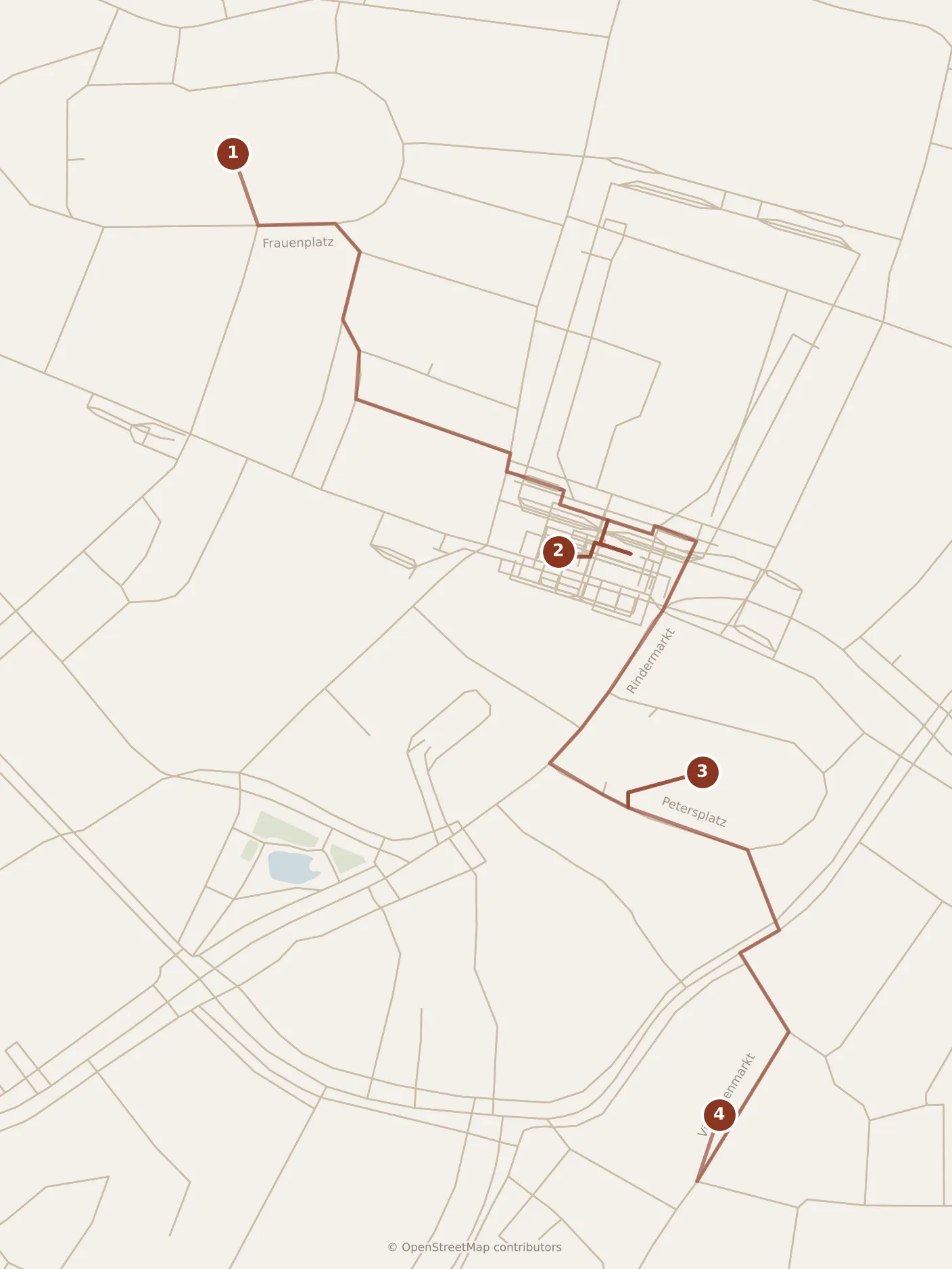
- Morning
- 1Frauenkirche
- 2Marienplatz
- 3St. Peter's Church
- 4Viktualienmarkt
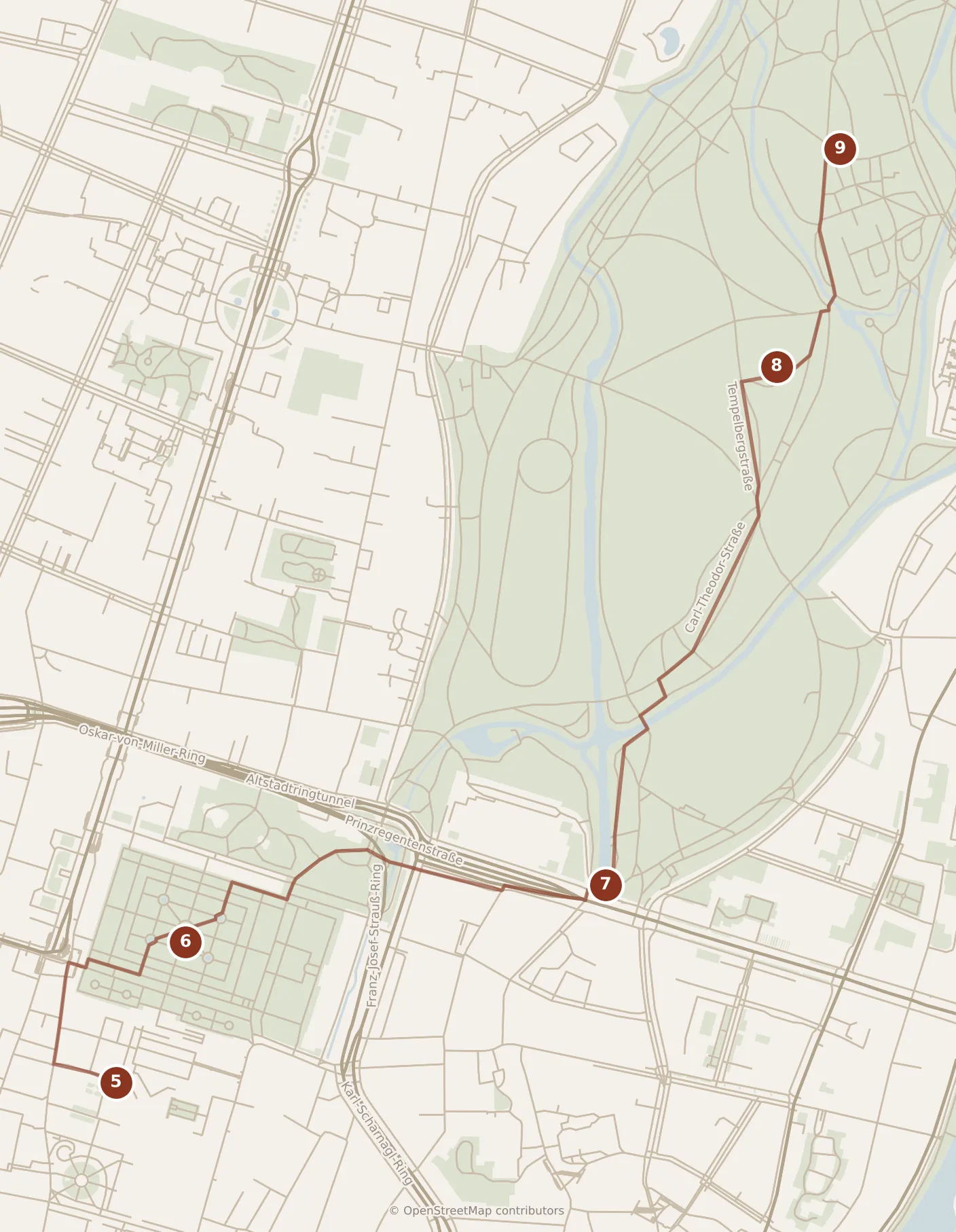
- Afternoon and evening
- 5Residenz
- 6Hofgarten
- 7Eisbach wave
- 8Monopteros
- 9Chinese Tower
Morning
Start at the Frauenkirche, a block north of the pedestrian street that runs east into the center. It is brick, it is enormous, and it went up in just twenty years, complete by 1488, which is why it has none of the accumulated fussiness of a cathedral built over four centuries. The bombing of 1944 took the roof and most of the fittings, so what you walk into is tall, white and nearly bare: two rows of octagonal pillars and very little else. That bareness is the point of the thing everybody comes to look at, a dark footprint set into the floor just inside the main entrance. Stand on it and the pillars swallow every window along the sides; in the church as the story knew it, a high altar closed the long view east as well, so not one window showed — which is what made the devil laugh, and then stamp. That altar is long gone, and the far window now gives the trick away, but the pillars still do their half of it. Fifteen minutes is enough inside. The building’s real subject is its two towers, and those are better from further off.
They are just under a hundred meters, capped with the copper onion domes added in 1525, and they are the reason Munich’s skyline looks like a small city’s. In 2004 the city voted in a referendum to keep new buildings below them; the vote’s legal force lasted a year and lapsed, and the skyline has mostly gone on obeying it anyway, which you can check for yourself within the hour. The south tower has a viewing platform of its own, reached partly by elevator, back in use after a long closure for works.
Five minutes east is Marienplatz and the clock. The show is on the front of the neo-Gothic town hall — the blackened pile that looks four centuries older than its actual 1900s — and it runs about a quarter of an hour in two tiers: a ducal wedding of 1568 with a joust above, the coopers’ dance of 1517 below. Watch it once, from the middle of the square with everyone else. It is slow, and it is the only thing all day that will not wait for you.
Then the tower on the south side of the square: St. Peter’s Church, Alter Peter to everyone here, the oldest parish in the city. The climb is 306 steps, there is no elevator, and the last stretch is wooden and steep. What you get is the view the postcards use — Marienplatz directly below you, the cathedral’s two domes filling the west, and on a clear day the Alps drawn along the southern horizon. Give it half an hour, most of which is stairs.
Local tip. Two towers within five minutes of each other and one day to spend: climb the one on the square. The cathedral’s domes are the thing you actually want in the photograph, and from the cathedral’s own tower they are the one thing you cannot see. The 306 steps are what that costs, and the elevator is the argument for the other one.
Two minutes downhill is the Viktualienmarkt, permanent stalls on a square that has been the city’s food market since 1807, and this is where lunch goes. It has its own beer garden in the middle under a blue-and-white maypole, and it works the way the good ones do: you buy the food at the stalls and only the drink at the counter, so lunch and a sit-down are one decision rather than two. Give it an hour. If you want the Weißwurst this is the last plausible moment for it — the pale veal sausage is a breakfast here, not a lunch, and the morning is nearly out.
Afternoon
From the market walk north through the lanes, ten minutes, and come out on Residenzstraße with the long gray front of the Residenz on your right. Four bronze lions stand at the portal with their shields rubbed to gold by two centuries of passing hands; that part is free and takes a minute.
Inside is what the Wittelsbach dukes and kings built for themselves across five hundred years, from a moated castle of 1385 to a complex of ten courtyards, flattened in the war and put back room by room. The museum runs to something like a hundred and thirty rooms and trying to see them is the mistake. Go for one. The Antiquarium was built in 1568 to hold a ducal collection of Greek and Roman busts: sixty-six meters of barrel vault, frescoed end to end, the largest Renaissance room north of the Alps, and a room you feel in the chest rather than examine. The Ancestral Gallery near it — a gilded corridor of Wittelsbach portraits — is worth the walk. The treasury and the little rococo court theater carry separate tickets and are a separate afternoon; leave them. Ninety minutes for the whole visit, then out.
Three hundred meters north up Residenzstraße is Odeonsplatz, with the yellow twin towers of the Theatinerkirche on one side and an open loggia on the other, and from there an arcade takes you into the Hofgarten. This is a formal garden of gravel walks and clipped hedge, laid out in the 1610s, with a small arcaded pavilion where the paths cross. It is a crossing rather than a destination — twenty minutes — and in warm weather somebody is usually dancing under the pavilion. Leave by the far corner, cross the boulevard, and the Englischer Garten starts.
Then the wave. Where Prinzregentenstraße bridges the Eisbach at the park’s southern tip, beside the gray slab of the Haus der Kunst, the channel narrows and throws up a standing wave about a meter high, and people have been surfing it since the early 1970s: cold, fast, in the middle of a city, with a line of wetsuits taking turns off both banks. It has had a hard couple of years — closed after a fatal accident in April 2025, gone altogether that October when the riverbed was cleaned, formally open again since May 2026 under new rules. Those dates will not change; whether anyone is in the water on your particular day might, so treat the surfers as the bonus and the bridge as the stop. Ten minutes.
Follow the water north for ten minutes or so to the Monopteros, a round Greek temple on an artificial hill put there in 1836 by Leo von Klenze so that the park would have somewhere to look from. Climb it, and turn south: over the meadow you get the two domes and the yellow tower you were standing under this morning, which is the whole argument for walking the day in this direction rather than the other. Twenty minutes including the hill.
Evening
Under ten minutes further north the trees open on a wooden pagoda twenty-five meters high, first put up in 1790, burnt out in the war and rebuilt in 1952. Around it is the second-largest beer garden in the city, several thousand seats of trestle table under chestnuts, self-service at one end and table service at the other. Take the self-service end. Get a beer and an Obatzda with a pretzel from the counter, sit down, and let the rest of the afternoon go; a band plays from the tower’s balcony when the weather holds.
That is a warm-weather ending, and it should be said plainly rather than assumed: the tables come out with the season, and for most of late autumn to spring this end of the day is a dark walk in a park. The exception is December, when a market of lit stalls rings the tower into the evening and the walk earns its keep after all. If your one day falls in the dark months either side of that, turn the evening round. Walk back south through the garden to Odeonsplatz — half an hour, and pleasant in the cold — and drink in one of the big old brewery halls in the lanes east of Marienplatz instead, which is the indoor version of the same institution and a good deal louder.
Either way, leaving from the tower is eight minutes west on foot to Giselastraße and the U-Bahn, or half an hour south through the park to where the day started.
Practicalities
The only ticket this day needs is the Residenz’s, and you buy it at the door. Nothing on the route rewards booking ahead; everything else on it is free or walk-in. The one time you will want the transport network is getting into the old town at the start and going home at the end — how the fares work is in the city guide — and in between the route asks nothing of it, because all of it is on foot: about four kilometers, and the longest single stretch of it is the walk up through the park from the wave to the Monopteros.
The day of the week matters here in one direction only. Sunday is the day that changes the shape of this route: German shops do not open on a Sunday and the market is not an exception, so the stalls are shuttered and the lunch stop loses most of its point — the beer garden in the middle may still open on a fine day, though with the stalls shut it is a drink rather than a lunch — and both churches are working churches at their busiest, which is the morning. Monday, which closes museums across much of Germany, barely touches this day — the one museum on the route keeps no weekly closing day.
That last is worth checking rather than trusting, because the palace is the only ticketed indoor stop on the page and the only one whose loss you would actually feel. Check it before you set out. If it turns out to be shut on your day, the afternoon survives without being rewritten: everything north of it is a park, the park has no hours, and the hour and a half you get back buys a slow lunch and a longer walk under the trees.


