Montréal in two or three days: the lower city, the mountain, and a third day for the markets

Last updated 14 August 2026
Overview
Montréal is a city in two stories, and two days is the number that lets you take one story at a time. Down on the flat by the water is the seventeenth-century town everything else grew out of, a few hundred meters across and made almost entirely of doors you can open. Above it, past the office towers, the ground tilts up into a wooded hill with a park on top of it and a terrace on the front edge of the park. One day here has to run from the bottom of that to the top of it and keep moving. Two days do not, and what the second day buys is not more sights — it is the right to stand still all through the first day and to give the whole of the second afternoon to going up the hill slowly.
So day one is the standing day and day two is the walking day, and they are not interchangeable. Day one comes to about eight and a half hours from the station door, with lunch inside that figure and dinner outside it, and it covers four and a half kilometers in total — ten stops, four of them ticketed, and eight of the ten inside a single square kilometer with never more than seven minutes between them until the evening moves you west. Day two is about seven and a half hours and close to ten kilometers, and three quarters of an hour of that is uphill on a park road through trees.
Only day two is tied to the sky. It ends on a stone terrace at the top of the hill that looks straight down the length of downtown, and what that terrace wants is the last of the light and the half hour after it. The sun goes down in Montréal anywhere between about ten past four at the start of December and about ten to nine in the third week of June. Do not interpolate inside that band: it is nearly five hours wide, and a guess inside it is worth forty minutes on the one thing in these three days that cannot be moved. Look the sunset up for your own date, and subtract six hours from it. Everything on day two above the terrace — the two cathedrals, the museum, lunch, the walk to the foot of the hill, the climb, the lake at the top and the level mile back east along the ridge — comes to about six hours, and six hours before your sunset is when to start.
Three things about that six, because a number gets planned on. It counts the time spent inside places and the time spent walking between them, and nothing else at all: not the ticket desk and the cloakroom at the fine arts museum, which is the largest single thing it leaves out and is worth a quarter of an hour on a busy Saturday. It presumes bare ground underfoot, which means every walking figure on this page is on the optimistic side from December through March, the ascent worst of all. And the same sum produces two quite different instructions depending on the month you hand it. In early December, six hours before sunset puts the start at about ten in the morning, a civilized hour to be opening a cathedral, and there is nothing to reconcile at all. At midsummer it asks you to begin at a quarter to three, which would mean walking into a large museum in the late afternoon. Do not do that. Start in the morning as written, and put the surplus on the hill itself, which will absorb three hours without any help from me — the woods, the lake, the lawns and the long way round are all up there and none of them is on a clock.
Nothing in day one depends on the light until its final half hour, and that is a feature rather than a shortage. Its one fixed point is a door. In 2026 the basilica’s daytime visit began at nine in the morning, and on Sundays the doors did not open to visitors until half past twelve; the day is built back from whichever of those two applies to you, and if the hour has moved since, build it back from the new one. From Gare Centrale to the first stop is about eighteen minutes on foot, so a nine o’clock door means leaving at around half past eight. Day one’s own ending is a square full of lights and wants darkness, which December hands you before you have finished the chapel and June will not hand you before about nine; in July the honest advice is to eat first and walk back to it afterwards.
One booking, and only one, across all three days: the basilica sells its daytime visit on its own website and at the door, and the line at the door is the reason to buy online. Make sure it is the daytime visit and not the evening light show, which is a separate ticket to a separate event in the same building. An adult’s daytime visit was sixteen Canadian dollars in 2026. Everything else here is either free or sold at the counter on the day, including the shrine on the third day, which takes no ticket at all. The two old-town museums are the ones worth pricing in advance, because they are the choice the day one afternoon turns on: in 2026 an adult over thirty paid about thirty Canadian dollars at the founding site and about fifteen at the Château. Worth holding beside the tip further down, which tells you to drop the cheaper of the two.
Two of the three days contain no ride whatsoever — day one and day two are walked end to end, and every metro or bus leg named inside them is an alternative offered to somebody whose weather or whose knees have ruled the walk out, never a step in the route. The third day is the opposite and is built on the network: three journeys, out and back and home, and no more than three. What you need for them is the OPUS card, the rechargeable plastic card sold from the machines in every metro station, or, if three days is all you have, the cardboard version called L’Occasionnelle, which holds a bundle of fares and cannot be topped up. Buy one in the first station you walk into. Everything else about fares, passes and the airport bus belongs to the city guide, and it is worth five minutes before you come. So does the thing that is more use than any of it, and this page should not have made you go there for it: this is a French-speaking city, French is the language of the signs and the ticket machines, and bonjour is how every counter on these three days opens.
Last, the bag. On a trip of this length you have a room, so luggage is a question about the first morning and the last one and about nothing in between. It is the last one that matters, because these days do not end in the same place: day one finishes standing on top of Place-des-Arts on the green line and day two beside Mont-Royal on the orange, while the third day ends twenty minutes’ walk from its nearest station and further from Gare Centrale than either of the other two days does. Left luggage at the station is the rail operator’s checkroom and it is for people traveling that day: there are no public lockers at all, and a bag left there has to belong to somebody holding a ticket. On the first morning and the last one alike, if you are not on a train that day the answer is one of the paid storefront services, of which there are several within a few minutes of the station. Those are arranged on the day from your phone, an hour ahead is enough and they cancel free, so nothing about the bag joins the count above: there is still exactly one thing worth holding before you come, and it is the basilica. So if your last day is a departure day, moving the third day is not a contingency, it is the plan, and the third-day section below says where to move it to.
Day one

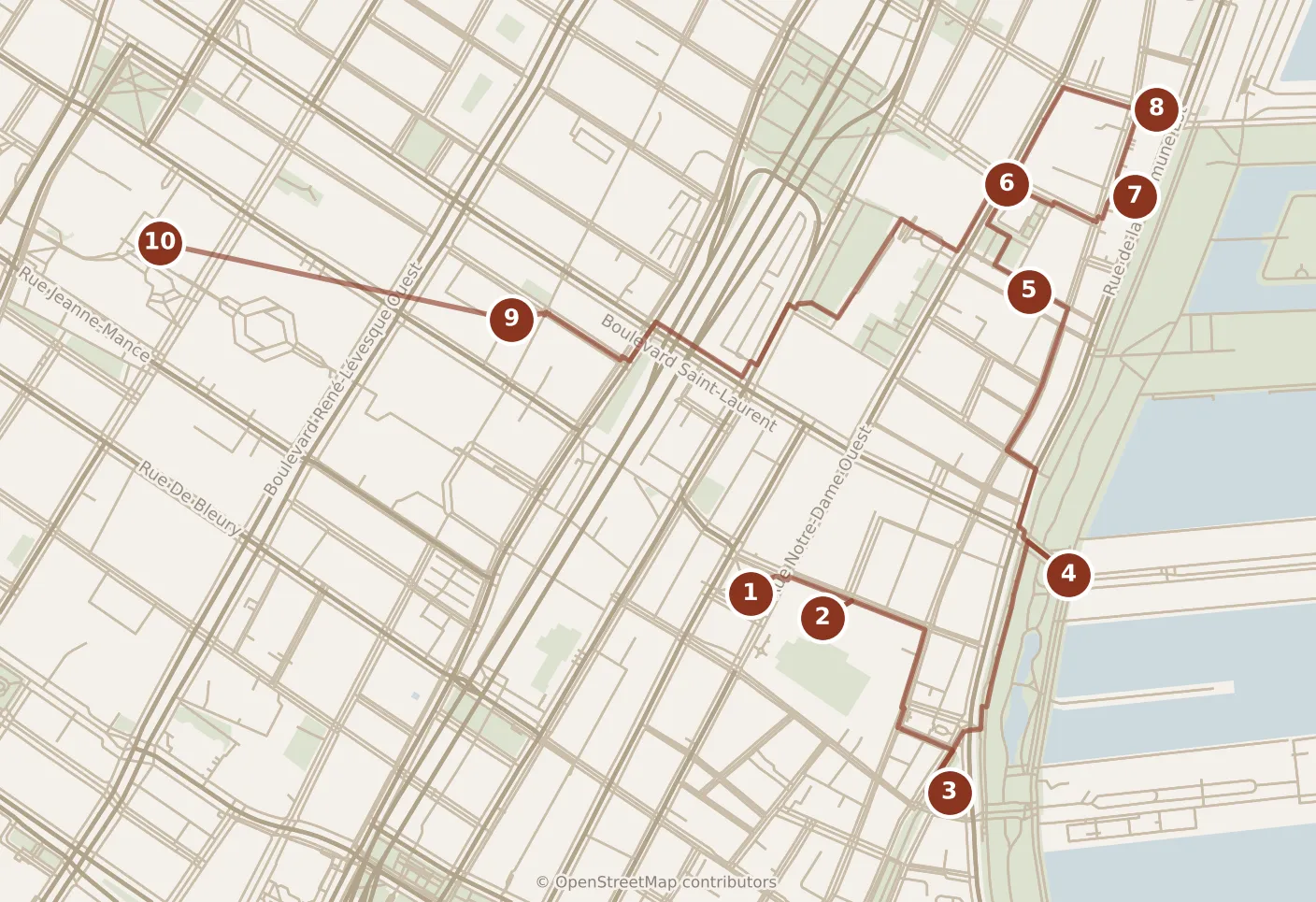
- Day one
- 1Place d'Armes
- 2Notre-Dame Basilica
- 3Pointe-à-Callière
- 4Old Port
- 5Place Jacques-Cartier
- 6Château Ramezay
- 7Bonsecours Market
- 8Notre-Dame-de-Bon-Secours Chapel
- 9Chinatown
- 10Place des Arts
The whole day until the evening happens inside a rectangle about eight hundred meters long, and it is arranged so that you never walk a street twice: along the high side of the old town first, down to the water, then east along the low street to the chapel at the far end. The longest stretch inside the day is the fifteen minutes out of it at the end. The eighteen minutes that bring you to the start are longer than that, and they are the only ones you might be carrying anything for.
Morning
Begin in Place d’Armes about a quarter of an hour before the basilica opens. You are standing on the seam of two cities. Behind you, down Rue Saint-Jacques, is the street that ran the banking of a whole country for a century, and the buildings on it were built to say so; in front of you is the parish church of the town that was here before any of that. The thing to find while you wait is the low gray building set back beside the basilica behind its own wall: the Sulpician seminary, begun in 1684 and finished in 1687, the second-oldest building still standing in the city — the oldest is a fur-trade house of 1671 out at the western end of the island, which no three-day visit reaches — with a clock installed on its front in 1701 that is among the oldest public clocks anywhere in North America. It is not a visit — it is a working religious house and you look at it from the sidewalk — but it is the only place in the square where the seventeenth century is still on show, and nobody stops for it. Fifteen minutes.
Then the basilica, and give it three quarters of an hour, of which the first fifteen should be spent sitting down at the back rather than walking a circuit. The ceiling is the reason. It is not stone at all but painted wood and plaster, and the blue of it is as dark as a night sky and thickly seeded with gold leaf — but that darkness only arrives after your eyes have given up on the daylight you brought in with you, which takes about as long as it takes to stop moving. Everybody who walks in, photographs the roof and walks out again has seen a bright blue ceiling. Afterwards take one side aisle slowly for the nave windows, which are unusual in putting episodes from the town’s own past where scripture would normally be, and then the chapel behind the high altar, burnt out by an arsonist in 1978 and rebuilt with an upper half making no attempt whatever to match the rest of the building, ending in a bronze altar wall the size of a house front. This is a working parish church, and the daytime ticket buys you the room between services rather than during them.
A five-minute walk downhill takes you to Pointe-à-Callière, whose subject is the ground the building is standing on: the spit where the town was founded in 1642, and the little river that once ran alongside it and was bricked over into a drain. The route drops below the sidewalk at the start and stays there, and the building is in fact several buildings stitched together underneath the street, so the corridors between them are the exhibit rather than an interval in it. An hour and a quarter, none of it above ground. Whatever is showing on the upper floors is the thing to leave out — it will be good, and it is not the site, and the site is the entire reason this museum is here rather than somewhere with better rooms.
Afternoon
Six minutes east puts you on the quays of the Old Port with the whole width of the river in front of you. Half an hour, walked rather than stopped: this is the one stretch of day one that is outdoors and wide, and after a morning of interiors it does more than it looks like it should. Lunch belongs in the lanes just behind it rather than on the quay itself, and an hour is right for it.
Seven minutes up from the water, Place Jacques-Cartier is the sloping cobbled square that connects the port to Rue Notre-Dame; give it a quarter of an hour and keep walking, because what it is really doing here is delivering you to the top of itself.
Two minutes from the top of the square is the Château Ramezay, and this is the stop that two days buys and one day cannot. It was built in 1705 as the residence of Claude de Ramezay, the French governor of the town, and then it kept being the seat of whoever was in charge: from 1775 it was the Canadian headquarters of the Continental Army during the American occupation of the city, and Benjamin Franklin slept a night here in 1776 while trying and failing to recruit the place to the revolution; afterwards the British governors used it as Government House until 1849. It has been a museum since 1894 and its collection came almost entirely from private Montréal families, which is why it is a house of thirty thousand oddments rather than a curated argument — furniture, coins, prints, manuscripts, the accumulated attic of a city. Behind it is the Governor’s Garden, a reconstruction of the kind of walled kitchen and pleasure garden the house would have had, opened in 2000. An hour, and take the garden second so you come out of the dark rooms into it.
Local tip. If the day is running late, the Château is the stop to lose and the founding site is not. The Château is an hour and the founding site an hour and a quarter, so the saving is smaller than it looks; the difference is what each of them is about. The Château’s subject — who governed here, and out of which country’s capital, decade by decade — is legible for nothing from the street outside, in the churches, the monuments and the bank fronts. The other museum’s subject is under your feet and there is no other way down to it.
Three minutes on is Bonsecours Market of 1847, its silver dome the thing you have been using to navigate all afternoon without noticing. Walk in one end and out the other rather than round the outside: a quarter of an hour, and the point is the length of the hall and the light down it.
The last stop before the evening is next door, and it is the best building of the day. The Notre-Dame-de-Bon-Secours Chapel is what the city has always called its sailors’ church. Marguerite Bourgeoys started a congregation on this ground in 1655; the chapel over it now went up in 1771, the one before having burnt; and the ceiling carries a hanging fleet of model ships, left as votive lamps by crews who made it home. The chapel is free and it is a working church. What is ticketed, and what makes this a forty-five-minute stop on a two-day trip rather than the ten-minute one a single day can afford, is the two ends of it. Underneath, the crypt is an open archaeological excavation you walk through, with First Nations material, the foundations of the first stone chapel and traces of the earliest colonial defenses all in the same hole. Above, the tower opens as a lookout, and from it the whole of the morning and the afternoon is laid out below you at once — the quays, the market roof, the squares, the basilica towers — which is the only moment in the day when the route explains itself.
Evening
Fifteen minutes west, uphill and away from the water, brings you into Chinatown: four short blocks around Rue de la Gauchetière, entered under painted gates on Boulevard Saint-Laurent, and small enough to walk the whole of it in twenty minutes. Give it three quarters of an hour, and spend the rest of that deciding where you want to sit down later, because this is where day one’s dinner is — the meal the day’s eight and a half hours deliberately leave outside the figure. It is a small quarter and it did not start that way: it lost close to a third of itself between the 1950s and the 1980s to a federal office complex, a convention center and an expressway that cut it off from the old town you have just walked out of. Knowing that is better than arriving expecting scale.
Eight minutes further and the streets open into the Quartier des Spectacles, which is where the evening ends: Place des Arts and the wide paved squares in front of it, Place des Festivals with its fountains in summer, and the Esplanade Tranquille beside them, which is an open square in the warm months and a free outdoor skating rink in the cold ones. Half an hour, and it is a half hour that only works after dark, because the whole quarter is designed around light — the buildings around these squares are lit as a system rather than individually. In December that is already true when you arrive, so take the half hour first and walk back into Chinatown to eat. In June it will not be dark for hours, so eat first and come back here late. And know what you are arriving into in the peak weeks of summer, because these squares are the reason the quarter is named what it is: through much of June and July they are not open pavement at all but stages, fencing and a crowd. That is not a worse evening, but it is a different one, and the half hour of architectural lighting is the version you get when the squares are empty. Under your feet is Place-des-Arts on the green line, which will take you anywhere you are sleeping.
Day two

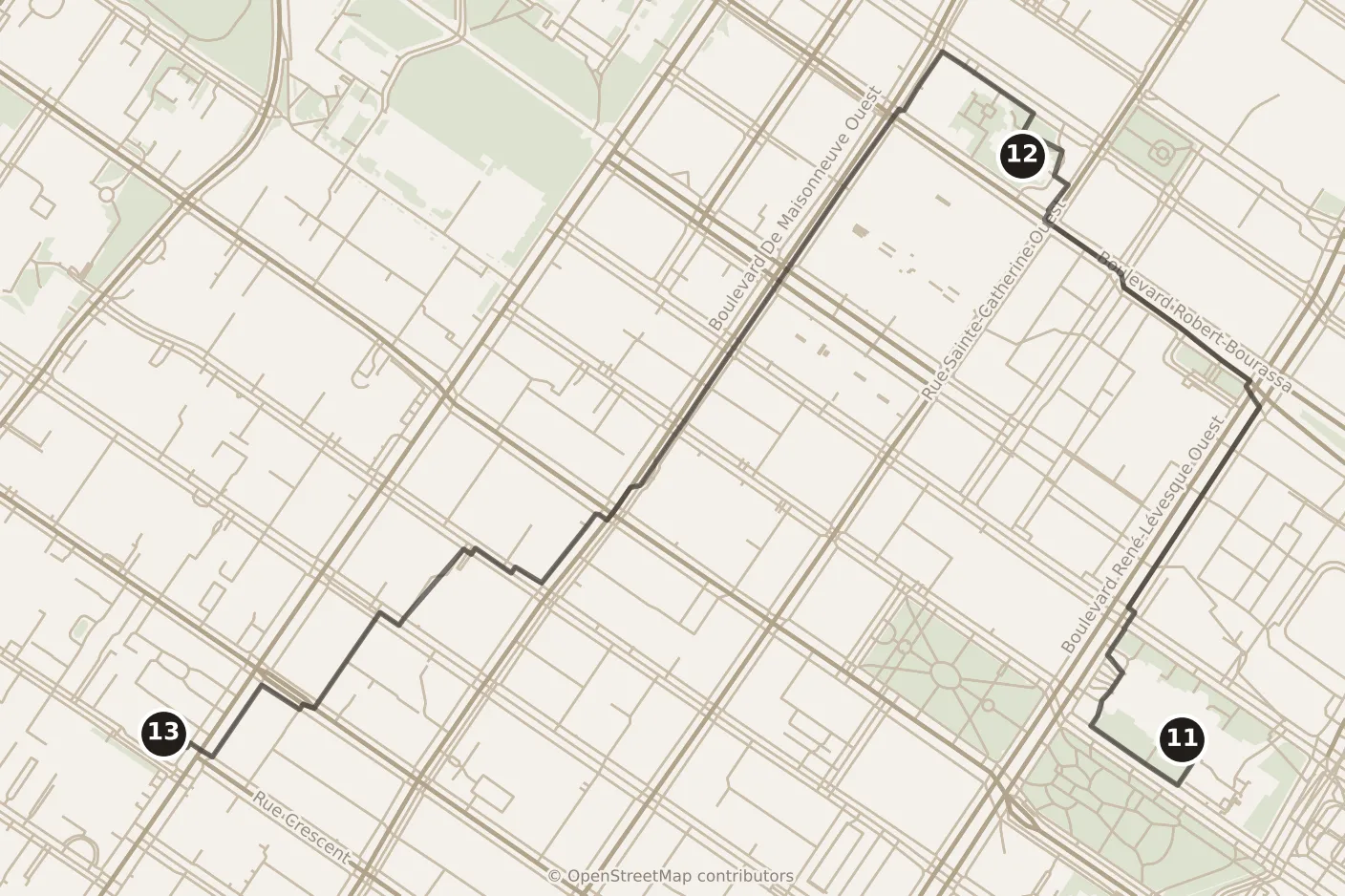
- Morning
- 11Mary, Queen of the World Cathedral
- 12Christ Church Cathedral
- 13Montreal Museum of Fine Arts
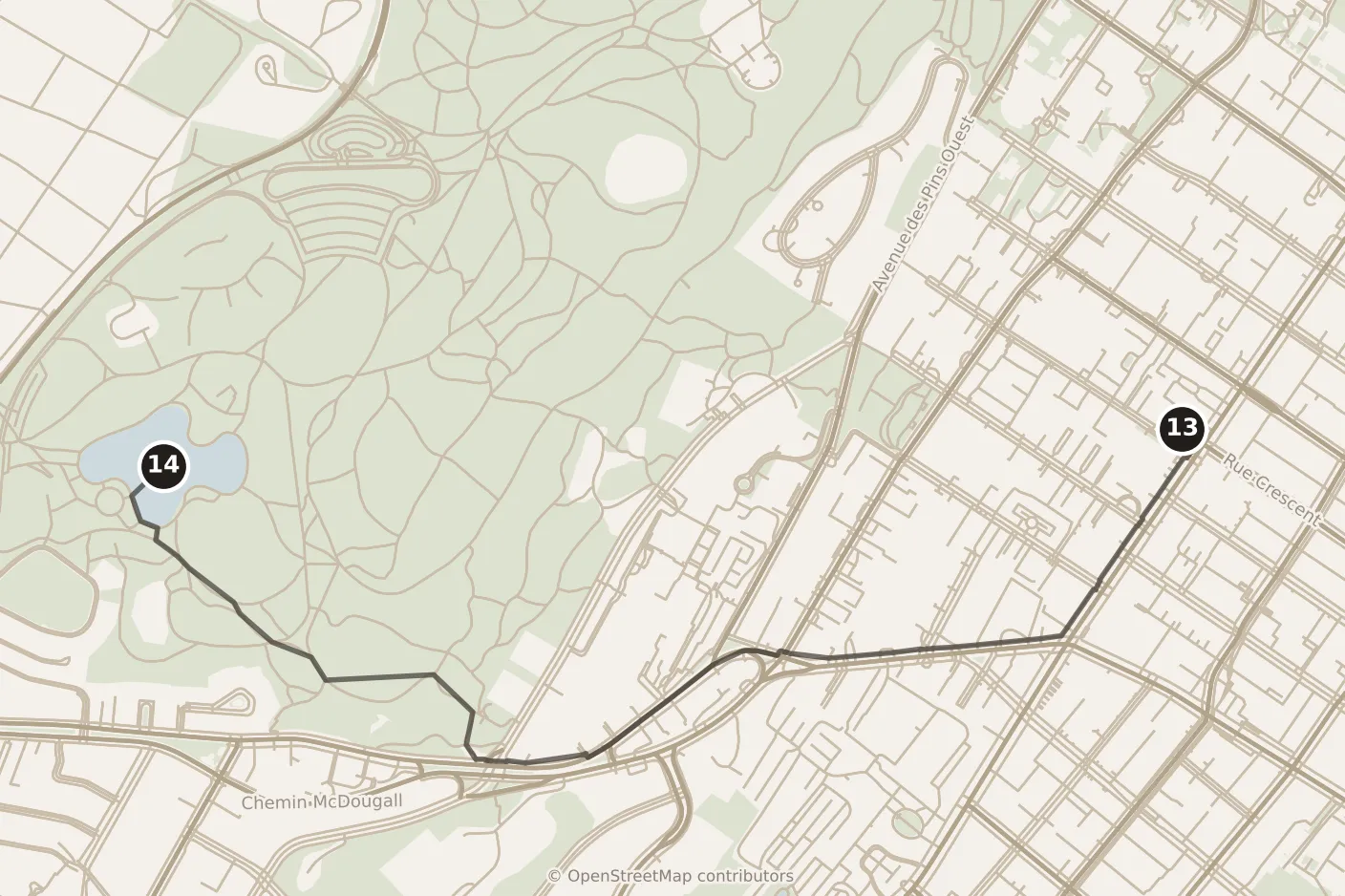
- Afternoon
- 14Beaver Lake
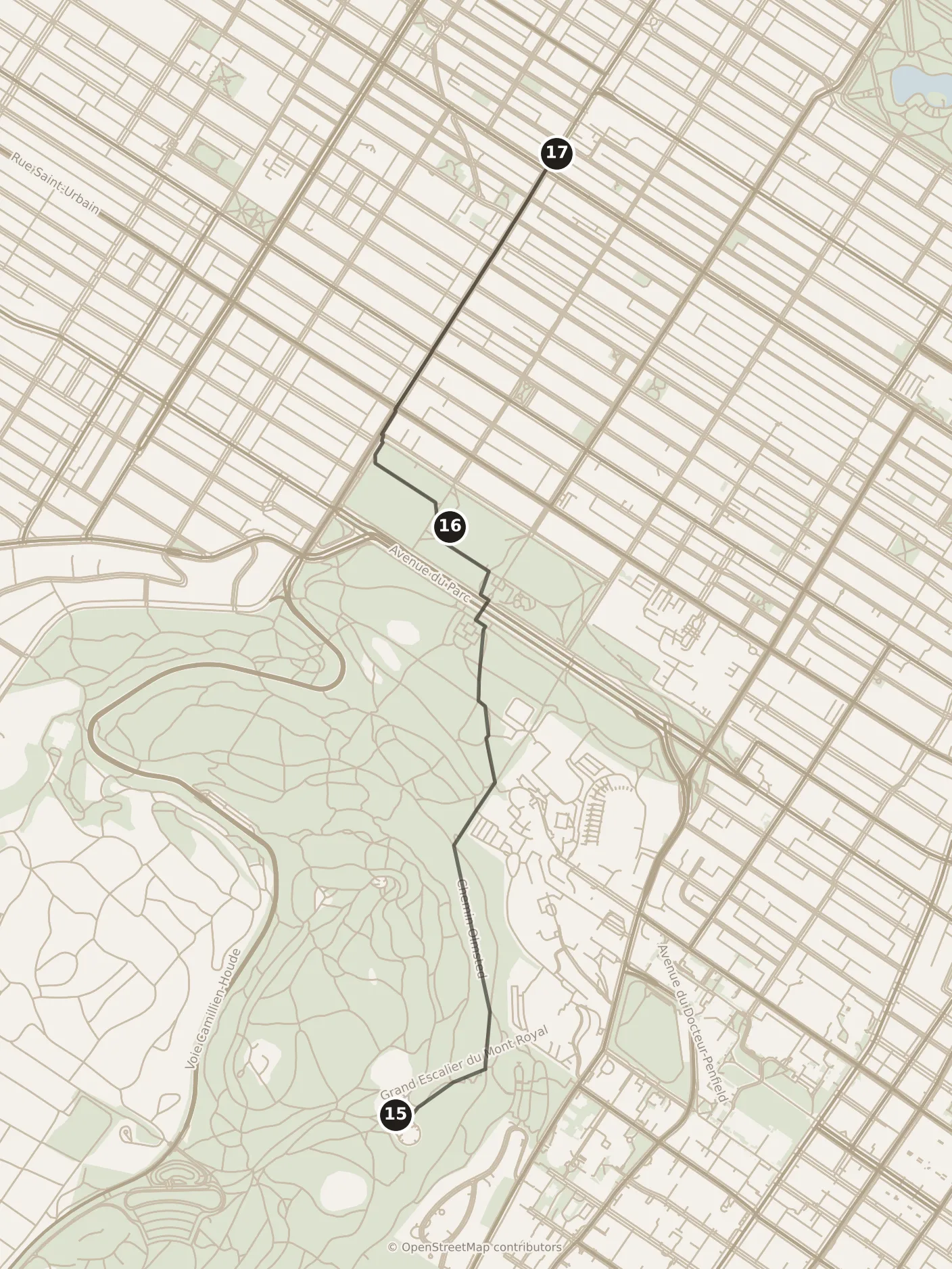
- Evening
- 15Mount Royal Chalet
- 16Parc Jeanne-Mance
- 17Avenue du Mont-Royal
Today climbs. It starts three minutes from the main station, works west along the two cathedrals and the museum street, then turns north and goes up the hill, and it ends on the far side of the hill in a different city. Nothing before the terrace is on a clock and nothing after it needs to be, so the whole day is a countdown to one place and a wander afterwards.
Morning
Mary, Queen of the World Cathedral is three minutes from Gare Centrale and is the strangest large building in Montréal. It is a deliberate scale model of Saint Peter’s in Rome, put here in the 1870s by a bishop, Ignace Bourget, who wanted the Catholic church of the French-speaking city planted in the middle of what was then the English Protestant west end. His first architect refused the job outright, having gone to look at the original and concluded it could not be reduced; a priest, Joseph Michaud, was sent to Rome to make a model in secret and the thing was built anyway, consecrated in 1894. The result is a small Saint Peter’s that is not embarrassed about it — a copied dome, and under it a copied canopy of red copper and gold leaf over the altar. The one detail worth looking up for is the statues along the roofline: on the original they are apostles, and here they are the thirteen patron saints of the city’s parishes, carved in the 1890s by Olindo Gratton and paid for by those parishes. Half an hour.
Ten minutes north-west is Christ Church Cathedral, and its interest is almost entirely structural. It is an English neo-Gothic church of 1857–60 by Frank Wills, built on ground that would not hold it: by the 1920s the stone tower had sunk more than a meter out of true, the sixteen-hundred-tonne spire was taken down in 1927, and the one you see is aluminum, put up in 1940. Then in 1987 the developers came, and for part of that year the entire cathedral stood on stilts while a two-level shopping center and an office tower’s footings were dug out underneath it. It is still there and the shops are still under it. Twenty minutes, and go down the stairs beside it afterwards for ten seconds to confirm that the story is true.
Eighteen minutes west and uphill onto Sherbrooke Street is the Montreal Museum of Fine Arts, which occupies pavilions on both sides of that street joined by passages running underneath it, so you cross the road without going outside. Two hours, and this is a place where what you skip decides whether the afternoon happens. The collection to take is the Canadian and Québécois one and the Inuit galleries with it — that is the half of this museum you cannot see anywhere else, and the European rooms, good as they are, are the half that has better versions in cities you will visit for other reasons. Take those and leave. Lunch after it, three quarters of an hour, on the streets just below in the Golden Square Mile.
Afternoon
From the museum door it is about a quarter of an hour north and east to where the pavement stops and the hill starts, at the top of Rue Peel where it meets Avenue des Pins. From there the way up is Chemin Olmsted, the carriage road Frederick Law Olmsted drew for this park in the 1870s. It switchbacks so patiently that a horse could take a loaded cart up it, and that patience is exactly why you want it: it is the one route onto this hill that never becomes a stair. The price is distance. The direct line to the top is a kilometer and a half and the road is about twice that, so reckon on three quarters of an hour, and considerably more with snow underfoot. Staircases cut the corners for anybody in a hurry, and today nobody is.
What the road delivers you to is Beaver Lake, which is the part of Mount Royal that a one-day visit never sees: a shallow artificial lake on a shelf near the summit with a pavilion beside it and a great deal of flat grass, which is the city’s lawn in summer and its tobogganing slope and skating surface in winter. Half an hour, and half an hour here is the difference between having been to a viewpoint and having been to a park.
Evening
Twenty minutes east along the ridge, roughly level the whole way, is the Mount Royal Chalet, built in 1932, and the wide stone terrace across the front of it that this entire day has been pointed at. Three quarters of an hour. The towers are straight down beneath your feet, the St Lawrence lies flat behind them, and the country past that goes on until it simply stops being visible. Be clear about what the light is doing, because a lot of people arrive expecting the wrong thing: the terrace looks out over the city and away from the west, so the sun goes down behind you, over the summit, and what you get here is not a sunset. What there is instead is the switch-on, and the half hour worth standing through is the one that begins after the sun has already gone.
Local tip. Day one’s fixed point is a door and an institution can move a door; this one is the sky, and nobody moves that. So when the afternoon slips, everything above the terrace gets shortened and the terrace itself does not get moved — and the thing to cut is the lake rather than the museum. Losing the lake takes out its half hour and lets you go straight up the Peel stairs instead of round on the carriage road, which is a little over an hour back in your pocket on this same day, and an hour is about what a late start costs you here.
Then down the far side, which is the point of ending here rather than going back the way you came. The path and the long stairway drop east off the terrace and take a little under half an hour to reach Parc Jeanne-Mance, the flat green rectangle at the foot of the hill on Avenue du Parc. If your day two falls on a Sunday between May and September, that rectangle and the slope above it have spent the afternoon holding an open drum circle — free, unofficial, going since late morning and breaking up around sunset. That is a real collision and not an oversight: the drums end when the terrace begins, and no arrangement of this day gets you both. Take the terrace as written and you come down a good hour after the last of them, into an empty rectangle; take the drums and you give up the switch-on. It is a wooded path and it will be dark; anyone who would rather not do that goes back down to the top of Rue Peel the way they came, where the streets are lit and Peel on the green line is about a quarter of an hour straight down. From the park it is twenty minutes north-east, and they bring you out on Avenue du Mont-Royal within sight of Mont-Royal station itself, which is the orange line and the way home whenever you have finished with the street. That street runs the length of the Plateau and carries most of its eating and drinking, and it is where the evening goes — and from late May to the middle of October the stretch of it east of Boulevard Saint-Laurent is closed to cars altogether, which is a different street from the one you would walk in February. A cold walking day that has just come down off a hill is the argument for poutine, which is eaten here at every hour by everybody and needs no argument at all.
With a third day

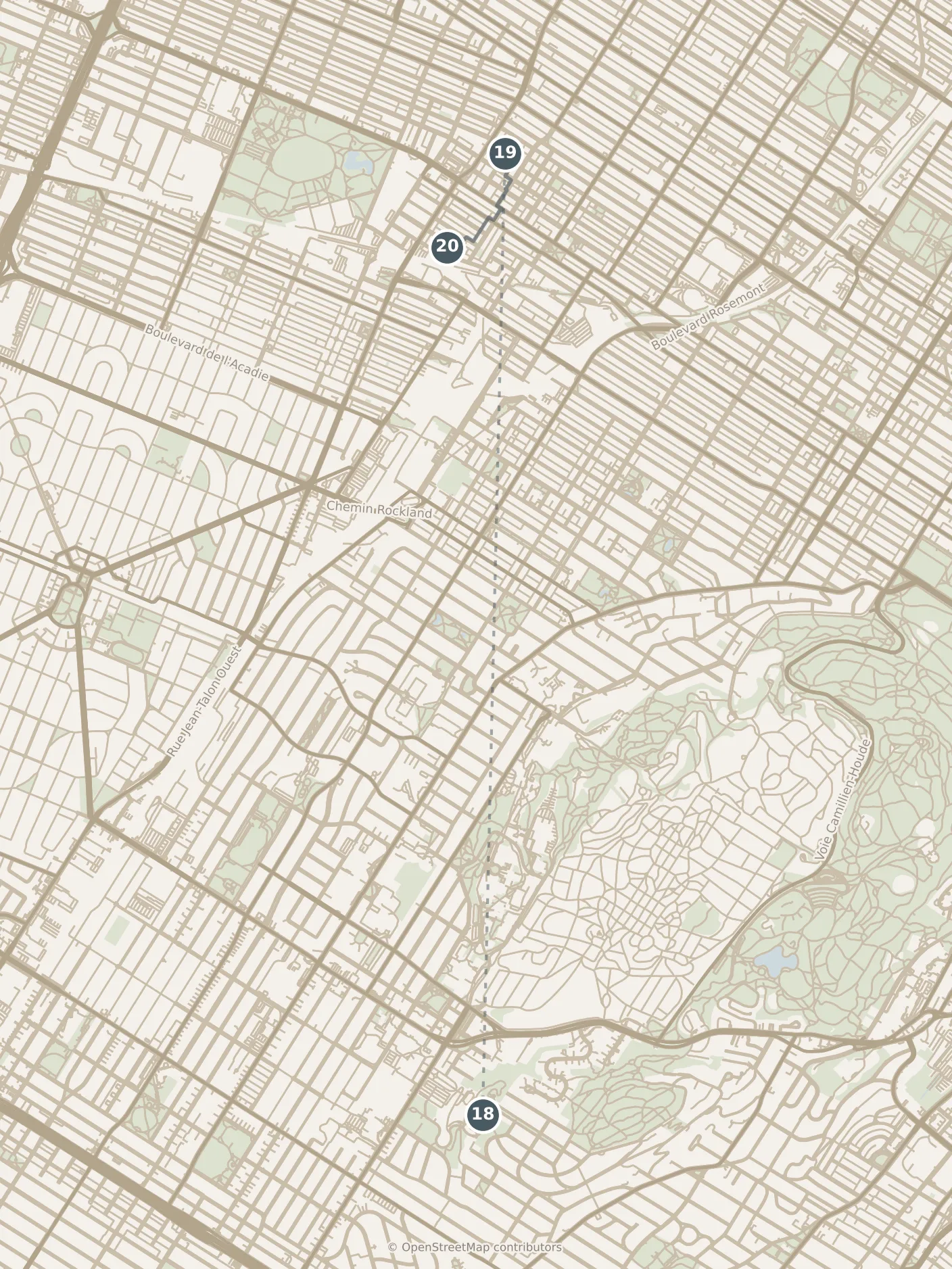
- With a third day
- 18Saint Joseph's Oratory
- 19Jean-Talon Market
- 20Little Italy
- Mile End — in the prose, not on the map
A third day buys the two things days one and two both give up: the great domed shrine on the far flank of the mountain, and the part of the city that is neither old nor downtown and is where people actually live and shop. It runs west to east along one metro line and then south down one street, and it needs three journeys on the network and about seven and a half hours.
Start at Saint Joseph’s Oratory, because it is the only thing on the day with a door that closes — though in 2026 that door stood open from half past six in the morning until nine at night, so it constrains nothing, and the real reason to take it first is the climb, before the day’s walking is in your legs. The rest is streets that do not care. It is orange line towards Côte-Vertu to Snowdon, then one stop on the blue line towards Saint-Michel to Côte-des-Neiges, then about a quarter of an hour on foot up Chemin Queen-Mary, climbing the whole way. What is up there began in 1904 as a wooden chapel put up by a lay brother, Brother André, who had a reputation as a healer; the basilica around it was begun in 1914 and not finished until 1967, and its dome is the largest church dome in Canada. Give it an hour and a half. Two things in it are worth the trip on their own: the votive chapel, a low art deco room holding something like ten thousand candles and nearly a thousand crutches and canes left behind by people who believed they no longer needed them, and the view back off the terraces, which faces the opposite way from day two’s and shows you the flat north-west of the island. The great staircase in front of the building has 283 steps, and the flight of ninety-nine wooden ones up the middle of it is reserved for pilgrims climbing on their knees — take one of the stone flights on either side instead, and do not stand about on the wooden one to photograph anything; people are using it for what it is for, slowly, and they cannot go round you.
Back down to Côte-des-Neiges and six stops east on the blue line towards Saint-Michel to De Castelnau, then eight minutes on foot, brings you to the Jean-Talon Market, which is a working produce market open every day of the year bar four — the twenty-fifth and twenty-sixth of December and the first and second of January — outdoor aisles from late spring, and from October the walls go up and the whole thing moves indoors, which makes it one of the few winter destinations in this city that is not a museum. An hour, plus three quarters for lunch eaten off the stalls. Five minutes south-west of it is Little Italy, which is the neighborhood the market sits in: three quarters of an hour of shopfronts, an Italian church and a lot of coffee counters.
Then walk south down Boulevard Saint-Laurent for half an hour to Mile End, and do walk it, because the street changing character block by block as you go is the clearest single lesson in how this city is arranged. It is also the sensible choice rather than the virtuous one: Mile End has no metro station of its own, so the alternative is ten minutes back to Jean-Talon, three stops on the orange line towards Côte-Vertu to Laurier, and then twenty minutes north on foot anyway, which saves you almost nothing and costs you the street. Mile End is still a Jewish quarter and was a Portuguese one, and is now also the quarter everyone else wants to live in. Dozens of Hasidic congregations have their synagogues and their schools on and around the streets you are about to walk, so on a Saturday you are walking through somebody’s sabbath: walk it, and do not photograph people. Two hours is right for it: the low streets off Rue Saint-Viateur and Avenue Laurier, the outdoor staircases, and the wood-fired bagel, which is genuinely of this neighborhood and is best bought warm, one at a time, straight out of the basket and eaten on the sidewalk. The city’s other own thing is smoked meat, and it belongs to the boulevard you walked down to get here rather than to this neighborhood — a counter, a line and a paper plate rather than a restaurant, further south along it than this day goes. Going home is that same twenty minutes south to Laurier on the orange line, and it is the longest walk-to-a-station of the three days, which is the fact the last paragraph below turns on.
Where the third day goes: last, by default. Days one and two are an argument in order — the lower city, then the city above it, then the terrace that shows you what you walked — and putting a day between them interrupts that for no gain. Move it to the middle in two cases only. The first is weather: day two is the one day of the three that cannot be rescheduled without losing its point, so if the forecast is against your second day, run the third day then and take the hill on the clear afternoon instead. The second is departure: this day ends in Mile End, twenty minutes on foot from its own station and further out than either of the other two days finishes, so it is the wrong day to be leaving on. One thing moves when it is inserted. Slotted second, it runs back to back with day two, and both of them end within a mile of each other in the same quarter — so on the inserted version, finish the day in Little Italy in the early evening, treat Mile End as an afternoon rather than a night out, and leave Avenue du Mont-Royal to the mountain day, which needs somewhere to arrive.
Practicalities
One thing on these three days is worth holding before you arrive, and it is the basilica’s daytime visit; the museums are all sold at their own counters on the day and the shrine on the third day is free. If the day one you have planned is a Sunday, the day inverts rather than breaks: in 2026 the basilica admitted no visitor before half past twelve on a Sunday. So run day one’s afternoon list in the morning and from its far end — the chapel first, then the market, the Château, the square and the port, which is the same chain walked east to west — eat in the lanes behind the quays, put the basilica in at whatever hour it now opens, take the founding-site museum straight after it since it is five minutes away, and let Chinatown and the lit squares have the evening exactly as written. The order of the stops changes and not one of them is lost. What the inversion costs is the shape: day one is arranged to give you the town from the top down and the Sunday version gives it to you backwards.
Five interiors across days one and two are ticketed, and four of the five are museums — the basilica is the exception. A museum in this city is the kind of institution that can keep one closed day a week, and I am not going to tell you which day each of them takes, because that is exactly the fact that changes without telling anybody. Read the closed day off each museum’s own site the week before, and come knowing what happens if the answer is your day. If the founding-site museum on day one is shut, its hour and a quarter goes to the quays and the Château and the day does not notice. If the Château is shut, the chapel’s crypt and tower take some of its hour and you reach Chinatown early, which from November to February simply means the lit squares are already lit when you get there. If the fine arts museum on day two is shut, that is the one that hurts, and the replacement is the McCord Stewart Museum, the city’s social-history museum, a quarter of an hour back east along the same street, which is smaller, tells the story of the place rather than of art, and wants an hour rather than two. That frees exactly one hour and it can be spent once: either day two starts an hour later, or the hill gets an hour more. Not both. In the dark half of the year take the later start, because the extra hour up the hill would be spent after the light has gone.
Getting between the stops needs almost nothing. Days one and two are walked in full, and the only transport in them is optional: if day one starts in bad weather, the orange line covers the approach under a roof — board at Bonaventure, two stops in the Montmorency direction, and come up inside Place d’Armes — which replaces the eighteen-minute walk in; Champ-de-Mars on the same line is the old town’s own station if you want to leave from the middle of the afternoon rather than the end; and day one ends over Place-des-Arts on the green line, which runs west towards Angrignon and east towards Honoré-Beaugrand. Day two ends at Mont-Royal on the orange line, at the far end of Avenue du Mont-Royal. The third day is the only one built on the network and it uses three journeys and no more: orange towards Côte-Vertu to Snowdon and one stop on the blue line to Côte-des-Neiges; the blue line back east to De Castelnau; and the orange line home from Laurier at the end. The half hour down Boulevard Saint-Laurent in the middle of it is walked, on purpose, for the reason given above.
If you cannot do the climb on day two, there is a real version of that day rather than an apology for one, and it costs you nothing you would miss except the climb itself. The 11 bus is named for the mountain park and crosses it, running between Mont-Royal on the orange line and Côte-des-Neiges on the blue, and it puts you on top of the hill without your walking a meter uphill. Keep the morning exactly as written. After lunch, walk down to Peel on the green line, ride east to Berri-UQAM, change to the orange line towards Montmorency and get out at Mont-Royal, then take the 11 up and over the mountain and get off at the lake. From there it is the same level twenty minutes east to the terrace at the same hour. Riding takes about as long as the fifteen-minute walk and the three-quarter-hour climb it replaces, so the cathedrals and the museum all stay in; the afternoon simply loses Chemin Olmsted, which is a real loss and is a third of what the afternoon was for. It also puts a schedule into the one day on this page that otherwise has none, so give yourself a margin at Mont-Royal rather than arriving on the minute. At the end of it you come down the same wooded stairway to Parc Jeanne-Mance, or ride the 11 back the way it brought you, which is the version that involves no descent either.
Season alters these three days more than it alters most cities’ three. Between December and March the terrace remains where day two should finish and becomes a harder piece of work to reach: the ascent nearer an hour than three quarters, boots instead of shoes, and darkness turning up in the early afternoon. That last is not an argument for moving the terrace forward — early darkness is the very thing that makes standing on it worth doing — but it is an argument for setting off before the sum above tells you to. What you get in exchange is that the indoor half of this itinerary is at its strongest then: the market with its walls up around it, the lit squares at the end of day one, and the passages under the street that join the fine arts museum’s pavilions to each other. They are the museum’s own tunnels and they do not put you on the downtown subway network, so this is not the paragraph to plan a February afternoon of never going outside around. In July it all runs the other way, the days have more hours in them than they have darkness, and the surplus is spent up the hill.


