Montréal in one day: the old town, the Plateau, and the mountain at dusk

Last updated 4 August 2026
Overview
Montréal’s visitable city is a band running from the river up over the flank of the mountain, and one day works here only if you take that band as a line and walk it in one direction. This day starts at the water in the oldest few streets, crosses to the Plateau for lunch, and finishes on top of the hill; it never doubles back, and it comes down the far side into the station it started from. It is about nine and a half kilometers on foot, which makes it a real walking day rather than a stroll, and the two longest stretches are both on the mountain — roughly forty minutes up from the park at its foot, and a little over half an hour down the other side at the end.
What a single day costs you is everything east and everything west of that line. Saint Joseph’s Oratory, the domed pilgrimage church on the far flank of the mountain, is a half-day however you cut it; so is the Olympic quarter with its botanical garden, out at the eastern end of the green line, and so is the run of museums and locks along the Lachine Canal. Jean-Talon Market and Mile End are the ones that hurt, because they are where a Montrealer would actually take you — but Mile End has no station of its own and is about twenty minutes on foot from the nearest point of this route, and that is forty minutes there and back this day has not got until midsummer. Give all of it up cleanly at nine in the morning rather than reluctantly at four in the afternoon.
Two moments in the day are fixed, and only one of them by an institution. Notre-Dame Basilica is the first door on this route, and in 2026 it admitted visitors from nine in the morning — and not until half past twelve on a Sunday. Build the morning back from that opening: the station and the walk in take about three quarters of an hour before it, which makes a quarter past eight the earliest hour worth being anywhere. If the opening has moved, build the morning back from the new one; if your day is a Sunday, the last section explains how the whole morning inverts.
The other fixed point is the light, and nobody revises that. The last stop is a stone terrace on the summit looking straight down at the towers, and what it wants is the half hour on either side of dusk, when the city comes on underneath you. The sun sets here from just after four in the first week of December to a few minutes before nine at midsummer, so take your own month’s hour and count back. Everything above that terrace — the station, the square, the basilica, the museum, the port, the market lanes, the chapel, the metro, the Plateau, lunch and the climb — comes to about seven hours, and that is when to start.
Three things about the seven, because a number is what a reader plans on. It counts the time inside the places and the walking between them, and nothing else — the biggest thing it leaves out is the wait at the basilica door, the busiest single entrance on this route and the one place where a ticket bought before you travel buys back real time. It also assumes dry sidewalk: from December to March every walking figure here is optimistic, the forty minutes up the mountain most of all. And it behaves very differently at the two ends of the year. In early December it lands the start just after nine, which is an hour when the basilica is already open, so the two constraints ask for the same thing and there is nothing to reconcile. At midsummer it asks you to begin in the middle of the afternoon; do not, because the surplus is worth more spent than saved. Three spare hours buys back exactly one item from the paragraph above — Mile End and the wood-fired bagels — and nothing else on that list is small enough to fit.
One practical thing, since you may have landed here without reading anything else about the city. This route contains exactly one ride, two stops on the metro’s orange line, and that single fare is the whole of the transport it needs. What the fare card is and how it is bought is in the city guide, along with everything else that is true of Montréal rather than of this walk.
Last, the bag, because on a one-day trip you are carrying one, and this day gives you neither a room to leave it in nor a flight to time it against. It begins and ends at Gare Centrale, which is the only shape that really matters — whatever you do with the luggage, you are not crossing town for it at nine at night. The checkroom there is VIA Rail’s rather than the station’s, and it is a staffed desk rather than a wall of lockers: the desk closes earlier in the evening than the station does, and after it has closed the ticket counter takes and returns bags until the station shuts. So ask at the desk, or at the ticket counter once the desk has gone — and ask two things, because only one of them has a published answer. When you can collect, which they will tell you; and whether they will take a bag from someone who is not traveling by train that day, which nobody publishes anywhere and which decides the shape of your day.
If that second answer is no, the day as written is out, because the climb is the one stop here you cannot do holding a case: forty minutes uphill on park paths, with nowhere at the top to set anything down. What replaces it is this same day with its ending cut off, and it is a real day rather than a consolation. Walk the morning exactly as it stands — the station, Place d’Armes, the basilica, Pointe-à-Callière, the Old Port, Place Jacques-Cartier, the market and the chapel, all of it flat sidewalk — then the metro to the Plateau, Square Saint-Louis, Prince-Arthur and lunch on the Main, and the same orange line back the other way, towards Côte-Vertu, to Bonaventure and the station door. That is about six hours rather than seven, the basilica’s opening is the only clock left in it, and it gives up exactly one thing: the terrace at dusk, which is also the one thing on this route worth coming back for.
The day

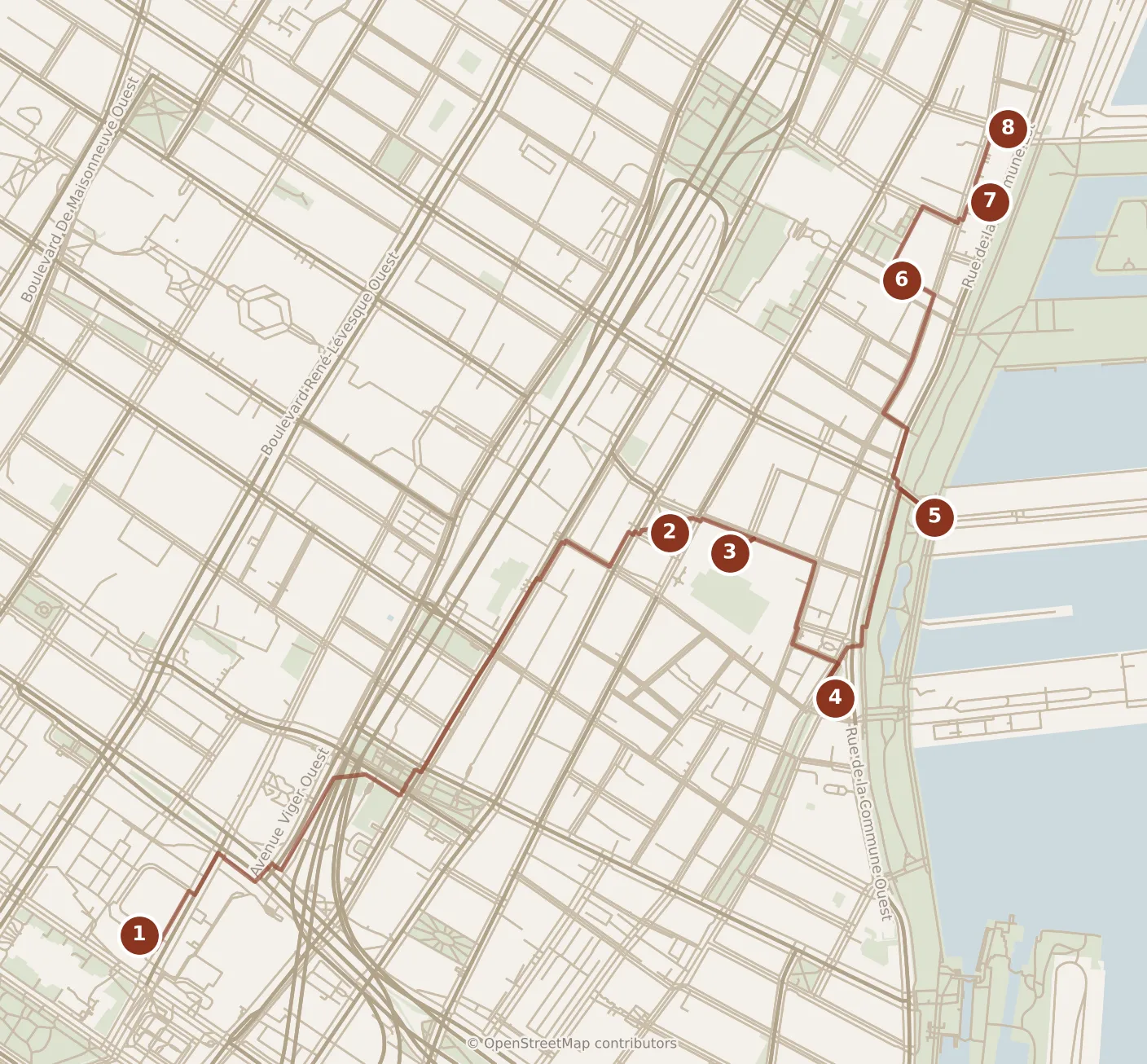
- Morning
- 1Montreal Central Station
- 2Place d'Armes
- 3Notre-Dame Basilica
- 4Pointe-à-Callière
- 5Old Port
- 6Place Jacques-Cartier
- 7Bonsecours Market
- 8Notre-Dame-de-Bon-Secours Chapel
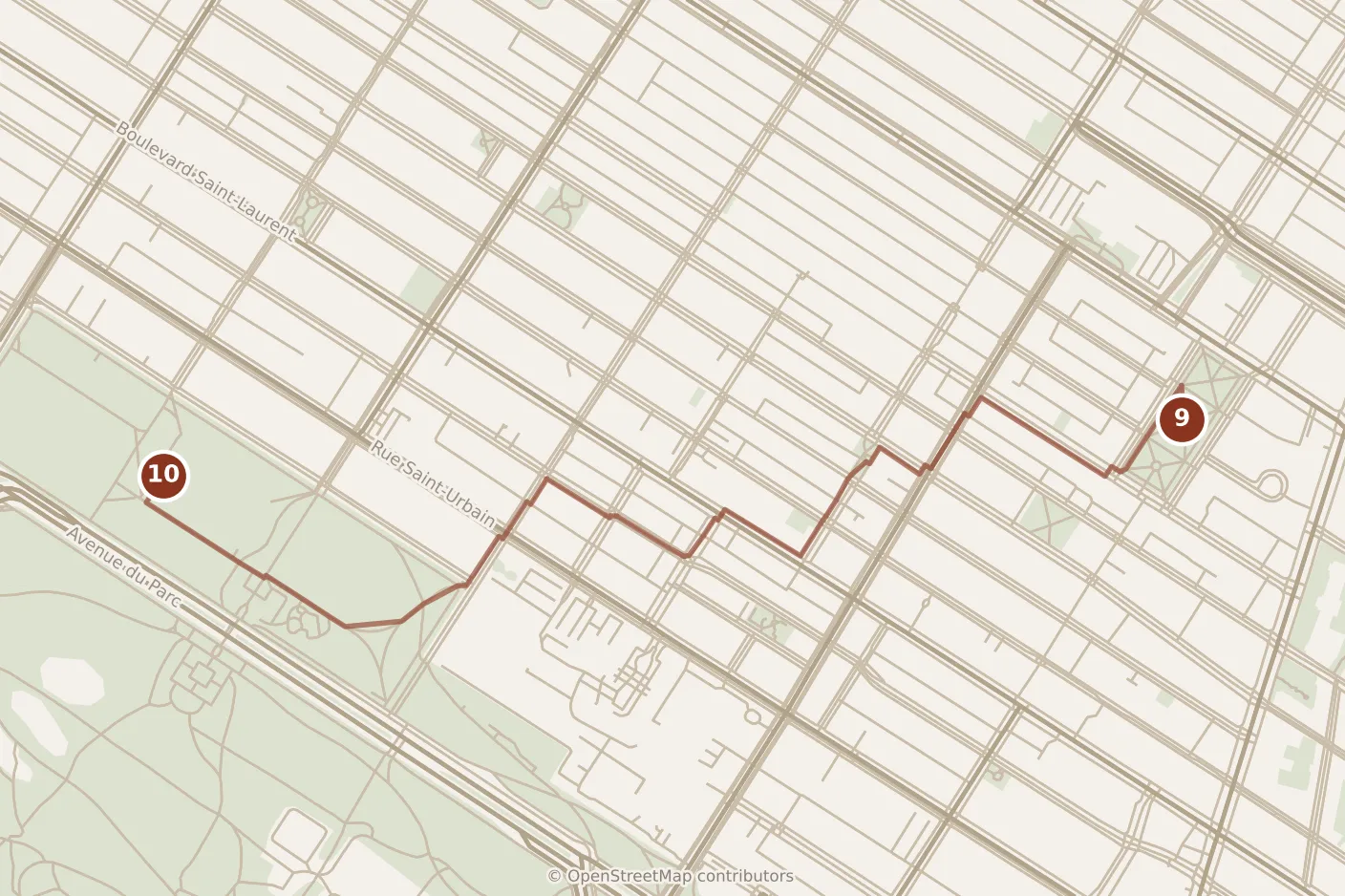
- Afternoon
- 9Square Saint-Louis
- Boulevard Saint-Laurent — in the prose, not on the map
- 10Parc Jeanne-Mance
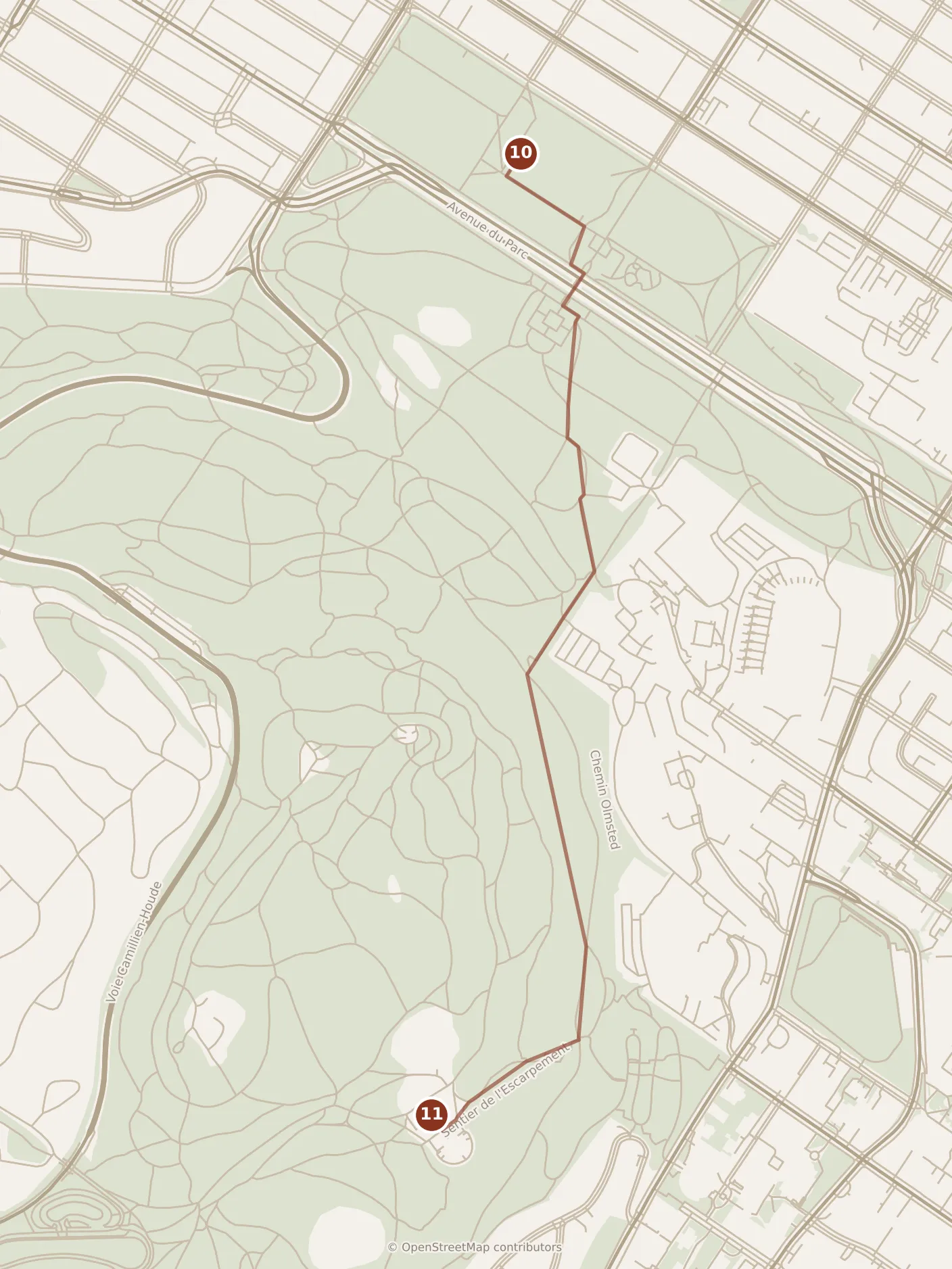
- Evening
- 11Mount Royal Chalet
Morning
Begin inside Gare Centrale rather than walking straight out of it. It opened in 1943, and the concourse is one long art deco room with two carved friezes facing each other down its length, designed by Charles Comfort: stylised scenes of Canadian industry and landscape, and running above them the words of O Canada — the French text on one wall, the English on the other, which is the country’s whole arrangement stated in stone before you have left the building. Fifteen minutes, most of it looking up.
From there it is about twenty minutes on foot down to Place d’Armes. If the weather has turned, the metro does the same thing in two stops, Bonaventure to Place-d’Armes on the orange line towards Montmorency, and puts you out in the middle of the square.
Stand at the Maisonneuve Monument in the center of it — Louis-Philippe Hébert, 1895, the man who founded Ville-Marie on this ground in 1642 — and turn once on the spot. Four centuries are around you: the basilica of 1829; the Bank of Montreal head office of 1847 behind its Corinthian portico; the New York Life Building of 1888, eight stories of red Scottish sandstone, which the city counts as its first skyscraper; and the Aldred Building of 1931, stepped back like a small art deco tower from somewhere else. Fifteen minutes. It is the best single square in the old town and almost nobody stops in it.
Then the basilica. Outside it is gray and severe, a Gothic Revival design of 1824–29 by James O’Donnell, an Irish-American Protestant who converted on his deathbed so that he could be buried under the church he had built, and is. Inside is the opposite: a vault of deep blue and gold stars, thousands of carved and gilded wooden details put in by Victor Bourgeau in the 1870s, and a Casavant Frères organ of 1891 carrying something over seven thousand pipes. Two things to look for. The nave windows, made in Limoges in 1929, show scenes from the city’s own history rather than from scripture, which is unusual and worth walking one whole side for. And behind the main altar, the Sacré-Cœur chapel, gutted by an arsonist in 1978 and rebuilt with its upper half frankly modern, ends in an enormous bronze altarpiece by Charles Daudelin. Forty-five minutes. The twin towers are named Temperance and Perseverance, which tells you what the nineteenth century thought it was doing here.
Five minutes downhill is Pointe-à-Callière, a museum built over the exact spot where the city began: the point of land between the St Lawrence and the Little Saint-Pierre, a river that was covered over and turned into a sewer. That is not a figure of speech. The route through the museum goes underground and stays there — foundations, the first Catholic burial ground, and a long walk along the inside of the collector built over the buried river in the 1830s. Give it an hour and spend all of it below street level; the changing exhibitions upstairs are the part to skip, because they are the part that is not the site.
Local tip. Two stops on this day cost anything at all, and if you only want one of them, take the basilica rather than the museum. The museum’s subject — the ground the city was founded on — is under your feet for the whole of this morning anyway, and the streets on top of it are free. The hour that buys back is the hour the mountain wants at the other end of the day.
Six minutes on and you are out on the quays of the Old Port. Twenty minutes here, walking rather than stopping. What to look at is across the water: Île Sainte-Hélène on one side and, off the other way, the stacked concrete boxes of Habitat 67, Moshe Safdie’s housing experiment for Expo 67, which still looks like a proposal for a future that never turned up. What to ignore is the fairground the quays have grown, the big wheel and the zip line and the lines for both. They are an hour, and the hour is the mountain’s.
Seven minutes up from the water is Place Jacques-Cartier, the sloping cobbled square that runs from Rue Notre-Dame down towards the port, lined with terraces and, in summer, buskers along its whole length. At the top of it stands Nelson’s Column, put up in 1809 by the city’s British merchants, which makes it the oldest monument in Montréal and more than thirty years older than the one in Trafalgar Square — and a genuinely strange thing to find at the head of a square in a French-speaking city. Ten minutes.
Three minutes further east along Rue Saint-Paul is Bonsecours Market of 1847, silver-domed, fronted by a cast-iron portico shipped in from England. It was the city hall for twenty-five years, and for one session in 1849 it was the parliament of the united province, after a mob burned the parliament building down the hill. Ten minutes: walk the length of the hall and out the far end.
The last stop of the morning is next door and is the better building. Notre-Dame-de-Bon-Secours Chapel is the sailors’ church — a congregation founded on this spot by Marguerite Bourgeoys in 1655, this building of 1771, and hanging from the ceiling a small fleet of wooden ships, votive lamps given by sailors who got home. On the roof a statue of the Virgin faces the river with her arms open towards the harbor, generally taken to be the Our Lady of the Harbour of Leonard Cohen’s Suzanne, which was written about this waterfront. The chapel is free; the museum beneath it and the lookout tower above it are the ticketed part, and this day does not need them. Twenty minutes.
Afternoon
Eight minutes back up through the old town brings you to Champ-de-Mars, whose street-level entrance is glazed from end to end in the colored glass Marcelle Ferron made for it in 1968 and is worth the thirty seconds before you go down the stairs. Two stops on the orange line towards Montmorency — Berri-UQAM, then Sherbrooke — and you come up on Rue Berri in a different city: Plateau-Mont-Royal, low, residential, French and busy.
Four minutes from the station exit, one block over and one up, is Square Saint-Louis, which is the Plateau in one block. It was laid out in 1876 around a fountain, and the houses facing it are the postcard version of the nineteenth-century city: mansard roofs, deep cornices, painted trim, and the outside staircases curling up to first-floor doors that the neighborhood is famous for. The usual explanation for those stairs is a set of early by-laws demanding a setback from the street, and builders who put the steps outdoors rather than surrender rentable space inside. There is a bust of the poet Émile Nelligan in the square, who lived on it. Ten minutes on a bench.
Then west along Rue Prince-Arthur, pedestrianized in the early 1980s and long the city’s best-known row of bring-your-own-wine restaurants, which is a genuine local institution rather than a gimmick: you buy the bottle on the way and the kitchen charges you for the food. It is ten minutes to Boulevard Saint-Laurent at the end of it, and five of those are looking at the paving and the shopfronts.
Boulevard Saint-Laurent is the Main, and lunch goes here. For a century this was the line the city divided on, French to the east of it and English to the west, and it is the street every wave of arrivals landed on and worked its way up. What to eat is smoked meat on rye, hand-cut, from one of the counters on the blocks around you; order it medium-fat unless you have views. Sit down for it. An hour. Poutine is the other thing you have heard of and it is better at the end of a cold day than in the middle of a walking one.
From the boulevard it is about twenty minutes to the foot of the mountain: west along Rue Prince-Arthur to Avenue du Parc, then right and north up it, with the wooded slope filling the end of the street ahead of you. That brings you to Parc Jeanne-Mance, a flat green rectangle whose main purpose is to be the foreground of the hill behind it. The Sir George-Étienne Cartier monument stands across the avenue at the park’s edge, and on summer Sunday afternoons the drum circle that has gathered around it since the 1970s makes this the loudest lawn in the city; if your one day is that Sunday, give it ten minutes and take the noise as a gift. Then cross and start climbing.
Evening
Mount Royal Park was laid out in 1876 by Frederick Law Olmsted, and Chemin Olmsted is his carriage road: a long switchback graded so gently that a horse could pull a carriage up it, which makes it the easiest possible ascent on foot and roughly twice as long as it needs to be. A staircase cuts straight up beside it. The road is longer and kinder, the stairs are quicker and are stairs; either way reckon on forty minutes to the top, more with snow on the ground, and there is no version of this in which you are not warm at the end of it.
What you arrive at is the Mount Royal Chalet, a hall of 1932 with a stone terrace in front of it called the Kondiaronk Belvedere, after the Wendat chief who did more than anyone to bring about the Great Peace of Montreal in 1701. The terrace is the whole point, and the reason this day ends here rather than anywhere else. The downtown towers stand directly below; the St Lawrence runs behind them; the Jacques Cartier and Champlain bridges cross it to either side; and on a clear day the isolated Monteregian hills sit out on the flat land beyond like things dropped there. Three quarters of an hour.
One thing to know before you arrive, because people get it wrong: the sun goes down behind you, not in front. This is not a sunset viewpoint, it is a city-lighting-up viewpoint, and the half hour you want is the one after the sun has gone, when the grid comes on below and the river goes black. It is also the one stop on this route with no door — the terrace is open ground in every month, and though the park around it does close for the night, it closes hours after this day has come down off the hill, which is exactly why the whole day can be built around it. The Mount Royal Cross, ten minutes further along the ridge, is not a second viewpoint: it stands among trees, and it is a thing to see from the city below, lit, later.
Then down. From the terrace the path and the steps drop to Avenue des Pins and the top of Rue Peel, past the edge of the McGill campus, and Peel runs straight south from there through downtown. It is a little over two kilometers and about half an hour, the longest single stretch of the day and the easiest, because all of it is downhill and the last third is shopfronts. Gare Centrale is at the bottom, two blocks east along Boulevard René-Lévesque on Rue de la Gauchetière. That is the entire distance between the last view of the day and the departure boards, and it is why this route runs uphill rather than down.
Practicalities
One thing on this day is worth arranging before you travel, and it is the basilica. It sells its daytime visit online for a chosen date rather than a timed slot — the slots you will see on the same platform are for the evening light show, which is a different ticket — the line at the door is the longest on the route, and the adult ticket was in the fifteen-to-twenty Canadian dollar range in 2026. Buy the date before you travel, be at the door for the opening, and the rest of the morning falls in behind it. Pointe-à-Callière is walk-up and separately ticketed; everything else here — the square, the port, the market, the chapel, the Plateau and the mountain — is free.
Pointe-à-Callière is also the one stop on this route that can be shut on a given weekday, and the small museum under the chapel carries the same risk. Check the closed day on each museum’s own site before you set out rather than after, because if yours is one of the closed ones the morning still works: the quay, the square and the market absorb the hour between them, and the chapel above the museum is a working church with its own hours. What you should not do is replace an hour underground with something at the same distance. The old town is better walked than substituted.
A Sunday inverts the morning rather than ruining it. Since the basilica admits nobody until the middle of the day, take the port, the square, the market and the chapel first, put the basilica at the hour it opens, eat in the old town instead of on the Main, and go straight up to the Plateau afterwards so that the mountain still gets its light. That works from roughly March to October. In deep winter it does not: on a December Sunday the sun is down less than four hours after the basilica has opened, and this is the one version of the day that cannot hold both. Keep the basilica and take the mountain in daylight — the view is still the view, and only the lights are missing.
Moving between the stops is almost all walking. The exception is the single metro ride from Champ-de-Mars to Sherbrooke; two other rides are optional and neither is part of the route as written — Bonaventure to Place-d’Armes if the morning starts in bad weather, and nothing at all at the end, because the walk down the mountain is the way off it and it finishes at the station door.
If you fly in rather than arrive by train, the day needs no rewriting at all. The airport bus finishes at Berri-UQAM, but it comes into town along Boulevard René-Lévesque and stops at Mansfield first, a couple of minutes’ walk from Gare Centrale: get off there, settle the bag, and the route starts where it is written to start. The airport fare also carries you on the metro and the buses for the rest of the day, so the single ride this route needs is already bought.
Finally, the season, which changes this route more than it changes most. From roughly December to March the mountain is still the right ending and it is a different piece of work: snow on the path, the forty-minute climb closer to an hour, and the dark arriving mid-afternoon. That is not a reason to move the mountain into the middle of the day, because the early dark is precisely what makes the terrace worth standing on. It is a reason to start earlier than the arithmetic says, and to treat the descent as the part of the day that needs boots rather than the part that needs nothing. In July the opposite problem: the light holds so long that the day has hours spare, and Mile End is what they are for.


