Mexico City in two or three days: the center, Chapultepec, and a third day in Coyoacán

Last updated 8 August 2026
Overview
Two days here does not buy more of the city — it is far too big for that to be the point — it buys the end of the compromises. With one day you must choose between the museum that holds the pre-Hispanic world and the square that world was dug out of; between the hill in Chapultepec and the buildings on the Zócalo; between the famous objects and the time to understand what they are arranged to say. Two days takes both halves of each of those. Day one is the historic center on foot. Day two is Chapultepec, and the whole argument for it is that the anthropology museum gets four hours rather than two.
The order is the reverse of the obvious one, and that is deliberate. You stand on the ground first — the temple platform, the cathedral raised out of its stone, the square laid over the ceremonial center — and only afterwards go and look at what came out of it. It costs nothing to run the days this way round and it changes what the second one is: on day one the objects are absent and you are standing where they were found, on day two they are in front of you and the hole is five kilometers behind.
Neither day crosses the city. Day one stays inside a rectangle about a kilometer and a half across and its longest stretch is the walk back east at the end. Day two runs one way, from the hill to the avenue, and never turns round.
Day one comes to about eight and a half hours: twenty minutes on the square, three quarters of an hour in the cathedral, two hours at the temple and its museum, an hour in the palace, twenty-five minutes at Santo Domingo, an hour and a quarter over lunch, a quarter of an hour in the post office, an hour and a quarter inside the Palacio de Bellas Artes, twenty minutes in the Alameda, and an hour of walking spread through it. The national art museum is not in that count; it stands on the route and adding it adds an hour and a quarter. Day two comes to about eight and three quarters: two hours in the castle, three quarters of an hour over lunch, four hours in the museum, ten minutes at the Ángel, and a little under two hours on foot, of which forty minutes is one stretch of avenue you could hand to a bus.
Both of those are the time you spend inside the places plus the time you spend moving between them, and neither is the length of the day. The largest thing they leave out is the security check at the Palacio Nacional, which is free to enter and therefore the one real line on day one; after that, the ticket desk at the anthropology museum, which is at its worst on a Sunday and for the reason given at the end. Day two’s four hours in that museum is a decision you are making, not a measurement of the building.
The end of day one is the one part of these two days that answers to the sky, and it is worth saying plainly what it can and cannot give you. This city stopped putting its clocks forward in 2022 and sits nineteen degrees north, so the sunset hour barely moves: the sun goes down here from just before six at the end of November to about twenty past seven in the first week of July, and never outside that band. From getting up from the lunch table to standing on the Zócalo again is two hours and twenty minutes of walking and buildings, so a day begun at nine puts you back on the square at about half past five — before sunset in every month of the year, and long before it in most of them. Starting later does not mend that, because the interiors close well before the sun does. That is a real collision and not an oversight, so take the walk back for what it actually gives you, which is the same ground in a different light and an emptier square; the floodlit version is a separate ten minutes after dinner, on Line 2 from wherever the evening ends.
What does shape both days is not the light but the altitude and, for half the year, the rain. At 2,240 meters a twenty-minute climb is a real twenty minutes and the first day of a trip is not the day to test it, which is one more argument for taking the flat center first. From roughly May to October a hard, short storm arrives most afternoons; both days are outdoors at exactly that hour, so carry the small umbrella — but not on the third day, when the Casa Azul will not let you bring one in and has nowhere for you to leave it. That day wants a jacket instead.
Nothing on days one and two has to be booked before you travel: everything with a ticket is bought at the door, and most of the best things on day one are free anyway. The third day adds exactly one booking and it is the only one in this article — the Frida Kahlo museum sells no tickets at its own door at all, only online, by date and hour, and general admission was in the three-hundred-peso range in 2026, about half that for Mexican nationals and residents. Book it the week you book the trip.
Three things the parent guide’s transport section will not hand you at the barrier. There is no paper ticket on the Metro or the Metrobús any more and no cash gate: the only way through is the rechargeable Movilidad Integrada card, sold and topped up with cash at the ticket window of any Metro station — the airport excepted, where it comes out of a machine at the Metrobús terminal instead. Buy it at the first station you use and put all three days on it at once. The front carriages of every Metro train and the front section of a Metrobús are reserved for women and for children under twelve, at every hour of every day, signed on the platform and enforced by the staff and by the other passengers. And the card is not the only thing here that wants cash: the market counters and street stalls this article sends you to are cash places.
Finally the bag, which for a trip of this length is a question about one day rather than all of them. There is no central railway station here and no left-luggage counter in the middle of the city; the airport keeps lockers in both its terminals, and that is the honest answer only if you are going that way anyway. What actually matters is the last day: Coyoacán finishes nine kilometers south of the center and thirteen from Benito Juárez, and the Casa Azul asks for anything larger than a day bag to go into a cloakroom that has not been in service, so a reader flying out that evening should not plan to arrive there with luggage. Do the third day in reverse if you must, or move Coyoacán off the last day altogether and end on day one or day two instead.
Day one

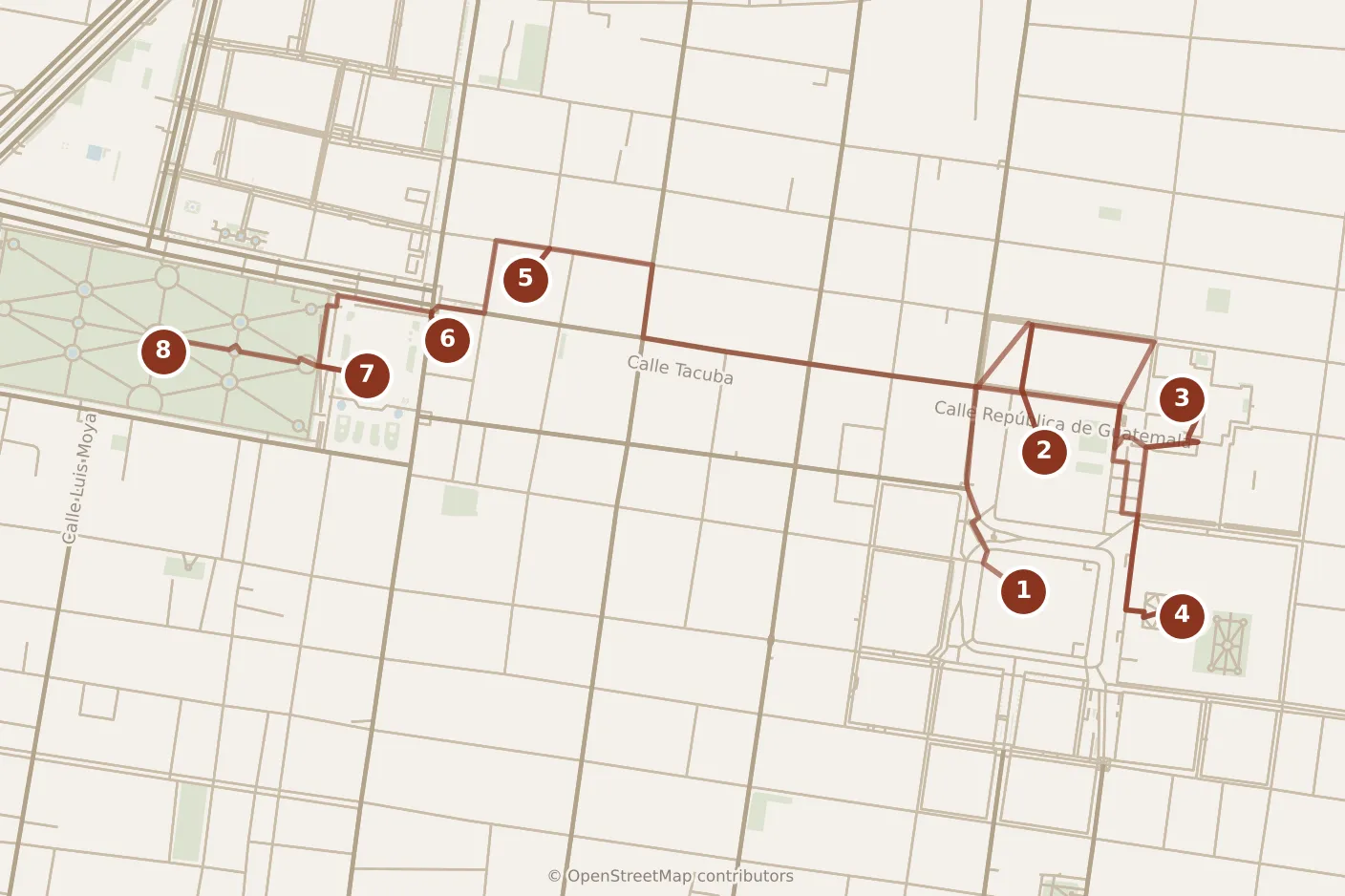
- Day one
- 1Zócalo
- 2Catedral Metropolitana
- 3Templo Mayor
- 4Palacio Nacional
- Plaza de Santo Domingo — in the prose, not on the map
- 5Museo Nacional de Arte
- 6Palacio de Correos
- 7Palacio de Bellas Artes
- 8Alameda Central
The whole day sits within a few hundred meters of one square, and the square is where it starts and where it ends — the same ground, a day and one changed light apart.
Morning
Get to the Zócalo for around nine. If you are sleeping in Roma, Condesa or Juárez, that is Metro Line 1 east to Pino Suárez, then one stop north on Line 2 to Zócalo/Tenochtitlan, which comes up inside the square itself; if you are staying in the Centro Histórico you walk. Eat first, wherever you are: chilaquiles are the local breakfast and the reason to have one is that the next proper meal is five hours away.
Give the square twenty minutes before you go into anything on it. It is not a place you look at, it is a place you cross and re-cross, and the thing to register is that it is empty on purpose — no trees, no benches, nothing in the middle but the flagstaff — in a city that has almost no other flat emptiness. Something is nearly always being built or dismantled on it: a stage, a market, a demonstration, a screen. That is not an interruption of the square, it is what the square is for.
The Catedral Metropolitana takes three quarters of an hour, and the two things to look for are not the ones on the outside. The first is the choir, which sits in the middle of the nave rather than behind the altar, walled in carved wood, with two great eighteenth-century organs facing each other above it — a Spanish arrangement that cuts the church in half and takes most visitors by surprise. The second is next door and is a separate building with its own parish: the Sagrario Metropolitano, a square block whose entire front is a single carved screen of pale stone set into dark red volcanic rock, and it is the better piece of architecture of the two. The cathedral is in use all day. Mass is said several times over, and when it is, the nave is not a corridor — go round by the aisles and do not photograph into a service.
Three minutes north-east is the Templo Mayor, and it takes two hours between the excavation and its museum. What you walk over on the raised boardwalks is not one temple but a stack of them, each built over the last every fifty-odd years, so what was uncovered reads as a cross-section: you can see the earlier stairways swallowed inside the later platform. At the top there were two shrines side by side, Tláloc for rain and Huitzilopochtli for war and the sun, which is the whole Mexica settlement compressed into one building — you fed the second so the first would keep coming. The museum alongside holds what the offerings contained rather than a reconstruction of any of it, and its single overwhelming object is the Tlaltecuhtli monolith, a four-meter carved slab of the earth deity found in 2006 under a street corner and lifted out in pieces. This is the stop with the fixed edge: the gate shut at five in 2026 and the whole day is arranged so you are here at nine rather than at three. If the hour has moved, keep the shape and build from the new one.
Local tip. The one ticket covers the boardwalks and the museum, and if you are running late cut the museum, not the walk. The excavation is the thing that exists nowhere else on earth; the museum is a very good room of objects behind glass, and you are going to spend four hours in a better one tomorrow.
Afternoon
Five minutes south, filling the eastern side of the square, is the Palacio Nacional. It is free, it is a working seat of government, and the price of that is a security check with a photo identity document, so carry one. Give it an hour. The reason to go in is Diego Rivera’s staircase — begun in 1929 and worked on into the 1930s, the history of the country wrapped round three walls of a stairwell — and then the corridor of later panels he added in the 1940s and early 1950s, which are quieter, flatter and far stranger: market scenes, dyeing, maize, a pre-Hispanic world painted as daily work rather than as pageant. The Recinto de Homenaje a Benito Juárez, in the north wing, is the rooms he actually died in and takes ten of the sixty minutes. Of fourteen courtyards only a few are open, and that is normal rather than a sign you have come on a bad day. It is also the one door on this route that can shut at no notice for a state occasion. If it does, you have lost the smallest hour of the day, and it frees most of the hour and a quarter the afternoon below otherwise tells you to give up.
Twelve minutes north up República de Brasil is the Plaza de Santo Domingo, which is worth twenty-five minutes and is the stop most visitors to this city never make. Along its western side runs the Portal de Evangelistas, a low colonnade of round arches under which public scribes still sit and write on most working days — letters, forms, petitions, contracts — on machines, beside small hand presses turning out wedding invitations. It is not a re-enactment. The church behind the plaza is the third on the site, built between 1717 and 1736 out of the same dark red tezontle and pale cantera the Sagrario used, and the fountain in the middle carries Josefa Ortiz de Domínguez. On the north-east corner, the heavy building with the cut-off doorway is the Antiguo Palacio de la Inquisición.
Lunch is here or just west of here, in the streets running down towards Tacuba, and give it an hour and a quarter. The big meal is the middle one in this city and eating it standing up to save forty minutes is the false economy of the whole trip.
Five minutes further west, on Tacuba, the Museo Nacional de Arte stands behind a square holding a colossal bronze horse cast by Manuel Tolsá in 1803, which has been moved around the city four times and is known to everyone here simply as the little horse. The museum is four centuries of Mexican painting and it is a serious collection. It is also the one stop on this day you should be willing to lose: an hour and a quarter here is an hour and a quarter you do not have if you want the murals at the far end of the street unhurried, and the murals are the ones this city made. Take it only if you are ahead.
Three minutes on, on the corner of Tacuba, is the Palacio de Correos, and it needs a quarter of an hour and no ticket, because it is still a post office and has been continuously since 1907. Walk in. The interior is marble and a double staircase that splits, meets on a landing and splits again, with bronze and iron window frames that were made in Florence and shipped over. The architect was Adamo Boari, which is worth knowing for two more minutes, because the building he was working on at the same time is a hundred meters further west and is where the day goes next.
Evening
The Palacio de Bellas Artes wants an hour and a quarter, and unlike the rest of the day it wants you inside rather than looking at it. The first floor is whatever exhibition is running; the two floors above it are the reason to buy the ticket. The murals up there are the argument the country had with itself in paint, and they run round the open galleries on three sides of the hall: Rivera, Siqueiros, Orozco and Rufino Tamayo, including the Rivera that was painted over in New York and repainted here out of spite and photographs. If you are short, skip the first floor entirely and go up. Note that the museum floors keep museum hours and close well before the light does, which is the other reason the day is shaped forwards rather than backwards.
The Alameda Central starts at its door and is worth twenty slow minutes: the oldest public park in the Americas, laid out in 1592, and now the one place in the center where the city sits down.
Then walk back east, a little over twenty minutes down 5 de Mayo — a different street from the one that brought the crowds west, and quieter for it — and come out on the Zócalo again with the day nearly gone out of it. The square is emptier than it was at nine and much larger for it, and the whole point of doing this rather than going straight to dinner is that you have now seen the same ground in two states, having spent the day learning what is underneath it. The floodlights come on later than this, so if you want them, come back after you have eaten — Zócalo/Tenochtitlan on Line 2 is under your feet here, and it puts you on the square again from wherever the evening ends.
If the day has slipped, this walk is the first thing to cut: take Line 2 from Bellas Artes two stops through Allende to Zócalo/Tenochtitlan instead. It is the first cut because it is the cheapest thing to lose rather than the largest saving: against a walk of a little over twenty minutes, the stairs at both ends and the wait on the platform buy back ten. The second thing to cut, if that is not enough, is Santo Domingo, which costs you twenty-five minutes and the twelve of walking that reach it. What does not go, at either stage, is the temple or the cathedral: the evening is a walk and they are the day.
Day two

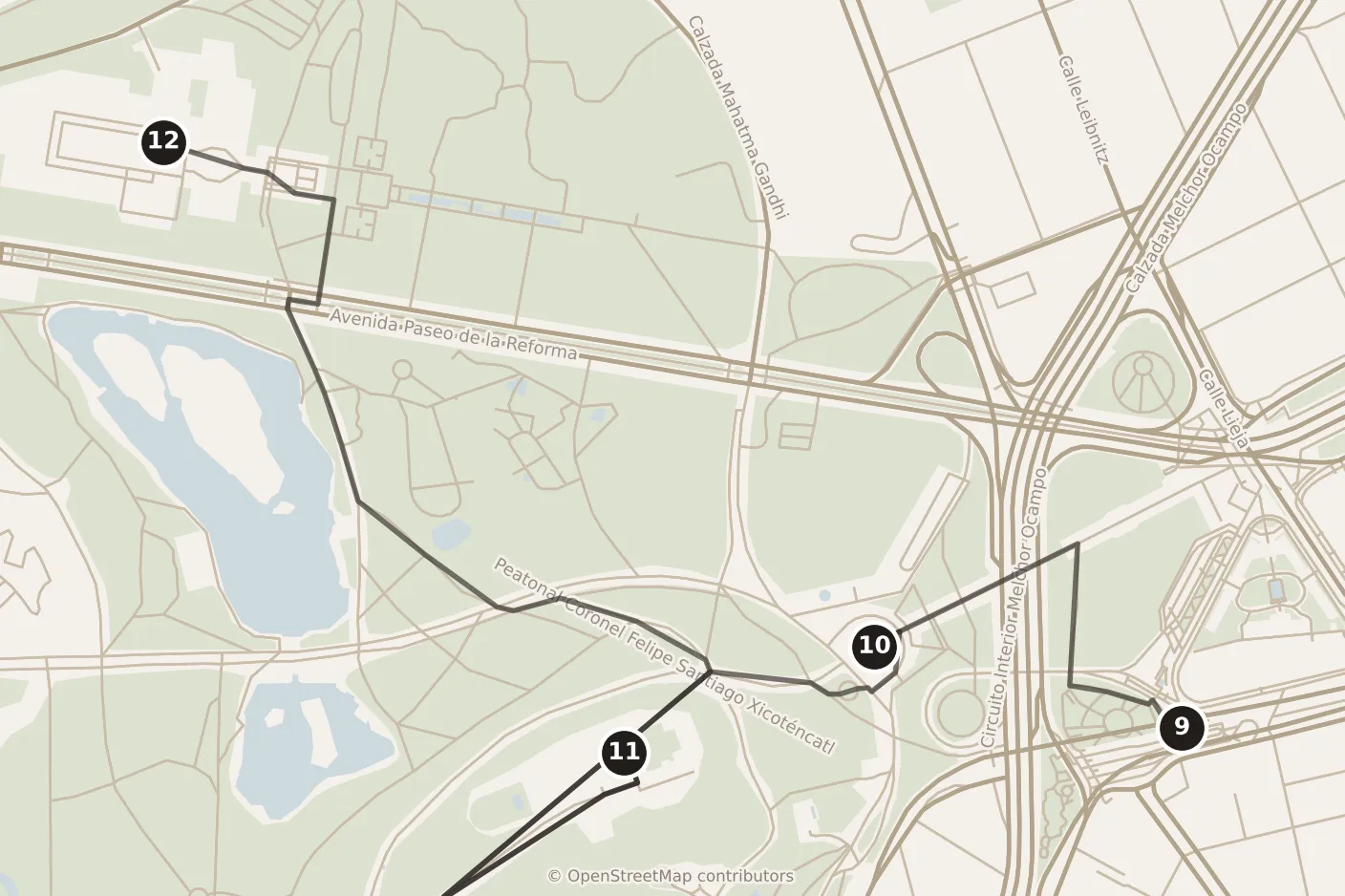
- Morning and afternoon
- 9Chapultepec
- 10Monumento a los Niños Héroes
- 11Chapultepec Castle
- 12Museo Nacional de Antropología
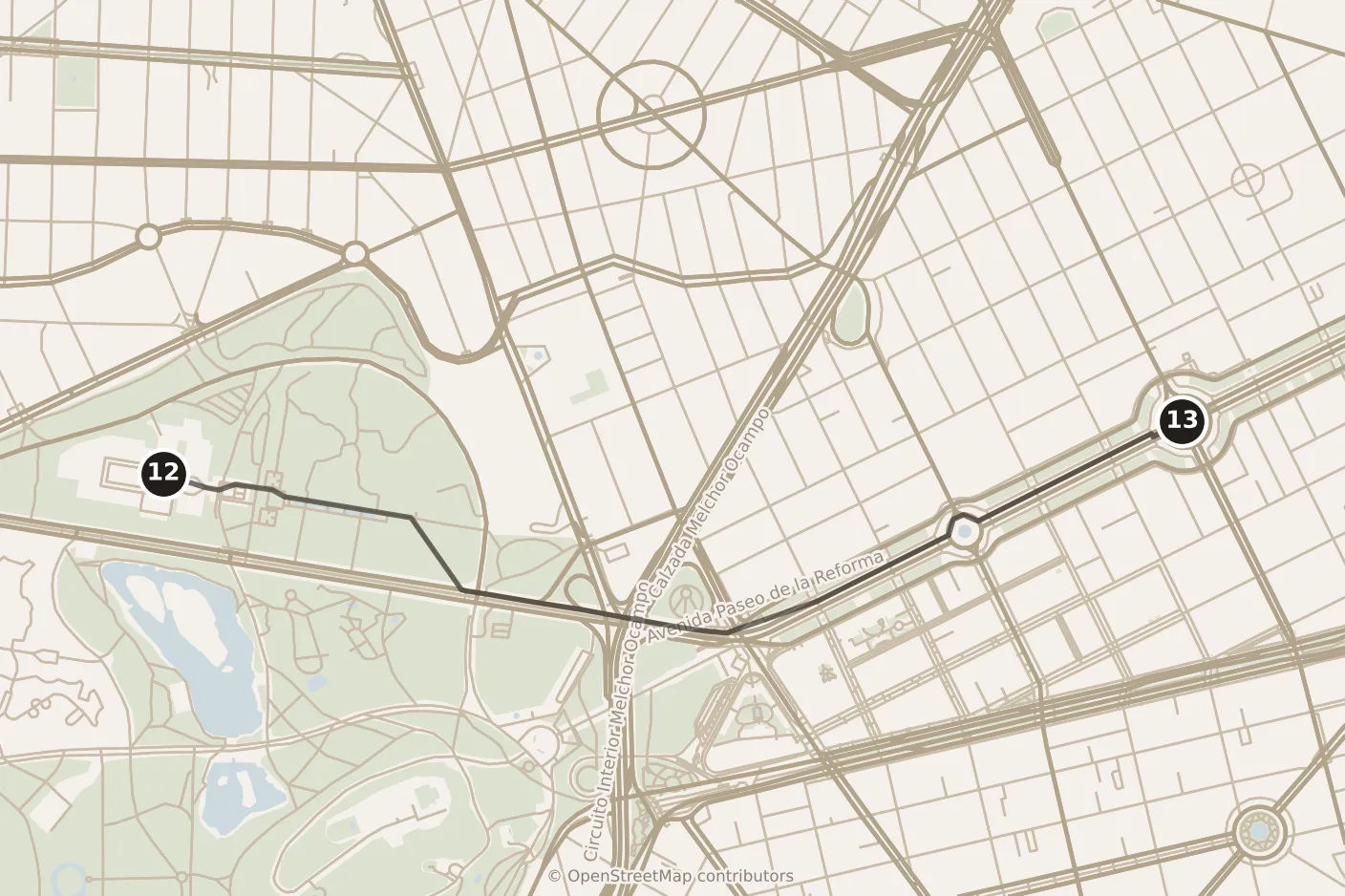
- Evening
- 13Ángel de la Independencia
- Roma Norte — in the prose, not on the map
Today is one line west to east: up a hill, into the museum at its foot, and then out along the avenue that was cut through the city to connect the two ends of it.
Morning
Start at Chapultepec station on Metro Line 1 — two stops west of Insurgentes through Sevilla, if you slept in Roma — and be there by ten. The climb, two hours in the castle, the descent, lunch and four hours in the museum run the day right up to the museum’s six o’clock close, and this is the day with no slack in it. Six minutes into the park you pass the Monumento a los Niños Héroes, six tall white columns in a half-circle, put up in 1952 to the cadets who died defending the hill in 1847. You pass through it rather than stop at it, and it is the introduction to the building above.
From there a paved ramp switchbacks up to Chapultepec Castle. Twenty minutes at a steady pace, and at this altitude that is a real twenty minutes with nothing to lean on halfway. Give the castle two hours. Its door opened at nine in 2026 and shut at five, which is an hour before the museum below it, and that single fact fixes the order of the whole day: the castle first, always, because the museum can absorb an overrun and the castle cannot.
What makes it worth two hours is that it kept changing its mind about what it was, and every change is still in the fabric. Begun in 1785 for a Spanish viceroy, sold off, turned into the military college in 1833, stormed in 1847, then rebuilt as a palace by Maximilian and Carlota in the 1860s, then lived in by presidents until Lázaro Cárdenas moved out to Los Pinos in 1934, and a national history museum since 1944. You can read all of that in the rooms. The Alcázar on the upper level is the imperial half — the private apartments, the tiled roof terrace and garden, the carriages — and the lower halls are the museum proper, where the things to give time to are the murals: Juan O’Gorman’s enormous painted retable of independence, and Siqueiros on the revolution, both of them arguments rather than illustrations.
Stand on the terrace that looks down the avenue before you go back down the hill. That avenue, running dead straight from the foot of it into the towers, is Paseo de la Reforma, and Maximilian had it cut so that he could get from this door to the Zócalo; it was called the Paseo de la Emperatriz first. You will walk this end of it tonight.
Afternoon
Down the hill and across, twenty-five minutes including the descent, is the Museo Nacional de Antropología. Eat before you go in — the streets north of the museum, on the Polanco side, are the nearest sit-down lunch and three quarters of an hour is enough — because what follows is four hours and there is no good moment to interrupt it.
Four hours is the entire reason this is a two-day trip. The first floor is the archaeology, laid out region by region and roughly in chronological order, and the upper floor is eleven ethnography halls covering those same regions as they are today. Almost nobody with one day goes upstairs, and the building was made to be read both ways. Downstairs, the rooms that repay standing still are Teotihuacán, where a temple front has been reconstructed at full height with its painted plaster still on it; the Mexica hall, which is the other end of the Templo Mayor morning; the Olmec heads, each one a different face cut from a boulder that had to be moved overland from a river; and the Maya rooms. A large part of the courtyard between them is covered by a single concrete canopy 84 meters by 54, carried on one column with water falling off its edge, and it is there so that the museum still works in the rainy season. It does not cover all of it: the archaeology halls are arranged round the part of the patio that is open to the sky, so one of the afternoon storms can still catch you crossing between two of them.
Local tip. The way to waste four hours here is to walk every hall on both floors at ten minutes each; you will have seen everything and remember none of it. Do about two thirds of the time downstairs, pick the two regions that actually held you, and spend the last hour on their ethnography rooms upstairs. That is the trade this day was bought to make.
Evening
Four hours puts you back outside with the museum still open behind you, which is deliberate: turn east out of the gate and walk down Reforma. It is just under two kilometers to the Ángel de la Independencia, a little under forty minutes, and the walk is the point rather than the transport: the avenue widens, the roundabouts arrive one after another, and the towers start. Metrobús Line 7 runs the whole of Reforma on double-deck buses and takes the same card, and it is the leg to give away if your legs have gone.
The Ángel is a column of 1910 with a winged Victory on top, and ten minutes is enough. Two things about it: the figure at the top came down in the earthquake of 1957 and was put back, and the base is a mausoleum, so the independence leaders are underneath a traffic roundabout that the city floods with people whenever the national football team wins.
From there it is twenty minutes on foot south into Roma Norte, and that is where the evening goes. This is where the city’s own dish belongs, and it belongs after dark: tacos al pastor come off the spit in the evening and late at night rather than at lunchtime, and Roma and Condesa are where you can eat them without leaving a sidewalk you would want to walk down. Insurgentes on Line 1 is at the top of the district when you have finished.
With a third day

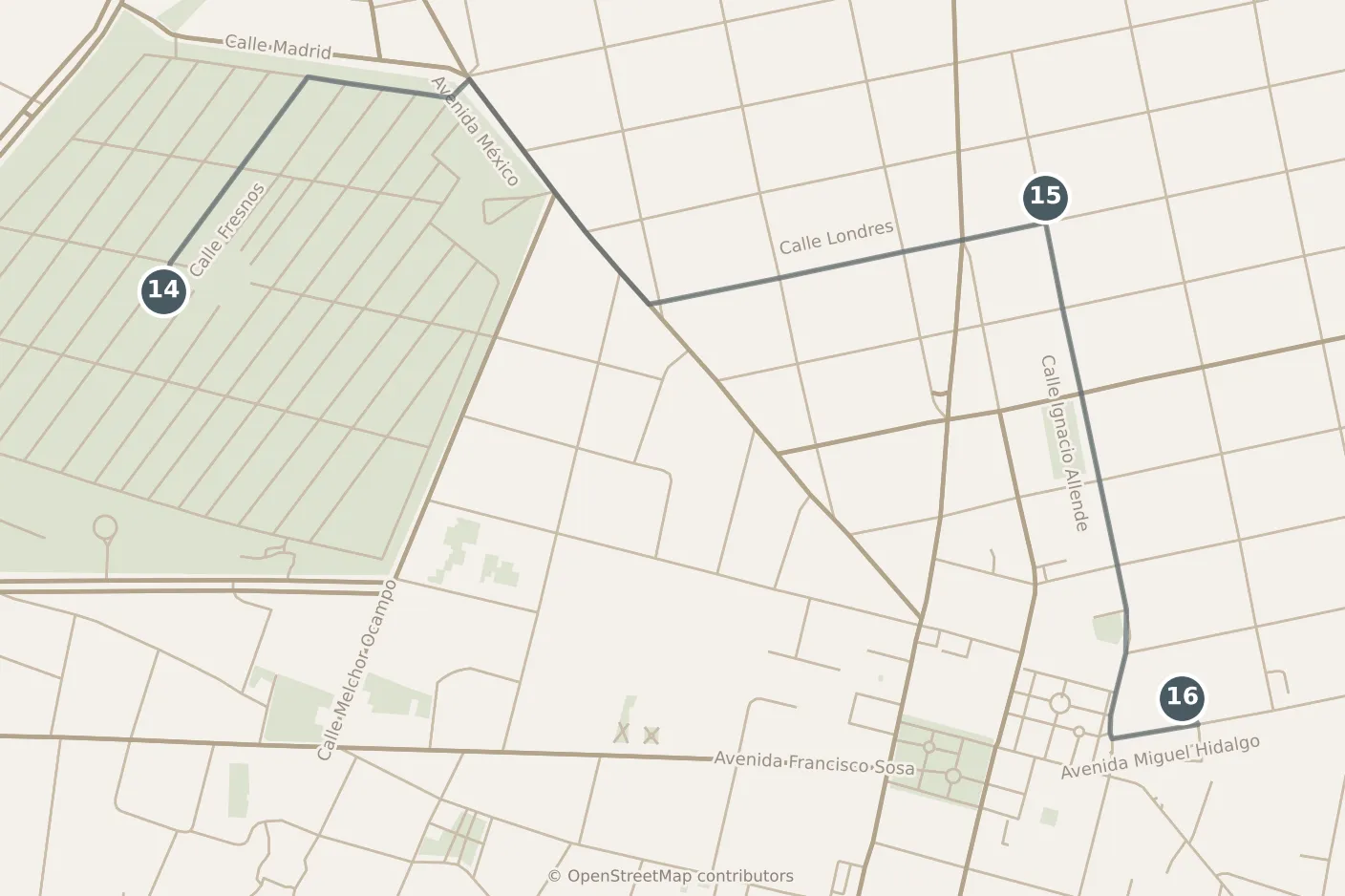
- With a third day
- 14Viveros de Coyoacán
- 15Museo Frida Kahlo
- Mercado de Coyoacán — in the prose, not on the map
- Jardín Centenario — in the prose, not on the map
- 16Museo Nacional de Culturas Populares
A third day goes on the end unless you are flying out on it, and it goes south — with one exception, the Monday version at the foot of this section, which trades the south for the pyramids and can sit anywhere in the three. Days one and two are the colonial city and the collections; Coyoacán is neither. It was a village with its own plaza and its own parish when the capital was ten kilometers north of it, and it still behaves like one, which is the only reason to give it a whole day rather than an afternoon.
Take Line 3 south to Viveros/Derechos Humanos — from Roma that is Line 1 to Balderas and a change, from the center it is Line 3 straight down from Hidalgo. Start with half an hour in the Viveros de Coyoacán at the station gate: a working tree nursery, given to the city by Miguel Ángel de Quevedo, which grows the plants for the parks elsewhere and lets everybody walk in it for nothing. It is full of runners at eight in the morning and squirrels all day, and it is the correct decompression from the center’s stone.
Twenty minutes east on foot is the Museo Frida Kahlo, the house she was born in and died in, opened as a museum in 1958 and painted the cobalt that gives it its other name. Give it an hour and a half. This is the one thing in the article you cannot simply turn up for, and the practical shape of it is the whole day: the museum sells nothing at its door, only online, by date and by hour, and it opened at ten in 2026 — except on Wednesdays, when it opened at eleven. Everything above and below is arranged around the slot you choose. The rules are enforced and you cannot guess them: no video at all, photographs indoors only without flash, and no umbrella, no food, no drink and nothing bigger than a day bag, with a cloakroom that has not been running — which is where the Overview’s umbrella rule comes from, because there is nowhere at this door to put one down.
Local tip. Book the earliest slot the day offers and count the day backwards from it: the Viveros and the walk are fifty minutes in front of the door, so leave the station gate fifty minutes before your hour. What you must not do is put the museum late. The line outside is only people with slots, so a late slot does not save you anything, and everything else here — the market, the plazas, the church — is better at the hour a booked slot would otherwise have you standing in the sun.
Seven minutes south is the Mercado de Coyoacán, and lunch is inside it: this is a tostada market before it is anything else, the fried tortilla loaded and eaten standing at a counter, and an hour is right. This is the one place in three days where eating standing up is not the false economy day one calls it: here the counter is the meal, not a way of saving forty minutes on it. Five minutes further, the Jardín Centenario and the Plaza Hidalgo run into each other across one street and make the largest piece of unhurried public space in the southern city — the coyote fountain in the first, the sixteenth-century parish of San Juan Bautista on the second. Half an hour, and it is the kind of half hour the first two days had no room for. The Museo Nacional de Culturas Populares is on the same square and is worth three quarters of an hour: it is about what people make and wear and put on altars now, which is the only living answer to everything the other days put behind glass.
That comes to a little under five hours, which is the point of the third day rather than a weakness of it: it is the one day with slack in it. If you are short, the cuts in order are the Viveros and then the Culturas Populares; the booked slot is not negotiable and the plazas are why you came south.
The alternative, and it is a full plan rather than a gesture. If you would rather leave the city than see another house, give the third day to Teotihuacán instead, forty kilometers north-east. Metro Line 5 to Autobuses del Norte puts you at the Terminal Central de Autobuses del Norte; buses to the pyramids leave from that hall through the morning, tickets bought at the counter with no booking, and the run is about an hour each way. On the ground it is a four-kilometer avenue forty meters wide with the Pyramid of the Sun halfway along it, the Pyramid of the Moon closing the north end, the Temple of the Feathered Serpent inside the walled Ciudadela at the south, and the Palace of Quetzalpapálotl with its carved courtyard between the two big ones. There is no shade anywhere on it; a hat, water and an early start are not optional, and the same afternoon storms arrive here in the wet months with nothing to stand under. Reckon on the day rather than the half-day, and go in at whichever of the five gates your bus reaches — walking the avenue one way and returning along it is the day, and there is no loop. Whether either pyramid may be climbed is worth asking the archaeology institute before you go; the day above is the avenue, and it does not rest on the answer.
This swap costs you the one booking in the article and gains you nothing to book, so if you take it, the Overview’s single reservation disappears. And it costs you the slack: Coyoacán is a little under five hours and this is a whole day, out and back. It also does one thing the Coyoacán version cannot, and that is the reason it is here rather than in a footnote: it is the version that can take a Monday. If one of your three days is a Monday, this is where it goes, wherever in the three it falls — day one, Teotihuacán, day two is a perfectly good order, and it puts the pyramids in front of the museum hall about them, which is arguably better than the order printed above. Nothing on days one or two depends on the other having happened first.
Practicalities
Monday is the thing that breaks this trip, and it breaks all of it at once. The state museums on these three days shut on one day of the week together, and so does the palace on the square, which is not a museum at all. The Templo Mayor and its museum, Chapultepec Castle, the Museo Nacional de Antropología, the Museo Nacional de Arte, the museum floors of the Palacio de Bellas Artes and the Palacio Nacional were all shut on Mondays in 2026 — and so was the Casa Azul, which is run by a private trust rather than by the state and therefore keeps the same day by coincidence rather than by rule. Do not carry the rule to anything this article does not name: check the Culturas Populares museum on the Coyoacán square yourself if it is what you are going south for. That is not a stop lost, it is both days gone. What survives a Monday is real and worth having — the Zócalo, the cathedral, the outside of the temple enclosure, Santo Domingo, the post office, the Alameda, Reforma, and Coyoacán’s plazas, market and Viveros without the Casa Azul — but it is a walking day, not the day above. Nothing on the hill survives it: the first section of the park at Chapultepec is itself closed on Mondays, gates, paths and ramp together, so a Monday does not cost day two its castle, it costs you day two. The better answer, if you have three days, is the alternative in the section above: an archaeological zone keeps a different week from a museum, which is exactly why Teotihuacán is the Monday version. The national archaeology institute publishes the zone’s days itself; read them the week before, because if that one thing is wrong the day has nowhere to go.
Two other days are worth a sentence. On a Sunday, the state museums are free to Mexican nationals and residents, which is right, and which makes the anthropology museum and the castle fuller than any other day of the week — be at the castle gate for opening rather than mid-morning, and expect the museum’s ticket desk to be your longest line even holding a foreign ticket. Sunday is also the one day the Palacio de Correos may not keep its usual hours, because it is a working post office rather than a monument; it is fifteen minutes of day one and the day survives losing it, but check it if that is what you came for, and the scribes at Santo Domingo are a working trade on the same terms, so a Sunday can leave that colonnade empty as well. On a Wednesday, the Casa Azul opened an hour later than usual in 2026, which matters only because the third day is counted forward from its slot.
Which day goes where. Days one and two may trade places freely: neither depends on the other having happened, and the only thing you lose by reversing them is the ground-before-objects argument, which is a pleasure rather than a mechanism. Both must miss Monday. The third day is appended rather than inserted, for two reasons — its ticket is bought for a named date, so it is the day to fix first and build the other two around; and it ends nine kilometers south of the center, which is the wrong shape for a day you are going anywhere after. The one arrangement that quietly fails is a last day in Coyoacán with an evening flight: you finish thirteen kilometers from Benito Juárez with a bag you were not allowed to bring, in the traffic direction that is worst at that hour. Move Coyoacán to the middle and end on day one or day two instead; the pyramids version does not rescue this, because it is a whole day out and back and gives the evening less rather than more. That arrangement is one of the two exceptions to the rule three sentences above — the Monday version is the other — and both are meant to be: the second of the two reasons given there is precisely that Coyoacán is the wrong day to leave the city from, so a flight out turns that rule against itself. The section above is written for a day that comes last, and nothing in it depends on that.
Booking. One reservation exists in this article and it is the Frida Kahlo museum, sold online only, by date and by hour, in the three-hundred-peso range for foreign visitors in 2026 and about half that for Mexican nationals and residents. It is the third day’s hinge, so book it before you book anything else about the third day. Everything on days one and two is bought at the door, and the Zócalo, the cathedral, the Palacio Nacional, Santo Domingo, the post office, the Alameda, the Viveros and the Coyoacán plazas cost nothing at all.
Getting between the stops this article names. Day one is entirely on foot inside the Centro Histórico: about four kilometers, nearly all of it in stretches of a quarter of an hour or less, the exception being the twenty-odd minutes back east from the Alameda at the end, which Line 2 will do in two stops from Bellas Artes through Allende to Zócalo/Tenochtitlan if you would rather. Day one begins at Zócalo/Tenochtitlan on Line 2 and ends there. Day two begins at Chapultepec on Line 1 and ends at Insurgentes on the same line, with about six kilometers of walking between them; the single stretch to hand over is the forty minutes along Reforma, which Metrobús Line 7 runs end to end. The third day is Line 3 to Viveros/Derechos Humanos and back, with under three kilometers of walking in between.
If you arrive by air, you land at Benito Juárez, six kilometers east of the Zócalo, and how long that drive takes is a traffic question rather than a distance one — the parent city guide’s advice on which car to take is worth more here than any number. The only public route that takes a suitcase without a fight is Metrobús Line 4, which leaves from outside both terminals on shorter buses built for the narrow streets. It needs the same Movilidad Integrada card as everything else but not the same fare: the airport leg was charged in the thirty-peso range in 2026 against a few pesos for an ordinary ride, so load it for that at the terminal machine before you reach the gate.
Two last things this particular route asks of you. Take the first morning gently: 2,240 meters is enough to make a flight of stairs surprising on day one, and day two’s climb is not the moment to discover it. And carry water — day one has a two-hour stretch on open boardwalks with no shade, and day two has a hill.


