Mexico City in one day: the Anthropology museum, the Zócalo and the center at dusk

Last updated 3 August 2026
Overview
One day is not enough for Mexico City and no honest page can pretend otherwise, so the question worth answering is which day. This one is two places with a single ride between them: the museum that holds the pre-Hispanic world, out west in the trees of Chapultepec, and the square the Mexica built on and the Spanish built over, five and a half kilometers east of it. The route runs one way, west to east, and never turns back on itself.
What that costs you is the south and the outskirts, and the list is worth naming so you can disagree with it. Coyoacán and the Frida Kahlo house, the canals at Xochimilco, the pyramids at Teotihuacán: each of them is a half-day out and a half-day back, and taking one means the day below becomes half a day of something else. Chapultepec Castle goes too, even though this route walks under the hill it stands on — it is a full museum in its own right, and an hour up there is the hour that buys you the cathedral and the Templo Mayor. A day here is not a tour of Mexico City. It is one long line drawn through the middle of it, and the line is chosen so that the two ends explain each other: the stone calendar you look at in the morning was dug out of the square you stand in after lunch.
The day is built around one stop whose value is the hour, and the hour is a fact about the sky rather than about anyone’s schedule. The last thing you do before dark is stand on an open deck forty-four floors above the center while the basin turns gold and the lights come on across it. The city sits far enough south, and has not put its clocks forward since 2022, that the sunset hour barely moves all year: the sun goes down here from just before six at the end of November to about twenty past seven in the first week of July, and never outside that band. Everything above the tower comes to a little under eight and a half hours — two and a half in the museum, twenty-five minutes through the park, twenty on the train, ten at the shrine underground, an hour over lunch, twenty minutes on the square, half an hour in the cathedral, three quarters of an hour in the palace, an hour and a half at the temple, a quarter of an hour at the tiled house, and a little over half an hour of walking and platforms spread through the rest. That count will not run backwards from the sunset, though, because the afternoon has a second edge: the palace and the temple both shut in the late afternoon, while the tower deck stays open into the night. So run it forward instead — be at the museum door when it opens, and the interiors all land inside their hours. In the short months that puts you on the tower deck as the light goes; from spring onward it puts you there early, and the hour to give away is the museum’s.
That total is the time you spend inside places plus the time you spend walking between them, and it is not the length of the day. It leaves out the security check and the identity document at the palace, which is the one line on this route. It leaves out the ticket line at the museum, which is longest on a Sunday and for the reason given at the end. And it treats two and a half hours in the museum as settled, which is a decision you are making rather than a measurement of the building — that place will take four if you let it.
One structural thing before you start, because it decides where your bag spends the day. Mexico City has no single central railway station and therefore no obvious left-luggage counter in the middle of it; what it has is the airport, which keeps luggage lockers in both terminals. That happens to suit this route, because the day ends about seven kilometers from Benito Juárez and begins about eleven, so the bag is behind you rather than across the city. Do not carry one through the day in any case: the palace will not take you through its security with a large bag, the Metro at rush hour is the wrong place to be holding one, and everything below assumes your hands are empty.
The day

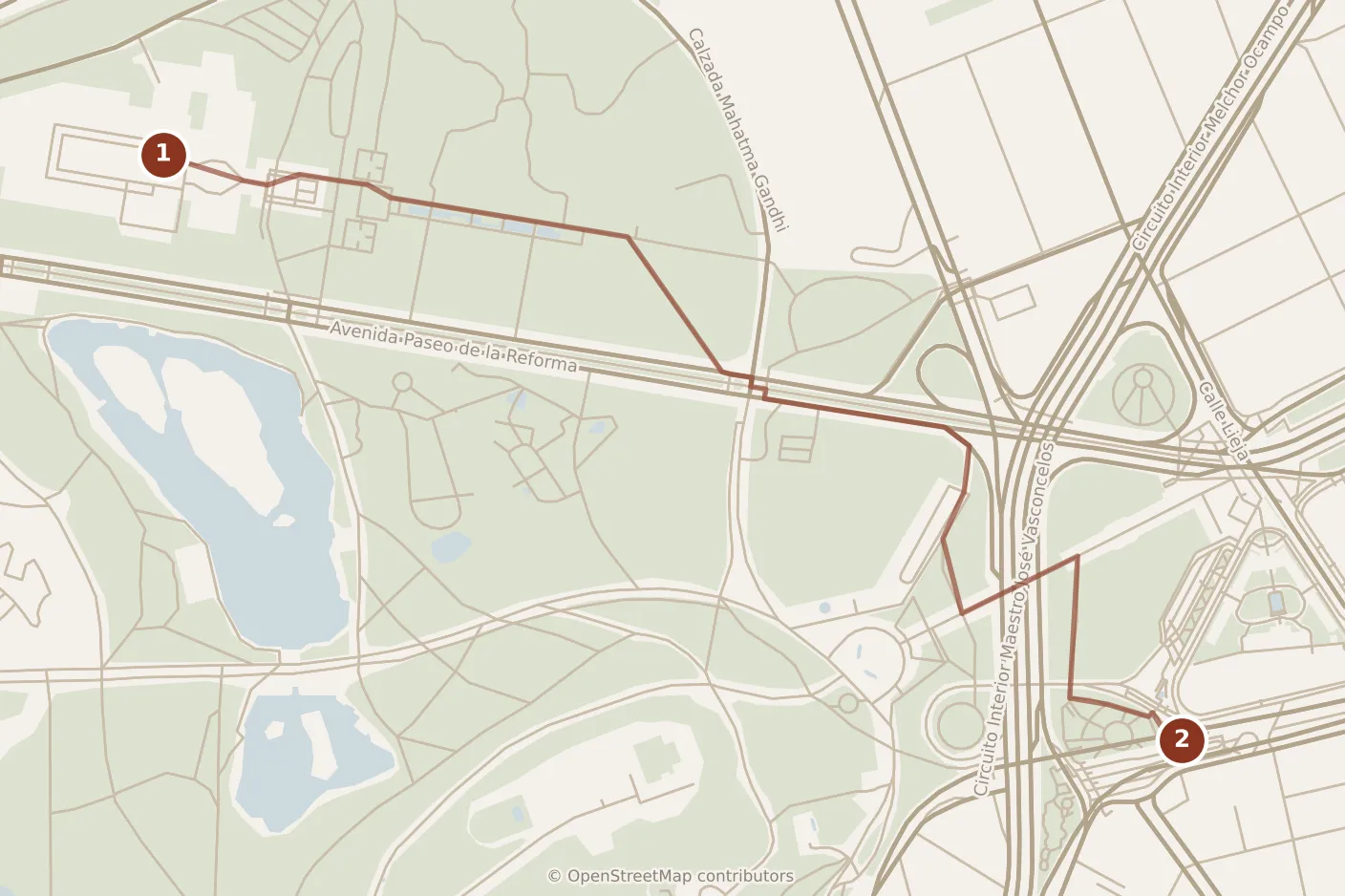
- Morning
- 1Museo Nacional de Antropología
- 2Chapultepec
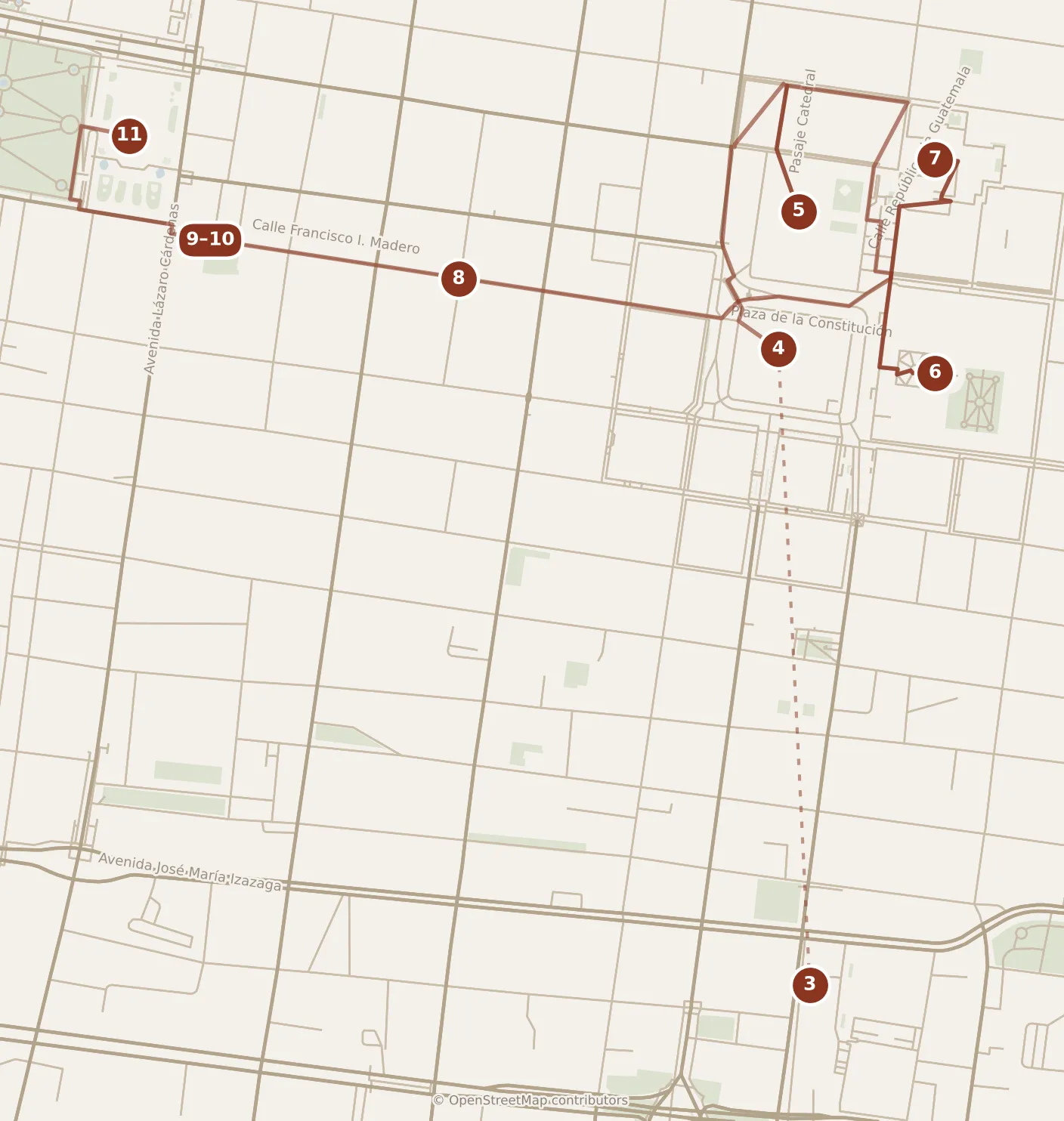
- Afternoon and evening
- 3Pino Suárez
- 4Zócalo
- 5Catedral Metropolitana
- 6Palacio Nacional
- 7Templo Mayor
- 8Avenida Madero
- 9Casa de los Azulejos
- 10Torre Latinoamericana
- 11Palacio de Bellas Artes
Morning
Start at the Museo Nacional de Antropología, on Paseo de la Reforma at the northern edge of the Chapultepec woods. It opened in 1964 to a design by Pedro Ramírez Vázquez, and the building is half the argument: twenty-three halls set around an open courtyard that is covered, over most of its area, by a single concrete canopy the size of a small field resting on one carved column, with water falling in a curtain off its edge. Give the place two and a half hours and spend all of them on the first floor, which is the archaeology. Work along it in the order the rooms are laid out: the reconstructed painted facades and murals of Teotihuacán; the Mexica hall at the far end, where the Sun Stone fills a wall on its own — a carved disc nearly four meters across, dug out of the main square of this city in 1790, which is the square you will be standing on after lunch; the colossal Olmec heads, each one a portrait cut from a boulder carried in from a river bed; and the Maya rooms, with the jade mosaic mask from Palenque and a full-scale replica of the burial chamber found under the temple there, walls and sarcophagus and all.
Local tip. The whole upper floor is ethnography — how the descendants of all this live now — and it is a good museum in itself and the wrong museum for today. If the morning is running long, the cut is up there, and it costs you nothing on the ground floor. Do not make the reverse trade.
Outside the entrance stands a tall steel pole with a small platform at the top. It belongs to the voladores of Papantla, who climb it, tie themselves on and come down head-first in widening circles while a fifth man plays a flute and drum standing on the platform. They go up repeatedly through the day rather than once, so there is a fair chance of catching it either on the way in or on the way out; if you do, give it five minutes and no more.
Then walk east through the park, twenty-five minutes, to Chapultepec station on Line 1. The path takes you along the foot of the hill with the castle on it, which is the good thing this day gives up. There is a shorter walk, to Auditorio on Line 7, and it is a false economy — it costs you a change at Tacubaya and gives back less than the walk does, and this stretch under the trees is the only quiet part of the day.
Line 1 is the oldest line in the city and has just been rebuilt end to end: it closed in sections from 2022 and reopened in full in November 2025, so anything you read about replacement buses on it predates that. Chapultepec to Pino Suárez is seven stops, about twenty minutes, and it runs straight under everything you would otherwise be sitting in traffic on.
Afternoon
At Pino Suárez do not go straight up to the street. The passage between Line 1 and Line 2 bends around a low circular stone platform standing in a bed of river pebbles: an altar to Ehécatl, the wind, one of the round temples the Aztec city built to that god, uncovered in 1967 when the station was being dug and left exactly where it was found with the metro built around it. By the reckoning of the national archaeology institute it is the smallest archaeological site in the country. Ten minutes, and it is the correct introduction to everything above ground, because the whole afternoon is that same layering seen at full size. Then take Line 2 one stop north and come up at the Zócalo — or walk it, a little over a quarter of an hour due north, if you would rather see the streets.
Eat before you start on the square; it is past midday by now and this is the last easy chance. The lanes west and south of the Zócalo are full of counters and small dining rooms doing a set midday meal, and the thing to look for on a griddle is tlacoyos — thick pointed oval cakes of masa stuffed before cooking, split and topped afterwards. Sit down for it and give it an hour. The temptation with one day is to eat standing and keep moving, and in this city the midday meal is the meal, so that economy costs more than it saves.
The Zócalo itself is twenty minutes and they are worth spending. It is a square 240 meters on each side, with nothing in it at all — no trees, no benches, no fountain — which is deliberate, because what it is for is holding a hundred thousand people. A flag big enough to cover a tennis court stands in the middle of it and is raised and lowered by soldiers every day and carried into the palace on the eastern side. Under the paving is the ceremonial center of Tenochtitlan; the Sun Stone came out of this ground.
Three minutes north is the Catedral Metropolitana, which took 240 years to build — from 1573 to 1813 — and shows it, changing style as it goes up. Much of the stone in the lower walls came from the temple the Spanish had just demolished. Inside it is five naves wide and the floor is visibly not level: the city is built on a drained lake and the whole building has been sinking unevenly since it was begun, badly enough that it spent years on an international endangered list and had to be underpinned in the 1990s before it came off in 2000. Walk to the far end for the Altar de los Reyes, a Churrigueresque wall of gilded carving 25 meters high that fills the apse from floor to vault. Half an hour.
Five minutes south-east, filling the eastern side of the square, is the Palacio Nacional, the working seat of the Mexican executive and, on its main staircase and the gallery above the first courtyard, the mural cycle Diego Rivera began in 1929 and was still adding panels to twenty years later — the history of Mexico from the pre-Hispanic city through the conquest and the wars to the industrial present. Entry is free and there is a security check with an identity document at the door, which is why the count above leaves it out. Three quarters of an hour. It comes before the temple and not after because three quarters of an hour is what it takes, while the temple is the stop that can absorb whatever is left before the gates shut. Because it is a government building in use, it is also the stop here most exposed to being shut at short notice: if it is closed on your day you have lost the smallest of the three, and the temple takes the time.
Four minutes north, at the north-eastern corner of the square, is the Templo Mayor. It was found on 21 February 1978, when electricity workers digging behind the cathedral struck a carved disc three and a quarter meters across: Coyolxauhqui, the sister of Huitzilopochtli, shown dismembered, lying where she had been placed at the foot of the temple stair. What came out of the ground after that is what you walk over now on raised boardwalks — not one temple but seven, each built over the last, so the ruin reads as a cross-section rather than a plan. The museum alongside it opened in 1987 and holds what the offerings contained. Both closed at five in 2026, and that closing is the afternoon’s back edge: build the temple back from it — an hour and a half before the gate shuts, half past three in that year — and if the hour has moved, build it back from the new one. If the hour and a half has to shrink, shrink the museum: the excavation outside is the thing there is nowhere else.
From the temple gate, cross the square and go west into Avenida Madero, which runs straight from the Zócalo to the tower and is closed to cars for all of it. Twenty minutes end to end if you walk it, and a good deal more if you do what everybody does, which is stop. It is a corridor of colonial and nineteenth-century fronts with shops behind them and a permanent crowd moving both ways. At the far end of it, a minute short of the tower, is the Casa de los Azulejos, an eighteenth-century palace whose entire facade is faced in blue-and-white tiles from Puebla, put up over the bare stone by the countess whose family owned it. A restaurant occupies the covered courtyard now, and the reason to walk in is the main staircase: an Orozco mural of 1925 called Omniscience. Fifteen minutes.
Evening
The Torre Latinoamericana is a minute further, at the end of Madero where it meets the big north-south avenue, and this is the stop the day was ordered around. It was finished in 1956, forty-four floors, the first tall building anyone dared put on the soft lakebed; it came through the earthquake of 1957 and then the far worse one of 1985 while blocks around it did not, which is why a rather plain 1950s office tower is a monument here. The viewing levels are near the top, the highest of them open to the sky and the ones below it behind glass. Three quarters of an hour, and the reason to be up there in the last of the light is that the shape of the place only makes sense from above: a flat grid running to the mountain wall on every side, with the ring of the basin closing it. On a clear day in the dry months the two volcanoes stand up on the south-eastern horizon, Popocatépetl usually with a plume off it and Iztaccíhuatl beside it; on most days the air does not allow it, and that is not something to plan around.
Four minutes north-west, across the avenue at the edge of the Alameda, is the Palacio de Bellas Artes, and it is the right last building. It was begun in 1904 by Adamo Boari in Art Nouveau, abandoned half-built when the Revolution came, and finished in 1934 by Federico Mariscal, who gave the inside a hard geometric Art Deco that has nothing to do with the outside — one building holding the two halves of a century. It is also the clearest lesson in what the lakebed does to heavy marble: it has settled about four meters since work started, and you can read that at the entrance, where the sidewalk has come up around it. Upstairs are murals by Rivera, Siqueiros and Orozco, the Rivera being the one the Rockefeller Center destroyed in New York and he repainted here. Behind the stage is a curtain of Tiffany glass weighing twenty-four tonnes with the two volcanoes worked into it, though when it is shown depends on what is on. Its museum floors shut well before the tower deck does, and this stop comes after the tower, so what you get here at the end of the day is the building itself, lit from outside: twenty minutes.
Bellas Artes station is three minutes away and carries Lines 2 and 8, which is the useful end for anywhere in the city. If you are flying out the same night, the airport is about seven kilometers due east of here — closer than the museum you started at, which is the point of running the day this way round — and how long that drive takes is a traffic question rather than a distance one, so the parent city guide’s advice on which car to take is worth more here than any number. If instead you have the evening, hand yourself over to it: the city’s own dish is tacos al pastor, the spits are an evening and late-night thing rather than a lunchtime one, and two neighborhoods to do that in are Roma and Condesa, three or four kilometers south-west of here.
Practicalities
Nothing on this route has to be booked before you travel, which is unusual enough to say plainly. There are three tickets and all of them are bought at the door. The one that decides something is the Anthropology museum, because it is half your day: the foreign-visitor ticket was in the two-hundred-peso range in 2026, with Mexican nationals and residents paying half that and getting in free on Sundays. The tower’s viewing levels cost roughly the same again. The Templo Mayor charges for the excavation and its museum together, with the same Sunday exemption for Mexican nationals and residents. The Zócalo, the cathedral and the Palacio Nacional are free, so this is a day whose entire paid content is those three tickets.
The thing most likely to break the day is a Monday. The Anthropology museum, the Templo Mayor and its museum, the Palacio Nacional and the museum floors of Bellas Artes are all state institutions and all close the same day of the week, and that day is Monday — which takes out every interior on this route at once. Check it before you set out rather than taking my word for it, because it is the single check worth making. If your one day is a Monday, the version that survives is real and worth having: the park and the woods in the morning instead of the museum, then the Zócalo, the cathedral, the outside of the temple enclosure, Madero end to end, the tower at the same hour and the Alameda after dark. You lose the archaeology and keep the city.
A Sunday changes it differently. State museums are free that day for Mexicans and residents, which is right and which makes the Anthropology museum extremely full — be at the door when it opens rather than mid-morning, and expect the ticket line to be the longest line of your day even holding a foreign ticket. Everything else on the route is easier on a Sunday, not harder, because Madero and the square are closed to traffic anyway and the center belongs to families.
One practical thing this particular route needs, and only one. It uses the Metro twice, and since April 2024 there is no paper ticket and no cash gate: the only way through the barrier is the rechargeable Movilidad Integrada card, sold and topped up with cash at the ticket window of any Metro station, and from a vending machine where a station has one. Buy it at the first station you use and put more on it than one day needs. How the rest of the city is paid for and moved around belongs to the parent city guide, which is where to read it.
On the shape of the walking: about four kilometers in seven stretches, which is modest for a city this size, and less modest than it sounds for the reason the city guide’s first paragraph gives about the altitude. The longest single stretch is the twenty-five minutes through Chapultepec in the morning; the second is the twenty down Madero at the end of the afternoon. Everything between Pino Suárez and Bellas Artes sits inside a square about a kilometer and a half across, so falling behind costs you the end of the day rather than the middle — and the end of the day is the one part that has an hour attached to it, which is the argument for not letting the museum run to four hours however much it wants to.


