Marrakesh in two to three days: both halves of the medina, and a day in the Ourika valley

Last updated 15 August 2026
Overview
Two days here is not one day with the pace taken off it. It is the medina cut along its own seam. The walled city has a bottom half and a top half and they are different places: the south is palaces, tombs and the old Jewish quarter, on lanes wide enough to have sky above them; the top is the covered souks, a madrasa and a set of courtyard houses, and in most of it you cannot see the sky at all. One day makes you choose between them or hurry through both. Two days gives each half a morning and an afternoon, and buys the thing a single day cannot buy at all: the hours outside the walls, up in the new town, where the garden is.
So day one is the south and ends in the great square. Day two starts in Gueliz at eight in the morning and comes back in through the north gate for the afternoon. Neither day is built on the other having happened, which matters more than it sounds, because three of the museums here shut on fixed weekdays: the two days trade places freely, and the calendar decides the order rather than you.
One thing has to be bought before you leave home, and it is really three of them: the Jardin Majorelle, the Berber museum inside its wall, and the Yves Saint Laurent museum a hundred meters away all sell through the garden’s own ticket office and through nothing else. That office is a website, it is online only, and the garden states plainly that its own site is the sole one whose code opens the gate — so a ticket bought through a resale page is a ticket that does not work, and there is no window at the entrance that will put it right. The garden was in the hundred-and-fifty to two-hundred-dirham range in 2026, with the Berber museum another fifty to seventy-five on top; read the current prices off that same site when you buy, and expect only the order of things to hold — these are much the dearest tickets of the trip and the only ones bought in advance, while everything else on these three days you walk up to and pay for at the door. For that, and for the taxis, and for the souks, carry dirhams in cash and in small notes. Do not plan to tap a card or open an app once you are here — the ticket above is bought at home, and nothing else on this trip, bus fares included, should be counted on taking one. The one bus number a visitor needs is the 19, which is the airport shuttle, has its city end at the edge of the great square, and is paid for separately from whatever the ordinary city lines are doing that year.
Day one is anchored at both ends, and that is what makes it the awkward one. The far end is Jemaa el-Fna, which by day is a space people walk across and after dark is a different institution entirely. The near end is a set of doors, none of which is open early. From 20 September 2026 Morocco is on GMT all year: zero offset, one setting, no summer change and, by the same decree, no Ramadan change either — the country did not give up the hour it used to drop for the lunar month, it kept that hour and gave up the other one. So a single band holds in every month: the sun goes down here from about half past five at the beginning of December to about twenty to eight at the end of June. Before that date the country is an hour ahead of this and those two times fall an hour later; after it, check that your phone reads GMT when you land, because a device or a booking site that has not taken a time zone update since the middle of 2026 will still show Morocco an hour ahead.
Day one comes to about five and three quarter hours inside places and a little over an hour on your feet, so just under seven in all. Start at nine and you are at the square a little before four — an hour and a half before dark in December, nearly four hours before it at midsummer. That count is time inside the monuments and walking between them, and it leaves out two things: four separate ticket desks, and getting lost, which in the top half of the medina is not a figure of speech. It also cannot fix the summer. From spring to early autumn there is a gap of two hours or more between the last gate of the day and the hour worth sitting through, and no further monument can fill it, because everything on this day except the square is behind a door that shuts in the late afternoon. The gardens along the Koutoubia are where that gap goes: ten minutes west of the square, the only real shade on this route, and that is the hour to be sitting in them. Do not try to close it by starting later instead — that pushes the tombs, the last ticketed stop, up against their own closing time.
You are sleeping here rather than passing through, and the shape that matters is where. Cars reach almost no door inside the walls, so however you arrive the last stretch is on foot with the bag down a lane, and arriving for the first time after dark is the hardest twenty minutes of the trip. Trains come in at Gueliz, three kilometers out and on the wrong side of the walls, so with a bag that first leg is a taxi rather than the walk it would otherwise be, taken to the gate nearest where you are sleeping and not to the square. It settles the last morning too: do not plan on a left-luggage office, plan on the bag waiting where you slept and on going back for it — asking a riad to hold it after checkout is the ordinary arrangement here — so the final hours belong to your own quarter rather than to the far side of the medina. That is the one argument against finishing on the third day below — it sets you down at a gate a kilometer south of the square in the middle of the afternoon, with everything you own still on the other side of the walls.
Ourika Valley, Setti Fatma — a day trip off the walking map; you get there by taxi.
- Day two
- 10Dar el Bacha
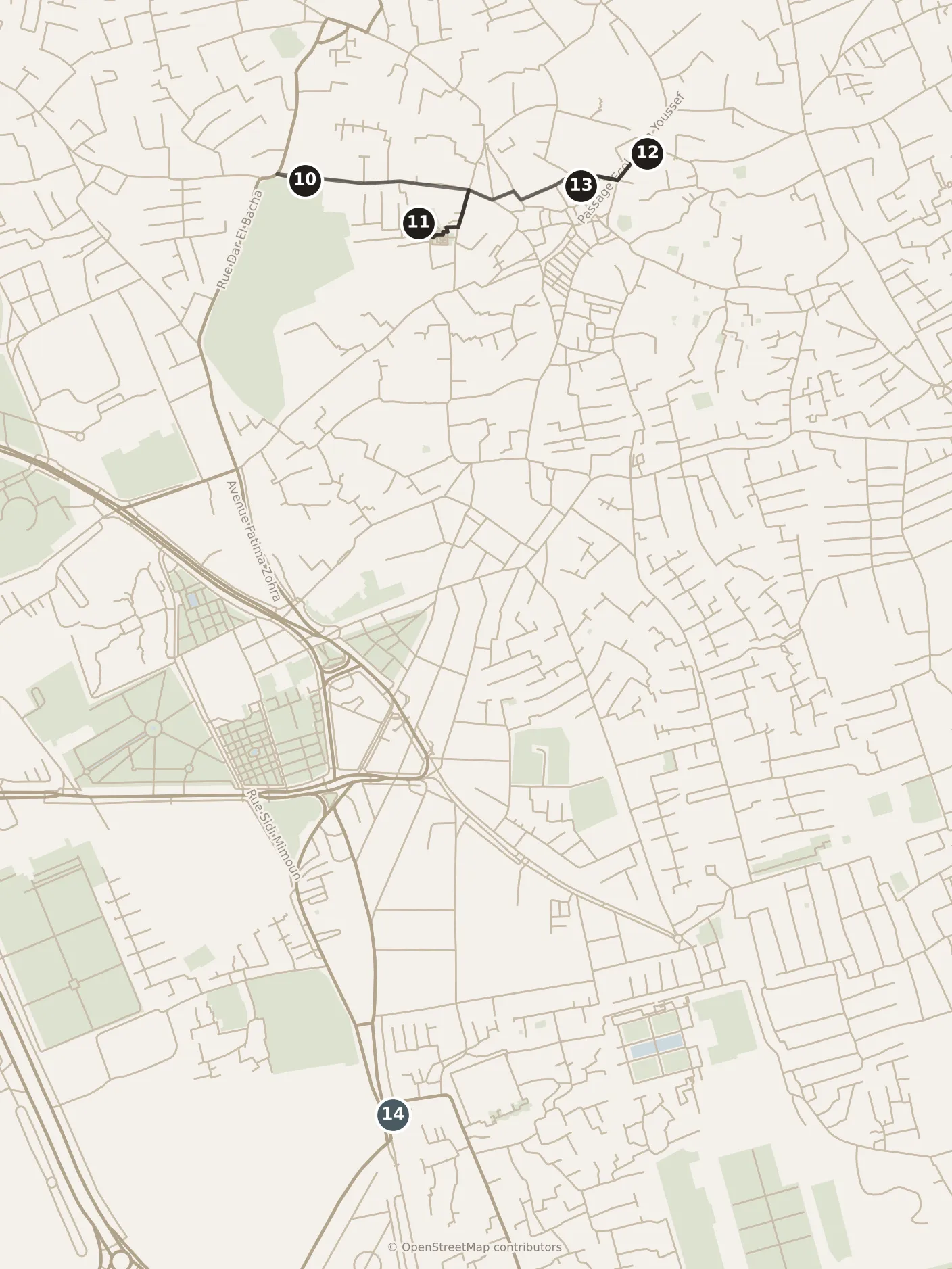
- 11Le Jardin Secret
- 12Ben Youssef Madrasa
- 13Almoravid Koubba
- With a third day
- 14Bab er-Robb
Rahba Kedima, Souk Semmarine — not on the walking map.
- Day two · Evening
- Rahba Kedima — in the prose, not on the map
- Souk Semmarine — in the prose, not on the map
Day one

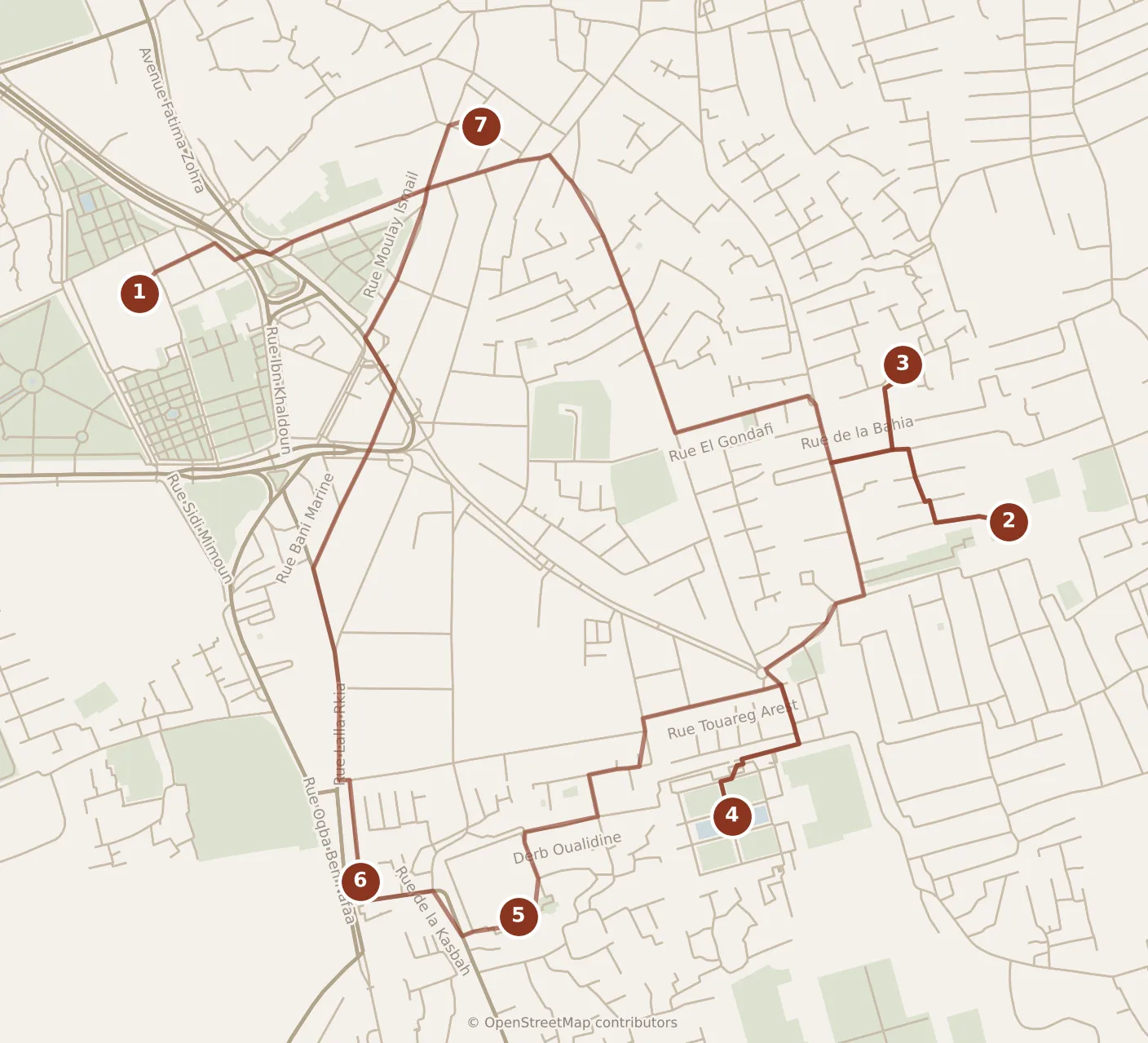
- Day one
- 1Koutoubia Mosque
- 2Bahia Palace
- 3Dar Si Said
- Mellah — in the prose, not on the map
- 4El Badi Palace
- 5Saadian Tombs
- 6Bab Agnaou
- 7Jemaa el-Fna
Everything today is in the lower half of the walled city, and the route runs down it in one direction and comes back up a single stretch at the end. You never cross the medina twice.
Morning
Start at the Koutoubia Mosque. It is the tallest thing in the medina by law as much as by design — nothing beside it may be built higher than a palm tree — so over the next two days you will use the minaret the way the city does, as the answer to where you are rather than to which lane you are in. Its name means the mosque of the booksellers, after the manuscript market that traded along its flank. What stands is the second building: Abd al-Mu’min began the first in 1147, the year the Almohads took the city, had the whole thing rebuilt about a decade later, and the tower was probably finished under Ya’qub al-Mansur around 1195, seventy-seven meters to the orbs on its spire. Its two near-contemporaries are the Giralda in Seville and the Hassan Tower in Rabat, and this is the one that came out complete. Half an hour outside is the whole visit, because you cannot go in: it is in use, and like nearly every mosque in the country it does not admit non-Muslims, so there is no ticket and no line to plan around. Spend the half hour on the esplanade, where the outline of the first mosque is set into the ground under your feet, and look at the gardens beyond it, which is where you may be coming back this evening.
A little over twenty minutes east — across the bottom corner of the square, then south down Riad Zitoun el-Jedid — brings you to the Bahia Palace. Two men built it, and that is how to read it. Si Musa, grand vizier in the 1860s, laid out the first house; his son Ba Ahmed, running the country for a teenage sultan, spent the six years to 1900 buying the properties next door and swallowing them. The result is roughly a hundred and fifty rooms with no governing axis anywhere, a palace assembled sideways, and that is precisely why it reads as a maze and why nobody can tell you the correct way round it. Ba Ahmed died in 1900 and, by most accounts, the sultan Abdelaziz had it being stripped of its valuables the same day. Give it an hour. Take the great marble court and the older riad garden slowly and let the remainder go: the decoration repeats itself, and an hour spent completing the circuit is worse spent than an hour in two rooms.
Four minutes on is Dar Si Said, and it is the clearest thing a second day buys you. It is the national museum of weaving and carpets, in another palace of the same century, and it holds urban and rural carpets from the whole south — the Tensift, the Sous, the High Atlas, the Anti Atlas — along with the woodwork, jewelry and pottery that furnished houses like the one you have just walked out of. It opened at ten in 2026 and not before, which is the one hour that fixes this morning’s order: the Koutoubia and the Bahia go first because they can, not because they are better. If that hour has moved, build the morning forward from the new one. Give it an hour.
Local tip. The Bahia and Dar Si Said are four minutes apart and cover the same century twice — first the palace, then the things that were in palaces. If the morning has slipped and only one of them can have its full hour, give it to Dar Si Said. It explains the Bahia. The Bahia does not explain it, and you will have seen its two best courtyards in half the time.
Afternoon
Under ten minutes south-east, pressed against the walls of the royal quarter, is the Mellah. The Jewish quarter was placed beside the palaces deliberately when it was created in 1558 under Abdallah al-Ghalib: nearness meant protection, and it also meant taxation, and the arrangement held for four hundred years. What it is now is the part of the medina that has stopped performing — spices and dried fruit sold to people who live here, butchers who are butchers, and the old street names put back on the walls by a program of works from 2016. Lunch goes here, and it wants an hour and a quarter with a chair under you rather than something eaten walking. The dish that belongs to this city and to nowhere else is tangia: meat sealed into a clay urn and left to collapse in the ash of a bathhouse furnace for most of a day. It cooks over hours and cannot be started when you order it, so a kitchen either has one coming or it does not — which is worth asking whoever meets you at the door, before you are seated rather than after.
Eight minutes west, El Badi Palace picks up where the Bahia leaves off: the same instinct four centuries earlier and with a hundred times the money behind it. Ahmad al-Mansur commissioned it within months of taking the throne in 1578, and he could afford it because of what that year had handed him — the ransom the Portuguese paid after the battle in which three kings died, on top of a Saadian grip on the sugar trade with Europe. Building took fifteen years and finished in 1593, with marble brought from Italy and other materials from as far as Mali. Its name is one of the ninety-nine divine names, and is usually rendered as the incomparable. A century later Moulay Ismail had every reusable surface taken off it and carried north to his own capital, and what he left behind is what you visit: a sunken court of orange trees inside high bare walls, storks nesting along the parapets, and rooms stripped back to rammed earth. An hour, and give part of it to the twelfth-century pulpit kept in the exhibition rooms — it came out of the mosque you began the day at. The site was badly shaken by the earthquake of September 2023 and was open again the following month, so read what is fenced before you come and arrange the hour so the answer does not decide anything.
Six minutes on, inside the Kasbah quarter, are the Saadian Tombs. Moulay Ismail, who took the palace apart, would not touch the graves of the family who built it: he had the way in walled up instead, and the necropolis stayed behind that blocking until 1917, when the heritage service set up five years earlier opened it again. Three quarters of an hour, and the wait is inside that figure, because the site is small and reached by a passage the width of one person — the only line on this day. The room to give your time to is the Chamber of the Twelve Columns, four meters square, under a stucco vault of muqarnas that still holds its blue and gold. The finest of the grave slabs are Carrara marble. Out in the garden, the plainer tiled graves are the household rather than the dynasty.
Four minutes on, Bab Agnaou closes the afternoon. It was completed around 1190 under the Almohad caliph Ya’qub al-Mansur as the state entrance to the royal kasbah, and it was decorative from the start, because it stands inside the city walls rather than in them. The stone carving around the arch is the original; the small plain brick arch sitting inside the great one is a later reduction of the opening. Ten minutes is the visit, and it is worth fixing in your head, because the taxi rank fifty meters beyond it is where the third day starts.
Evening
From the gate it is about twenty minutes straight up to Jemaa el-Fna, or half an hour by way of the Koutoubia gardens, which from spring to early autumn is where the spare time goes. Get up on to one of the terraces that overlook the square while there is still light in the sky. They are plain cafés with a staircase and a pot of tea, and the tea is not the transaction; the transaction is a chair for the hour in which the square turns from the daytime version of itself — juice carts, water sellers, people crossing — into the thing it is known for. Reckon that hour from the moment you sit down and not from the moment you arrive, because none of those places will tell you beforehand what a table costs or how long you may keep it. On a clear evening the mountains run along the whole southern horizon from up there, and that is where the third day goes.
Then come down into it. Rows of numbered food stalls are pushed out and lit, smoke stands in the air above them, and audiences collect round musicians, storytellers and men with trays of remedies. Eat on your feet or at a bench; the other night is the one with a table. Walk past three things, which are really one thing — the monkeys on chains, the snakes laid out in front of the flutes, and the henna offered to your hand. A picture taken there is billed afterwards at a figure you never agreed to; the henna is the same transaction, except that it starts before you have agreed to anything and cannot be handed back; and the animals are not kept well.
Day two

- Morning
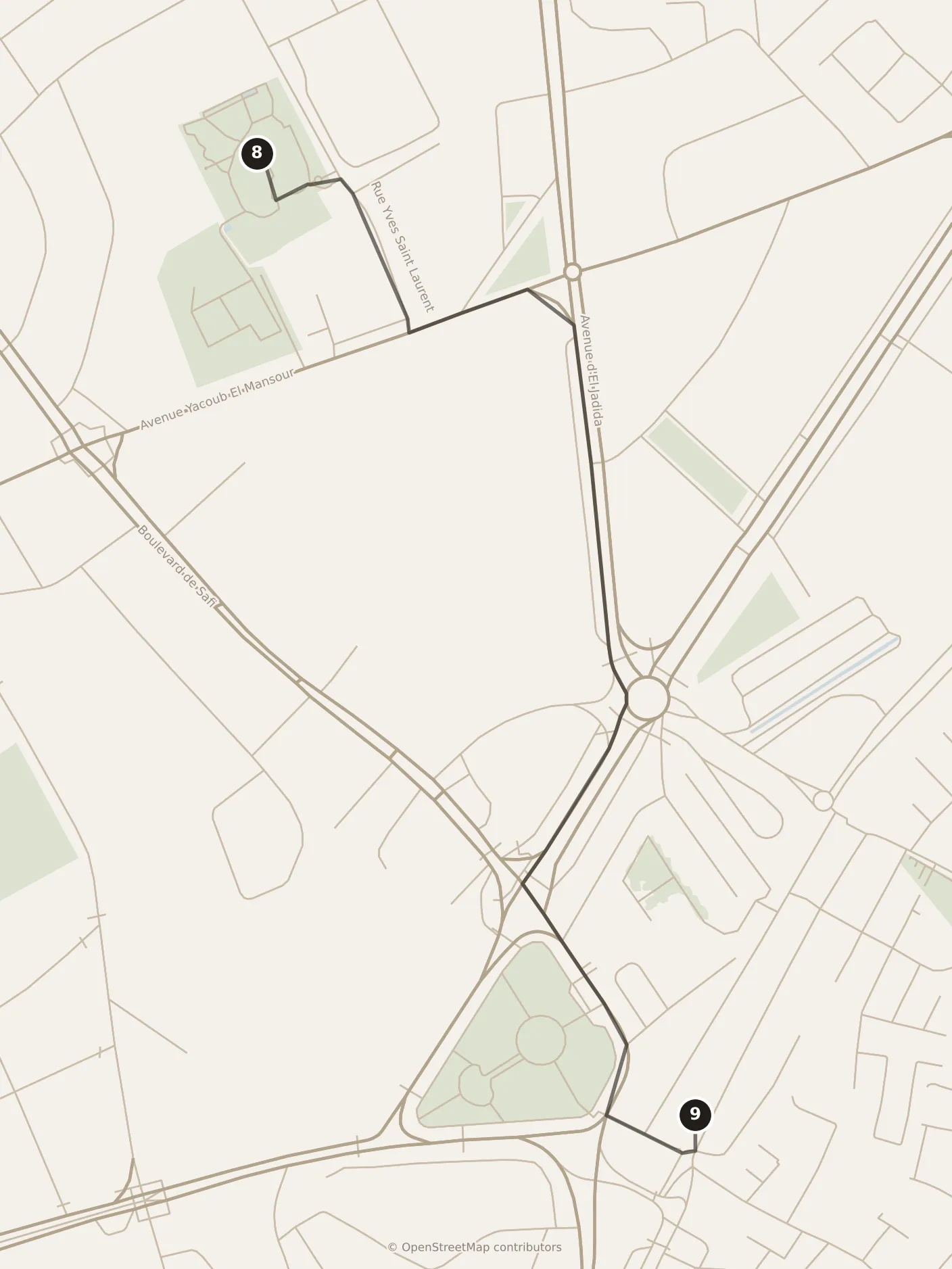
- 8Jardin Majorelle
- Musée Yves Saint Laurent Marrakech — in the prose, not on the map
- 9Bab Doukkala
Today starts outside the walls and comes back in through the north gate. It is the longer day — about eight and a half hours from the garden gate to the bottom of the souks, which puts you in the square by half past four in any month of the year. That count leaves out what day one’s leaves out — the ticket desks, and half an hour of getting lost, in the half of the medina where getting lost is not a figure of speech — as well as the line at the garden gate, which is the whole reason the day is built to start when it does. Call it five, and be pleased if it is earlier.
Morning
Be at the Jardin Majorelle for its opening, which was eight o’clock in 2026; if the hour has moved, move the day with it, because everything below simply follows. From a lane in the medina that means a taxi at about half past seven, or forty minutes on foot up through the new town. It is not fastidiousness: one hectare takes something close to six hundred thousand people a year. Jacques Majorelle made it from 1923 over nearly forty years, around a cubist villa painted in the blue he mixed and gave his name to, and it is a botanical collection rather than a decorative one — bamboo, cactus, water, and that blue used as a structural color against green. An hour and a quarter, taken slowly, because the garden is small and the pleasure is entirely in standing about in it.
Inside the same wall is the Pierre Bergé Museum of Berber Arts: Amazigh jewelry, textiles, weapons and domestic objects in one dim, concentrated room. Three quarters of an hour. It is the natural companion to Dar Si Said on the other day — the same material culture, better lit and much shorter — and if you are only going to do one of the two, this is the compressed version.
The Musée Yves Saint Laurent Marrakech is a hundred meters away and did not open until ten in 2026, which is precisely why the garden goes first: by the time you have done both of the above, its door is open and you have waited for nothing. The building earns as much attention as the collection — brick laid outside in a weave meant to read as cloth, and a pale, quiet interior behind it — and the permanent display is a single darkened room of the couturier’s own work. An hour. It shut on Wednesdays in 2026, and that is not the weekday the two museums on either side of it close on. The mismatch is why the Practicalities below carry a weekday rule rather than a sentence.
From the museum gate, walk south-east into the medina: under twenty minutes to Bab Doukkala, the north-west gate, with the long-distance bus station immediately outside it. Ten minutes for the gate, then sit down and eat by it for three quarters of an hour, and do take the time, because this is the last straightforward meal of the day. Past here the lanes stop running straight and the phone stops being much use.
Afternoon
A quarter of an hour inside the gate is Dar el Bacha, the pasha’s palace, now the Museum of Confluences, and the best-restored courtyard in the city: a long central pool, citrus trees, and tilework you can stand a foot away from. Three quarters of an hour. It is run by the national museums’ foundation and it shuts on Mondays, and so does Dar Si Said on the other day — the same weekday for both, which is what makes the arrangement in the Practicalities worth reading before you book.
Four minutes on, off Rue Mouassine, is Le Jardin Secret: a riad garden rebuilt on its own ruins and opened to the public, with two courts — one formal and Islamic, one loose and exotic — and a tower you climb. Three quarters of an hour with the tower in it. This is the one place in the top half of the medina where you can see the shape of what you have been walking through, and the lanes make more sense afterwards than they did before.
Eight minutes east stands the Ben Youssef Madrasa, the best building in Marrakesh and one of the best in the country. Abdallah al-Ghalib commissioned it in 1564, and when it was finished it was the largest college in the Maghreb, taking upwards of eight hundred students on a plot of about forty meters by forty-three. The way in is the point of it and was designed to be: one plain street door, a narrow corridor, a small vestibule, and then the courtyard arrives all at once — carved cedar over stucco over tile, floor to cornice, around a long shallow pool. It stopped being a college in 1960 and opened as a monument in 1982, and the surfaces you are looking at were cleaned in a restoration running from late 2018 to spring 2022. Three quarters of an hour: do the courtyard, then climb to the students’ cells, because the contrast is the building — rooms the size of a bed, windows the size of a hand, no decoration at all. In 2026 it ran from nine to seven, seven days a week, so unlike the museums whose closing days shape the weekday rule in the Practicalities, it has no weekly closing day; what it does have is a much shorter day during Ramadan, which is below. A foreign adult paid fifty dirhams at the door.
Two minutes away, on the open ground in front of the mosque, the Almoravid Koubba is easy to miss because it is below you: it sits at the bottom of an excavated hollow some seven or eight meters under the level of the modern lanes, which is a measure of how far the city has risen in nine hundred years. It is a small domed building of the 1120s, put up for the washing before prayer at a mosque that has since gone, and it is the last piece of the dynasty that founded Marrakesh still standing anywhere in it — everything else on these two days belongs to the dynasties that pulled that one down. Ten to fifteen minutes. Nothing else on the trip is this old.
Evening
Six minutes south is Rahba Kedima. It was the corn market once and the shape still says so: an actual square with a floor, opening off lanes that have none. Round the edges are wool, basketwork, hats, and the apothecaries with their walls of jars. Half an hour, and this is the half hour in which to buy rather than to look. You have spent a day and a half seeing the same objects in different lanes at different prices, and a price is only negotiable to somebody carrying a second one in their head.
From there work south down Souk Semmarine, the wide covered lane that empties into the top of Jemaa el-Fna. Three quarters of an hour if you are still looking. One offer not to take on the way: being shown the tanneries, which are north-east of here and well off your route. It is the most reliably staged errand in the city, it ends in a shop, and there is nothing at the end of it that repays the hour and the argument. Come out at the top of the square and eat sitting down tonight. A tagine that has genuinely been cooked in the pot it arrives in cannot be hurried, so ask at the door how long one will be before you sit down: a kitchen that says it comes straight away is reheating, and that wait is the whole difference between this evening and the other one.
With a third day

The third day goes to the mountains, and it is appended rather than inserted: the medina is days one and two, in either order, and nothing has to move to make room for it. There is one exception and it is the calendar. If either city day would land on the Monday that shuts both museums, put the mountains on the Monday instead and take the city days on the days either side of it. Nothing in the Ourika valley closes, so that arrangement costs nothing and saves a stop; and because the two city days do not depend on each other, splitting them apart with a day in the mountains breaks neither.
The Ourika valley starts about forty kilometers south-east of the city in a straight line and rather more by road, and climbs from irrigated fields into the High Atlas. Shared grands taxis and minibuses for it go from the rank at Bab er-Robb — the gate fifty meters from the Bab Agnaou that closed day one’s afternoon, and the departure point to go to. Some vehicles also leave from around Sidi Mimoun, half a kilometer north of it, but ranks on this side of the walls get moved about, and the one anchored to a gate you have already stood at is the one to trust. Nothing here is booked: you turn up, say where you are going, and leave when the vehicle is full, which is why this is a morning that rewards being early rather than being organized. What you are buying is a seat and not the car, and those are two quite different transactions — being offered the whole vehicle to yourself is a real offer and a much dearer one, so if that is what comes back, say you want a seat and wait. The shape of the day is three hours of road, three hours of walking and village, and an hour on the valley floor coming back: leave the gate at eight and you are set down at it again by four, with the waiting for a vehicle to fill still to add at each end.
The head of the valley is Setti Fatma, a village strung along the river under walnut trees, and what you do there is walk. A chain of seven cascades climbs the gorge behind it; the first is a scramble of half an hour or so over wet rock, it is where most people stop, and stopping there is a perfectly good decision rather than a failure of nerve. Give the walk and the village three hours together, and eat at one of the tables set out on stilts over the water. The valley floor below the village is the other half of the day — terraced fields, footbridges of poles and planks, and roadside co-operatives pressing argan oil, which are worth a stop and are also the one place up here where you will be sold something.
One thing to know before you go up, because nothing on the road will say it for you. The earthquake of September 2023 had its epicentre in these mountains rather than in the city: thousands of people died in the valleys south and west of here, whole hamlets came down, and the rebuilding is still visibly under way — new breeze-block houses standing beside the ruins they replaced. Nobody up here needs it mentioned, and the reserve the next paragraph asks for is partly this.
One thing this day asks more firmly than the city does, and one it asks that the city does not. Dress is more conservative in the valley than in the medina — a degree rather than a kind, since the city asks it too in the places the Practicalities below name. Here shoulders and knees covered is not a courtesy, it is what everyone around you is doing, and the difference is visible the moment you get out of the taxi. And photographing people, particularly women, is something you ask about first. In the square there is a crowd to disappear into and a fee to argue over; in a village of a few hundred there is neither.
If you would rather walk than sightsee, the alternative is Imlil: about seventy-five minutes by shared taxi from the same rank, changing at Asni, and a walking village rather than a river one, with a mule track up to the hamlets above it that makes a good three hours out and back. This is also the road that took the worst of 2023 — Asni lost the great majority of its houses, Imlil is among the settlements listed as destroyed or severely damaged, and reconstruction has run years behind — so check the state of the road and the village for the year you are traveling rather than taking it from here. Take it instead of the Ourika day, not as well — the two are up different roads and there is no way to join them. What Imlil is not is the mountain itself: an ascent of Toubkal is two days with a night in a refuge, and it has required an accredited guide since 2018.
And if you will not leave the city at all, do not stretch two days into three. Days one and two are the medina, and a third day spent adding a fourth palace to them is what makes a short trip feel long. The honest third day inside the walls is a rest day: a hammam in the morning, an hour back in the lanes above Rahba Kedima for whatever you did not buy, and a roof for the afternoon. Two quite different places go by that name and it is worth knowing which one you are walking into. The kind attached to a riad is a booked treatment and everything is found for you. The neighborhood kind is a working public bath rather than a spa: men and women use it at separate hours or through separate doors, you take your own towel, soap and change of clothes, and you are undressed among strangers. It is the better of the two and not the restful one. That is a plan. A fifth monument is not.
Practicalities
Two calendars govern this city and only one of them is a week. The week is short and exact. Dar Si Said on day one and Dar el Bacha on day two are both run by the Fondation Nationale des Musées and both shut on Mondays. The Musée Yves Saint Laurent on day two shuts on Wednesdays. The madrasa, the Jardin Majorelle and the Berber museum inside it were open seven days a week in 2026. So: day one must miss Monday, day two must miss Monday and Wednesday, and — this is the part usually left out — the two city days will swap freely, because neither is built on the other. Start on a Wednesday, Thursday, Friday or Saturday and nothing is lost. A Tuesday arrival is the one that looks safe and is not, because it puts day two on the Wednesday; arriving on a Tuesday, simply do day two first. A Sunday or a Monday arrival is the one that cannot be saved on two days, because a Monday museum goes whichever way you turn it: take the Monday as day two and lose Dar el Bacha, which is the cheaper loss, since that afternoon keeps three other stops and day one’s morning, without Dar Si Said, would keep two. With three days the problem disappears, because the mountains take the Monday — and if that pushes a city day onto the Wednesday, swap the two city days, which costs nothing.
The Ministry of Culture’s monuments in the south are the Bahia in the morning and El Badi and the tombs after lunch. They publish their own hours and closing days, and those are the thing to read the week before you travel rather than to take on trust here. If one of the three is shut on your day, day one still stands: the two that remain, a longer hour in Dar Si Said and a longer lunch fill it without anything being invented.
The other calendar is lunar, and it moves about eleven days earlier every year, so it will not be where it was the last time you looked. Ramadan rearranges both days here more than any weekday does. Far fewer kitchens serve during the day, and the ones that do are mostly outside the walls and in the places that feed visitors, so plan the midday meal rather than assuming it: day two’s is in Gueliz and by Bab Doukkala and is the easier to arrange, while day one’s is inside the medina, where the honest answer is to eat before you set out or to carry something. What is not negotiable is the conduct — do not eat, drink or smoke in the streets while it is light, which is the piece visitors most often get wrong and the one most quickly noticed. The clock itself no longer moves for the month, only the opening hours do, and they contract sharply — the Ben Youssef Madrasa closed at half past four during Ramadan in 2026 against seven for the rest of the year — so on a Ramadan day two the madrasa moves to the front of the afternoon and Dar el Bacha to the back. What you get for the inconvenience is the finest version of the first evening in the year, because the square goes from deserted to full in about the space of a minute at dusk. Eid al-Fitr and Eid al-Adha are the harder ones: the monuments close and every road and rank out of the city is full, which is the third day gone. Find out where the lunar month falls before you book rather than after.
Friday is, unexpectedly, the easiest day of the seven for this pair, and worth saying so because it is the one people rearrange around. Prayers at midday take an hour or two out of the souks and a fair number of shutters stay down into the afternoon — but day two is in Gueliz until eleven, at a table by Bab Doukkala at noon, and does not reach a souk until after three, by which time the lanes are trading again. What Friday genuinely changes is that a sit-down lunch takes longer everywhere, so on day one let the Mellah have its full hour and a quarter instead of trimming it.
What you are wearing matters in the city too, less than in the valley and not everywhere in it. The souks and the square are used to everything; the places on these two days where it is noticed are the residential ones — the Mellah, the lanes above Rahba Kedima, the walk out to Bab Doukkala — and the open ground in front of the Koutoubia and the Ben Youssef mosque, which are working mosques you are standing outside. Shoulders and knees covered costs nothing and settles all of it.
If you are short of time. On day one the first stop to go is the Bahia Palace: that is a full hour back on the same morning, and it leaves the Koutoubia, Dar Si Said and the whole southern cluster intact. The second is twenty minutes of the Koutoubia’s half hour, which comes down to ten without losing the reason it goes first. On day two the first cut is the Berber museum — three quarters of an hour, and it costs no walking at all to skip, because it is inside the garden you have already paid to enter. The second is Dar el Bacha: three quarters of an hour plus the quarter of an hour of walking to reach it, and dropping it puts you at Le Jardin Secret straight from the gate. Do not cut the madrasa or Le Jardin Secret’s tower. They are the two things on day two you cannot get a version of anywhere else.
Getting to the start, and away from the end. Marrakesh Menara Airport is about five kilometers out. The number 19 shuttle runs from a marked stop in the parking lot outside arrivals to the edge of Jemaa el-Fna, and the airport taxis are sold from a machine in the arrivals hall that prints a fixed price and a car number — the one place in this city where the fare is not a conversation. Everywhere else it is one, and the whole of it happens before you get in: say where you are going, settle the figure on the sidewalk, and do not start a ride on the understanding that it will be worked out at the other end. That covers every taxi this plan schedules, and the first of them is the one it matters most on: the ride in from the station with the bag, then the early one on day two, then the run back to the station on the last morning. The shared grands taxis of the third day are a different transaction again, and that one is set out with the day itself. Marrakesh railway station stands over in Gueliz, a shade over three kilometers from the Koutoubia: three quarters of an hour if you walk it, ten minutes in a taxi, and the same ten minutes back out to it on the morning you leave. Do not build the last morning around a left-luggage office at the station; build it around going to your own door for the bag, which is what a riad holding it after checkout makes easy.


.jpg)

