Marrakesh in one day: the southern palaces, the souks, and the square at dusk

Last updated 4 August 2026
Overview
Marrakesh gives up a single day more easily than a city of a million people has any right to, because the longest leg of this route is about twenty minutes’ walk. The walled medina is about three kilometers from wall to wall; its monuments sit in two tight clusters, one at the bottom of it and one at the top; and between them lies Jemaa el-Fna, which is the only stop on this route that has to happen at a particular time of day.
The awkward part is not distance, it is finding things. The souks are a covered lattice of lanes that do not run straight, are not signed, and defeat a phone, and the most useful fact about this city is that it has one fixed reference in the sky. The Koutoubia minaret is seventy-seven meters high and an ordinance forbids anything near it to be built above the height of a palm tree, so from most of the medina you can see it. Every time you are lost — and you will be — the question is not which lane this is, but which side of the tower you are on. That is why the day starts there rather than at the more obvious place two minutes away.
What one day costs you is everything outside the walls. The Majorelle garden and the museum beside it are up in Gueliz, forty minutes on foot from all of this and a morning of their own, and so are the avenues that make the new town worth a second day. It also costs you the High Atlas, which for many people is the reason Marrakesh was on the list at all: the valleys begin an hour or so to the south by road and they take a day, not an afternoon. Squeezing the mountains into this one buys you a coach and loses you the medina.
The day is built around Jemaa el-Fna after dark. In daylight it is a wide dusty rectangle with juice stalls round the edge and a certain amount of hustle in the middle, and if that is all you see of it you will not understand why anybody talks about it; it becomes a different object once the light goes, when the food stalls are wheeled out in rows and circles of musicians and storytellers form around them. So it goes last and everything else counts backwards from it. The sun sets here between about half past five in early December and about twenty to eight in late June, and the early end is where you would expect it: Morocco has kept a single clock since September 2026, with no seasonal change and none for Ramadan. Take your own month’s hour and count back from it.
What you are counting back through is about six hours from the Koutoubia to the last monument, and you want the hour before dark spent on one of the roof terraces round the square rather than in a lane, so call it seven. Two things that number leaves out. It is time inside the places and walking between them, and it says nothing about getting lost, which here is not a figure of speech: the twenty minutes from the bottom of the medina back up to the souks can be forty the first time, because the lane you wanted turns out to be a shop. And it assumes the doors are open when you reach them. The Bahia and El Badi ran from nine to five in 2026, and that pair of hours is the whole reason this day is shaped as it is — build the morning forward from the opening, and if the hours have moved, build it forward from the new ones, but keep the three southern monuments in the first half of the day whatever they say, because all of them shut while the square is still empty. Count seven hours back from your month’s sunset and it lands later than nine in every month of the year, which is the useful thing the arithmetic tells you: you are not short of time in Marrakesh, you are short of shade. Start at the opening anyway and give the difference to lunch. In late June that difference is nearly four hours, and it falls exactly on the hours you should not be outdoors.
You are probably carrying a bag, and the shape that matters is that this day does not ask you to come back for it. It begins at the Koutoubia and ends at Jemaa el-Fna, five hundred meters apart, and Marrakesh railway station over in Gueliz is the same ten-minute taxi ride from both. Do not count on leaving it there: nobody lists a left-luggage office at that station. So the bag either stays wherever you slept or it comes with you, and if it comes with you the day as written is not yours — the souks are the width of two people and shared with handcarts and mopeds, the ground down to the Kasbah is uneven, and the tombs are reached along a passage barely wider than one person. The day that does work with everything you own on your back is the southern half of this one, in the same order and stopped short: twenty minutes at the Koutoubia, a little over twenty minutes’ walk east to the Bahia and three quarters of an hour inside it, ten minutes on to El Badi and another three quarters there, then ten minutes north to a long lunch in the Mellah and a taxi back to the station from the edge of it. Call it three and a half hours with the lunch in it. What it leaves out is the tombs, whose passage is the one place on this route a bag genuinely cannot go, and the souks and the square — a real loss, and the smaller of the two.
The day

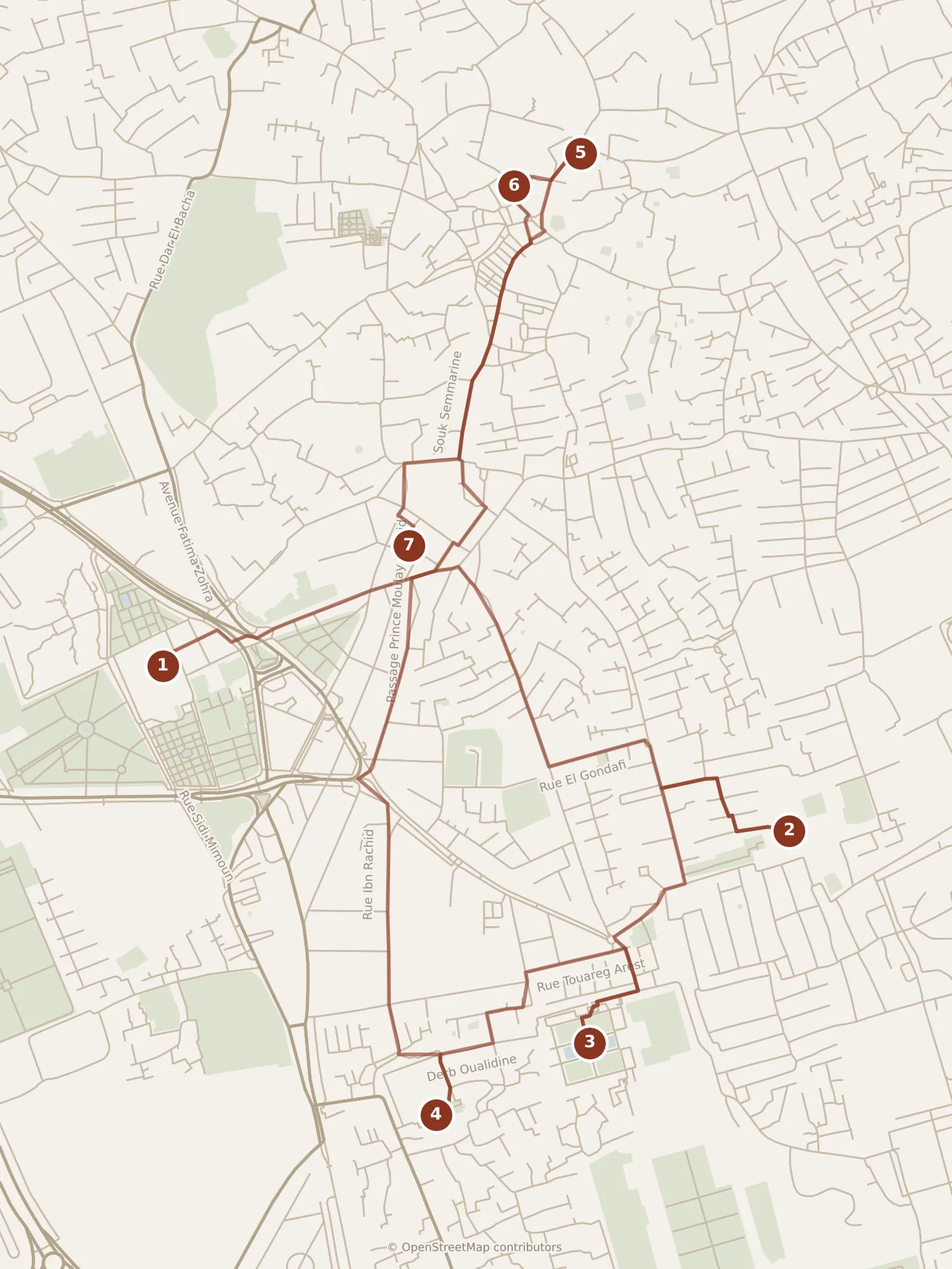
- The day
- 1Koutoubia Mosque
- 2Bahia Palace
- 3El Badi Palace
- 4Saadian Tombs
- Mellah — in the prose, not on the map
- Rahba Kedima — in the prose, not on the map
- 5Ben Youssef Madrasa
- 6Almoravid Koubba
- 7Jemaa el-Fna
Morning
Start at the Koutoubia Mosque — ten minutes by taxi from Marrakesh railway station, or three quarters of an hour on foot from it, which is not the way to begin a day in this heat — and start there knowing you cannot go into it. It is a working mosque and, like almost every mosque in the country, closed to non-Muslims, so what you are here for is the outside, and twenty minutes is well spent on it. It was founded in 1147 by the Almohad caliphs, rebuilt about a decade later, and the minaret finished towards the end of that century; every later Moroccan tower is a copy of it. On the esplanade beside the mosque the footings of the first version are laid out at ground level, so what you are walking over is the building that was replaced. There are large gardens alongside, a rose garden among them, and this is the last quiet grass you will stand on until the evening.
A little over twenty minutes east and then south, across the corner of Jemaa el-Fna and down Riad Zitoun el-Jedid, is the Bahia Palace. Do not stop in the square on the way; it is worth nothing at this hour and you are coming back to it tonight. The palace was built for Ba Ahmed, grand vizier at the very end of the nineteenth century, on top of the older house his father had begun in the 1860s, and it is where you see what the money actually bought: painted cedar ceilings, carved plaster, and a courtyard fifty meters by thirty paved in Italian marble with some eighty rooms opening off the wooden galleries around it. You pay at the door here, or ahead on the culture ministry’s ticketing site, as at each of the monuments below except the madrasa; there is no combined ticket covering them. Give it three quarters of an hour, and do not try to see every room — the great marble courtyard and the older garden court behind it are what you came for, and the rest is the same idea repeated smaller.
Ten minutes further down is El Badi Palace, which is the opposite experience and the reason to take them in this order. Ahmad al-Mansur spent fifteen years on it and finished in 1593; a little over a century later Moulay Ismail had it stripped to the brick and carted the marble and the cedar off to Meknes for his own capital. What is left is a rectangle of sunken orange groves inside high walls with storks nesting along the top of them, and it is more moving than a restored version would have been. The twelfth-century minbar from the Koutoubia is displayed here — the pulpit that stood in the mosque you began at — and it is worth going to find. The palace was damaged in the earthquake of September 2023 and reopened that October, so check what is fenced before you plan the visit; give it three quarters of an hour.
Six minutes on, into the Kasbah quarter, are the Saadian Tombs: a walled garden of graves and the mausoleum chambers of Ahmad al-Mansur and his family, sealed up by the same Moulay Ismail who dismantled his palace and left alone for two hundred years, until they were surveyed and restored from 1917. The Chamber of the Twelve Columns is the room to stand in. It is a small site reached down a narrow passage, which is why it is the one stop on this route where you may have to wait, and half an hour inside is plenty.
Local tip. These three are three separate tickets bought at three separate doors, so a slow morning does not have to cost you all of them. If one has to go, drop El Badi: it is the ruin of a palace and you will have spent the previous hour inside a complete one, ten minutes back up the lane. The tombs are the stop with no substitute anywhere in this city, and they are the one to keep.
Afternoon
Come back north out of the Kasbah and eat in the Mellah, ten minutes away — the old Jewish quarter, created by decree in 1558 under Abdallah al-Ghalib, the sultan who also finished the madrasa you will see this afternoon, and sitting just outside the walls of El Badi, which is why the two are neighbors. It is the least performed part of the medina you walk through today: a market of spices and dried fruit, ordinary butchers, and street names restored in a program of works begun in 2016. Sit down for an hour. The temptation with one day is to buy something to carry and keep moving, and in this heat that is the wrong economy — the point of the long lunch is not the food, it is the hours you are not standing in the sun. If you want the one dish that is this city’s and nobody else’s, it is tangia, which is cooked overnight in the embers of a bathhouse furnace and does not travel. Nowhere publishes which places have it on a given day, so ask at the door before you sit down rather than after.
Twenty minutes north, up the eastern side of the square, is Rahba Kedima, the small open square where the souks properly begin: baskets, hats, wool, and the apothecary stalls with their jars and dried things. Give it twenty minutes and use it to calibrate rather than to buy. You come back down through these same lanes at the end of the afternoon, so anything you want is available on the return leg too, and a thing you have walked past once you can price.
Under ten minutes further north, through Souk Semmarine and the covered lanes above it, is the Ben Youssef Madrasa, and it is the best building on this route. It was completed in 1565 under Abdallah al-Ghalib and it housed up to eight hundred students in a hundred and thirty tiny rooms on two floors, on a floor plan of about forty meters by forty-three, arranged around a courtyard with a shallow reflecting pool down the middle. Every surface at eye level is carved cedar, tile or plaster. Go upstairs into the cells: the courtyard is the photograph, and the cells — the size of a bed, with windows the size of a hand — are the building. It closed as a school in 1960 and closed again for a restoration that ran from 2018 to 2022, so what you see is newly cleaned. Give it three quarters of an hour.
Two minutes away, on the small square in front of the mosque, is the Almoravid Koubba, and it is easy to walk straight past because it sits in a pit seven or eight meters below the modern street. It is a domed pavilion built for the ritual washing before prayer in the 1120s — the inscription gives the day and the month but not the year — and it is the only Almoravid building left standing in the city. Everything else you have looked at today went up under the dynasties that came after, beginning with the Almohad caliphs who took Marrakesh in 1147 and demolished most of what they found. It lay under rubble until French scholars documented it in 1947. Ten minutes, and it is the oldest thing you will see.
Evening
Walk back down through the souks to Jemaa el-Fna, a quarter of an hour if you do not stop and longer if you do. Spend the last of the daylight on one of the roof terraces round the edge of the square: they are ordinary cafés with an unremarkable mint tea and a staircase, and what you are paying for is the hour in which the square fills up underneath you. Count that as the hour you are sitting rather than the hour you arrive: no café up there publishes what it expects you to spend or how long the table is yours. The High Atlas is usually visible from up there, which surprises most people the first time.
Then go down into it. The stalls are wheeled out in rows and lit, the smoke goes up, and circles form around musicians, storytellers and men selling remedies — the square has been on a UNESCO list since 2001 for exactly this, the performance rather than the buildings. Eat standing or at a bench and stay as long as you like: this is the one part of the day with no next thing after it. Two things to walk past, and they are really one thing: the chained monkeys and the snakes. A photograph is followed by a demand for money nobody agreed to, and the animals are kept badly.
If you have a train, Marrakesh railway station is ten minutes west by taxi, over in Gueliz. Do not walk it at the end of a day like this — three and a half kilometers and the better part of an hour, for no reason. The airport is the same kind of ride, and the number 19 bus, which is the airport shuttle, has its city end here — but not where you have been standing. The stop is out on the road at the square’s southwestern corner, on the Koutoubia side, a bit over two hundred and fifty meters from the food stalls, with a shelter and a schedule board on it.
Practicalities
There is no timed entry on this route and no combined pass, which is worth saying plainly because it is unusual. The four monuments the culture ministry runs — the Bahia, El Badi, the tombs and the Koubba — do sell tickets ahead on the ministry’s own ticketing site, but those pages ask for a category and a quantity and nothing else, so buying early holds no hour for you; the madrasa sells at its entrance only. What the day needs either way is cash, in dirhams, in your hand before you start — every one of these doors takes it, and cards are not the norm at them. Each ticket was in the fifty-to-a-hundred-dirham range in 2026 and you will pass four or five of them. For the taxi fares, the touts and the haggling in the souks, the city guide for Marrakesh covers what to expect; the route-specific version of it is simply that you should not arrive at the Bahia with nothing but a card.
The stop most likely to be shut on the day you come is the madrasa, which is the one monument here that the culture ministry does not run and the one that publishes its own hours, on its own site. Check that one before you set out, because it is the best building on the route and the afternoon is thin without it; if it is shut, the Koubba and the lanes above Rahba Kedima will hold the time, and the hour goes back into lunch.
Friday changes this day rather than breaking it. The midday prayer empties the souks for an hour or two and a good many stalls do not reopen until the middle of the afternoon, and that falls exactly on the walk north above. On a Friday take lunch long and reach Rahba Kedima later; nothing else has to move.
Ramadan no longer moves the clocks — that stopped with the change of September 2026, so the sunsets above are the ones you count back from. What it does change is that the middle of the day has no lunch in it — the long sit-down this route uses to get through the hot hours will mostly not be available, so eat before you start or carry something. What you get in exchange is the best version of the evening there is: the square goes from empty to full at the minute the sun goes down, and the meal is the event rather than the spectacle.
Two stretches catch people out. The walk from the Kasbah back up to the souks is the longest single leg of the day and has almost no shade, which is what makes this itinerary pleasant in March and hard in July. And the medina has very few places to sit that are not a business, so the hour of sitting down is the lunch — which is why it is written in as an hour rather than left to chance.


