Manila in two or three days: the walled city, the north bank, and the national collections

Last updated 8 August 2026
Overview
Manila is not a city you can see, it is a metropolis of more than a dozen cities sewn together, and two days work here only if you refuse to cross it. Everything below sits within three kilometers of the mouth of the Pasig, except the cemetery that opens day two, which is a further two kilometers north and the only ride of any length in the trip; the river does the dividing. Day one is the south bank: the Spanish walled town, its museums, and the water at the end. Day two is the north bank, which is Chinese, Catholic and denser — a cemetery the size of a district, a church made of steel, and the oldest Chinatown anywhere. Neither day is built around a mall or a business district, and you will be on your feet almost the whole time.
The two days are deliberately unlike each other. Day one is nine and a half hours of interiors with gates and tickets, ordered so that the one stop with a closing hour comes before the ones without. Day two has almost no gates at all: it is streets, a market and four churches, and its only structure is that it runs from north to south, with one short loop west of Quiapo and no other backtracking.
The sun sets here between about twenty-five past five in the middle of November and about half past six at the end of June. Sixty-five minutes is the whole annual swing, and it is worth saying out loud, because it cuts both ways: there is no long summer evening here to rescue a day that has over-run, and no four-o’clock winter dark to be afraid of either. Take your month’s hour and count back from it, and be honest about how little the answer will move.
Day one is the one that rests on that count, because it ends on the sea wall and the bay is open water to the west — the sun goes down into it, with the Bataan hills on the far side on a clear evening and nothing at all on a hazy one. Everything above the wall comes to about nine and a half hours from an eight o’clock start. That sum models the time you spend inside the buildings, the walking between them, and an hour for lunch. It models nothing else, and here the omission has a name: from March to May the heat is not weather you walk through but something you stop for, three or four times, in shade, and what people stop for here is halo-halo, shaved ice with evaporated milk, sweet beans and fruit. Add those stops to the count or accept that the day slides.
Nothing on either day is booked in advance and nothing can be: every ticket is a walk-up counter taking cash. The paying gates are on day one inside the walls, with one more in a Quiapo house on day two. Fort Santiago was seventy-five pesos in 2026 and the Museo de Intramuros a hundred and fifty; the monastery museum beside San Agustin is the dearest of the three, a couple of hundred. Those are the sums worth drawing cash for. What the trains cost and how you pay for them is the city guide’s, and it is the one thing you should read there before you come, because a rechargeable card bought on your first morning is what makes day two painless.
Where you sleep decides how long these days actually are. From the bay-side belt in Ermita or Malate both of them begin within a short walk or a ten-minute ride; from Makati or Bonifacio Global City you are adding an hour each way, twice a day, and a nine-and-a-half-hour day becomes eleven and a half. There is no left-luggage office at any station on this route — LRT-1 and LRT-2 stations are turnstiles and stairs and nothing else — so on the day you check out, the room you slept in is the answer, and the plan that follows from it is to keep your last afternoon on the same side of the river as your bed rather than in Chinatown, which is where day two ends.
Two weekdays decide the order, and they pull against each other. Day one’s museums inside the walls shut on Mondays; day two’s one paid interior, a house in Quiapo, opens on Saturdays alone. With two days, a Monday is the north bank; with three, it is the museum day, which shuts on nothing. A Saturday, wherever it falls, is the day to put Quiapo on. The foot of this article carries the full version, including what to do when your two days are exactly a Monday and a Saturday.
Day one

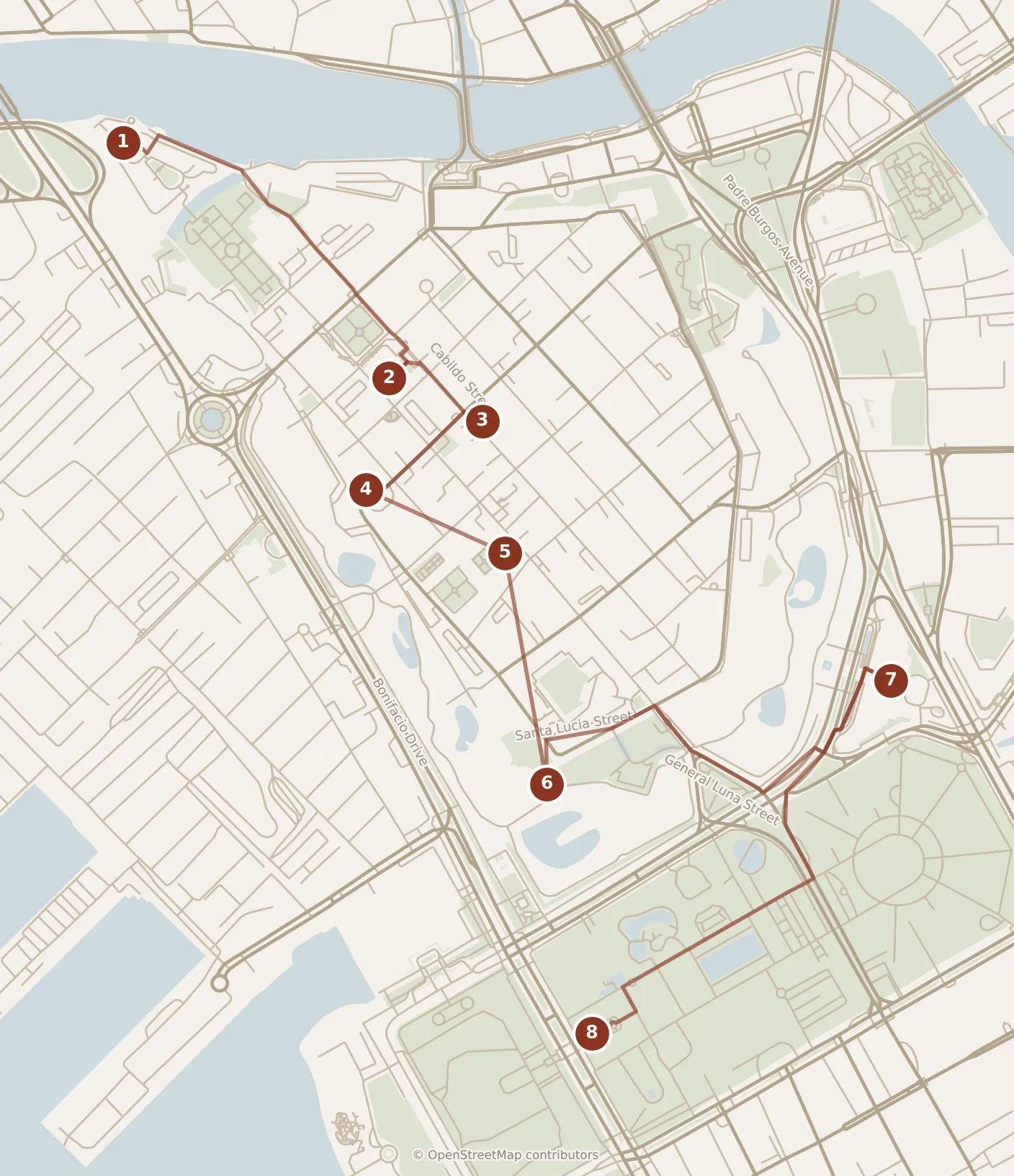
- Day one
- 1Fort Santiago
- 2Manila Cathedral
- 3Bahay Tsinoy
- 4Museo de Intramuros
- 5San Agustin Church
- 6Baluarte de San Diego
- 7National Museum of Fine Arts
- 8Rizal Park
Everything today is inside four hundred meters of wall, or three hundred meters beyond it, and the day is built so that you do not leave the enclosure until the middle of the afternoon.
Morning
Start at Fort Santiago, at the north-west corner of the walls where the Pasig turns into the bay. In 2026 the gate opened at eight on a weekday and at six at a weekend, but the gate is not the museum, and the Rizal Shrine that is half of this stop is a staffed counter rather than an open plaza. So count the day from eight whichever day you come, and treat an early weekend gate as slack rather than as an earlier start. Give the fort an hour and a quarter.
The citadel is Spanish, begun in 1571 on the site of the palisaded fort of Rajah Matanda, the Tagalog ruler the Spanish displaced, and the two things worth your time inside it are both underfoot. One is the set of bronze footprints let into the ground, tracing José Rizal’s last walk from his cell in December 1896 out of the gate towards the execution ground; you can follow them and they take about four minutes. The other is the dungeon range in the Baluarte de Santa Bárbara, at the water’s edge, where about six hundred American prisoners of war died under the Japanese occupation. The Rizal Shrine, in the building where he spent his last night, is the museum part and takes half of your hour and a quarter.
Twelve minutes east through the walls is Manila Cathedral, and half an hour here is what two days buy that a shorter visit cannot. The building is the eighth on the site — fire, earthquake, typhoon and finally the Battle of Manila in 1945 took the other seven — and this one was consecrated in 1958, which is why the interior reads as calm rather than encrusted. Under it is the crypt where the archbishops and cardinals of Manila are buried, and above the west end is a pipe organ built in the Netherlands in the same year, with about six and a half thousand pipes, the largest in South East Asia and restored in 2025. The bronze doors are the third thing: eight panels, each over four meters high, telling the cathedral’s own destructions.
Three minutes on is Bahay Tsinoy, on the corner of Anda Street and Cabildo Street, and it is the stop that explains tomorrow. Forty-five minutes. It is a museum of the Chinese in Philippine life, told in life-size tableaux: the Parián, the ghetto outside these walls where the Spanish confined Chinese traders precisely so they could be watched from them; the galleon trade that ran on Chinese goods; the massacres of the seventeenth century; and the long dissolution of that separateness into Filipino families. It is privately run rather than one of the Intramuros Administration’s own gates, so it keeps its own days and hours and publishes them itself. Check them the week before you come. If it is shut, spend the forty-five minutes on the monastery museum this afternoon instead, which will take them happily.
Four minutes further, in a reconstructed church on the same block, the Museo de Intramuros opened in 2019 with the ecclesiastical art the Intramuros Administration had been storing for decades: ivory-faced saints made by Chinese carvers for Spanish patrons, processional silver, retablos salvaged from churches that no longer exist. Fifty minutes. What it is really about is the Patronato Real — the arrangement by which the Spanish crown, not the papacy, ran the church out here — and once you have seen it you understand why the walled city had seven churches inside a square kilometer.
Local tip. The morning holds one ecclesiastical museum and the afternoon holds another, and the collections are the same kind of thing — but only the monastery beside San Agustin is also a building from before the fire that you walk through to see them. So if you are already behind before lunch, the Museo de Intramuros is the stop to drop and you lose the least by it. The cut list at the foot of this article is the plan-ahead version and starts somewhere else, because from home, on a two-day trip, the free museum is the cheap thing to give up.
Afternoon
Eat inside the walls before you go on; the restaurants along General Luna Street are the last easy lunch until the evening, and adobo is the thing to order in a city that argues about it. Give it an hour.
Then San Agustin Church, and give the whole complex an hour and three quarters, most of it in the monastery museum rather than the nave. The church was declared complete in 1607, it was the only one of the seven inside these walls left standing in 1945, and it has been on the UNESCO World Heritage list since 1993. The nave takes fifteen minutes and rewards looking up. The museum is the rest: two stories of cloister built round a courtyard, the crypt below, the choir with its carved stalls, a refectory, a sacristy of vestments, and room after room of the order’s own accumulated possessions. Two rooms in it are history rather than art. In one, in August 1898, the Spanish governor-general settled the terms on which Manila was handed to the United States, ending three hundred and twenty-seven years. In another the museum tells what happened here in February 1945, when Japanese troops held hundreds of Intramuros residents and clergy hostage inside the church through three weeks of shelling, and most of them did not come out. It is a working parish as well as a museum, much used for weddings, so on a Saturday you may find the nave in use; the museum runs regardless, and the ticket is for the museum.
Eight minutes south along the inside of the wall is Baluarte de San Diego, and it goes here rather than later for one reason: it stopped admitting anyone after four in the afternoon in 2026, and nothing else today does. Forty minutes. It is the round stone keep at the southern corner, opened out into a sunken garden you walk down into and then climb back on to, and it is where the thickness of these defenses stops being an abstraction.
Twelve minutes east, out of the walls and across the moat lawns, the National Museum of Fine Arts occupies the Old Legislative Building on Padre Burgos Avenue, and it is free. Give it an hour and a half. The first room holds the Spoliarium, Juan Luna’s canvas of dead gladiators being stripped under a Roman arena — four meters by seven and a half, painted in 1884, gold-medalled in Madrid, and the largest painting in the country. It is hung so that you meet it as you come in and there is no gradual approach to it. Beyond are the other Luna rooms and four centuries of Philippine painting; the old session hall of the legislature upstairs is worth ten minutes on its own.
Evening
Fifteen minutes west through Rizal Park brings you to Roxas Boulevard, with the sea wall on the far side of it; it is a wide road, getting across it is the last few minutes of the walk, and the whole day is built on arriving before the sun goes. Twenty-five minutes for the park is enough to take in what it is — the old execution ground of Bagumbayan, with the monument where Rizal’s remains lie and the point from which the country measures every road distance — before you carry on to the sea wall for the reason the day was ordered this way. Manila Bay is open water with nothing between you and the horizon, the promenade fills at this hour with families and students and people selling grilled things on sticks, and the sun goes into the sea rather than behind a building.
Now do the arithmetic, because it does not quite work in every month. Eight o’clock plus nine and a half hours puts you at the wall at about twenty to six. At the end of June that is fifty minutes before the sun goes and you will sit down. In the middle of November it is a quarter of an hour after, and the fix is small and specific: give the Fine Arts an hour rather than an hour and a half — the Spoliarium room and the two Luna rooms and out — which buys back half an hour against a shortfall of fifteen minutes, so it more than covers it, and the museum is free and open every day, so what you skipped costs nothing to come back for. To go home from the wall, allow half an hour: back east across the park the way you came, then a quarter of an hour more along the park’s edge to United Nations station on LRT-1. For dinner, the bay-side belt in Ermita and Malate is a short walk or a ten-minute ride south of the park.
Day two

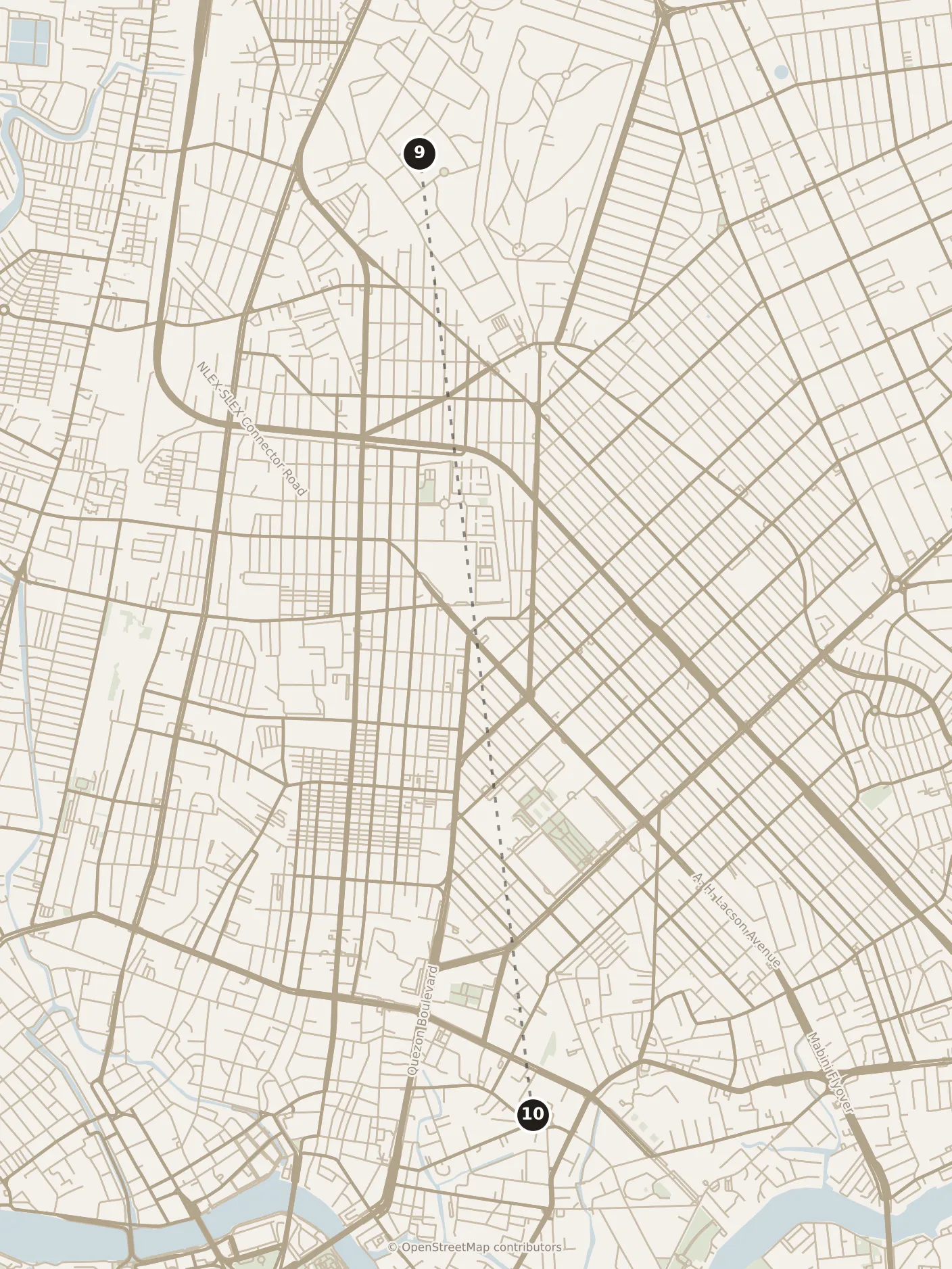
- Morning
- 9Manila Chinese Cemetery
- 10San Sebastian Church
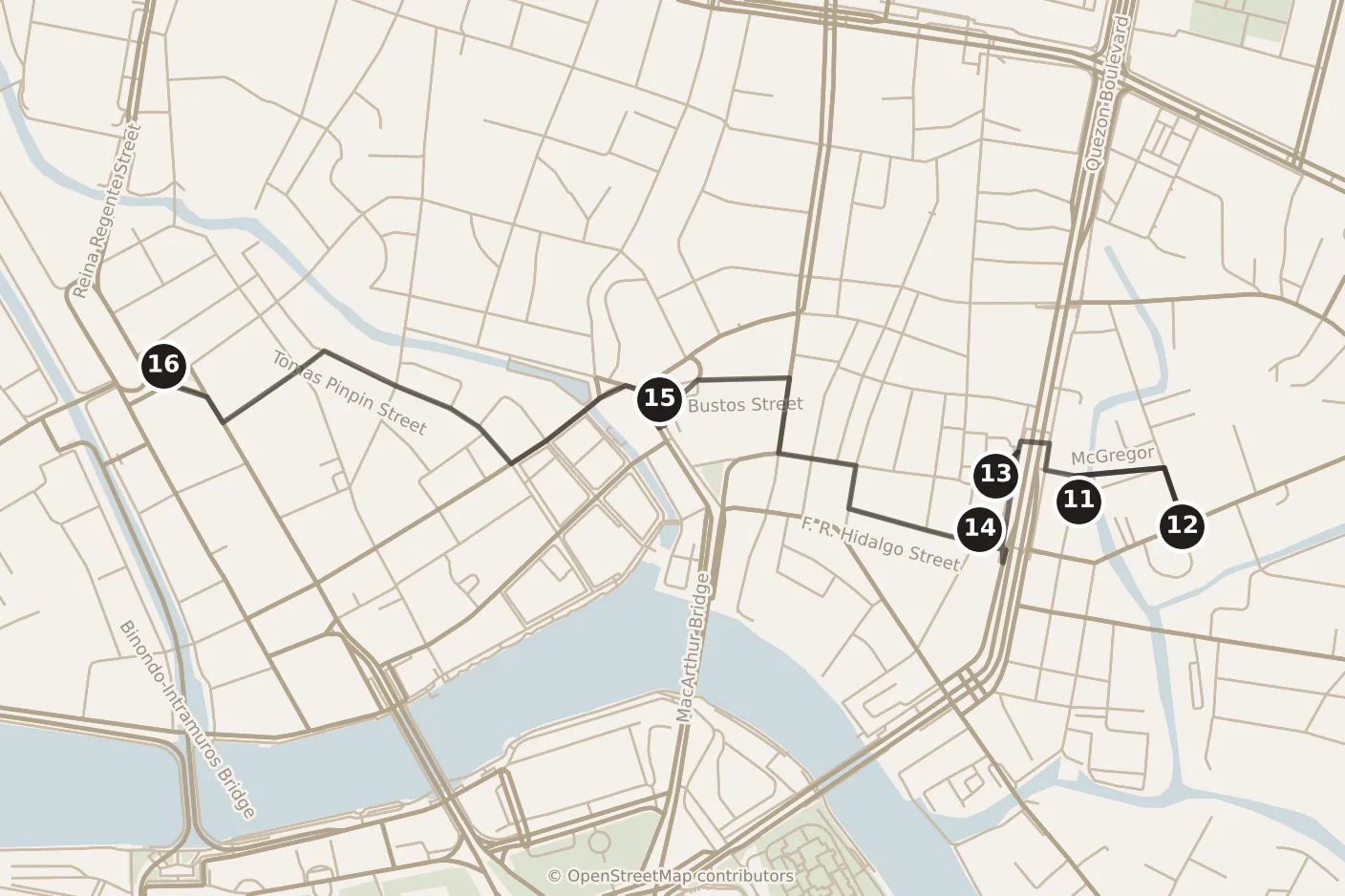
- Afternoon and evening
- 11Nakpil-Bautista House
- 12Hidalgo Street
- 13Quiapo Church
- 14Plaza Miranda
- 15Santa Cruz Church
- Ongpin Street — in the prose, not on the map
- 16Binondo Church
Today crosses the Pasig and works from north to south down a single line, so nothing you finish is behind you. It has one gate — a house in Quiapo that opens on Saturdays alone — no closing hour to race, and about nine and a half hours in it from the cemetery to Binondo Church, with dinner eaten on Ongpin Street on the way rather than after. There is no moment in it that depends on the light, and rather than invent one, here is the honest anchor: be at the cemetery gate at nine, which from the bay-side belt means leaving about half an hour before that, because the one stop three kilometers out of the way is also the one you least want to walk in the afternoon heat.
Morning
Take LRT-1 north to Abad Santos station — from the bay-side belt that is a straight run of seven stops from United Nations or eight from Pedro Gil, on one line, with no change — and walk the eight minutes north-east to the gate of the Manila Chinese Cemetery. An hour and three quarters, and it is the most extraordinary place in this article.
It was founded in the middle of the nineteenth century because Chinese residents who had not converted were not allowed to be buried in the Catholic cemeteries, and what grew from that exclusion is fifty-four hectares of streets, kerbs and house numbers. The mausoleums are houses: two stories, verandas, letterboxes, tiled kitchens, some with air conditioning and running water, built by families who come out to sit in them. There is a temple near the older north-western end that holds Taoist, Buddhist and Christian rites in the same building, and a hall commemorating the Chinese Filipinos executed here during the Japanese occupation. Do not try to walk it all; take the main avenue in and one loop off it, and turn back when the grid stops being nineteenth century. It is a working cemetery, not a park — families are tending graves, incense and paper offerings are being burnt, and funerals happen while you are there, so keep off the forecourts of tombs in use and do not photograph anyone at a grave. Two dates fill it to the point of impassability: the first days of November, when the whole country goes to its cemeteries, and the tomb-sweeping days in early April. On either of those, do the rest of this day and leave the cemetery out.
Walk back to Abad Santos and ride LRT-1 four stops south — Blumentritt, Tayuman, Bambang, Doroteo Jose — then cross by the footbridge to Recto on LRT-2 and take one stop east to Legarda. Eight minutes’ walk from there is San Sebastian Church, and forty-five minutes is right for it. It is the only all-steel church in the country: fifty-two tonnes of prefabricated sections cast in Belgium, shipped out in eight consignments and bolted together here, consecrated in 1891 and built that way because stone kept falling down in the earthquakes. Inside, the steel columns and vaults are painted to look like marble and jasper, with saints and martyrs done in trompe-l’oeil on flat metal, and the effect is a Gothic cathedral that rings when you knock on it. It has been under a phased conservation program since 2023 — corrosion in the dome first, then the roof, then the belfries and the front — so expect some part of it to be sheeted, and plan the visit so that which part does not matter.
Afternoon
Eat something near Quiapo before you go on, and give it three quarters of an hour; on the count above you get here at about one, so this is lunch rather than a snack, and there are stalls the length of every street.
Nine minutes west is the Nakpil-Bautista House, and forty minutes covers it. It is a bahay na bato of 1914 — stone below, timber above, sliding shell windows — built for a doctor and his wife and lived in by people who had been in the Katipunan, the revolutionary society: Gregoria de Jesús, widow of Andrés Bonifacio, sheltered here, and Julio Nakpil, who wrote music for the revolution, lived here for decades. It is run as a small museum and community center rather than by a public body, and it opens on Saturdays only, from half past nine to half past four, shut on every other day and on public holidays. So unless day two is a Saturday you will find it locked — and you have lost less than you think, because the reason to be on this corner is three minutes further on.
Three minutes on is Hidalgo Street, and twenty minutes of walking it slowly is the point. Before the war this was the street of the city’s grandest private houses, a row of merchant and professional families’ town houses with stone ground floors, wooden upper stories and shell-panelled galleries running the length of the façades. A handful survive, in every condition from restored to occupied-and-collapsing, with hardware shops and photocopy counters in the ground floors. There is no visible conservation of the street as a whole, and it is the most complete picture left of what the nineteenth century looked like outside the walls.
Five minutes brings you to Quiapo Church — formally the basilica of the Black Nazarene, and locally the center of the largest popular devotion in the country. Half an hour. The present building dates from 1935 and was enlarged in the 1980s, and it is not the interest; the image is, a dark seventeenth-century figure of Christ carrying the cross that arrived from a Spanish galleon and has been credited with miracles ever since. There is nearly always a line of people waiting to touch or kiss the foot of a replica, and mass is being said more or less continuously. Walk round the edges, do not join that line as a spectator, and do not photograph people praying at close range. Two dates it is worth knowing: every Friday is Quiapo Day, when a novena runs and thousands come, and on 9 January the Traslación carries the image through the streets in a procession that has drawn millions and closes the whole district and much of downtown Manila for a day and a night.
Local tip. At Quiapo the square, the stalls and the streets round them are free, open all day and most of what you came for; the interior is the twenty-minute part. So if you arrive on a Friday and cannot get in, you have lost the smaller half — stay outside, where the day was anyway.
Plaza Miranda is the square in front of it and takes fifty minutes, because what is on it is the real subject. The stalls sell devotional candles by color, dried medicinal roots and barks, amulets, rosaries and printed novenas, and the fortune-tellers work from folding tables; the trade runs on under Quezon Bridge and down the side streets, and it is the most concentrated survival of folk practice in urban Manila. It is dense and slow and worth being unhurried in. It is also as crowded a place as you will stand in on this trip; carry your bag in front of you.
Then walk west along Carriedo Street. In eight minutes you pass Santa Cruz Church on its own square — twenty minutes, a parish the Jesuits founded in 1619 for the Chinese living outside the walls, leveled in 1945 and rebuilt by 1957, with a domed belfry of six stages and a cool interior to sit down in — and thirteen minutes beyond it you are in Chinatown.
Evening
Ongpin Street is the spine of Binondo, named after a nineteenth-century Chinese-Filipino merchant, and an hour and a half is the least it deserves. Come at it slowly. What it sells is what the morning explained: the gold dealers, the dried-goods pharmacies with roots and fungi in glass jars, the bakeries selling hopia and, at new year, tikoy — and, in several shops, the folded paper houses, paper cars and paper money that are burnt for the dead in the cemetery you stood in this morning. Eat here, and eat in more than one place: none of it needs a reservation or a plan, and the point of Binondo is that it has been cooking Chinese here for four hundred years and the city came to it.
Twenty-five minutes for Binondo Church, at the far end of the street on Plaza San Lorenzo Ruiz. The Dominicans founded the parish in 1596 for Chinese converts, and the octagonal, tiered bell tower is the giveaway — a pagoda in everything but name, put on a Catholic church for a Chinese congregation. American bombing in September 1944 left the walls and that tower and almost nothing else, and the rebuilding ran into the 1970s. It became a national shrine in 2024 to Lorenzo Ruiz, born in this parish about 1594, altar boy and then clerk of this church, who fled to Japan in 1636 after being accused of a killing, was executed at Nagasaki in 1637, and was canonised in 1987 as the first Filipino saint. Masses here run in Tagalog, Mandarin, Hokkien and English, which tells you most of what the quarter is.
Carriedo station on LRT-1 is a quarter of an hour east on foot when you have finished; that is the same line you started the day on, so wherever you are staying, you are one ride from it.
With a third day
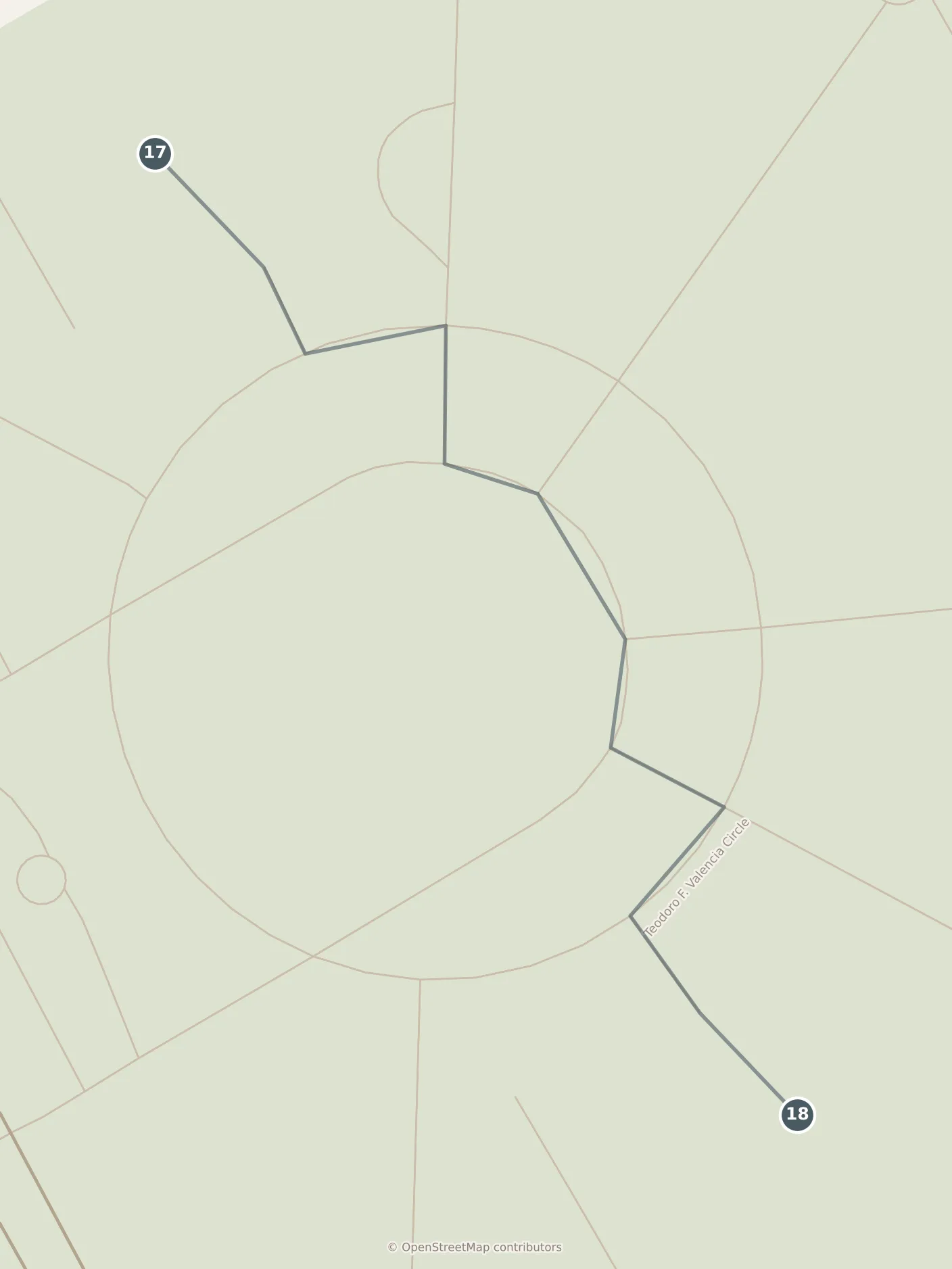
- With a third day
- 17National Museum of Anthropology
- 18National Museum of Natural History
A third day does not extend either of the two above. It picks up the one thing the pair of them leaves on the table, which is the national collections, and it goes at the end. It is a museum day and nothing else, so if that is not what you want a third day for, two days is the right length for this city and the pair above is complete without it.
The reason it goes at the end rather than in the middle is that it is the only day of the three with no gate to beat, no closing hour to order it around and no leg longer than ten minutes: the National Museum of the Philippines has been free since 2016 and, since January 2025, open every day of the week, and its three buildings stand within five hundred meters of each other on Rizal Park. So it is the day that absorbs a late start after a long evening, and the only one of the three a Monday cannot damage — which is the real answer to a Monday arrival if you have three days: put the museums on it and leave both bank days whole, rather than making the swap a two-day reader has to make.
One thing moves the moment you decide to take it: the National Museum of Fine Arts comes off day one. That is a real subtraction, not a tidying — it removes an hour and a half and two walking legs, brings day one’s total down from nine and a half hours to about eight, and puts you on the sea wall at around four o’clock, which is comfortable in every month of the year and removes the November problem described above entirely. Day one then ends at Baluarte de San Diego and walks eight minutes to Rizal Park instead of twelve to the museum.
Start at half past nine at United Nations station on LRT-1, which is ten minutes’ walk from the first of them. Give the National Museum of Anthropology two hours: it fills a 1918 government building on Agrifina Circle, and its two unmissable things are the Manunggul Jar, a burial jar of around 800 BC with two figures paddling a boat of the dead modeled on the lid, and an entire gallery built from a Spanish galleon that sank in 1600 off the Batangas coast — hundreds of jars, cannon and porcelain lifted off the seabed, which is the whole galleon economy laid out as objects. The textile floor above is the one to skip if you are tiring.
Lunch is ten minutes south of the park in Ermita, and it is where to have sinigang, the sour tamarind soup that is the other thing a Filipino table will argue about. Then an hour and a half at the National Museum of Natural History, five minutes away in the 1940 agriculture building. Its courtyard has been roofed with a glass dome on a double-helix frame — the Tree of Life — with an elevator and ramps spiralling up through it, and the collections are Philippine: eagles, tarsiers, the tamaraw, and Lolong, the saltwater crocodile taken in 2011 in Agusan del Sur and the largest ever held in captivity, stuffed and laid out at over six meters.
Then eight minutes to the National Museum of Fine Arts and the two hours day one could not give it, which is what the Spoliarium is worth on its own. Nothing on this day takes a ticket, so the paying gates are still only the ones on the two days above. Finish with forty minutes in Rizal Park and walk west to the water: if November took your sunset on day one, this is the day with the margin to get it back. That comes to about seven and three quarter hours from half past nine, which puts you at the wall a little after five, with dinner back in Ermita and Malate afterwards as on day one.
If you would rather insert this day between the other two than append it, nothing breaks. It starts and finishes in the same corner of the same park that the walled-city day finishes in, it closes on no weekday, and the Fine Arts still comes off the walled-city day either way — day one stops meaning the walls the moment you reorder. The only thing you lose is the neatness of ending the trip somewhere quiet.
Practicalities
Nothing here is booked in advance. Every gate on these three days is a walk-up counter taking cash, and the ones worth drawing cash for are priced at the top of this article. What you should sort out on your first morning instead is a rechargeable travel card, because day two uses two rail lines and a transfer, and the parent city guide is where that is explained.
Which day must miss which weekday. Two rules pull against each other, so read both before you fix the dates. Day one is the Monday problem: the Museo de Intramuros closes on Mondays, as does the Intramuros Administration’s visitor center beside it, and Bahay Tsinoy is privately run and keeps its own days, which it publishes and which you should read the week before you travel. Day two is the Saturday problem the other way round: its churches and its streets close on nothing, but the Nakpil-Bautista House opens on Saturdays alone, from half past nine to half past four. The third day closes on nothing at all — the national museums are open seven days. So: with three days, put the museum day on the Monday and leave both bank days whole. With two days and a Monday among them, the Monday is the north bank, and you walk Hidalgo Street without the house. If that Monday is the second of the two, it also ends the trip in Chinatown rather than on the side of the river your bags are on, and the calendar leaves no order that avoids both: the answer is the one ride back from Carriedo station, on the same line day two starts on. And a Saturday anywhere in the trip is the day to put Quiapo on — unless your other day is that Monday, in which case the two rules cannot both be honored, and the walled city is the one to protect: losing the Museo de Intramuros and the visitor center costs more than losing forty minutes in the house.
Three more days that change what you see rather than close it. Friday is Quiapo Day and the church and its square are full from morning until night — not shut, but a different experience, and if you want the church interior rather than the crowd, day two should miss it. Sunday puts services in all six churches on these days — the cathedral and San Agustin on the first, the other four on the second; you will be at the back of a full church rather than walking round an empty one, which is arguably the better way to see any of them but is not twenty unhurried minutes with a bell tower. And Saturday is when San Agustin’s nave is most likely to be occupied by a wedding, which the monastery museum is not affected by. Three fixed dates are worth checking against your trip, all of them day two’s: 9 January, when the Traslación takes Quiapo and much of downtown out of use for a day and a night, and the first days of November and the tomb-sweeping days in early April, when the Manila Chinese Cemetery is packed to the point of impassability and should simply be left out of the day.
What to cut, in order. If day one is short, the first thing to go is the National Museum of Fine Arts, because it is free and open every day and therefore the cheapest thing on the trip to come back for; the second is Bahay Tsinoy. If you are taking the third day the Fine Arts has already come off day one, so the first cut is Bahay Tsinoy and the second is the Museo de Intramuros. That is the plan-ahead order and it is not the one the tip in the day-one morning gives: deciding at home you cut Bahay Tsinoy, deciding inside the walls with the monastery museum still ahead of you it is the Museo. No single order is right from both places. The one that cannot go is the monastery museum at San Agustin, which is half the reason the day exists. If day two is short, the first thing to go is the Manila Chinese Cemetery — not because it is the least good, it is the best thing on the day, but because it is the only stop that costs a three-kilometer detour and about forty minutes of rail at the two ends, so cutting it buys back nearly three hours and turns the day into a continuous walk from San Sebastian Church down to the river. Start such a day at Legarda station on LRT-2 instead of at Abad Santos on LRT-1.
If the afternoon breaks in the wet months. Day one is largely indoors after lunch and looks after itself. Day two is not. If the rain arrives at Plaza Miranda, do not wait it out under Quezon Bridge or in the underpasses — an underpass is the lowest ground on any street and the worst place to be in heavy rain. Decide early, and the usable plan is to leave: Carriedo station on LRT-1 is five minutes’ walk from the square, and two stops south — Central Terminal, then United Nations — puts you ten minutes from the National Museum of Anthropology, indoors, free and open. What that displaces is the third day, which loses its morning and gains the Ongpin Street evening day two did not get to; if you only have two days, what it displaces is Chinatown, and Chinatown is the thing to come back for after dark rather than the thing to do wet.
Getting to the first scene. The airport is about eleven kilometers from the walls and there is no rail into its terminals, so the road is the only way in and the city guide covers how. From a bay-side base, Fort Santiago is a good forty minutes on foot — up through Rizal Park and along the moat lawns, which is a pleasant walk and a poor way to begin a nine-hour day — or ten minutes in a booked car, which is what to do at eight in the morning. From Makati it is MRT-3 from Ayala to Taft Avenue, a footbridge and five minutes on foot to EDSA on LRT-1, then north to United Nations and a car for the last stretch; allow an hour and a quarter and leave earlier than that.


