Manila in one day: Chinatown in the morning, the walled city, and the bay at sunset

Last updated 4 August 2026
Overview
A single day in Metro Manila is won by refusing to cross it. The metropolis is more than a dozen cities sewn together and the traffic between them is what every visitor remembers, so the only honest way to spend one day here is to pick the strip where the city actually began and never leave it. This route runs about five kilometers, north to south, from Chinatown over the Pasig to Intramuros, the walled Spanish town, out of it into the park, and along the sea wall until the sun goes down. Every leg of it is on foot.
What one day costs you is everything east of that line. The malls and the business districts go, which is no loss; the national museums a few minutes off the route go, which is. That is the right sacrifice all the same, because an hour spent indoors here is an hour taken from the two things this day is made of, which are streets and water. Naming a fourth museum is easy and useless.
The stop that cannot move is the last one. The bay lies west of the city, so the sun goes into the water rather than behind anything, and the sea wall at that hour is what people here actually do in the evening. Everything above it — the eating, the fort, the churches, the park — comes to about eight hours of walking and looking, of which the bastion inside the walls falls about six and a half hours in. The sun sets here from just before half past five in the middle of November to about half past six at the end of June, so you could take your month’s hour and count back the eight. Do not, quite. Start at nine. In November the two answers nearly coincide and nine is the safer of them; in June counting back from sunset would tell you to begin at half past ten, and that is the trap, because it puts you at the bastion gate past five, and the bastion stopped letting anyone in after four in 2026. The door wins in every month. Start at nine, and in June the extra daylight goes on to the sea wall at the end, where it belongs.
Two things those eight hours do not include. They model the time you spend inside places and walking between them and nothing else — not the line at a ticket window, and above all not the heat, which from March to May is not something you walk through but something you stop for, three or four times, in shade, with a cold drink in your hand. And they begin at Carriedo station rather than at your hotel: getting to Carriedo is the least predictable part of the day, and the city guide is the place that explains why.
You are probably carrying a bag. These are commuter stations with turnstiles and stairs and no left-luggage office, so the honest assumption is that the bag comes with you and stays on your shoulder for all eight hours: up the stone staircase in the reconstructed house, down into the bastion’s sunken garden and back up on to it, and across the middle of the afternoon in whatever heat the month is giving. Two things follow. Drop the reconstructed house — it is the stop the tip below already names as the one to lose first, its whole content is rooms you walk through, and the forty minutes it costs are what turn half an hour of margin at the bastion gate into an hour and ten. Keep the bastion, even though it is the other stop a bag argues with, because it is the one that fixes the shape of the afternoon and there is no later hour to move it to. What the bag does not do is send you back for it: the route is a line and not a loop, it never asks you to return for anything, and it ends five kilometers south of where it starts, which is five kilometers nearer the airport than where it starts.
The day

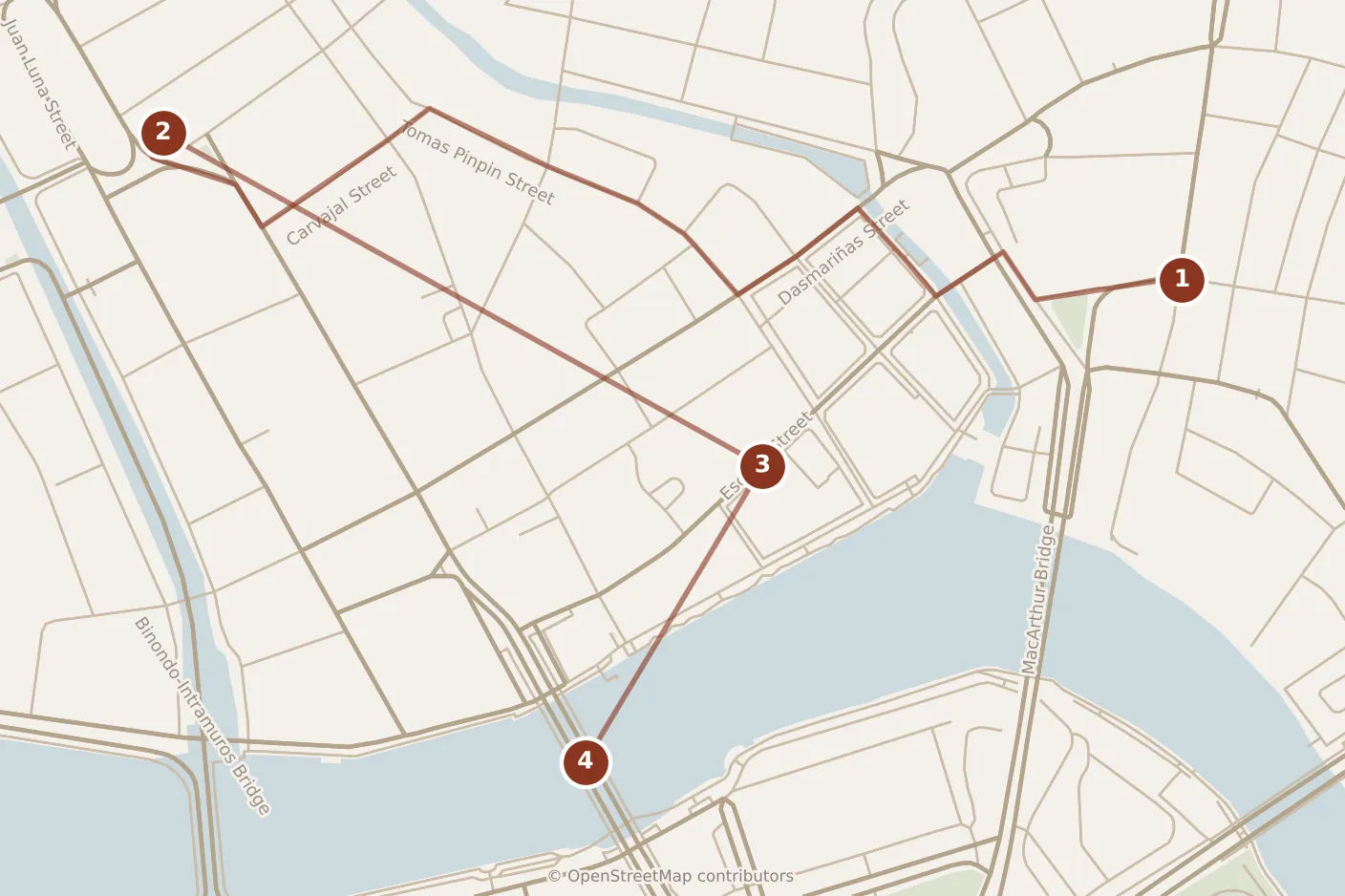
- Morning
- 1Carriedo station
- Ongpin Street — in the prose, not on the map
- 2Binondo Church
- 3Escolta Street
- 4Jones Bridge
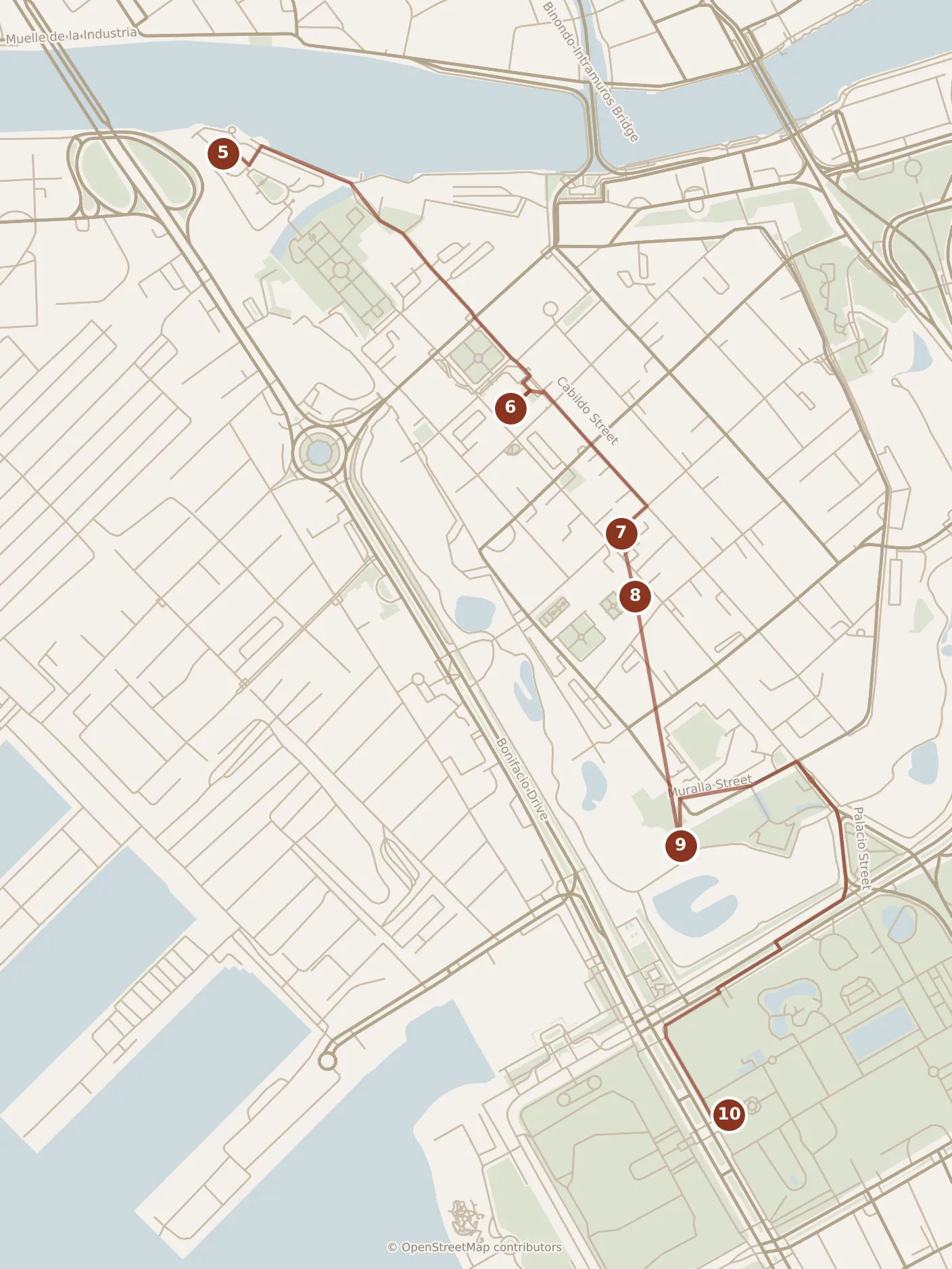
- Afternoon
- 5Fort Santiago
- 6Manila Cathedral
- 7Casa Manila
- 8San Agustin Church
- 9Baluarte de San Diego
- 10Rizal Park
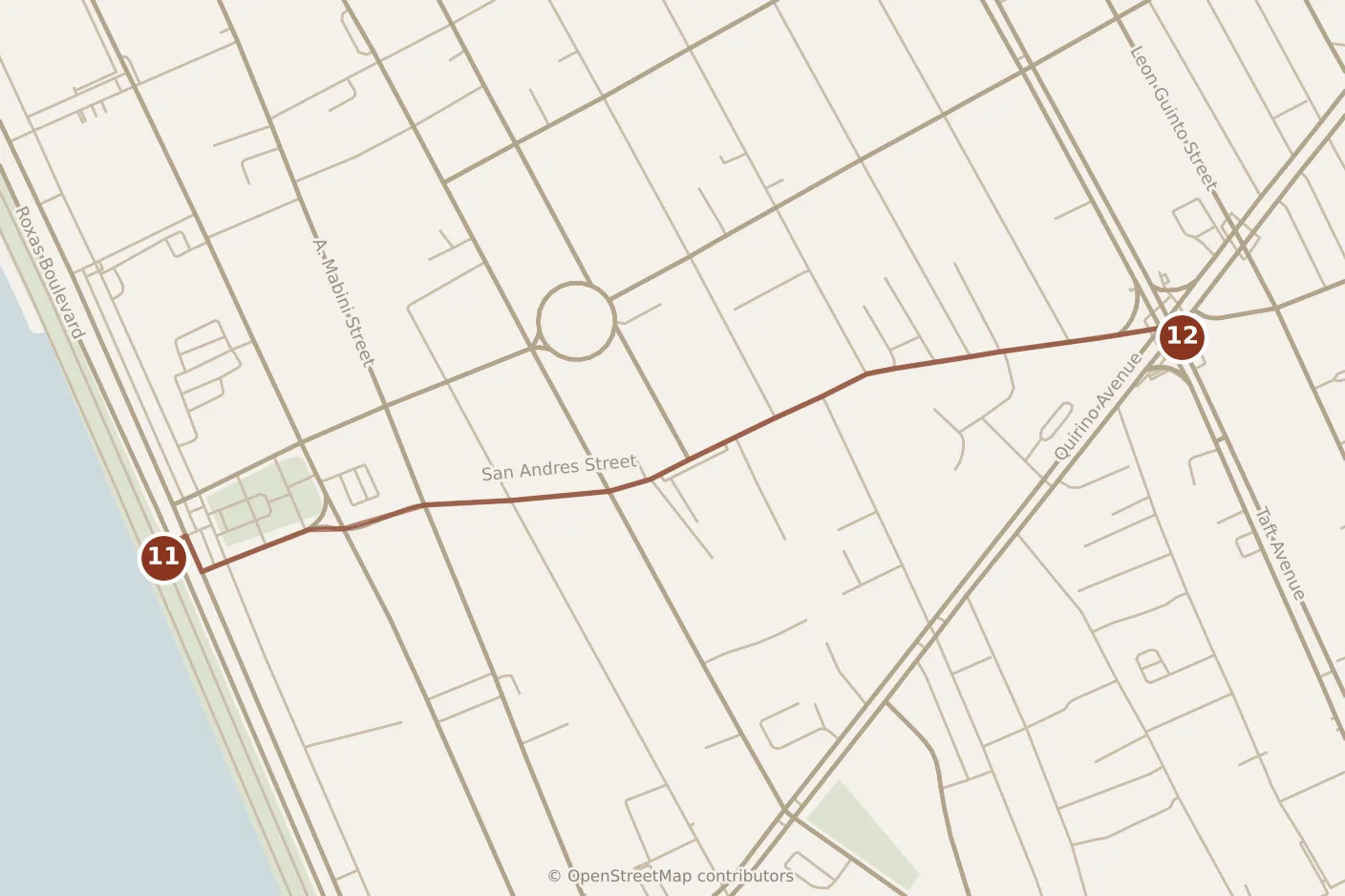
- Evening
- 11Baywalk
- 12Quirino station
Morning
Start at Carriedo station on LRT-1. From the bay-side hotels that is two or three stops north from United Nations or Pedro Gil; from the business districts, take MRT-3 to its southern end at Taft Avenue, cross into the LRT-1 station there, which is called EDSA, and ride north to Carriedo.
From the station, walk west into Ongpin Street. This is the spine of the oldest Chinatown in the world — a settlement founded in 1594 for Chinese converts, put here deliberately across the water from the Spanish walled town so that it could be watched from it — and it is a working commercial street rather than a preserved one: gold dealers, herbalists, roast-duck windows, bakery counters selling hopia by the box. It is a quarter of an hour’s walk to the far end and the point is to take an hour and a half over it. Eat here, and eat properly, because nothing later in the day is as good: a bowl of noodles sitting down, a siopao from a counter, fried lumpia in your hand for the walk.
Binondo Church closes the street: an octagonal granite bell tower and, behind it, a church rebuilt after the fighting of 1945 flattened this quarter along with almost everything else you will look at today. Twenty minutes.
Ten minutes on is Escolta Street, which was Manila’s main shopping street before the war and is now a strange half-occupied corridor of nineteen-twenties and nineteen-thirties commercial buildings with hardware sellers in their ground floors. Twenty minutes is enough: walk it and look up. It is not a restored street and it will not behave like one.
Five minutes at the bottom of it is Jones Bridge, and crossing it is the hinge of the day. Stop in the middle. Facing the walled town, the river runs away to the sea on your right, Chinatown is behind you, and the whole shape of what the Spanish built — a fort on the water, a wall around it, everybody else outside — is laid out in one view.
Afternoon
Fort Santiago is a bit over a quarter of an hour west along the south bank, and it is the only stop today worth more than an hour. It is the citadel at the river-mouth corner of the walls: a gate with a stone relief above it, a parade ground, ruined barracks, and cells at the water’s edge. Give it an hour and a quarter, and the reason for the quarter is the Rizal Shrine inside — the building where José Rizal spent his last night in December 1896, holding the shells he had collected in exile, his manuscripts, and the story of the oil lamp, in which he hid Mi último adiós, the poem he wrote that night, and had it carried out to his sister. Everything at the far end of this day is the second half of that sentence.
Eleven minutes east through the walls is Manila Cathedral on the old central square. It has been destroyed and rebuilt eight times — fire, earthquake, typhoon, and finally 1945 — and the building you walk into was consecrated in 1958. Twenty minutes: a large, plain interior where the interest is the fact of it rather than anything in it.
Five minutes south down General Luna Street are the two buildings that are the reason to be inside the walls at all, and they face each other. Casa Manila first: a reconstruction, put up in the nineteen-eighties, copying an eighteen-fifties merchant’s house that stood in another quarter of the city. Knowing it is a copy is what makes it worth the ticket rather than what spoils it — nothing original survived here to furnish — so what you get is a museum of how the rooms were arranged and used, up a stone staircase to a floor of sliding shell windows, a dining room laid for a household, and a lavatory built for two people to sit in at once. Forty minutes. It is also the one stop on this route that shuts a whole day a week: Mondays, in 2026.
Then a minute across the street to San Agustin Church, which is the opposite kind of building. Completed in 1607, it is the oldest stone church in the country, it was the only one of the seven churches inside these walls to survive 1945, and it has been on the UNESCO World Heritage list since 1993. Go in and look up before anything else: the barrel vault appears to be carved into panels, rosettes and mouldings, and is in fact flat plaster painted to look that way, an illusion of the eighteen-seventies that holds all the way from the floor. Then the choir stalls in dark molave with ivory inlay, the pulpit with pineapples worked into the carving, and Legazpi, who founded the Spanish city in 1571, buried inside it. An hour, with the monastery museum alongside if the heat has beaten you and you want to sit down.
Local tip. These two are ticketed separately and stand a minute apart, which makes them the one place on this route where the day can be shortened without losing its shape. If you are running late, or if it is a Monday and the house is shut anyway, drop the copy and keep the original: the reconstruction is the one you can imagine from a photograph, and the church is the one you cannot.
Eight minutes south along the inside of the wall is Baluarte de San Diego, and this is the stop that fixes the shape of the whole day. It is the round stone keep at the southern corner of the defenses, opened out into a sunken garden you walk down into and then climb on to. Forty minutes, and it is the best place on the route to understand what these walls actually are — how thick, how low, how much earth is packed inside them. It also stopped admitting anyone after four in the afternoon in 2026, and it is the only thing on this route that does. That is the reason the day starts at nine rather than later: nine puts you at the gate at about half past three, which is half an hour of margin and no more. If you get there and find the hour has moved, build the afternoon back from the new one — everything above the bastion is the fixed part, and it comes to about six and a half hours.
If the heat has won by now, this is the hour halo-halo exists for.
Out through the walls and eight minutes south across the moat lawns is Rizal Park, and here the morning’s story ends. This is Bagumbayan, the old execution ground: Rizal was shot here on 30 December 1896, on a spot now held by a group of bronze figures standing in the actual place, and his remains lie under the monument just south of them. In front of that monument is Kilometer Zero, the point from which every road distance in the country is measured, and the flagpole where independence was proclaimed in 1946. Thirty-five minutes for all of it, and walk west while you do, because the park runs out at the sea.
Evening
The last stretch is the longest single walk of the day and it is also the stop: half an hour south along the sea wall, the Baywalk, on the seaward side of Roxas Boulevard. Do it slowly. The bay is open water straight ahead, the promenade fills at this hour, and there is nothing to see except that — families, students, people selling grilled things on sticks. In the short half of the year you will be walking into the sunset as it happens; in June you will have an hour on the wall before it does, which is not time to fill but time to sit.
When you have had enough, Quirino station on LRT-1 is about twenty minutes inland on foot, straight east along the avenue of the same name. It will be dark, and the honest alternative is the one the city guide already recommends for Manila after dark: Roxas Boulevard is wide, lit and the easiest street in the city to be collected from, so a booked car is a reasonable end to the day rather than an admission of defeat. Either way, that is where the day’s one piece of arithmetic pays off — you finish nearer the airport than you began, with nothing left behind you to collect.
Practicalities
Nothing on this route is booked in advance and nothing needs to be. There are four ticketed stops and not three: the fort, the reconstructed house and the bastion were seventy-five pesos each in 2026, and the monastery museum beside San Agustin two hundred. All four are walk-up gates taking cash. That is the whole financial content of the day; the card above covers what the transport costs and how it is paid for, and the city guide covers the rest.
Two weekdays matter, and only one of them is a museum. Casa Manila is shut on Mondays, and it is the only interior on this route that closes a full day a week: the fort, the cathedral, San Agustin and the bastion all run seven days. So a Monday costs this route exactly one stop out of thirteen, and the tip above says what to do about it. That is worth knowing precisely because it is not true of a longer stay in Manila, where the museums this day already gives up are the ones that close. The second weekday belongs to the sea wall rather than to anything with a ticket: the first five hundred meters of Baywalk south of the park, the dolomite stretch between the embassy and the yacht club, is a gated section, and in 2026 it closed all day on Thursdays for maintenance and shut its gate at six in the evening on the other six days. Neither ends the evening — the wall runs on far longer than that stretch does — but they decide where you get on to it, so on a Thursday, and in the months when six o’clock falls before sunset, join it below the gate instead of at the park’s own corner. If those hours have moved, the test has not: set the gate against sunset in your month, and get on the wall wherever it is open.
Sunday is the day the churches catch you rather than the museums. Binondo Church in the late morning and San Agustin in the mid-afternoon are working parishes with services running, and on a Sunday you will be standing at the back of a full church rather than walking around an empty one. That is not a reason to change the day — it is arguably the better way to see either building — but it is a reason not to plan on twenty unhurried minutes with the bell tower.
Everything here is walking, and there is no transport inside the route at all: both ends are LRT-1 stations, Carriedo at the top and Quirino at the bottom, and between them the longest single stretch is the half-hour down the sea wall in the evening, and the next longest is the seventeen minutes from the bridge to the fort. What that means in practice is that the route has almost no roof over it — the hour or so inside the walls is the only sheltered part of the afternoon — so in the wet months, when the rain arrives in the afternoon, the walled city is where you want to be when it does. Ordering the day the way it is written puts you there.


.jpg)