Madrid in two or three days: the palace and the Habsburg center, the Paseo del Arte, and a third day west

Last updated 4 August 2026
Overview
Two days is the length at which Madrid stops being a list of three museums. The old city is genuinely small — you can cross it on foot in half an hour — so a second day does not buy more ground. It buys doors: the convent behind a plain wall on a shopping street, sealed off from the world since 1559; the crypt under the cathedral that most people who go into the cathedral never learn is there; the third hour in a gallery that a single day forces you out of. A third day buys something else again, which is the ground west of the palace, where the city drops away towards the river and the whole western sky opens up.
The shape barely uses transport. Day one is everything west of Puerta del Sol: the palace at opening, the crypt, two Habsburg squares, a long lunch, and a guided hour inside a working convent. Day two is the Paseo del Arte, the avenue that carries the Prado and the Reina Sofía about eight hundred meters apart, with a botanical garden and a row of second-hand book stalls between them. Both days are walked end to end. The only ride from one stop to the next is on the third day, and it changes lines once.
What settles which day is which is the weekday, not the hour. The convent on day one shuts one day a week and it is Monday; the chapel the third day is really for shuts on Mondays as well; the Reina Sofía, which is half of day two, shuts on Tuesdays. So day two is the only one of these days that can take a Monday, and it is the one day that cannot take a Tuesday — and that sentence arranges any two or three consecutive dates you happen to have. A Sunday among them is arranged inside the day rather than between the days, and both of the first two days below say how. Monday and Tuesday: run day two first. Tuesday and Wednesday: run day one first. Each institution publishes its own closing days, and reading them the week before costs a minute.
Neither of the first two days is built around the light. Each rests on one hour, and both hours are given where the route reaches them. The third day is the one built around the sun, so the band is worth having in advance: the sun goes down here anywhere between a little before six, in the first week of December, and ten minutes short of ten at midsummer. Spain keeps central European time although Madrid sits west of Greenwich, which is why the light runs so late in summer, and why dinner does too.
One thing wants to be in your hand before you arrive, since a reader who has landed on this page has not necessarily read anything else: two timed tickets, the palace on the morning of day one and the convent’s guided session on the afternoon of the same day. Both are sold by the body that runs them, and it is the same body for both: Patrimonio Nacional, which holds the crown properties. Search for that name rather than for the monument — search for the monument and you will be offered half a dozen intermediaries before you are offered the people who own it. Both of those hours sit on your arrival day, so book them against your train rather than against a blank date: if your train cannot make the start day one is counted back to, run day two first — nothing in it is booked ahead — and take day one on your next date, under the weekday rule above. The two museums on day two can be bought at the door, but the desk is the reason not to. The palace was the dearest of these tickets in 2026, in the fifteen- to twenty-euro range; the convent’s guided visit was a single-figure sum, and the museums sat between the two. How the metro is paid for, and everything else true of Madrid rather than of this route, is in the city guide.
Barrio de las Letras — not on the walking map.
- Day two · Evening
- Barrio de las Letras — in the prose, not on the map
Day one

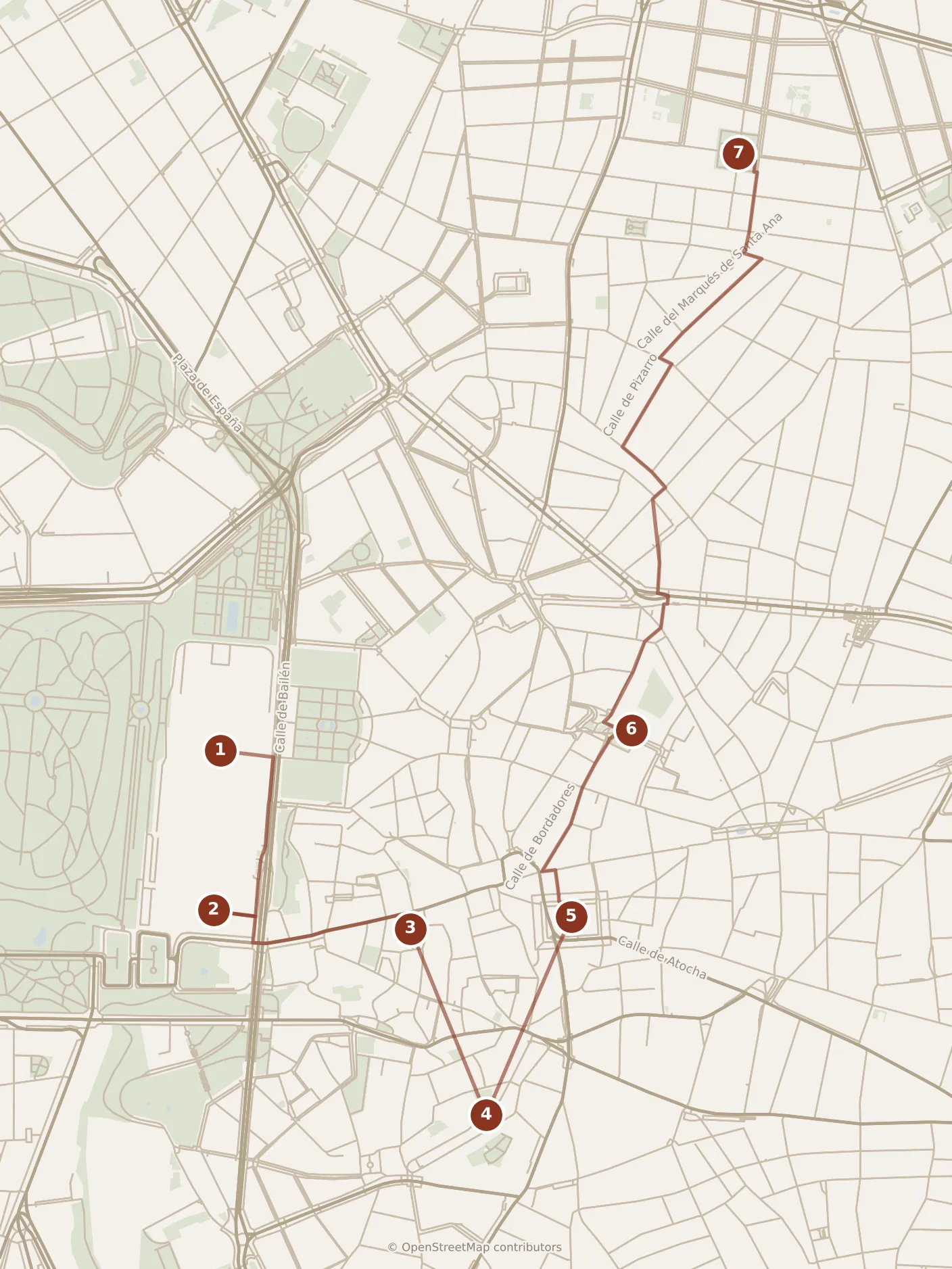
- Day one
- 1Palacio Real de Madrid
- 2Catedral de la Almudena
- 3Plaza de la Villa
- 4Cava Baja
- 5Plaza Mayor
- 6Monasterio de las Descalzas Reales
- 7Plaza del Dos de Mayo
Everything today sits inside a square kilometer between the palace and Puerta del Sol, and the day drifts north-east across it without doubling back once. It is the Habsburg and Bourbon city: three interiors, two squares, and a lunch that is a stop rather than an interruption.
Morning
First, the leg nobody describes. Arriving by high-speed train you are at Atocha: line 1 to Sol, then line 2 one stop west to Ópera, and the palace is under ten minutes’ walk from that exit. From Chamartín, line 10 runs to Plaza de España without a change, and from there it is a little over ten minutes downhill along Calle de Bailén with the palace wall on your right. From the airport, line 8 to Nuevos Ministerios and then line 10 to Plaza de España, joining that same walk. Half an hour from either station; nearer an hour from the airport, and more again from the far terminal.
Be at the Palacio Real de Madrid for opening, whatever hour that is in the month you come. This is the one stop in three days where being in the first group through the door is worth real money: everybody who goes in goes in through a single door, and the line at it is the only thing here that can wreck a morning. Give it two hours. It stands on the site of the Alcázar, the fortress the Habsburgs lived in, which burned to the ground in the last days of 1734. What went up in its place is a masonry building with almost no wood in it — a decision about fire rather than about architecture — and Charles III was the first king actually to move in, in 1764. You do not choose a way through it; there is one, and it runs one way, so the only variable is where you stand still. Stand still in three rooms. The Gasparini room is a single chamber of embroidered silk, stucco and inlaid marble in which no two surfaces agree with each other. The porcelain room near it has walls and ceiling made entirely of Buen Retiro porcelain, modeled in place and fitted together like a puzzle. And the Royal Chapel is where the palace stops being decoration and becomes a building. The Royal Armoury has its own hall off the great courtyard and is covered by the same ticket; keep the last half hour for it, because after two hours of silk and gilding, plate armor is a change of subject rather than another room.
Out of the palace, cross to the Catedral de la Almudena opposite — but walk past its west front and round to Calle Mayor, where the crypt has a door of its own. This is the half of the building almost nobody sees, and it is much the older half: it was finished and opened in 1911, more than eighty years before the church above it was consecrated, and it is neo-Romanesque where the church is not. Nearly four hundred squat columns hold up a low forest of vaulting and no two capitals are carved alike. Entry is free, a donation is asked, half an hour is plenty. It is also a working parish church with burials in the side chapels, so if a service is under way, go round it rather than through it. It keeps its own hours, shorter than the cathedral’s, and shuts over the middle of the day; the parish publishes them, and taking the crypt at the end of the morning is how you stop the question arising.
Five minutes east along Calle Mayor the Plaza de la Villa opens off the south side of the street. Ten minutes. It is a courtyard more than a square — built on three sides with the street entering at one corner — and the thing to look for is the covered passage that crosses the alley behind it, joining two of the buildings over your head.
Afternoon
Seven minutes south-east, down into the lanes below the Plaza Mayor, and lunch is a stop rather than a pause. Cava Baja and the streets either side of it are a continuous row of old lunch-and-vermouth houses, and this is the day to eat cocido madrileño instead of reading about it: a chickpea and meat stew that arrives as three separate courses out of one pot — first the broth with fine noodles in it, then the chickpeas and the boiled vegetables, then the meats. Give it two hours. It is the clearest single thing a second day buys, and Madrid does not sit down to lunch until two.
Seven or eight minutes north-east and you are under the arcades of the Plaza Mayor. Twenty minutes, spent on what the square was for rather than on the brickwork. It was built as a stage: royal proclamations, canonisations, bullfights and the public spectacles of the Inquisition all happened inside this rectangle, with the balconies rented out by the window. Then walk out of its south-western corner, where you get the other thing about it — the ground falls away, and the Arco de Cuchilleros drops a full story of steps into Cava de San Miguel, so the square you have been standing in turns out to have been a first floor.
Six minutes north is the Monasterio de las Descalzas Reales, which from the street is a blank wall on a busy shopping block and inside is the strangest interior in central Madrid. Juana of Austria — daughter of Charles V, sister of Philip II — founded it in 1559 in the palace where she had been born, and for two centuries the daughters and widows of the court entered it as Poor Clares, each bringing a dowry paid in art. So a Franciscan house vowed to poverty contains a frescoed staircase painted to look like a royal one, panels by Titian and Sánchez Coello, and the Triumph of the Eucharist tapestries that Isabel Clara Eugenia commissioned to Rubens’s designs and had woven in Brussels. Give it the hour the guided visit takes — and it is guided because it is not a museum, and the guiding is in Spanish only. A community of nuns still lives behind the doors you walk past, so you go at the guide’s pace, you do not wander off on your own, and photography is not allowed inside.
This is the hour the day rests on. In 2026 the afternoon session opened at four and took its last group in at half past five, and on a Sunday there was no afternoon session at all. Build the afternoon back from that hour; if it has moved, build it back from the new one.
Local tip. Of the two ticketed things today, only one can be moved, so book the convent first and hang the rest of the day off it. If its afternoon session is full, or if your day one falls on a Sunday, take the earliest session instead and run the whole day backwards — convent, crypt, palace, lunch at half past two. Nothing else today is timed, so nothing else has to move. What that costs is not the pleasure of eating late but the empty palace: you reach its single door around midday rather than at opening, which is the line this day is otherwise built to dodge, so allow for it. And on a Sunday allow for the table as well — the Rastro runs through the lanes below Cava Baja until three and empties into their bars when it packs up, so half past two is the busiest hour of the week down there and it wants booking rather than walking into.
The stops and the walking above come to about six and a half hours as written, with the long lunch that is half the point of them, and an hour less if you eat standing up. That is the figure to count back from the convent’s session to find your starting hour, and it counts the time you spend inside things and walking between them, nothing else. It does not include the line at the palace’s single door, which is the same door for everybody however they bought their ticket and is the one place today where twenty minutes can vanish standing still, and it does not include the walking inside the palace, which is a real distance in its own right.
Evening
Just under twenty minutes north of the convent, gently uphill, the Plaza del Dos de Mayo is the middle of Malasaña. This is the part of the city day one has otherwise ignored: no monuments, a square full of people sitting on the ground, cheap and late bars round all four sides. It is the right correction after a day of royal interiors.
Day two

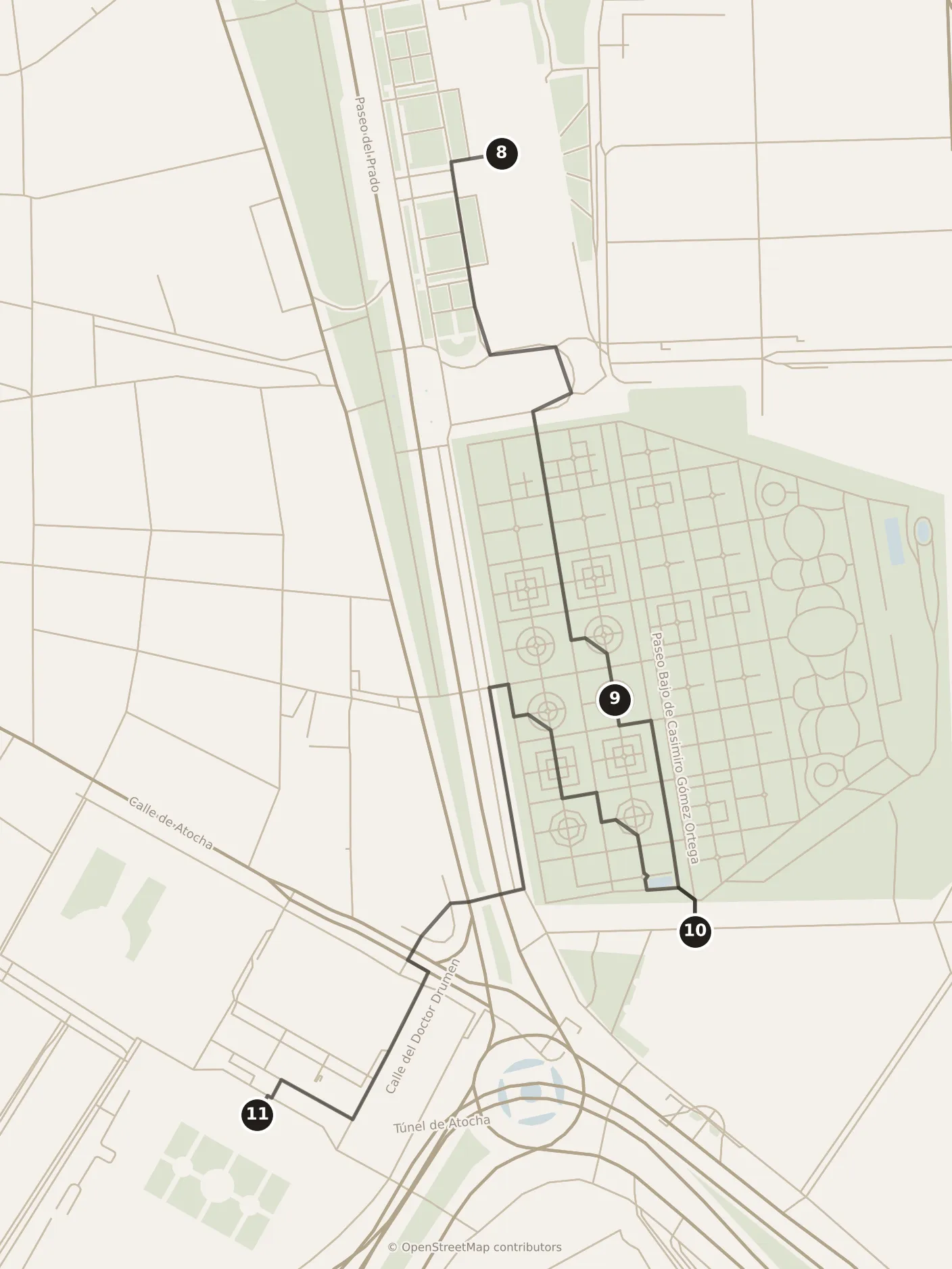
- Morning and afternoon
- 8Museo del Prado
- 9Real Jardín Botánico
- 10Cuesta de Moyano
- 11Museo Reina Sofía
Today is one avenue. The Paseo del Arte runs south from the top of the Paseo del Prado, and the whole day happens along about a kilometer of it, so there is no navigating to be done: the walking between the four stops totals well under twenty minutes.
Morning
Take the Museo del Prado at opening and give it three hours — or the two the tip below cuts it to, which is a real version of this day rather than a consolation. The first hour is the emptiest of the day by a wide margin; give it to Velázquez and Goya and then leave them. What makes three hours different from two is everything on either side.
This is not a survey museum but a household’s accumulation, which is why it is unrepeatable in some rooms and simply empty in others: the crown collected what it liked, and stopped when it stopped. Take the Italian rooms — Titian’s Charles V at Mühlberg, painted for the emperor who won that battle and kept by his descendants ever since, and the mythological pictures Titian went on sending to Philip II for twenty years afterwards. Take the Flemish, deep for the same reason, since the crown ruled those provinces for two centuries and bought accordingly. Fra Angelico’s Annunciation is here because a ducal family gave it away and a queen took it in. El Greco is the great painter of Spain that a hurried visit always drops, and the tall thin saints are far stranger in a row than one at a time. And if you already know Goya’s late black paintings, walk the tapestry cartoons before them — bright, cheerful, commercial designs for the royal weavers, painted by the same man forty years earlier — because the distance between those two rooms is the whole biography.
The building deserves ten minutes on the way out. The extension of 2007 wrapped itself round the cloister of the Jerónimos monastery next door: Moneo had the cloister taken down stone by stone and rebuilt inside the new block, so you come out of a nineteenth-century gallery into a sixteenth-century courtyard with a roof over it.
Local tip. If the day is short, do not drop one of the two museums — shorten both. The Prado at two hours, taking only the Spanish rooms, and the Reina Sofía at one, going straight up to Guernica and back down, still leaves you having seen both collections, which dropping one does not. The stop that actually goes first is the botanical garden below, because it is the only thing today whose value is the time you spend in it rather than what you look at.
The Real Jardín Botánico has its main gate beside the museum’s southern end, three minutes away and a different climate. It was moved here for Charles III in 1781 and laid out on three walled terraces, and it is still arranged as a scientific collection rather than a park — labeled beds in straight lines, not lawns — with almost nobody in it. Forty-five minutes, and it is the one place in three days where you stop hearing the traffic.
Afternoon
Out of the garden’s southern gate onto the Cuesta de Moyano, where the permanent second-hand book stalls run in a line down the hill along the garden wall. A quarter of an hour to walk it, and it costs nothing; it is the last surviving piece of a kind of street this city used to be full of. Lunch belongs in the streets between here and the next stop rather than on the avenue itself, where the eating is aimed squarely at the museums.
Six minutes west is the Museo Reina Sofía, and give it two and a half hours. The building is half the story: the old general hospital of Madrid, built under Charles III to Sabatini’s design, a vast plain block of wards turned into a museum in the 1980s, with Nouvel’s red extension bolted on behind it in 2005. Inside, the collection is the Spanish twentieth century and it is hung as a century rather than as a gallery of names. Guernica is why most people come and it deserves the room it has: painted for the Spanish pavilion of the Paris exhibition of 1937, kept out of the country for four decades, and shown here among the preparatory studies and the photographs taken in the studio while it was going up, which turn it from an icon back into something a man worked out on a wall. Then give a real hour to the rest — Dalí, Miró and Juan Gris are all here in strength, and the Picasso rooms around Guernica are not an afterthought.
This is the day’s one hour and it is dangerous only once a week. In 2026 the Reina Sofía shut at half past two on Sundays and stayed open into the evening every other day it opened at all. So if your day two is a Sunday, reverse it: the museum at opening, then the garden and the book stalls, then the Prado for the afternoon, which on a Sunday runs to early evening and holds the day perfectly well. On any other day the order above is better and there is no deadline in it at all — the reason to start early is the crowd, not the clock.
The day accounts for about eight hours of stops and walking with a short lunch. What that count leaves out is the security check and the cloakroom at both museums, and the walking inside the Prado, whose main gallery is a couple of hundred meters end to end and which you will cross more than once.
Evening
Walk north out of the museum, just under twenty minutes, into the Barrio de las Letras. The two days end up here because it is where the city’s writers lived, on top of one another and mostly at war: Lope de Vega’s house is a museum on a street named after Cervantes, and Cervantes is buried in a convent on a street named after Lope de Vega. The lanes are quiet, cobbled and set with lines of verse in bronze; the drinking axis through the middle of them is loud until very late; and both of those are true at the same time about ten meters apart. Dinner goes in the lanes; the axis is for after it, if you want it at all.
With a third day

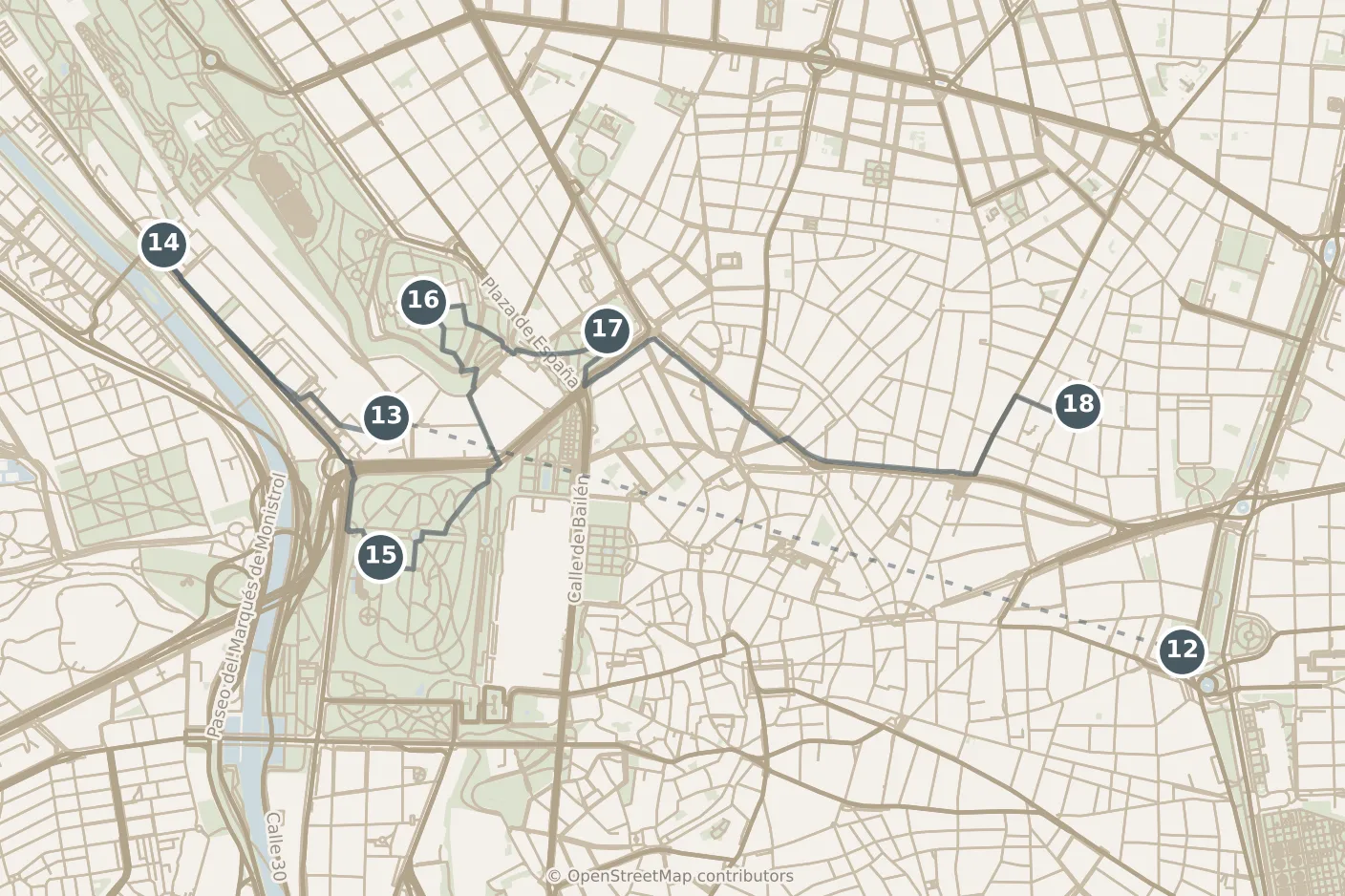
- With a third day
- 12Museo Thyssen-Bornemisza
- 13Príncipe Pío
- 14Ermita de San Antonio de la Florida
- 15Campo del Moro
- 16Templo de Debod
- 17Plaza de España
- 18Chueca
The third day goes on the end, not in the middle, and it goes west. Days one and two are a pair that share the same center and the same feet; this one leaves the center, uses the article’s one ride between stops, and finishes at the top of Gran Vía, which is where you want to be on the day you travel.
It is also the day that stays put when the weekday forces a swap, and a Tuesday in the middle is the case that shows why. Three consecutive dates with a Tuesday in the middle are Monday, Tuesday and Wednesday, and the Monday is the harder of the two: the convent on day one is shut that day, and so is the chapel below. Day two is the only one of the three that can take a Monday, so day two goes first, and days one and three take the Tuesday and the Wednesday in that order — nothing on this day cares which of those two it is. Where the weekday leaves the order free, day one goes first, because it is the only one of the three written from a station.
Begin at the Museo Thyssen-Bornemisza, in the Palacio de Villahermosa at the top of the Paseo del Prado, and give it two hours. It earns the third day rather than the second precisely because of what the other two leave out. It is a private collection put together by two generations of one family across the twentieth century and bought by Spain in 1993, and it is strongest exactly where the two national museums are bare: early Dutch and German painting, Dürer, the Italian primitives, and then two floors of Impressionists and nineteenth-century American painting that exist nowhere else in this city. It hangs chronologically from the top down, so start on the upper floor and walk downhill through five hundred years.
Then the one ride. Banco de España station is five minutes from the museum door; take line 2 west three stops to Ópera and change there onto the short branch line — the Ramal, which is how it is signed — one stop, to Príncipe Pío. Under twenty-five minutes altogether, and it puts you at the bottom of the city, on the flat by the Manzanares, which is a different Madrid from the one you have spent two days in.
A quarter of an hour north-west along the river is the Ermita de San Antonio de la Florida. It is free, it takes forty-five minutes, and it is the best thing on this day. From the middle of June to the middle of September it shuts over the middle of the day, between two and three, and closes an hour earlier in the evening than it does the rest of the year — which is why the long lunch on this day goes before it and not after. A small round chapel built for Charles IV in the 1790s, and Goya frescoed the dome in 1798 in a few months. What he painted is Saint Anthony of Padua raising a dead man to give evidence — and instead of angels on the balustrade that runs round the dome, he crowded it with ordinary people of Madrid leaning over the rail to watch, painted from below, so you look up into a gallery of faces looking down at you. Goya himself is buried under the altar; his remains came back from Bordeaux in 1919 without the skull, which had already gone missing. An identical second chapel was put up alongside in the 1920s so the parish could keep holding services without the candle smoke, which is why the original is now silent and empty.
Twenty minutes back south along the river brings you to the gate of the Campo del Moro on the Paseo de la Virgen del Puerto. These are the palace gardens on the western slope, free to walk into, and they are the view of the palace nobody gets from the front: a wooded park in the English manner climbing a hill, with the whole west facade standing along the top of it, which is the elevation the building was meant to be seen from. Three quarters of an hour. It keeps garden hours and shuts earlier in winter than in summer, and it is palace ground rather than a city park — the same body runs it that runs the palace, and publishes its calendar in the same place.
The last stop is the one the day is built around. Fifteen minutes north from the garden gate, the last of it a climb up the Cuesta de San Vicente, the Templo de Debod stands on an open terrace on the high western edge of the center — an Egyptian temple given to Spain and re-erected here in the early 1970s. The building is not the point and the single chamber inside it is not why you have come. The point is where it stands: this is the last rise before the city runs out, the ground drops away in front of it for kilometers, and the whole western sky is available at once, which is a thing central Madrid otherwise never gives you. Nobody sells a ticket to the terrace and nobody locks it, so the hour is decided by the sky.
So count. From the museum door, the stops and the walking above come to about five hours before lunch is added and nearer six and a half with it. That count and the sunset agree only in the short half of the year: from about November to February, subtract it from your month’s sunset and you get a late-morning start and a day that closes exactly on the light. The rest of the year the sun stays up longer than the chapel and the gardens do, and forcing the arithmetic sends you to two locked doors. So run those months forwards instead — start at opening, eat properly at two, take the chapel and the gardens through the afternoon — and accept the gap the day leaves you before the light goes, which in July is closer to five hours than to two: the day as counted ends in the middle of the afternoon and the sun does not. That is an evening rather than a gap to fill, so spend it below instead of standing about on the terrace. The Plaza de España is ten minutes east and downhill from the temple, Gran Vía begins there, and eating before sunset rather than after is the one thing a Madrid July makes easy. Then walk back up the hill for the sunset alone: ten minutes, and this is the only stop in the article worth doubling back for.
If the evening is simply gray or wet, the temple gives you nothing and there is no substitute for it, so do not stand about waiting for a sky that is not coming. Take the same ten minutes down to the Plaza de España instead, which puts you at the top of Gran Vía with the whole evening ahead of you rather than behind it. That costs nothing at all, because it is the same evening, simply begun earlier.
Either way the day ends the same. Gran Vía runs half an hour east from the Plaza de España and is worth walking rather than riding under: it was cut through the medieval street plan from 1910 onwards, and the point of it is the parade of ambitious early twentieth-century buildings down both sides. Chueca is a couple of streets north of its eastern end, and that is where the last dinner goes — or, if the July gap has already fed you at the foot of the hill, where the evening simply ends.
A third day out of the city is a real alternative and this article does not take it. Toledo is a little over half an hour from Atocha on the high-speed line, which is exactly what tempts people into trying it; the case against is not the distance but the trade, because it takes the whole day and hands back a different city rather than more of this one. If you do go, book the train ahead — the cheap fares sell out first — give it the entire day rather than a morning, and know that everything above is what you are spending on it.
Practicalities
Two things want booking before you arrive and neither is a museum: the palace slot on the morning of day one and the convent’s guided session on the afternoon of the same day, both run by the same national body and sold on its own site. The two big museums on day two are worth buying online the night before purely to skip the desk. The other tickets in this article are the Museo Thyssen-Bornemisza, which opens the third day, and the Real Jardín Botánico on day two, which charges at its own gate; the crypt, the palace gardens, the chapel, the squares and the temple terrace are all free and walk-in.
The weekly closures decide more here than the hours do, and the rule is in the Overview: day two takes the Monday, day two avoids the Tuesday, and the third day stays on the end whichever of the other two goes first. Two things to add to it. A Monday arrival looks like the trap and is not — put day two first and the rest falls out on its own. And check the closing calendars at the moment you buy the tickets rather than as a separate errand later, because a public holiday can close any of them regardless of what weekday it is.
Two stops can also shut at very short notice, and for the same reason. The palace is still in official use, and when the household needs it the doors close to visitors; that is published, but sometimes only days ahead. If it happens, the answer is thirty meters away. The Galería de las Colecciones Reales is a separate building with its own door and its own ticket on Calle de Bailén, between the palace and the cathedral, holding the tapestries, armor, carriages and paintings the crown kept rather than hung, and it absorbs the same two hours. Check both at the same moment and from the same body, because an occasion that closes one does not automatically close the other, and you want to know which before you are standing on the square. The Campo del Moro is run by that same body and is worth the same look at the same moment, because it has no substitute and it is a twenty-minute walk from the previous stop: if it is shut on your third day, go straight from the chapel up to the temple and give the extra hour to the Jardines de Sabatini on the palace’s northern side, which are entered off Calle de Bailén and cost nothing.
The walking is about three kilometers on day one and a little over two on day two, and close to six on the third — which is worth knowing, because the third day looks like the easy one and is not. Nearly a third of that six is the last stretch along Gran Vía after dark, and the only real climb in three days is the one up to the temple. What the center has very little of is shade, and that same third day is the exposed one: the river walk, the climb, and a terrace with no shade on it at the hour you are asked to stand still on it. Day two is the sheltered day — the Paseo del Prado is planted down its central walk, and most of its hours are indoors anyway. Which is what turns a long midday lunch in July from an indulgence into the plan.
On luggage: this article assumes you are sleeping in the city, so the bag is a problem on the first morning and the last evening only. Do not build the morning on the station taking it: the lockers that used to be at Atocha have closed, and what is operating there now is worth establishing before you travel rather than at nine with the bag in your hand. What matters is that neither of the days that can go first begins at a station — day one opens at the palace, a good two kilometers across the center from Atocha, and day two opens at the Prado’s door — so be rid of the bag before the day begins rather than in the middle of it. At the other end, the third day finishes in Chueca, whose own station is one stop from Gran Vía on line 5, and line 1 from Gran Vía reaches both main stations without a change: south to Atocha, north to Chamartín.


.jpg)
.jpg)
.jpg)
