Madrid in one day: the Prado in the morning, royal Madrid on foot, and Debod at sunset

Last updated 3 August 2026
Overview
Madrid is a large city with a small middle, and that is the whole reason one day works here. Everything below is a single line running east to west, about six kilometers of walking spread across a day, and it never turns back: park, museum, the old Habsburg streets, the palace, and then the western edge of the center where the ground rises and the sun goes down. There is no transport between any two stops on it. The only rides are the one that brings you in and the one that takes you home.
What the single day costs you is the other two museums, and it is worth saying plainly because almost every one-day list refuses to. Do not go to the Reina Sofía, which means you do not see Guernica. It sits about ten minutes’ walk down the same avenue from the Prado, it is a real museum rather than a room with one painting in it, and taking it is not an hour — it is the afternoon, and the afternoon is the half of this day that is free, outdoors and unrepeatable. The Thyssen goes the same way, for the same reason. One day in Madrid buys exactly one museum, and choosing which is the only serious decision in planning it. This route chooses the Prado because the Prado is the one that could not be anywhere else: it is a royal collection rather than a survey, so it is unmatched at four or five painters and simply absent everywhere else, and that is a thing you cannot see a version of in another city.
Other things go cleanly. The nightlife barrios north of Gran Vía are an evening, not a morning, and this day ends too far west to fold them in. The day trips are worse than useless here: Toledo and Segovia are both under an hour away, which is exactly what makes people try them on their only day, and what they get is a day of stations. And the Rastro is a Sunday morning, which is a different article for a different reader.
The day has one moment that will not wait, and it is the last one. The temple at the far end stands on a hill looking west out over the parkland on the far edge of the city, and it is what it is for the twenty minutes either side of the sun going down; the ground around it is public park with no gate on it, so what fixes the hour is the light and nothing an institution can change. So work backwards. The stops above it, given the time each is worth, come to about seven and a half hours with lunch eaten standing up, and closer to nine if you sit down to it — and that is when to start.
Two things about that number, because a number like it is the thing readers most often act on. The first is what the number is made of. It is the time at the stops and the walking between them, and nothing else: it does not count the ticket lines, and the palace’s is the one to plan against, since it is the only stop here where everyone entering a very large building passes a single desk — which is also why the ticket is worth buying before you arrive. Nor does it count the walking inside the two big buildings, which on this day is not a rounding error: the museum’s long gallery is a couple of hundred meters end to end and you cross it more than once, and the palace’s visit route runs through several dozen rooms in sequence. Add both back before you decide the day is comfortable.
The second is that Madrid’s clock and Madrid’s sun disagree more than almost anywhere in Europe. The city lies west of London and keeps Berlin’s time, so the sun sets here somewhere between just before six in the darkest weeks and nearly ten at midsummer. In winter, seven and a half hours before dark is first thing in the morning and the day fits with nothing spare, which is an argument for the short lunch. In July, counting back the same way would have you starting in the middle of the afternoon — do not. The afternoon is the part of a Madrid summer nobody spends outdoors on purpose. Start in the morning anyway, take the long version of lunch and the slow version of everything, and treat the temple as a separate errand at the end of the evening rather than as the last thing you walk to.
One thing to have in your hand before you come, since a reader of this page has not necessarily read anything else: two timed tickets, one for the museum and one for the palace, bought from the institutions themselves rather than from the resellers a search returns first. Nothing else on this route is ticketed, and nothing else on it needs to be booked. How the metro is paid for, and everything else that is true of the city rather than of this walk, is in the city guide.
The day

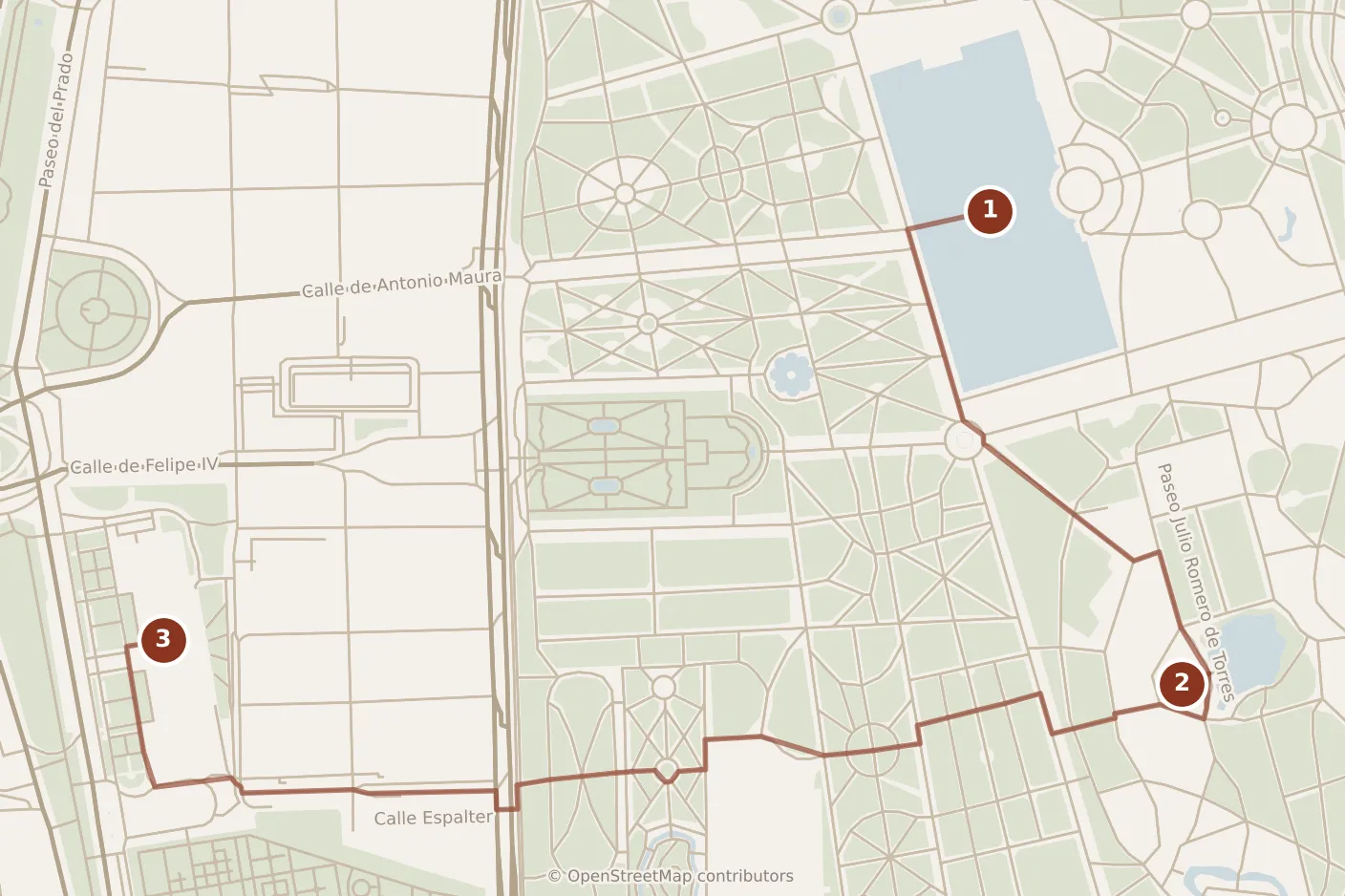
- Morning
- 1Estanque del Retiro
- 2Palacio de Cristal
- 3Museo del Prado
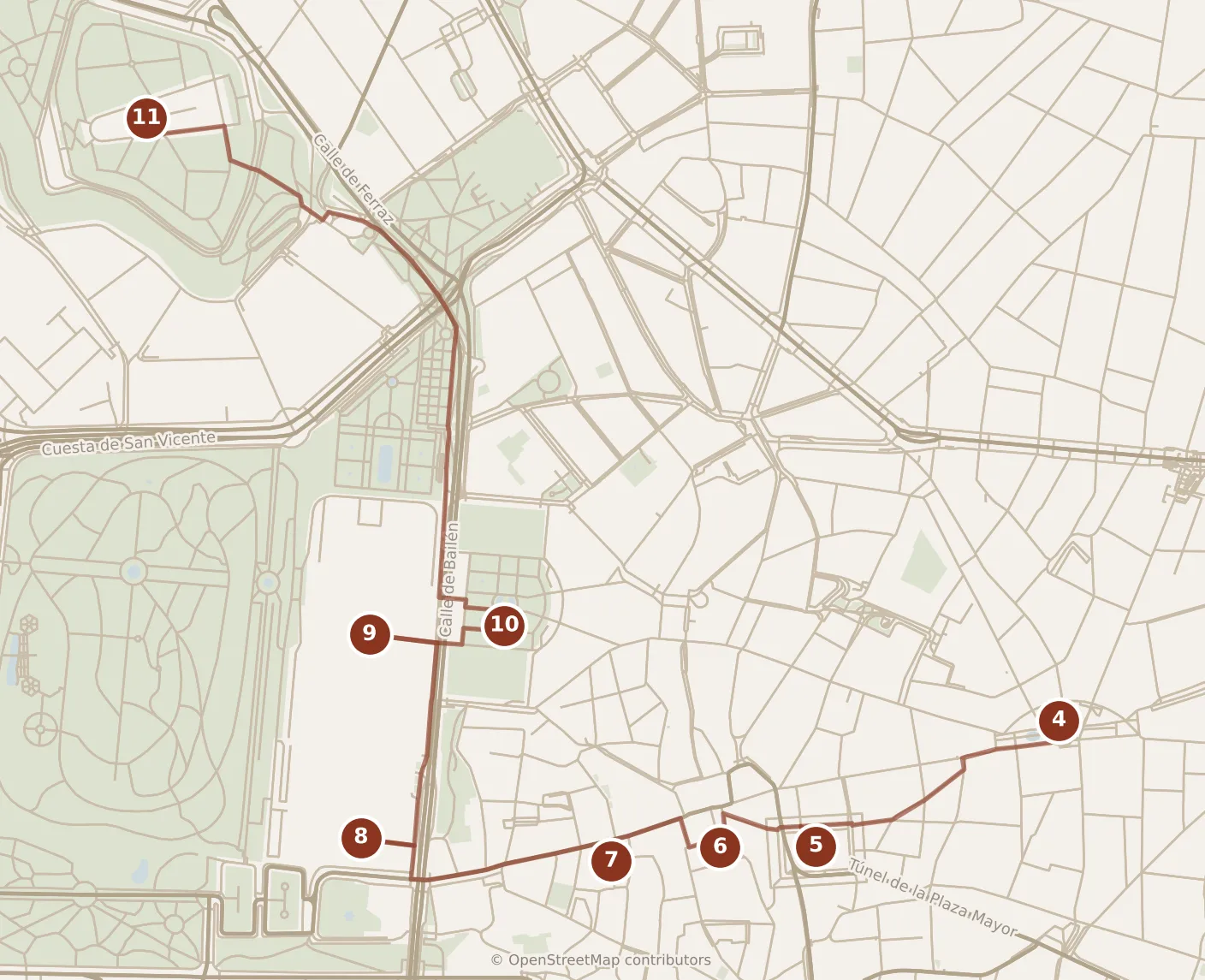
- Afternoon and evening
- 4Puerta del Sol
- 5Plaza Mayor
- 6Mercado de San Miguel
- 7Plaza de la Villa
- 8Catedral de la Almudena
- 9Palacio Real de Madrid
- 10Plaza de Oriente
- 11Templo de Debod
Morning
Start in the Retiro, at the water. The metro station named after the park comes out at its north-west corner and the Estanque del Retiro is under ten minutes from there on the paths. This is a rectangle of artificial lake dug in the 1630s for a royal palace that no longer exists — the Buen Retiro was wrecked when French troops garrisoned it during the war that began in 1808, and what survives of it is a couple of halls elsewhere in the city and this garden, which passed to the town later in the century. On the far shore a half-circle of colonnade carries a bronze Alfonso XII on a horse, put up in 1922, which is the grandest thing in the park and getting on for three hundred years younger than the pond it looks at. Rowing boats are rented out on the water. Whether you take one is a question of whether you are ahead of yourself; this day is not built around it.
Then ten minutes further in, deeper into the park, to the Palacio de Cristal: glass and iron on a brick base, put up in 1887 by Ricardo Velázquez Bosco to hold tropical plants for an exhibition, standing over a small pond with cypresses in it. It is empty except for whatever contemporary installation is in it at the time, and what that is changes, so treat the building and its reflection as the point and the contents as a bonus. There is a small joke in it worth knowing: it is run as an exhibition space by the Reina Sofía, so the one piece of that museum this day does take is its glasshouse in a park. Give the two of them together about forty minutes. In the short months, when the light runs out early, this is the forty minutes to hand back.
Come out west and walk down to the Museo del Prado, fifteen minutes, the park at your back and the museum’s long flank ahead of you along the Paseo del Prado. Two hours here, and the two hours work only if you understand what the building is. Juan de Villanueva designed it in 1785 for Charles III, as a cabinet of natural history; it opened as a picture gallery in 1819, and its collection is what the kings of Spain bought, commissioned and were given over three centuries. That is why it is shaped so oddly. It holds the largest collection of Velázquez anywhere by a distance, and of Goya, and it is deep in Titian and Rubens because Habsburg kings bought them by the roomful — and it has almost nothing of the nineteenth and twentieth centuries, because by then the crown had stopped collecting.
So do what it is unmatched at and let the rest go. Velázquez first, and in the middle of those rooms Las Meninas, which is worth standing in front of for longer than feels reasonable: the picture is a room with a mirror at the back of it and you are standing where the king stood. Then Goya, and within Goya the fourteen black paintings — murals he put on the walls of his own house in his seventies, never meant for anyone to see, cut off the plaster and moved onto canvas after he died — and the two great canvases of the second and third of May 1808, the second a cavalry charge in a crowd and the third a firing squad by lantern light. If a third thing survives the two hours, make it the Bosch triptych of paradise, the world and hell, which a Habsburg king bought for the crown in 1591 and which has not left royal hands since. Everything else in the building is a museum you can find the equivalent of elsewhere, and it is where a one day visit leaks its afternoon.
Two hours is a recommendation and not a limit; the limit is the walk west, which has not started yet. One reason to take this museum in the morning rather than late: it has for many years given its final couple of opening hours away without charge, and the line that forms outside for them is the longest of its day.
Afternoon
Come out onto the Paseo del Prado and walk up it to the big fountain at the top of the museum’s flank, then turn into the Carrera de San Jerónimo, twenty minutes in all, through the Barrio de las Letras — the old writers’ quarter, with lines of verse set into the paving in bronze, and worth looking down at as you go. It brings you out into the Puerta del Sol.
Sol is a crossroads pretending to be a square and you should treat it as ten minutes of orientation, not as a sight. It was remodelled at the start of this decade into a hard, open, almost shadeless space, which is the first thing anyone says about it. Two things in it are worth finding. In the paving in front of the old post office with the clock tower — built in the 1760s, now the seat of the regional government, and the clock the whole country watches at the end of the year — there is a slab marking kilometer zero, the point the country’s six radial roads are measured from. And somewhere around the edges stands the bronze bear reaching up into a strawberry tree, which is the city’s coat of arms in three dimensions; it has been moved about the square more than once, so look for the cluster of people photographing something rather than for a spot.
Five minutes south-west and you are under the arches of the Plaza Mayor, which is the opposite kind of space: entirely enclosed, entered only through arched passages at the corners, and uniform in a way no square that grew by accident ever is. It was built in one go between 1617 and 1619 for a Habsburg king, and then it burned three times. What you are standing in is the version Juan de Villanueva rebuilt after the fire of 1790 — the same architect who, five years before, had drawn the museum you spent the morning in, which is the closest thing this day has to a through-line. The one building on the square painted over with mythological figures is the old bakery house; the paintings are from 1992, which surprises most people who assume they are original. The horseman in the middle is the king the square was built for, cast in 1616 and only put here in the nineteenth century. Twenty minutes.
Out through one of the arched passages on the square’s western side and a hundred meters on is the Mercado de San Miguel, an iron and glass market hall of 1916, the only iron-framed market left in the city, restored and reopened in 2009. Walk through it for the ironwork, which takes ten minutes, and then be honest with yourself about eating in it: it is a handsome building full of small expensive plates and a great many people, and it is not where lunch belongs on a day this tight.
Lunch belongs a few streets south, in the lanes running down towards La Latina — Cava Baja and the streets either side of it are a continuous row of bars, and this is the eating quarter the market is an ornament to. There are two entirely different lunches available and they cost different amounts of the day. One is a bocadillo de calamares, a roll of fried squid, eaten standing at a counter near the square, and it is forty-five minutes including the walk. The other is the full midday meal sitting down, which in winter means cocido madrileño, a chickpea and meat stew brought to the table in separate courses, and that is two hours because that is what the meal is.
Local tip. Lunch is the only real decision in this day, and it is a decision about time rather than about food. Both versions above are correct and neither is a compromise. But the long one is paid for out of the palace at the end of the afternoon, so make the choice before you sit down rather than discovering it afterwards. Without the palace interior, the great courtyard in front of it, the cathedral facing it across that courtyard and the gardens along its north side are all walked into off the street, and the day still ends where it was going to end.
Then west along the Calle Mayor. Two minutes along it, on the left, the Plaza de la Villa opens off the street: a small square with three buildings on it from three different centuries, which is as close as the center gets to showing its age in one glance. The tower is fifteenth century and among the oldest civil buildings left in Madrid; the plateresque house beside it is from the 1530s; the heavy one with the twin spires was begun in the 1640s and was the town hall until the council moved out in 2007. The story the city has always attached to the tower — that the king of France was held in it after his capture at Pavia in 1525 — has been doubted for about as long as it has been told. Ten minutes.
Six minutes further and the Calle Mayor runs out at the Calle de Bailén, and the whole western end of the day opens at once: the Catedral de la Almudena and the palace stand facing each other across a courtyard the size of a small park, and you cannot miss either. Take the cathedral first: it is the shorter of the two, and your palace slot is timed. It was begun in 1883 and not consecrated until 1993, and a hundred and ten years of stopping and starting are visible in it: the outside is neoclassical because it had to face the palace without arguing with it, the inside is Gothic in outline, and the ceilings were painted late in the twentieth century in flat bright geometric color that looks like nothing else in any cathedral you have been in. That disagreement between the parts is the reason to go in rather than a fault to forgive. Twenty minutes, and there is no ticket for the church itself; the museum and the dome walk have one of their own, and the dome is a view down onto the courtyard and the palace roofline.
Cross that courtyard — the Plaza de la Armería, the old parade ground — to the Palacio Real de Madrid, and give it an hour and a half. The fortress that stood here burned down on the night of 24 December 1734, and the Bourbon king who replaced it had the new one built of stone and brick with as little timber in it as could be managed, so that it could not happen twice. It is the largest royal palace in western Europe by floor area and has over three thousand rooms, of which you will see a few dozen. There is nothing to skip inside, because the visit is a fixed one-way route and the choice was made for you; what you control is pace, and the pace to keep is slow in three or four rooms and brisk in the rest. The throne room ceiling is by Tiepolo, painted in his sixties after he moved here to do it, and he died in this city eight years later without going home. The Royal Armoury is a separate hall off the same courtyard, included in the ticket, and it is the part to keep something in reserve for: tournament armor and the war gear of emperors, and it rewards a second wind more than another gilded room does. The palace also owns the only complete decorated set of Stradivari instruments in the world. And the royal kitchens were opened to visitors in 2017 — a genuine working kitchen with its copper still in it, on a scale that explains the building better than the throne room does — so ask about them when you buy the ticket.
Evening
The Plaza de Oriente lies along the palace’s eastern front, three minutes away, and it is where the day slows down. Joseph Bonaparte cleared the tangle of buildings that stood here during his few years on the throne, and the square was finished in the 1840s. The row of stone kings standing along its sides were carved for the roofline of the palace and never went up there; the reasons given have always been their weight and a queen’s bad dream, and neither is documented. In the middle is a bronze king on a rearing horse by Pietro Tacca, after a design worked out with Velázquez, and it was the first equestrian statue anywhere to balance on the hind legs alone — the account that has always come with it is that Galileo was asked how to distribute the weight so that it would stand. Fifteen minutes on a bench here, because what comes next is the last walk.
Go north up the Calle de Bailén along the palace’s flank, past the Jardines de Sabatini on its north side, across the Plaza de España, and up the Calle de Ferraz into the Parque del Oeste. Fifteen to twenty minutes, and it rises gently at the end onto the low hill the temple stands on.
The Templo de Debod is an Egyptian temple, begun some two thousand two hundred years ago in Nubia, south of Aswan, and it is in Madrid because of a dam. The high dam at Aswan was going to drown a stretch of the Nile valley full of monuments; Spain took part in the campaign that saved Abu Simbel, and in 1968 Egypt gave this temple away in return. It came here in pieces and was re-erected and opened in 1972, and it now sits on an open terrace with shallow reflecting pools in front of it, facing west across the green sprawl at the edge of the city with nothing in the way.
That view west is the whole reason the day was walked in this direction. The stone goes from gray to orange over about twenty minutes and the pools take the sky, and afterwards the city lights come up behind you. The interior is one small decorated chamber, it has had spells of restricted access for conservation, and it is emphatically not why you are here.
When it is over, do not try to eat in this quarter — it is residential and largely shut in the evening. The Plaza de España is five minutes back down the hill with a metro station under it, and the eating half of Madrid is east and south of it, which is also where this day’s morning began. That is the shape of an evening here rather than a footnote to the day: the city’s own night starts long after this itinerary ends.
Practicalities
Two tickets, both timed, both bought before you arrive: the museum and the palace. Buy each from the institution that owns it — most of what a search returns above them is resellers charging a margin for the same slot. Take the museum slot as early as the day allows and the palace slot for the late afternoon, and the rest of this route needs nothing bought at all.
The one stop here that can be shut with very little warning is the palace, and it is worth knowing why rather than just that: it is a working royal residence, and it closes to visitors when it is needed for a state ceremony. That is announced, but often not far ahead. So check that one thing the evening before you go — it takes a minute and it is the only thing on this route worth checking twice. If it is shut, the day survives without rewriting: the cathedral, the great courtyard between the two, the gardens on the palace’s north side and the square on its east are all outdoors and all walk-in, and the hour and a half goes to a longer lunch or a slower Retiro. Both of the ticketed stops also take a small number of days off across the year and they do not take the same ones, so check the two calendars at the moment you buy the tickets rather than as a separate errand later; with one day, either closure takes out half the route.
Sundays change the middle of this day rather than breaking it. The Rastro fills the streets south of the Plaza Mayor with a street market in the morning and the crowd moves into the bars of La Latina afterwards, so the lunch stretch is at its best and at its most crowded on the same day. If your one day is a Sunday, either accept the crush as the point or eat earlier than you otherwise would and let the walk west start ahead of schedule.
Do this day without luggage. Neither of the two ticketed buildings is a place to solve that problem, and there is nowhere between them that is; the stations have left-luggage and the day begins on the metro anyway.
The walking is about six kilometers across the whole day, and none of it is hard. The only sustained climb is the last stretch onto the hill at the end, and the two long legs are the fifteen minutes out of the park to the museum and the twenty up through the Barrio de las Letras to Sol. What that walking does have is a lot of open sky and very little shade, especially the stretch from the Paseo del Prado to the palace, which is the reason the two-hour lunch stops being an indulgence in July and starts being the plan.


