Los Angeles in two or three days: the museum row by rail, the coast at sunset, and a third day downtown

Last updated 14 August 2026
Overview
One day in Los Angeles is a choice between two cities that happen to share a name, and it has to be made before breakfast: the old center on foot, or the coast, and not both. Two days is the length at which that choice stops being necessary. Three is the length at which the center comes back.
So the two days below are deliberately the halves a single day gives up. Day one is the museum row on the Miracle Mile — the densest few hundred meters of building in the county, and until this year a bus ride or a parking lot. Day two is the coast: the pier at Santa Monica, an hour of beach path, Venice, and the light going over the bay at the end of it. The third day, if you have one, is downtown, and it goes first where it can; its own section says why.
What makes this shape possible is a railway, and its dates are worth having. The D Line’s first westward extension opened on 8 May 2026 and put a station under the crossing of Wilshire Boulevard and Fairfax Avenue; the county art museum’s new galleries had opened to the public four days before that. Until then a visitor without a car reached the museum row by bus or did not reach it at all. Nothing in these three days needs a car now, and nothing in them wants one.
Day one has no moment that turns on the light. It has doors instead, and their hours decide its order: in 2026 the Academy Museum admitted nobody before ten and the art museum not before eleven on a weekday, so the day starts at ten and it starts at the Academy. If either hour has moved, build the morning back from the new one and the order still holds. Day two is the opposite. The whole of it is arranged around the one thing nobody can reschedule, which is the sun going down over the bay. Sunset here runs from about a quarter to five in the first days of December to about ten past eight around the summer solstice, passing seven in the evening at each equinox, and everything on that day above the light comes to about five and a quarter hours — so take your own month’s hour and subtract. Neither of those totals covers the ride out, and on day two the ride is not a rounding error: three quarters of an hour each way is an hour and a half of the day that no duration below accounts for.
You need one thing to follow any of this and it is a TAP card, which is what pays a fare on the rail, on the buses and on the shuttle up the hill at the end of the third day. There is a TAP app as well, and the machines that sell the plastic version are inside the stations; how it is loaded is the city guide’s business. What is worth knowing here is the count, and one figure to set against it: a Metro ride was $1.75 in 2026 and no day on that network cost more than $5 however many you took. Three rides on each of the first two days, four on the third, and one card covers all of them — including the Santa Monica municipal bus and the hill shuttle, which are other operators with fares of their own, outside that cap.
Two things want booking before you travel and both fall on day one: the two museum tickets, each in the twenty-to-thirty-dollar range in 2026, the Academy’s sold as a timed slot on its own site. The third day adds nothing to that list. Everything on it is free, walk-up, or sold at the door on the day.
Finally the bag, which at this length is a question about one day only. The coast is the day a suitcase ruins — nine kilometers on foot, half of it on sand and boardwalk, and nowhere on the route to put anything down — so the coast is never the arrival day if you can help it. Union Station has no public left-luggage counter; its lockers went years ago, and what stands in their place is app-booked storage, rented by the day inside shops and cafés around the station — the phrase to search is luggage storage against the station’s name, and it is booked before you travel rather than found on the morning. A reader landing with a case therefore goes to the bed first and starts the itinerary after, and for this format’s reader that answer is a real one, because this format’s reader has a bed. Somebody arriving and leaving on the same day is reading the wrong article on this site.
Abbot Kinney Boulevard — not on the walking map.
- Day two · Evening
- Abbot Kinney Boulevard — in the prose, not on the map
Day one

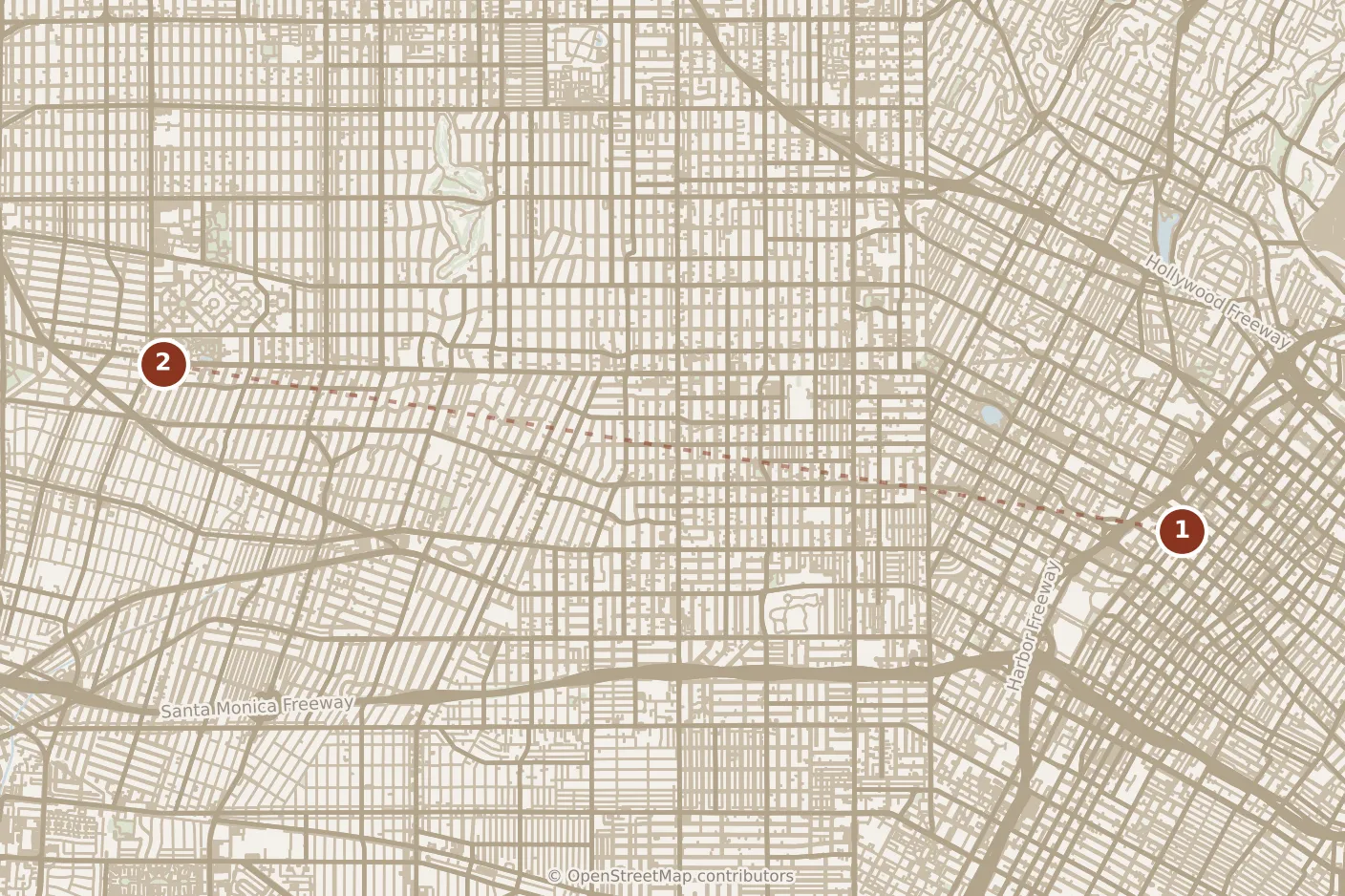
The ride on to stop 2, by metro, not on foot.
- Morning
- 17th Street/Metro Center
- Morning
- 2Wilshire/Fairfax
- 3Academy Museum of Motion Pictures
- Afternoon
- 4Los Angeles County Museum of Art
- 5La Brea Tar Pits
- Evening
- 6Wilshire/Western
- 7Koreatown
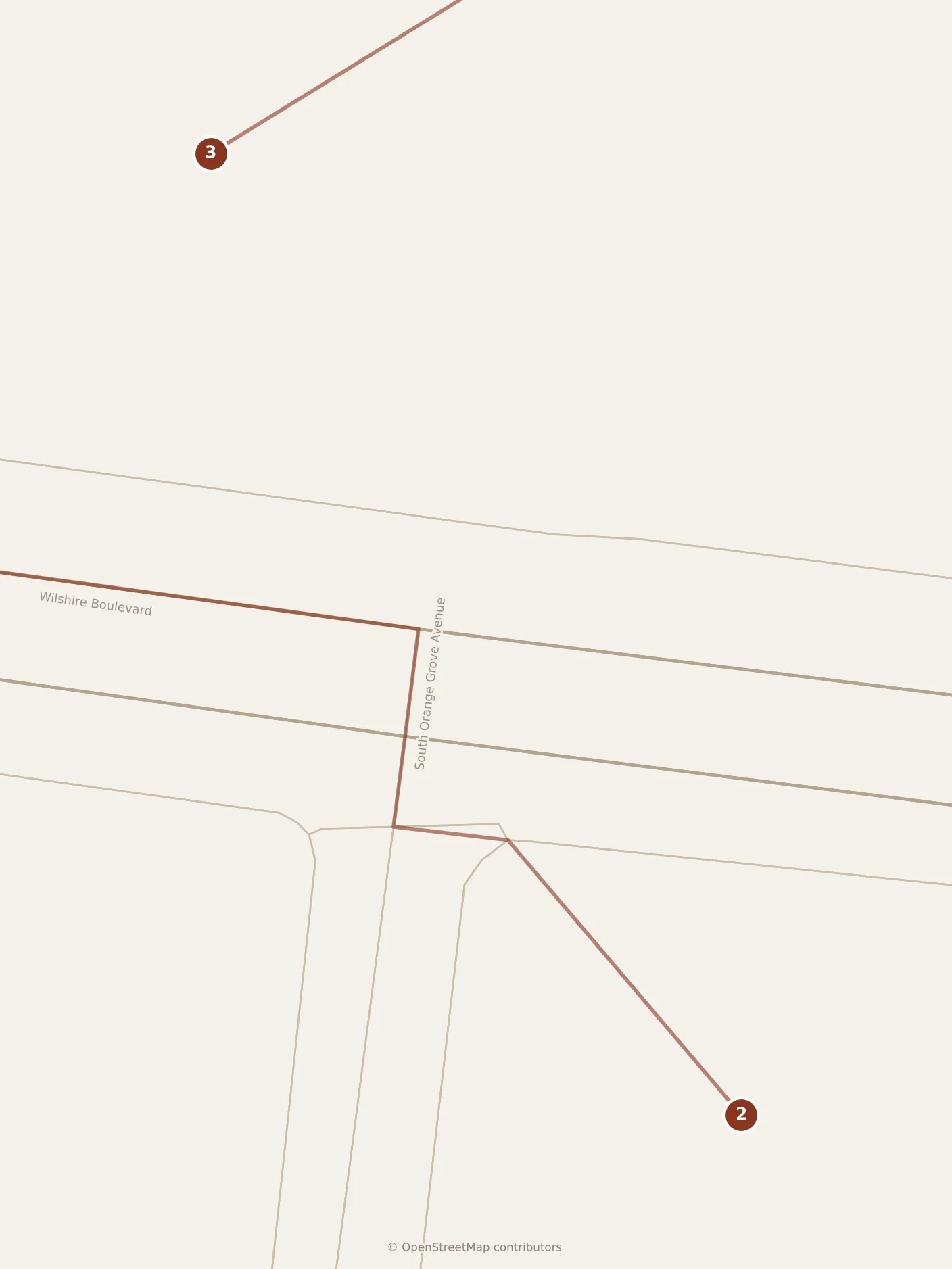
Everything today except dinner is within five hundred meters of the crossing of Wilshire Boulevard and Fairfax Avenue, and you arrive in the middle of it. This is the least walking of the three days, which is rather the point: the Miracle Mile is where Los Angeles put its museums, and for most of the last century the hard part was getting to them.
From ten, the whole day as written comes to about six hours and puts you back on the street at four. That total counts the time inside the buildings, a meal, and the few minutes between them, and nothing else — not the ride out, and not the bag check and ticket scan at the Academy, which on a weekend afternoon is its own quarter of an hour and belongs in your plan as a separate line.
Morning
If you are sleeping downtown, the day starts at 7th Street/Metro Center, the underground interchange where four lines meet. Take the D Line west: six stops, about a quarter of an hour, and you come up the stairs at Wilshire/Fairfax on the corner you want. From Union Station it is the same train and nine stops. If you are staying out on the Westside instead, invert the two days — take the coast first from where you already are, and come inland for this one.
The Academy Museum of Motion Pictures is the gold-cornered block on the north side of the crossing, and it is two buildings pretending to be one. The larger is the May Company department store of 1939, Streamline Moderne: a long limestone slab with a gold-leaf cylinder wrapped round the corner, now the Saban Building, its tiles relaid under Renzo Piano. Joined to the back of it by glass bridges is Piano’s sphere, a concrete drum holding the 945-seat David Geffen Theater — a working cinema that still projects sixteen, thirty-five and seventy millimetre film, which is rarer than it sounds — with a glass-roofed terrace on top looking north at the hills.
Give the museum two and a half hours and spend them on one thing. Stories of Cinema runs over three floors and is the collection: Dorothy’s ruby slippers from The Wizard of Oz, the only surviving shark mold from Jaws, and long, argumentative rooms about what the industry did to the people inside it. That is the visit. The Oscars simulator is a separate small ticket sold on top of admission, and it is an elevator, a stage and a photograph; skip it without regret unless you are traveling with somebody who would never forgive you. The temporary shows change and are not what you came for.
Afternoon
Eat first and give it three quarters of an hour. This crossing is not a restaurant district and what is close to it is thin: a scattering of counters three or four blocks north up Fairfax Avenue, around Sixth Street, five to ten minutes each way, which is all the three quarters of an hour will carry. The proper hall is further — the Original Farmers Market has traded at Third Street and Fairfax since 1934, a quarter of an hour up the same sidewalk — and half an hour of walking on top of a meal belongs to a day that gives lunch a full hour, not to this one. Either way it is the only sidewalk today that goes anywhere.
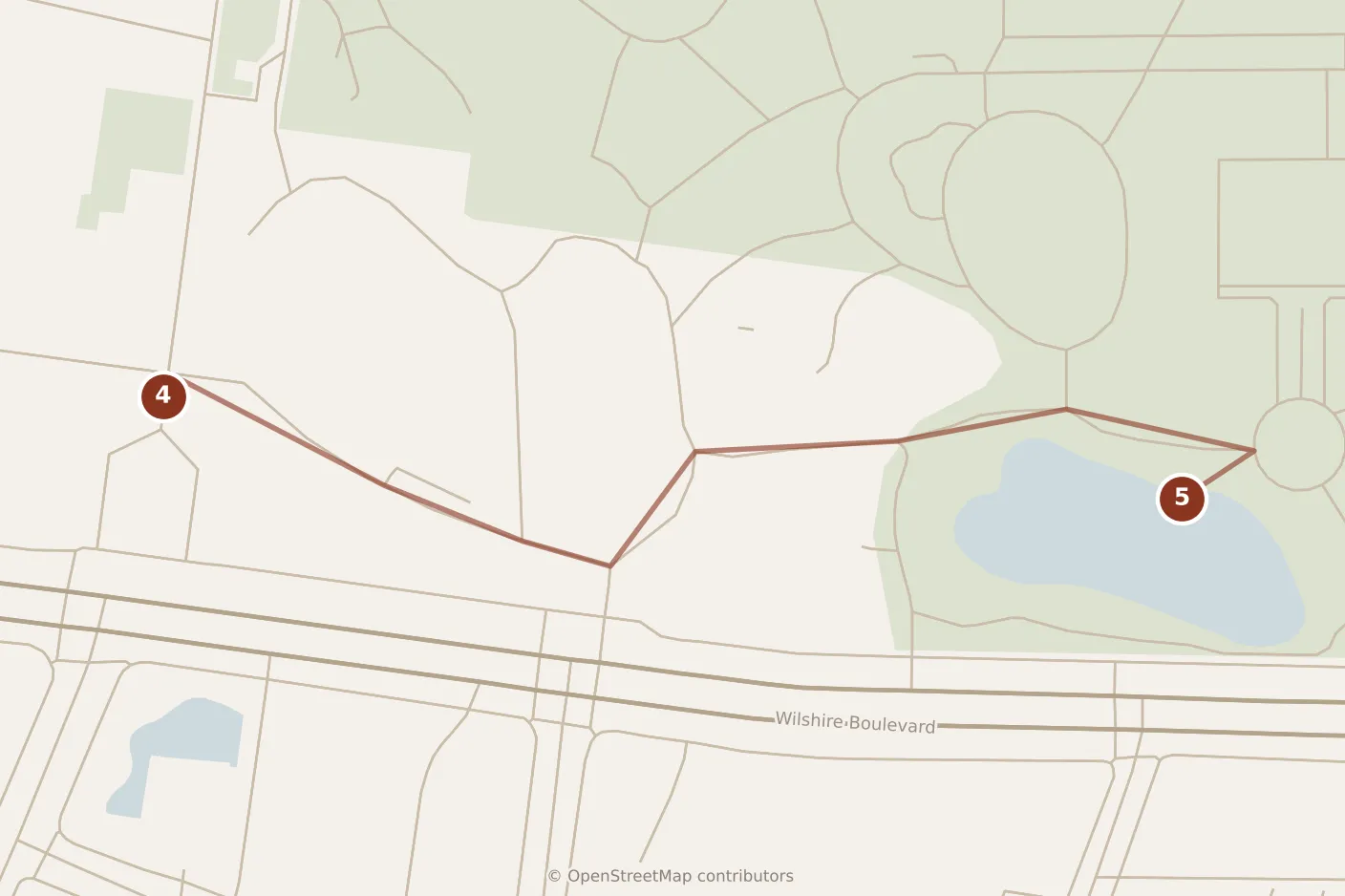
Three minutes east is the Los Angeles County Museum of Art, and what you are walking into is new enough that most descriptions of it are of a museum that no longer exists. Four of the old buildings came down in 2020 and were replaced by the David Geffen Galleries, open to the public since 4 May 2026: one story of rooms lifted on concrete piers above the ground, sand-colored, glass-walled, long enough to cross Wilshire Boulevard on an arm and come down on the far side. Twenty-six galleries hold about three thousand objects, and there is no chronology and no route — you walk in under the building, come up into it, and the light changes on every side as you go.
Give it two hours and know what you are getting. The new building holds a good deal less than what it replaced, which is the substance of the argument that has followed the design since it was published, and anyone arriving for a great encyclopaedic collection laid out in order will not find one. What it does instead is put unrelated things in one room and leave the work to you. At the Wilshire entrance, free and outside the ticket, stands Urban Light — Chris Burden’s grid of two hundred and two restored cast-iron street lamps, gathered from the streets of this county and lit every night — and at the northern edge of the campus, also free, Levitated Mass, a three-hundred-and-forty-ton granite boulder by Michael Heizer sitting over a concrete slot you walk down into and under.
Six minutes further east the ground begins to smell of asphalt. The La Brea Tar Pits are a working excavation inside a public park: natural seeps that have been coming up through this block for tens of thousands of years and have preserved, among a great deal else, the largest Ice Age collection anywhere. Lake Pit on the Wilshire corner is the one everybody photographs, a fibreglass mammoth sinking in the asphalt while its family watches from the bank; Project 23 is the row of wooden crates lifted whole out of the car-park dig in 2006 and still being picked apart by volunteers in the open air. The park is free and the seeps are outdoors. The museum on the site closed on 7 July 2026 for a rebuild expected to run two years — the county’s natural history museum runs it and publishes what has reopened — so read the forty minutes here as an outdoor visit until you hear otherwise.
Local tip. The two museum tickets are separate and neither includes the other, and between them the tar pits are free, outdoors, and open when the buildings are not. That is what makes them the day’s flexible stop rather than its weakest: they absorb a late start, a long line or a closed museum without costing you a ticket you have already paid for. Cut them last, and only once the afternoon has gone anyway.
Evening
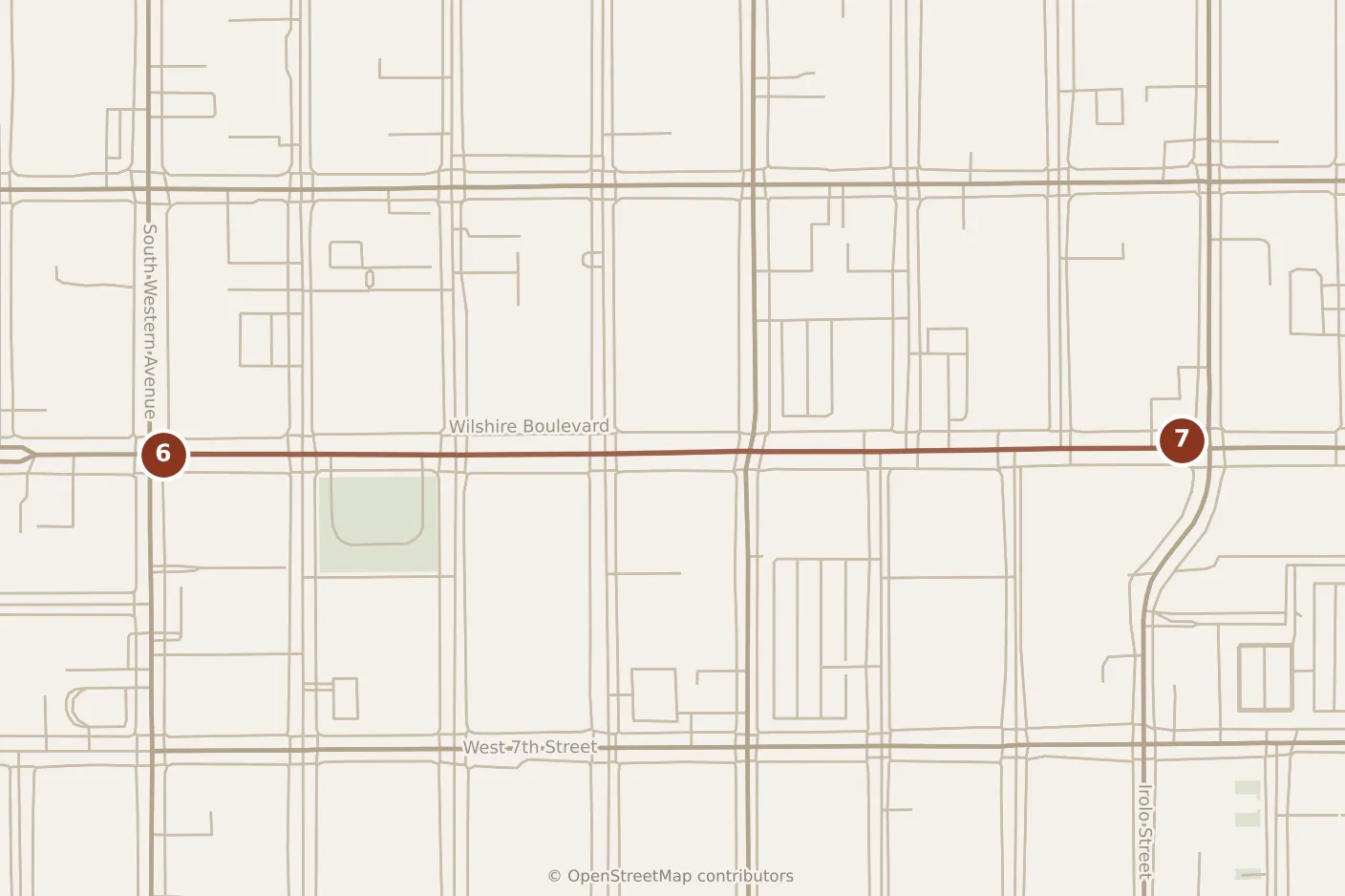
Two stops back east on the D Line is Wilshire/Western, and you come up the stairs into Koreatown — the station stands on its western edge, the eating runs east and south from there, and none of it has anything whatever to do with the museums you have just left. That is the reason to come: it is the ordinary Los Angeles that the Miracle Mile is not, and it is on the same line you have been riding all day. Korean barbecue is the obvious order and the tables want booking at a weekend; the less obvious thing is that the district keeps eating very late, so eight o’clock here is early.
In summer this day finishes with four hours of daylight still in hand and the Miracle Mile has nothing to do with them. Two answers, both concrete. The art museum stayed open until eight on Fridays in 2026, which is the one evening the surplus can be spent where it stands, and it folds neatly into a district that eats late anyway. Otherwise come east earlier and give the extra hours to Koreatown, which does not need the dark.
And if you have only two days and the observatory on the hill is the thing you refuse to leave Los Angeles without, this is the evening it goes in, and Koreatown is what it costs — on any day but a Monday, which is the day the observatory itself is shut. From Wilshire/Fairfax take the D Line four stops east to Wilshire/Vermont, change to the B Line and ride three stops to Vermont/Sunset; the DASH Observatory shuttle leaves from the street outside and runs up into the park every twenty minutes or so, daily, until ten at night, and your TAP card pays for it. That is five rides on the day rather than the three the rest of this article counts on, and the shuttle is two of them. With three days you do not need the swap at all, because the hill is where the third day ends.
Day two

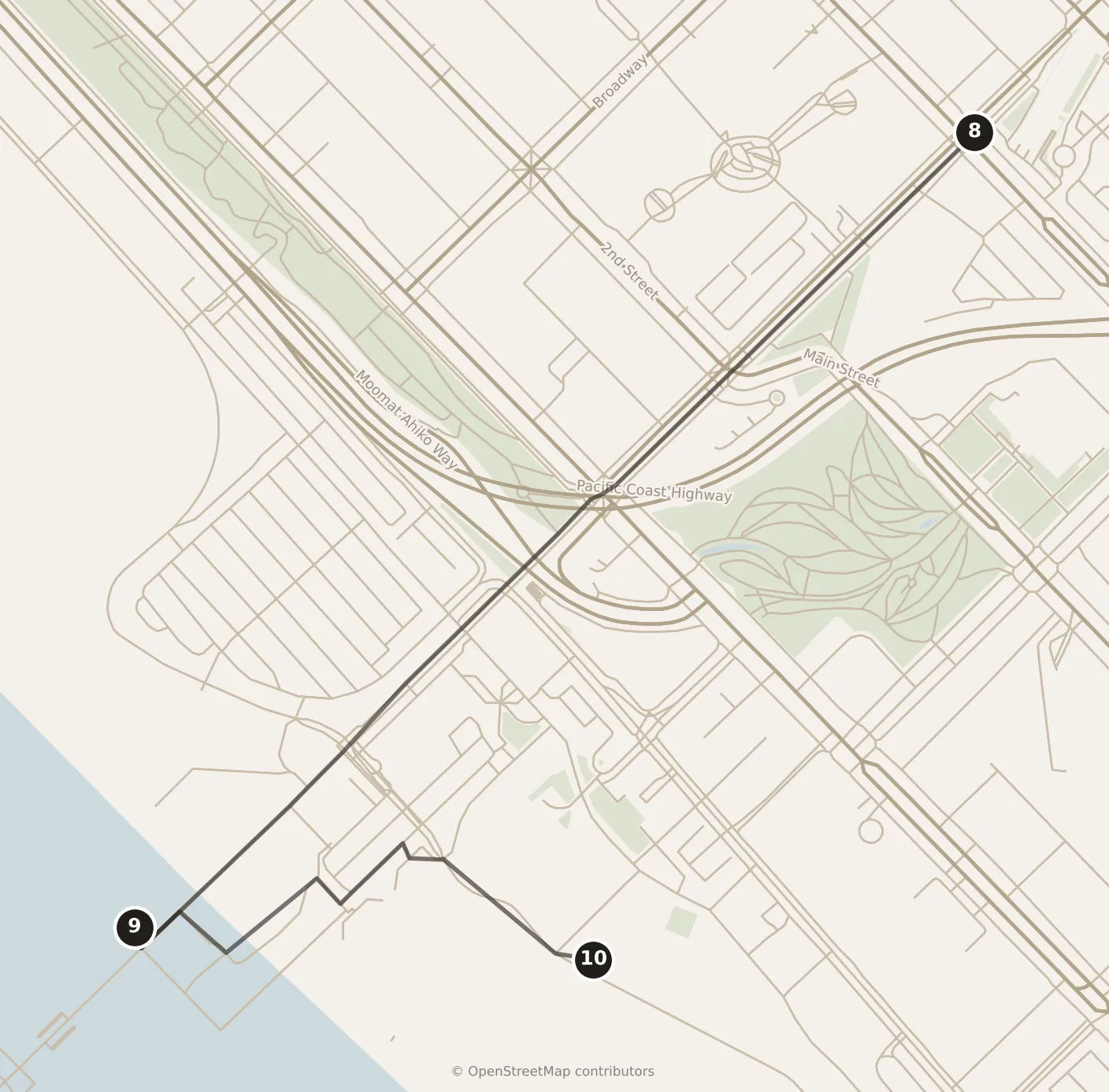
- Morning
- 8Downtown Santa Monica
- 9Santa Monica Pier
- 10Muscle Beach
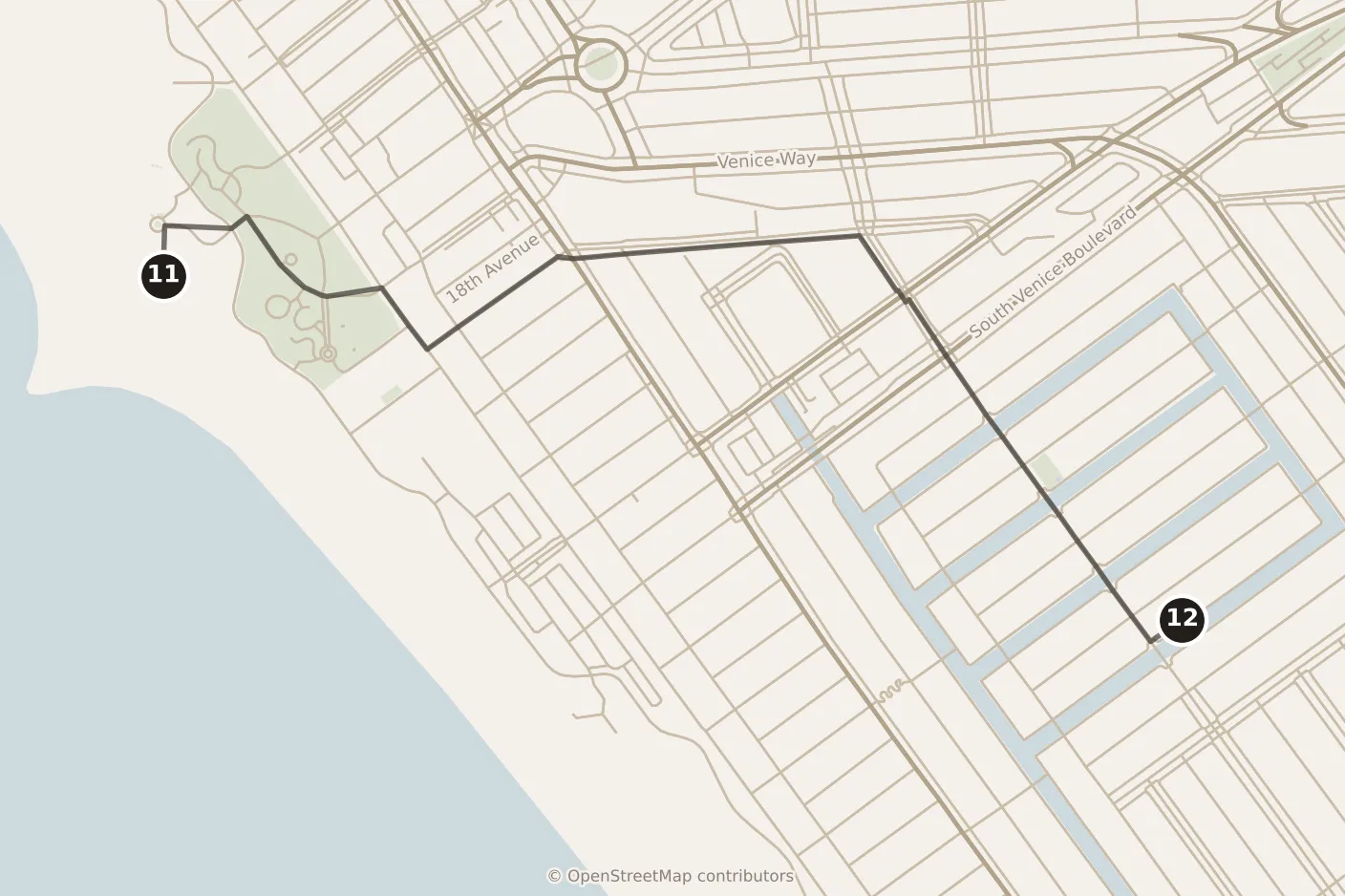
- Afternoon
- 11Venice Beach
- 12Venice Canal Historic District
Today is one long walk down a beach with two towns on it, and the only real decision is how much of the middle you walk rather than ride. It comes to about nine kilometers on foot end to end, nearly three times yesterday, and close to half of that is a single stretch of concrete beside sand.
This is the day with the deadline in it. Everything from stepping off the train to standing on the sand at the end comes to about five and a quarter hours: the pier, the walk, the boardwalk with something to eat in it, the canals, and the walk back out to the water. So subtract five and a quarter from your month’s sunset. In December, with the sun down at about a quarter to five, that puts you off the train at about half past eleven and out of 7th Street/Metro Center three quarters of an hour before that. In June the same sum would have you starting in the middle of the afternoon, which is the wrong instruction: go in the morning as though it were winter and let the surplus fall on the sand, because a beach is the one stop in this city where spare hours are not a problem to be solved.
Morning
The E Line runs from 7th Street/Metro Center to Downtown Santa Monica, its western terminus, in about three quarters of an hour. You come out on Colorado Avenue; the water is downhill and west, and it is a quarter of an hour on foot to the Santa Monica Pier, past the end of the shopping street and down the ramp.
Give the pier an hour. The municipal pier underneath the whole thing opened in 1909 to carry a sewer outfall out past the surf, which is not the origin anyone wants, and the pleasure pier alongside it was built by Charles Looff and his son in 1916. What survives of that is the Looff Hippodrome, the fat wooden hall near the landward end, and inside it a Philadelphia Toboggan Company carousel of 1922 with forty-four hand-carved horses, still turning. Pacific Park, the small amusement park with the solar-panelled wheel, dates from 1996 and is a fairground: ride the wheel if the line is short and walk past it if it is not, because the view it buys is the view you already have for nothing from the deck below. At the far end there is a small aquarium under the boards and the sign marking the end of Route 66, which is where every photograph on this pier is taken.
Down the ramp on the beach side, on the sand, stands a set of rings, bars and a climbing frame under a sign reading Muscle Beach. This is the original — the one that started here in the 1930s and turned outdoor weightlifting into a Californian export — and it is not the famous one, which is three kilometers south in Venice and is its descendant. Five minutes, and the only reason to stop is that knowing which came first changes what you are looking at this afternoon.
Afternoon
Now the walk. From the pier the Marvin Braude Bike Trail runs south along the sand for twenty-two miles, and the stretch of it down to Venice Beach is an hour on foot. One thing to have straight before setting off: the paved strip is a cycle path, it is busy, and the people on it are moving at speed. For much of the way a separate walking path runs beside it, and where it does not there is sand; take either, and reckon on sand for part of the hour. Standing on the concrete to take a photograph is the most reliable way to be shouted at on this coast.
Venice Beach was Abbot Kinney’s resort of 1905, built with canals, a pier and an arcaded business street, and what is left of that idea on the front is Ocean Front Walk — two miles of concrete promenade whose busiest stretch is stalls, painters, preachers, buskers and hustle, which is either the best free theater in the county or an hour you will resent, and you will know which inside five minutes. Give it an hour and a half with something to eat in the middle. The skate park of 2009 sits directly on the sand and earns ten of those minutes on its own, and the weight pen next to it is the Muscle Beach the photographs actually mean.
The water is cold. This is the Pacific with a cold current running down it rather than the Mediterranean, it does not warm up much by August, and people swim in it anyway. If you go in, go in where a lifeguard tower is watching: the towers are numbered along the whole of this beach and the open ones are the ones to swim beside, the surf breaks harder than it looks from the promenade, and the currents that run out through it are the reason the towers are there at all.
Twenty minutes south-east, inland off the boardwalk, is the Venice Canal Historic District, and it is the strangest quarter of an hour of the trip. Kinney dug miles of canals in 1905; most were filled in for roads in 1929 and six survive, running between back gardens with wooden footbridges over them and ducks on the water. They were rebuilt across 1992 and 1993, and what they are now is a residential street with water where the tarmac should be — people live here, the paths are public and narrow, and the conduct that goes with that is to walk quietly and not photograph into windows. Forty minutes, most of it along the Grand Canal and over the bridges.
Evening
Come back out to the sand for the light: twenty minutes north-west from the canals to the beach you walked down this afternoon. One thing about that sunset, because it is the reason the day is shaped this way and almost nobody writes it down. The coast bends west above Santa Monica, so the top of the bay is land rather than horizon, and the sun does not go into open water all year — for roughly the winter half of it, call it the end of September to the end of March, it goes down on the sea horizon straight in front of you, and through late spring and summer it swings far enough north to drop behind the Malibu headlands at the far end instead. Both are worth standing still for. Only the first is the picture people come for, and it is one more reason the winter version of this day is the better one. There is a third possibility as well, which is nothing at all: from May into July the coastal marine layer — the low cloud known here as June gloom — often fails to clear, or clears at midday and rebuilds before dusk, and the sun goes into gray rather than into water. A summer reader should not hang the day on the light. What survives it is everything before it, which is the other reason the pier, the boardwalk and the canals come first. One more thing about the sand itself: alcohol and smoking are banned on it, at Santa Monica and at Venice alike, and an evening spent sitting on a beach is exactly when a visitor assumes otherwise.
Then go inland to eat, and go as the light goes rather than after it. Ocean Front Walk closes down with the light — the stalls come off the concrete, the crowd goes with them, and very little stays open — so it is not where this day should end. A quarter of an hour east is Abbot Kinney Boulevard, a run of derelict cottages and brick sheds until it was renamed in the late 1980s and now the eating street for this whole end of the coast — small rooms, a lot of them, and the line outside is how you tell which.
Getting home is a bus and then a train. The Big Blue Bus is Santa Monica’s own operator and its Route 1 runs up Main Street between Venice and Santa Monica; your TAP card works on it, and it sets you down within a few minutes of Downtown Santa Monica for the E Line east. It runs until about eleven at night, which is later than this day needs. Allow an hour and a quarter from the table to downtown, and more than that on a Friday.
Local tip. The hour of beach path between the two piers is the part of this day you can buy back if you have started late, and the way to buy it is that same Route 1 down Main Street — it runs inland, it is not the same experience, and that is exactly why it is the right thing to give up. Waiting for it eats some of the saving, so reckon on getting back most of the hour rather than all of it. If you are shorter than that, the canals are the cut: forty minutes there and twenty each way is an hour and twenty minutes returned to the same afternoon, and the boardwalk and the sunset are what the day exists for.
With a third day

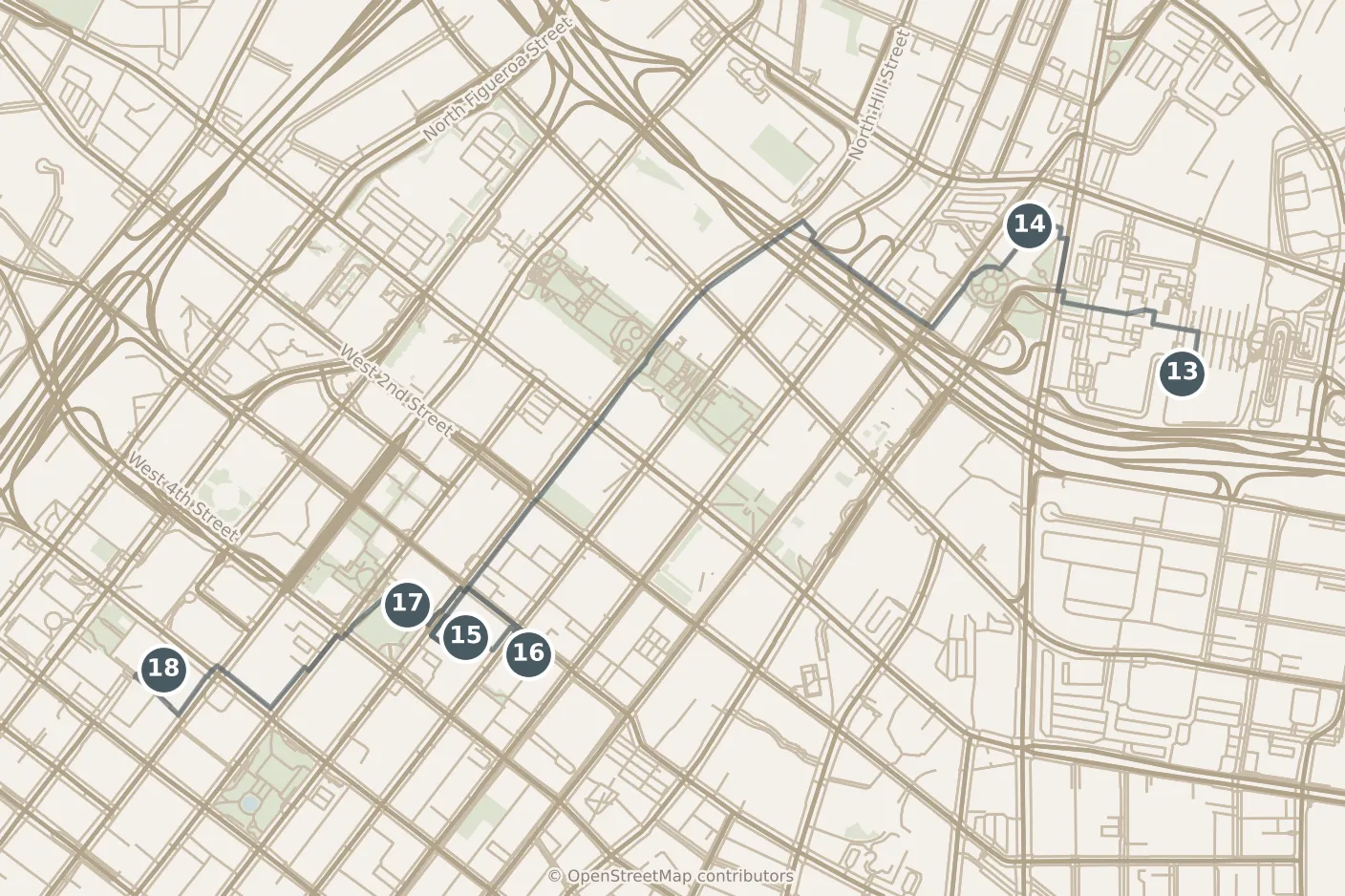
- With a third day · stops 13–18
- 13Los Angeles Union Station
- 14Olvera Street
- 15Grand Central Market
- 16Bradbury Building
- 17Angels Flight
- 18Los Angeles Central Library
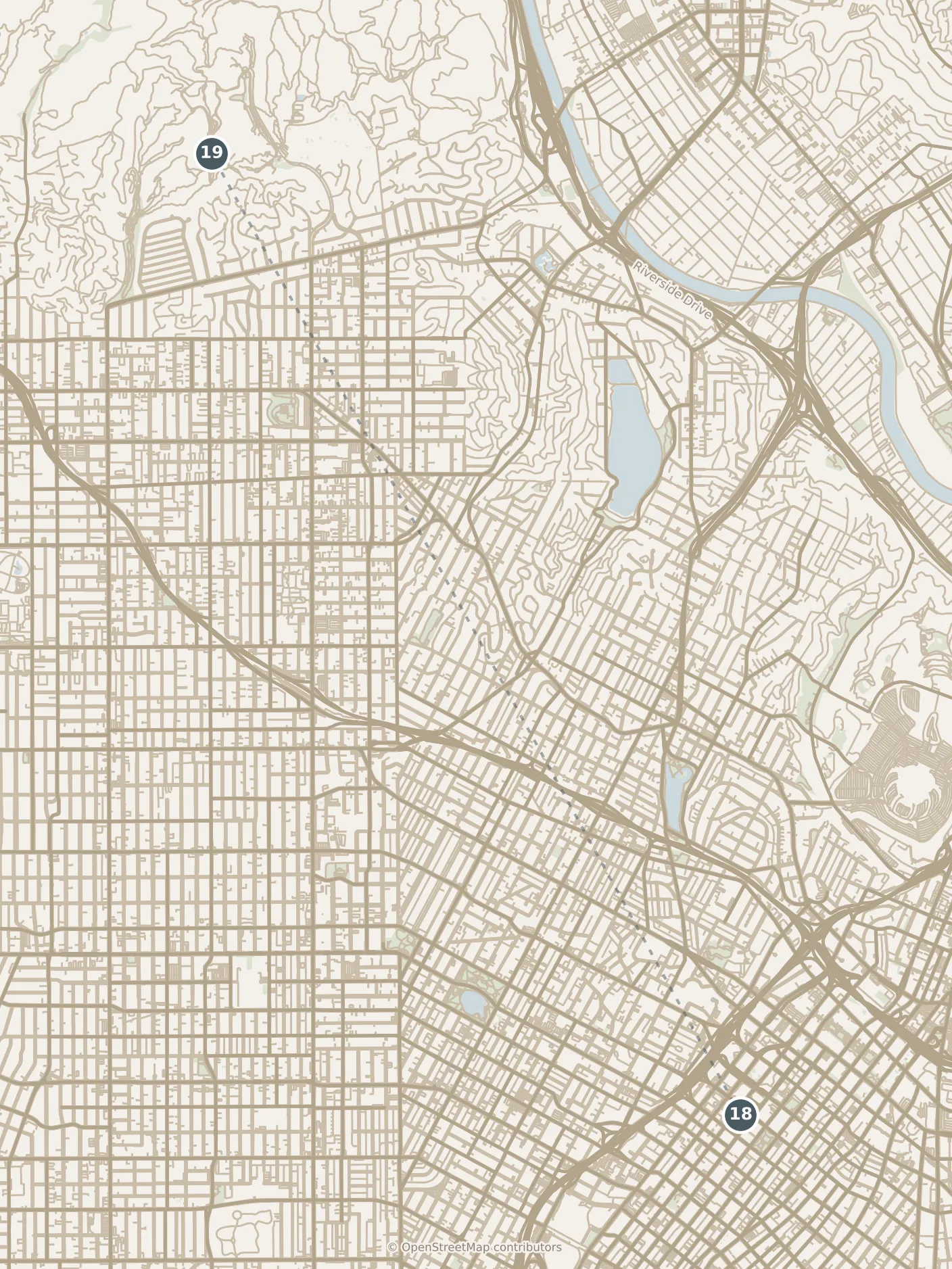
The leg out of the center: from stop 18 by metro, not on foot.
- With a third day · stop 19
- 19Griffith Observatory
Give the third day to downtown, and put it first.
It goes first because it is where you arrive, where every line on the network converges, and where the walking is shortest — about three and a half kilometers across the whole day — which is what you want while you are still working out the shape of the city. It is also the day a visitor with only one day should take instead of either of the two above, and that is worth saying plainly: nothing on it is out on a limb, and it is the compact, old, walkable half of Los Angeles that the other two days never touch.
Start inside Los Angeles Union Station, 1939 and the last of the great American railway terminals, and give the waiting hall ten minutes before you walk out of it: a room the length of a street, Art Deco chairs in leather and mahogany, planted courtyards opening off both sides. Across the road is the block the city was founded on in 1781, and Olvera Street runs north off its plaza — a Mexican market lane laid out in 1930, when the block was derelict and its oldest house under a demolition order, and a working market every day since. What that campaign saved is still there and still free: the Avila Adobe of 1818, the oldest house standing in the city, opens off the lane. Half an hour, with something small to eat in it.
Then twenty-five minutes south-west, down Main Street and Broadway, to Grand Central Market, a hall of food counters open every day since 1917 and the sit-down meal of this day; three quarters of an hour, and be there before one if you want a stool. Directly across Broadway is the Bradbury Building of 1893, plain brick from the sidewalk and, inside, a five-story court under a glass roof with open-cage elevators and iron stairs climbing up through the light. It is somebody’s office building: you get the first floor and half a flight, which is enough, because everything worth seeing is over your head. Ten minutes — and note it keeps office hours and thins out on the weekend.
Five minutes up the hill, Angels Flight is a funicular of 1901, ninety meters of track and two wooden cars, under a minute end to end, and it has spent more of the years since 1969 taken apart, relocated or shut than in service, so the right posture is to treat it as a bonus rather than a plan; the public stairs beside it climb the same slope in five minutes. You come out on Bunker Hill, and five minutes north along Grand Avenue stand its two famous buildings, Walt Disney Concert Hall and The Broad — what a one-day visitor gives the afternoon to, and what this day deliberately leaves alone.
Go instead ten minutes south-west to the Los Angeles Central Library, which is the downtown interior nobody waits in line for. Bertram Goodhue, 1926: a stepped tower under a tiled pyramid with a hand holding a torch at its apex, the Light of Learning, and inside a rotunda beneath a zodiac chandelier with Dean Cornwell’s four-part mural of the history of California running round the walls above it. Two arson fires in 1986 destroyed a fifth of the collection; the rebuilding that followed added the Tom Bradley Wing, an eight-story atrium hung with glass chandeliers, which you come into from the other side and which could not be less like the 1926 half. Give it an hour. It is free, and it is a working public library, so it keeps a library’s week rather than a museum’s: in 2026 its Sunday ran only from one in the afternoon, and it shut earlier on a Friday and a Saturday than on a weekday. That is the one hour on this day worth checking against its own site before you set out. If it is shut the hour goes back up the hill to those two buildings on Grand Avenue, which is no loss at all — The Broad charges nothing, and although its timed tickets go weeks ahead, without one there is a standby line, which on a weekday is a wait rather than a closed door.
The day ends above the city. From Pershing Square station, six minutes from the library, take the B Line in the North Hollywood direction six stops to Vermont/Sunset, and the DASH Observatory shuttle up into Griffith Park to Griffith Observatory — free, open until ten at night, and admitting nobody before midday on a weekday or ten at a weekend in 2026 — so the morning downtown is not a filler, it is where the hours before the door opens have to go, and if that hour has moved the same rule applies to the new one. Everything below it comes to about three and a half hours from Union Station and the connection is the better part of an hour on top, so a ten o’clock start in December puts you on the hill by about half past two with a couple of hours of light left, which is the shape you want: the inside of the building first, the terraces as it goes.
From about April that same sum strands you up there in broad afternoon with far too long to wait. Take the downtown half at the same hour anyway and spend the surplus where you already are — a second hour in the library, and the twelve theater fronts of the old movie-palace district, which begin where the market does at Third Street and run six blocks south of it, and which cost nothing to walk. Then eat downtown late and go up after dinner. The building’s own late hours are what make the summer version work, and nothing else in the day moves.
Inside there is a Foucault pendulum swinging in the rotunda, a Tesla coil that is fired to an audience, a camera obscura beside the door, and a planetarium whose show is the one thing up here that is not free — it carries its own small ticket, and the observatory itself publishes where and how that is sold. Do the inside first and come out with light still in hand. The building shuts at ten and the last shuttle down goes at the same hour, so that is where the evening ends whatever the month. The way down is the shuttle you came up on and the same line back; reckon on twenty-five minutes of traveling to Union Station once you are aboard, and leave margin above it, because everybody on the hill comes down on the same buses at the same hour.
Inserting this day rather than appending it moves exactly one thing. Both museum tickets stay on the Miracle Mile day, so fix that date before you buy them: with downtown first, the Miracle Mile is your second date on most arrivals and your third if you land on a Tuesday, when the coast takes the middle day — so it is the Miracle Mile date the Academy’s timed slot has to match, not the second one.
Practicalities
Two tickets have to be bought and nothing else does. The Academy Museum sells timed slots on its own site and the weekend ones go first, so buy them the day you fix your dates; the art museum sells online and at the door, and the door is fine on a weekday. Both were in the twenty-to-thirty-dollar range in 2026. Everything else across all three days — the tar pits, the pier, the beach, the canals, the market, the Bradbury, the library, the observatory — is free, or paid for at the moment you use it.
The weekday rules are what will actually catch you out, and there are two of them and one permission. The Miracle Mile day must miss Tuesday and Wednesday: in 2026 the Academy Museum closed on Tuesdays and the art museum on Wednesdays, so those are the two dates on which the row cannot be done whole. The Monday rule belongs to the observatory rather than to a day. It closed on Mondays in 2026, and it is the whole of an evening wherever that evening is put — so the downtown day must miss Monday, and so must any two-day trip that takes up day one’s offer to swap the hill in for Koreatown. On a Monday that swap is not available and Koreatown keeps the evening. The coast takes any day of the week there is — that permission is what makes the rest workable, because it is the day that can be moved anywhere, so when the arithmetic fails it is the one that moves.
From most arrivals this runs clean. Land on a Wednesday, Thursday, Friday, Saturday or Sunday and the three days go downtown, Miracle Mile, coast, in that order. A Sunday arrival is the one that still wants a look, because it puts downtown on the day the library does not open until one — and no reshuffle of the morning closes that gap: run the day as written from ten and you are at the library door at about a quarter past twelve, with the Bradbury’s ten minutes the only piece there is to move. So take the trade rather than a rule. Spend the three quarters of an hour above the library instead, on the two buildings on Grand Avenue that this day otherwise leaves alone, and go down to it after one. That is the one version of the third day that reaches the hill an hour later than the third-day section’s sum, which in December is the difference between arriving with two hours of light and arriving with one. Land on a Monday and lead with the Miracle Mile: coast on the Tuesday, downtown on the Wednesday. Land on a Tuesday and take downtown first, the coast on the Wednesday and the Miracle Mile on the Thursday — the middle two trade places because Wednesday is the day the art museum is shut.
Two-day trips arriving on a Tuesday or a Wednesday are the arrangements that need thinking about, because those are the two dates that shut a museum and a two-day trip has no third date to move the row on to. Do not abandon the day; take it reduced, and know which half you are losing. The Tuesday version keeps the art museum and the tar pits and adds the Petersen Automotive Museum on the opposite corner of Wilshire and Fairfax — four floors of cars inside a building wrapped in red steel ribbons, which in this city is not the frivolous choice it would be anywhere else, and which is walk-up and ticketed on its own. The Wednesday version keeps the Academy instead, with the same tar pits and the same Petersen. Either is about five hours rather than six, and neither changes the rides or the walking.
A Wednesday arrival is the easier of the two: take the reduced row on the Wednesday, keeping the Academy, and give the coast the Thursday whole. A Tuesday arrival is where two of this article’s own rules collide, and you should have the trade rather than a rule. The Academy is the half most people come for, which argues for the coast on the Tuesday and the Wednesday row; but the coast is the day a suitcase ruins, and this is the one arrival on which the coast would land on the day you are carrying one. So: if you can leave the case before the morning train, take the coast on the Tuesday and the Academy on the Wednesday. If you cannot, invert it — the museum row is the day that survives a late start, because it is bounded by opening hours at both ends anyway, and a coast day that starts at four in the afternoon in December has no daylight left in it at all.
Three closures are worth checking rather than trusting. The tar-pits museum is shut for its rebuild, as day one sets out, so that stop stays an outdoor one until the museum that runs it says otherwise. The Bradbury Building keeps office hours and thins on the weekend, so on a Saturday or a Sunday take it before lunch rather than after. And the Central Library opens late on a Sunday and closes earlier on a Friday and a Saturday than on a weekday; that is one look at its own site, and the fallback is five minutes back up the hill.
If a day is short, cut in this order. On the Miracle Mile day the tar pits go first — forty minutes, free, and on your way back to the station regardless — and after that it is the second hour at the art museum, which is the hour the new building rewards least. On the coast day the beach path goes first and the canals second, in that order and for the reasons in that section. On the downtown day it is the half hour on Olvera Street, and the twenty-five-minute walk down to the market goes with it: the A Line runs from Union Station to Historic Broadway in two stops, six minutes from Grand Central Market, which turns that morning into a train ride and makes it five rides on that day rather than four.
On the walking. The Miracle Mile day is about three kilometers in total and has no long single stretch in it: everything but dinner sits inside five hundred meters of one crossing, the walk to lunch is ten minutes at the outside, and dinner is whatever blocks you cover around Wilshire/Western looking for a table. The downtown day is about three and a half kilometers and its longest stretch is the twenty-five minutes from the plaza down to the market. The coast day is about nine kilometers, close to half of it in one hour-long leg, and that leg is the only one on these three days with a real alternative.
If you have two days rather than three you are giving up the old center, and the honest thing is to name what that costs: the plaza, the market hall, the light court of the Bradbury and the hill at dusk. Only the last of those can be rescued, and day one’s evening is where it goes, at the price of Koreatown; the route is written out in that section. Not on a Monday, though: that is the observatory’s closed day, and a two-day trip has no other evening to move it to, so on a Monday arrival the hill is simply part of what two days cost. Everything else on the downtown day wants daylight, and a two-day trip has none spare to give it.
Coming in from LAX, there is no rail link into the terminals yet. The airport’s own people mover was still in testing through 2026 and had carried no passengers when this was written. With a case the plain answer is the FlyAway coach, which leaves the terminal kerbs and runs direct to Union Station, with a hold for the luggage and a fare of its own — several times a Metro ride, and outside that daily cap, though TAP is among the ways the airport’s own site says it is paid. The rail answer is cheaper and slower: the free airport shuttle from the curb to LAX/Metro Transit Center, then the K Line north to Expo/Crenshaw and the E Line east to 7th Street/Metro Center — an hour of moving, and more than that once the terminal loop, the wait for the shuttle and two changes are in it. Both work backwards at the end. If the people mover has opened by the time you read this it replaces the shuttle on the rail route and nothing else changes.


.jpg)
.jpg)

