Los Angeles in one day: downtown on foot, and the hill at sunset

Last updated 26 July 2026
Overview
One day in Los Angeles is not a compression. It is a choice, and making it is most of the work.
The city covers about five hundred square miles, and the things people come for sit at opposite ends of it. The pier is twenty-five kilometers from downtown, the studios are over a hill from both, and the drive between any two of them can take an hour at the wrong time of day, which is most of the day. So the question is not which museum to give up. It is which Los Angeles you are having.
Two versions are defensible, and both work without a car. One is the coast: the light rail runs from downtown to within a few blocks of the pier in about three quarters of an hour, and the day is flat and walkable at the other end. The other is the one below — the old center on foot, ending on a hill above it. This day is the second because it starts at the station you arrive into, needs no transport at all until the evening, and explains the rest: the plaza the city was founded on, the street it built when it got rich, and at the end the whole basin lit up in front of you, which is the only honest way to see the size of what you are not seeing. If your one day is really about the beach, take the coast instead, and do not try to hold both.
Then the clock, because everything below depends on it. The walking half of this day runs from mid-morning to about five, and the evening is pinned to sunset — which in this city moves from just before five in December to after eight in June. Work back from the date you actually have. In winter this is a nine-hour day that ends early; in summer it is an eleven-hour one with a gap in the middle of the afternoon, and the gap is easier to spend than to find.
The day

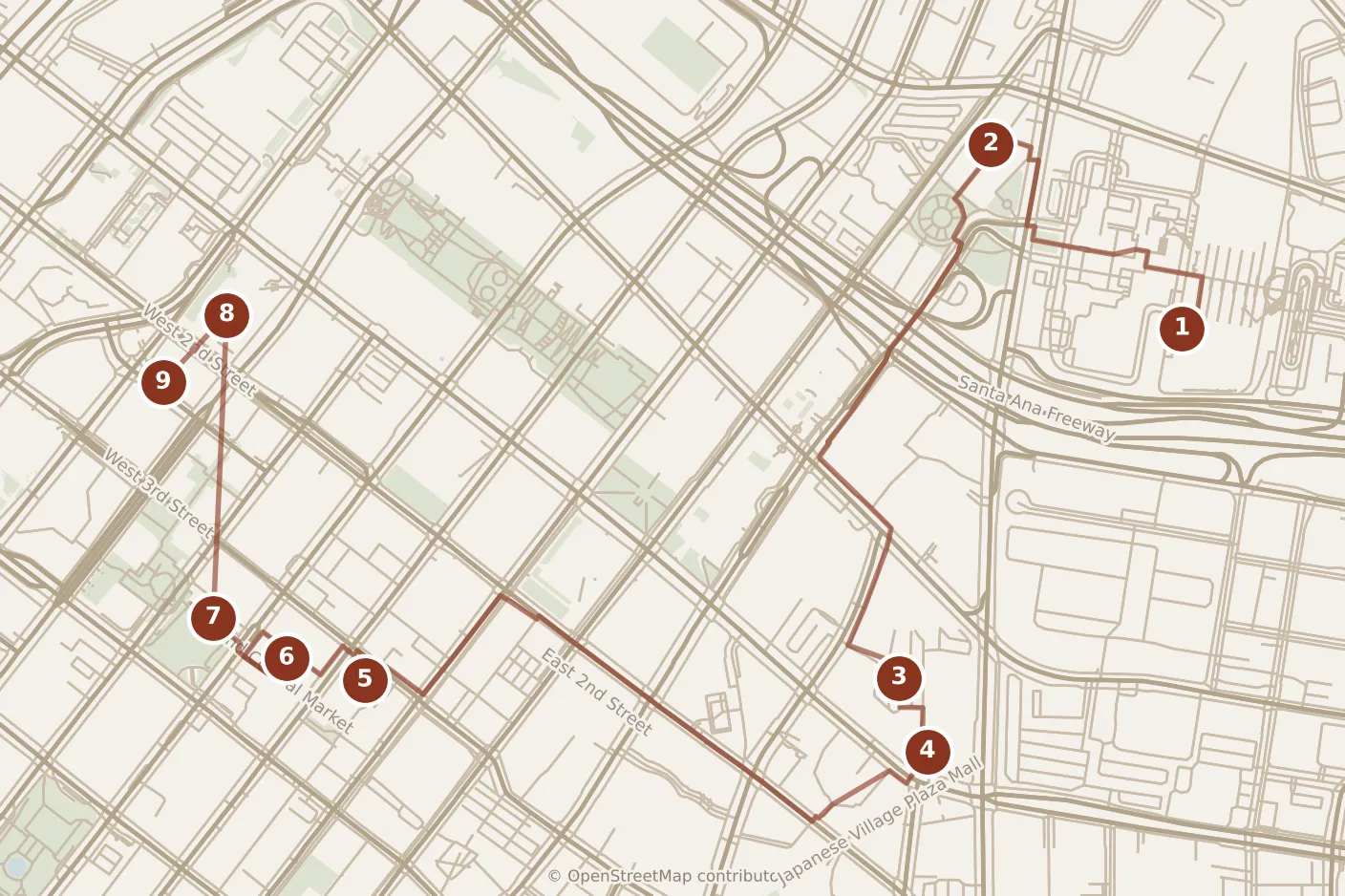
- Morning and afternoon
- 1Union Station
- 2Olvera Street
- 3Little Tokyo
- 4Japanese American National Museum
- 5Bradbury Building
- 6Grand Central Market
- 7Angels Flight
- 8Walt Disney Concert Hall
- 9The Broad
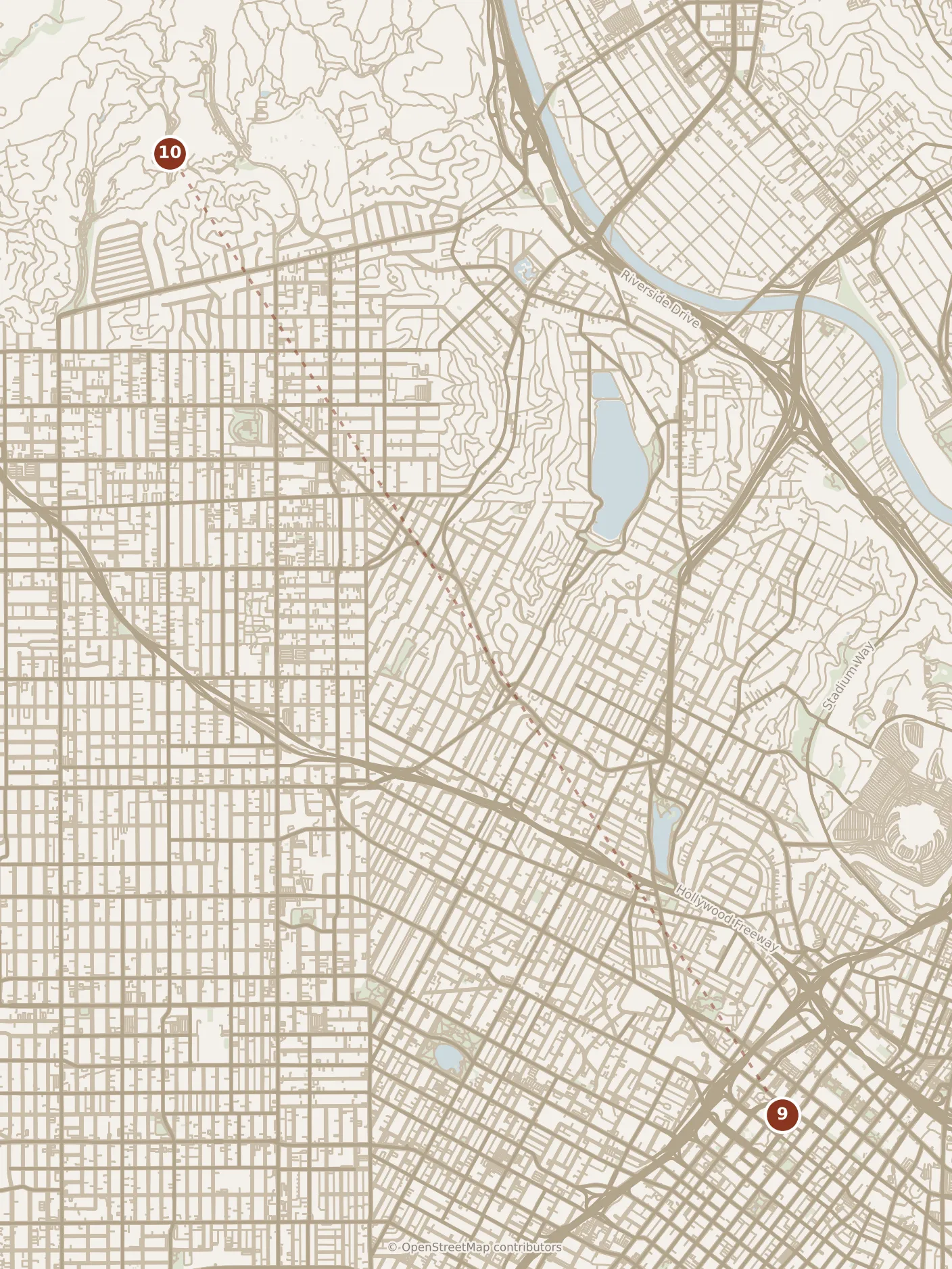
The leg out of the center: from stop 9 by metro, not on foot.
- Evening
- 10Griffith Observatory
Morning
Begin inside Union Station rather than walking straight out of it. It opened in 1939, the last great railway station built in this country, and the waiting hall is worth ten standing-still minutes: a room the length of a street under a beamed ceiling, ranks of Art Deco chairs in mahogany and leather, planted courtyards opening off both sides. Two things before you plan around it. The historic seating is for passengers holding a ticket, and the old ticket concourse — the most photographed room in the building — is closed to the public and used for events. What you can count on is the hall, the courtyards, and the walk through them.
There is also no left luggage. The station’s lockers were taken out years ago and never replaced; what exists instead is app-booked storage in shops nearby, which has to be arranged rather than found. This day is three kilometers on foot and ends on a hill, so settle the question of the bag before you start, not at the first stop.
Cross Alameda Street to the plaza the city was founded on in 1781. The Avila Adobe on its far side is the oldest standing house in Los Angeles, built in 1818: six rooms round a courtyard, furnished as a house rather than laid out as a museum, and fifteen minutes is the whole of it.
Olvera Street runs north off the plaza under awnings, a lane of stalls laid out in 1930 as a Mexican market street. It is usually described as staged, and it was — and that is the least interesting thing about this ground. In February 1931, months after the lane opened, immigration agents sealed the exits of this plaza and demanded papers from the four hundred people standing in it. That raid opened the decade of “repatriation”, in which hundreds of thousands of people of Mexican descent, a majority of them American citizens, were pressed out of the country. Nothing on the street tells you. Stand in the plaza for a minute before you walk down the lane and buy something to eat.
Then south for fifteen minutes into Little Tokyo, one of three Japantowns left in the United States; the others are in San Francisco and San Jose. Two blocks of low pre-war shopfronts on First Street, a shopping plaza of the 1980s built round a courtyard, and on the same block the Japanese American National Museum — a restored Buddhist temple with a glass building beside it, holding the history of this community’s incarceration in camps during the war.
That museum is the day’s real decision, and it is better made here than at the door. Going in costs an hour and a half, and an hour and a half is the afternoon’s museum. Take this one if what you want from a single day is the city’s own history; take the one on Bunker Hill if you want the art. Taking both is how a day like this stops working at about four o’clock.
Afternoon
Ten minutes west and you are on Broadway. For six blocks south of Third Street stands the largest surviving concentration of movie palaces in the United States — twelve of them, built between 1910 and 1931, when this was the street the city dressed up for. Most are dark, converted or open only for events, so this is a walk with your head up rather than a sequence of interiors: terracotta fronts, marquees, lobbies you can sometimes see into.
The exception, and the best building on this day, is on the corner of Third. The Bradbury Building is 1893 and plain from the sidewalk; inside it is a five-story court under a glass roof, with iron filigree stairs, open-cage elevators and light falling the whole way down — the interior half of the world in Blade Runner. It is a working office building, so visitors get the ground floor and half a flight of stairs and no further, which is enough, because the view is upward. Ten minutes. It keeps office hours and shuts earlier on weekends, so on a Saturday or Sunday walk Broadway before lunch rather than after it.
Across Broadway, Grand Central Market has been a hall of food counters since 1917 and opens every day. This is lunch, and the scarce thing here is not food but a seat: in the middle of the day the good counters have lines and the stools are taken. Come at half past eleven and eat before the crush, or accept that you will be standing. Eat here regardless — it is the one sit-down meal the day has room for, and the alternative is a sandwich walked up a hill.
Then Angels Flight, the funicular of 1901 that runs up the face of Bunker Hill: ninety meters of track for thirty of climb, under a minute, two wooden cars called Sinai and Olivet. Treat it as something that may not be running — it has been closed, dismantled, moved and reopened repeatedly since 1969, returning to service most recently in 2017 — and if it is shut, the public stairs alongside do the same job in five minutes.
At the top, take the concert hall before the museum. This is the opposite of the order the map suggests and it is the right one. Walt Disney Concert Hall is Frank Gehry’s, 2003, and what you do here without a ticket is the outdoor stair on the far side, which climbs to a planted acre of public garden at roof level that most people never learn is there. Its hours are short and end in the early afternoon, and it closes for private events — so it is the fragile part of the afternoon, and the fragile part goes first.
Then The Broad, next door: contemporary art in a perforated white box, free, on timed tickets released in advance. Book an early-afternoon slot rather than a late one — the museum closes in the late afternoon on most days, and the slot you hold is what decides whether the rest of the day is comfortable or a march. Two hours to see it properly, an hour for the top floor alone. The mirrored room everyone photographs needs its own same-day sign-up and its own line, and giving it up is a decision rather than a defeat.
Evening
From Grand Avenue it is five minutes downhill to the Metro at Civic Center, then about twenty on the B Line to the Vermont and Sunset station. From the street outside it, a shuttle bus runs up into the park to Griffith Observatory — every twenty minutes or so, every day, until ten at night, for small change. That is the whole of the connection, and it beats driving on its own merits: the road up is narrow, the parking lot on the hill fills early, and the shuttle exists precisely because of that.
Go up earlier than the view needs. The observatory is free, open until ten, and the inside is not a waiting room: the Foucault pendulum turning in the entrance rotunda, a Tesla coil fired for an audience, the camera obscura by the door. Do those first and you come outside with an hour of light in hand — which is also how the summer version of this day fills the gap between the museum closing and the sun going down.
Local tip. The two views are on opposite sides of the building and want opposite light. The west terrace is the one that faces the ridge with the Hollywood sign on it, and the sign needs daylight to read at all; the south side is where the basin is, and the basin needs the dark. West first, then south, and one evening gives you both instead of making you choose.
On a clear night the telescope on the roof is opened free to whoever waits in line for it, and the line is long and does move. Going down is the same shuttle to the same station and the B Line back to Union Station, about twenty-five minutes end to end. The last shuttle leaves at roughly the hour the building closes, so the telescope line and the ride down are compatible — worth knowing before you talk yourself out of one of them.
Practicalities
Monday takes two things out of this day: the observatory and The Broad both close. That is the afternoon’s museum and the whole of the evening, so a Monday is not a day to follow this as written. The nearest substitute for the view is the observation deck on the twenty-seventh floor of City Hall, ten minutes from Bunker Hill and free — but it sits inside a working government building, entry goes through screening on its own hours, and the deck shuts for events. Confirm it is open rather than walk over on the strength of this sentence.
The Broad’s tickets cost nothing but they are timed, released in advance, and the weekend slots go first. Book the day you fix your date. Standby exists and costs an unpredictable share of the one day you have, which is the wrong currency to gamble with.
The other thing to settle before you set out is which museum you are taking — the one in Little Tokyo in the morning, or the one on Bunker Hill in the afternoon. Both are described above and both are worth the time. The point is that a day this size holds one of them, and choosing at the door means choosing badly.
Nothing else here needs arranging. The walking comes to under three kilometers from the plaza to the concert hall, the longest single stretch being the fifteen minutes down through Little Tokyo, and the only rides in the whole day are the funicular, the train out, and the shuttle up.


