Lisbon in two or three days: the hill above the Baixa, the convents behind the castle, and Sintra on the third

Last updated 8 August 2026
Overview
One day in Lisbon is a line along the water. Everything the city is famous for stands in sight of the Tagus — the monastery and the tower at the western end, Praça do Comércio in the middle, Castelo de São Jorge over the eastern end — and a single day here is spent getting along that line without doubling back. A second day does not lengthen the line. It turns ninety degrees and goes up.
That is not a figure of speech. The old city sits on steep ridges with valleys between them, and almost everything worth going inside stands on top of one: a Jesuit church and a roofless convent on the western ridge, a monastery and a domed pantheon on the eastern one. A one-day route can climb once. These two days climb once each, on opposite sides of the Baixa, and between them they open six interiors, none of which a single day in this city has room for, and a frigate on the far bank in the months when its opening hours and the sunset still meet.
So neither day below goes to Belém and neither goes into the castle. If this is your only visit and you have never seen the Mosteiro dos Jerónimos or the Torre de Belém, that is a genuine loss, and there is a plan for it at the end of this page. What these two days are for is the Lisbon the monuments are not in.
No door on days one and two sells a timed ticket, which is unusual enough to say out loud: nothing to buy days ahead, no slot to hit. That is a claim about ticket desks and not about tables — the fado room on day two’s evening is the one part of these two days worth arranging before you walk up to it, and it is dealt with where it happens. The third day has exactly one ticket to buy before you go, and it is the palace on the hill above Sintra, where the palace-and-park ticket sat in the twenty-euro range in 2026 and the park on its own at a little over half of that. The third day is also the only one that leaves the city, which is why the title says so.
Apart from reaching each day’s first stop, the only thing these two days as written ask you to ride is a boat, once out and once back across the river on day one. Everything else is walked, including one flat and dull twenty-seven minutes on day two which is the longest single stretch on either day. How the metro and the ferries are paid for is the city guide’s business, and there is nothing route-specific to add to it: the rechargeable card named there is the one to load, and the guide already says the Sintra train takes it.
Take one warning with you before you plan any climb here. The city’s three funiculars have been out of service since the Ascensor da Glória car ran away and derailed on 3 September 2025, killing sixteen people, and an official report that October recommended they stay shut until they could be declared safe. Check what has resumed, and plan so that the answer does not matter. Both days below assume no funicular is running, which is why day one starts inside a metro station rather than at the bottom of a hill.
Day one ends on the water and is the only one of the three with a light anchor. The sun sets here at a quarter past five in the first days of December and just after nine in the week of the solstice, so take your own month’s hour before you fix the afternoon. Everything from the metro station to stepping off the boat on the far bank comes to a little over five hours. That is the time spent inside the places plus the walking and the crossing, and it is nothing else: it does not include the line for the ferry, and it allows forty-five minutes in the covered market at Cais do Sodré and not a minute more, which is optimistic, because that hall is the easiest place on this route to lose an hour you had not budgeted.
In the short half of the year that count binds and you can work backwards from it. In the long half it does not — day one’s indoor stops all shut hours before the light does — so start in the morning regardless, and use the western reserve at the end of this page to fill the gap.
Rossio station — not on the walking map.
- With a third day · stop 15
- 15Rossio station
Day one

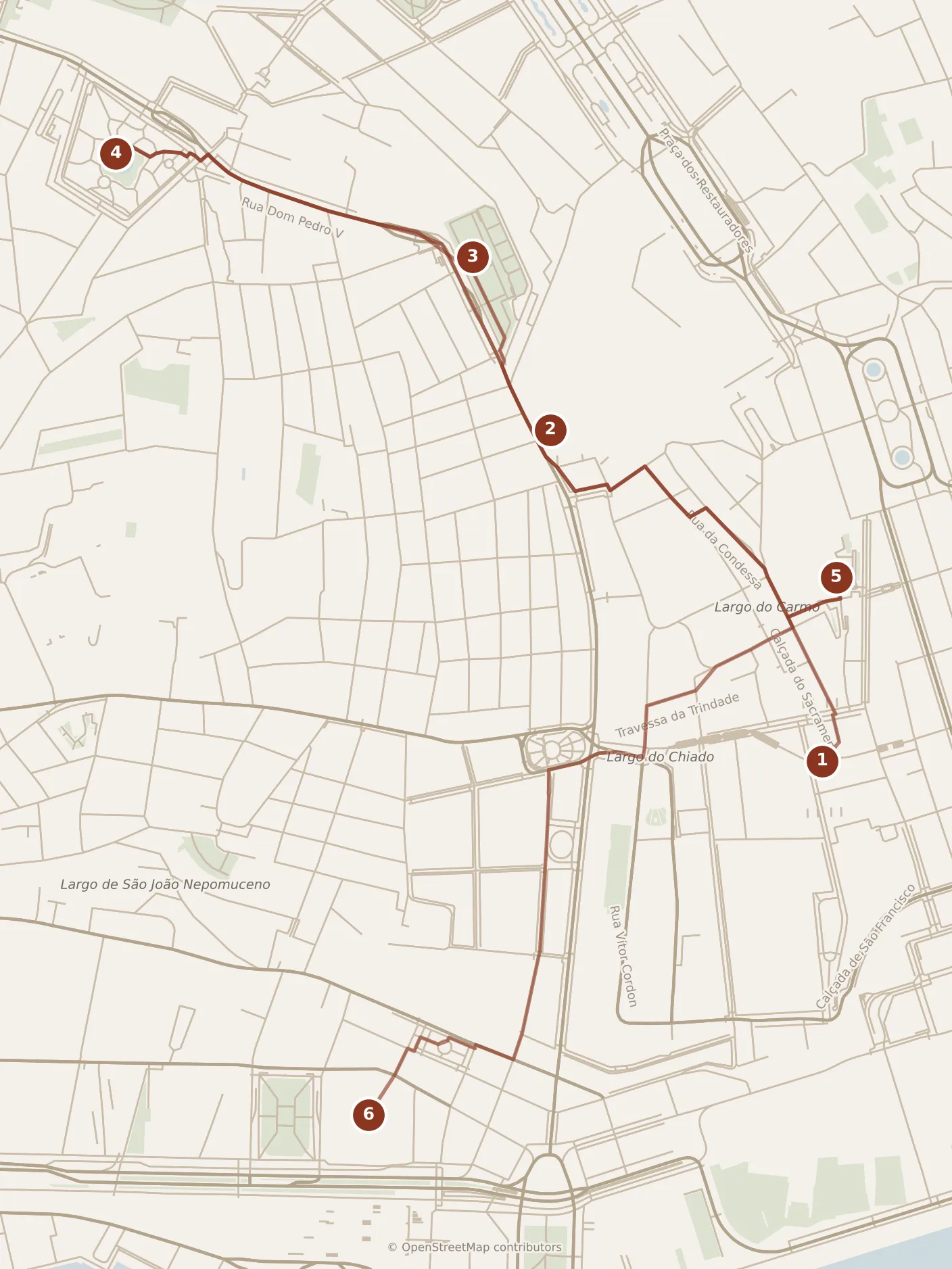
- Morning and afternoon
- 1Baixa-Chiado station
- 2Igreja de São Roque
- 3Miradouro de São Pedro de Alcântara
- 4Jardim do Príncipe Real
- 5Convento do Carmo
- 6Mercado da Ribeira
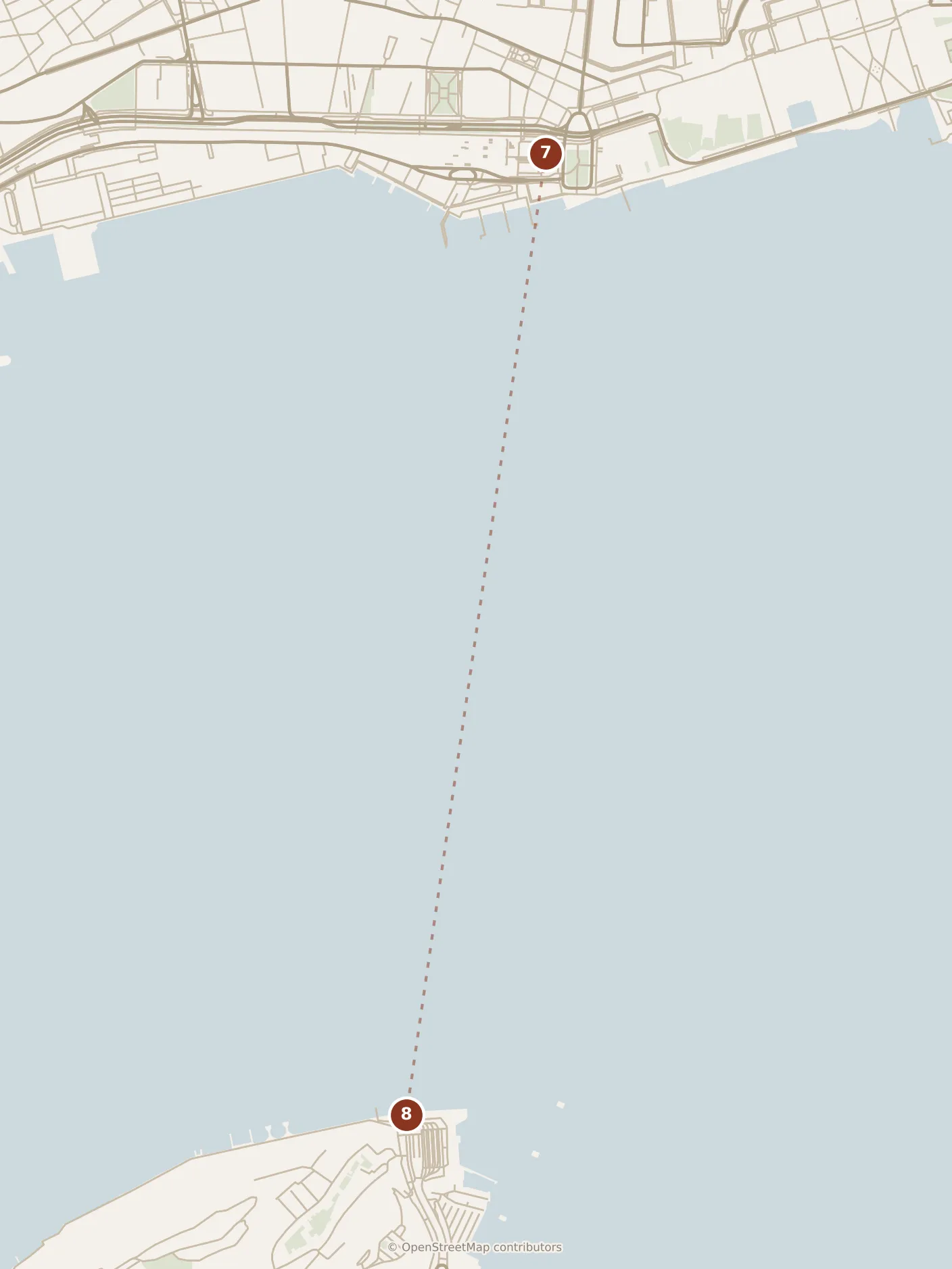
- Evening
- 7Cais do Sodré station
- 8Cacilhas
The whole of today happens on the ridge west of the Baixa and then falls off the end of it into the river. You climb once, at the start, and by machine.
Morning
Begin inside Baixa-Chiado station, on the blue and green lines, which is the one piece of transport in the center that is also a shortcut. One of its entrances is down in the flat Baixa and the other is high up at the top of Chiado, and the long run of escalators between them does the climb the Ascensor da Glória used to do: go in at the Baixa end, come out at the Chiado end, and you are on the ridge for the price of a metro ride. From the airport it is the red line to Alameda and then the green line six stops. From Santa Apolónia it is the blue line, two stops, through Terreiro do Paço. From Rossio station it is ten minutes on foot and all of it uphill, which is the argument for the metro — and which is also the fallback, because a day that opens by riding a long run of escalators should know what it does when they are not running.
Nine minutes north-west and up from the Chiado exit is the Igreja de São Roque, which looks like a warehouse from the street and does not prepare you for anything inside it. The Jesuits began it in 1555 and Filippo Terzi finished it in 1619, and it is one of the very few buildings here that came through 1755 more or less intact — so what you are standing in is pre-earthquake Lisbon, which almost nothing else in this city is. The flat wooden ceiling was painted by Francisco Venegas in the 1580s to look like a barrel vault carried on four great arches. It is a painting of a roof, on a roof, and it works.
Then the chapel the church exists for. The Capela de São João Baptista was designed by Luigi Vanvitelli and Nicola Salvi and built in Rome from 1742, paid for with the gold coming out of Brazil; the pope consecrated it there in 1744, and in 1747 it was taken apart and carried to Lisbon in three ships. It is lapis lazuli, amethyst, alabaster, agate, porphyry and Carrara marble, and the three pictures in it are not pictures: they are mosaics by Mattia Moretti, laid in tesserae of two to five millimetres, and you have to stand closer than feels polite before they break up into pieces. Give the church three quarters of an hour. It is a working church, so on a Sunday morning it belongs to its congregation and you visit around them.
Four minutes north the street opens out into the Miradouro de São Pedro de Alcântara, a terrace on two levels looking straight across the valley at the castle hill you are not going to today. Fifteen minutes. It is the one place on this day where the whole eastern half of the city lines up in front of you, which is worth having the day before you spend one inside it.
Eight minutes west is the Jardim do Príncipe Real, a square garden built around one enormous cedar trained flat on iron props into a green ceiling you can stand under, with an octagonal water reservoir buried beneath the paving. Twenty-five minutes, on a bench, is the correct use of it.
Afternoon
From the garden it is seventeen minutes back down through the grid of Bairro Alto to Largo do Carmo, and lunch happens somewhere along that walk rather than at either end of it. Bairro Alto is shuttered and quiet by day — it is a hill that works at night — which is why lunch here is a calmer business than lunch four streets east in Chiado. Take an hour over it. The pastel de nata is not a stop on either of these days and does not need to be: it is sold warm in every pastelaria you will pass, and the bakery it is said to have come out of is at Belém, which is the one district these two days deliberately do not go to.
The Convento do Carmo is the reason this side of the city earns a day. Nuno Álvares Pereira founded it in 1389, it was finished in 1423, and it was the largest church in medieval Lisbon; on the morning of 1 November 1755 the earthquake took the roof off it while it was full. It has never been put back. What the ticket buys is a nave with sky in it — five bays of arcading, the ribs of the vault sheared off where they spring, grass between the flagstones — and, in the apse at the far end, the Museu Arqueológico do Carmo, which has kept its collection inside the ruin since the 1860s: prehistoric material, Moorish tiles, the tomb of a fourteenth-century king, and, at the back, the mummies that Lisbon schoolchildren are taken to see. Give the whole thing an hour, and give most of that to standing in the nave rather than reading the cases.
This is the only door on today with an hour that matters, and it also keeps the strangest closing day in the city. In 2026 it closed at six from November to April and at seven from May to October, with the last admission twenty minutes before that, and it was shut all day on Sundays — the reverse of almost everything else here. That is why it comes before the market and the boat rather than after them. If the hour has moved, nothing else changes: the ruin first, then the river.
Local tip. Largo do Carmo is level with the top of the Elevador de Santa Justa, not below it. The line at the bottom of that elevator is people paying to arrive where this morning has already put you. Walk out along it if you want the view; the ride is the part you can skip without losing anything.
Fifteen minutes downhill from the square, mostly on stepped lanes, is the Mercado da Ribeira at Cais do Sodré: half of it still a working produce market in the morning, the other half a hall of food counters, signed and generally spoken of as the Time Out Market, that runs all day. Forty-five minutes. Decide before you go in whether this is a drink or a meal, because the hall does not decide for you — and at a busy hour take a seat at the long shared tables before you go looking at counters, because the seat is the part that runs out.
Evening
Three minutes from the market is the ferry terminal beside Cais do Sodré station, and the crossing to Cacilhas takes about ten minutes. This is the moment the day is built around and the only thing on these two days that turns on the light: go over in the last of it, because the point of the far bank is what is behind you. From the deck, and then from the quay at the other end, Lisbon assembles into the thing it never is from inside — seven kilometers of pale city stacked up a green hillside, the castle at one end and the monastery at the other, the whole of it going orange and then gray while you watch.
Cacilhas is in Almada and is a working ferry and shipyard town rather than a resort, and what is easiest to do there is within sight of where the boat lands. A three-masted wooden frigate of the 1840s, the last sailing warship built for the Portuguese navy, has been moored here since 2008 with a submarine in the dock beside her. Going aboard and crossing in the last of the light are not necessarily the same evening, and which they are depends on your month. The ship is a daytime visit with a closing hour of its own; the crossing is built around the sun going down, and in June that is past nine. Read the one against the other before you fix the hour of the boat, and where they will not meet, take the crossing — the light is what this day was built around — and give the ship a morning of its own. Then the row of fish restaurants along the quay, where you eat grilled fish looking back at the city you have spent the day walking on. Sardines belong to the summer here — the city guide puts them at the June festas — so out of season ask what came in that day rather than ordering what the postcard promised. High on the ridge above, the outstretched concrete figure of Cristo Rei is floodlit after dark; getting up to it is a separate outing and this evening does not make it, which is worth saying, because from down here it looks close enough to walk to.
The boats run late and the schedule is posted at the terminal on both banks — read it before you sit down to dinner rather than after it. If you would rather have the last crossing settled before you leave home than at the quay, the operator is Transtejo Soflusa and it publishes the Cacilhas schedule itself. You land back at Cais do Sodré, which is the green line’s southern terminus, so wherever you are sleeping is one ride away.
Day two

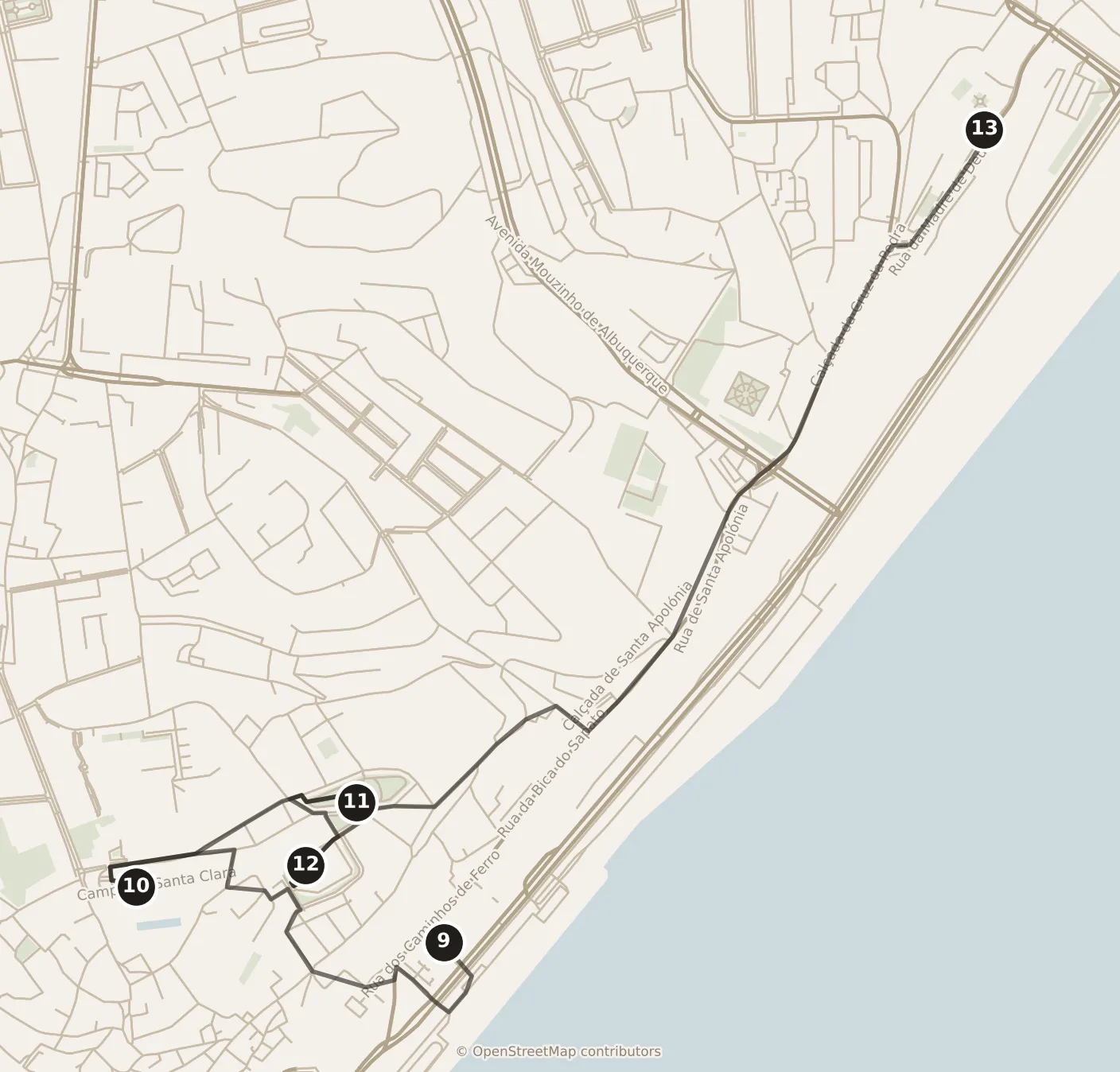
- Morning and afternoon
- 9Santa Apolónia station
- 10Mosteiro de São Vicente de Fora
- 11Feira da Ladra
- 12Panteão Nacional
- 13Museu Nacional do Azulejo
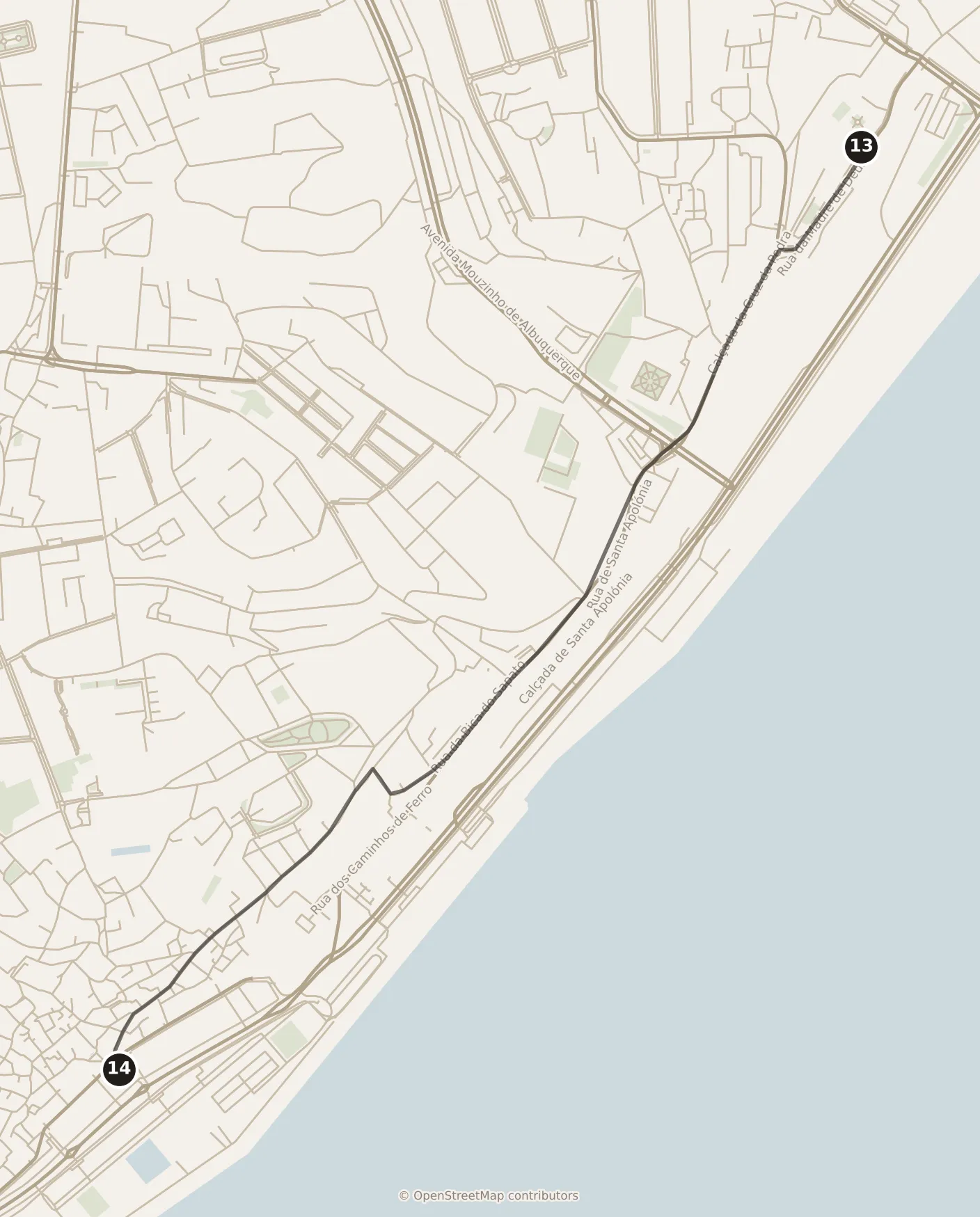
- Evening
- 14Museu do Fado
Today is the eastern ridge, behind and above the castle, and it goes up, along, out and back down. It is the longer of the two days: just under seven hours of stops and walking, or about seven and a half if it falls on a market day. That count does not include the ticket desk at the tile museum, which is the largest single thing a line can cost you here.
There is no hour on this day and nothing on it that depends on the light, so the count runs forward from the first door rather than backwards from the last. Reach the monastery at its opening. The reason is arithmetic, not atmosphere: the far end of the afternoon is a museum two kilometers east of everything else, and a late start puts you there with it shut.
Morning
The day begins at Santa Apolónia station — the end of the blue line and the mainline terminus, so it is one ride from almost anywhere in the city and a walk from Alfama or Graça. From the forecourt it is nine minutes up to the Mosteiro de São Vicente de Fora, and all nine of them are gradient.
Go in for three things: a wall of tiled fables, a room of dead kings, and a roof you can stand on. The front gives none of it away — huge, cold, deliberately plain Mannerist, which after yesterday reads as an argument rather than as a shortage of money — and the provenance is quickly told: Afonso Henriques founded the monastery around 1147, the year the city was taken, and what stands now is the church begun in 1582 under Spanish rule and finished in 1629, attributed to the same Filippo Terzi who closed the roof on São Roque. Give it an hour and a quarter and spend it in the three places above. The cloisters carry over a hundred and fifty eighteenth-century tile panels, and one run of them tells the fables of La Fontaine in blue and white, which is a very odd thing to meet on a monastery wall. The old refectory was turned in 1834 into the pantheon of the Braganza kings, and the last dynasty to rule Portugal lies in it in rows, stopping abruptly. And the roof, reached from inside, gives you the eastern city from above: the dome of the Panteão Nacional a couple of hundred meters east, the river past it, the container cranes past that. It is also a working church, so on a Sunday the cloisters and the royal pantheon are the parts to aim at and the church itself may be in use when you arrive.
Seven minutes on, the long open slope of Campo de Santa Clara holds the Feira da Ladra. The one perishable thing on this day is not an hour but a weekday: the market runs on Tuesdays and Saturdays and on no other day of the week. If yours is one of the two, give it forty minutes and expect junk — cracked tiles, single shoes, drawers of keys, the occasional real thing — because junk is what it is, and the sorting is the whole pleasure. If yours is not, you cross an empty square in two minutes and the day is forty minutes shorter.
Two minutes below the market is the Panteão Nacional, which is really the church of Santa Engrácia and which took so long to finish that obras de Santa Engrácia became the Portuguese phrase for a job that never ends: begun in 1682, reinaugurated in 1966, two hundred and eighty-four years. Inside is one vast cold marble cross under the dome with almost nothing standing in it, and the emptiness is the effect. Around the walls are the real graves — novelists and poets, four presidents of the republic, the footballer Eusébio, and Amália Rodrigues, whose voice you will be hearing this evening — and then a row of cenotaphs for Luís de Camões, Vasco da Gama and Henry the Navigator that contain nobody at all, because those men are buried elsewhere, two of them out at Belém in the monastery this route does not visit. Give it an hour, and give the last twenty minutes of that to the walkway around the outside of the dome, which is what the ticket is really for.
Afternoon
Four minutes steeply down from the Panteão puts you back at Santa Apolónia, and lunch belongs at the bottom of Alfama rather than up on the hill, where the choice thins to whatever a residential ridge keeps for the people who live on it. A bifana at a counter takes ten minutes if you want it to; an hour at a table is the better use of the middle of a long day.
Then the one stretch on these two days that is neither short nor pretty: twenty-seven minutes east on foot from the station along the dock road to the Museu Nacional do Azulejo. It is flat, it is loud, and it is the one leg here worth riding rather than walking — check what runs along the avenue before you decide it has to be a taxi. What it buys is the museum most likely to be the one you remember and the one nobody schedules. It lives in the convent of Madre de Deus, which Leonor founded in 1509, so before the tiles you get a church interior of gilt woodwork and painted panels that would justify the entry on its own. Then five centuries of azulejos in sequence, and the thing everybody comes for: a tiled panorama of Lisbon made around 1700 that runs the length of a whole room and shows the entire waterfront as it stood before the earthquake — the palaces, the churches, the ships — almost none of which existed fifty-five years later. You have just spent two days in the city that replaced it. An hour and a half; if you are short, take the church and the panorama and leave the middle centuries alone.
Local tip. The tile museum is the furthest stop on these two days from the one before it — the twenty-seven minutes above — and it is also the one to protect. If the afternoon has run short, drop the fado museum below rather than shortening this one: the evening gives you fado either way, and nothing else in Lisbon gives you that room.
Evening
Twenty-seven minutes back the way you came, or the same ride, and then ten minutes on into Alfama proper. At the bottom of the quarter the Museu do Fado sets out where the music came from — the nineteenth century, the port, the taverns — with a listening room that is the whole reason to go in. Forty-five minutes, and it is the difference between an evening you enjoy and an evening you understand.
Then the lanes above it, which is where fado is sung after dinner. This is the one part of these two days worth arranging ahead, and the exception to everything said above about walking up. Nothing on this route sells a timed ticket, but a small room with a singer in it does not work like a ticket desk: ask where you are staying to put your name down for the evening, that afternoon at the latest, rather than testing lit doorways at nine with a hungry companion. Then one thing that is not optional and a visitor cannot guess: when the singing starts, the room goes silent. The lights drop, conversation stops, the waiters stop moving, and talking through a fado is not a small lapse — you will be told, by the room if not by the staff. Order before it begins, and treat the songs as the reason you are sitting there rather than as something behind the meal, because that is what everyone else in the room is doing.
Santa Apolónia is ten minutes downhill when you have had enough, with the blue line and the mainline platforms in the same building, which is why this is the better of the two days to put last if you are leaving from there. Check that you are: Santa Apolónia is not the city’s only mainline station, and some long-distance departures leave instead from Oriente, out to the east. If yours is one of those, this ordering rule is not about you.
With a third day

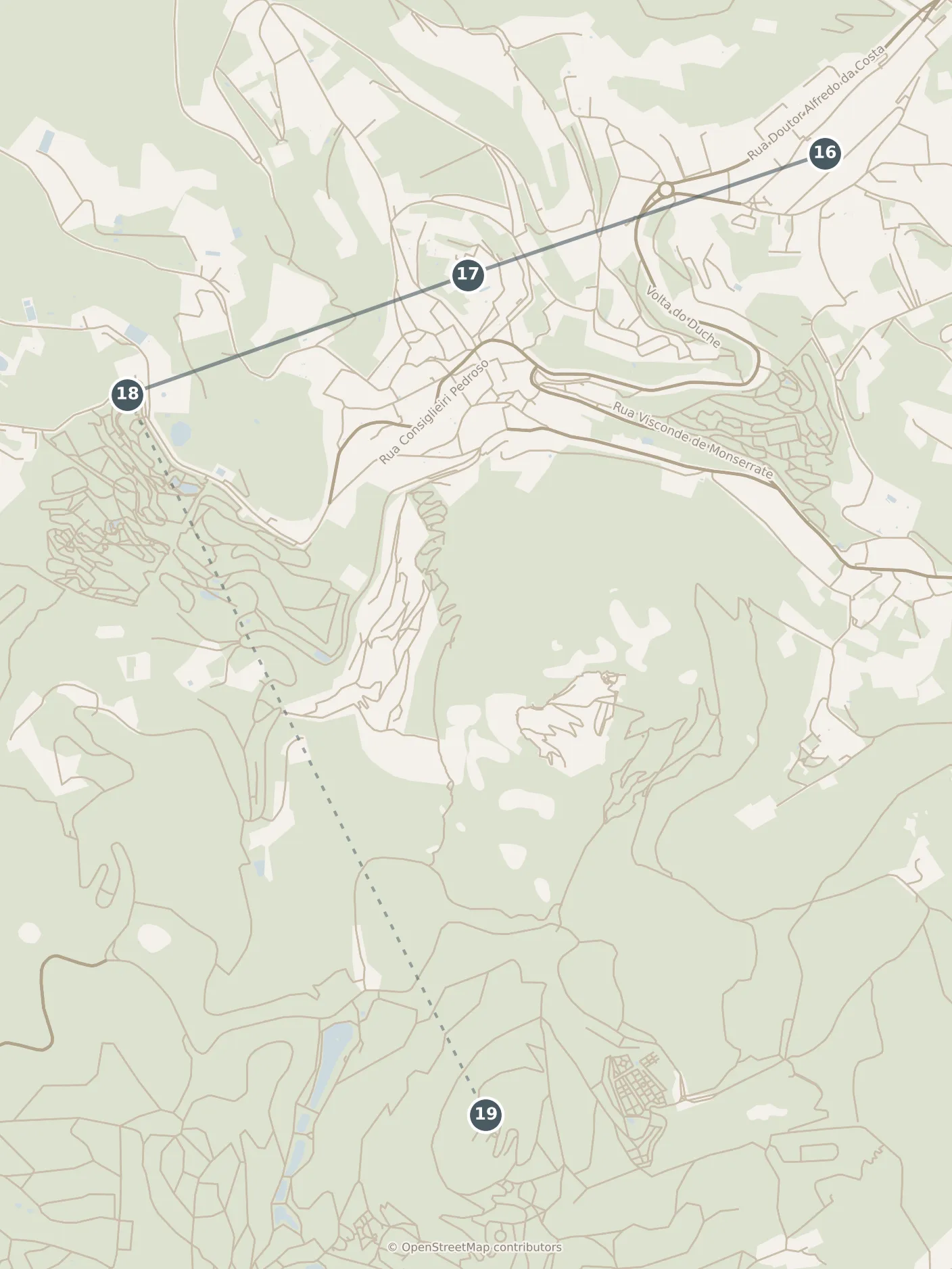
- With a third day · stops 16–19
- 16Sintra station
- 17Palácio Nacional de Sintra
- 18Quinta da Regaleira
- 19Palácio Nacional da Pena
Give the third day to Sintra, and give it the whole of the day. It is the thing a Lisbon trip is routinely too short for, it is a real journey into the hills rather than a run out to a suburb, and it is why the title of this page mentions it.
Where it goes is decided by the calendar rather than by taste. Sintra is the only one of these three days that does not care what day of the week it is — the palaces open every day and shut only for a couple of dates at Christmas and the turn of the year — while day two is closed by a Monday and day one loses its ruin on a Sunday. So the third day takes whichever of your dates is a Monday. If that is your middle date, it goes in the middle and day two moves to the end. If none of your dates is a Monday, put it last, because it is the longest of the three. One case needs care, and it is the common one: leaving by train. Day two finishes ten minutes’ walk from Santa Apolónia and the mainline platforms; the third day finishes at Rossio, which is where the Sintra trains come in and not where the long-distance ones leave from. Those two rules cannot both hold on a departure day, and that is a real collision rather than an oversight — one of them has to give. Where you have the freedom, take day two last and put Sintra in the middle. Where you do not — because your Monday is your last date, and day two is the one day of the three that cannot take a Monday — put Sintra last anyway and plan the connection rather than worry about it: Restauradores, the blue line station beside Rossio’s own front door, runs three stops direct to Santa Apolónia. All of which assumes your train leaves from Santa Apolónia at all; if it leaves from Oriente, none of this ordering applies and you have one fewer rule to satisfy.
Trains for Sintra leave from Rossio station, under the horseshoe arches at the top of the Baixa, and take about forty minutes. From Sintra station it is ten minutes down into the town to the Palácio Nacional de Sintra, the two white cones of its kitchen chimneys visible the whole way and unmistakable from anywhere in the valley. The crown lived here from the fifteenth century until 1910 and the building grew room by room without a plan, which is its charm: a ceiling painted with magpies, a ceiling painted with swans, a hall lined with the coats of arms of seventy-odd noble families, and the two chimneys standing open above the kitchen floor like the inside of a rocket. An hour and a quarter.
Nine minutes west along the road is the Quinta da Regaleira, an estate built at the turn of the twentieth century as a private allegory: a house of stone lacework, and behind it a garden of grottoes, tunnels and towers ending in a well that is not a well — a spiral of nine galleries cut down through the rock, entered through a door in the hillside and climbed up into the garden. An hour and a half, a good part of it underground.
Then the hill. The Palácio Nacional da Pena is the one thing on these three days that has to be booked, and it sells timed slots by date and hour, which is itself the evidence that the crowd is real; that slot is what the rest of the day is protecting. Parques de Sintra runs the hill and sells the ticket on its own site, which is the channel to use rather than a reseller. In 2026 the palace admitted nobody before half past nine and sold no ticket after half past five — build the morning forward from the first of those if you are taking the earliest train, and if the hours have moved, build it forward from the new ones. Book the slot for the early afternoon: the town palace is an hour and a quarter, the walk on to Regaleira nine minutes, Regaleira an hour and a half, and the bus line an unknown quantity on top, which from a first-train arrival puts you at the gate somewhere after one. Get up there on the 434 bus, which runs a one-way circuit from Sintra station through the historic center to the hilltop; walking up is several kilometers of hairpins and a serious climb, and it is not the way to arrive. Pena itself is a nineteenth-century romantic invention in yellow, red and glazed tile, built over a ruined monastery by a king who wanted a folly and produced a landmark, and on a clear day you can see the Atlantic from the terraces. Two hours for the park and the interior together.
Add the two bus legs and the walk back to the stop to the durations above and this is about seven and a quarter hours, Rossio to Rossio. The count does not include the line for the bus, which is the largest single thing this day can lose to. If it runs short, the stop that goes is the Quinta da Regaleira — it is the only one of the three that is not on the way to anything, and it costs an hour and a half plus the nine-minute walk. What stays is the town palace, ten minutes from the platform, and Pena, which is what you came for. The Castelo dos Mouros on the ridge between them is a fourth thing and this day does not attempt it: two hilltop sites in one afternoon is one more than the bus line allows.
Practicalities
Buy one ticket ahead, and only one. The timed slot at Pena, a few days ahead in high season, is the whole ticket list for three days in and around this city. Every door on days one and two is walk-up — the church, the ruin, the monastery, the pantheon, both museums — and that is not laxity, it is part of why the route was chosen. The one thing on these days that is not a door is the fado evening, which wants a name put down rather than a ticket bought; it is dealt with where it happens.
The weekday rules, and then the shorthand. Day two must miss Monday: its ticketed stops are national museums and a monastery, and the Portuguese national museum closes on Mondays as a rule. The monastery and the fado museum each keep a closing day of their own, so read those two the week before rather than assuming they match. Day one must miss Sunday, and here the day is certain rather than inferred: the Carmo ruin and its museum opened Monday to Saturday in 2026 and closed on Sundays. The third day will take any date at all. So the arrangement is Monday to Sintra, Sunday to day two, whatever is left to day one — and if your dates contain neither a Sunday nor a Monday, the three will go in any order, though day one reads best first, because its terrace looks across at the ground day two walks on. On a Tuesday or a Saturday day two gains the flea market and runs about forty minutes longer, which is a reason to put it there if you are choosing.
A two-day trip containing both a Sunday and a Monday looks like a trap and is not one, as long as you will run the days out of order. Put day two on the Sunday and day one on the Monday and both weekday rules hold: day two’s rule is about Mondays and says nothing about Sundays, and the Carmo ruin — the thing a Sunday would have taken — opens on a Monday like every other weekday. What that arrangement costs is the order, not a stop. Day one is the arrival-day route and day two the departure-day one, for the reasons in the bag paragraph below, and this puts them the wrong way round; on a Sunday-to- Monday pair that is simply the price. Two things to look at before you take it. A Monday day one meets two doors this page has claimed no weekday for — the museum side of São Roque and the ship at Cacilhas — and both keep closing days of their own, so read them for a Monday before you commit the first hour and the last. And if you would rather keep the order and give day one the Sunday, it loses the Carmo ruin: Largo do Carmo is a public square and the west front of the church stands on it, but the nave with the sky in it is what has gone. Use the western reserve below in its place. Be clear about what that costs — the reserve replaces the ruin, the market and the walk between them, and it runs about an hour and a half longer than they do, so a Sunday day one comes to nearer seven hours than to five.
The western reserve, which does three jobs. From Largo do Carmo it is ten minutes downhill to the tram 28 stop on Largo do Calhariz. Two things about that tram before you get on it: Calhariz is a mid-route stop, so a full car can go past you and the wait is not the one a schedule would predict, and the 28 is where visitors in this city lose their wallets — bag in front, as the city guide says at more length. Tram 28 runs from there to Estrela and sets you down outside the Basílica da Estrela, the white dome you have been seeing from every terrace, built by a queen in fulfilment of a vow and finished in 1790, with the Jardim da Estrela — bandstand, ponds, old trees — across the road. From the basilica it is seventeen minutes downhill to the Museu Nacional de Arte Antiga, the national painting collection, and from there twenty-eight flat minutes east along the river to the ferry at Cais do Sodré, so the reserve rejoins day one exactly where day one was going anyway. Use it in three cases: on a Sunday, in place of the ruin and the market; in high summer, when day one as written finishes the better part of six hours before the light and this fills about three and a half of them, with dinner on the far bank taking the rest; and in rain, when it replaces the afternoon outright. One caveat matters: the painting museum is a national museum and shuts on Mondays. On a Monday the reserve is the basilica and the garden and nothing else, which is about a third of it.
If you have never been to Belém, the choice is not between adding it and skipping it. Belém is half a day at the very least, its monastery runs on timed slots that sell out, and it sits at the opposite end of the city from everything above. Trade a whole day for it rather than trying to graft it on. On a three-day trip, give the third day to Belém instead of Sintra — it is the same shape of decision, one ride out and back, and it costs you the hills instead of the palaces. Two things come with that swap and both are easy to miss: it adds a booking these three days did not otherwise have, and it inherits none of the calendar freedom Sintra has, because the monastery and the tower close on Mondays. So a Belém day cannot take your Monday, and the Monday then has to go to day one, which takes it — subject to the same two doors named in the two-day paragraph above. On a two-day trip, take the one-day route for this city as your first day and day two above as your second, and lose the western ridge.
Distances, honestly. Day one is about three and three quarter kilometers of walking, almost all of it within a few hundred meters of the same ridge, with one machine-assisted climb at the start and one long descent to the river at the end. Day two is about five and three quarter kilometers, and three and a half of that is the dock road, out and back. Neither day is long by the standards of a city walked on foot; both are steep in places, and the surface is the polished limestone calçada the city guide warns about, which is genuinely slippery in rain. Nothing here needs a vehicle except that leg to the tile museum, and that only if you would rather not walk it.
The bag. This is a two- or three-night trip, so the case is a problem exactly twice: the morning you arrive and the evening you leave. Day one is the one to put on an arrival day, because it starts inside Baixa-Chiado station in the middle of the city. Day two is the one to put on a departure day, because it ends ten minutes above Santa Apolónia, where both the mainline trains and the blue line are — if that is the station your train leaves from, since some long-distance services go from Oriente instead. What you must not do is take a case up either hill: the nine minutes from Baixa-Chiado to São Roque are gradient and steps, the lanes of Alfama are stepped for most of their length, and there is nothing at the top of either to leave anything with. If you land early and the room is not ready, the case stays where you are sleeping — ask when you book whether they will hold it before check-in, because the alternative is doing that first climb carrying it.


.jpg)
