Lisbon in one day: Belém in the morning, the Baixa at lunch, the castle hill as the light goes

Last updated 4 August 2026
Overview
One day in Lisbon is not a shortened version of three, because what shapes it is not which things you pick but how far apart they sit. The old city runs about seven kilometers along the north bank of the Tagus, from the monastery at Belém in the west to the castle hill in the east, and none of it is flat. So a single day here contains one train ride and one tram ride whether you want them or not, and the only honest route is a straight line west to east that never doubles back.
What that costs you is Sintra. It is the classic outing from here and it is a day of its own; with one day you have Lisbon or you have Sintra, and this page assumes Lisbon. It also costs you the museums and most of the miradouros, the terrace viewpoints the city is stitched together with. You get three of them, all at the eastern end of the day, and three is the right number.
The end is where the day is anchored, because the last stop is a terrace and terraces are about light. The sun goes down here from just after five in the first days of December to a few minutes past nine at midsummer — close to four hours of swing across the year — so take your own month’s hour and count backwards about seven and a half, which is what everything below comes to.
Be clear about what that seven and a half hours is. It is time spent inside the places plus the walking and riding between them, and it is nothing else. It does not include the line at the monastery, which in season is the largest single thing this day can lose to and can run to an hour on its own; and it does not include lunch running long, which in this city it will.
The count has a floor at the other end, too. The monastery is the first stop and it does not open at dawn: in 2026 it admitted nobody before half past nine, and it was shut all day on Mondays. Build the morning forward from that door, and if the hour has moved, build it forward from the new one. In December the backward count from sunset lands almost exactly on the opening, so the winter version of this day has no slack in it anywhere. At midsummer the same count lands in the early afternoon, which is the more useful thing to know: high summer hands you four spare hours. Spend them at the front of the day — put Chiado back in before lunch rather than dawdling at the end — because the castle at the far end is the one stop with a gate, and you do not want to reach it pressed against its own closing.
You are probably carrying a bag, and this route is a one-way sweep, so decide where it lives before you start rather than after. The day begins on the western waterfront at Cais do Sodré and ends high on the eastern hill in Graça, a quarter of an hour downhill from Santa Apolónia — the mainline station, and the one most readers of this page will be leaving from. Whatever you do with the bag, do it before the train west: the afternoon and evening are a continuous climb up stepped lanes to the castle, and there is nowhere at the top to put anything down.
The day

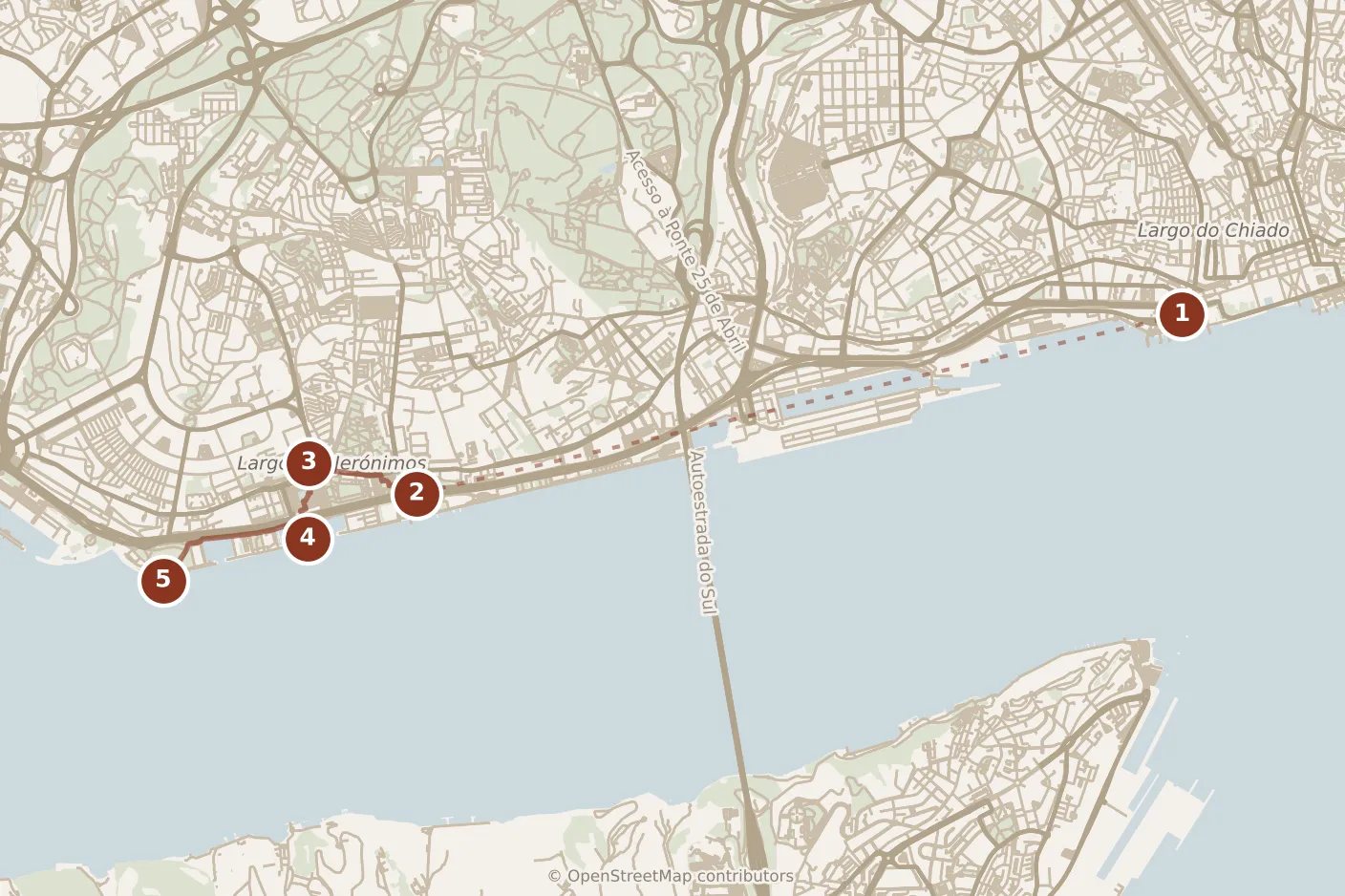
- Morning
- 1Cais do Sodré station
- 2Belém station
- 3Mosteiro dos Jerónimos
- 4Padrão dos Descobrimentos
- 5Torre de Belém
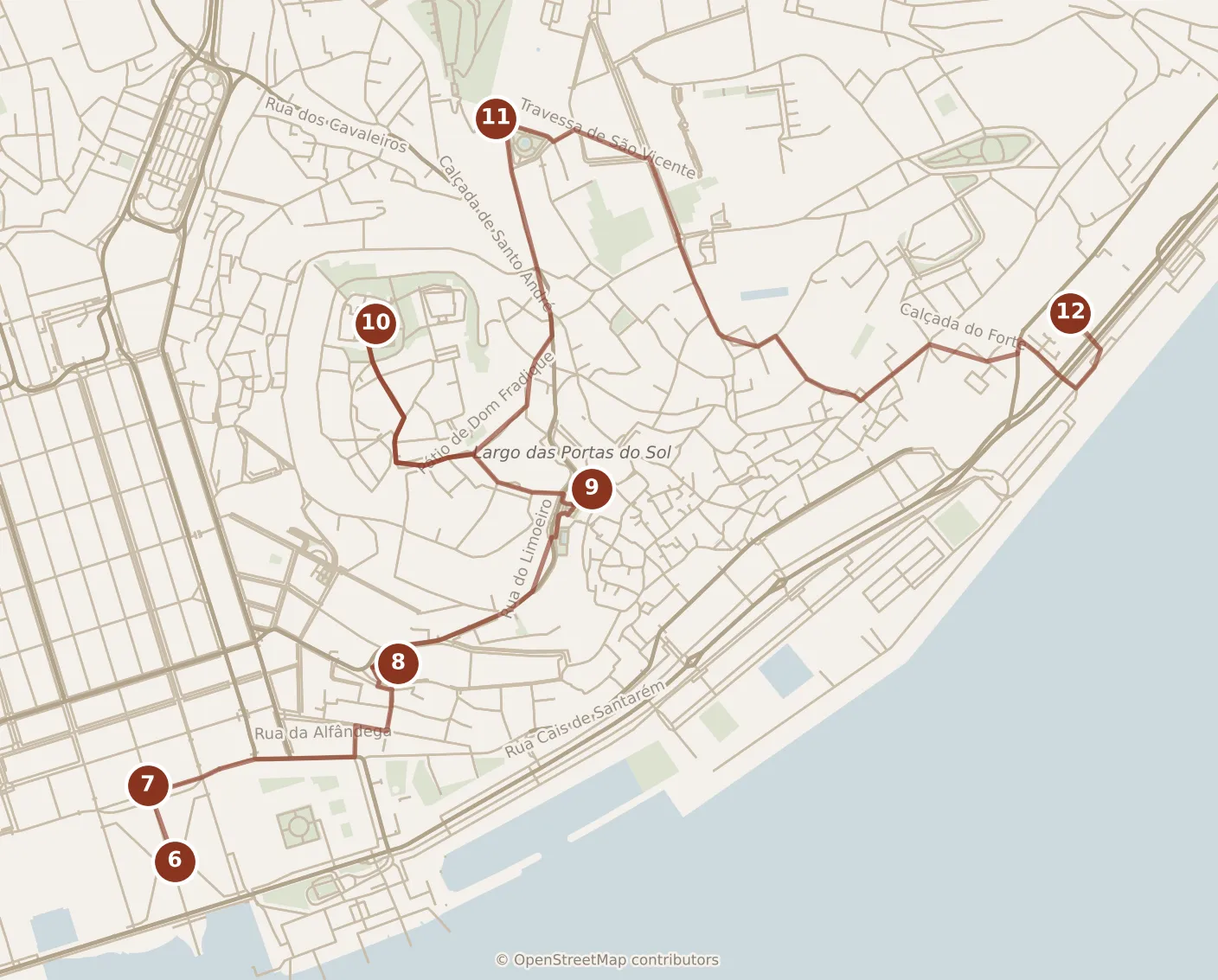
- Afternoon and evening
- 6Praça do Comércio
- 7Arco da Rua Augusta
- 8Sé de Lisboa
- 9Miradouro das Portas do Sol
- 10Castelo de São Jorge
- 11Miradouro da Graça
- 12Santa Apolónia station
Morning
Cais do Sodré station is the southern terminus of the metro’s green line and the city end of the Cascais railway line, which makes it the easiest place in Lisbon to begin from wherever you slept — from the airport it is the red line to Alameda and then the green line to the end of it. Take the Cascais line west and you are at Belém station in under ten minutes, with the river alongside the whole way.
From Belém station it is about a quarter of an hour on foot to the Mosteiro dos Jerónimos, which announces itself long before you reach it: three hundred meters of white limestone frontage, paid for out of the crown’s fifth of the spice trade and begun in 1501, when the money from the sea route to India was arriving faster than anyone could spend it. The carving is Manueline — ropes, knots, armillary spheres, artichokes, sea creatures — and it is stone behaving like something soft. Inside the church, the columns branch into the vault like trees, and two tombs face each other across the entrance: Vasco da Gama on one side, the poet Luís de Camões on the other. The ticket is for the cloister, and the cloister is what you came for — two stories of arcading with every bay carved differently. Give the church and the cloister an hour and a quarter together.
Two minutes east of the monastery is the bakery the pastel de nata is said to have come out of. There is a line on the sidewalk for the takeout counter and a warren of tiled rooms behind it that is usually emptier; eat two, warm, with cinnamon, and give it twenty minutes.
Nine minutes due south, across the gardens and under the road, the Padrão dos Descobrimentos stands on the water: a concrete ship’s prow raised in 1960, with Henry the Navigator at the point and a line of navigators, cartographers and missionaries filing up behind him. It was built by a dictatorship to celebrate an empire, and knowing that is most of what there is to do here. In the sidewalk in front of it is a vast compass rose with a map of the voyages inside it. Fifteen minutes, unless you take the elevator up.
Then eighteen minutes west along the waterfront — the longest single stretch on this itinerary — to the Torre de Belém, a small fortress standing out in the river, built between 1514 and 1520 to guard the harbor mouth. It is the same carved-rope Manueline as the monastery but compressed into something the size of a house, with corner watchtowers that look Moorish under ribbed stone domes. Walk right round the outside and hunt for the rhinoceros head on one of the corbels, carved after a live one was shipped up this river to the king in 1515. Inside is a spiral stair so narrow that traffic goes one way at a time, and it has a ticket of its own.
Local tip. Two stops on this day sell you a view from a height and each has its own ticket: this tower, and the castle at the end of the afternoon. If you are buying one, buy the castle. It is higher, you are going there anyway, and the hour the tower’s stair costs you is exactly the hour that gets you up the hill while it is still light.
Afternoon
The 15E tram runs along the avenue two minutes inland from the tower and goes the whole way to Praça da Figueira, along the riverfront and past the front of Praça do Comércio. Give it half an hour and expect to stand. The train is quicker, but its station is a mile back east past the monastery, so catching it means undoing the morning.
You get off on Praça do Comércio, which is open on one whole side to the Tagus and arcaded in ochre on the other three, with a bronze king on a horse in the middle. The royal palace stood here until 1755, when the earthquake, the fire and the wave took it and most of the city with it. What replaced it is the point of the square: a government quarter laid out like a stage set, with the river as the fourth wall. Walk down the marble steps at the water’s edge. Fifteen minutes.
The Arco da Rua Augusta closes the square on the landward side. Go through it rather than up it — there is a viewing platform on top with a ticket of its own, and everything it shows you the castle will show you higher, three hours from now. Beyond it, Rua Augusta runs dead straight through the Baixa, the grid Pombal’s engineers threw up after the earthquake around timber cages built into the masonry and designed to flex. You cannot see them, and knowing they are there changes the walk.
Lunch happens here or nowhere, because the Baixa is where the day crosses the middle and everything after it is uphill. The thing to eat standing at a counter is a bifana, thin pork in a bread roll with mustard; the thing to eat sitting down is petiscos, the Portuguese version of small plates. Take an hour over it, at a table, a street or two off Rua Augusta itself, which is the tourist axis.
Seven minutes east of the arch, and the first of the climbing, is the Sé de Lisboa: two square bell towers and a rose window on a front that looks like a keep, which it partly was. It was begun in 1147, the year the city was taken, on the ground the main mosque had stood on, and it has been shaken and patched by every earthquake since — which is why the outside is Romanesque and the inside is a committee. Twenty minutes. The cloister behind it is a live archaeological dig with a Roman street and Moorish houses under the floor, and it costs another ticket; with one day, skip it. Tram 28 grinds round the front, which is why every photograph of this church has a yellow tram in the corner of it.
Seven more minutes up the same street, and a little short of the top, you pass a small terrace walled with blue-and-white tiled panels showing the city as it looked before the earthquake: the Miradouro de Santa Luzia. Stop at it on the way rather than press on, because the tiles are the reason to be here and most people photograph the roofs and leave. A minute above it the street opens out into the Miradouro das Portas do Sol. This is the view of Alfama: a slope of terracotta roofs falling to the river, the big white twin-towered church standing over them is São Vicente de Fora, and the pale dome further along is the Panteão Nacional. Twenty minutes for both.
Evening
From Portas do Sol the castle gate is seven minutes, all of it up, through a knot of lanes that will try to send you round in a circle; follow the signs and follow the other people, both of which work.
Castelo de São Jorge is where the day pays for itself. The big view arrives almost at once, on the wide gun terrace just inside the walls: the whole Baixa grid directly below, the river, the bridge, and Belém somewhere in the haze at the far end of it — the entire morning laid out in one frame. Past the terrace, the castle proper is a ring of walls and towers whose tops you can walk, and there are peacocks in the grounds. Give the whole thing an hour and a half, most of it on the walls.
It is also the one stop on this route with a gate that shuts, and that is what fixes the order of the evening. For most of the year it is still open when the sun goes down. Around midsummer it is not: through the summer of 2026 it closed at nine in the evening, and the sun sets here a few minutes past nine in late June. That is a handful of weeks, and they are the busiest weeks of the year, so the day is written the safe way round — the castle while it is open, and the light afterwards from somewhere with no door on it. Check the closing against your own month’s sunset before you fix the afternoon; if it turns out to shut first, nothing in the plan needs to change.
Six minutes from the castle gate, down one side of a small valley and up the other, is the Miradouro da Graça: a wide terrace under pines with a kiosk in the middle and the castle you have just left standing on the skyline in front of you. That is the point of it. This is the place where the castle is in the picture rather than under your feet, and at sunset it goes black against an orange river. The crowd is young, local and sitting on the wall. If the terrace is full there is a higher and quieter one a few minutes further up the hill.
Then the descent, which is the part of the evening with a deadline in it. Santa Apolónia station is fifteen minutes from here, east and steeply downhill through the lanes, and it is where most people leaving Lisbon by train are heading. The metro’s blue line ends there too, which puts the airport one change away. If you would rather eat before you go, the fado houses are in the lanes between this terrace and the river, and you walk through them either way.
Practicalities
One thing on this day has to be bought before you travel, and it is the monastery. Entry runs on timed slots, and in high season the mid-morning slots go days ahead — which matters more here than it would elsewhere, because the whole shape of this itinerary is built forward from that first door. The full ticket was in the fifteen-to-twenty-euro range in 2026. Everything else is free or bought at the door: the tower, the cathedral cloister, the top of the arch and the castle each have a ticket of their own, and the day as written asks you to buy one of them.
The route uses the Cascais line train out to Belém, the 15E tram back into the center, and the metro at each end. All three take the same rechargeable travel card, which the city guide explains; there is nothing route-specific to buy beyond loading it.
Monday is the day this itinerary breaks hardest, and it breaks at the beginning: the monastery is closed on Mondays as a matter of course, and so is the Torre de Belém. What it costs you is those two interiors rather than the west itself — the Padrão dos Descobrimentos and the bakery are open every day of the week — so a Monday morning in Belém is the waterfront, the compass rose and the pastéis de nata, with the cloister and the tower’s stair cut out of it. If two closed doors are not worth the train, start at the arch instead and give the whole morning to the Baixa and Chiado and the terraces above them. Either way take the cathedral, Alfama and the castle from the afternoon onwards exactly as written — the castle opens every day of the year bar a handful of public holidays, and it is the half of this route that survives anything. The cathedral has a closed day of its own, and it is Sunday: the Sé is a working church and shuts to visitors on Sundays and holy days, so a Sunday takes the inside of it out of the afternoon the way a Monday takes the monastery out of the morning. The front is on the street whatever the day, and the twenty minutes you save go to the terraces above.
On distances: the morning is a short train ride and just under three kilometers of flat waterfront walking, and the longest single stretch on the whole itinerary is the eighteen minutes from the Padrão dos Descobrimentos west to the Torre de Belém, with nothing but river in between. The afternoon and evening are shorter — two kilometers from the square to the last terrace, and another kilometer down to the station after it — but they climb the whole way, on stepped lanes and on the polished limestone paving that turns slippery in rain. If you are going to run out of legs it will happen here rather than in Belém, so protect the hour and a half at the castle and cut something in the Baixa instead.
And the bag, once more, because the geometry of this day is what makes it matter: you start at Cais do Sodré and finish above Alfama, so at no point does the route conveniently pass your own luggage. If you have a room to go back to, or a station that will hold it for you, use it and go west empty-handed. If you have neither — and a reader crossing this city between two trains often has neither — the day is still walkable with a bag on your back, but two of its stops turn against you. The tower’s spiral stair is too narrow to pass anybody on, let alone anybody carrying something, and the castle’s hour and a half is spent on wall-tops and tower stairs, which is the same problem for longer. Carrying, cut the inside of the tower, walk the castle’s gun terrace instead of its walls, and put the time back into lunch in the Baixa and the two terraces at the end — the parts of this day you can do sitting down with a bag beside you. The climb from the cathedral upwards is the worst stretch in Lisbon to be carrying anything, and there is nothing at the top to leave it with.


