Lima in a day: the historic center, Miraflores and Barranco

Last updated 15 August 2026
Overview
Lima is a coastal city built long and thin, and the version of it most visitors actually stay in — Miraflores, and next to it Barranco — sits several kilometers south of the old town that gives the city its history. One day cannot hold both halves in a single walking loop, so this route treats them honestly as two errands joined by a taxi: a morning in the Centro Histórico, then an afternoon and evening back in the coastal districts most travelers are already based in.
That shape is not a compromise. The historic center is where the colonial city and the republic were built, and it rewards three or four hours properly spent rather than a rushed morning; after dark it thins out, which is the plain reason nearly every guide sends visitors back to the coast for the evening rather than keeping them there for dinner. Miraflores and Barranco are where the day is meant to end: a clifftop, a bridge, streets that get busier as the light goes rather than emptier.
If you are staying in Miraflores or Barranco, as most visitors are, this is a bagless day: leave everything at the hotel and go with a camera and enough for two taxi rides. If instead you are between flights with a case in tow, be honest about the shape of this route — it crosses the city twice by taxi and finishes with half an hour on foot along a clifftop — and take the shorter version below rather than drag a bag the length of it.
One thing this city does not make you plan around is rain. Lima sits on a coastal desert and genuinely does not get much of it, in any month — one contingency this itinerary can leave out entirely.
The day

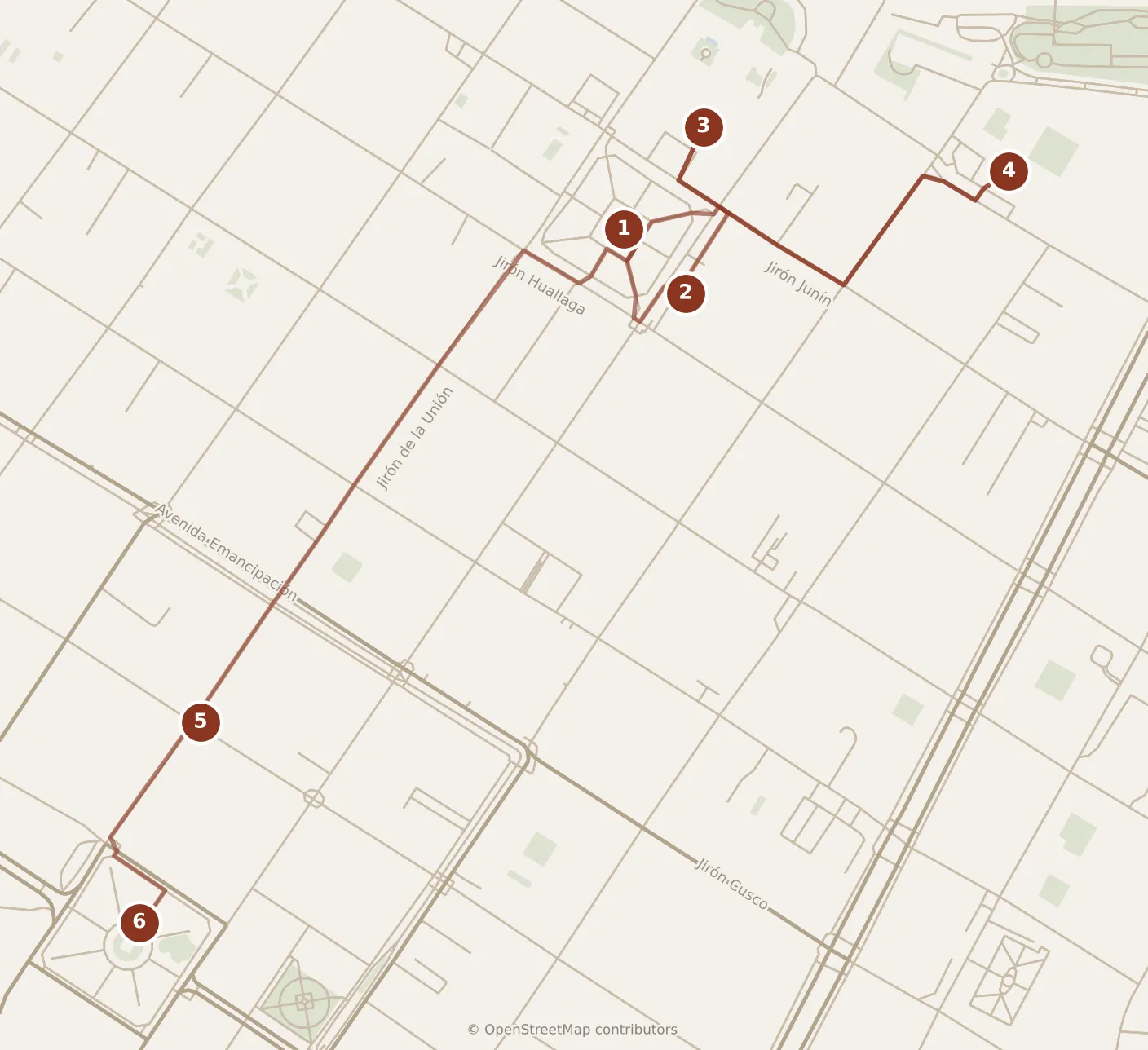
- Morning
- 1Plaza Mayor
- 2Lima Cathedral
- 3Palacio de Gobierno
- 4Convento de San Francisco
- 5Jirón de la Unión
- 6Plaza San Martín
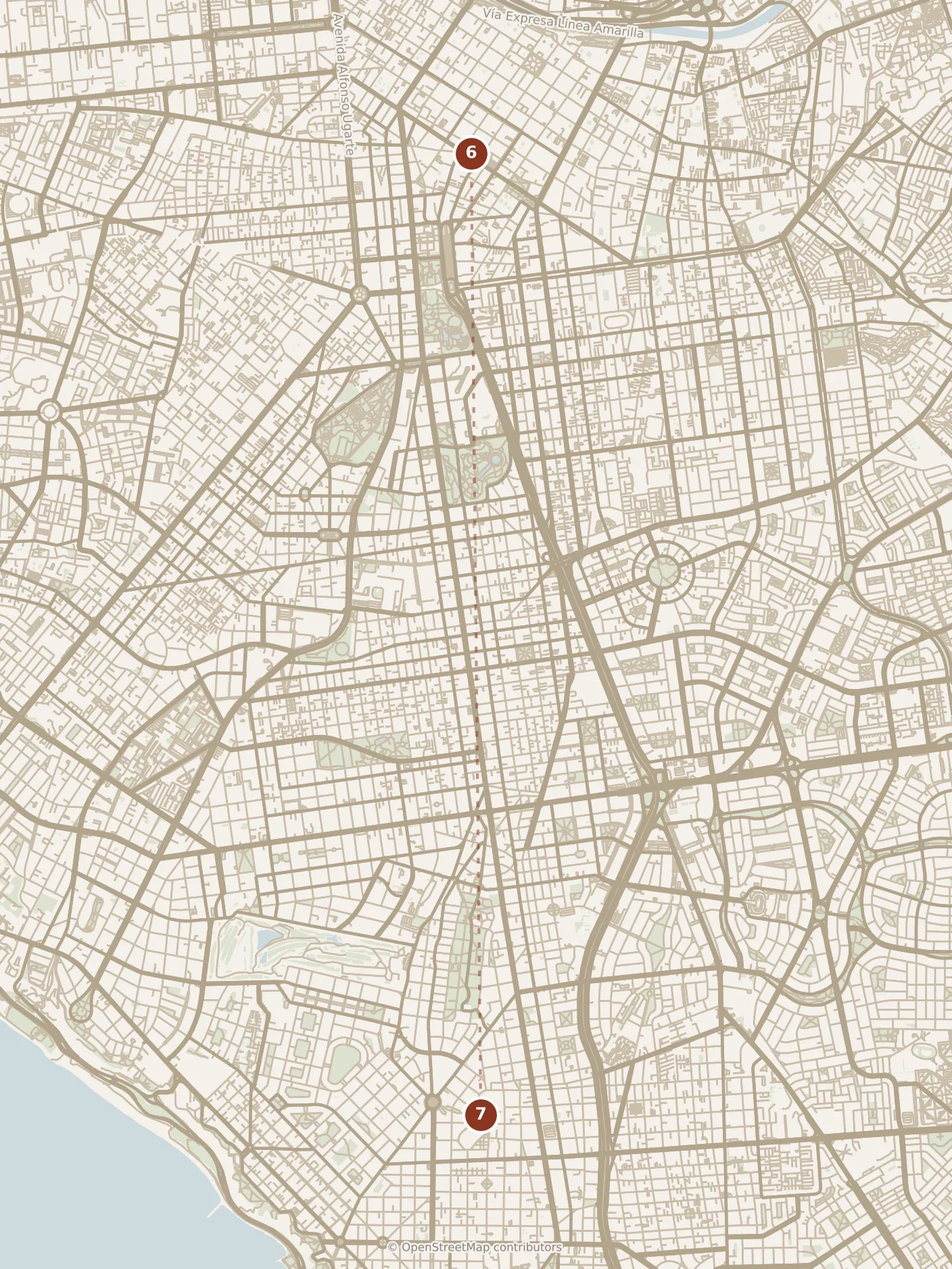
The leg out of the center: from stop 6 by taxi, not on foot.
- Afternoon
- 7Huaca Pucllana
- Parque del Amor — in the prose, not on the map
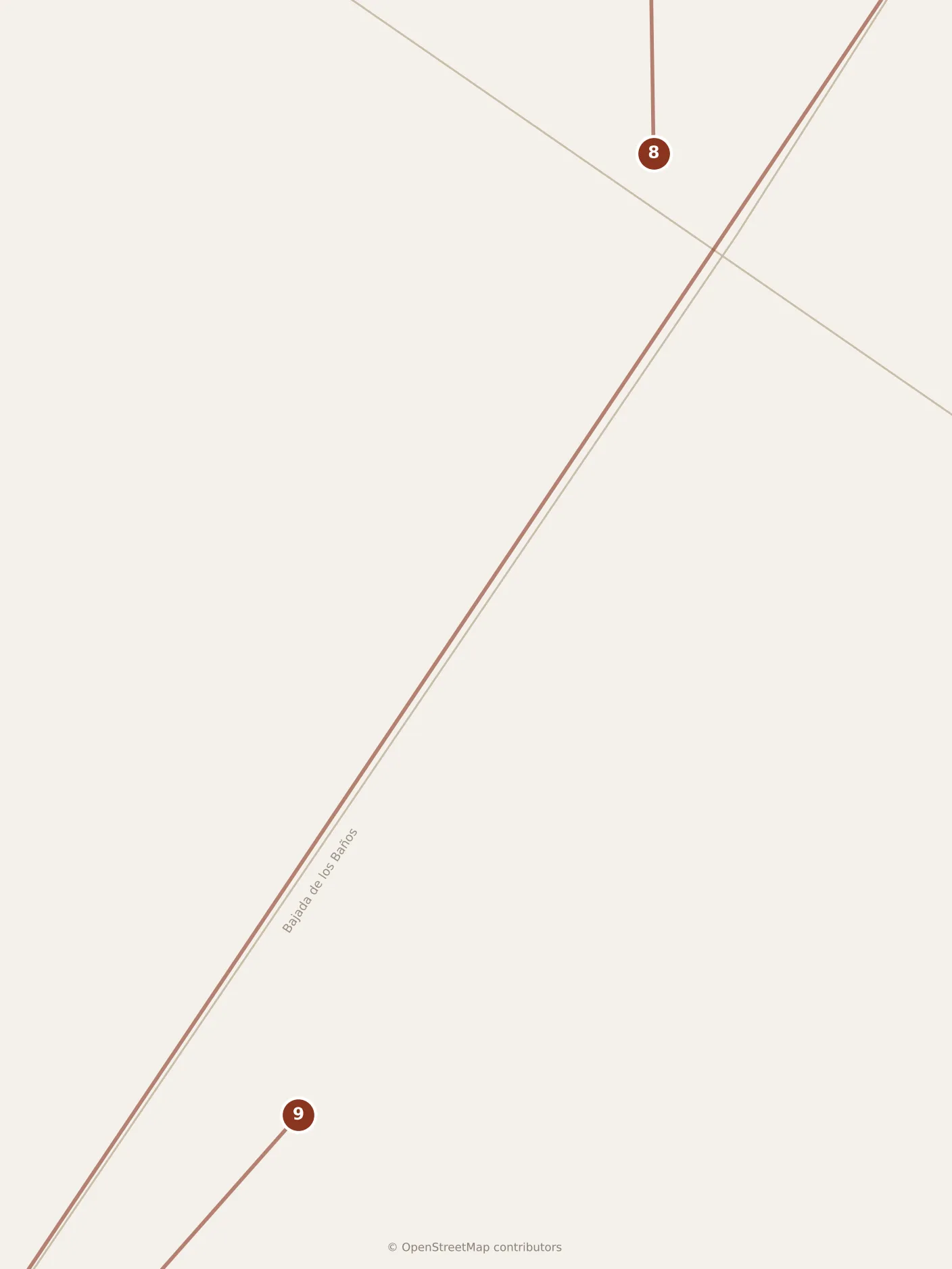
- Evening
- 8Puente de los Suspiros
- 9Bajada de Baños
Morning
Most visitors are staying in Miraflores or Barranco, so the day’s first leg is a taxi or a ride-hailing app — Uber operates here — inland and north to the Centro Histórico: figure on twenty-five minutes with an easy run of traffic, closer to three-quarters of an hour if you’re moving with the rest of the city, which on a weekday morning you probably are.
Start in Plaza Mayor, the square the Spanish laid out when they founded the city, with Lima Cathedral along its eastern side. Inside, a side chapel holds what are said to be the remains of Francisco Pizarro, the city’s founder, in a glass-fronted tomb — give the interior half an hour, including this. On the square’s north side is the Palacio de Gobierno, the seat of the presidency: you view this one from outside rather than walk into it, and most days around midday a changing of the guard draws a small crowd at the gate — check there yourself on the way past rather than build the morning around a fixed time, since the palace, not this article, is the one that knows exactly when.
Local tip. If the morning is running long, let the guard change go rather than wait for it — you only catch it if you happen to be at the gate anyway — and put the spare time into the catacombs instead. They are the better use of an hour you don’t have twice.
A short walk from the square is the Convento de San Francisco, still a working Franciscan house, seen only on a guided tour: a baroque church with tiled cloisters and a library of old bound volumes, and beneath it all a catacombs where the bones of tens of thousands of colonial-era Limeños are stacked and, in places, arranged into deliberate patterns of skulls and femurs. Give the tour the best part of an hour; it moves at the pace of the group you join, not yours.
From the convent, it’s a walk of about fifteen minutes down Jirón de la Unión, the pedestrian street that runs between the two main squares of the center — browse it rather than rush it — to Plaza San Martín, a broad square with a statue of the independence leader it’s named for at its center, and a natural place to end the morning before the taxi back to the coast.
Afternoon
A second taxi or ride-hailing trip — the same traffic caveat applies, and midday is rarely the light hour of the two — returns you to Miraflores. The first stop is Huaca Pucllana, a stepped pyramid of sun-dried adobe raised by the pre-Inca Lima culture centuries before the Inca reached this coast, and startling for where it sits: fenced off in the middle of an ordinary residential grid, surrounded by houses and traffic that have simply grown up around it. It’s seen on a guided tour, walking the ramps between the platforms; the bricks were laid on edge in vertical columns rather than flat courses, a technique that let the walls flex rather than crack when the ground moves, which on this coast it periodically does. Give the visit three-quarters of an hour.
From there it’s about twenty minutes on foot to the clifftop, where the ground simply stops at the Pacific. Parque del Amor sits right on the edge of it, built around El Beso, an oversized tiled sculpture of an embracing couple that most visitors photograph without knowing its name. The park itself is small; what’s worth the half hour here is the clifftop path either side of it, with the ocean directly below and, on a clear afternoon, paragliders launching off the same cliffs a little further along.
Evening
From Parque del Amor, walk south along the clifftop path — it’s roughly half an hour, unhurried, with the ocean on your right the whole way — into Barranco. The path itself is the transition: Miraflores’ manicured cliff gives way gradually to Barranco’s looser, more bohemian one, and you notice the change in the murals and the ironwork before you notice a district boundary.
The first stop proper is the Puente de los Suspiros, a plain wooden footbridge over a lane rather than a river, known locally for a piece of superstition rather than for the bridge itself: cross it holding your breath and make a wish before you exhale, and it’s said to come true. Whether or not you hold your breath, it’s worth pausing on it — the lane below runs straight down towards the sea, and the view along it is one of the better ones in Barranco.
Beside the bridge, the Bajada de Baños drops down the same lane towards the water, a stepped path lined with the district’s bars and studios rather than the box hedges of Miraflores. This is where the day is meant to end rather than tick off: give it an hour or more without a fixed plan, and let the evening be the least scheduled part of the route. If you’re staying in Barranco, you’re more or less home; if you’re back in Miraflores, it’s a short taxi or a walk of about twenty minutes back up the coast the way you came.
Practicalities
Nothing on this route needs to be booked ahead: the Convento de San Francisco and Huaca Pucllana are both seen on a guided tour, and a walk-up one on an ordinary day — pay at the door and join the next group — though Huaca Pucllana also sells its slots online, worth using on a busy weekend. The one thing worth carrying is patience with the two taxi rides, since Lima’s traffic does not keep to a schedule any more reliable than the guard change does.
If your day is short, cut Huaca Pucllana first. It is the one stop that asks for an extra walk inland from the coast rather than sitting on the route you are already walking, and the morning in the center plus the clifftop and Barranco in the evening still make a complete day without it.
Move between the historic center and the coast by taxi or ride-hailing app; there is no walking connection between them that makes sense in a single day. Within each half of the day, everything above is on foot, and nothing asks for more than about half an hour at a stretch — the walk south from Miraflores into Barranco along the clifftop is the longest single leg.


