Las Vegas in two or three days: downtown first, the Strip after dark, and a day out to the Hoover Dam

Last updated 31 October 2026
Overview
Las Vegas is a two-day city that most people try to see in one long night, and the night is the reason it fails them. The place is built to be seen after dark, but it is also built to keep you indoors, and the two halves of the trip that are worth the journey sit seven kilometers apart: downtown, the old city around Fremont Street, which is where Las Vegas actually began and where its history is kept; and the Strip, the four-mile run of resorts along Las Vegas Boulevard to the south, which is not technically in the city at all but in unincorporated Clark County. Day one is downtown, day two is the Strip, and they go in that order because downtown explains what you are looking at on the Strip the next night.
The thing that will shape your trip more than any sight is the distance. On the Strip, the resort “next door” is routinely a ten- or fifteen-minute walk away, the major crossings are made on pedestrian bridges rather than at street level, and in the Mojave summer the afternoon is regularly above forty degrees. The days below are planned so that the walking happens in the morning and after dark, and the middle of the day happens indoors or not at all. Nothing on days one and two needs a car. The third day does.
Both main days are built around the dark, so you need to know when it comes. The sun sets here from just before half past four at the end of November to just after eight around the June solstice, so take your month’s hour and use it for the counts given in each day. In summer the gap between lunch and dark is long and hot, and the honest advice is to spend it off the street.
Two things about conduct, because a visitor finds out the hard way. Nevada allows smoking on casino floors, and almost every route through a resort crosses one. And nobody under twenty-one may linger in a gaming area: a family can walk through, but security will move on a teenager who stops to watch.
LINQ Promenade — not on the walking map.
- Day two · Afternoon
- LINQ Promenade — in the prose, not on the map
Boulder City, Hoover Dam, Mike O'Callaghan–Pat Tillman Memorial Bridge — not on the walking map.
Day one

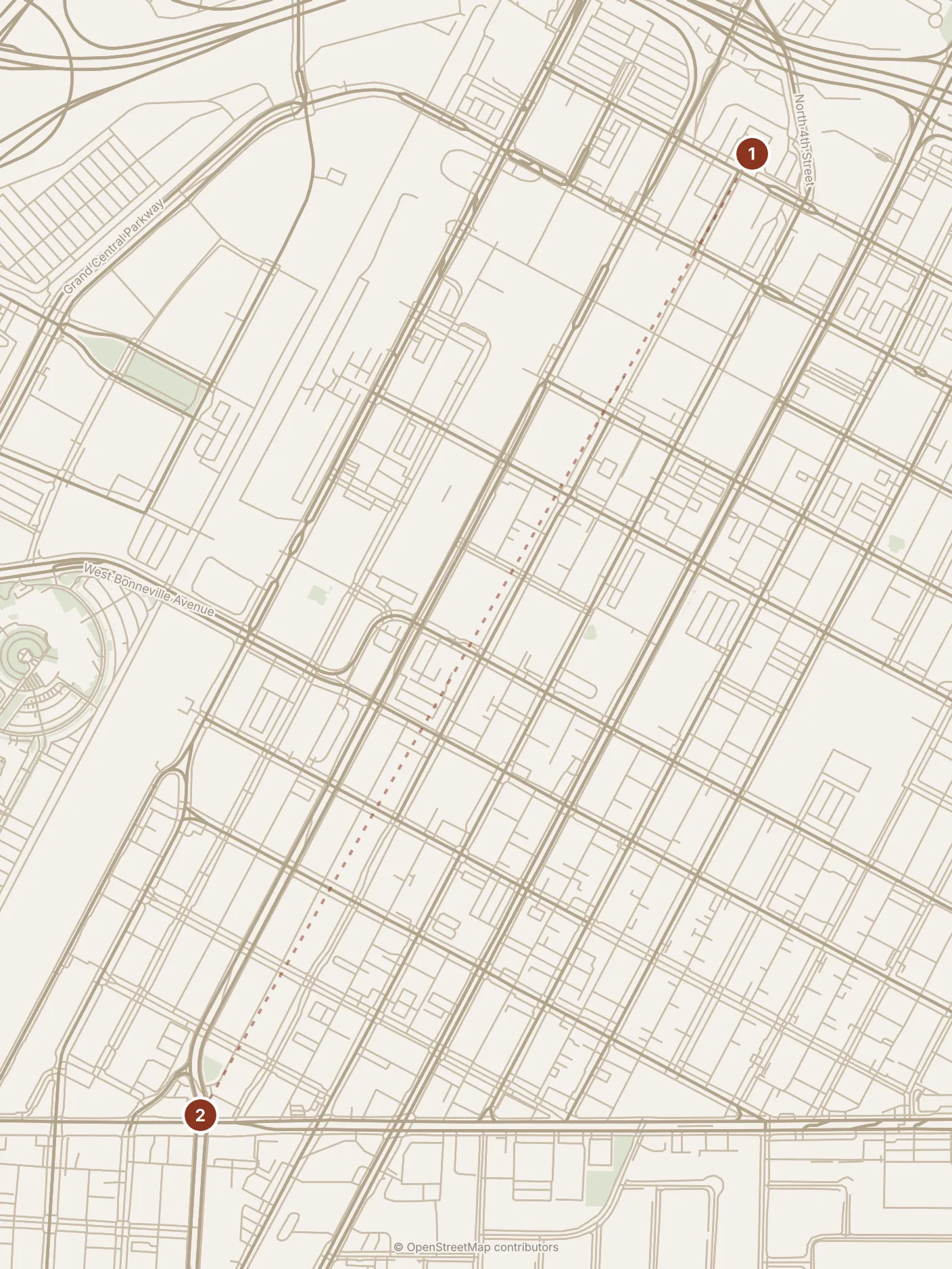
- Morning and afternoon
- 1Mob Museum
- 2Arts District
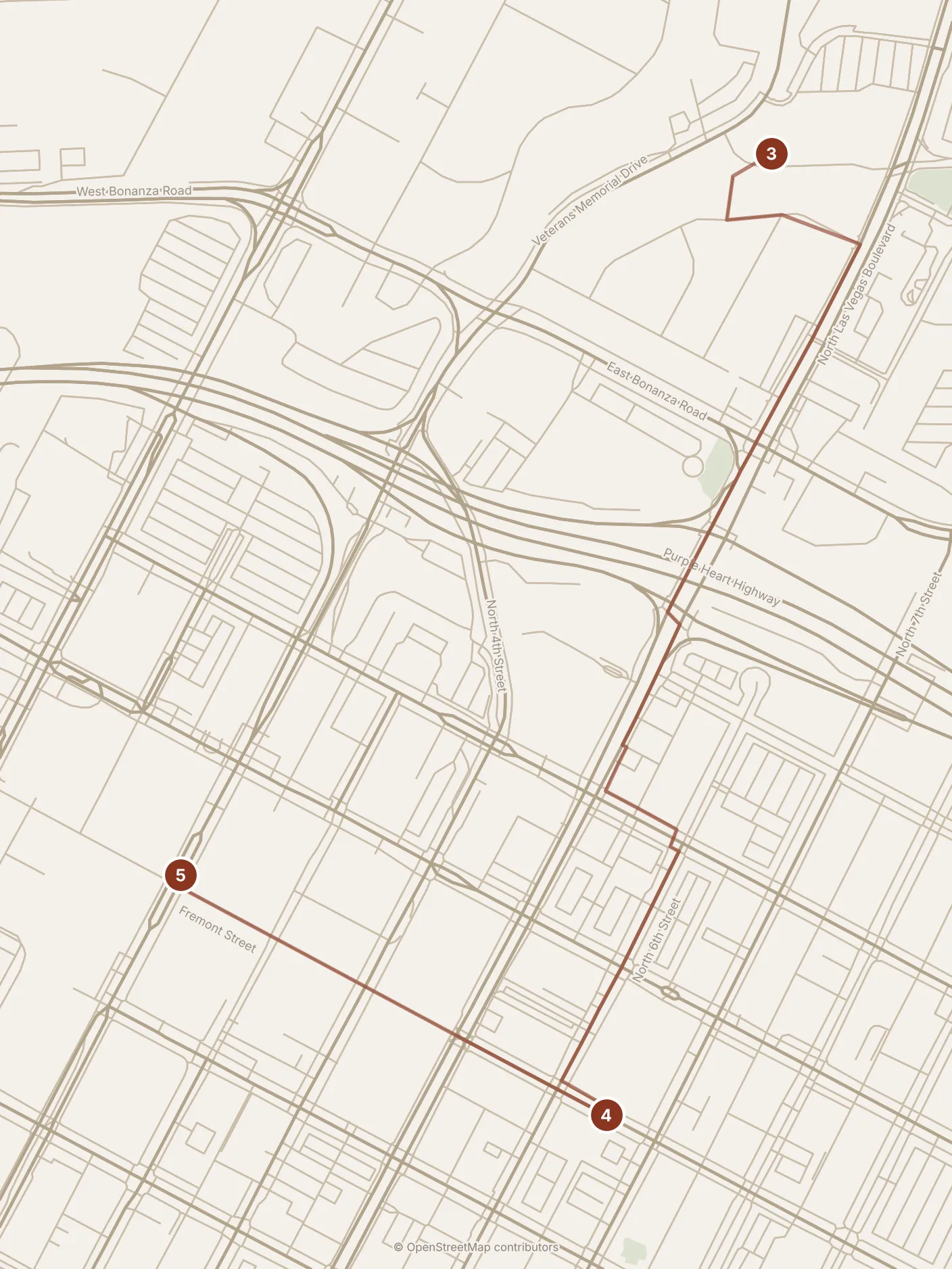
- Evening
- 3Neon Museum
- 4Fremont East
- 5Fremont Street Experience
Downtown today, ending under the lights. The day has one fixed point, a booked evening slot at the Neon Museum, and everything before it is counted back from that.
Morning
The first leg is from wherever you are staying, which for most visitors is the Strip. The Deuce, the city bus that runs the length of Las Vegas Boulevard around the clock, goes north to downtown and ends at the Bonneville Transit Center; it is slow in traffic, so allow most of an hour from the middle of the Strip. A taxi or ride-share is the quicker option. Either way, the one thing this route asks you to sort out first is the bus fare: install the transit authority’s app, rideRTC, before you leave and buy a day pass in it. The parent guide covers the rest of how the RTC buses are paid for.
Start at the Mob Museum, on Stewart Avenue two blocks north of Fremont Street. The building matters as much as the collection: it is the 1933 federal courthouse and post office, and its courtroom is where one of the Senate’s Kefauver hearings into organized crime sat in 1950. The museum, open since 2012, tells the story of how the mob built and ran this city and how the law eventually took it back, and it holds the brick wall from the 1929 massacre in a Chicago garage, reassembled. Give it two hours. If the morning is running short, give the courtroom and the history its time and skip the hands-on rooms, which are aimed at groups and take longer than they are worth on a short trip.
Lunch is the few blocks south of the museum around Fremont Street, which is busy and slightly worn by day and none the worse for it. Give it an hour.
Afternoon
Take a taxi south to the Arts District, around Main Street and Charleston Boulevard; it is about thirty-five minutes on foot from the museum, which is too far in the heat and along streets with little to see. The district is a grid of converted low buildings: small galleries, vintage and antique shops along Main Street, murals on the side walls. It is the one part of the city that was not designed to sell you anything larger than a lamp, and it is the right counterweight to the Strip. Give it an hour and a half to two hours, walking slowly and going into whatever is open. If your day one falls on the first Friday of the month, the district holds its First Friday street evening, and it is worth staying for instead of the museum slot; book the slot for another night if you can.
Evening
The Neon Museum is the stop the day is built around, and it wants to be seen after dark. It is a fenced lot north of downtown, the boneyard where the city’s retired signs go: casino signs, motel signs, letters the height of a person, some of them restored and lit again. The visitor center is itself a rescued piece of the old city, the swooping shell-shaped lobby of a 1961 motel designed by Paul Revere Williams and moved here. Entry is by timed ticket and you walk the yard at your own pace, with guided tours sold separately; the evening slots sell out first.
So work backwards: book the first slot after your month’s dark. The museum, lunch and the Arts District above come to about five hours, and the two taxi rides add half an hour, which puts the start downtown about six hours before the slot. In winter that means a late-morning start and a straight run. In summer it means a gap: do the museum and lunch, go back for the hottest hours, and come downtown again for the Arts District in the late afternoon. The count is time spent inside the places, and it does not include waiting for a bus on the boulevard, which is the commonest way to lose the slot.
From the Neon Museum walk south down Las Vegas Boulevard, about fifteen minutes, or take a short taxi ride, to Fremont East: the blocks of Fremont Street east of the boulevard, where downtown keeps its bars and its later evening, lower-key than the Strip and noticeably cheaper.
Five minutes further west, the Fremont Street Experience is the old casino street roofed in since 1995 with a vaulted canopy of screen, on which light shows run through the evening. Stand under it for one show, then walk the length of it past the oldest casino fronts in the city. Back to the Strip on the Deuce from the downtown stops, which runs all night, or by taxi.
Local tip. If the Neon Museum’s after-dark slots are gone for your night, do not take a daytime one and keep the rest of the day as written. Swap the day round instead: the Arts District in the morning, the Mob Museum through the afternoon heat, and Fremont after dark, which needs no ticket.
Day two

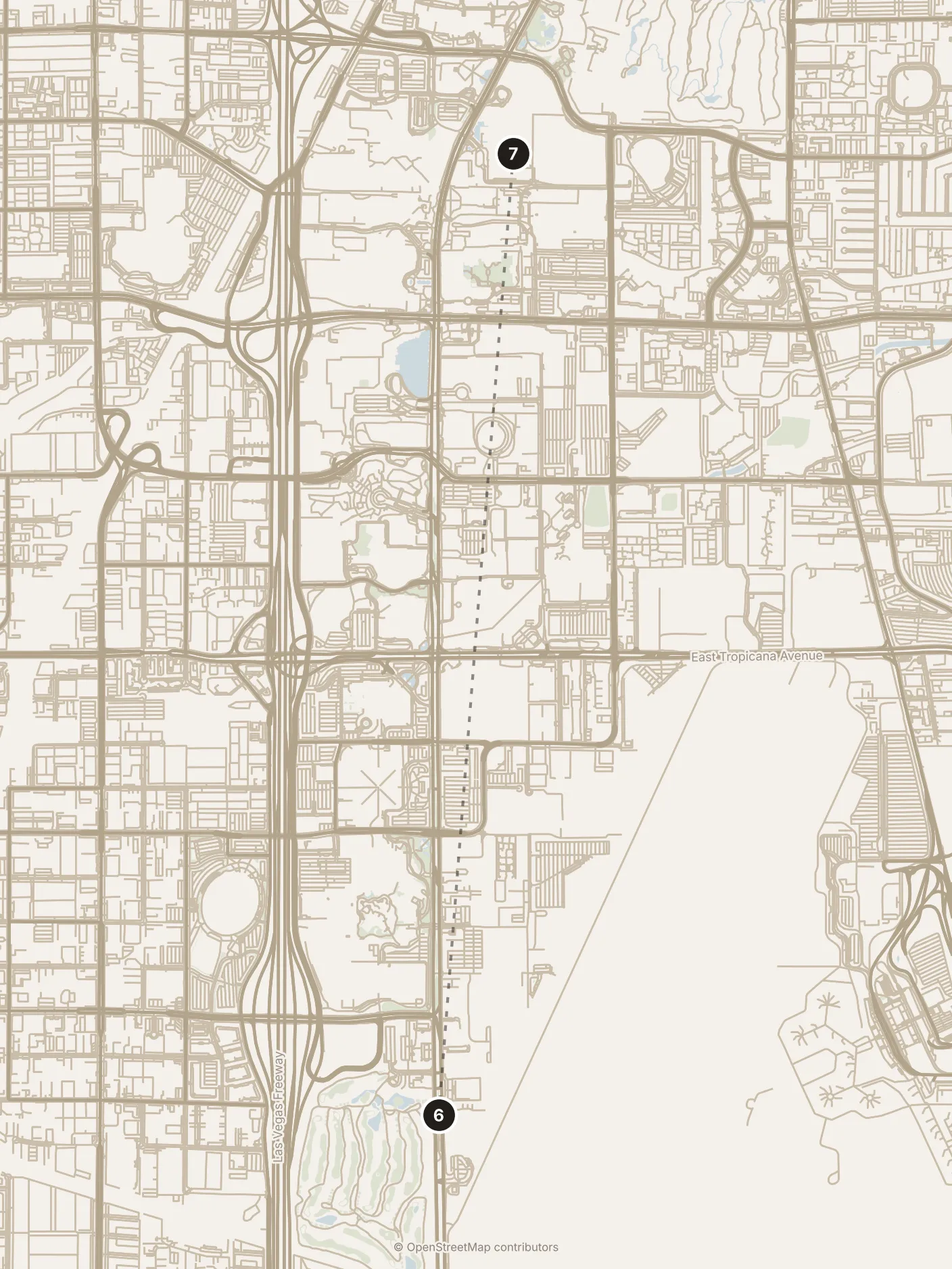
- Morning
- 6Welcome to Fabulous Las Vegas sign
- 7Grand Canal Shoppes
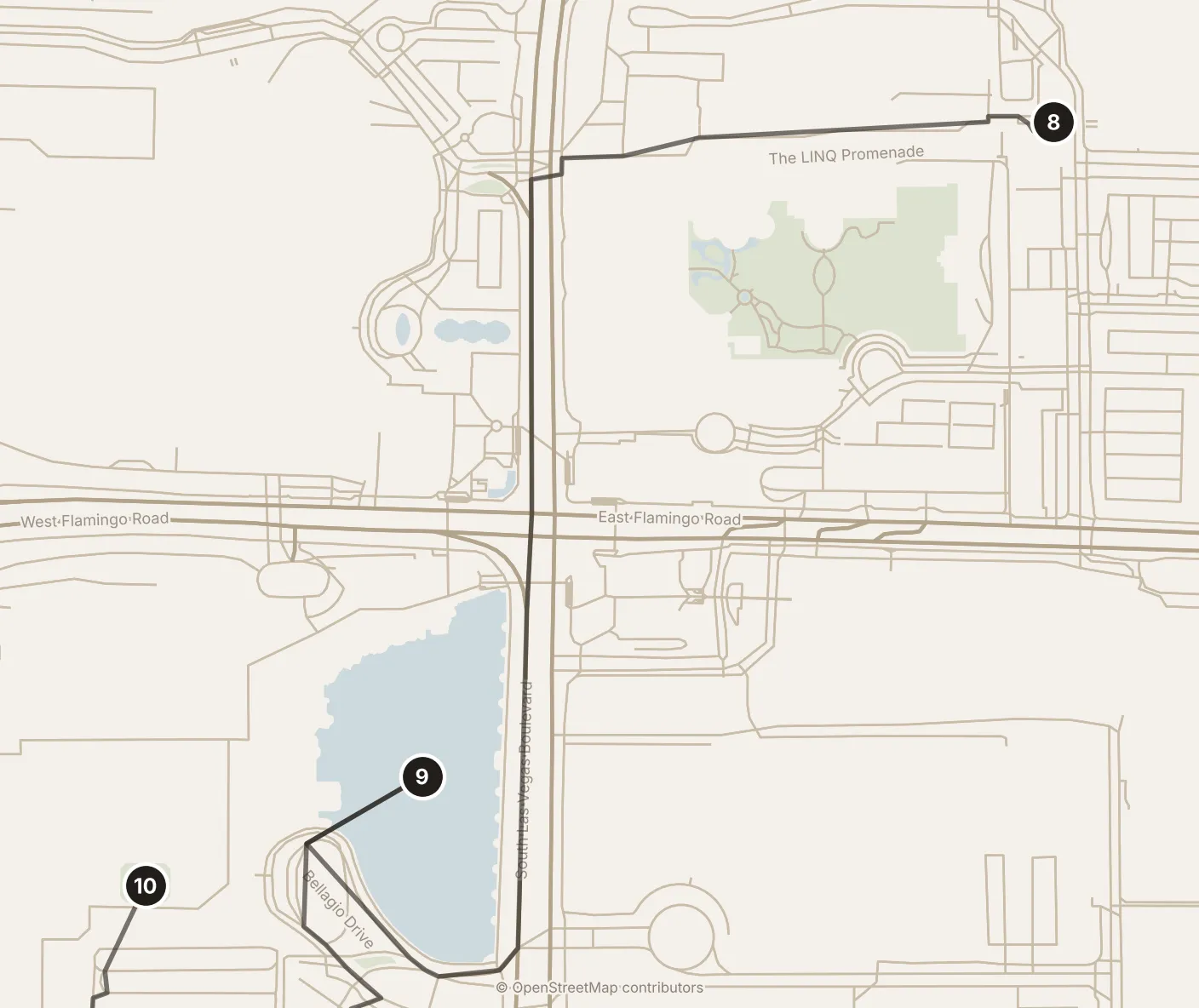
- Evening
- 8High Roller
- 9Fountains of Bellagio
- 10Bellagio Conservatory
The Strip today, in two halves with a long gap between them: the morning from the south end, the evening at its center, where the wheel and the fountains are close enough to walk between.
Morning
Start early at the Welcome to Fabulous Las Vegas sign, in the median of Las Vegas Boulevard south of the resorts. Betty Willis designed it in 1959, and it is a photograph and nothing more: there is a small parking area in the median and usually a line of people waiting for their turn in front of it. Give it twenty minutes, and go early for the line and for the light. A taxi gets you there; walking to it from the resorts along the boulevard is long and dull.
From the sign, take the Deuce north up the boulevard to the middle of the Strip, getting off around Flamingo Road. The rest of the morning is the Venetian, the resort built as Venice, on the east side of the boulevard about a fifteen-minute walk north of Flamingo Road: on its upper level, a canal with gondolas runs under a painted sky, between replica bridges and shop fronts. It is the purest example of what the Strip does, which is to put a city indoors and keep the temperature at twenty-one degrees. Give it an hour, and do not pay for the gondola unless you want to; walking the canal is the thing.
Afternoon
Walk south, about fifteen minutes on the same side of the boulevard, to the LINQ Promenade: the open-air pedestrian street that runs east from the boulevard to the foot of the High Roller. It is lined with places to eat, and it is where lunch goes. Give it an hour.
Then stop. From late spring to early autumn the hours between lunch and dark are the hottest of the day and there is nothing on the Strip worth crossing on foot in them. Go back to where you are staying, or spend them inside. In winter, when the afternoon is mild, this is the time to walk the boulevard between the resorts and go into whatever catches your eye, crossing on the pedestrian bridges at the major intersections.
Evening
The High Roller is the hinge of the day. It is the observation wheel at the far end of the promenade, 167 meters high and open since 2014, and one rotation takes thirty minutes, which is fixed. Ride it at dusk: you see the desert and the mountains in the last light on the way up, and the whole Strip switching on beneath you on the way down, with the Sphere’s lit globe off to the east. So work backwards: be at the wheel half an hour before your month’s sunset. Everything else today fits around that, because the afternoon is a rest, but buy the ticket at the base or online before you arrive at the front, since the line at the desk at dusk is the one thing that makes you miss the light. The count does not include that line.
From the wheel, walk back west along the promenade and south to the corner of Flamingo Road, then cross the boulevard on the pedestrian bridge to the Fountains of Bellagio: the lake in front of the Bellagio on the west side of that corner, where jets of water are choreographed to music. The show repeats through the evening, more often after dark, and it is free; stand at the balustrade along the boulevard, watch one, and go. It is about twenty minutes on foot from the wheel.
Inside the same resort, a few minutes from the lake, the Bellagio Conservatory is a glass-roofed hall planted with a new seasonal display several times a year. It is free and open late, and it is the last stop of the day. The Deuce stops on the boulevard near the corner for the ride back, or a taxi takes you from the resort’s own front entrance.
Local tip. If the evening is short, the conservatory is the stop to drop, not the fountains: the fountains are the thing you came to the Strip to see, and the conservatory will be the same tomorrow.
With a third day

Give the third day to the Hoover Dam, and give it the morning, because the dam is in full sun and in summer the walks there are punishing by midday. This is a day outside the city, and it needs a car or a booked tour from the Strip: there is no public transit to the dam. Organized tours pick up at the Strip resorts, and most follow this same order, Boulder City or the bridge included; the stops below hold either way.
Drive south-east through Henderson on the interstate towards Arizona; it is under an hour from the Strip. Stop on the way at Boulder City, the town built in the early 1930s to house the dam’s workers, which is still one of only two places in Nevada that does not allow gambling. Its small old center is the place for coffee before the dam, and half an hour is enough.
The Hoover Dam was built across the Colorado River between 1931 and 1936, and it holds back Lake Mead. Vehicles go through a security inspection point on the approach road. Park and walk across the top of the dam: the state line runs down the middle, Nevada on one side and Arizona on the other, and since Arizona does not change its clocks in summer, the two intake towers carry clocks that disagree from spring to autumn. The guided tours are sold at the visitor center on the day, first come, first served, and can be cancelled without notice; the Powerplant Tour, which goes down inside to the generators, is the one to take if it is running. Give the dam two hours in all, with the tour inside it.
Then drive a few minutes back up the road to the parking area for the Mike O’Callaghan–Pat Tillman Memorial Bridge, the arch that has carried the highway over the canyon since 2010. A walkway runs along it, and from the middle you see the whole face of the dam from above, which is the view nobody on the dam itself gets. The walk out and back takes half an hour; it is fully exposed, and in summer it is the stop to do first rather than last.
Back on the Strip by mid-afternoon. If you have no car and do not want a tour, the Hoover Dam is not a day you can improvise, and the better third day is the downtown evening you missed, or the Strip’s south end, which day two only touched.
Practicalities
Book two things before you arrive: an evening slot at the Neon Museum, which is sold on its own website and fills first on Fridays and Saturdays, and in 2026 was in the twenty- to forty-dollar range, the after-dark slots at the higher end; and, for the third day, either a car or a tour that includes the Hoover Dam. The High Roller and the dam’s own tours are sold on the day.
Day one rests on two places with hours of their own, the Neon Museum and the galleries of the Arts District, which keep short, irregular hours and are often closed early in the week. Check the galleries before you set out; if they are shut, the district’s murals and shops still fill an hour, and the Mob Museum can take the time.
The days may be swapped freely. Day one is better first, because it shows you the city the Strip grew out of, but nothing on either day depends on the other, and the only days to avoid are a first Friday you would rather spend elsewhere, and any day with a booked slot at the Neon Museum you cannot change. The third day goes wherever the car is.
Moving between the stops: the Deuce runs the length of Las Vegas Boulevard and downtown, all night, and taxis and ride-shares cover the two legs on day one where the walk is too long. The parent guide covers arriving at Harry Reid International Airport and how the buses are paid for.


