Las Vegas in one day: downtown in the morning, the Strip after dark

Last updated 31 October 2026
Overview
Las Vegas has two centers, and they are not the same place. The city itself, the one with the mayor, is downtown: the old casino blocks of Fremont Street, the museums built into its history, and the bus station that ties it to everything else. The Strip, which is what most people mean by the name, starts a few kilometers south and is not in the city at all; it runs through unincorporated Clark County. One day can hold both, and the order is the whole decision. This route takes downtown by daylight, rides the boulevard south in the afternoon, and gives the dark to the Strip, because the Strip is the end that sits closest to the airport you will most likely leave from.
What one day costs you is the shows, the pools and downtown at night. The canopy over Fremont Street is a light show only after dark, and you will see it as a roof. That is the trade: the fountains in front of the Bellagio after dark are the stronger ending, and a day that tried to have both nights would spend its evening on a bus.
The day is built around one hour, which is dark at the fountains. The sun sets here from just before half past four at the end of November to just after eight in late June, so take your month’s hour and count back the six hours the day below adds up to: in winter that means starting at the Mob Museum by about ten, and in midsummer the arithmetic says early afternoon. Do not follow it in summer. A summer afternoon here runs well past 40°C, so keep a morning start and spend the spare hours indoors on the Strip, where every interior on this route is air-conditioned. The six hours count the time inside the places, the walks and the bus; they do not count the wait for the bus, the taxi line at the airport, or the queue for the tower’s elevator at night, which on a weekend is the largest of the three.
Las Vegas has no railway station, so there is no left-luggage office at the start of this route and none on it. That is not a detail if you are between flights with a case. The Strip afternoon is a long walk over pedestrian bridges and through casino floors, and that is the part you should not do holding one. A reader with a bag should keep the Mob Museum and Fremont Street, which are compact and indoors, ride the bus straight to the Bellagio, and take a taxi between the resorts rather than walking. A reader who drove in has a trunk, which solves it.
The day

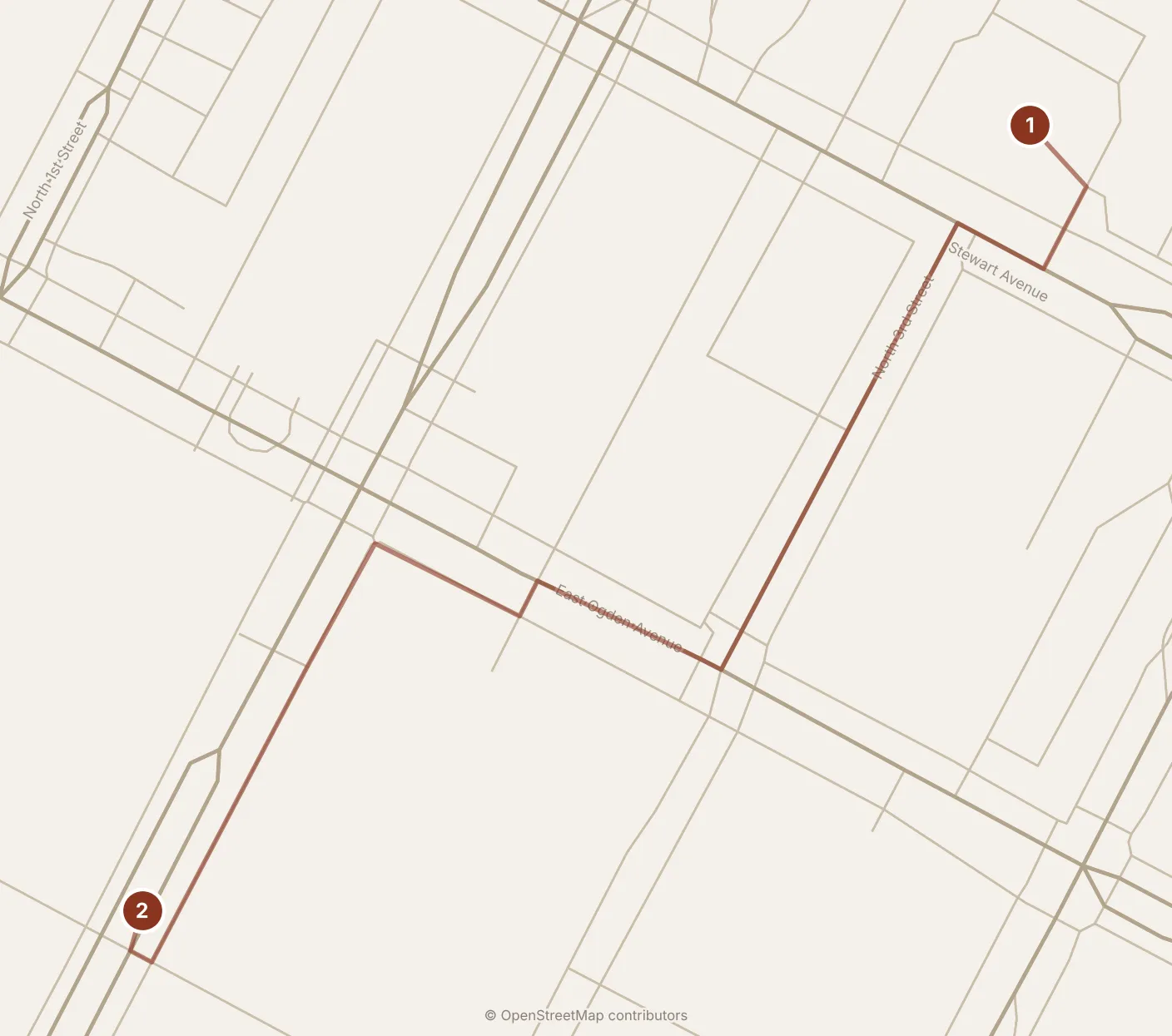
- Morning
- 1Mob Museum
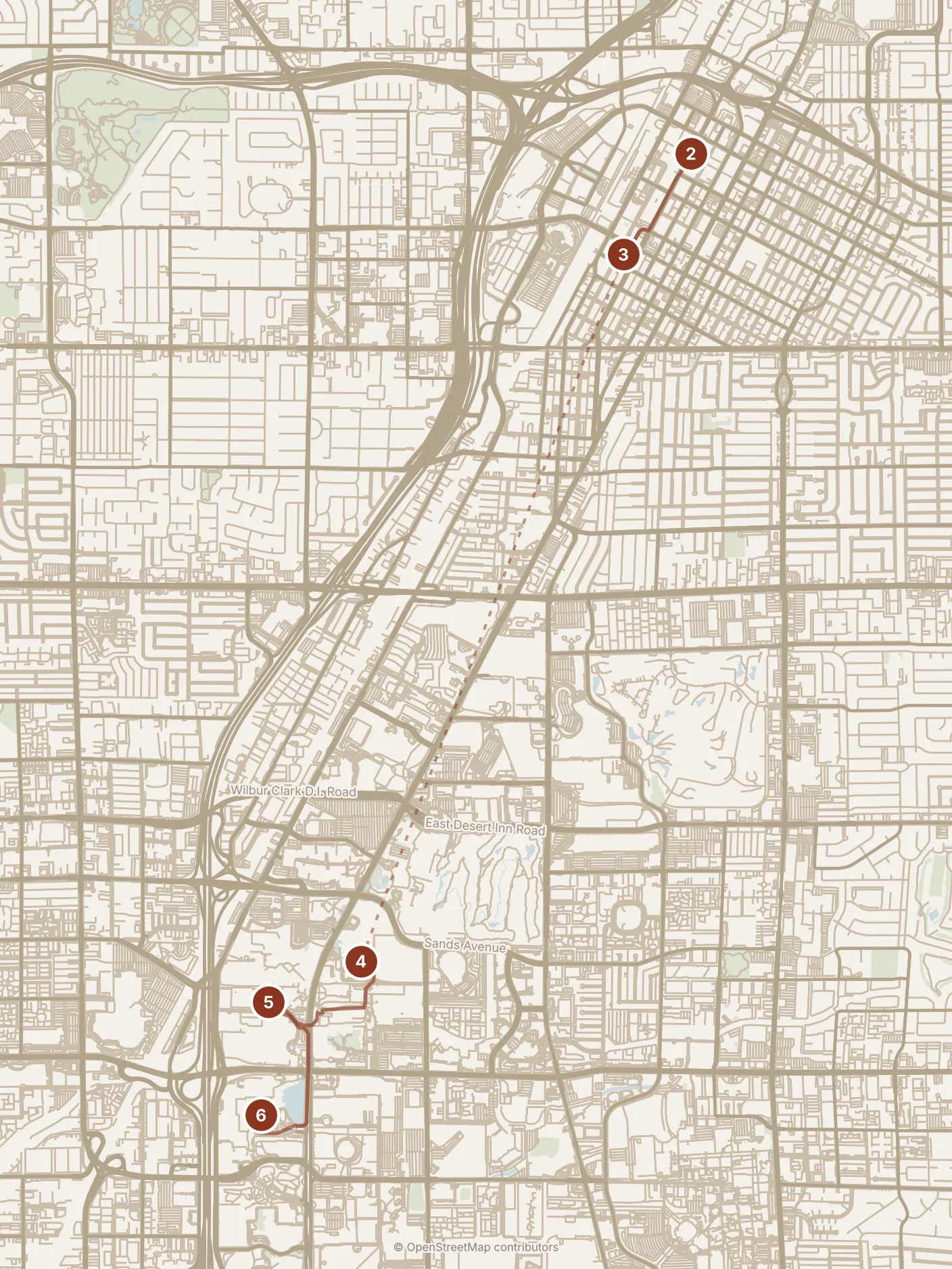
- Afternoon
- 2Fremont Street Experience
- 3Bonneville Transit Center
- 4Grand Canal Shoppes
- 5Forum Shops
- 6Bellagio Conservatory
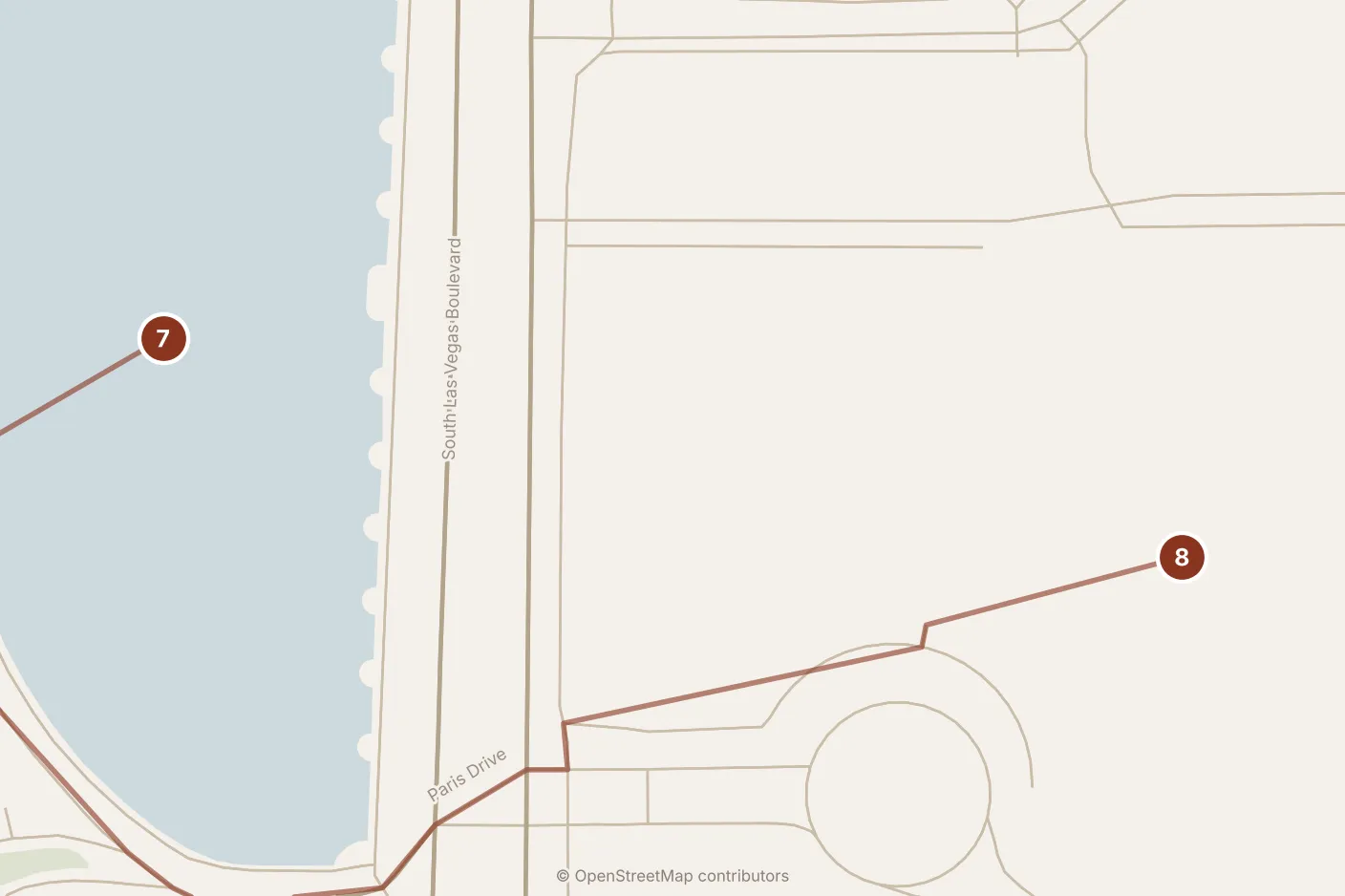
- Evening
- 7Fountains of Bellagio
- 8Eiffel Tower Viewing Deck
Morning
The first leg is a taxi or a rideshare from Harry Reid International Airport straight to the Mob Museum, on Stewart Avenue downtown; allow about twenty-five minutes. The airport’s buses go downtown too, but they are slow, so for the first leg of a single day the car is the honest answer.
The Neon Museum, the yard of old casino signs just north of downtown, is left out of this day on purpose. It has no morning entry, its daytime tickets cover only a short late-afternoon window, and its signs are at their best lit after dark, which this day gives to the fountains; the two-to-three-day itinerary gives it an evening.
The Mob Museum fills the 1933 federal courthouse and post office, and the building is the point. One of the Kefauver hearings, the Senate committee that put organized crime on television, sat in the courtroom upstairs in 1950, and the room is kept as it was. The other piece worth the visit is the brick wall from the garage of the Valentine’s Day Massacre, brought from Chicago and reassembled, bullet holes and all. Give the museum an hour and a half. It is laid out across three floors and dense with text, and the right way to keep it to that time is to decide in advance what you are there for.
Local tip. If the hour and a half is running out, keep the courtroom and the massacre wall and let the rest go. They are the two things in the building that are real objects rather than panels about them, and everything else can be read about later.
Afternoon
Two blocks south, under ten minutes on foot, is the Fremont Street Experience: five blocks of the oldest casino street in town under a curved roof of screens. By day it is mostly shade and noise, and that is fine, because this is lunch. Eat it sitting down somewhere along the covered blocks or just east of Las Vegas Boulevard in Fremont East, the streets where downtown’s smaller bars and restaurants have gathered; give it an hour. Look up on the way for Vegas Vic, the waving neon cowboy who has stood over the street since 1951. This is the stop that gets shortchanged by the plan: the canopy show runs only after dark, and you are trading it for the fountains.
From the west end of the street, the Bonneville Transit Center is about a quarter of an hour on foot to the south. The Deuce, the double-decker that runs the length of the Strip, starts here and goes south down the boulevard; allow most of an hour. Ride it to the stop for the Venetian.
Inside the Venetian, the Grand Canal Shoppes are a mall built as Venice: a canal with gondolas running between shopfronts, a painted sky overhead, and a version of St Mark’s at the end, all indoors. Out front, facing the boulevard, are copies of the Rialto and the campanile. Give it forty-five minutes and skip the gondola: the point is the strangeness of walking it, not the ride.
Then cross the boulevard on the pedestrian bridge and walk south to Caesars Palace, about a quarter of an hour. On the way you pass the site of the Mirage, which closed in 2024; its volcano is gone, and the guitar-shaped hotel tower rising there is not due to open before 2027. The Forum Shops at Caesars are the same idea as the canal done as ancient Rome: a long arcade of statues and columns under a ceiling painted as a sky. Give it half an hour, walk it end to end, and do not shop.
From Caesars it is about a quarter of an hour south along the boulevard to the Bellagio. Walk through the lobby, where the ceiling is a field of some two thousand hand-blown glass flowers by Dale Chihuly, and into the Bellagio Conservatory behind it: a glass-roofed hall of flowers and plants rebuilt into a new display several times a year, and free. Give it twenty minutes.
Two things about this whole afternoon that a visitor cannot guess. Every route between resorts crosses a casino floor, and smoking is legal on Nevada’s casino floors, so the air changes as you walk in. And anyone under twenty-one may walk through a casino but not stop at the tables or the machines; security will move a teenager on, so keep walking with them.
Evening
The fountains are what the day was counted back from. Walk out of the Bellagio to the sidewalk along the boulevard, five minutes, where a balustrade runs the length of the lake in front of the building. The show is a choreographed set of water jets fired to music across the whole lake, and it runs through the day, but after dark it is lit and it is the reason to be here. The shows come round more often in the evening, so you will not wait long for one. Watch one from the balustrade, close enough to feel it.
Then cross to the other side of the boulevard on the pedestrian bridge at Flamingo Road and walk down to Paris, under ten minutes, for the Eiffel Tower Viewing Deck. The tower is a half-scale copy, and its legs come down through the casino roof; the deck at the top looks straight across the boulevard onto the lake. Watch the next fountain show from above. It is a different thing from up here, a pattern rather than a spray, with the whole lit length of the Strip to either side. Give it forty-five minutes, more if the elevator line is long.
To leave, take a taxi from the resort’s front entrance to the airport, about fifteen minutes in ordinary traffic and more on a weekend night. The Welcome to Fabulous Las Vegas sign, drawn by Betty Willis in 1959, stands south of here near the airport, and this day leaves it out: it is a photograph from a parking lot in the middle of the road, and the hour it costs is the hour the fountains needed.
Practicalities
Nothing on this route has to be booked before you fly. The Mob Museum sells tickets at the door and online, and buying online saves the queue at opening; the Eiffel Tower deck sells them at the foot of the tower. The Mob Museum publishes its own hours and closing days; read them before you set out.
If the day is short, cut in this order. The Forum Shops go first, because the canal at the Venetian has already made the same point better. The Mob Museum goes to an hour, courtroom and wall only. What you keep is the courtroom and the fountains after dark, which are the two things on this route that exist nowhere else.
The only transport this route uses beyond the first and last taxi is the Deuce from the Bonneville Transit Center. Fares are paid with an RTC pass, bought in the rideRTC app or from the ticket machines at the stops; the 24-hour pass is the one for a day like this, and the parent guide has the rest. The Las Vegas Monorail runs along the back of the resorts on the east side of the boulevard and reaches neither downtown nor the airport, so this day does not need it.


