Kyoto in two or three days: the west, the eastern hills and a southern third day

Last updated 14 August 2026
Overview
Kyoto’s sights are not in Kyoto’s middle. They ring the edge of the basin the city sits in, and the gap between any two of them is routinely wider than the whole of the old grid lying between. A day here is therefore not a list of places; it is one arc of that ring, and the only planning decision that matters is which arc you take.
There are four arcs worth having, and this article takes two of them properly and a third as an extra. Day one is the west: Arashiyama at the mouth of its gorge, then the two enclosed gardens in the north-west. Day two is the eastern hills above Gion: the Silver Pavilion at the top, a canal path down the inside of the slope, and the temples at the bottom of it. A third day goes south, into the quarter nearest the station.
What is deliberately not here is the fourth arc, the south-east — Fushimi Inari-taisha’s mountain of vermilion gates and Kiyomizu-dera on its stage above the lanes. That is not squeamishness about the crowds. Those two sit on one railway line with a downhill walk between them, which makes them a day of their own rather than an afternoon of anybody else’s, and this site has that day written as a single day. So: if this is your first time in Kyoto and you have exactly two days, the honest arrangement is to take the south-eastern day as one of them and day one below as the other, and to keep day two for a second trip. Day one is the half to keep because the south-eastern day cannot reach the west at all, whereas day two’s hills come down into the same district that day already ends in. And if you have three days on a first visit, that same reasoning runs on: take the south-eastern day, day one and day two, and keep the southern third day below for a return. The one thing arguing the other way is that the southern day is the only one of the four that ends at the station, so if your third day is also your departure day, take it and let the south-east be what you come back for.
The two days share nothing but a bus stop. Day one is one train, one tram and one bus, with about six kilometers of walking spread over the whole of it and no walking leg longer than the twenty minutes between the rock garden and the Golden Pavilion. Day two contains exactly one ride, the bus that takes you to its first gate, and then a little over eight kilometers on foot with no transport at all; its longest single stretch is the half hour from the Silver Pavilion down the canal path to the temple at the foot of it. The third day is two railway stops and about five and a half kilometers, which makes it the shortest walking day of the three.
Not one gate on these three days needs a reservation, and a third day adds nothing to that count. For a city holding this much that is worth stating rather than leaving a reader to find out, because it changes what you have to do before you travel, which is nothing. What that sentence covers is gates and not tables: no gate here asks to be booked, and a dinner you actually care about may, so that is worth arranging before you fly rather than on the evening itself. Every admission is bought at the window you are standing in front of; the Golden Pavilion charged somewhere around five hundred yen in 2026, and nothing else on the route asks much more than double that. The one thing on the route itself that can be reserved is the Sagano Scenic Railway — the open-sided train, signed as the Sagano Romantic Train, that runs up the Hozu gorge from Torokko Saga. It is optional, it is an alternative to half of day one rather than an addition to it, and it is dealt with where that choice belongs.
Neither of these days is built on the light, and it is worth saying so plainly, because the single-day route through this city is. Day one ends at a gate that shuts; day two starts at a gate that opens; the sky is not the deadline in either. But the sky decides what the evenings are, so here is the range. The sun is gone here by about a quarter to five in the first week of December, and it stays up until a quarter past seven in the last week of June: two and a half hours of spread across the entire year, which is narrow, and the country keeps no summer time, so the clock on your phone is the clock of the sky in every month. The consequence is specific rather than decorative: in midwinter the last garden gate on this route shuts at about the moment the light goes, so the evening is entirely after dark and both days below end in lit streets; at midsummer you are turned out of that same gate with more than two hours of daylight still in hand, and days one and two each have somewhere to put it.
One hour decides the shape of each day, and only one. On day one it is a closing: both gardens in the north-west stopped admitting at five in 2026, the rock garden at half past four between December and February, and the whole afternoon is counted backwards from whichever of those two applies to your month. On day two it is an opening: the Silver Pavilion’s gate opened at half past eight in 2026, at nine from December to February, and the day is counted forwards from it because there is nothing at the far end to catch. If either hour has moved by the time you read this, the method survives it — count back from the new closing, or forward from the new opening, and everything below keeps its order.
The counts themselves. Day one comes to about five and a half hours from Kyoto Station to the Golden Pavilion’s gate, and a little over six with the pavilion itself. Day two is about seven and a half hours from the Silver Pavilion’s gate to the bottom of Gion. The third day is about five and a half hours with a meal in it, plus twenty minutes back to the platforms. Those numbers measure the time you spend inside places and the time you spend walking between them, and they measure nothing else. On day one they do not include the ticket window at the Golden Pavilion in the two weeks of the blossom or the two weeks of the maples, nor the fact that in those same weeks the bamboo lane is effectively single file and you go at whatever speed the camera ahead of you has decided on — both of those fall on the same day, and between them they are the reason it is the day to start early. On day two they do not include the wait for the bus that begins it, which in this city is the slow part of any plan, and they do not include the way Nanzen-ji turns out to be a village of separate temples with gates of their own rather than one building.
What you need in your hand, if you have arrived holding nothing, is one thing: a tappable transit card. In this region it is ICOCA, sold from the ticket machines at Kyoto Station, and it works on JR, on the two subway lines — Karasuma and Tozai — on the private railways and on the city buses, which matters here because day one alone touches three different operators. Buy it in the first ten minutes of your first morning rather than at each machine as you go; the parent city guide has the rest.
Last, the bag, and the shape of these days settles it without much thinking. Left luggage is the coin lockers at Kyoto Station. Day one begins there and the third day ends there, so whichever of the two you take on the day you arrive is the one that handles the case, and the answer is the same either way. Day one is the day a case genuinely ruins: the bamboo lane and the climb behind it to the villa are a narrow uphill path with nowhere to put anything down. Day two never goes near the station and never needs to. And if the lockers are full — which is the point at which a one-day visitor’s plan collapses — yours does not, because unlike that reader you have a room somewhere in this city and the correct answer really is to go and drop it there first. Day one ends downtown rather than at the station, so if the case is in a locker you come back for it: Shijō Station on the Karasuma line is two stops from Kyoto Station and five minutes’ walk from the crossing the evening starts at — dinner is a quarter of an hour north of that, so you come back down the canal the way you went up.
Day one

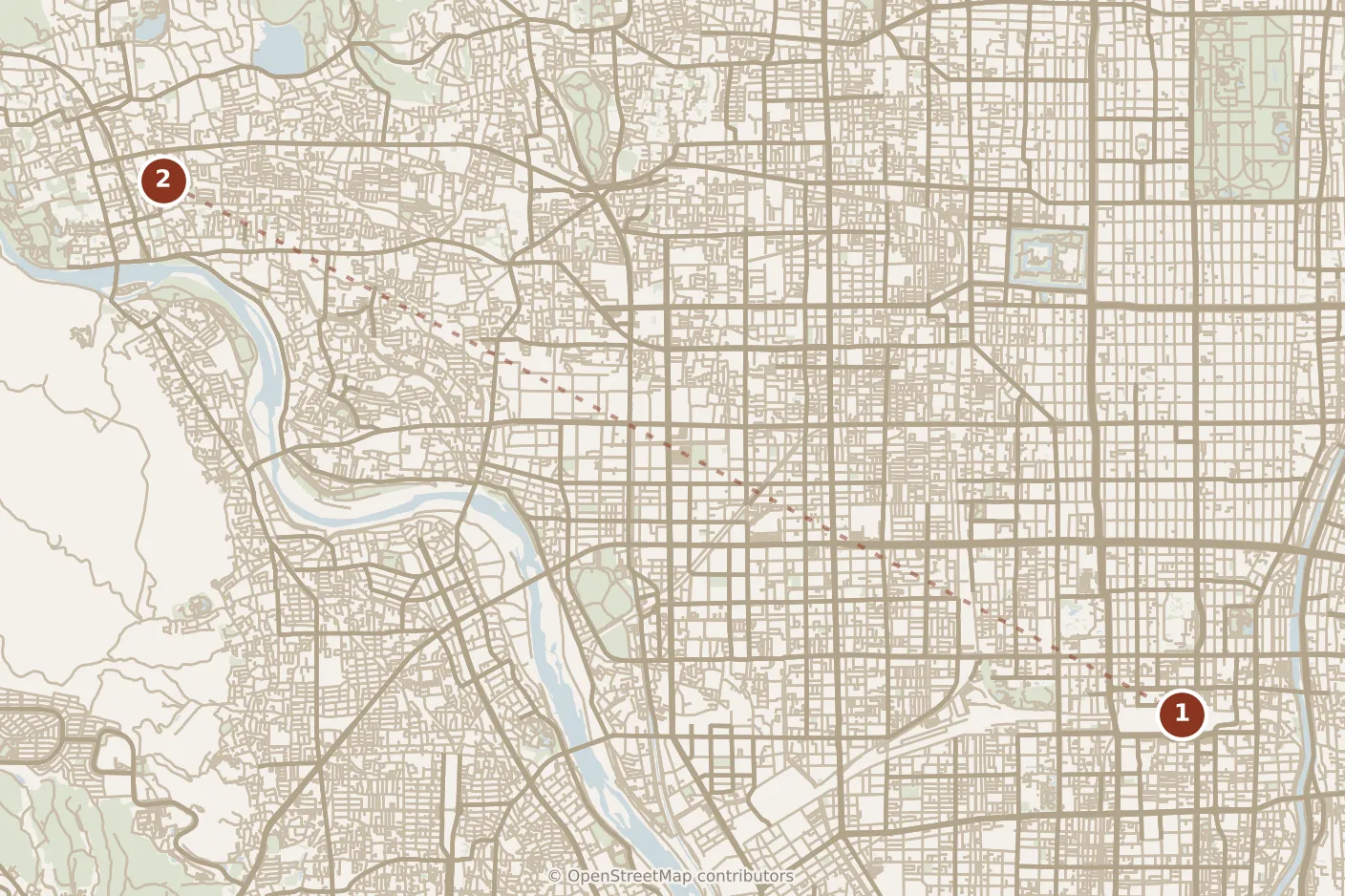
The ride on to stop 2, by train, not on foot.
- Morning
- 1Kyoto Station
- Morning
- 2Saga-Arashiyama Station
- 3Tenryū-ji
- Arashiyama Bamboo Grove — in the prose, not on the map
- 4Ōkōchi Sansō
- Afternoon
- 5Arashiyama Station
- 6Ryōanji Station
- 7Ryōan-ji
- 8Kinkaku-ji
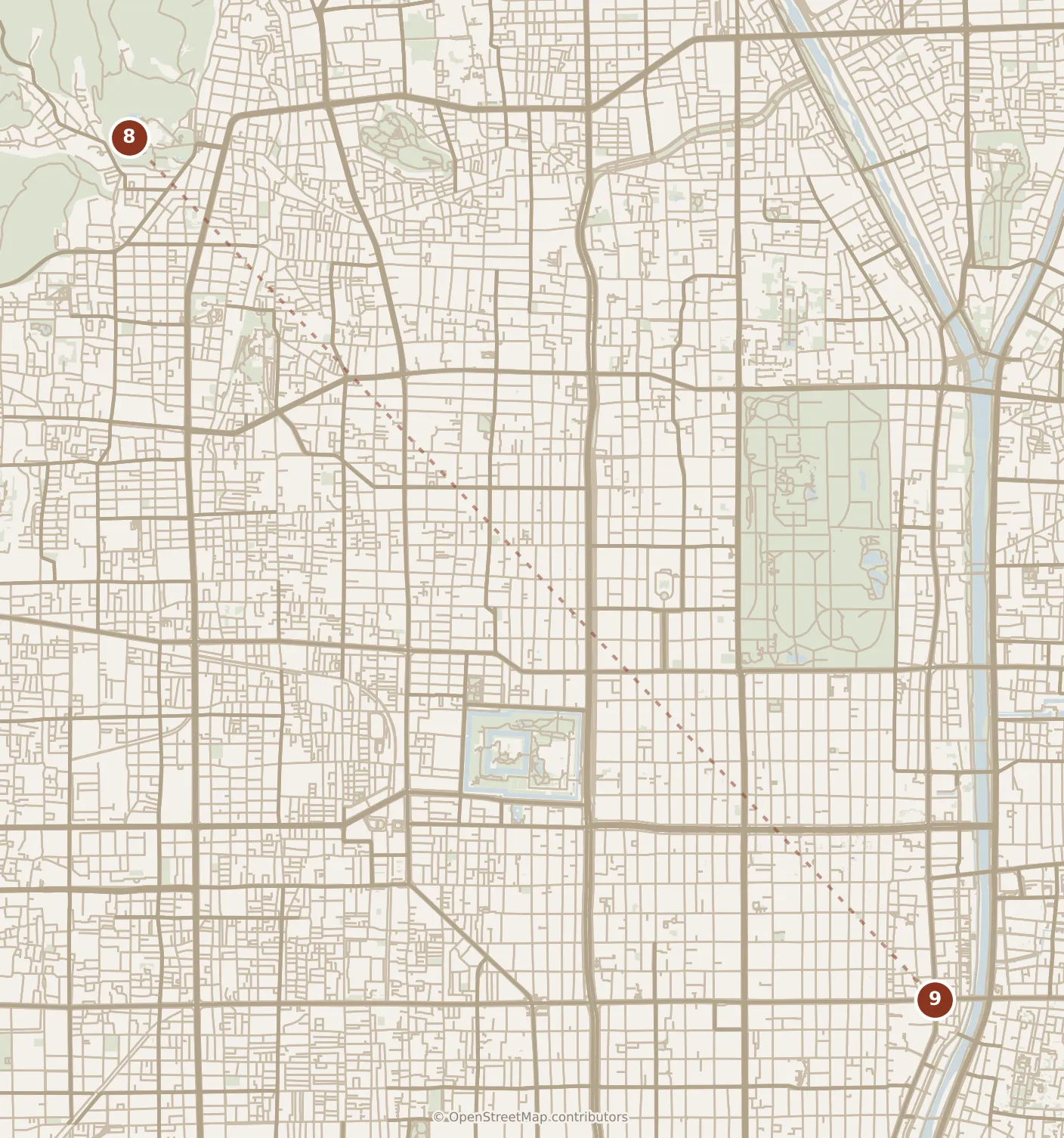
The leg out of the center: from stop 8 by bus, not on foot.
- Evening
- 9Kyoto-Kawaramachi Station
The west, and the argument for putting it first is that it is the half of Kyoto a short visit never reaches, and the half that most rewards being early. Everything today is one movement outward and then one movement back: a train to the mouth of a gorge, a tram along the foot of the northern hills, and a bus down into the middle of the city for the evening.
Morning
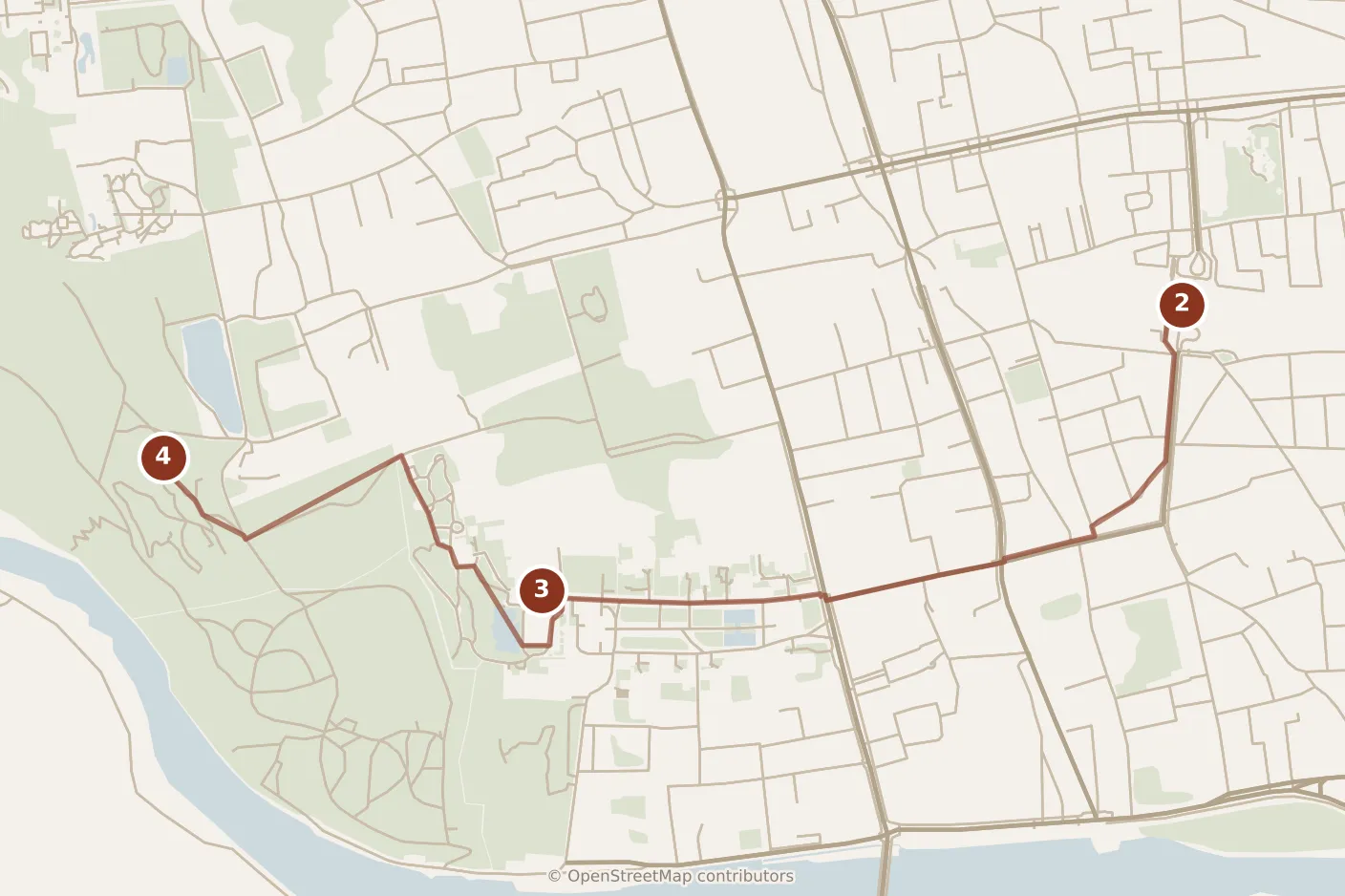
The day starts at Kyoto Station, which is where the fast trains and the airport services put you down and where the lockers are. From the concourse, the JR Sagano Line runs west to Saga-Arashiyama Station in about a quarter of an hour. From the ticket barrier it is a quarter of an hour on foot, most of it along one straight shopping street, to the gate of Tenryū-ji — and get this train early, because the argument for the whole morning is arriving before the coaches do.
Tenryū-ji was founded in 1339 by Ashikaga Takauji, and its garden was laid out by Musō Soseki, who was its first abbot; it has been a UNESCO site since 1994. The garden is the Sōgenchi, a pond you walk round rather than look at from a seat, and its whole design is an argument about what a garden is allowed to contain: the wooded hills behind the temple are composed into it as though they were planted, so the boundary of the garden is somewhere out on the mountainside. Give it three quarters of an hour, and pay for the garden alone unless you already know you want the halls — the buildings are a separate ticket and the garden is the reason you are here.
Leave by the north gate, which puts you straight into the Arashiyama Bamboo Grove. Two honest things about it. It is a lane, not a forest: a few hundred meters of path with houses and walls behind the screen of stalks on both sides, and you can walk it end to end in ten minutes. And it photographs badly, because it is dim under the canopy and by mid-morning the frame is full of other people doing the same thing. It is still worth the ten minutes; it is not worth an hour, and the people who leave disappointed are the ones who were promised one.
The path climbs at the far end to Ōkōchi Sansō, and this is the stop that a second day in Kyoto buys you. It is the private garden of Ōkōchi Denjirō, a film actor who spent thirty years building it into the hillside — a house, a Buddhist shrine, a tea house and a gate, all registered cultural properties, wound into two hectares of planting on a slope. The path through it is a loop that keeps giving you the same view from different heights: the city on one side, the hills on the other, and the Hozu gorge cut into the ground below. Give it an hour. It is the one place in Arashiyama where you can stand still without being in somebody’s way.
Afternoon
Come back down, about a quarter of an hour, to the river. Togetsu-kyō, the long bridge across the mouth of the gorge, is the view everyone photographs and is worth two minutes and no more from the bank. Lunch is here, and this is the right meal on these days for yudofu — plain tofu heated at the table in clear broth, lifted out into a dipping sauce, with nothing whatever done to it beyond that — because Arashiyama is one of the two districts in this city where the dish belongs. Give it an hour, sitting down.
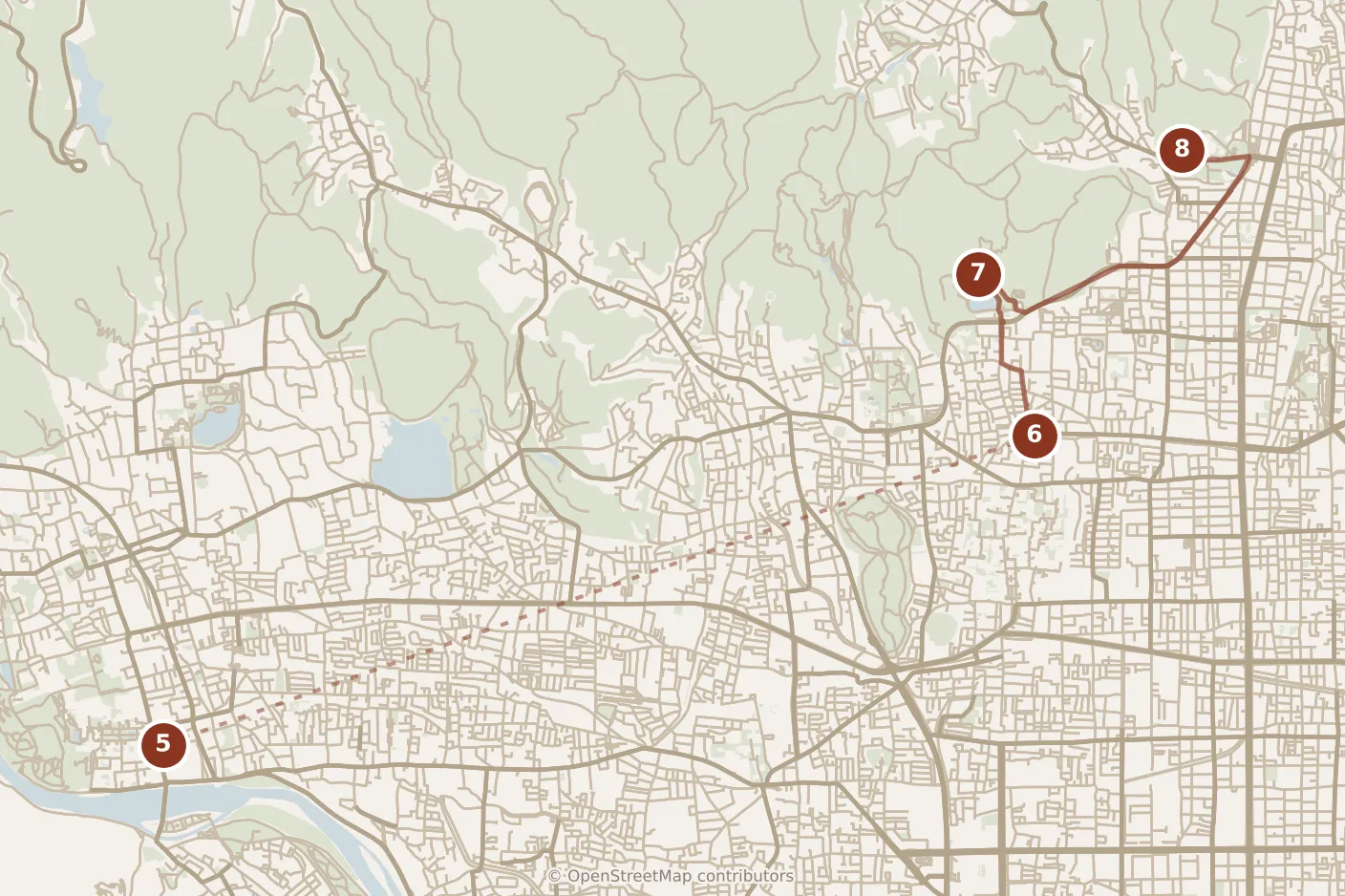
Arashiyama Station, the tram terminus, is five minutes from the bridge. This is the Randen, the last street tramway in Kyoto, run by Keifuku: take the Arashiyama Line east to Katabiranotsuji Station, change there onto the Kitano Line, and get off at Ryōanji Station. About twenty-five minutes altogether including the change, and the ride is half the pleasure — the tram runs in the road for part of it, through back streets no other line touches.
From the station it is ten to fifteen minutes uphill to Ryōan-ji, the last of it up the temple’s own approach past a twelfth-century pond, the Kyōyōchi, which most visitors walk past without a glance and which is the best thing here after the garden itself. The rock garden is a rectangle twenty-five meters by ten, walled on three sides, holding fifteen stones in five groups in raked gravel and nothing else. From the veranda you cannot see all fifteen at once from any single position; at least one is always behind another. Nobody knows who made it or exactly when — the fifteenth century is the usual answer and it is genuinely contested. Give it three quarters of an hour, which sounds absurd for one small rectangle and is not: the garden is a thing you sit in front of, and the visit is either fifteen minutes or forty-five with very little in between.
This is where the first interior of the trip catches people out, so it belongs here rather than in a list at the end. You take your shoes off at the door and carry them with you, and that is true of nearly everything you go inside on these three days. Wear socks you are happy to be seen in, and shoes you can get out of standing up with a line behind you. It sounds like nothing until it is you, on one leg, unlacing a boot.
Then east along Kinukake-no-michi, the road that runs along the foot of the hills, a little over twenty minutes and the longest single stretch of the day, to Kinkaku-ji. The site was a statesman’s villa, bought in 1397 by the shogun Ashikaga Yoshimitsu and turned into a temple by his son after his death. The pavilion you see is not the one he built: a novice monk burnt it down in July 1950 and it was rebuilt in 1955, and in a restoration in the mid-1980s the gold leaf was replaced with a layer five times thicker and ten times heavier than the original. Three stories, three different architectures stacked on each other — an aristocrat’s residence at the bottom, a warrior’s floor above it, a Chinese-style Zen hall on top. Be clear about what the visit is: you do not go inside, the route round the pond is one-way, and it takes forty-five minutes whether you hurry or not. It is a photograph rather than a place, and it is a very good one.
Local tip. Two things on this day are free and two have gates, and when the day slips you will be tempted to protect the free half, because that is where the photographs are. Do the opposite. The bamboo lane and the bridge come to twenty minutes between them and cannot be improved by giving them more; the villa and the rock garden are the two stops that only work unhurried. Take the minutes out of the free half.
Now the arithmetic, because this is the day with a gate to catch. Everything above the Golden Pavilion — the train, the walk in, the temple garden, the bamboo, the villa, lunch, the tram and the two walks in the north-west — comes to about five and a half hours. Add the three quarters of an hour inside and count back from five o’clock: a quarter to eleven is the latest you can leave Kyoto Station and still get through both gates. That is a floor, not a plan.
And in December and January two of this page’s own rules cannot both hold, so here is the trade. The gate shuts at five; the sun in those months is gone by a quarter to five. Counting back from the gate, as the paragraph above tells you to, therefore delivers you to a building made of gold leaf for the last part of it in the dark. Count back from the light instead: leave Kyoto Station by about half past ten and you are inside the grounds by about four with the whole of the visit in daylight, and the rock garden’s earlier winter closing at half past four is still comfortably clear, because you reach it just before three. That is a quarter of an hour of extra discipline in the morning and it is the difference between the two things the stop is for. If half past ten is not a morning you can make, the other trade is to drop the rock garden altogether and give the pavilion the daylight. Do not try to keep both.
Evening
Two city bus routes leave from outside the gate and take you back into the city: the 205 runs south down the western edge to Kyoto Station, and the 12 runs into the middle of it. Take the 12, and about forty minutes in traffic puts you at Shijō-Kawaramachi, the main crossing, which sits above Kyoto-Kawaramachi Station. This is downtown, it is where the parent guide sends you to eat, and the evening here has one specific walk in it.
Turn up Kiyamachi, the narrow street one block back from the Kamo, and walk north beside the water. That water is the Takase, and it is a canal rather than a river: Suminokura Ryōi cut it in 1611, nearly ten kilometers of it, to carry cargo between the city and the port down at the southern end. Boats needed places to turn, and there were basins for the purpose at roughly hundred-meter intervals along this stretch — one survives, the Ichi-no-Funairi, at the Nijō end, a quarter of an hour north, and it has been a protected site since 1934. Traffic on the canal stopped in 1920. It is now a shallow strip of water with cherry trees over it and drinking places on both banks, and the walk is fifteen minutes of the flattest, easiest ground in this article.
Dinner goes at the top of it, in the streets around the north end of Kiyamachi, which are quieter and cheaper than the crossing you arrived at. Ask for obanzai — the Kyoto way of serving a spread of small home-style dishes, which is what this city eats when it is not performing. Note what this evening is deliberately not: it is not Ponto-chō, the alley on the other side of the block, which belongs to the single-day route through this city and is a different and busier evening. Nishiki Market is downtown too, but it fits neither of these two days, and the hours are why: it is a covered food arcade whose shops open between nine and ten and shut in the late afternoon, so it is not an evening — and although it is five minutes west of where tomorrow’s bus leaves from, that bus leaves an hour or more before the first shutters go up. Treat it as an arrival-day errand. If you want it inside day two anyway, that is a trade and not a detour: leave the crossing at nine rather than half past seven, and the whole of day two runs an hour and a half late, which April to September has the daylight to absorb and the winter half of the year does not.
Day two

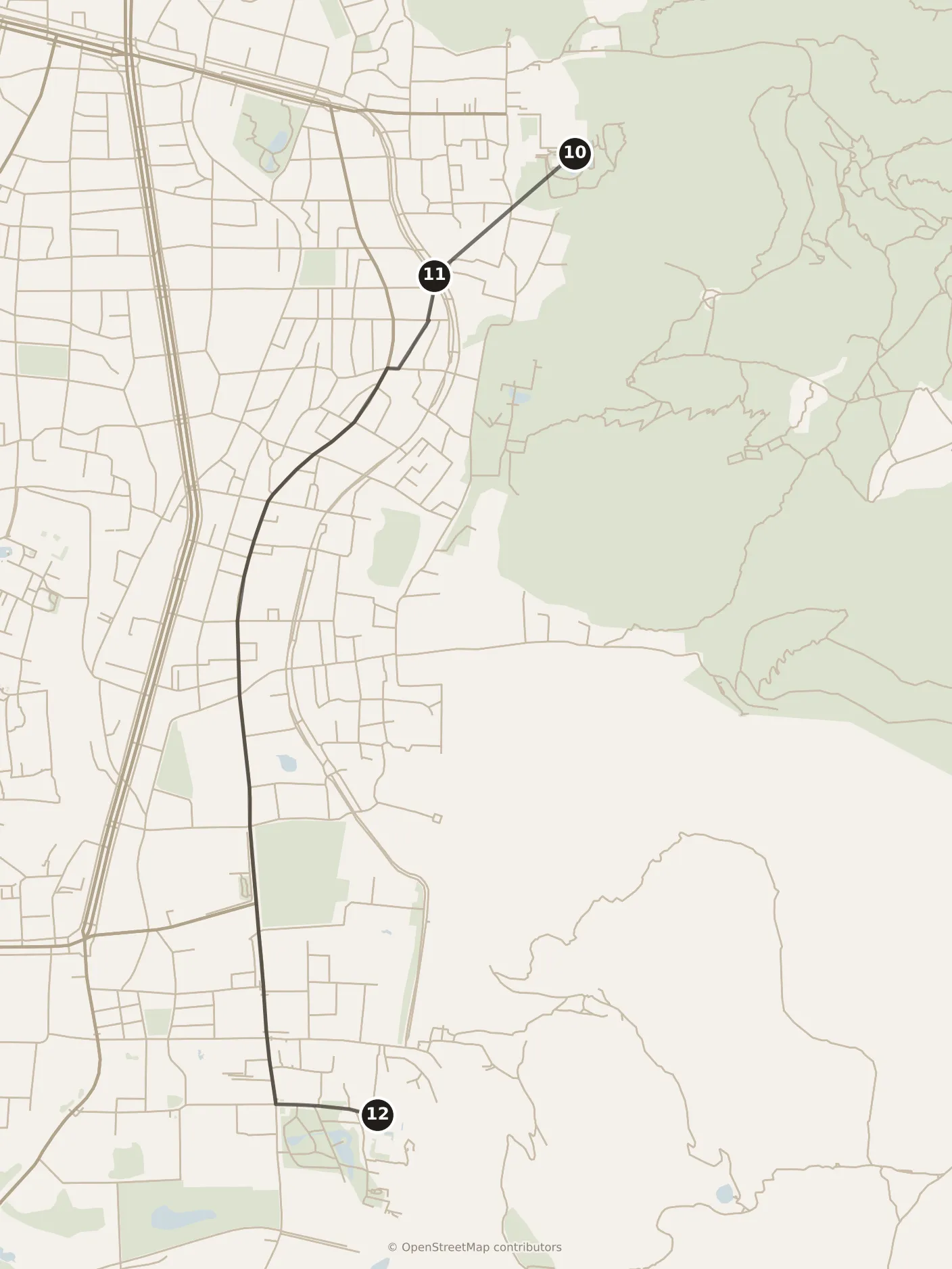
- Morning
- 10Ginkaku-ji
- 11Philosopher's Walk
- 12Eikan-dō
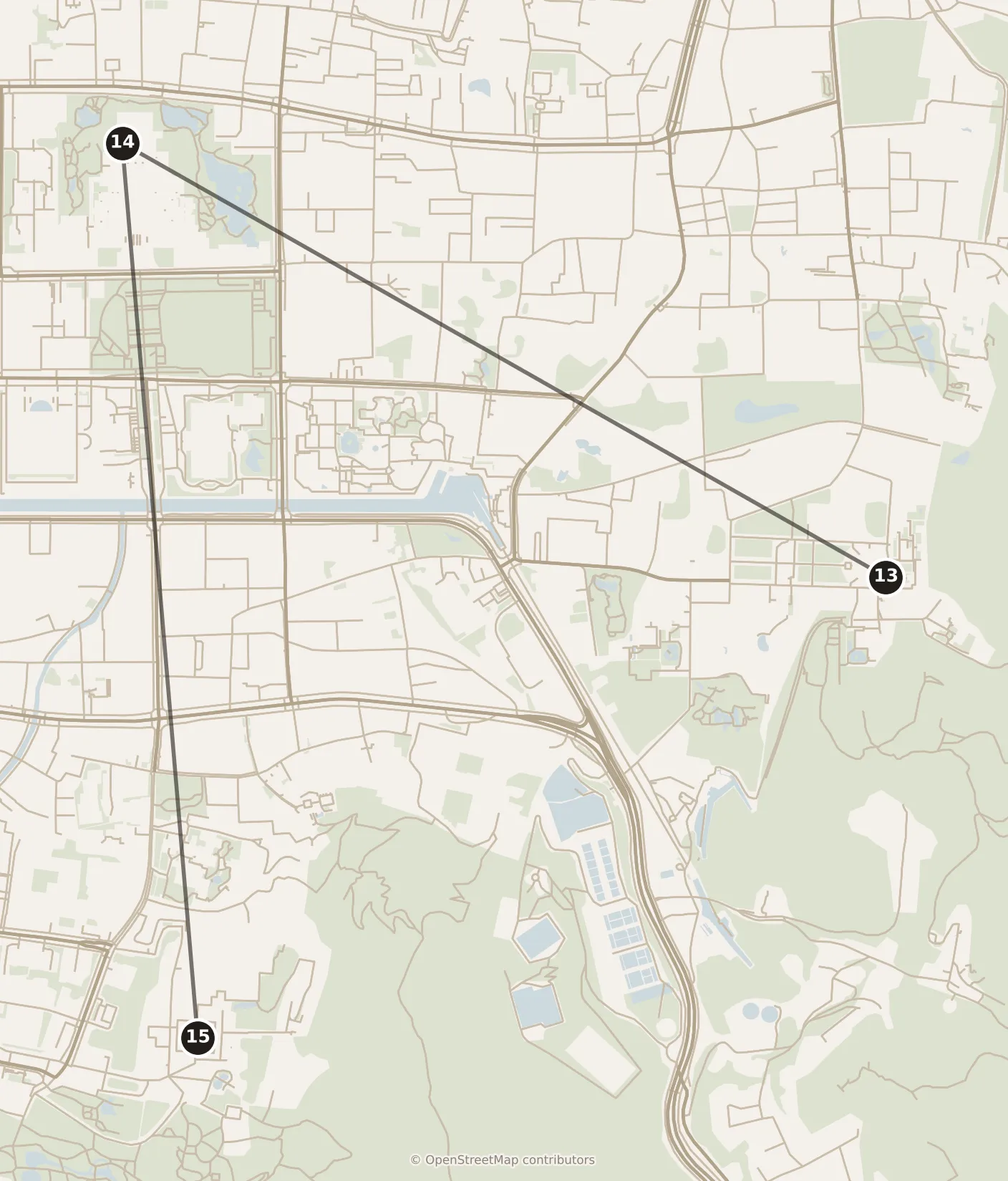
- Afternoon
- 13Nanzen-ji
- 14Heian Jingū
- 15Chion-in
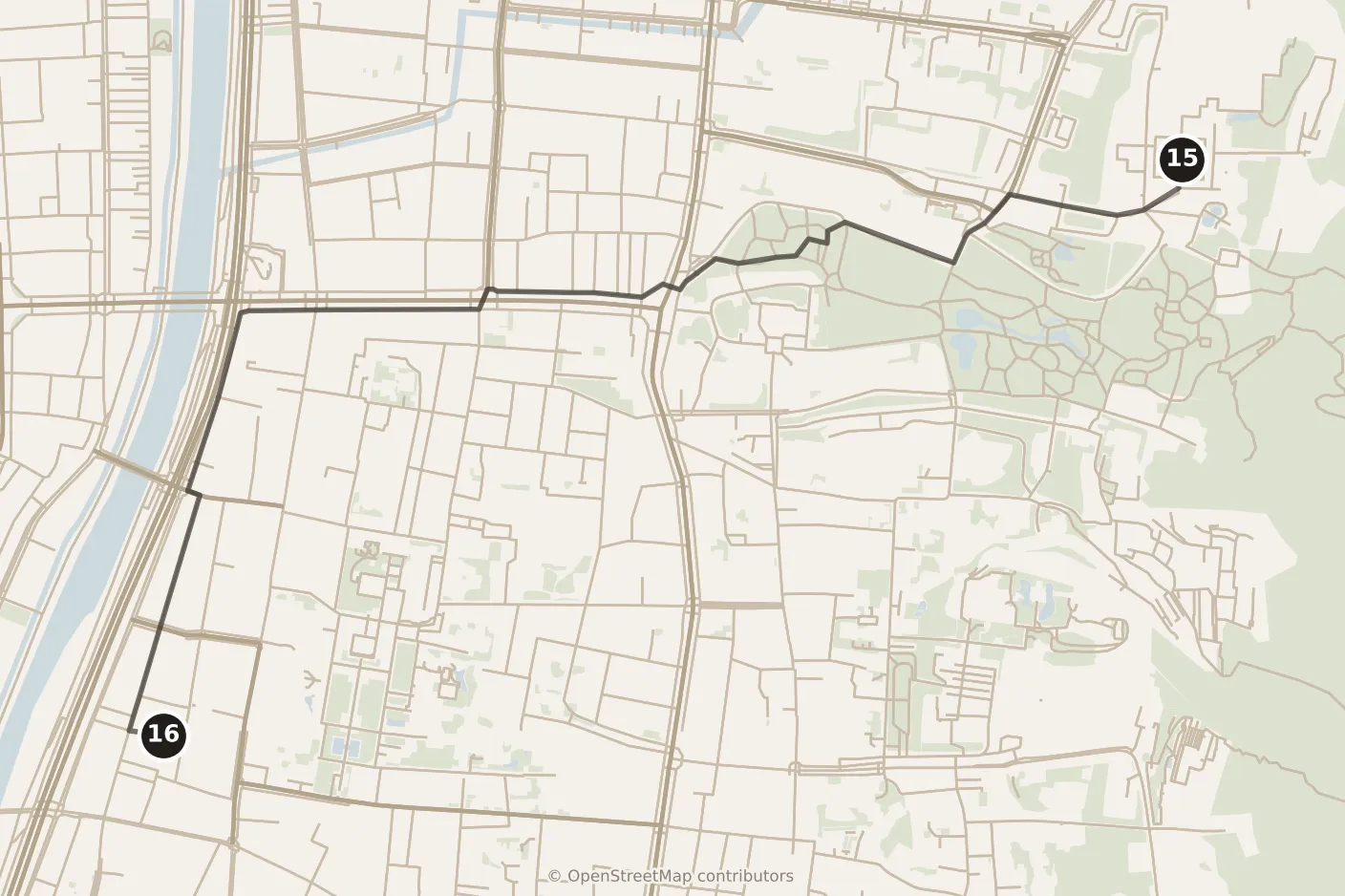
- Evening
- 16Miyagawa-chō
The eastern hills, top to bottom. Today is one continuous descent along the inside of the slope — a canal path with temples hung off it — and once the bus has dropped you at the top there is no transport in it at all. A little over eight kilometers, roughly two hours of that actually walking, and nothing at the end of it that has to be caught: everything ticketed in the afternoon is something this day is willing to drop, which is why it is counted forwards from the morning rather than back from anything.
Morning
City buses 5 and 17 both run from the Shijō-Kawaramachi stops up the east side of the city to Ginkakuji-michi, about half an hour in traffic. Leave the crossing an hour before the gate opens — half past seven for most of the year, eight from December to February — and that hour covers the ride, the ten minutes uphill at the other end, and the wait at the stop that this article keeps telling you is the slow part of any plan here. From the stop it is ten minutes up a lane of shops to the gate of Ginkaku-ji, and this is the day’s one hour: the gate opened at half past eight in 2026 and at nine in the depth of winter, and everything below is counted forward from it.
Ashikaga Yoshimasa began the Kannon-den here in February 1482 as a retirement villa, in conscious imitation of his grandfather’s golden one across the city, and it became a temple after he died. It was never silvered. He meant to, the work was put off, and the name is an Edo-period nickname for a building of plain dark timber. What is actually here is better than the story: the Tōgu-dō beside it, from 1486, contains the Dōjinsai, a four-and-a-half-mat room with a built-in desk and shelves that is claimed as one of the earliest rooms of its kind anywhere — the ancestor of the Japanese domestic interior and of the tea room both. In front of the hall is the Ginshadan, a raked sea of white sand, and beside it the Kōgetsudai, a truncated sand cone about two meters high that has stood there being re-made for centuries and about whose purpose nobody agrees. Behind, a moss ground supposedly laid out by Sōami, and a path that climbs the hillside to a viewpoint over the whole basin. An hour and a quarter, and spend a real part of it on the climb rather than on the sand.
Out of the gate and five minutes south you are on the Philosopher’s Walk, the path along the canal that carries water from the lake over the mountains into the city. It is a couple of kilometers of gravel and stone between private gardens and the water, with several hundred cherry trees along it, and it is named for a philosopher who is said to have walked it to work. From the Silver Pavilion’s gate to the temple at the foot of it is about half an hour, which makes this the longest continuous walk of the two days, and it is the spine of the day rather than a stop on it. It is also where the day’s conduct rule belongs: the gardens beside you are people’s front rooms, and the lane is somebody’s route to the shops.
The path comes out at the gate of Eikan-dō, and it is worth three quarters of an hour. The temple goes back to 853; the name is not its name but a nickname taken from Yōkan, the head monk who turned it towards Pure Land practice a thousand years ago. The thing to find is the Mikaeri Amida, a small twelfth-century wooden Buddha, seventy-seven centimeters tall, carved looking back over its shoulder instead of straight ahead — you will see which way as soon as you are in front of it. The story attached to it is that in 1082 the figure turned its head and told Yōkan, who was walking behind, that he was slow. From the top of the grounds a two-story pagoda of 1928, the Tahōtō, gives you the city; the climb to it is short and steep.
Afternoon
Lunch is at the bottom of the hill, and this is the other district in Kyoto where simmered tofu is the local dish — so if you had it yesterday in Arashiyama, this is the meal to give to yuba instead, the skin lifted in sheets off the top of the vat, which is the same tradition doing something else entirely. An hour.
Then Nanzen-ji, eight minutes further, and give it an hour and a quarter — which buys the aqueduct, the gravel garden and one of the paid interiors rather than all of them. It was founded in 1291 by the retired Emperor Kameyama on the ground his own palace had stood on. The precinct is open ground with no ticket and no gate, which is why it swallows more time than a plan expects: it is not a building but a scatter of separate temples with their own walls and their own admissions. Three things. The Sanmon, rebuilt in 1628, is a vast two-story gate you can climb for a fee, and the upper gallery is the reason to. The Hōjō garden, laid out in the 1600s and attributed to Kobori Enshū, is a long strip of raked gravel with its stones pushed into one corner — the opposite composition to yesterday’s and a good argument in favor of seeing them a day apart. And the thing nobody expects: the Suirokaku, a brick aqueduct on Roman arches driven straight through the middle of the temple grounds in 1890 to carry the Lake Biwa Canal. Walk up the slope beside it to where the water runs in the open channel on top, and carry on a couple of minutes to Nanzen-in behind it, which is the quiet one.
Photography, since you are now going in and out of halls all afternoon: inside them it is usually not allowed, and the notice saying so is as often in Japanese as not. The reliable rule is the one your feet give you — if you have taken your shoes off, put the camera away — and it will not embarrass you anywhere on these three days.
Twenty-five minutes west and slightly north brings you to Heian Jingū, and it is the stop to be honest about. The shrine was built in 1895 for the eleven-hundredth anniversary of the founding of Heian-kyō, and its halls are a five-eighths-scale reproduction of the Chōdō-in, the ceremonial heart of the original palace, dedicated to Emperor Kanmu who founded the city and Emperor Kōmei who was the last to rule from it. Read as architecture it is a late-Victorian reconstruction and looks it. The reason to pay is behind and around it: the Shin’en, three hectares of strolling garden made by Ogawa Jihei — the gardener known as Ueji — over more than twenty years, wrapped round the buildings on three sides in four separate parts. It is the best argument in the city for what a garden built for walking rather than sitting can do. An hour, and skip the halls if the hour is short.
Twenty-five minutes south along the foot of the hills is Chion-in, and half an hour is enough. It is the head temple of Pure Land Buddhism, built in 1234 by Hōnen’s disciple Genchi in memory of his master, and rebuilt at Tokugawa Iemitsu’s expense after the fires of 1633. Two things are worth the walk. The Sanmon of 1619 is the largest surviving gate of its kind in Japan and it is genuinely difficult to take in from underneath. And the bell, commissioned in 1633, weighs seventy-four tonnes; it took twenty-five men to sound it and the temple now says seventeen. The grounds are free, the corridors of the Mieidō have nightingale floors that sing under your weight, and the paid gardens are the part to skip.
Local tip. If today is running late, the stop to lose is the 1895 shrine and not anything older. It costs an hour inside and about half an hour of walking, because without it you go from the aqueduct temple straight down to the great gate in twenty-five minutes rather than fifty. Second to go is the temple on the canal path, three quarters of an hour and no walking at all, since it stands on the route either way. Never cut the canal path itself: it is not a stop, it is the day’s only means of getting from the top of the hill to the bottom.
Evening
From the gate it is twenty-five minutes down and west to Miyagawa-chō, on the east bank below the main crossing. This is one of Kyoto’s five geisha quarters: a single long street of two-story wooden fronts running south, with the district’s own spring dances, the Kyō Odori, staged here for the first two weeks of April since the 1950s. It is quieter than the quarter to the north of it and it is a working street rather than a photographed one. The alleys off it are private: stay on the main street, and if a woman in the district’s dress passes you on her way to work, do not stop her, follow her or photograph her.
Dinner goes in the streets between here and the main crossing rather than on this street itself: what stands on it is the wooden fronts described above, which are houses and places of work and not doors a stranger walks through. The whole point of ending the day at this hour rather than at a gate is that you arrive with the light going and nothing left to catch. The arithmetic falls out neatly in the ten months the Silver Pavilion opens at half past eight: seven and a half hours later puts you here at about five past four, an hour or more before dark for most of the year. In December, January and February the gate opens at nine instead, which puts you here at about twenty-five to five, ten minutes before the sun goes — the day and the light run out together, which sounds elegant and is in fact the one arrangement on this page with no slack in it at all. If you would rather see the great gate in daylight in those three months, cut the 1895 shrine as the callout above says and you are down here by about ten past three. In June the half-past-eight start leaves you three hours of daylight in hand, and the two places to spend it are named above: climb the two-story gate at the aqueduct temple, which is the one interior on this day with a view out of it, and walk the far half of the shrine garden instead of the near half.
With a third day

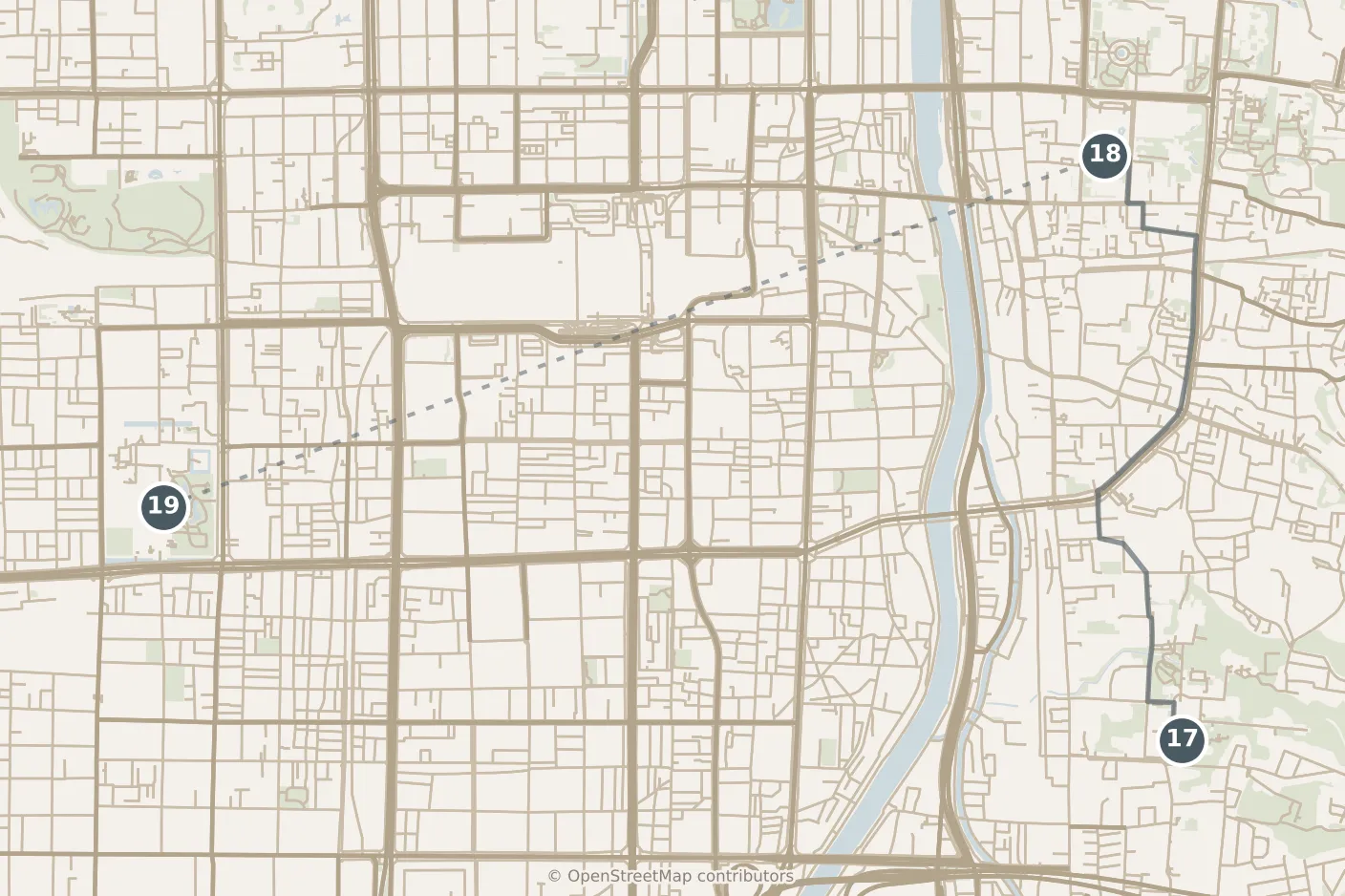
- With a third day
- 17Tōfuku-ji
- 18Sanjūsangen-dō
- 19Tō-ji
Add the third day at the end, and the reason is the geography rather than the closures: it finishes twenty minutes’ walk from Kyoto Station, which makes it the departure day. It is also the only one of the three that is largely indoors, so it is the day to move if one of the others lands in heavy rain — and moving it costs nothing at all, because days one and two do not depend on each other or on this one. There is one thing to re-check if you do move it, and it is the only place a swap touches anything: day one starts at Kyoto Station and this day starts one railway stop from it, so whichever of the two lands on your arrival day is the one that takes the case to the lockers, and the bag paragraph in the overview holds either way.
This is the south, and it is the day of objects after two days of landscape. One stop on the JR Nara Line from Kyoto Station to Tōfukuji Station, then a dozen minutes on foot, brings you to Tōfuku-ji. It was founded in 1236 by the imperial chancellor Kujō Michiie, who wanted something to rival the great temples of the old capital and named it by borrowing a character from each of the two he had in mind. Its gate is the oldest of its kind in Japan. What you have come for is two things at right angles to each other: the Tsūtenkyō, a covered wooden bridge thrown across a wooded ravine inside the grounds, which in the second half of November is one of the most photographed places in the country and for eleven months of the year is simply a quiet bridge over trees; and the four gardens laid out round the abbot’s hall in the summer and autumn of 1939 by Shigemori Mirei, which are the argument that a Japanese garden was still a living form in the twentieth century. One is a chequerboard of square stones set into moss. Another stands old stone cylinders upright in gravel for the stars of a constellation. An hour and a quarter for both, and take the gardens slowly and the bridge quickly.
Half an hour north on foot, up the east side of the river valley, is Sanjūsangen-dō. The hall is a hundred and twenty meters long, rebuilt in 1266 after a fire, and inside it, in ten ranks rising away from you, stand a thousand and one gilded standing figures of Kannon, each with its own face. In front of them is a rank of twenty-eight guardians, several of whom began as Hindu gods and were carried east with the religion, and at the two ends Fūjin and Raijin, wind and thunder. Give it an hour and walk the length twice, once looking at the mass of them and once at individual faces, which is the only way the point of the room lands. Two rules here are enforced rather than suggested and you meet them at the door: shoes off, and the floor is a hundred and twenty meters of cold timber, so this is the day the socks matter; and no cameras at all inside the hall. There is an archery competition on the veranda on the second Sunday of January that has been held in one form or another for centuries. Directly across the road stands the Kyoto National Museum, which is not on this route and is the one building in this whole article that keeps a weekly closing day: it is shut on Mondays, and the callout below is about whether to give it an hour and a half.
Twenty-five minutes west on foot brings you to Kyoto Station, or city buses run the same way in about ten minutes; from there the Kintetsu line takes you one stop to Tōji Station, five minutes from the last gate. Lunch fits in that gap and the honest thing to say about it is that the station district is the dullest eating in Kyoto — do it quickly, or eat properly before you leave the temple quarter. Tō-ji was founded in 796, at the same moment as the city, and given in 823 to Kūkai, the monk posthumously called Kōbō Daishi, who founded the esoteric school that still holds it. Its five-story pagoda is fifty-five meters, the tallest wooden tower in Japan; the present one was put up in 1643 at Tokugawa Iemitsu’s expense, the fifth on the site. But the pagoda is the postcard and the Kōdō is the visit: a hall holding twenty-one statues arranged on their platform as a three-dimensional diagram of the esoteric universe, laid out to Kūkai’s own scheme, which is not a collection of sculptures but a single object with twenty-one parts. An hour. On the twenty-first of every month the grounds fill with a flea market, Kōbō-san, which is several hundred stalls of tools, kimono, pottery and junk and is the best reason to arrange a departure around a date. From the gate it is twenty minutes on foot back to Kyoto Station, or one stop north on the Kintetsu line from Tōji Station, and that is the last leg of the trip.
Local tip. The museum across the road from the thousand statues is an addition and not a substitution, and the number is what decides it: put it in and this day goes from about five and a half hours to about seven. That is the whole reason it is not in the route above. So the rule is a simple one — take it if this day has been moved off the end and is not your departure day, or if it is your departure day and your train is a late one. Otherwise it is the thing that makes you run for a platform, and running for a platform is a poor last memory of a city you have just spent three days walking.
Practicalities
What has to be booked: no gate. Every temple, shrine and garden named here sells its own ticket at its own gate on the day, and none of them takes a reservation. The one ticket in this article that does take a reservation is the Sagano Scenic Railway up the gorge. Treat it as an alternative to half of day one and never as an addition: it is seven and a bit kilometers up the valley from Torokko Saga to Torokko Kameoka, you have to come back down again to rejoin anything, and between the ride, the return and the waiting it is the morning. So it replaces the temple garden and the villa, and you pick the day up at the bridge for lunch with everything after that unchanged. Do it that way or not at all — bolting it on is how people end up at a gate in the north-west at ten to five. A one-way seat was under a thousand yen in 2023, seats go on sale about a month ahead through the railway’s own reservation site, and a share of each train is held back for sale on the day at the stations themselves. It keeps a weekly non-running day and it shuts down altogether for the winter, so read the operating calendar it publishes before you build a morning on it — and if the day you want is not running, day one as written is the plan and loses nothing at all.
Closing days, and the good news. What shuts one day a week in this city is museums, and there is one museum in this article. The two gardens in the north-west publish no closing day at all — both state plainly that they are open every day of the year — and neither does the Silver Pavilion. Shrines and working temples as a class do not keep a weekly closing day here, which is why the weekday you arrive decides very little on this route — unusual enough to be worth saying outright, and still worth one check of your own: if your trip is short enough that a single closed gate would break it, read the page each of these temples publishes in the week before you go, because that is where a temple says so and nowhere else does. Two things this page will say outright. The Kyoto National Museum on the third day is shut on Mondays, and it is an addition and not a stop, so a Monday costs you nothing you had planned on. And Tenryū-ji closes its buildings, though not its garden, on a handful of announced dates each year; the garden is what day one is there for, so this costs you nothing unless you had planned on the halls, and the temple publishes those dates itself.
What to cut, day by day, and the minutes do not transfer. On day one the first to go is the rock garden: three quarters of an hour inside plus the walks either side of it, and instead you ride the tram two stops further along the same line to Kitano-Hakubaichō Station and walk something under half an hour to the Golden Pavilion from there — the best part of an hour saved on the day. Second is the villa on the hillside, an hour. Do not cut the bamboo lane; it is free, it is on the way, and cutting it saves ten minutes and removes the reason most people come to Arashiyama at all. On day two the first to go is Heian Jingū, an hour and a half once the walking is counted, and the second is Eikan-dō, three quarters of an hour, for the reasons in that day’s callout. The third day has nothing to cut, which is the other half of why it is the departure day. And an hour saved on day one is day one’s: the days do not lend to each other, for the simple reason that they are on opposite sides of the city and there is no borrowing across a basin.
Getting between the stops. Day one is one train, one tram and one bus, and those three belong to three different operators, which is the argument for the tappable card in the overview rather than a day ticket sold by any one of them. Day two contains one bus and then nothing: a little over eight kilometers on foot with the whole of it downhill or flat, which makes it the wrong day for new shoes and the right day for a wet morning, if the alternative is standing about at bus stops. The third day is one railway stop out and one across. Nothing in this article needs a taxi and nothing in it needs a car.
A note on the season, and it does not fall evenly across the three days. In the two weeks of the cherry blossom and the two weeks of the autumn maples, three stretches on these days stop being about atmosphere and start costing you real time. The bamboo lane on day one, which is narrow and is the only way through. The canal path on day two, which is lined with cherry trees and is that day’s only way from the top of the hill to the bottom, so in blossom its half hour is not a half hour and the seven and a half will not hold — cutting the 1895 shrine, as that day’s callout says, is what buys the time back. And the covered bridge on the third day, which in late November is the single most crowded object in this article. Add an hour to day one in those weeks or start it earlier — earlier is better, and it is what the whole morning is arranged around anyway. The third day’s crowding has no fix except going in any other month, and for eleven months of the year it is not there at all.


.jpg)