Kyoto in one day: the torii mountain, the Higashiyama lanes, and Gion at dusk

Last updated 4 August 2026
Overview
Kyoto’s famous places are not in the middle of Kyoto. They sit around the rim of a flat basin, and two of them can be an hour of bus apart. A single day here is therefore not a compressed version of the city; it is the choice of one edge of it, with the rest given up rather than hurried.
This day takes the southern and eastern edge, and the reason is geography rather than taste. The shrine on the fox mountain in the south and the temple on the hillside east of the river are the only two of Kyoto’s headline sights strung on a single railway line, and everything that follows the temple runs downhill on foot into Gion. So the day goes south to north on two short train rides and one subway hop, and never turns back on itself.
What it costs you is the west and the north, and the list is not small: Kinkaku-ji, the bamboo and the river gorge at Arashiyama, the shogun’s palace at Nijō Castle, Ginkaku-ji and the canal walk below it, the covered lanes of Nishiki Market downtown. Each of those is a genuine half-day once you have crossed the basin to reach it, and that crossing is the arithmetic that ruins most one-day plans here. Give them up cleanly rather than trying to bolt one on.
Most readers of a page like this are between trains rather than in a hotel room. Kyoto Station is where the Shinkansen stops and where the bag goes into left luggage before anything else: the whole of this day is arranged so that you come back to within two subway stops of it. Leave it there rather than carrying it. The first stop is a mountain of stone steps and the last three hours are spent standing about in narrow lanes, and neither is done well with a case in your hand. If the lockers are full, the day as written is off, and the one that replaces it is at the foot of this page: the same route with the climb taken out, about five hours to Gion instead of six.
The day is built around the light at the end of it. The stone lanes of Higashiyama and the streets of Gion are worth most in the last hour of daylight and the first hour after it, once the coach parties have gone; and the sun goes down in Kyoto anywhere from a quarter to five at the beginning of December to a quarter past seven at the end of June. Everything above Gion — the mountain, the two rides, the temple, the lanes and lunch — comes to about six hours. Six hours before your month’s sunset is therefore the latest you can start and still arrive in the light.
Take that as a floor and not as a schedule. At midsummer it would have you starting after lunch, and you should not: the mountain is worth far more empty than the evening is worth long, so start early and let Gion have three hours instead of one. And note what the six hours does not contain. It counts the time you spend in the places and the time between them, and it knows nothing about the two things that actually swallow this day — the climb at the first stop, which is stairs rather than walking, and the last few hundred meters up to the temple gate in high season, where you move at the pace of the lane.
One hour decides the order of everything else. Kiyomizu-dera shut its gate at six in the evening through 2026, half an hour later in July and August, and it keeps no closing day at all, which is unusual and useful. The exceptions it does keep run the other way: for three announced stretches a year — late March into early April, the second half of November, and the days around Obon in mid-August — it stays open into the night, and it is the temple itself that publishes those dates. Outside them six o’clock is the constraint, and that is why the temple sits in the middle of this day rather than at the end of it, where the view off its stage would tempt anyone to put it: for much of the year six o’clock falls before sunset, and in June it falls more than an hour before. Build the afternoon so that you are through the gate with an hour to spend inside, and if the hour has moved, build it back from the new one. In those three stretches it has moved far enough that the constraint is off altogether, and the temple will hold a later slot than this day gives it.
The day

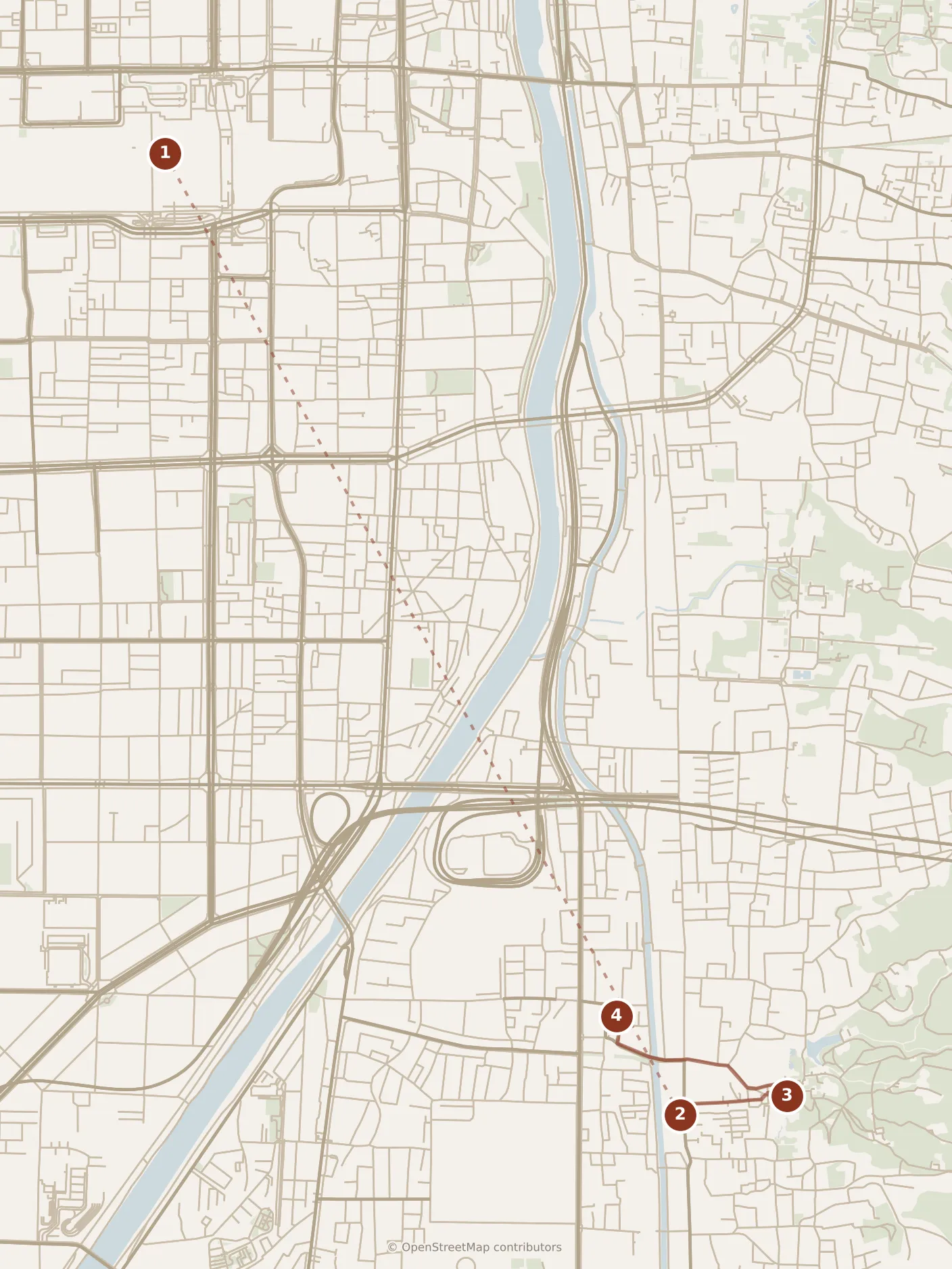
- Morning
- 1Kyoto Station
- 2Inari Station
- 3Fushimi Inari-taisha
- 4Fushimi-Inari Station
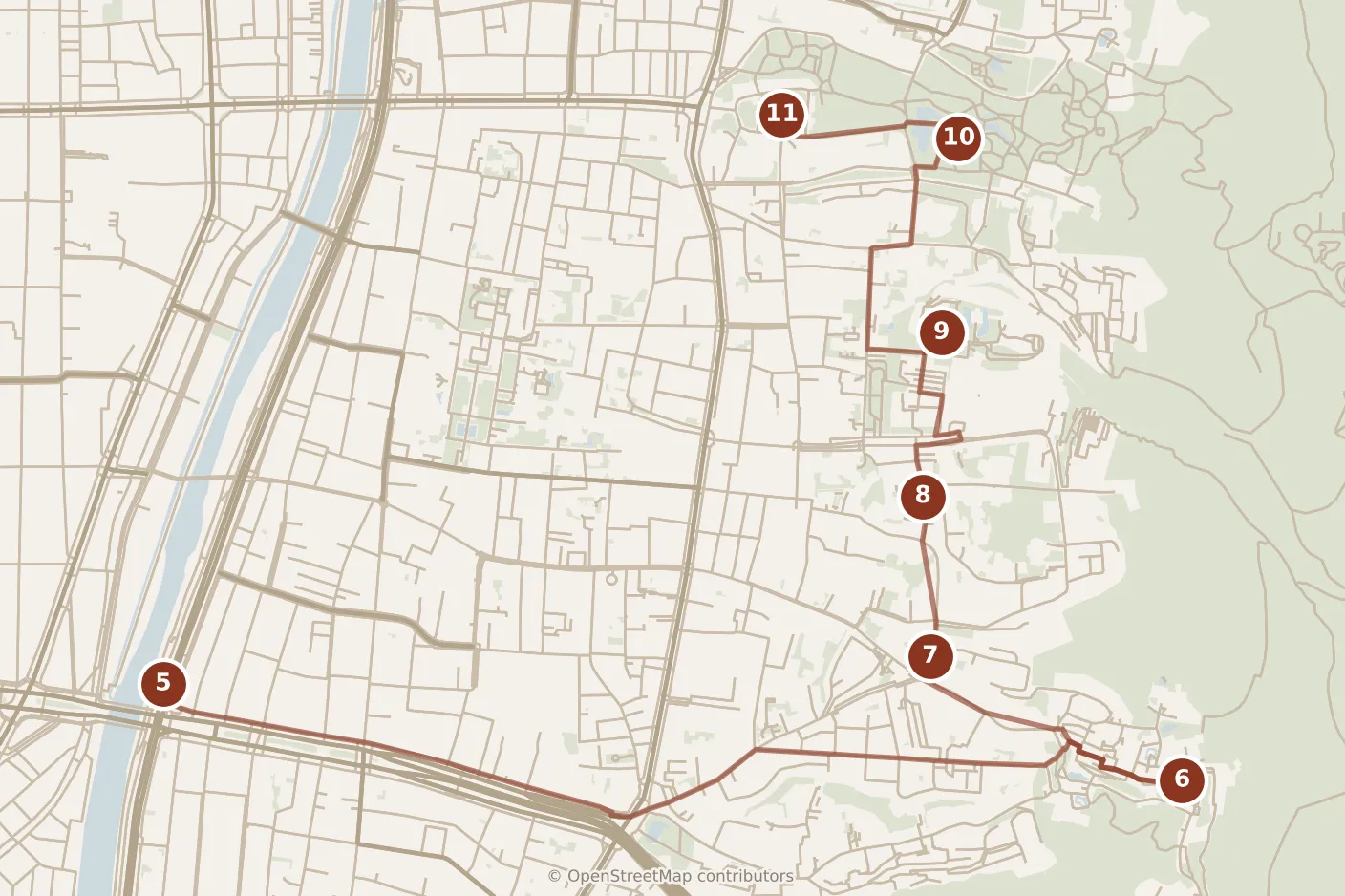
- Afternoon
- 5Kiyomizu-Gojō Station
- 6Kiyomizu-dera
- 7Sannenzaka
- 8Ninenzaka
- 9Kōdai-ji
- 10Maruyama Park
- 11Yasaka Shrine
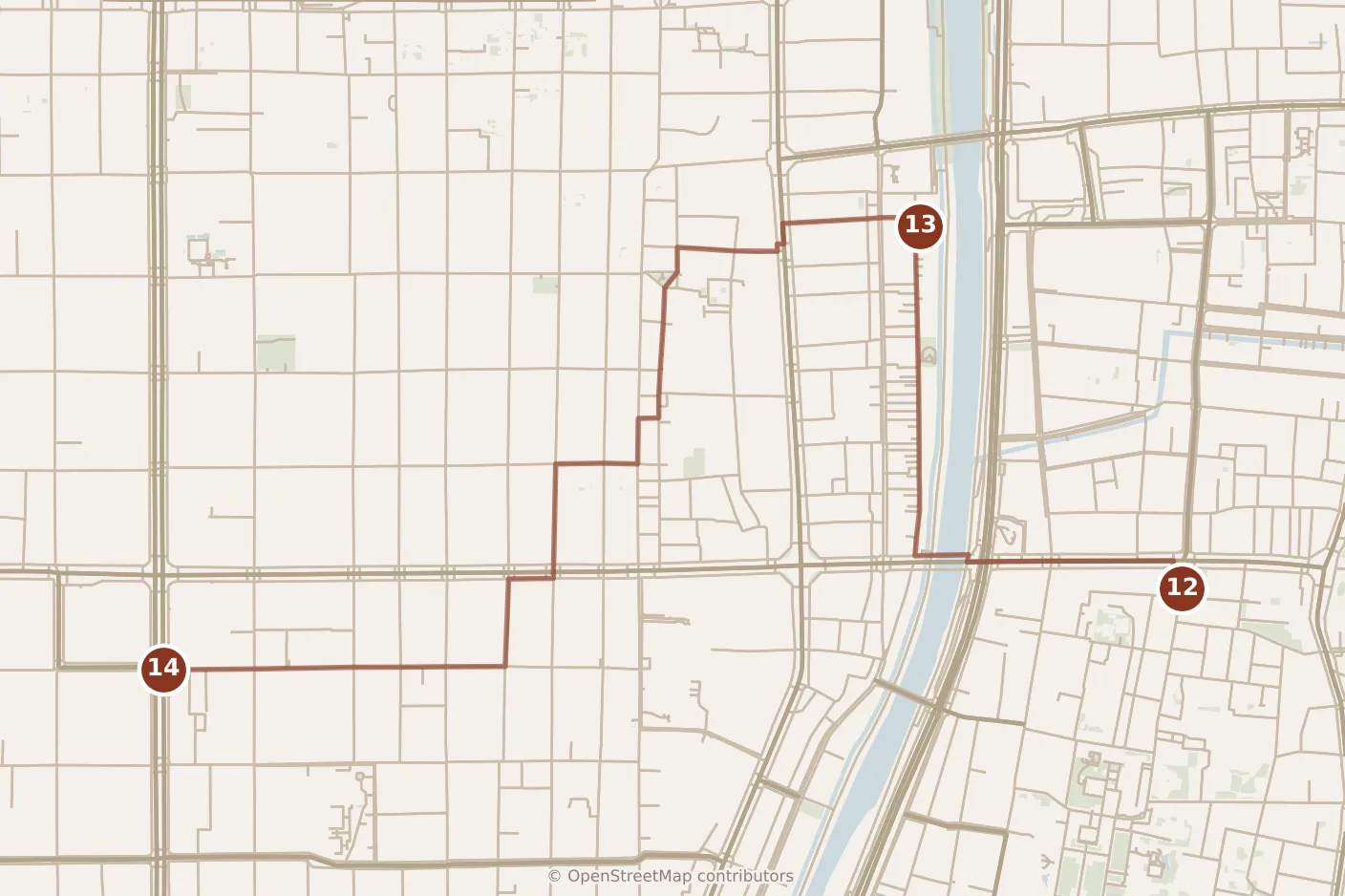
- Evening
- 12Gion
- 13Ponto-chō
- 14Shijō Station
Morning
From Kyoto Station the JR Nara Line runs out to Inari Station in five minutes — two stops — and the shrine’s first gate stands about five minutes from the ticket barrier, straight across the road. Take a Local: the Rapid services on this line run straight through Inari without stopping, so the first train standing at the platform is not necessarily yours.
Fushimi Inari-taisha is the right place to begin for a reason no other stop in this city can offer: it has no gate, no ticket and no opening hour. The shrine was founded in 711 by the Hata clan and is the head of some thirty-two thousand Inari shrines across the country. Inari is the kami of rice, and because rice was wealth, of business — which is the entire explanation for the gates. Around ten thousand torii stand on the mountain, every one paid for by a company or a family, with the donor’s name and the date painted on the back. Walking up you see nothing but vermilion; walking down you read a directory of Japanese business going back decades. The densest stretch, where about eight hundred of them are set close enough to form a tunnel, is the Senbon Torii, and it starts behind the main hall.
Then the mountain, and this is where a day is won or lost. Mount Inari is 233 meters, the full circuit of the summit is about four kilometers, and it takes two to three hours. Do not do it. Climb instead to Yotsutsuji, the intersection roughly halfway up — thirty to forty-five minutes of steps — where the trees open on the south of the city and the path divides for the summit loop. Turn round there. Give the shrine an hour and a half altogether, and spend the first twenty minutes of that in the lower precinct before you start climbing, where the fox statues hold keys in their mouths: the key to the rice granary, for a god who began in agriculture and ended in commerce.
Local tip. Turning back at Yotsutsuji is a decision, not a compromise. The gates thin out above it, the summit has no view, and the loop costs an extra hour and a half for the least photogenic part of the mountain. What that hour and a half buys instead, further down this page, is a sit-down lunch in the stone lanes and an unhurried Gion — and those are the two things a single day here is most often robbed of.
Coming down, leave the precinct on the west side and walk about eight minutes to Fushimi-Inari Station. This is the Keihan Main Line, a different railway from the one you arrived on and the one that goes where you are going next: four stops north to Kiyomizu-Gojō Station. The same trap is set here: the Limited Express and the Rapid Express do not stop at Fushimi-Inari either, so board a Local or a Sub Express.
Afternoon
From Kiyomizu-Gojō Station the temple is about half an hour on foot and uphill for nearly all of it. That is the longest single stretch on this itinerary, and it is worth knowing in advance that the road it takes you up is a stop in its own right. Gojōzaka is the city’s pottery slope. Kiyomizu ware has been made and sold on this hill since the eighteenth century — Kiyomizu Rokubei set up his studio here in 1771 — and there are something like four hundred china shops on and around it, one of the largest concentrations of the trade in Japan. Half are aimed squarely at visitors and half are not, and the difference is visible from the sidewalk.
Kiyomizu-dera is a Buddhist temple built into the hillside, and what everybody comes for is the veranda of the main hall, which juts out over the slope on tall pillars with not a single nail in the structure. The hall standing there now was rebuilt in 1633, after a fire four years earlier, on Tokugawa Iemitsu’s money. Below it the Otowa waterfall drops in three separate channels into a pond, and the line you will find there is people taking one channel each with a long-handled cup. Give the temple an hour and resist adding its sub-temples: on a single day the stage, the waterfall and the walk round the back of the hall for the view of the stage itself are the whole of what you came for.
Then the descent, which is the best hour of walking in Kyoto and the reason this route runs the direction it does. Sannenzaka begins about eight minutes below the temple: a stone-paved lane of wooden frontages that in 1976 was one of the first three districts in Japan protected as a whole under the national preservation system. Ninenzaka carries it on five minutes further. Lunch goes here, sitting down, because this is the one part of the day where the eating and the walking are the same activity — and because the shops along both lanes hand out samples of yatsuhashi, the cinnamon rice-flour sweet, until you have effectively had a second lunch on the way through.
Five minutes on, the lane runs past the gate of Kōdai-ji, and on one day that is where it stays. It is a good temple with a garden and a bamboo walk behind it, and it is an hour taken directly out of Gion. The trade is not worth it unless you decided before you came that gardens are what you are here for.
The lane comes out at Maruyama Park five minutes later — the city’s evening park, with a weeping cherry at its center that draws a crowd of its own in early April. Cross it west to Yasaka Shrine, which has stood on this spot since 656 and for which the park is effectively a back garden. The dance stage in the middle of the grounds is hung with hundreds of paper lanterns, each carrying the name of the business that paid for it: a wall of names rather than a decoration, and worth reading as one. The festival that fills the whole city every July begins here. This is the right last thing to see in daylight, because the gate below it opens straight onto Shijō and into Gion.
Evening
Gion starts at the foot of those steps, and Hanami-kōji is the lane to walk — six minutes west along Shijō from the shrine gate, then off it to the south. Wooden frontages on both sides and nothing overhead, because the cables went underground and the stone paving went down here, finished in 2001 — which is most of why the street photographs the way it does and why it looks unlike anywhere else in Kyoto. Give it half an hour, then go north to the Shirakawa canal, a narrower and quieter version of the same thing, with water and willows down the middle and the buildings standing straight in it.
One thing about how to behave, because it is the difference between being welcome here and not. The small alleys running off both of those are private property, people live and work in them, and this is not a matter of courtesy any more: whole lanes in the district have been closed to visitors and carry posted no-entry and no-photography signs. Walk the main lanes, read the sign at the mouth of a side one before you take it, and leave those alone. And if a geiko or a maiko passes you in the street, do not photograph her and do not follow her — that is the behavior the signs went up because of.
Then west across the Kamo to Ponto-chō, twelve minutes. It is an alley one block back from the river, running from Shijō up to Sanjō, barely wide enough for two people to pass, and dinner goes here. In the warm months the places on the river side put out wooden decks over the bank, and eating on one is worth waiting for a table. The dish to look for is nishin soba — buckwheat noodles under a whole simmered herring — which was put together in 1882 in a soba house beside the kabuki theater at the end of the bridge, a few minutes from where you are sitting.
Then the way out, which is the one paragraph of this day with a deadline in it. Walk to the south end of the alley, cross onto Shijō and keep going west: it is a little over twenty minutes on foot from the middle of Ponto-chō to Shijō Station, which is the subway, and two stops on the Karasuma line from there to Kyoto Station and your bag. That walk is the price of ending the day where the evening is rather than where the train is, and on a straight, lit shopping street after dinner it is not a bad twenty minutes.
Practicalities
Nothing you have to see on this route has to be booked, which is unusual for Kyoto and is a property of this particular day rather than of the city. Dinner is the exception that sentence does not cover: the riverside decks are run restaurant by restaurant, and the official guidance for them is to contact each one directly rather than to walk up. The only ticket is Kiyomizu-dera’s, bought at the gate, and it was in the five-hundred-yen range in 2026. Fushimi Inari-taisha charges nothing. Yasaka Shrine, Maruyama Park, Gion, Ponto-chō and the two stone lanes are open ground and public street.
The one thing this day does ask of you, if you have arrived holding nothing at all, is the means to pay three different railway companies. The rides here belong to three separate operators — JR out to Inari Station, the Keihan Main Line up to Kiyomizu-Gojō Station, the city subway back at the end — so a day pass sold by any one of them covers at most a third of this route. A single tappable transit card covers all three, and the parent city guide has the rest of the detail; sort it out at Kyoto Station before you leave it, because the alternative is buying paper tickets from three different machines in three different liveries while the day runs down.
None of the stops this day actually goes into keeps a weekly closing day. Kiyomizu-dera has none, and the shrines, the park and the lanes are open ground, so this route survives a Monday — which most Kyoto plans do not, because what closes on Mondays in this city is the museums, and this itinerary has already given those up. That is a reason to take the single day as written rather than to swap something into it.
Season is the real variable and it acts on two specific points of this route. In the cherry blossom of late March and early April, and again in the autumn color of mid-to-late November, the half-hour climb up Gojōzaka and the descent through Sannenzaka and Ninenzaka are where the crowd costs you actual time rather than atmosphere — the lanes are narrow, they are the only way down, and you move at the pace of the person in front. Add an hour to the afternoon in those weeks, or start the whole day earlier, which is better. Gojōzaka has one of its own besides: the pottery festival takes over the slope from 8 to 10 August every year, which is either three days to keep off it or the reason to be on it.
Left luggage is at Kyoto Station and this day is built to return to it: the last stop, Shijō Station, is two subway stops away. Coin lockers are the plan; the fallback is the part we cannot give you, because no published source we could open lists the station’s staffed baggage counters, their hours or their price, so do not build the morning on finding one. Between the two train rides everything is on foot, about seven and a half kilometers in all, and there are exactly two long stretches — the half-hour up Gojōzaka in the afternoon and the twenty minutes west along Shijō at the end. Every other leg is between five and twelve minutes.
If the lockers are full, or the bag is coming with you for any other reason, there is still a day here, and it is this one with the climb taken out rather than a shortened version of it. Ride out to Inari Station as written and give the shrine half an hour at ground level — the fox statues, the main hall, the mouth of the Senbon Torii behind it — then walk the eight minutes on to Fushimi-Inari Station without starting up the steps, and take the rest exactly as it is written: four stops north to Kiyomizu-Gojō, the half-hour up Gojōzaka, an hour at Kiyomizu-dera, the descent through Sannenzaka and Ninenzaka with lunch in them, Maruyama Park and Yasaka Shrine, then Hanami-kōji, the Shirakawa canal and dinner in Ponto-chō. That is about five hours to Gion rather than six, so it starts an hour later and ends in the same light. What it costs is the mountain, which is the one stop here you genuinely cannot do with a case: the best part of an hour of stone steps up and down. Everything after it is flat or downhill the whole way.


