Kunming in two or three days: the Dragon Gate above Dianchi, the center on foot, and a day out at the Stone Forest

Last updated 14 August 2026
Overview
One day in Kunming is a day in the center, because the center is all one day reaches. What a second day buys is the thing the city is actually known for and cannot show you from inside itself: the wooded ridge along the west shore of Dianchi, and the corridor of caves, galleries and stairways that three men spent seventy-two years cutting into its cliff by hand. That is a full day out and back, walked at eighteen hundred and ninety meters and mostly on stairs, and it goes first below because it is the day that needs the weather — if the forecast is against you, swap the two city days and take the hill on the better morning. The center goes second, walked at half a single day’s speed and with the museum that explains the city added back into it.
Sleep by Green Lake if you have two nights. Everything on the second day starts or ends within a quarter of an hour of it on foot, and the first day’s return drops you at its edge. From the city-center station it is Line 1 north to Milesi and Line 5 two stops on to Huashan West Road, about half an hour with the walking at both ends; from Kunming South Railway Station out at Chenggong it is Line 1 the whole way and the better part of an hour.
Two of these days rest on hours, and both are the kind that decide an order rather than fill a schedule. The Western Hills scenic area opened at half past eight in 2026, stopped admitting at five and shut its gates at half past, and everything on day one — the temples, the cliff, the cable car down — sits behind that gate, so the first day is built backwards from five; if the hour has moved, build it backwards from the new one. Day two has no such wall. Its anchor is the light, and the light here barely moves: the year’s earliest sunset falls around twenty past six, in the last days of November, and its latest just after eight, at the start of July — an hour and three quarters between the two extremes, where a European capital swings by five. Both are late for where Kunming sits, because the whole country keeps one clock, set for the coast.
Start day two at eight, in every month of the year. That is the whole instruction, and the reasoning behind it contradicts the article’s own arithmetic, so here is the trade rather than the silence. Day two as written comes to about nine and three quarter hours from the lake to the archways, its walking and its one metro leg included; subtract that from your month’s sunset and you would be standing at Green Lake at about half past eight in late November and about a quarter past ten in early July. But Green Lake is worth the first hour of a day and not the fifth — the dancing and the singing under the willows are a morning thing — so a quarter past ten is what the arithmetic says and not what to do. Eight o’clock puts you at the archways at about half past five, which is fifty minutes before sunset in late November and two and a half hours before it in July — so you see them by daylight either way, and the lit version is a seven-minute walk back from where you will be eating. Eat late and come back down. Waiting in the square is the one thing not to do with the surplus.
That total, and the eight and a quarter hours day one comes to below, count the places, the transport between them, and the waits the days themselves name — the shuttle’s twenty minutes, the cable car’s half hour — and nothing beyond those. Day one is the one to distrust: nearly two and a half of its eight and a quarter hours are transport rather than sightseeing, and the cable car down to the lake is the one line on either day that can double.
One thing on these two days has to be booked before you reach its door, and it is free — the railway museum on day two. The third day adds a train seat. Three metro journeys carry the two days and not one more. And the bag, which in this format matters twice: you have a room, so what counts is the day you arrive and the day you leave, and neither the cliff staircase on day one nor the country bus on the third will take a case. It stays at whichever of the two stations your train uses, and they are a long way apart: the city-center Kunming railway station, three Line 1 stops north of where day two ends, and Kunming South Railway Station out at Chenggong, the better part of an hour down the same line. Put the center day against whichever end of your trip has a train in it, because it is the only one of the two city days that finishes standing on top of a metro station.
Shilin West railway station, Stone Forest — not on the walking map; you get there by metro.
Day one

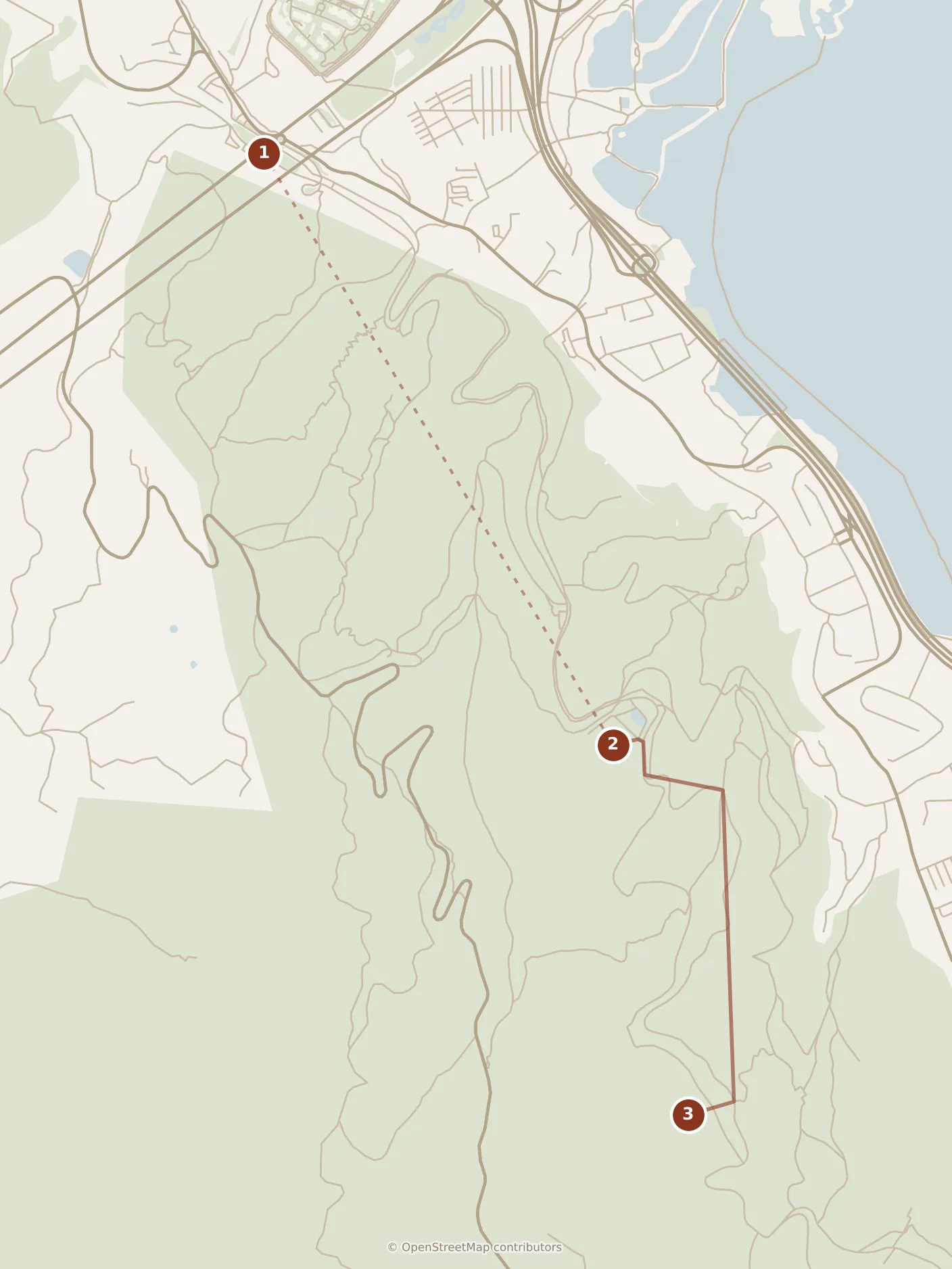
- Morning
- 1Western Hills Park station
- Gaoqiao — in the prose, not on the map
- 2Huating Temple
- 3Taihua Temple
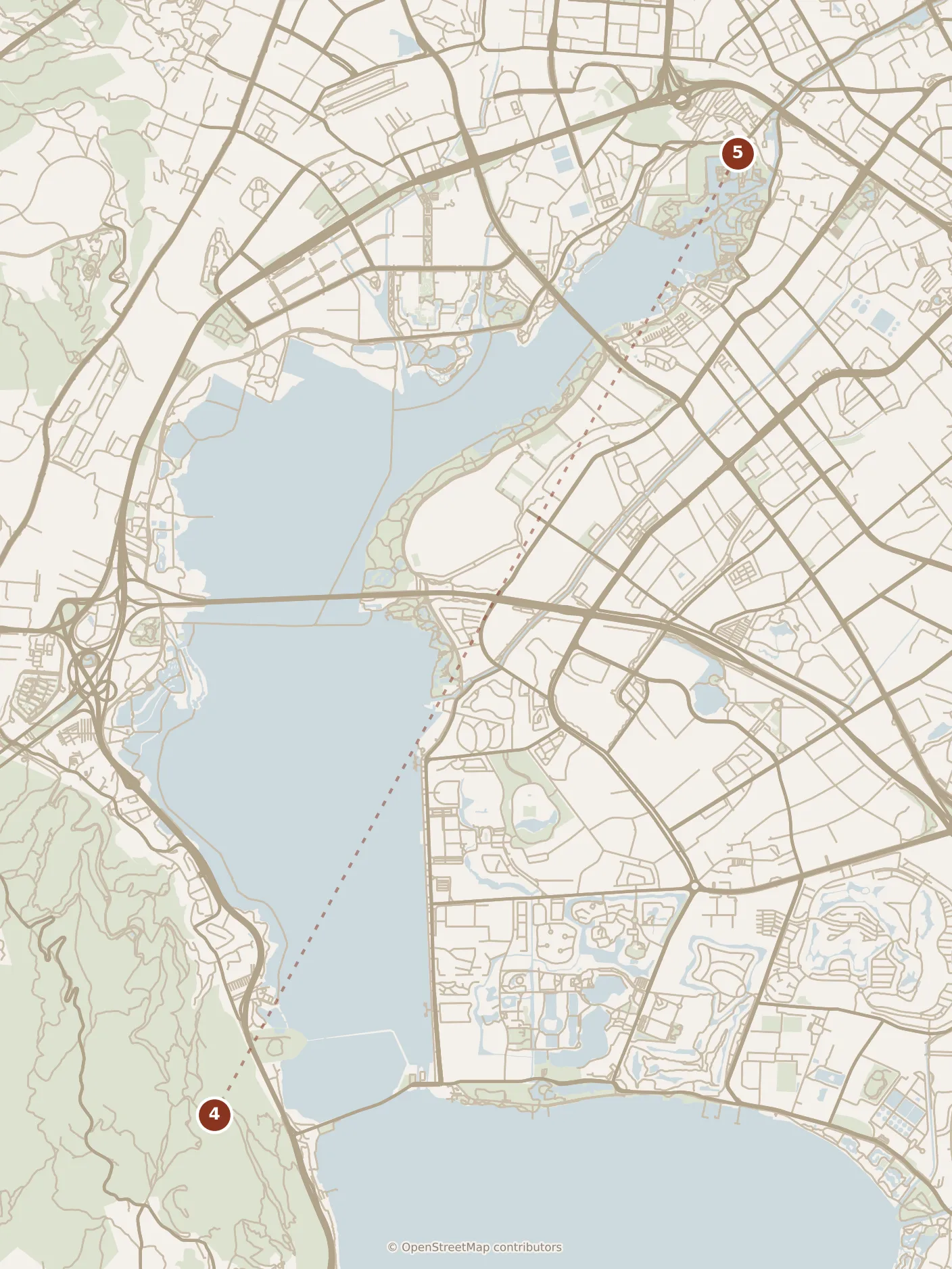
- Afternoon
- 4Nie Er's Tomb
- Sanqing Pavilion — in the prose, not on the map
- Dragon Gate — in the prose, not on the map
- Haigeng Park — in the prose, not on the map
- 5Daguan Park
Today leaves the city and comes back to it, and it is arranged in one direction: up the hill by road, along the ridge on foot, and down to the water by cable. Nothing is walked twice. Leave the quarter at eight and the whole of it, transport included, comes to eight and a quarter hours.
Morning
Take Line 5 one stop south from Huashan West Road to Wuyi Road, change to Line 3, and stay on it west to the end of the line at Western Hills Park station. It is twelve stops and the whole leg, from the Green Lake quarter to the platform, is fifty minutes. The station is not at the hill: it is ten minutes east on foot to Gaoqiao, where the scenic area keeps its visitor center and where you buy whatever you are going to buy for the day. Buy lunch before any of that, in the Green Lake quarter — the hill sells food and you will not want it, and this is the last hour in which that is a choice. The shuttle up the hill goes from there. Give it twenty minutes with the wait.
The shuttle climbs in stages and calls at both temples before ending at Nie Er’s tomb. Get off at the first, Huating Temple, the largest on the hill and the reason to start at the north end of the ridge rather than at the cliff. It has been rebuilt over and over and its ages are jumbled, which matters less than what is in the side hall: five hundred painted arhats, individually modeled, ranked around the room in tiers, no two faces alike. Give the temple three quarters of an hour, and give most of it to that one room. This is a working temple with a resident community and not a monument, so you are walking through somebody’s morning — go round the halls rather than through them, and step over the raised timber sill in a doorway rather than on it, which is the one thing everybody here does and no visitor knows to.
Twenty minutes south along the road, Taihua Temple was founded under the Yuan and is the quieter of the two: a sequence of halls stepping down the slope to a terrace, and from the terrace the first proper sight of the lake, three hundred square kilometers of it opening east below you. Half an hour, and take the terrace rather than the halls if you are choosing.
Afternoon
A quarter of an hour further south along the same road, Nie Er’s tomb is laid out in the shape of a moon-lute — the grave itself the body of the instrument, seven flower beds along the approach for the seven notes of the scale, and twenty-four stone steps for the twenty-four years he lived. He wrote the tune that became the national anthem and drowned in 1935; he was moved up here in May 1980. Twenty minutes. Eat here, and eat what you carried: the food on the hill is thin and expensive, and this is the last flat place before the cliff. Half an hour for that.
You are now at the gate of the Dragon Gate section, and the rest of the afternoon is the reason the day exists. Twenty-five minutes of climbing brings you to Sanqing Pavilion, a stack of halls and shrines wedged into the rock — a Yuan prince’s summer retreat before it was Taoist, and mostly rebuilt in the nineteenth century. From there the works begin. Sixty-six and a half meters of gallery, tunnel and stair were hacked out of the cliff face between 1781 and 1853 by three men in relay: a Taoist called Wu Laiqing, who spent fourteen years alone opening the Ciyun Cave, then Yang Rulan and his son Yang Jitai, who finished the Dashi Pavilion at the far end. It is narrow, it is cut rather than built, and the drop on your open side goes straight to the lake. Give the pavilion and the corridor together an hour and a quarter. Come at this hour rather than earlier: you are facing east over the water, and in the afternoon the sun is behind you instead of in your eyes.
Then down by cable car to Haigeng Park, on the shore directly below. Twenty minutes in the air, half an hour with the line. This is the day’s one large fare and a separate operator from the through ticket — forty yuan one way out of season and sixty in it, in 2026 — and it is worth that for one thing beyond the saving: from the water the ridge you have just walked reads as a reclining figure, which is what the city calls it — the Sleeping Beauty — and you cannot see that from on top of it. Forty-five minutes along the shore. From November to March the gulls are here in thousands. Yunnan Nationalities Village is the next gate along: a large built park of reconstructed houses and staged performance from the province’s minority nationalities, and a half-day in its own right. It does not fit into the end of this one, which is the only reason it is not below.
A twenty-minute taxi north brings you to Daguan Park, at the top of the lake, and this is the last stop rather than an extra one. Daguan Tower looks back down the water at the hills you spent the day on, and pinned to its front is the couplet Sun Ranweng wrote in 1765: a hundred and eighty characters, ninety a side. It opens on the five hundred li of Dianchi rushing into the eye, which is a description of exactly what you are looking at, and the answering half runs through several thousand years of Yunnan’s history and ends by dismissing every dynasty that held it. That paraphrase is most of what a visitor who cannot read classical Chinese will carry away from the board itself; the rest of the three quarters of an hour is the water, and the ridge you spent the day on seen from the far end of it. A quarter of an hour by taxi from there and you are back at the lake you started from.
Local tip. Buy the through ticket at the Gaoqiao visitor center — it covers the shuttle up and the Dragon Gate section, and the electric cart that now runs the closed lift’s line above the tomb is sold there too, if you would rather not walk that stretch; the pieces came to well under forty yuan a head in 2026, with the temples and the tomb themselves free — and take the hill in one direction only: shuttle up, cable car down. Going back down the road you came up returns you to a metro station instead of to the water, and the water is the only place from which the hill looks like anything. It is also the choice that puts the two temples before the cliff rather than after it, which is the order the closing time wants.
Evening
You are back in the Green Lake quarter by about a quarter past four, which is deliberate: the day was long and the evening is the reward for it, and it is the one stretch of these three days with no clock on it. Wenlin Street and the lanes off it, behind the university’s old campus, are the student eating quarter, and they fill up in the evening rather than at half past four — so take an hour off your feet first, then eat. In late November dark comes soon after; in July you will still be sitting there when it does. Then walk the causeways after dark, when the park belongs to the people who live around it rather than to anyone photographing it, and note that tomorrow morning you will be standing in the same place and it will not be the same place at all.
Day two

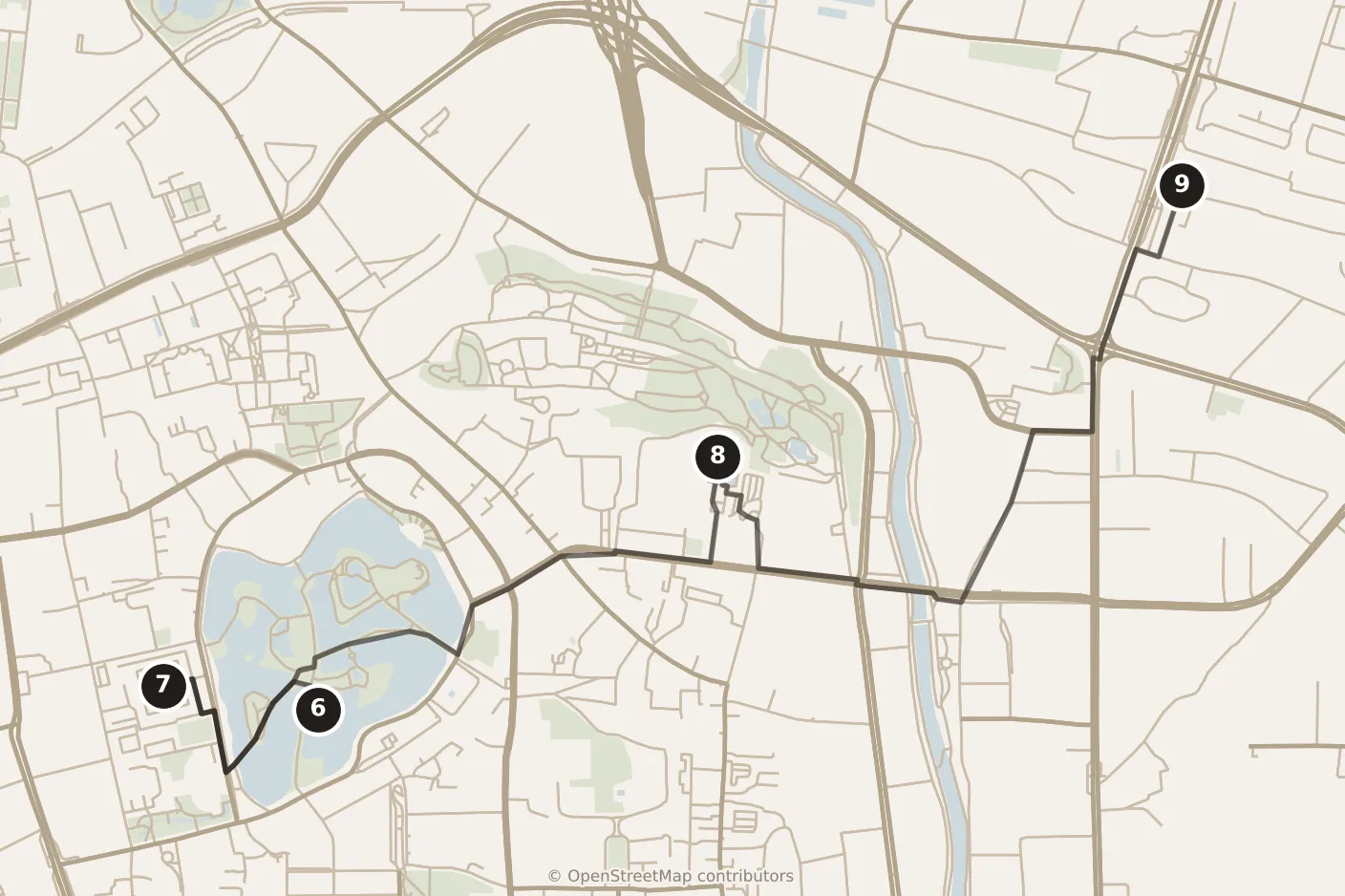
- Morning
- 6Green Lake
- 7Yunnan Military Academy
- 8Yuantong Temple
- 9Yunnan Railway Museum
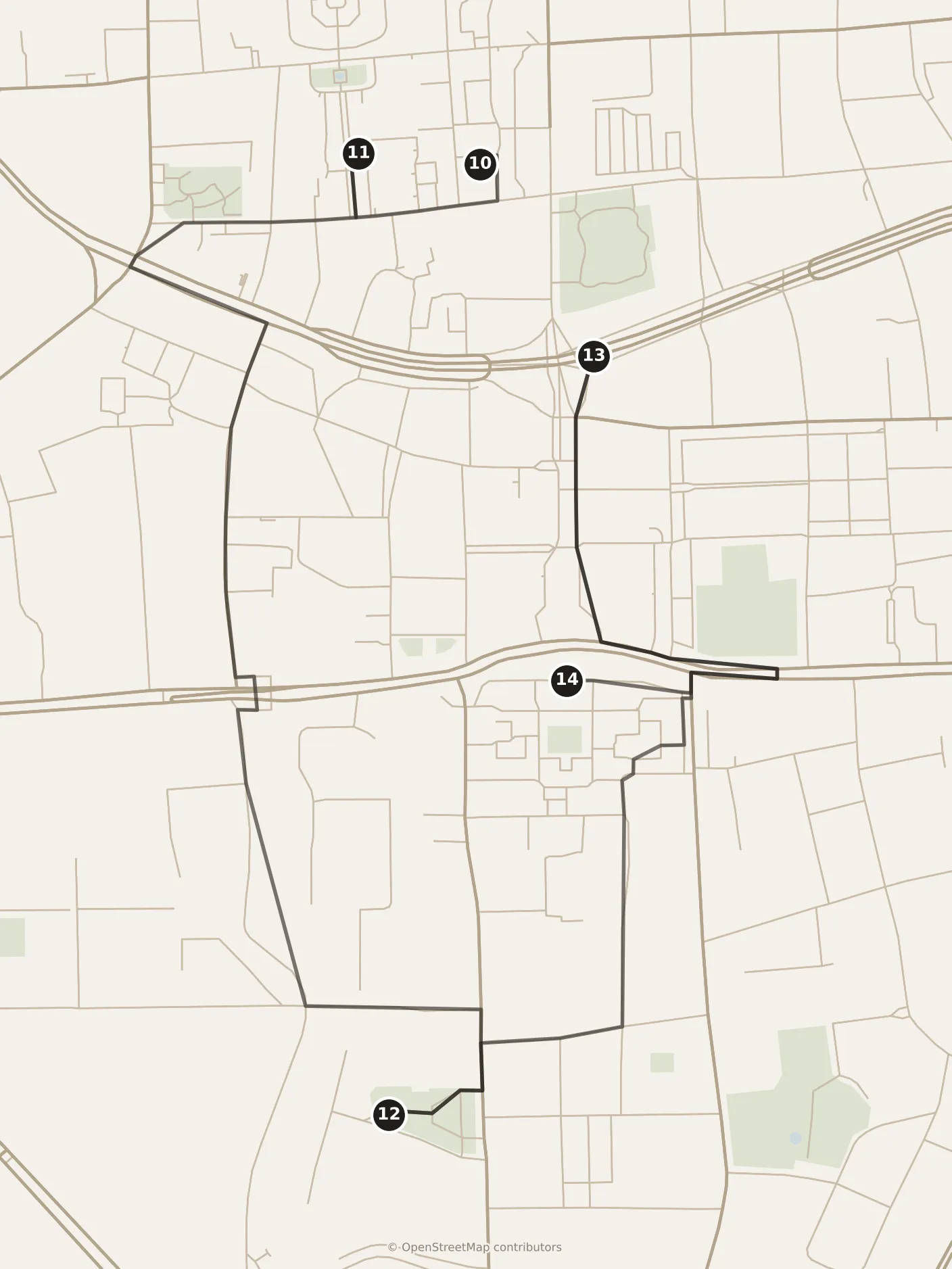
- Afternoon and evening
- 10Majia Compound
- 11Nie Er's Former Residence
- 12Eastern and Western Pagodas
- 13Nanping Pedestrian Street
- 14Jinma and Biji Archways
Everything today is inside three kilometers of the same north–south line, and the order is not negotiable: the two stops with doors are both before lunch, and everything after it is a street, a courtyard, two towers in the open and a square.
Morning
Start at Green Lake at eight. Two causeways cut it into quarters, and the fifteen hectares of water with the ring of park round it are willow, bridges and not much else, but the reason for the hour is the people: choirs, dance circles, instruments played loudly under the trees, all of it over by the middle of the morning. Three quarters of an hour. Between November and March the black-headed gulls that have wintered here since 1985 are the other half of it, and the bread that used to be sold for them is banned — a city rule in force since November 2023 — so feed them the proper stuff from the selling points or not at all.
Six minutes round the west shore is the Yunnan Military Academy, and the hour it takes is the morning’s investment. Founded in 1909 to build a modern army on the southern frontier, it survives as a two-story ochre quadrangle of 1917, a hundred and twenty meters a side, with a galleried walk running the whole way round and a bare parade ground in the middle. Zhu De trained here and came back to teach; Ye Jianying was a cadet. There is a museum inside it, and the whole place — museum and courtyard together, not merely the rooms — is shut every Monday that is not a public holiday. That is one of the two doors that decide which weekday day two can be. When it is open, the yard is the better half of it.
Twenty-three minutes east, round the top of the lake, Yuantong Temple is the city’s oldest and its principal one, a Nanzhao foundation of the eighth or ninth century rebuilt in the fifteenth and again in 1686. Its trick is the ground: it is high at the gate and low at the back, so you enter at the top and descend into it, with the main hall standing in a pond at the bottom and covered walks running round the water. Three quarters of an hour. The same threshold rule as the hill temples, and for the same reason: this is the seat of both the provincial and the municipal Buddhist associations, and the busiest working temple in the city.
Then twenty minutes north to what a single day in this city has to sacrifice. The Yunnan Railway Museum sits at Kunming North Railway Station on Beijing Road, in and around the station the French built, and it is about the meter-gauge line they drove up here from Haiphong in Vietnam between 1904 and 1910 — the thing that made Kunming reachable, and the reason a provincial capital this far inland has the shape it has. The centrepiece is a French rubber-tyred railcar that ran on that line and is now a nationally protected object; there is narrow-gauge steam beside it, and a steel bridge carries you from the old hall across three live tracks to the new one, so you are looking down at working trains from inside the museum. An hour and a quarter. Entry is free and it is not walk-up: you book it, and the booking is a mini-program inside Alipay carrying the museum’s own name — search Alipay for Yunnan Railway Museum and that is the whole of it — up to seven days ahead. A passport is one of the documents the booking itself accepts, and it is the one the door then checks. It opens at nine and stops admitting at half past four, which is the whole reason it sits here in the day and not after lunch.
Local tip. If the morning has slipped, the railway museum is the cut and the temple is not. Dropping it gives back about an hour and a half once the walk out and the metro leg back go with it, and it is the only stop today whose door you have to have booked. The temple has a small ticket at its door and cannot be seen from the street at all.
Afternoon
From the metro’s North Railway Station take Line 5 two stops south to Huashan West Road — the station you started the day beside — and eat there before walking on. The student streets round the lake are thick with crossing-the-bridge noodles at student prices, and steam-pot chicken is the other thing to sit down for. An hour, and it is the only time today you are off your feet.
A quarter of an hour south-east and the rebuilt city stops for three lanes. Wenming Street, Qianwang Street and Yongdao Street are two-story shophouses with timber fronts, now tea sellers and small shops, and they are what the center looked like before the 1990s took the rest of it. The set piece is the Majia Compound on Qianwang Street, built in 1923 for the man who was the city’s first mayor: four ranges in the Bai manner round five light-wells, a galleried upper floor going the whole way round — the academy quadrangle you stood in this morning, at a twentieth of the size and in a family’s hands. Three minutes on, Nie Er’s Former Residence is a plain shophouse with the trade below and the rooms above; his parents sold herbal medicine from the ground floor, he was born upstairs in 1912, and his grave is the one up on the hill. Three quarters of an hour for the block.
Twenty minutes south, in the streets under Jinbi Road, the Eastern and Western Pagodas stand about two hundred meters apart: thirteen tiers of close-set brick eaves each, the taller a little over forty meters, both raised under the Nanzhao kings in the ninth century and both knocked down and put back — the western after an earthquake in 1499, the eastern after another in 1833. A bronze cockerel sits at each of the four corners of each spire. Twenty minutes. They stand in the open street, you look up at them from the sidewalk, and you now have the name of the square you are walking to.
Evening
Seventeen minutes north to Nanping Pedestrian Street, wide and lit and the city’s old commercial center, and then off it into Nanqiang Street, which is the eating lane rather than the shopping one. You arrive at about four, which is early for a meal and right for the street, so walk the length of it first and eat at the end. An hour and a half, and it is the one stop today whose length is a recommendation rather than a requirement: this is where the day’s slack goes, and in June there is a great deal of it.
Seven minutes back south are the Jinma and Biji Archways, two timber gates twelve meters high standing at the Jinbi Road crossing. What is there now was laid down in December 1998 and finished in March 1999; the originals went up in the Ming, were rebuilt in 1687, rebuilt again in 1884, and taken down for the last time in the 1960s. Four attempts at the same two gates tells you something about the city that the gates themselves do not. A quarter of an hour, and you get them in daylight, which is when the carving is readable at all. Then note that they are the only stop on either day that is better in the dark, and that they are seven minutes from where you ate: go back down after the lights come on rather than standing about waiting for them. In late November that is a short wait and in July it is a long dinner.
Jinbi Square station is at that crossing, and Line 1 runs north from it: three stops to Kunming railway station if you are catching something, or on to Milesi and a change to Line 5 for the Green Lake quarter. That is the shape of the day’s ending, and it is why the archways come last and not first.
With a third day

A third day goes out of the city, and it is appended rather than woven in: the two days above are a whole, and nothing inside either of them moves to make room. What can move is the order of the three days, and two things move it: the weekday rule at the end of this article, which can send this day into the middle of the trip, and the forecast, which can put the center day ahead of the hills. Give it to the Stone Forest, seventy-eight kilometers east — a karst field of gray limestone blades and pillars standing forty meters out of the ground in ranks, weathered out of a seabed and walked through on paths cut between them. It is the one thing near Kunming that is genuinely unlike anywhere else, and it is a full day.
High-speed trains run to Shilin West railway station from Kunming railway station and from Kunming South Railway Station, and the ride is under an hour from either. Book the seat on 12306, against your passport, a day or two ahead; that booking is the only one the third day requires. Shilin West is not at the stones — bus 99 leaves the station forecourt and takes about three quarters of an hour to the gate. Door to door, with the transfers and the waits, the day is close to nine hours, of which four and a half are travel.
The gate ticket was in the region of a hundred and thirty yuan in 2026 — call it between a hundred and a hundred and fifty — which is the number that decides whether this day happens at all, and it is bought at the gate, so nothing is lost by deciding late. The electric buggy from the parking lot in is a further twenty-odd and is worth it on the way in and not on the way out. Give the main forest three hours and do not add the Naigu forest nine kilometers north to the same day; it is a separate gate, a separate fare and a separate hour of road. What you are walking through is Yi country, and the Sani who live around the stones tell the tale the tallest pillar is named for, Ashima, which is why you will hear the name every hundred meters.
If the forecast is wrong, or the seats have gone, do not fill the day with the karst photographs. Take the south-east corner of the city instead, which is indoors and half the travel. Yunnan Provincial Museum, on Guangfu Road out at Guandu, holds the bronzes of the Dian kingdom — cowrie containers with whole scenes cast in miniature on their lids, markets and sacrifices and processions, forty and fifty figures at a time, and nothing else in the province comes close. It is free, it opens Tuesday to Sunday, it stops admitting at half past four, and it is not walk-up either: it is booked through its own WeChat official account, under the museum’s name, and the door turns away anyone without a booking. Line 1 south to Xingyao Road and a short taxi or the 284 bus east gets you there. Give it two and a half hours, then walk fifteen minutes north-east into Guandu Ancient Town, which is the piece of old Kunming that was kept whole rather than in pockets: a restored quarter round a stone pagoda of 1457 on a temple site, Miaozhan Temple, founded in 1290. An hour and a half. That is a day, it is reachable on the metro you already have, and it is the only version of the third day that works in rain.
Practicalities
Book two things and check one more. The railway museum on day two, free, through the Alipay mini-program in its own name, up to a week ahead — and if the third day is the Stone Forest, the train on 12306, or if it is Guandu, the provincial museum through its own WeChat account. Each of those wants the passport number that will be checked at the door or the barrier, and each will turn you away without it: carry the passport itself on every one of these days, and not a photograph of it. The Western Hills through ticket is bought at Gaoqiao on the day; the scenic area does publish time-slot booking through its own account and has used it at busy periods, so look the week before if your day is a holiday. That is the check. The academy’s Monday, below, is not something to check but a rule, and it is what decides which weekday day two can be.
Do not plan on a visitor fare card, and do not leave this to the barrier: the way through the metro gates that reliably works for someone arriving from abroad is a code from Alipay or from WeChat Pay, and the hill’s tickets are bought once at Gaoqiao and carried as a code on the same phone. Getting one of those two working against a foreign card is the parent guide’s subject and it is not optional reading before you fly.
The weekday rules are short and they bind one day of the three. Day two must miss Monday and Tuesday: the railway museum opens Wednesday to Sunday, and the academy is shut every Monday that is not a public holiday — the museum and the courtyard together, which is the half people get wrong. Day one and a Stone Forest third day take any date at all, which is what makes the arrangement easy: put the hills or the stones on whichever of your days is a Monday or a Tuesday and the problem disappears, and the center day simply slides. That is one of the two things that reorder the three — the rain, below, is the other — and it is why the third day is appended rather than fixed at the end. The Guandu version of the third day is the exception, because the provincial museum is shut on Mondays too — if your spare day is a Monday, that version is not available and the stones are.
The trap is a two-day trip that lands on Monday and Tuesday together, because there is then no date left for day two that clears both doors. It is not fatal. Put the hills on the Monday and the center day on the Tuesday: the academy is open, and the railway museum is the only thing you lose, which is the one to feel. The lake, the temple, the lanes, the pagodas and the archways never close, so the day still works. Spend the recovered hour and a half on the lanes and the evening street rather than trying to add a stop.
Day one’s chairlift is gone. The one that used to lift people from the gate up to the Dragon Gate stopped on 21 April 2025 to be rebuilt as an eight-seat gondola, so the climb above Nie Er’s tomb is on foot or on the electric cart that runs the same line. Check what has reopened before you go and plan the afternoon so that the answer does not matter — the twenty-five minutes of stairs is the honest assumption. The cable car down to Haigeng Park is a different machine and is unaffected, but it keeps the scenic area’s hours, so treat five o’clock as the wall for everything on that hill.
And the rain, which is the other reason day one goes first. Nearly all the year’s rain falls between May and October, and most of it arrives as short heavy storms in the afternoon and early evening — which is exactly the stretch day one spends on an open ridge and on a staircase cut into rock with a drop on one side. That is what the swap at the top of this article is for: the weekday rule can already put the center day first, and the forecast is the second reason to. Where the two disagree, and a wet Monday is how, the weekday rule wins: a closed door costs you the stop, and rain only costs you the view.
Cutting, if you are short. On day one, drop Taihua Temple: walking Huating Temple straight down to Nie Er’s tomb instead gives back a little over half an hour on the same morning, and Taihua’s best part — a terrace over the lake — you get again, better, from the cliff two hours later. The latest start that still gets you off the cliff and onto the cable car by half past four is just before eleven with Taihua in the day, and about half past eleven without it; that is what the cut is for. On day two the first cut is the railway museum, as above, and the second is the academy’s museum rather than the academy, which returns most of an hour and leaves you the yard, which is the better half of it anyway.
Distances. The two days are on foot except for three metro journeys — out to Western Hills Park on the first morning, one stop on Line 5 and then Line 3 to the end of it; back in on Line 5 from North Railway Station after the museum on the second; and Line 1 from Jinbi Square at the very end, changing at Milesi if you are going back to Green Lake. Day one adds a shuttle bus, a cable car and two short taxis, and its longest walk is the twenty-five-minute climb to Sanqing Pavilion. Day two’s longest is the twenty-three minutes from the military academy round to Yuantong Temple. Neither day is hard walking, but both are long days at the altitude named at the top of this article, which you feel on stairs rather than on the flat — and the cliff on day one is nothing but stairs.


.jpg)


