Kunming in one day: Green Lake, the old academy, and the walk south to the archways

Last updated 4 August 2026
Overview
Kunming is where people change trains. It is the door to the rest of the province and it is not, for most travelers, the reason they came — which makes one day the honest allocation rather than a compromise, and turns the question into what a day here can actually hold.
Two things shape the answer. The center was rebuilt, thoroughly, in the 1990s, so what survives of the old city inside it is a block of lanes here and a pagoda there standing among tower blocks, and a day spent hunting for more of it in the center will not find more. But everything worth the day is stacked in a strip under three kilometers long, from the lake in the north down to the archways in the south, and you can walk the whole of it. So this day walks it, once, north to south, with a single deliberate loop at the end.
What one day costs you is everything outside that strip. The Western Hills and the lake they stand over, Dianchi, are the view Kunming is known for, and they are a half-day at the very least, out to the south-west and back. The Stone Forest is a day of its own. The Yunnan Provincial Museum is out at Guandu, in the opposite corner of the city from all of this, and so is the one piece of old Kunming that was kept whole rather than in pockets: the restored quarter there, round a Ming stone pagoda of 1457 on a temple site founded in 1290, which is the better of the two reasons to make that trip. And Kunming Museum, half an hour east of where this day ends, holds a carved stone sutra pillar covered in hundreds of small figures that is stranger than anything below — it loses on the grounds that a museum is the easiest thing to add to a second visit and the hardest to fit into a first.
The one stop whose hour matters is the last. The archways are two wooden gates in an open square and the square is an evening place. The sun goes down here between about twenty past six at the end of November and a little after eight at the start of July, and both of those are later than the latitude would suggest, because the whole country runs on a single clock set for the coast and Kunming sits some seventeen degrees of longitude west of it — the better part of an hour and a quarter of sun behind Beijing. So count forwards rather than back. The morning is two and three quarter hours of standing still — three quarters at the lake, an hour at the academy, a quarter at the university, three quarters at the temple. Lunch is an hour. The afternoon and evening are a little over two and a half more — three quarters in the lanes, twenty minutes under the pagodas, an hour and a quarter on the evening street, a last quarter of an hour at the archways. That is six and a third hours in all, with a little under two hours of walking threaded between them: a little over eight hours from the lake to the square. A nine o’clock start therefore puts you at the archways by about a quarter past five, which is before dark in every month of the year — and the better part of two hours before the gates are floodlit, which is what the square is worth staying for. Sunset is not the target here; the lights are, and they come on at around seven. So treat the arithmetic as a floor rather than a schedule: start at ten rather than nine, and give the extra hour to the evening street, which is the one stop of this day whose length is a recommendation rather than a requirement. What that total leaves out is the metro at either end, which is half an hour a side once you count the walking, and the long ride to and from Kunming South Railway Station if that is the station on your ticket.
Nothing else on this route rests on an hour, and that is the reason the order is what it is rather than an accident of it. The only two stops with a gate in front of them, the military academy and the temple, are both before lunch; everything after lunch is a street, a courtyard, two pagodas standing in the open and a square. Built the other way round, the same nine stops would spend the afternoon in front of closed doors.
One last shape. Luggage storage is at Kunming railway station; this day begins two lines and one change away from it and ends three stops from it on one, and nothing below asks you to come back for the bag in the middle. Do it without one. The temple is built down into a hollow and is all steps, the walking comes to seven and a half kilometers, and the city stands at 1,890 meters, which you notice on stairs rather than on the flat.
The day

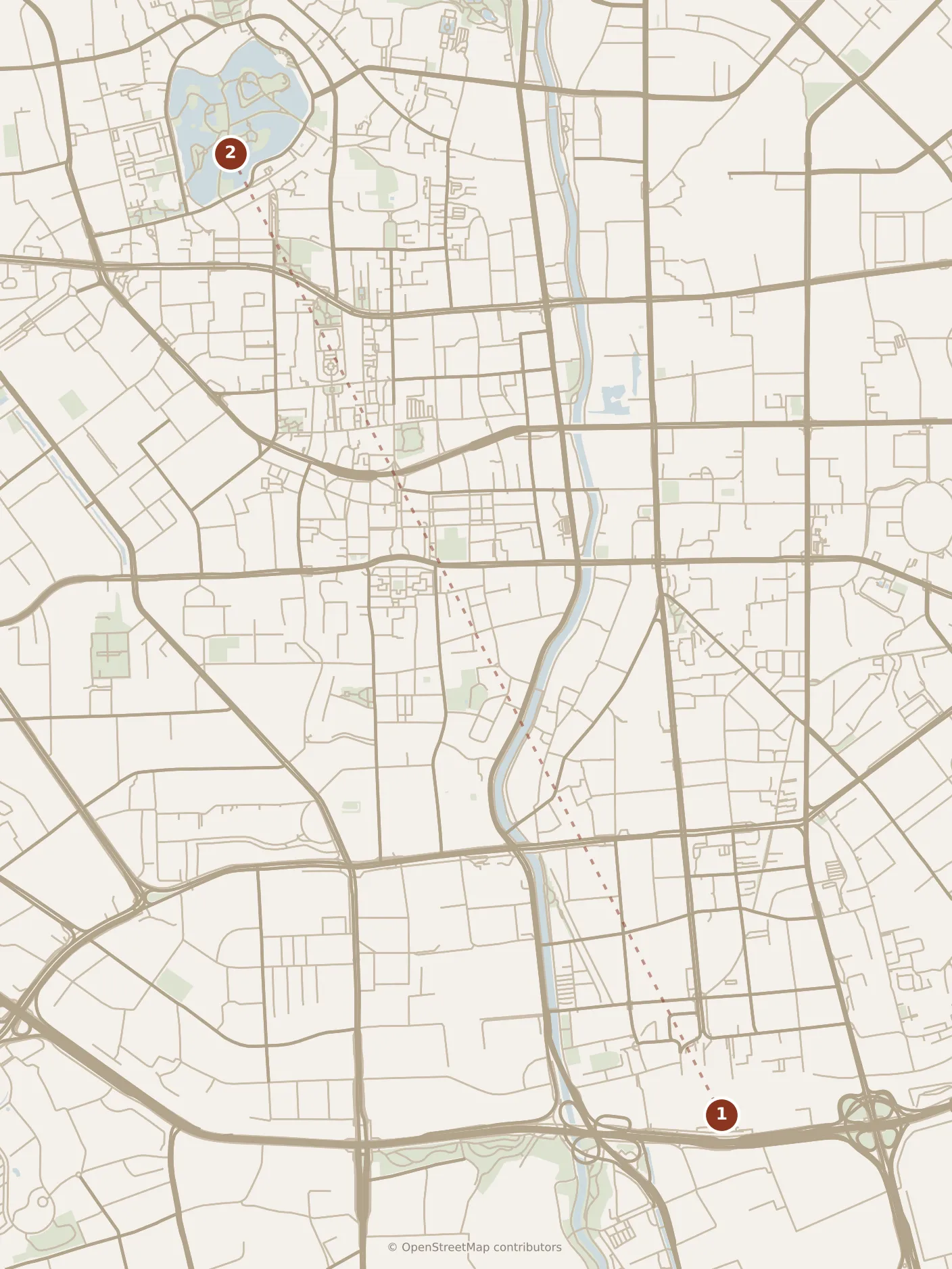
The ride on to stop 2, by metro, not on foot.
- Morning
- 1Kunming railway station
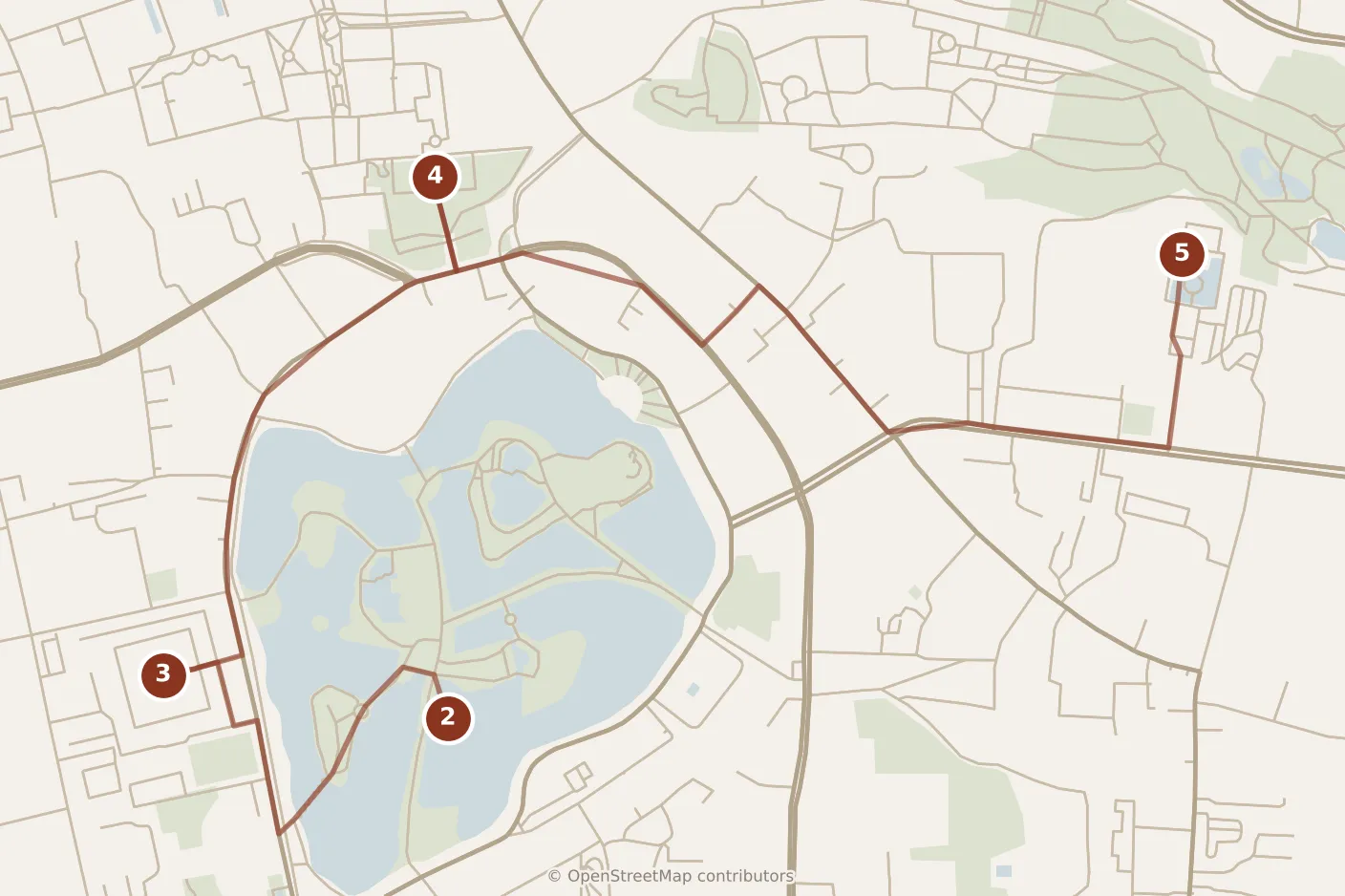
- Morning
- 2Green Lake
- 3Yunnan Military Academy
- 4Huize Hall
- 5Yuantong Temple
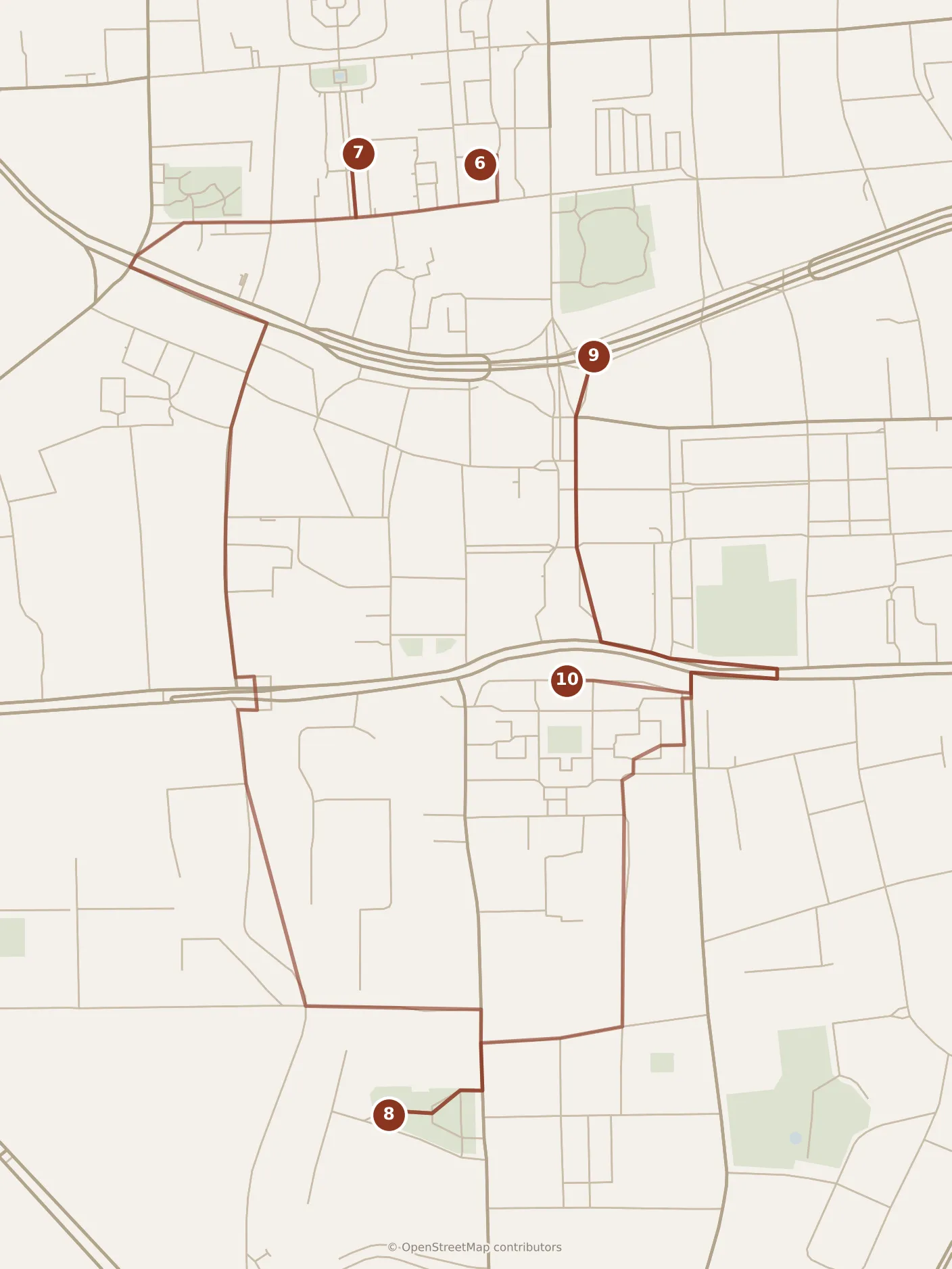
- Afternoon and evening
- 6Majia Compound
- 7Nie Er's Former Residence
- 8Eastern and Western Pagodas
- 9Nanping Pedestrian Street
- 10Jinma and Biji Archways
Morning
Which station you arrive at decides the first half hour of this day. From the city-center one, take Line 1 north four stops to Milesi and change there to Line 5, north two more, to Huashan West Road; the exit leaves you a few minutes from the lake’s south-eastern corner, and the leg is half an hour once the walking at each end is counted. From Kunming South, leave the bag there and ride Line 1 in — the better part of an hour — then pick this paragraph up at the city-center station. That means being on a train an hour before the day is meant to start at the lake, or making the first of the two cuts named at the end of this article. A taxi covers either leg in one go and is the right call if you have started late.
Green Lake is not somewhere you look at, it is somewhere you walk across. Two causeways cut it into quarters — the Ruan Causeway of 1834 and the Tang Causeway of 1917 — and the fifteen hectares between them are willows, water, small bridges and islands you cross without noticing. Give it three quarters of an hour and give it early, before the middle of the morning, because the thing to see here is not the water but the people who use it every day: groups dancing, groups singing, instruments played loudly and not always well under the trees. In the cold months it belongs to the gulls as well. Black-headed gulls have come down from the north to winter on this lake every year since 1985, they arrive in thousands, and half the park is people feeding them. Not with bread: selling bread as gull food has been prohibited here since a city regulation took effect on 1 November 2023, and what is sold instead, at feeding points set aside for it, is proper gull feed, thrown from the bank rather than into the water. That is a seasonal sight rather than a permanent one — deep winter is when the birds are thickest, and by early summer there is not one on the water.
Six minutes round the western shore is the Yunnan Military Academy, founded in 1909 in the last years of the Qing to build a modern army on the southern frontier. The quadrangle that survives went up in 1917: two stories, about a hundred and twenty meters to a side, a continuous galleried walkway running the entire way round, a bare parade ground in the middle, and the whole of it painted a strong ochre yellow that you can see from the lake path. Zhu De trained here and came back to teach; Ye Jianying was a cadet. The building now holds the academy’s own history museum. Give the whole thing an hour, and spend part of it standing in the parade ground rather than in the rooms — the yard is where the place makes sense.
Twelve minutes north, round the top of the lake, Cuihu North Road runs under the wall of Yunnan University and a stone staircase climbs from it to Huize Hall: a broad block in the Western manner finished in 1924, with four ten-meter columns across the front, built on the ground where the province’s imperial examination halls had stood, and now the building drawn on the university’s own emblem. A quarter of an hour, with one condition attached. This is a working campus behind a gate, and the university publishes two ways through it: a booking made in advance through its own account, or an identity document shown at the entrance outside the busiest hours. Entry is on foot only. What the announcement does not say is whether a foreign passport counts as that document — it names a Chinese identity card and stops there — so treat the gate as a maybe. If you get in, the stair and the front are what you came for. If you do not, you have spent a quarter of an hour and the rest of the morning is untouched.
Then sixteen minutes east to Yuantong Temple, and take that walk round the north shore rather than back along the way you came. This is the oldest Buddhist temple in the city and its principal one, founded under the Nanzhao kings in the late eighth or early ninth century and given its present shape by rebuildings in the fifteenth century and again in 1686. What makes it unlike other temples is the ground it sits in: it is high at the entrance and low at the back, so you come in at the top and go down into it, and the main hall stands at the bottom in the middle of a pond, reached across bridges, with covered walkways round the water and the hill rising behind. There are two great carved dragons in the main hall, and a newer hall at the back paid for from Thailand. It is a working temple rather than a monument — the seat of both the provincial and the municipal Buddhist associations — so you are walking through other people’s morning. Three quarters of an hour.
Local tip. If you have arrived too late to do both of the morning’s gated stops before lunch, drop the academy museum and keep the temple. The temple cannot be seen from outside at all — it is below the street and closed in on every side — while the best of the academy is the yellow quadrangle, and that reads perfectly well from the lake path without going in.
Afternoon
Lunch goes before the walk south rather than after it, because the walk south is the longest single stretch of this day: half an hour on foot from the temple, down Qingnian Road and then Zhengyi Road, the city’s old north–south spine and pedestrian along part of its length. What to eat is crossing-the-bridge noodles, which the province traces not to Kunming but to Mengzi, two hundred kilometers to the south-east, and which Kunming eats everywhere anyway — a bowl of broth under a film of oil hot enough to cook what you put in it, brought with the rice noodles and the raw slices on separate plates, tipped in yourself and in order. It is sold along here at every price. Steam-pot chicken is the other thing worth sitting down for. The wild mushrooms this province is known for are a third, but only from June to August: that is the season, and outside it what reaches the table is imported or preserved. They also come with a cooking rule and, in many kitchens, a timer on the table — that is the city guide’s subject, and it is not optional reading before you order them. Give lunch an hour; it is the only time today you are off your feet.
What the walk is aimed at is the one piece of old Kunming that was kept rather than cleared: three or four pedestrian lanes — Wenming Street, Qianwang Street, Yongdao Street — of two-story shophouses with timber fronts, now full of tea sellers, small shops and open courtyards. The set piece is the Ma family courtyard on Qianwang Street, built in 1923 for the man who was the city’s first mayor: a house in the Bai manner, four ranges round five light-wells, with a galleried upper floor running the whole way round — the same plan as the academy quadrangle at a twentieth of the size and in a family’s hands, which is a better argument for seeing both than either makes alone. Two minutes further, on Yongdao Street, Nie Er’s former residence is a plain two-story shophouse, trade below and rooms above; his parents ran a herbal medicine business from the ground floor, he was born upstairs in February 1912, he wrote the tune that became the national anthem, and he was dead at twenty-three. Three quarters of an hour for the block, doors included, and the lanes themselves do not shut.
Twenty minutes south, in the streets below Jinbi Road, the Eastern and Western Pagodas stand about two hundred meters apart. Both were raised under the Nanzhao kings in the ninth century, which makes them contemporaries of the temple you were standing in before lunch and the two oldest foundations you will see today; both are thirteen tiers of close-set eaves in brick, the taller a little over forty meters; and both have fallen down and been put back up, the western one after an earthquake in 1499 and the eastern one after another in 1833. At the four corners of each spire stands a bronze cockerel. Twenty minutes is enough: they are in the street, you look up at them from below, and then you already have the name of the square you are walking to.
Evening
The archways this day ends at are named for a golden horse and a jade cockerel, and the birds on the spires you have just left are the same bird. The last three stops sit within four hundred meters of one another, so the order among them is a choice rather than a route, and this is the one worth making: dinner first, the archways last.
So walk seventeen minutes north to Nanping Street — pedestrian, wide, lit and busy, and the city’s old commercial and entertainment center — and turn off it into Nanqiang Street, which is the eating lane rather than the shopping one and runs a night market of its own. An hour and a quarter, and that is a recommendation about how long a street is worth rather than about how long dinner takes. It is also this day’s one elastic stretch: if you have eaten and the archways are still in daylight, the extra time goes here rather than at the gates.
Then seven minutes back south to the archways themselves. Jinma and Biji are two timber gates, twelve meters high and eighteen across, standing tens of meters apart at the Jinbi Road crossing, and what stands there now went up in 1999. They were first raised in the Ming, knocked down and rebuilt in 1687, knocked down and rebuilt again in 1884, and taken down for the last time in the 1960s. That history is why they are worth the final quarter of an hour of the day rather than a passing glance in the afternoon: a city that has put the same two gates back four times is telling you something about itself, and the floodlights come on at around seven, which is the hour to be standing there.
And Jinbi Square station is at that crossing. Line 1 runs from it to Kunming railway station in three stops, through Deshengqiao and South Ring Road, and the bag is at the end of them. That is the whole of the end of the day, and it is why the archways go last rather than first — they are the only stop on this route standing directly on top of the station you leave from.
Practicalities
Nothing here has to be booked before you travel, and the only gate fee on the route is the temple’s — six to eight yuan, paid at the door. What can still catch you is the academy museum, the one stop with an institution behind it: free public museums in this country are commonly entered on a booking made a day or more ahead rather than at the door, the museum publishes its own arrangements, and whether a foreign passport can complete that booking is not something this page can tell you. That is the one thing to check before you set out, and the Monday note below is the other half of it. If it is shut or fully booked, the yellow quadrangle from the lake path is most of what you came for, and the morning loses an hour rather than its shape. The university gate above is the second maybe, and it risks nothing beyond the quarter of an hour it costs.
The route needs the metro twice, at the beginning and at the end. How a metro ride is paid for in this country is not a thing to solve standing on a platform with a train leaving: it is the city guide’s subject, and on a first visit it is not optional reading.
The second thing to take from that page is the weather, because this day is outdoors on foot from nine in the morning until after dark, at 1,890 meters. That is the altitude’s real trick rather than the stairs: the sun burns through mild air on the way south and the warmth leaves the moment it goes down over the square, so the sun protection and the jacket travel together in the same bag on the same day, in every month of the year. From May to October add the afternoon. Nearly all the year’s rain falls in those months and most of it arrives as short heavy storms in the afternoon and early evening, which is precisely the stretch this route spends in the open between the lanes and the archways.
Written down, the transfers are short. Out: Line 1 north from Kunming railway station, four stops to Milesi, then Line 5 north two stops to Huashan West Road. Back: Line 1 from Jinbi Square, three stops to Kunming railway station. Everything in between is on foot — seven and a half kilometers of it, of which the half hour from Yuantong Temple down to the lanes is by some way the longest single stretch.
This day survives a Monday better than most, which is worth knowing if your one day lands on one. A lake, a temple, three pedestrian lanes, two pagodas and a lit square do not close; the museum inside the academy is the only thing on the route that does, and it is shut every Monday that is not a public holiday — certain rather than likely, because the museum publishes it. The building housing it does not stop being the thing you came to look at, and the yellow quadrangle reads from the lake path in any case.
Then the bag, and the way it most often goes wrong here: there are two Kunming stations and they are not near each other. The one this day starts and ends at is the city-center one, on Line 1 and Line 2, and the whole route above is built round it. High-speed trains use Kunming South Railway Station instead, twenty-one kilometers out at Chenggong, reached by Line 1 and Line 4, and that is the better part of an hour away once the walking at each end is counted. Leave the bag at the station your train actually leaves from. If that is Kunming South, take the hour out of the middle of the day rather than off its end: skipping the pagodas alone gives back close to fifty minutes, because it removes two walks as well as a stop, and dropping the university on top of that returns twenty minutes more. Neither cut changes the shape of the day, which is the reason they are the two to make.


.jpg)