Kraków in 2–3 days: the Old Town, Kazimierz, and what a third day is for

Last updated 26 July 2026
Overview
Kraków is a two-day city and a three-day trip, and the gap between those two things is what this article is about. Everything on days one and two sits inside a strip about two kilometers long, from the barbican at the top of the Old Town to the far side of Kazimierz, and you can walk the length of it in half an hour. So the planning question is never what you can reach. It is how much of the twentieth century you want in the trip.
Days one and two are the city that survived: Kraków was not flattened in the war the way most Polish cities were, so the center is the real thing rather than a careful copy of one. Day one stays inside the Planty ring and spends its afternoon under the main square. Day two climbs Wawel hill and comes down the other side into Kazimierz, which is the direction the royal road ran and the direction the Jewish quarter grew in. A third day crosses the river to Podgórze, where the ghetto was, and that is where the trip stops being a pleasure. For some travelers it is the reason they came at all.
Two things fix the shape before you read the days. The working synagogues and the old cemetery in Kazimierz close for Shabbat, which makes Saturday the one afternoon that does not work as written — if your trip contains a Saturday, put day one on it and day two on the Sunday, when Kazimierz is open again. What day one will not take is a Sunday of its own: St Mary’s admits no visitors until two in the afternoon on Sundays and holidays, and the altarpiece opens with them. And the closing days are not uniform — the Wawel interiors and the Czartoryski shut every Monday, while Rynek Underground and Schindler’s Factory shut on a particular Monday or a particular Tuesday of the month rather than on a weekly day off, so check the two or three you have set your heart on instead of assuming.
Everything below is on foot.
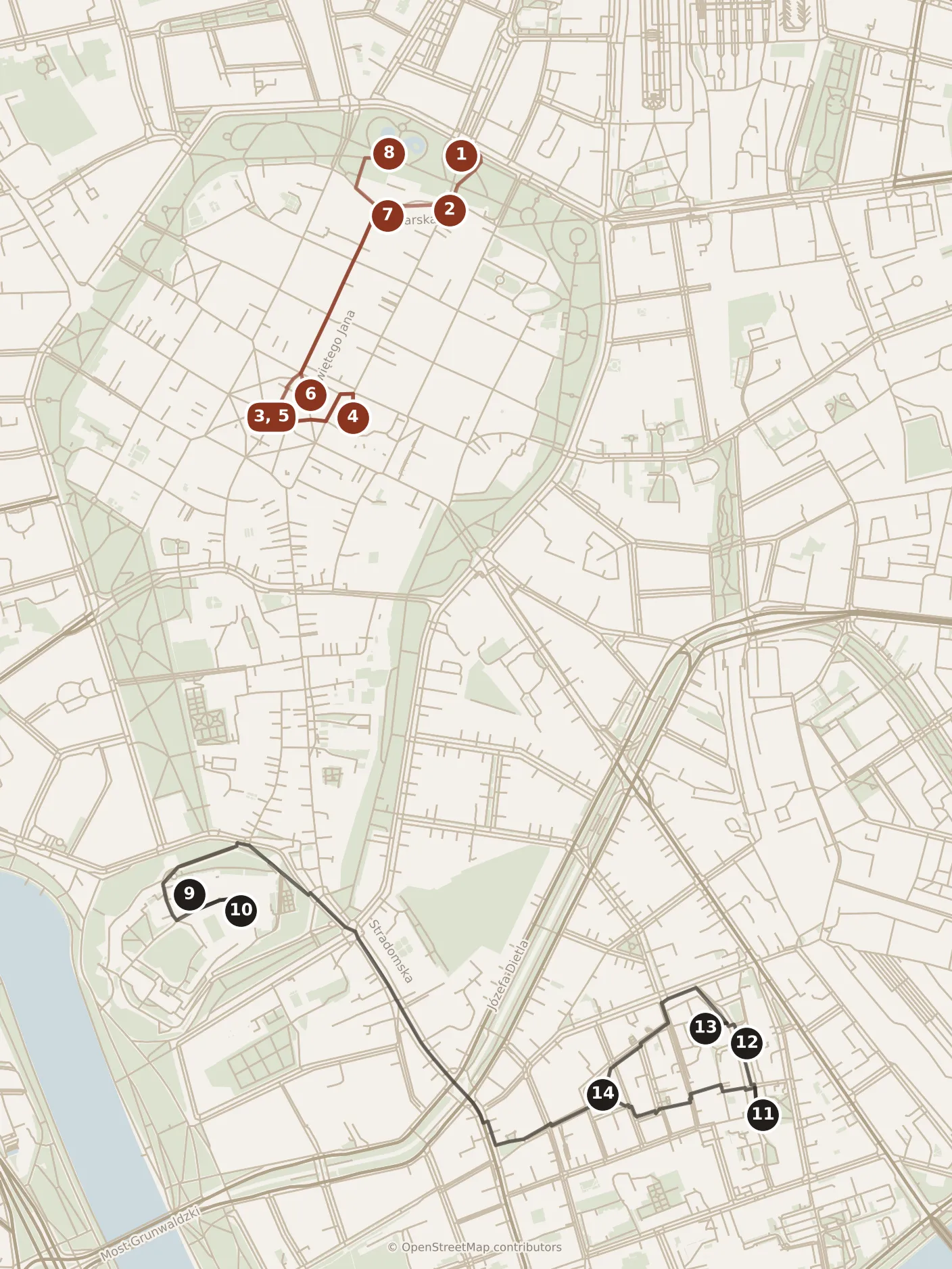
- Day one
- 1Kraków Barbican
- 2St Florian's Gate
- 3Rynek Główny
- 4St Mary's Basilica
- 5Sukiennice
- 6Rynek Underground
- 7Czartoryski Museum
- 8Planty
- Day two
- 9Wawel Cathedral
- 10Wawel Castle
- 11Old Synagogue
- 12Szeroka Street
- 13Remuh Synagogue
- 14Plac Nowy
Day one

Today runs the length of the old royal approach, from the gate the kings came in by to the square they came in to, and never leaves the ring of park that replaced the walls.
Morning
Start outside the ring, at the Kraków Barbican: a brick drum with seven turrets and walls three meters thick, built around 1498 to guard the city’s main gate, its inner courtyard twenty-four meters across. Three of these survive in Europe and this is the best kept of them. Going inside is a ticketed museum visit and a seasonal one: the Barbican opens for the warm half of the year, roughly April to October, and is shut through the winter, when you walk round the outside of it instead. Twenty minutes either way. Behind it stands St Florian’s Gate, the last of the medieval town gates left; the walls that ran from it came down in the nineteenth century and the Planty took their place.
Go through the gate and down Floriańska Street into Rynek Główny. It covers close to four hectares, it was laid out on this plan in 1257, and the scale of it takes a minute to absorb. Buy an obwarzanek from one of the blue carts and eat it walking the perimeter.
St Mary’s Basilica stands on a corner of the square, and what you go in for is the Veit Stoss altarpiece: thirteen meters of carved and painted limewood, finished in 1489, the largest Gothic altarpiece anywhere. The ticketed half of the church opens to visitors at half past eleven, and the wings of the altarpiece are folded shut until ten to twelve, when they are opened ceremonially and left open until the church closes to visitors at six. On Sundays and holidays the whole thing slides: no visitors before two, wings at ten past. Be inside for the opening if you can, because closed it is a painted cupboard and open it is the Virgin collapsing among the apostles at close to life size. There are two ways in and they buy different things: the door on the square is free, meant for people who have come to pray, and it holds you at the back of the nave a long way off; the ticket, sold from a separate office on the small square behind the church, puts you in the body of the church. Nobody is admitted as a visitor while a service is being said.
On the hour, day and night, a trumpeter plays the hejnał from the taller of the church’s two towers, four times over, once in each direction, and breaks off mid-phrase.
Local tip. The hejnał plays every hour of every day, so you will hear it whether you plan for it or not. The altarpiece opens once. Build the morning around the altarpiece and let the trumpet find you.
Afternoon
The Sukiennice runs down the middle of the square: a fourteenth-century cloth market, rebuilt after a fire in 1555 and arcaded in the nineteenth century, with souvenir stalls on the ground floor and the national collection of nineteenth-century Polish painting upstairs. The stalls take ten minutes. Give the gallery an hour and it is the better use of it — unless you do the thing underneath instead, which you should.
Rynek Underground is the excavated market four meters below the paving: the foundations of the medieval trading stalls left where they stand, walked over on glass floors, with the coins, jewelry and small objects that came up with them. Ninety minutes to two hours if you read the labels. It is timed, capped and it sells out, so book it before you arrive.
Then five minutes back towards the gate, the Czartoryski Museum, reopened in 2019 after nearly a decade shut. Most people come for one small panel — Leonardo’s Lady with an Ermine, painted in Milan around 1490 — and the rest is a princely cabinet of arms, antiquities and a Rembrandt landscape. Ninety minutes done properly; forty if you have come for the one picture, which is an honest way to do it. It closes at six and stops letting people in an hour before that, which is the one real constraint on this afternoon: book the Underground early enough to leave an hour here, or take the pictures first. It is shut every Monday.
Evening
Stay inside the ring and get off the square: prices and patience both improve one street back from it. The Planty is a complete circuit of about four kilometers, lit, and it will carry you back to wherever you are sleeping without making you walk the day again.
Day two

Today takes the second half of the royal road, off the hill and out of the medieval town altogether.
Morning
Wawel is free to walk into. The hill, the gates and the arcaded courtyard cost nothing, and on a short trip that is a legitimate morning by itself. What is ticketed is the interiors, sold one route at a time, by the hour, with a fixed number of people in each slot. The one this morning wants is the castle’s second floor — the State Rooms, where the tapestries and the carved heads are. The first floor, the royal private apartments, is a separate ticket, and there is a combined one for both if you have the morning for it. Booking opens about a month ahead and the second floor goes first in summer, so do it before you arrive. The interiors close every Monday; the hill and the courtyard do not.
Two ticket offices, and this is what catches people out: the castle does not sell tickets to the cathedral. Wawel Cathedral has its own office opposite its door, and the one ticket there covers the royal crypts, the bell tower and the cathedral museum.
Take the cathedral first. Polish kings were crowned and buried here for four centuries and the crypts hold most of them. The Sigismund Bell, hung in 1520, weighs close to thirteen tonnes and is still swung by hand on the days that matter — twelve ringers on the ropes, six a side.
Then Wawel Castle, an hour and a half. The State Rooms are the sixteenth-century court at its most confident: Flemish tapestries woven for the king by the hundred, of which about a hundred and forty survive, and the deputies’ chamber whose coffered ceiling once carried a hundred and ninety-four carved wooden heads looking down on the men debating below. Thirty are left, and they are worth standing under for a while.
Afternoon
Walk off the hill and keep going, fifteen minutes, into Kazimierz. It was a separate town until 1800, chartered in 1335, and from the end of the fifteenth century it was where Kraków’s Jews lived — which is why the two places still feel different underfoot.
Szeroka Street is the heart of it and is not really a street: it is a long widening, the old market place, with something to go into at either end. The Old Synagogue is the oldest synagogue building still standing in Poland, fifteenth century, fortress-thick, gutted in the war and now the city museum’s account of Jewish Kazimierz. The Remuh Synagogue at the other end is small and still in use, and behind it lies the sixteenth-century cemetery, where gravestones broken up during the occupation were recovered and set into a wall.
Two hours covers the pair and the walk between them. Leave time to do nothing in particular afterwards, because the district is best taken at the pace of somebody with no appointment.
Evening
Plac Nowy, five minutes on. The round brick building in the middle went up in 1900 and was the kosher poultry slaughterhouse until the occupation; its hatches now sell zapiekanka until around two in the morning, which is why there is still a line at one.
With a third day

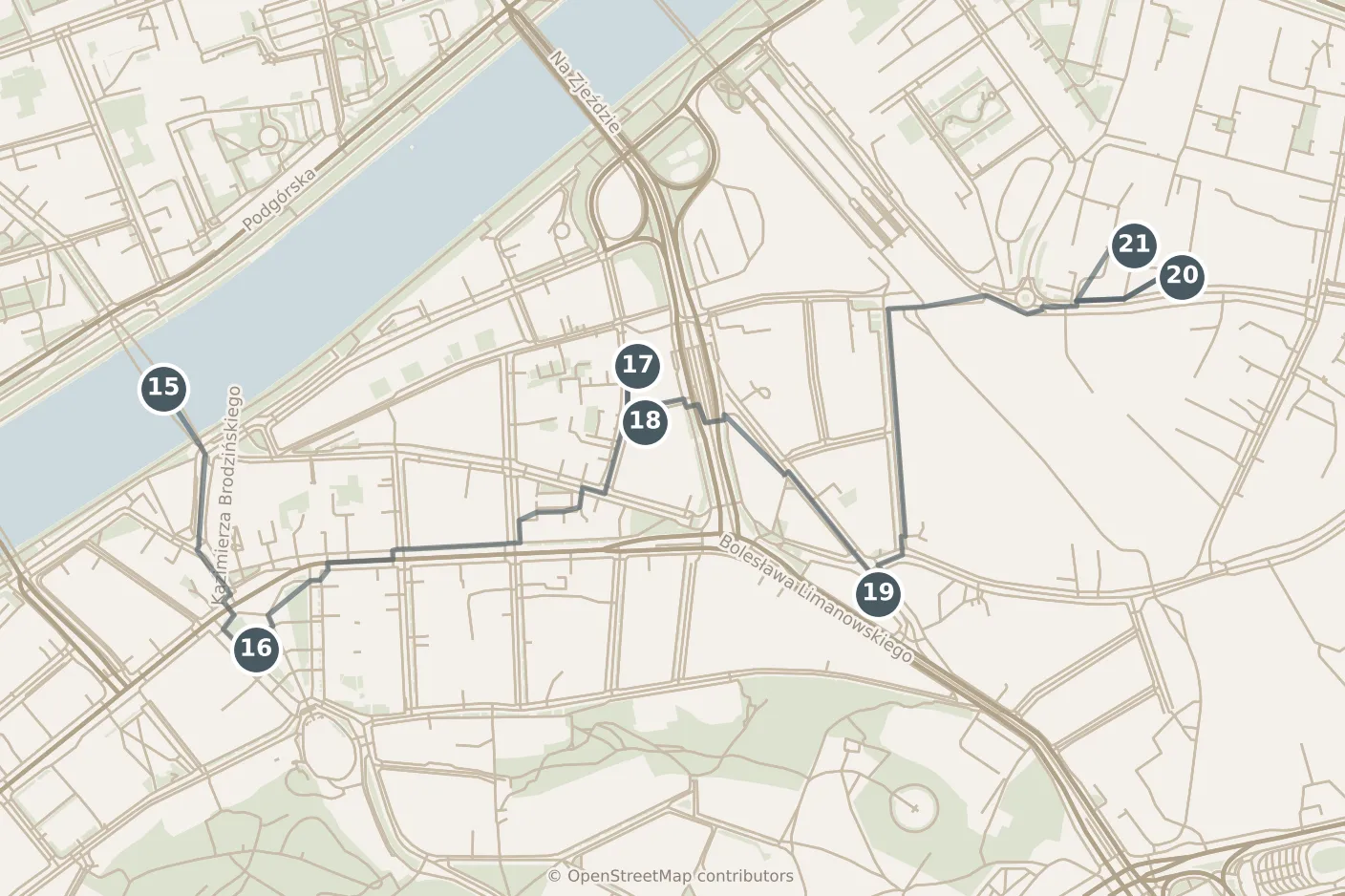
- With a third day
- 15Father Bernatek bridge
- 16Podgórze
- 17Plac Bohaterów Getta
- 18Eagle Pharmacy
- 19Ghetto wall on Lwowska Street
- 20Schindler's Factory
- 21MOCAK
Give the third day to Podgórze, across the river, and give it the morning.
Cross by the Father Bernatek bridge from Kazimierz: a hundred and thirty meters of footbridge, opened in 2010, walkers and cyclists only, with ten acrobats by Jerzy Kędziora balanced on wires above the deck. Five minutes, and the last light thing in the day.
Podgórze was its own town too, on the far bank and Austrian rather than Polish, and in March 1941 the Germans emptied Kazimierz and walled Kraków’s Jews into about twenty of its streets.
Plac Bohaterów Getta is the square they were assembled on for the deportations. Since 2005 it has been filled with rows of oversized iron chairs, taken from a line in the ghetto pharmacist’s memoir about the furniture left standing there after the ghetto was cleared. Nothing to wait in line for and nothing to read: ten minutes or an hour, as you find it.
The Eagle Pharmacy is on the same square — the only pharmacy inside the ghetto, kept open throughout by a pharmacist who was not Jewish and did not have to stay, and now a small museum put back the way it was. Half an hour, and it is the one at human scale.
Four hundred meters on, a length of the ghetto wall still stands on Lwowska Street. The Germans finished its top in arcs shaped like matzevot, Jewish gravestones, and that detail and the plaque beneath it are the whole reason to walk down.
Then Schindler’s Factory, ten minutes further, and know what it is before you book. The permanent exhibition is a history of Kraków under Nazi occupation between 1939 and 1945, told room by room through reconstructed streets, a tram, a barber’s shop. Schindler’s own office survives and his story arrives late and briefly. People who come for the film are thrown by this and people who come for the city are not. Two hours. It is the one thing on all three days that reliably sells out, so book it before you leave home. MOCAK, the contemporary art museum, occupies the rest of the factory site next door and is a reasonable place to put your head back together afterwards.
Local tip. Take the day in this order rather than the reverse. The factory is the long one and the heavy one, and walking out of two hours of it to look at a pharmacy and a row of chairs asks more of a day than it can carry. And if the day runs short, the pharmacy is the half-hour one, so it is the one that still fits.
If you would rather leave the city, a third day is the day to do it, and the two options are not interchangeable. Wieliczka is twenty minutes out, and the standard route through the salt mine is guided only: three and a half kilometers of chambers and carved chapels, some eight hundred steps and nearly all of them down, two to three hours underground at a steady seventeen degrees. The Auschwitz-Birkenau Memorial at Oświęcim, about seventy kilometers west, is the other, and it takes the whole day. It does not combine with anything, and it should not. Entry is free but it is not a place you can turn up to: passes are issued only through the Memorial’s own booking system and none at all are sold at the gate. The booking window opens ninety days before the date, and in season the guided visits in English go within weeks of it opening. The standard guided visit runs about three and a half hours across the two sites, and you are asked to be there half an hour before it begins. There are also free passes to walk the site without an educator, but only for the later part of the afternoon, and they have to be reserved in the same way.
Practicalities
Three things want booking, in this order. Schindler’s Factory, which is timed, limited and gone days ahead in summer. The Wawel interiors you actually want, each its own timed ticket — and remember that the castle office does not sell the cathedral’s. And Rynek Underground, timed and capped. St Mary’s, the synagogues, the Eagle Pharmacy and everything outdoors are walk-up.
If the third day goes to the Auschwitz-Birkenau Memorial, book that one first. Its window opens ninety days before the date and that is when to use it, because the English guided slots are the ones that go.
Closing days will break these days as written. Rynek Underground closes on the second Monday of the month and Schindler’s Factory on the first Tuesday, which are exactly the dates nobody thinks to check. The synagogues and the cemetery in Kazimierz close for Shabbat, so a Saturday afternoon there gives you the streets, the square and none of the interiors.
Days one and two are walking from end to end, and the longest single leg is the fifteen minutes off Wawel hill down into Kazimierz. The third day starts on a footbridge and stays on foot after that; if you do Kazimierz and Podgórze on separate days you cross the river twice, which costs five minutes each way and is no reason to reorganise anything.


.jpg)