Kraków in one day: the market square, Wawel hill and Kazimierz, walked in one line

Last updated 3 August 2026
Overview
Kraków in one day is a straight line, and that is the whole reason it works. The Old Town, Wawel hill and Kazimierz sit in a strip about two kilometers long down the west bank of the Vistula, and the route below walks it once, north to south, and never goes back on itself. There is no metro to learn and nothing to time a connection for.
What one day costs you is the interiors. The Kraków sights that people book — the excavated market four meters under the main square, the state rooms inside the castle, the factory museum over the river in Podgórze — are timed, capped and gone days ahead in summer, and between them they would take five hours and most of the walking. Give them up without arguing about it. A single day buys you the shape of the city and one great object inside it, and the shape is the thing a first visit actually lacks.
You are carrying a bag, and here the shape is the easy one. Kraków Główny, the main station, is where this day starts and where it ends, it has left luggage, and the route is a loop that brings you back to within a few minutes of it at night. Put the bag in before you walk south. Nothing below asks you to make a special trip for it, and nothing below is improved by having it: Wawel is a hill, and the last hour of the day is spent standing up eating.
Two things decide the hours. The middle of this day is a hill and a river bank and it wants daylight; the end of it is a district that is better after dark, except for the two interiors on Szeroka Street, which keep afternoon hours rather than evening ones. The sun sets in Kraków anywhere from about twenty to four in the middle of December to just before nine at the end of June, so take your own month’s hour and count back from it. The other hour is the one the day is counted from: in 2026 the basilica admitted no visitor before half past eleven, and not until the afternoon on Sundays and holidays. Build the morning back from the opening rather than from a start time, and if the hour has moved, build it back from the new one. From the station, the square, the basilica, an hour for lunch and the hill come to roughly five hours, and that is when you come down onto the water — which puts you at Szeroka Street around half past three, with the synagogue and the cemetery about to close. In June it leaves you the whole evening for the street and the food. In December the sun has gone by the time you are on the water, and what the dark costs you there is those two interiors, because Kazimierz once those two doors have shut is a district of lit windows rather than of views. That five-hour figure counts the time you spend inside places and nothing else. It does not count the ticket line on the small square beside the basilica, which is the one real line on this route, and it does not count a lunch that turns into two hours, which in this city it easily can.
The day

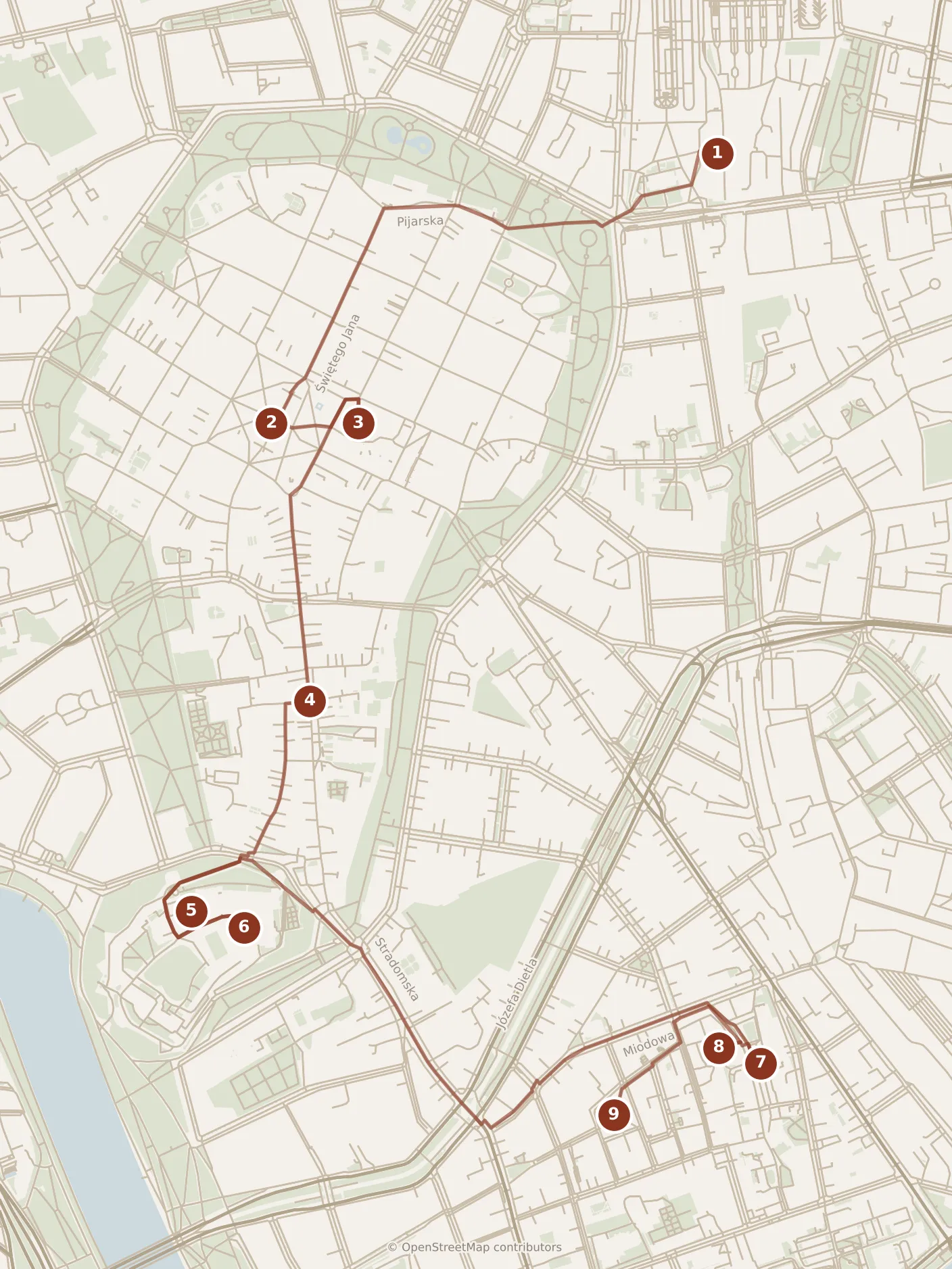
- The day
- 1Kraków Główny
- 2Rynek Główny
- 3St Mary's Basilica
- 4Grodzka Street
- 5Wawel Cathedral
- 6Wawel Castle
- 7Szeroka Street
- 8Remuh Synagogue
- 9Plac Nowy
Morning
Kraków Główny sits just off the top corner of the Old Town, and the way in is fifteen minutes on foot, south through the Planty — the ring of park laid out where the medieval walls stood, a complete circuit of about four kilometers round the center. Walk it rather than looking for a tram: nothing on rails goes into the old town, the trams run round the outside of the Planty, and this is the only part of the day that shows you the ring.
Come out of the trees into Rynek Główny. It was laid out on this plan in 1257 and covers close to four hectares, which makes it impossible to photograph and easy to underestimate until you try to cross it. Give it forty-five minutes and do the least ambitious thing on offer: walk the perimeter, go under the arcades of the Sukiennice — the fourteenth-century cloth hall down the middle of the square, rebuilt after a fire in 1555 and arcaded in the nineteenth century — and buy an obwarzanek from one of the blue carts. The souvenir stalls inside it take ten minutes. The gallery of nineteenth-century Polish painting upstairs in the same building is good, and it is not for today.
St Mary’s Basilica stands on the corner of the square, and you go inside for one object: the Veit Stoss altarpiece, thirteen meters of carved and painted limewood finished in 1489, the largest Gothic altarpiece anywhere. Its wings are folded shut and are opened ceremonially once a day, shortly after visiting begins; shut it is a painted cupboard and open it is a crowd of figures at close to life size. Two things to know before you walk up. The door on the main square is for people who have come to pray, and it holds you at the back of the nave a long way from anything; the visitors’ way in and the ticket point are round on Plac Mariacki, the small square along the church’s flank. And the church admits no visitors at all until late in the morning, and on Sundays and holidays not until the afternoon — the single fact that decides when this day can start, so check that one hour before you fix anything else around it. Give the inside an hour, which is more than most people give it.
On the hour, day and night, a trumpeter plays the hejnał from the taller of the two towers, four times over, once towards each quarter of the compass, and breaks off mid-phrase. You will hear it whether you arrange to or not.
Afternoon
Eat before you walk south, and eat sitting down. The one-day instinct is to buy something to carry, and in Kraków that is the wrong economy — a plate of pierogi at a table is an hour spent on the city rather than an hour taken off it, and the streets one block back from the square are cheaper and more patient than the square itself.
From the corner of the square, Grodzka Street runs south towards the castle: the second half of the old royal approach, and about fifteen minutes’ walk to the foot of Wawel with churches on both sides that you can put your head into for nothing as you pass.
Wawel is free, and most people arriving for one day do not know it. The hill, the gates, the outer terraces and the great arcaded courtyard of Wawel Castle cost nothing at all. What is ticketed is the interiors, sold one route at a time, by the hour, with a fixed number of people in each slot and the good ones gone weeks ahead in summer. Give the free half an hour and a half, and let that hour and a half include the climb up from Grodzka and the walk back down, because the hill is bigger than it looks from below. Inside it: the courtyard, three tiers of slender Renaissance arcades running the length of two wings; the outside of Wawel Cathedral, a pile of chapels and domes added over centuries in different stone, where Polish kings were crowned and buried for four hundred years; and the terrace on the river side, which gives you the reason a castle went here rather than anywhere else.
The cathedral has a ticket of its own, sold at its own office and not by the castle, and it covers the royal crypts, the bell tower and the cathedral museum. On one day it is the honest thing to leave.
Local tip. The castle interiors are timed, capped and have to be booked; the cathedral ticket is not — it is bought at its own office and used — but the cathedral stops admitting visitors well before the hill itself empties, which an afternoon up here runs straight into. What is free can be walked into at any hour. With one day, take the free half and do not feel short-changed: the courtyard and the river terrace are the picture of Kraków, and the ticketed rooms are the reason to come back for a second day rather than a reason to spoil the first.
Come off the hill through the Bernardyńska gate and round to the water: nothing comes down off the walls onto the embankment that is not ticketed and seasonal. Turn east and follow the water: a little under twenty minutes, flat, with the castle behind you on its rock, and then up off the path into Kazimierz.
Evening
Kazimierz was a separate town until 1800, chartered in 1335, and from the end of the fifteenth century it was where Kraków’s Jewish population lived — which is why the two places still feel different underfoot even now that they run into each other.
Szeroka Street is the heart of it and is not really a street: it is a long widening, the old market place. The Remuh Synagogue is the small one still in use, and behind it lies the sixteenth-century cemetery, where gravestones broken up during the occupation were recovered after the war and set into a wall. Both keep afternoon hours rather than evening ones — so they are the first thing you do in Kazimierz and not the last, and this day’s clock gives them about half an hour rather than the hour they deserve. The street itself keeps no hours: stand in the middle of Szeroka Street doing nothing afterwards, which is the correct use of it.
Then Plac Nowy, four minutes west. The round brick building in the middle went up in 1900 as a market hall, was leased to the Jewish community in 1927 and served as its kosher poultry slaughterhouse until the occupation; its hatches now sell zapiekanka late into the night. That is the right last thing to eat here after a day that started with a bread ring, and it is why this square is still busy at an hour when nothing else is.
From Plac Nowy, Kraków Główny is half an hour on foot straight up Starowiślna, or six or seven minutes east to the Miodowa tram stop and then four stops north on line 3 to Dworzec Główny Zachód, which sets you down beside the station and its left luggage. Be honest about what the tram buys: the walks at either end eat most of the ride, so it saves about ten minutes rather than half the journey. Take it for the cold and the dark, not for the time.
Practicalities
Nothing on this route has to be booked in advance, and that is the trade the day is built on rather than an accident of it. The three things in Kraków that reliably sell out — the excavated market under the main square, the Wawel interiors, the factory museum in Podgórze — are precisely the three this day gives up, and a single day spent waiting for one of them is a day in which you have not seen the city. The only ticket you have to buy is the one for the visitors’ half of St Mary’s, bought on the spot at Plac Mariacki, and it was in the fifteen-to-twenty-five-złoty range in 2026. The cemetery behind the Remuh Synagogue takes a small one too. Everything else on this page — the square, the Planty, Grodzka Street, the whole of Wawel hill outside its doors, Szeroka Street, Plac Nowy — is free.
Two days of the week change this route and they change opposite ends of it. On a Sunday the basilica admits no visitors in the morning at all. In the long half of the year that costs nothing: give the morning to the square and the Planty, go in when it opens, and there is still light in the rest of the day. In December it forces a choice, because an afternoon start puts the hill in the dark — so either give up the altarpiece, or take Wawel first and walk the fifteen minutes back up Grodzka Street to the church afterwards, which is the only backtrack this route ever asks for and the only occasion worth it. On a Saturday the Remuh Synagogue and the old cemetery are shut for Shabbat, while the buildings in Kazimierz that are museums rather than working synagogues keep their own hours, so the evening becomes streets, the square and the food — not a bad evening, but one to know about before you are standing at a locked gate. And if the basilica turns out to be shut when you get there, for whatever reason, the day still works: the square, Grodzka Street and Wawel are the spine of it, and the altarpiece is one object hanging off the side.
The whole day is on foot inside a strip about two kilometers long, which is not the same as two kilometers of walking: the station to the main square alone is a good kilometer. There are three long legs and they are all about a quarter of an hour: the station down through the Planty at the start, the basilica down Grodzka Street to the foot of Wawel, and the river bank into Kazimierz, which is the longest of the three if you follow the water rather than cutting the corner. Nothing else on the route is more than a few minutes from the last thing. Wawel is the only climb, and taken by the Bernardyńska gate it is a cobbled ramp rather than a stair.
Beyond your feet this route needs two things: the basilica ticket above, and one tram ticket at the end of the night if you take line 3 home rather than walking. Buy that from the machine at the stop or on board and validate it. How Kraków’s transport is priced, and how you get in from the airport in the first place, are in the city guide, and they have not changed for this day.


