Kolkata in one day: the flower market at first light, the colonial core, and the river at dusk

Last updated 3 August 2026
Overview
One day in Kolkata buys you the river, the colonial core and one great museum, and what it costs you is the north. Kumartuli, where the idol-makers build Durga out of river clay, and College Street, where the second-hand book stalls go on for street after street, are among the best hours in the city and they sit on the far side of forty minutes of traffic from everything below. So do Kalighat and the southern neighborhoods, and so does the Chinese cooking of Tangra. A single day that tries to hold them spends itself in cars.
What replaces them is a line. This route runs north to south, down the riverbank and then down the old spine of the city, and it never turns back on itself until the last hour, when it turns back on purpose, for dinner. Nothing on it is more than half an hour’s walk from the thing before it, and exactly one leg uses the metro. That matters more here than the choice of sights, because crossing this city by road is what eats days in it.
The day is shaped by the sun rather than by opening hours. The outdoor half goes at the two ends and the single indoor stop takes the middle, which is not a scheduling trick but the only sane way to spend a day on foot in a humid delta city. And start early: the country keeps one time zone and this city sits well east of the meridian that time zone is set to, so the light arrives and leaves noticeably earlier by the clock here than in Delhi or Mumbai. An afternoon that feels as though it has hours left in it has fewer than you think.
The day has no hinge at its end. There is no tide to catch and no market that shuts, so nothing here should be timed backwards from a closing hour — that would be a number this article was guessing at. All the pressure is at the front instead: the flower market is a dawn market and the walking is a dawn activity, so what matters is when you start, and the count runs forwards. The looking below comes to about seven hours and the moving between it to close to two, which makes nine hours of route. Started at first light those nine hours do not reach dusk, and the gap is the point rather than an error in the sum: it goes into the middle of the day, into a lunch that is not hurried and a museum entered when the sun is at its worst, which is what leaves the river to the end of the light.
Read that total for what it is. It adds up the time this article recommends giving each place and it models nothing else — not ticket desks, not bag checks, and above all not the Victoria Memorial, where the gardens and the rooms are sold as two separate tickets and there are therefore two of those desks between you and the stop. Hand one leg to a taxi that meets traffic and the number moves again. A nine-hour day here is a ten-hour day, and it stops at the river: dinner is extra.
The day

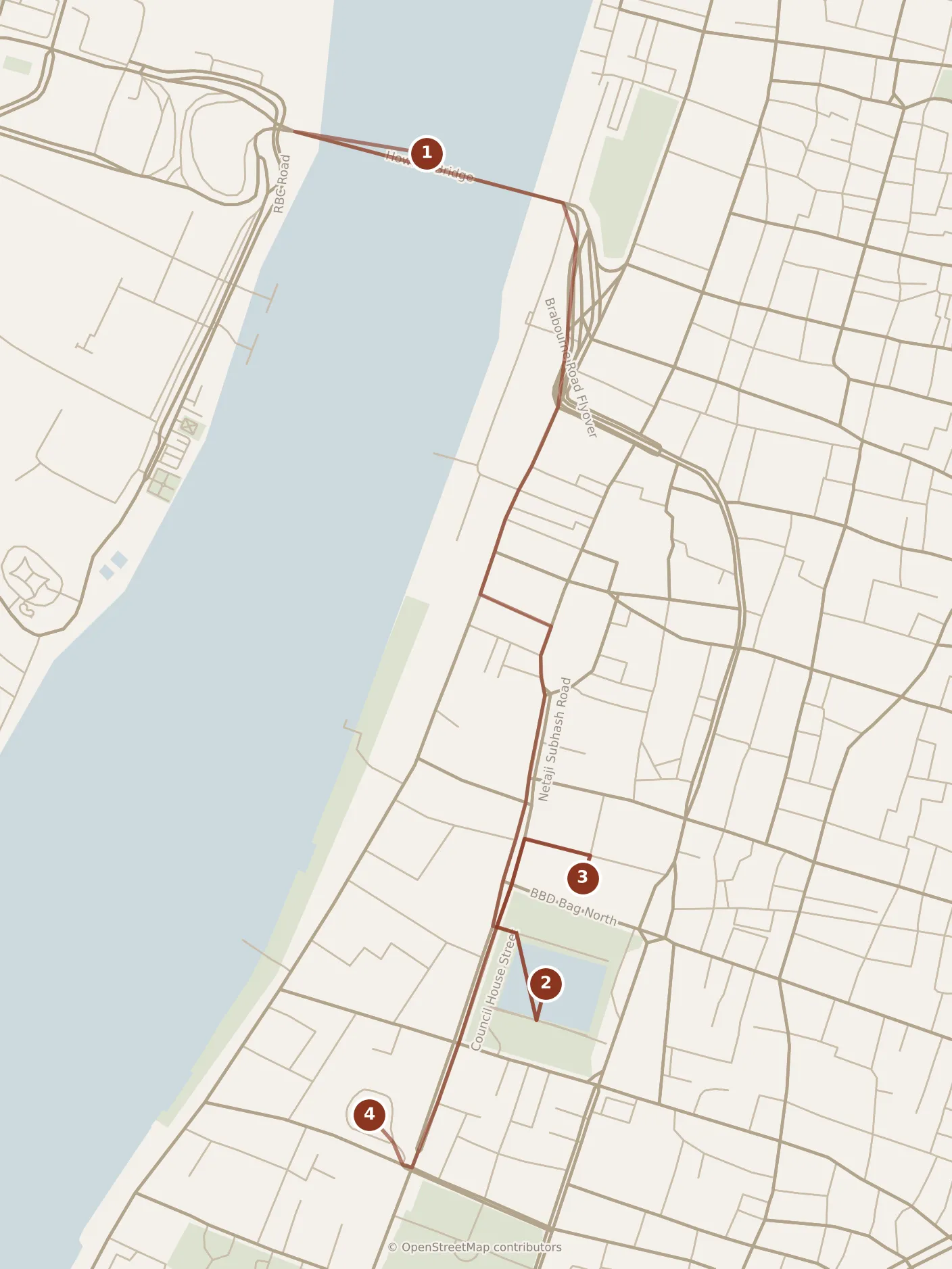
- Morning
- Mullick Ghat — in the prose, not on the map
- 1Howrah Bridge
- 2BBD Bagh
- 3Writers' Building
- 4St John's Church
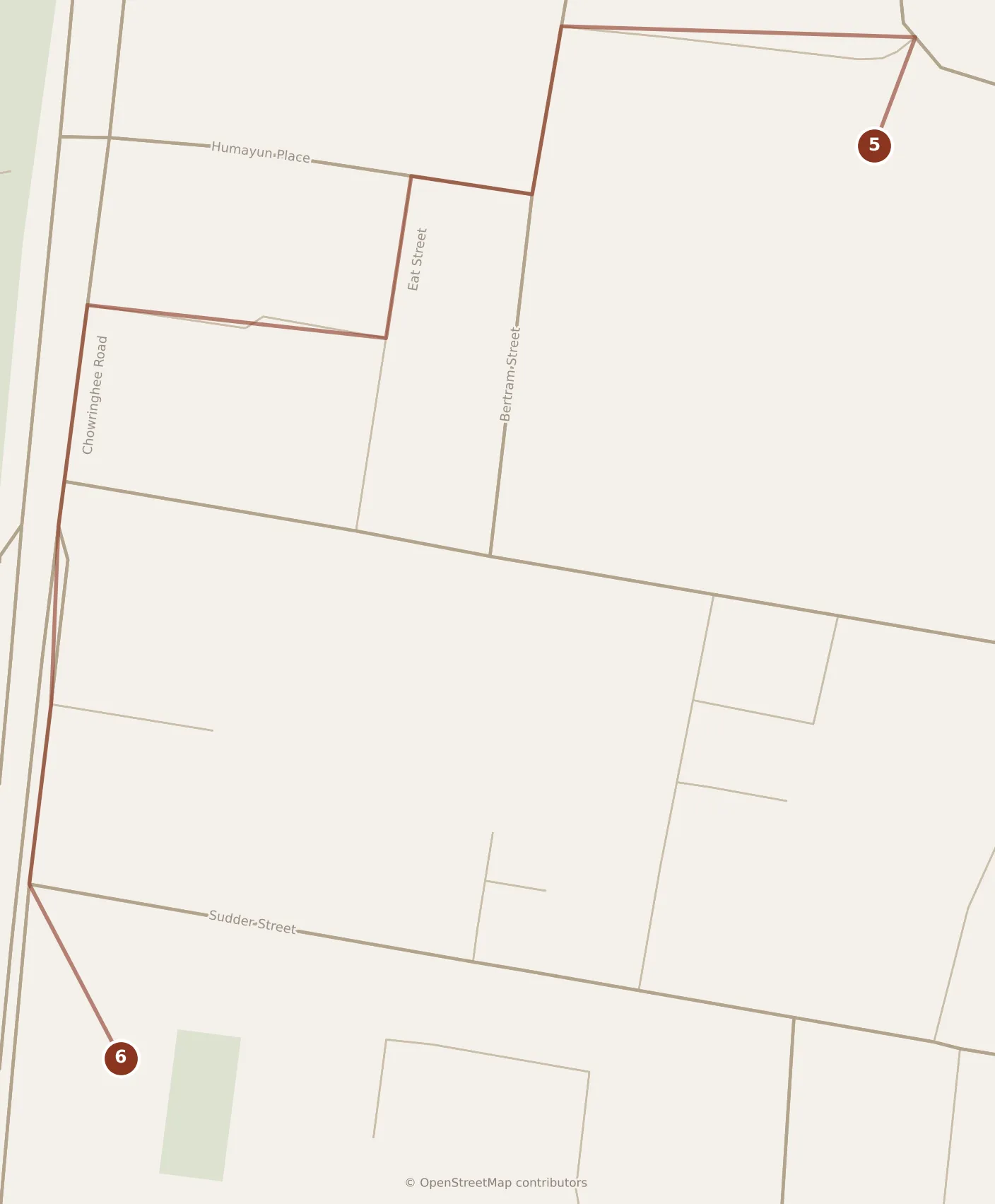
- Afternoon
- 5New Market
- 6Indian Museum
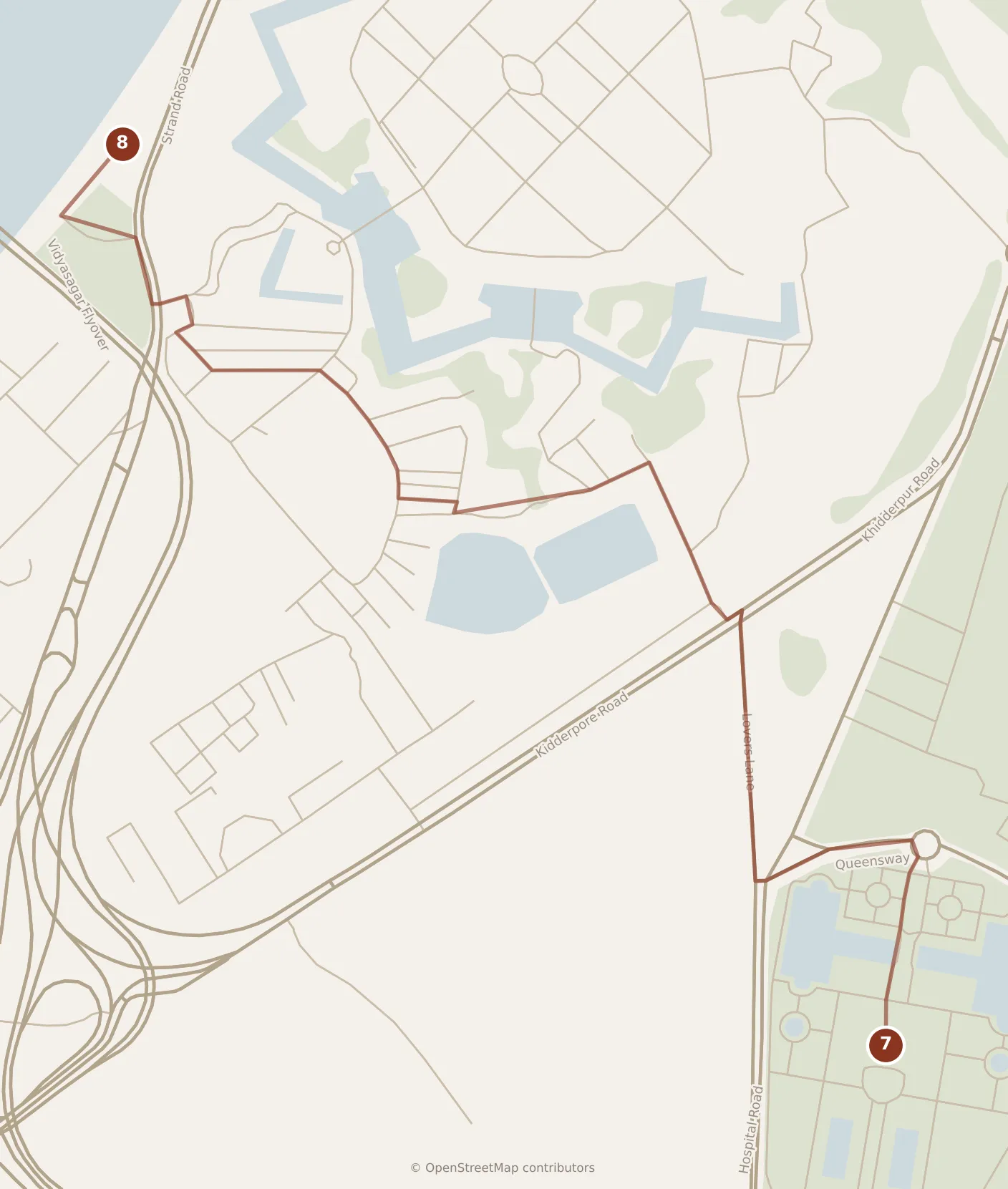
- Evening
- 7Victoria Memorial
- 8Prinsep Ghat
- Park Street — in the prose, not on the map
Morning
Start under the bridge. The flower market on Mullick Ghat has worked the Kolkata bank since the 1850s and it works hardest in the first hours of light — marigolds by the sackful, tuberose and jasmine coming off the night transport from the districts, garlands measured out by the arm’s length, all of it under and around the eastern approach of Howrah Bridge. Give it three-quarters of an hour and spend that down among the stalls rather than looking at it from the ramp above. From the ramp it is a photograph; from inside it is a working market that will move you out of the way. It thins as the morning goes on, and it is not the same place by eleven.
The bridge is straight overhead and this is where you look at it from, not from the deck. It went up between 1936 and 1943 as a balanced cantilever and it is riveted throughout: twenty-six and a half thousand tonnes of steel and not a nut or a bolt in it. Well over a hundred thousand people cross it on foot every day, and that river of walkers is as much the sight as the span is.
Then walk south down Strand Road, half an hour with the water on your right, past the working ghats and the jetties, to BBD Bagh. The square is a tank of green water with the old East India Company city built round it, and the red-brick pile along its north side is the Writers’ Building — put up in 1777 to house the company’s writers, which meant its junior clerks, and the seat of this state’s government for most of the two centuries after. In December 1930 three young men walked into it and shot a colonial prison inspector dead in a corridor upstairs; the square carries their initials because of that. You see it from outside. Give the square half an hour and walk one full circuit: the point is not any single facade but that there are twenty of them, in every stage of grandeur and collapse, around one sheet of water.
Ten minutes west is St John’s Church, finished in 1787 and modeled on St Martin-in-the-Fields. Half an hour, for one thing inside and one thing out. Inside, Johann Zoffany’s Last Supper, painted the same year, in which the apostles are portraits of men the painter knew in the city — a joke that was not well received and has hung there ever since. Outside, in the churchyard, the octagonal mausoleum of Job Charnock, who was taught to generations of schoolchildren as the founder of Calcutta until the Calcutta High Court ruled in May 2003 that he was not, and ordered his name struck out of the textbooks. The mausoleum is still standing and still says otherwise, which may be the most Kolkata thing on this route.
Then the one transit leg of the day: back east to the metro at Mahakaran and one stop south to Esplanade. It barely saves anything on the clock, and the clock is not the reason: this is the hour at which the heat starts to win, and the rest of the day needs you.
Afternoon
You come up beside New Market — the Hogg Market of 1874, a long arcaded brick hall with a clock tower, still selling fabric and luggage and cane baskets to people who are not tourists. Walk through it for ten minutes, then eat around it rather than in it. Lunch is an hour and it is worth sitting down for: a kathi roll, which was invented in this city, or a plate of Kolkata biryani with the whole potato sitting in it.
Ten minutes south down the main road is the Indian Museum, and it takes the worst of the heat on purpose. It was founded in 1814, it is the oldest museum in the country, and it is thirty-five galleries around a colonnaded courtyard — far too much to see. Two hours is what to give it, and the two hours have an obvious shape. The Bharhut gallery is the reason to come: the railings and gateway of a Buddhist stupa some twenty-one centuries old, taken down in central India and rebuilt indoors here, carved end to end with the Jataka stories, and close enough to read. Then the Egyptian room and its mummy, which every school party in Bengal is lined up for and which is worth five minutes anyway. What to give up is the zoology and geology wings: they run on for room after room of cases and will take the rest of your afternoon if you let them.
Evening
Leave the museum and go south-west across the Maidan, half an hour on foot or ten minutes in a taxi, to the Victoria Memorial. The Maidan is the reason the middle of this city is bearable at all — a great open field with Fort William, an army cantonment and closed to visitors, sitting inside it.
The memorial was begun in 1906 and finished in 1921, in white marble from the same quarries that built the Taj Mahal, as the centrepiece of the capital of British India — which had stopped being the capital in 1911, five years into the building of it. Nobody planned that, and it is the best joke in the city. Give the whole stop an hour and a half, counted from the gate: the building stands in the middle of walled gardens and the walk in is a real part of the visit. Two tickets are sold and they are separate, one for the gardens and one for the rooms; the gardens and the building seen from them are what people come for, and inside, of twenty-odd galleries, the one worth the time is the Calcutta gallery, which is about the city rather than about the empire. The rest is portraits.
Local tip. If the day has run late, take the gardens and let the rooms go. The building seen from the lawn at the end of the afternoon is what this stop is for, the galleries are the half you can give up without losing it, and the two are sold separately precisely so that you can.
From the memorial it is half an hour on foot south-west across the rest of the Maidan to Prinsep Ghat, or five minutes by taxi. It is a river stair of 1841 with a Palladian porch of columns added two years later for James Prinsep, the man who worked out the Brahmi script and so made Ashoka’s rock edicts readable again. The cables of the Vidyasagar Setu stand over the water beside it. The river is the city’s western edge, so this is where the light goes, and that is the only reason this stop is last: there is nothing here to close and nothing to catch. Give it three-quarters of an hour, sit on the steps with tea from the stalls along the promenade, and watch the ferries and the country boats work.
Then the one doubling-back, and it is deliberate. There is street food along the ghat and it is good, and if you would rather stay by the water, stay. But the sit-down end to this day is ten minutes east by taxi on Park Street — longer if the road is against you — which after dark is a different street from the one you crossed at midday. This is the single point at which the route turns round.
Practicalities
Nothing on this route is booked and nothing on it can be: both ticketed stops sell at the gate on the day, and the rest is street, market, church and river. One thing to sort before you set off is the single metro leg in the middle — how the city’s fares and tokens work is in the city guide, and it is two minutes at a station window the first time you do it. The one caution is the day of the week: the line this leg uses has kept shorter hours on Sundays since it opened, at times running nothing before the afternoon, so on a Sunday check it before you lean on it — the leg is a flat half-hour’s walk if the trains are not there yet.
Those two ticketed interiors are also the stops whose closing days cost you most. The museum and the galleries inside the memorial both close one day a week, both take Monday, and both also close on the country’s national holidays and the biggest festival days, which is the half of that rule that catches people out. Check those two before you fix the order of the day, and check the day itself: New Market keeps Sunday as its closed day, so a Sunday walk-through becomes a look at the arcades from outside — lunch is unaffected, since it was always around the market rather than in it. Nothing else on the route has a closed day: the flower market, the bridge, the square, the gardens and the river do not shut. And if your one day turns out to be their day, the route survives whole — the garden ticket at the memorial is sold when the galleries are not, and the two hours the museum would have taken go back into a slower morning in the colonial core, which is the part of this day most worth having more of. St John’s is a working church rather than a monument, so treat it as one: if something is going on inside, the churchyard and the mausoleum are the half of that stop that matters most anyway.
The route is walked, so the weather is the plan. Its shade is thin — Strand Road is open to the river and both crossings of the Maidan are open field — and there is no version of this day in the hot months that is not a shortened one. The honest adjustment there is not to walk better but to walk less: the Strand Road stretch and both Maidan crossings go into taxis, and the museum takes three hours instead of two. In the rains those same three legs are the ones that flood, and the metro leg is the one least affected by any of it.
One last thing about distances, because on this day they are the only real cost. Three legs are half an hour on foot, and two of them fall back to back at the end of it: the half-hour from the museum across the Maidan to the memorial, then the half-hour from the memorial down to the river, both on open ground with the day already behind you. Those are the two to hand to a taxi first, and handing over the second one costs you nothing but the walk. And a taxi here now mostly means an app cab: the yellow ones that used to own these streets are down to a remnant and rarely cruise the open ground, so have the app working before the day needs it.


