Jerusalem in two or three days: one hill from four sides, then the ridge opposite

Last updated 14 August 2026
Overview
One day in Jerusalem is spent getting round the Old City. Two days is spent getting into it, and the difference is vertical rather than horizontal: the extra day does not add a district, it adds the levels underneath the one you already walked.
Day one takes a single hill from four sides. You stand on top of the Temple Mount — al-Haram al-Sharif to the people who pray on it, and a working mosque compound before it is a viewpoint — then beside its western retaining wall, then a story below the sidewalk inside a tunnel that follows the buried length of that same wall, then out at the corner where the whole structure came down in 70 CE and was left lying. Nothing on that day is more than a quarter of an hour from the last thing, and by the end of it the platform has stopped being a photograph and become a building whose size you know.
Day two walks the ring around it. The ridge opposite in the morning, with the wall and the platform laid out below you from outside; the valley at its foot; then the narrow spur under the south wall where the city actually began, three thousand years before the walls you spent yesterday inside. It ends above ground on Mount Zion. A third day leaves the walls altogether and goes west, and what it adds is an explanation rather than a sight.
The light here swings less than most visitors expect. The sun goes down at about twenty-five to five at the end of November and at about ten to eight in the last week of June, and that is the whole range — a little over three hours, where a northern European city has six or seven. So the light is not what shapes these days. Friday is. Shabbat begins before sunset on Friday rather than at it, which means the shutdown moves with the season: the trams stop and the western half of the city closes in the middle of a December afternoon and only in the evening in June, and it stays closed until after dark on Saturday. The rule behind that is the thing worth carrying, not the season: the trams stop an hour or two before sundown on the Friday and start again about an hour after dark on the Saturday, so the two sunset times above are enough to place it on your own dates. That one rhythm decides more about a trip of this length than any museum’s closing day.
The weekday is only the shape of an ordinary week, and this city does not have fifty-two of them. The Jewish calendar is lunar, so its festivals fall on different dates each year, and three kinds of date do things to this route that no weekday rule can describe. Yom Kippur stops the whole country for about twenty-five hours: no flights, no buses, no trams, no taxis, almost no traffic at all and nothing open, so a day of a three-day trip is simply gone. The first and last days of Sukkot and of Passover, and the other festival days, run to a Saturday schedule, public transport included. The intermediate days between them keep the sites open and fill the Old City to the walls. Check your dates against the Jewish calendar before the flights are booked, rather than the weekdays afterwards; the weekdays are the easy half.
Day one rests on a single hour and there is no arranging around it. Non-Muslims reach the platform by one wooden ramp beside the Western Wall, and only inside a morning window: in 2026 that window ran from half past seven to eleven between April and September, from seven to half past ten in the winter half of the year, with a short second window after midday, and it did not open at all on a Friday or a Saturday. There is no single page that keeps that window reliably up to date — the hours are a policing matter and they move — so the body to ask is the Western Wall Heritage Foundation, which runs the plaza the ramp starts from and is where visitors are sent to check. Build day one backwards from whichever hours you are given, and if they have moved the shape has not: the platform first, the wall beside it second, everything underground afterwards.
Add the days up before you plan the evenings. Day one’s stops come to about six and three-quarter hours as they are recommended below, and the walking between them to a little over half an hour, so from the gate to leaving the last church is around seven and a quarter hours with lunch inside it. Day two is a shade under seven, lunch included. Both numbers model the time you spend inside places and nothing else, and on this route they leave out three things worth naming: the line for the ramp, which forms all at once because the window is short; the scanners at the entrance to the Western Wall plaza, which everything you carry goes through and which you meet twice on day one; and the wait between arriving for a booked tunnel slot and the slot starting.
One thing on these days has to be booked before you travel and one more should be. The tunnel tour is guided, timed and sold in slots by the Western Wall Heritage Foundation, which runs it, and the slots go. The timed entry into the water system under the City of David is bought on the site’s own page, and the reason to buy rather than turn up is that the water system stops admitting anyone well before the park closes. Everything else across the two days is free or bought at the door. Inside the route itself the two days contain one taxi and two tram rides — the taxi up the ridge on the second morning, the tram in on the first day and out on the second — and every meter between the stops is walked. Getting back to wherever you are sleeping is on top of that, and on a Friday night or a Saturday it is a taxi, because there is no tram.
You will be carrying something, and the constraint is not weight but water. Day two puts you in a tunnel with a stream running through it for half an hour, and there is nowhere to leave anything at the mouth of it; a bag that matters should not go down the spur at all, and the dry route below is the answer if it has to. These three days assume you sleep here the night before day one: day one is built backwards from a window that shuts at eleven in the morning, so a day you land on cannot also be day one, and every weekday rule on this page is counted from your first full morning rather than from the flight. If one of the three has to absorb the arrival it is the third day, because the museum and the memorial both survive a midday start and the ramp does not — except where a Saturday falls in the same window, which has the same claim on it and wins, there being only one third day. The practicalities below say what that costs. The arrival day’s other constraint is wheels: no vehicle reaches most of the Old City, and if your room is inside the walls the last part of the journey is stepped lanes, so arrive with something you can carry up a stair rather than something you drag. The city guide has the districts and the trade-offs between them.
What these two days give up is everything more than a walk from the walls, and one thing inside them: neither the Dome of the Rock nor Al-Aqsa can be entered by a non-Muslim at all, so the hour on the platform is an hour outdoors. Know that before you wait in line for it.
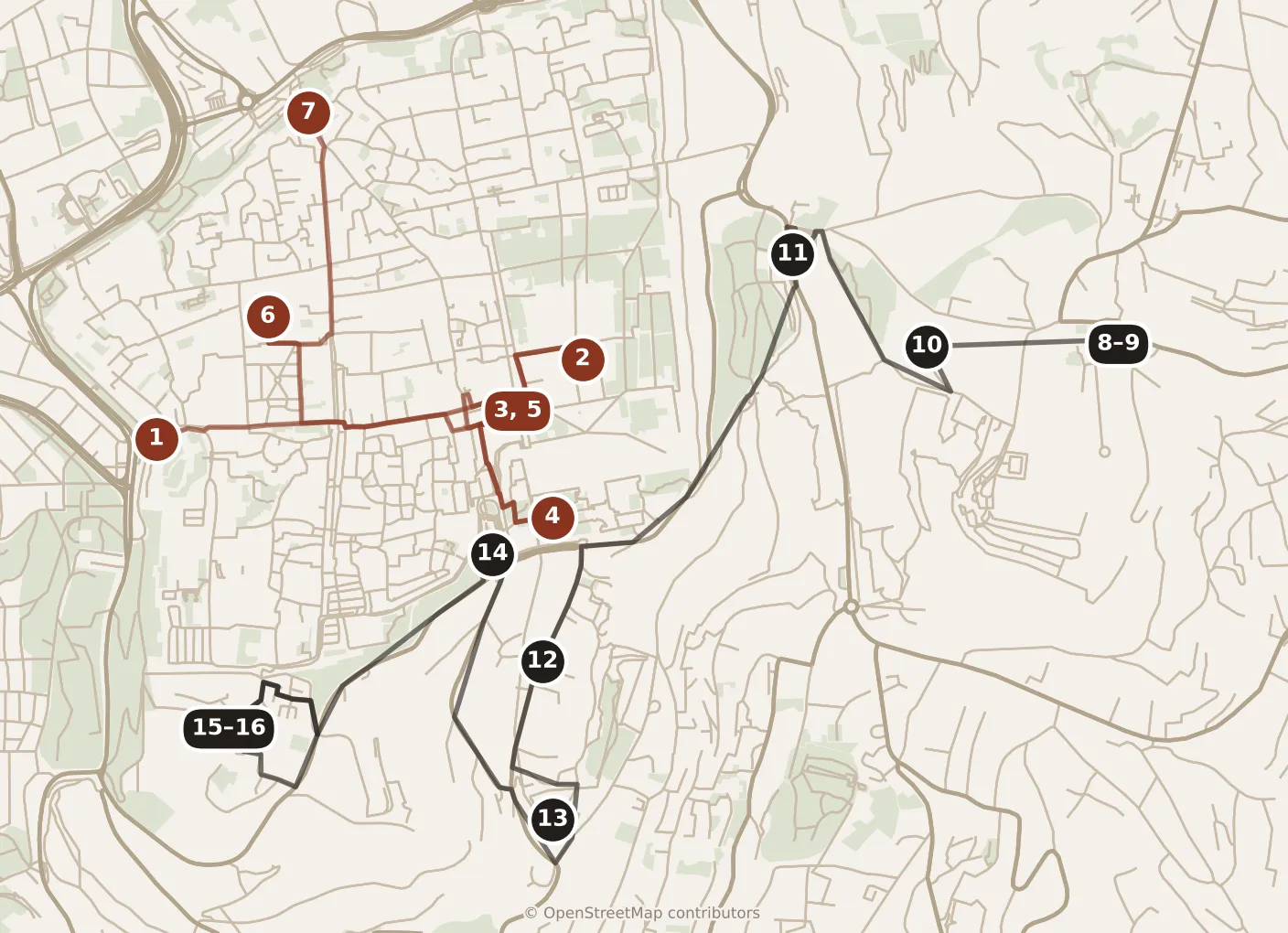
- Day one
- 1Jaffa Gate
- 2Temple Mount
- 3Western Wall
- 4Jerusalem Archaeological Park
- 5Western Wall Tunnel
- 6Church of the Holy Sepulchre
- 7Damascus Gate
- Salah al-Din Street — in the prose, not on the map
- Day two
- 8Mount of Olives
- 9Church of the Pater Noster
- 10Dominus Flevit
- 11Gethsemane
- 12City of David
- 13Pool of Siloam
- 14Dung Gate
- 15Dormition Abbey
- 16Cenacle
Day one

Four levels of one hill, then the church, then out of the walls to eat. Everything before the evening is inside a rectangle you could cross in twenty minutes, which is what makes the day possible: the walking is trivial and the waiting in line is not.
Morning
Start at Jaffa Gate, because it is the gate a taxi reaches and the gate the tram comes nearest to, and do not spend the morning on it. The nearest Red Line stop is City Hall, twelve minutes on foot to the south-east. Coming straight from the train — Tel Aviv and the airport both arrive at Yitzhak Navon — you cross Jaffa Road to the tram stop at Central Bus Station and ride five stops: Ha-Turim, Mahane Yehuda, Ha-Davidka, Jaffa Center, City Hall. You cannot pay on board the tram; you buy before you get on, from the machines on the platform. The card is the Rav-Kav; an anonymous one costs a few shekels and is loaded at the same machine, and the same machine sells a single paper ticket if one ride is all you want. The parent city guide has the rest of it.
Ten minutes at the gate is enough. Then go straight in and downhill: David Street, which becomes the Street of the Chain, twelve minutes of stepped, covered, shop-lined lane running due east. The lane itself carries on to the Chain Gate, which is a way onto the compound that a non-Muslim may not use, so the turn down to the security check for the Western Wall plaza comes before that and is the one to watch for. The ramp onto the Temple Mount climbs from the far side of that plaza.
Give the platform an hour, and spend it on the edges rather than the middle. Along the eastern wall you can look down into the Kidron and straight across at the ridge you will be standing on tomorrow morning, with the Golden Gate blocked up in the wall below your feet; at the northern end there are olive trees and unswept ground and almost nobody; and the eight stairways up onto the inner terrace each finish under an arcade of slim columns, which are the most photographed things here after the Dome and the least explained. Two rules are checked at the ramp itself and neither is negotiable there: legs and shoulders have to be covered, and you may bring no scripture of any faith with you. Prayer by a non-Muslim is not allowed on the platform, and an argument about that at the barrier will cost you the whole morning.
Come down and walk three minutes to the Western Wall, and do it in this order deliberately: you have just been standing on top of what you are now looking up at, and half an hour at the foot of it does something that no amount of time there first can. Men and women pray in separate sections, and there are cardboard caps at the entrance for a man with nothing on his head.
Four minutes south, at the corner of the plaza, is the Jerusalem Archaeological Park, and this is the stop a single day cannot afford. Give it an hour and a quarter. What you walk on is the Herodian street that ran along the base of the western wall, with the stones that were levered off the top in 70 CE lying where they landed, still in the shallow crater they made in the paving. Above them projects the springer of Robinson’s Arch, the pier of a monumental staircase that carried people up off this street and onto the platform. Among the fallen blocks is one from the parapet, inscribed and found face down, that names the place where a trumpeter stood to sound the start of the Sabbath. Round the corner, the southern monumental steps climb to the blocked Hulda Gates: the treads are deliberately uneven, so that nobody could run up them, and they are the one surface on this route that everybody who came here two thousand years ago actually touched. If the morning is running late, the Umayyad palace foundations at the southern edge are the part to skip; the steps are not.
Local tip. The ramp is the only fixed point in the whole day and the tunnel is the only booking, so book the tunnel around the ramp’s window and never the other way round. A tunnel slot can be taken at another hour. The platform cannot.
Afternoon
The Western Wall Tunnel starts from the northern end of the plaza and runs 488 meters along the buried continuation of the same wall, under the houses of the Muslim Quarter. It is guided, timed and walked in a group at the group’s pace. What it is for is scale: at one point the wall beside you is a single course containing the Western Stone, a block about thirteen and a half meters long that has never been moved since it was set, and standing at its foot is the moment the morning’s four levels resolve into one thing. Further on you cross a stretch of Herodian street at its original level and finish at the Struthion Pool, a rock-cut reservoir that was open to the sky before anyone built over it. It is narrow, low in two places, and there is no turning round once your group has started; the tour is about an hour and a quarter and the walk out puts you in the lanes north-west of the plaza, under ten minutes short of the church.
Lunch goes on the way, on Souk Khan al-Zeit — the market street that runs north from beside the church up to Damascus Gate, full of small kitchens and stalls, and the lane the Old City does its own shopping in. An hour, sitting down, and hummus is what they do best.
The Church of the Holy Sepulchre takes an hour and a half here rather than the hour a single day can give it, and the extra half hour is the whole reason to have it on a two-day trip. The line to go inside the Aedicule, the small stone house over the tomb under the rotunda, can run to hours; look at it, and if it is long, do not join it. Spend the time instead on three parts of this building that never have a line at all. The stairway down to the Chapel of Saint Helena is cut through rock and its walls carry thousands of small crosses scratched by pilgrims over centuries, one beside another until the stone is more cross than stone. Behind the Aedicule, at the back of the rotunda, a low door leads into a bare Syriac chapel with rock-cut burial shafts opening off it — first-century tombs, which is the strongest physical argument that this ground was a cemetery when it needed to be. And the roof, reached from the courtyard rather than from inside, is a village of small Ethiopian cells built on top of a chapel. Six denominations share this building under an arrangement nobody has been able to change, and those three rooms are where you can feel it without being told.
Evening
Seven minutes north through the lanes and out at Damascus Gate, which is a different place at this hour from the one a morning route meets. The sunken plaza in front of it fills up: the steps become seating, the traders are going the other way, and the gate is doing the thing it was built for, which is to be the front door of the eastern half of a city rather than a monument in it.
It is also the most heavily policed hundred square meters on this route, and better known about before you arrive than while you are standing in it: there are glassed-in guard posts built above the plaza and cameras across it, sitting on the steps has at times been made a ticketable offense, and the plaza is closed off outright at short notice. None of that is a reason to skip the gate. It is a reason to treat the walk beyond it, rather than the steps, as the fixed point of the evening.
Five minutes further north is Salah al-Din Street and the streets around it, and this is where the evening goes. Not because the west of the city has nothing, but because this half of Jerusalem keeps its own week: on the Friday evening or the Saturday that will break one of your days, this is the only evening still running, and it is worth having walked it once before you need it. Eat here. Knafeh is cut hot off the tray at the sweet counters and is a different object once it has cooled, so eat it standing at the counter rather than carrying it away. The honest note is that these are ordinary commercial streets that thin out after about nine, and that once the trams have stopped the way back to a bed in West Jerusalem is a taxi and not a tram.
Day two

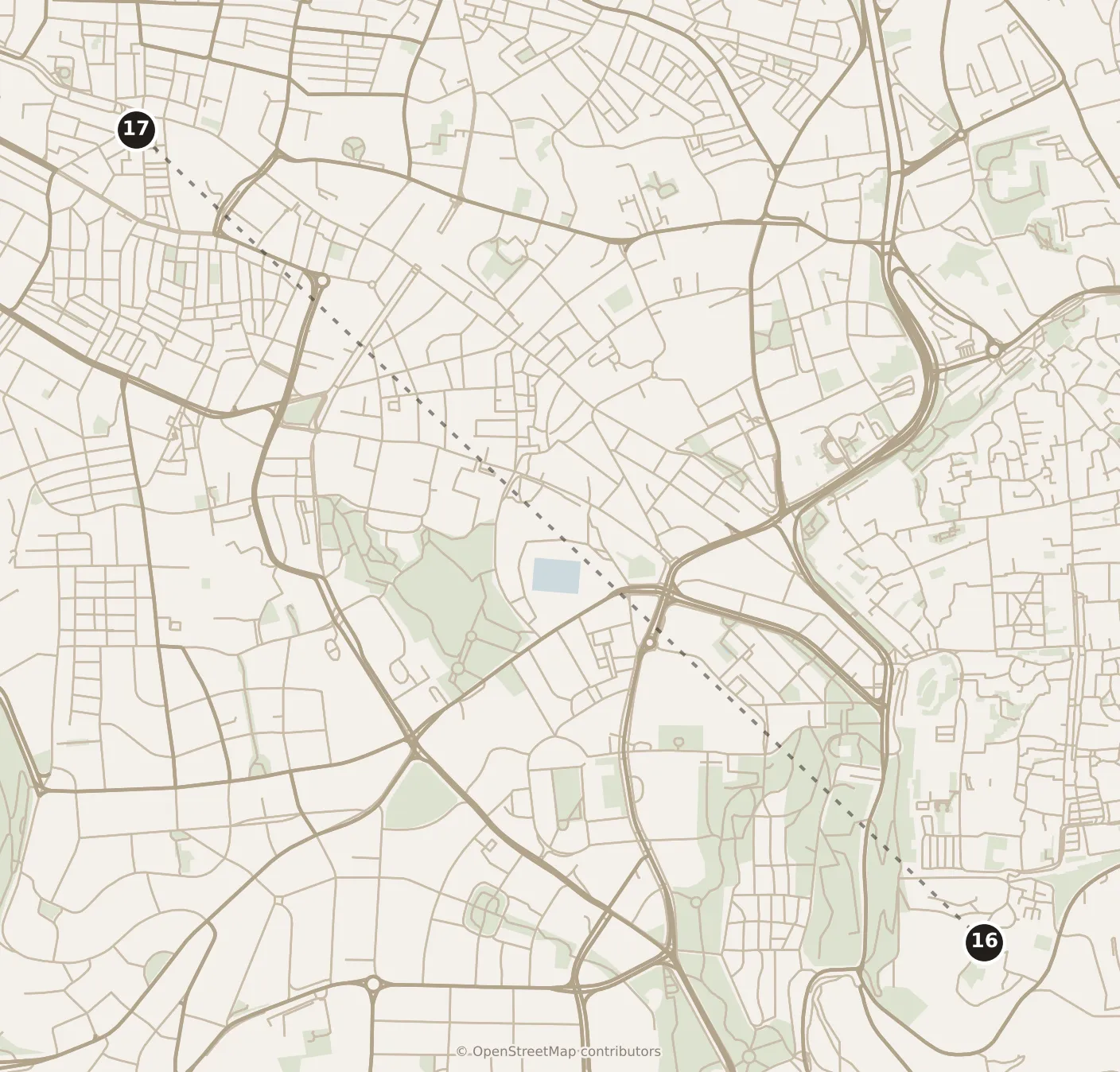
The leg out of the center: from stop 16 by tram, not on foot.
- Evening
- 17Mahane Yehuda Market
Everything today looks at yesterday from outside it. The morning is a descent — you are set down at the top and walk down the whole way, which is the single reason to pay for the ride up — and the afternoon goes underneath the south wall to the spur where the city started. Two hills and a valley, and no stretch of it flat.
Morning
Take a taxi. From anywhere inside or beside the Old City it is about ten minutes by road round the walls and up the far side, and it is the one ride on these two days that is worth paying for, because walking up first would spend the morning you came for. Ask for the ridge at the top of the Mount of Olives, and start there.
What you get is the picture of Jerusalem: the entire eastern wall, the platform behind it with the Dome sitting level with your eye rather than below it, the Old City stacked up behind that, and the Judean hills falling away east. This hillside faces the city, so the earlier you are the better the wall is lit, and the count on this day therefore runs forward rather than backwards — be up here at the start and everything else follows. Give it half an hour. The slope below you is a Jewish cemetery that has been buried in for something over two and a half thousand years, though not continuously: burial stopped there between 1948 and 1967 and tens of thousands of the stones were destroyed in those years, which is the part of its history the people around you remember. Walk the paths and not between the stones.
A minute along the ridge is the Church of the Pater Noster, a Carmelite cloister on the site of the basilica that Constantine’s mother founded here. The walls of the cloister, the church and the excavated older foundations are tiled with panels of the Lord’s Prayer in well over a hundred languages, and the thing to do is simply to find yours, and then find three you cannot identify. Half an hour. This is the one stop on the hill that keeps a closed day of its own, and the day is Sunday — it opens Monday to Saturday, mornings and again from the middle of the afternoon. Since day two cannot be a Saturday either, a Sunday day two is a real collision and not an oversight: it is a perfectly good day for everything else on this route and it costs you the tiles. The descent below is unchanged and what you lose is thirty minutes.
Six minutes down the steep road is Dominus Flevit, a small chapel of 1955 built in the shape of a tear, and it earns its fifteen minutes on one detail: the wall you face as you come in is a single arched window left clear, so the city you have spent the morning looking at arrives framed, as an object inside a building. There are excavated burial chambers in the garden beside it, with ossuaries.
Six minutes more and you are at the bottom, in Gethsemane. The olive trees in the walled garden are very old and gnarled in a way that photographs badly and is worth standing in front of anyway. Beside them the Church of All Nations, finished in 1924 by the same architect as the chapel above, has violet alabaster in place of glass, so the interior stays at a permanent dusk whatever the hour outside, and the bare rock of the hillside is left exposed in front of the altar. Forty minutes. Shoulders and knees again, and services run through the morning. The churches on this hillside all shut in the middle of the day and open again in the middle of the afternoon, as churches in this city generally do, which is a second reason the hill is a morning and not an afternoon; the four stops above come to about two hours with the walking, so a start at eight has you at the bottom with time to spare.
Afternoon
A little over a quarter of an hour south along the valley road, around the foot of the south wall, brings you to the City of David: a narrow spur outside the present walls and lower than everything around it, which is where Jerusalem was for the first several centuries of its existence. The road down and the spur itself run through Silwan, a Palestinian neighborhood of East Jerusalem, and the national park inside it is operated day to day by a private foundation rather than directly by the state parks authority; both are worth knowing before you walk it. Give it two hours. You go down past Warren’s Shaft and the Gihon Spring — the reason the city stands here at all rather than on the more defensible hill above it — and then into the tunnel cut in the eighth century BC to bring that water inside the walls: 533 meters, driven from both ends at once by two teams who met in the middle. They cut an inscription into the rock saying exactly that, and it is not there: found in 1880, chiselled out of the wall ten years later, and in Istanbul ever since, so the only version of it in this country is the copy in the museum on day three. There is water underfoot the whole way, ankle to knee, no light but what you carry, one stretch where the roof comes down, and no way out halfway.
The dry route is a real alternative and not a consolation. The older Canaanite channel runs beside the water tunnel and is walked without getting wet; you choose between them at the ticket desk, it is the shorter of the two, and it gives back something like half an hour of the afternoon. Take it if you are carrying anything that minds water, if you are with small children, or if half an hour in the dark in a passage you cannot leave is not a thing you want to discover about yourself underground. Entry to the park started in the mid-teens of shekels for a self-guided visit in 2026 and ran to about fifty for a guided one, and the site sells timed slots itself. The clock on this day is that the water system stops admitting anyone an hour and a half before the park closes — in 2026 that closing was five o’clock from Sunday to Thursday and two on a Friday — so it is the deadline the whole afternoon is built to beat, and if the hour has moved, build the afternoon back from the new one.
The tunnel comes out at the Pool of Siloam, at the bottom of the spur, where broad stone steps run down into what was the city’s reservoir; the excavated Pilgrimage Road that climbed from here back up to the temple is being dug out along the same line. Fifteen minutes. Then the return, which is the hardest walking of the two days: nine or ten minutes back up to Dung Gate, all of it climbing. The site runs a shuttle up from the pool, and this climb is what it exists for. There is nothing at all to eat down on the spur, so lunch happens above the gate in the Jewish Quarter, which is the first place there is any — an hour, and late.
Local tip. Decide about the water before you buy the ticket, not at the mouth of the tunnel. Wet and dry are sold at the same desk, the dry one is shorter, and once your group has started into the water there is no turning back and nothing you are carrying will stay dry.
Eleven minutes west along the inside of the south wall and out at Zion Gate is Dormition Abbey, a German Benedictine church of 1910 whose upper floor has a mosaic pavement ringed with the signs of the zodiac and whose crypt holds a carved figure of the sleeping Mary under a canopy. Half an hour. Sixty meters on, the Cenacle is a vaulted Gothic hall the Crusaders built, entirely empty, with an Ottoman prayer niche cut into one wall from the centuries when it was a mosque — the emptiness is the point, and twenty minutes in it is enough. Directly beneath is the room venerated as the Tomb of David, and that is a working synagogue: men and women enter by separate doors and men cover their heads, with paper caps at the entrance.
Evening
From the Cenacle it is eleven minutes back to Jaffa Gate and twelve more to the tram at City Hall, then three stops on the Red Line — Jaffa Center, Ha-Davidka, Mahane Yehuda.
Add the afternoon up and you land here in the middle of it rather than at dinner time, which is the one loose end in day two — and it is also the point. Mahane Yehuda is one covered lane, Eitz Chaim Street, and one open one, Mahane Yehuda Street, and it does not shut so much as change use: produce, spice and pastry while the stalls are up, then bars in the same doorways once they are down, with hundreds of portraits painted on the shutters that cannot be seen at all while there is a stall standing in front of them. Somebody with a single day gets one side of that change and then has a train. You have neither a train nor anything left to do, so you can be here for the whole of it — the trading, the shuttering and the hour afterwards — which is the only stretch of these two days with nothing scheduled in it. Two hours is the minimum and there is no reason to hold to it. Eat properly while you are here: the grills at the edge of this market are where me’orav yerushalmi was invented, out of what the poultry butchers could not sell, and it is still the right thing to order within a hundred meters of where that happened.
With a third day

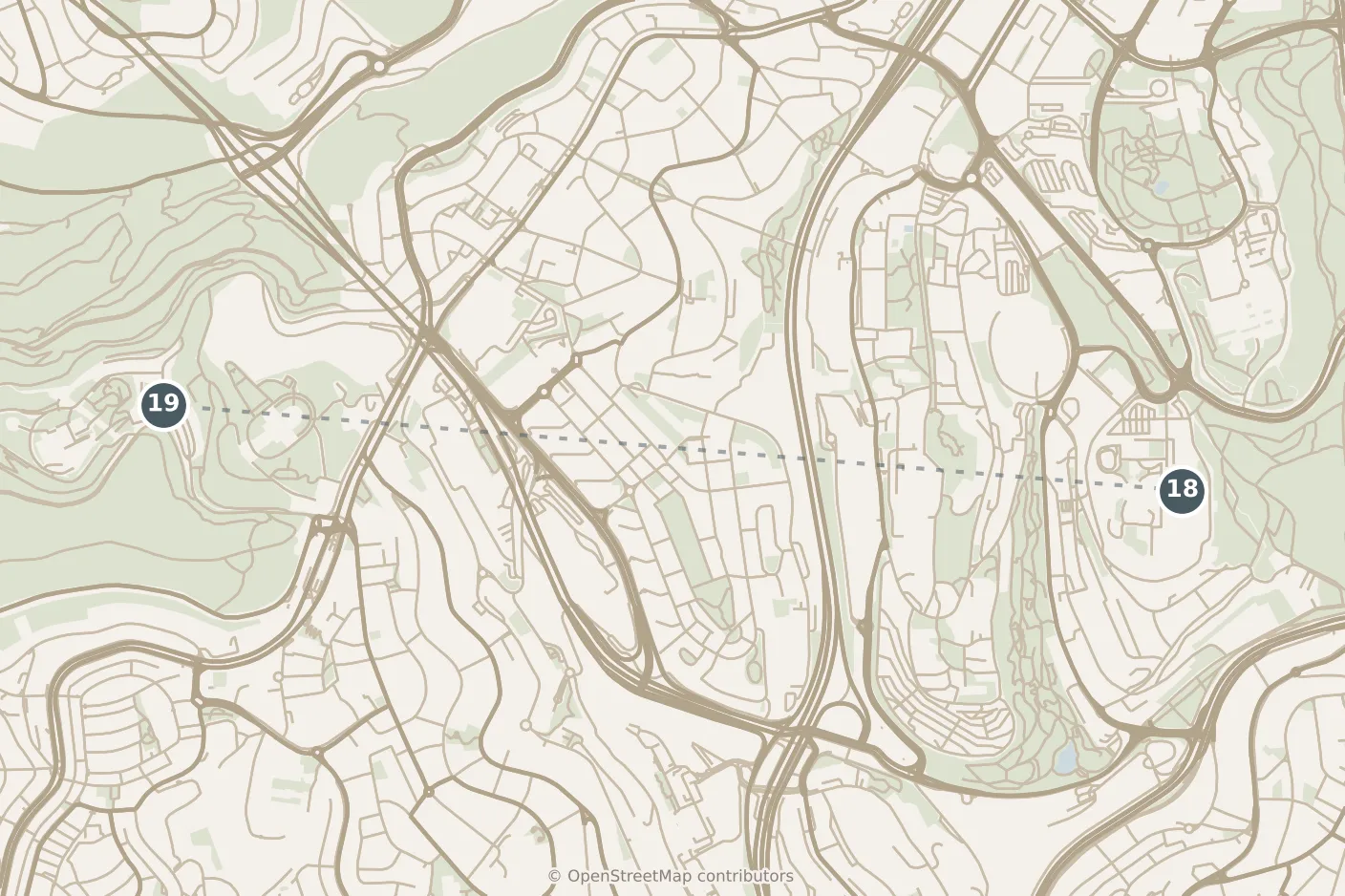
- With a third day
- 18Israel Museum
- 19Yad Vashem
The third day goes on the end wherever the week allows it, and it is never inserted between the other two. Days one and two are a sequence rather than a pair — the second looks back at what the first stood on — and the third explains both, so it only pays once you have walked them. It is the one day of the three that is not the Old City, and it is the one that can move.
There are three cases for moving it, and none of them is the content. Two are the calendar and are below; the third is the flight you arrive on, and it sits in the practicalities with the rest of the arrival arithmetic. If any of your three days is a Saturday, that Saturday has to be this day, wherever in the week it falls, because neither of the others can be done on one. Yad Vashem then drops out entirely, since it is shut on a Saturday, which leaves the museum as the whole day rather than half of it. And where in the week the Saturday sits decides one more thing. If it is the last of three consecutive days, day two lands on the Friday and its evening has to go east instead of to the market, because the market shuts that afternoon — two evenings running in the same half of the city. If the Saturday comes first, this day simply comes first with it and the other two follow in their proper order, which is the cleanest a Saturday here ever gets. Either way it is cheaper to know before the flights are booked than after.
The second case is the weekday, and there are two of them. On a Tuesday the museum does not open until four in the afternoon and the memorial shuts at two; on a Friday the memorial shuts at one and the museum at two. Both break in the same direction and are mended the same way, by running the day backwards — the memorial first, in the morning, then the museum — which is exactly the order the paragraphs below tell you not to use. That is a real collision and not an oversight, and the trade is worth making, because the alternative is dropping one of the two. What the two days cost is not the same, though. Tuesday costs only the order: three hours at the memorial from nine, a long gap, then three hours at the museum from four. Friday costs the museum as well — the memorial from nine to twelve, then whatever is left between half past twelve and two, which is an hour and a half and buys the Shrine of the Book and the model and nothing after them. Three consecutive days starting on a Sunday land this day on a Tuesday: take it inverted, or put this day earlier in the week and break the sequence, and the sequence is the more valuable of the two. Three starting on a Wednesday land it on a Friday, where the same choice is worth making the other way round — moved to the Wednesday it costs the sequence and an hour, left where it is it costs half the museum.
Give the Israel Museum the morning and three hours — on any day but Tuesday and Friday, when the day has to be turned round: on the Tuesday it does not open until four in the afternoon, on the Friday it shuts at two. Two things in it are the reason this day exists. The Shrine of the Book is a white dome over a sunken drum with the long scroll of Isaiah laid around the inside, faced across a plaza by a wall of black basalt — the building is an argument before you have read a caption. Outside it stands the Model of Jerusalem in the Second Temple period, one to fifty, the whole city as it stood before the Romans took it, and you will spend the first ten minutes finding the four places you were standing in on day one. The platform stops being a terrace and becomes a building with a roof on it; the corner you walked under in the archaeological park is up there, intact, with its staircase. After those two, the Archaeology Wing runs the same ground from prehistory forward and is worth an hour, and somewhere in this building is the museum’s copy of the tunnel inscription, which is as close to the thing itself as anyone gets without going to Istanbul. The fine arts wing and the sculpture garden are the parts to skip unless you have the whole day, and the archaeology wing is the hour to give back if the morning has slipped. Be here when it opens rather than after a slow breakfast: three hours in the museum, a ride and something to eat, and three hours at the memorial only fit inside a Monday or a Thursday, which are the two days the memorial stays open into the evening. On a Sunday or a Wednesday it shuts at four with the last admission an hour before that, so one half of the day gives back an hour; on a Tuesday and a Friday it shuts in the early afternoon — two on the Tuesday, one on the Friday — and the day cannot be run in this order at all: both are run backwards instead, as above. This is the one stop across the three days the Red Line does not reach: a bus, or a ten-minute taxi from the center.
Give Yad Vashem the afternoon and three hours, and take it in that order rather than the reverse, because nothing follows it well. Entry costs nothing and never has, but a slot has to be reserved in advance through Yad Vashem’s own booking system, and the last admission to the Holocaust History Museum is an hour before the campus closes — which on most weekdays is earlier than a visitor assumes, so book the afternoon and read the closing hour off the booking. The Holocaust History Museum is a concrete prism driven straight through the ridge with a two-hundred-meter skylight running its length, and you cannot walk it straight: the spine is blocked at intervals so that you are pushed sideways into each chapter and back out again, and the length of the building is what you have left when the chapters are finished. At the far end is the Hall of Names, a cone of photographs above a shaft cut into the rock, and outside it the Children’s Memorial, which is a dark room of mirrors and candles with names read aloud. The prism opens at its end onto the Jerusalem hills, and that is deliberate. One thing to know standing at the door rather than in the line: children under ten are not admitted to the Holocaust History Museum, and it is enforced, which is the sort of thing a family discovers too late. If the afternoon is short, the History Museum alone is the visit — the Avenue of the Righteous, the Valley of the Communities and the art museum are all separate from it and each is another hour. Mount Herzl is the end of the Red Line and the memorial is signposted from the stop, under ten minutes on foot; from the museum it is a short bus or taxi ride west. There is no evening planned on this day, and that is deliberate rather than an omission: nothing sits well after the memorial. If you want one anyway, the market is the one thing on these three days worth doing twice — but not where this day is the Friday or the Saturday. The stalls come down on the Friday afternoon and do not go back up until the Sunday, and what opens in their place on the Saturday night, once the Sabbath is out, is the bar half of the lane without the trading that was the reason to come back. Where a Saturday has taken this day, the evening still running is the eastern one, as on the first night.
The third day stays inside the city on purpose. Bethlehem and the Dead Sea are the two things people add here, and both are a day rather than an afternoon — Bethlehem needs a passport and a crossing, the Dead Sea a drive each way — so neither is planned on this page. If what brought you was the Old City, the model and the memorial are the better trade.
Practicalities
Book the tunnel slot before you travel, from the Western Wall Heritage Foundation, which runs the tunnel and sells the times itself; an adult ticket was under forty shekels in 2026. Buy the City of David slot on the site’s own page, mainly so that you are not turned away from the water system by its last-entry rule. Those are the only two tickets that have to be arranged before you arrive; everything else across all three days is free, or bought at the door on the day. Yad Vashem is the odd one and is neither: entry costs nothing, but a slot has to be reserved in advance through its own booking system, so it is a thing to book and not a thing to buy.
Which weekday each day falls on is most of the planning inside an ordinary week — the festival dates above come first, and those are the half that can lose you a day rather than an hour. The rules matter more than the answer they produce. Day one must fall between Sunday and Thursday: the ramp admits non-Muslims on those five days only. The tunnel is the less restrictive of the two — a short Friday morning, and nothing on a Saturday before the evening — but the ramp settles it. Day two must miss Saturday, when the park on the spur is shut and the tram that ends the day is not running. It will take a Sunday at the cost of the Pater Noster tiles, and it will take a Friday, but a Friday shortens it at both ends. The park on the spur closes at two rather than five, which drags its last entry back into the middle of the day: an eight o’clock start on the ridge still clears it comfortably, a ten o’clock one does not, so a Friday day two is one that cannot begin late. And its evening has to go east rather than to the market, which shuts that afternoon. The third day must miss Saturday if you want the memorial, and it wants a Monday or a Thursday, which are the two days the memorial stays open into the evening; Tuesday and Friday are the two days it cannot hold its shape at all — on the Tuesday the museum opens only in the late afternoon, on the Friday it shuts at two and the memorial at one — and both are run backwards instead, the memorial first. There is no Monday closure of the European kind to dodge anywhere on this route. Days one and two may trade places if the weekday forces it, and the cost is small but real: the view from the ridge means less on a first morning than on a second.
Three start days are worth naming, and a start day here is your first full morning in the city rather than the day you land. A Thursday start is the one that quietly sees least — day one takes the Thursday, day two is squeezed into the Friday as above, and the Saturday takes the third day minus Yad Vashem. And a Friday start is the one window of three consecutive days that cannot be put in order at all, because Friday cannot be day one and Saturday can be neither of the first two: the only arrangement left runs day two on the Friday, the third day on the Saturday and day one on the Sunday, so you look back at the platform from the ridge before you have stood on it. It still works; what you lose is the reason the order exists. A Sunday start costs nothing on the first two days and lands the third on a Tuesday, which is one of the two weekdays that day cannot keep its shape on: take it inverted, or move it to the Monday and break the sequence.
If the flight has to eat one of the three days rather than the night before them, it is the third day that absorbs it, because the museum and the memorial both survive a midday start and the ramp does not. That works everywhere except where it is most needed. A Saturday inside the same window has the same claim on the third day and there is only one third day, so an arrival day and a Saturday cannot both be paid for out of three: land on a Thursday with only the Friday and the Saturday after it and what is left is day two on the Friday and the third day on the Saturday, with day one — the platform, the wall and the tunnel this itinerary is built around — simply not happening. The answer there is a night earlier or a fourth day rather than a rearrangement, because there is not one.
What you wear is a route-wide decision rather than a stop-by-stop one. The ramp, the Wall, the Sepulchre and every church on the ridge all want legs and shoulders covered, and since those are most of both days, the practical answer is to dress that way in the morning and stop thinking about it. Head coverings for men are supplied at the Wall and again under the Cenacle; nothing else is.
The walking is almost all short and almost none of it is flat. Day one’s longest stretch is the twelve minutes down the Street of the Chain at the start; the rest of the legs run between three and ten minutes. Day two is the harder day by a distance: a continuous descent from the ridge in the morning, and a nine or ten minute climb out of the Pool of Siloam in the afternoon that comes at the worst possible moment. Wet weather changes the surfaces underfoot here more than the gradients do, and the wet months are November to March. From June into September the problem is the opposite one and it is the hour rather than the surface: the ridge, the archaeological park and the climb out of the pool are all in the open with nothing over them, and the climb lands in the early afternoon. In those months the eight o’clock start on day two is about the heat as much as about the churches. If day one has to lose something, the Jerusalem Archaeological Park is the stop that goes and it gives back an hour and a quarter; it is the one level of the four you can most afford, because the platform gave you the top and the tunnel gives you the bottom. If day two has to lose something, Mount Zion goes — the abbey and the Cenacle together, with the walk out to them, are just over an hour of that day, and they are the only part of it that is neither underground nor above the valley.
Two last things, neither of them about the weekday. The first is that the platform has a second kind of closure with no calendar behind it: it has been shut to visitors for stretches at a time whenever the city is tense, which was true for years before 2026 and will be true again, and it also stands down around each of the Muslim prayers. So it is a stop you confirm on the morning you intend to use it, and day one is deliberately built so that the other three levels of the hill still stand up without it — start at the archaeological park instead, take the tunnel slot at midday, and the church has the afternoon exactly as written. The second is Ramadan, and it cuts both ways. The platform is normally closed to non-Muslims altogether for the last ten days or so of the month, which takes day one’s first stop away rather than shortening it, so those dates want the fallback above and not a hopeful morning at the ramp. Against that, the walled city at night is then the liveliest it ever is rather than the emptiest, which inverts the first evening on this page: it already ends a few hundred meters outside Damascus Gate, and in Ramadan it belongs a few hundred meters inside it instead.


.jpg)

.jpg)