Jerusalem in one day: the Old City west from Damascus Gate, ending at the market

Last updated 4 August 2026
Overview
The walled Old City is under a square kilometer, and that is the single most useful fact about a day in Jerusalem. Four quarters, a handful of working gates, and nothing on this route more than a quarter of an hour from the last thing: the whole day’s walking comes to under an hour, and its longest single stretch is the first one, thirteen minutes down the souk from Damascus Gate to the Western Wall. Distance is not what makes the day hard. What makes it hard is that several religions and half a dozen churches share a space the size of a large park, and almost everything in it is lined up for, searched, or open only at certain hours.
Which is why the order below is not a matter of taste. One place on this route has a door with an hour on it, and it is the one everybody comes for: non-Muslims reach the Temple Mount — the Haram al-Sharif — only by a single wooden ramp beside the Western Wall, and only in the morning. In 2026 that ramp took visitors from seven and stopped admitting them at eleven in summer, half an hour earlier in winter, with a short second window after midday and none at all on a Friday or a Saturday. So build the morning back from the ramp: the city’s tourism authority publishes the current window, and if the hours have moved, build the morning back from the new ones. Everything else here is open all day or open always — the Wall itself never closes, which is precisely why the Wall goes second and not first.
What one day costs you is the view of the thing you are standing in. The Mount of Olives, across the valley to the east, is where the photograph of Jerusalem is taken from, and it is a taxi out, a hill, and an hour and a half you have not got. It is the first thing to add on a second day, and to add in the morning, because that hillside faces west and by mid-afternoon the walls opposite are in silhouette. The same day gives up the City of David below the south wall, and Yad Vashem and the Israel Museum out in the west of the city, which are each half a day on their own.
Nothing at the end of this day has a deadline, so the count runs forward from the ramp rather than backwards from anything. From walking in at Damascus Gate to sitting down in the market, the stops below and the walking between them come to about seven hours, lunch included. Be at the gate around half past seven and you reach the market in the middle of the afternoon, with the two lines below still to be added and the whole evening in front of you.
Those seven hours do not include the two lines on this route, either of which can outlast the stop it leads to: the ramp onto the Haram, where a short window puts everybody in it at once, and the line to go inside the tomb in the Church of the Holy Sepulchre, which on a busy morning is longer than everything else on this page put together. What to do about the second one is below, and it is to look at the line and decide.
Which day you come changes this route more than it would in most cities. Shabbat runs from sunset on Friday to nightfall on Saturday: the light rail and the buses stop before Friday’s sunset rather than at it, and the market that ends this day shuts on Friday afternoon and stays shut all Saturday. Sunset moves by about three hours between late November and midsummer, so a Friday in December loses the trams in the middle of the afternoon and a Friday in June barely notices. The rest of that arrangement, including what a Saturday leaves you, is in Practicalities.
You are carrying a bag, and this is a day you cannot do holding one: the lanes are stepped and narrow, the Wall plaza and the ramp put everything you carry through a scanner, and there is no stretch of this route where a case is merely inconvenient. The place to look is the Central Bus Station, across Jaffa Road from Yitzhak Navon, where the train from the airport and from Tel Aviv sets you down: ask in the concourse rather than online, because left luggage here is a concession and nobody publishes its hours. Ask what time it closes before you hand anything over, since this day sends you back for the bag in the evening, and take a no for an answer on a Friday evening or a Saturday, when the western side of the city shuts. If the bag goes in, the day begins six tram stops from there and ends two, so it comes out on the way back and never enters the Old City at all.
If it does not — if there is nowhere to leave it, or nowhere that will still be open when you come back — then the route above is not your day, and this is. Take a taxi to Jaffa Gate, which is the one entrance a car reaches, and start at the citadel beside it: an hour and a half. Then the Muristan below it, and lunch, for an hour; then three minutes uphill to the Church of the Holy Sepulchre for another; then back out through Jaffa Gate to the tram and the market for the evening. That is three and a half hours of stops and about four with the walking between them, it keeps the whole day within a few minutes of the one gate a car reaches, and what it gives up is the eastern half of the route — Damascus Gate, the Jewish Quarter and the Cardo — along with the two stops that would end the day for anyone holding one, the ramp onto the Haram and the Wall plaza, which is where the scanners are.
The day

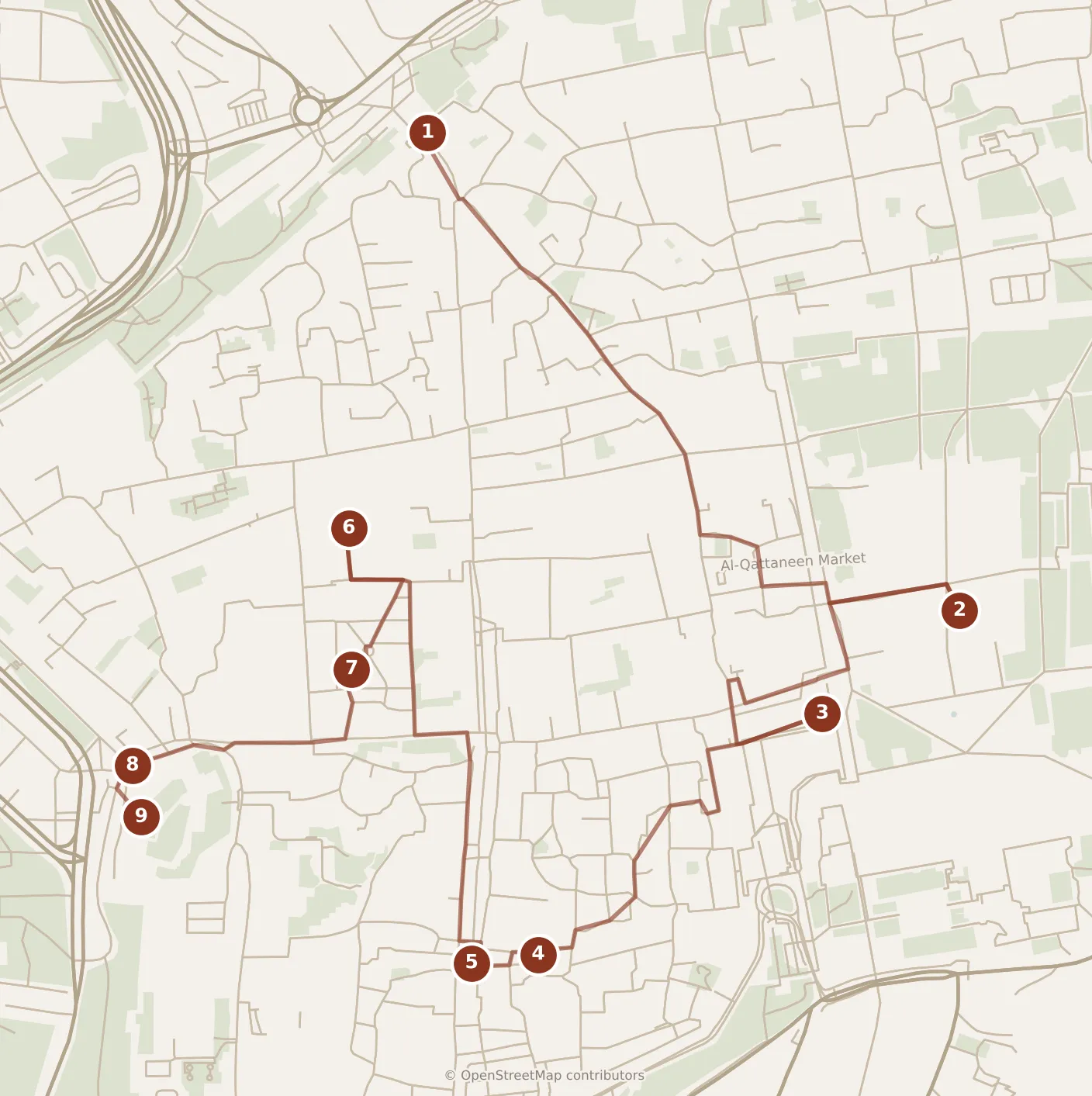
- Morning and afternoon
- 1Damascus Gate
- 2Temple Mount
- 3Western Wall
- 4Hurva Square
- 5Cardo
- 6Church of the Holy Sepulchre
- 7Muristan
- 8Jaffa Gate
- 9Tower of David
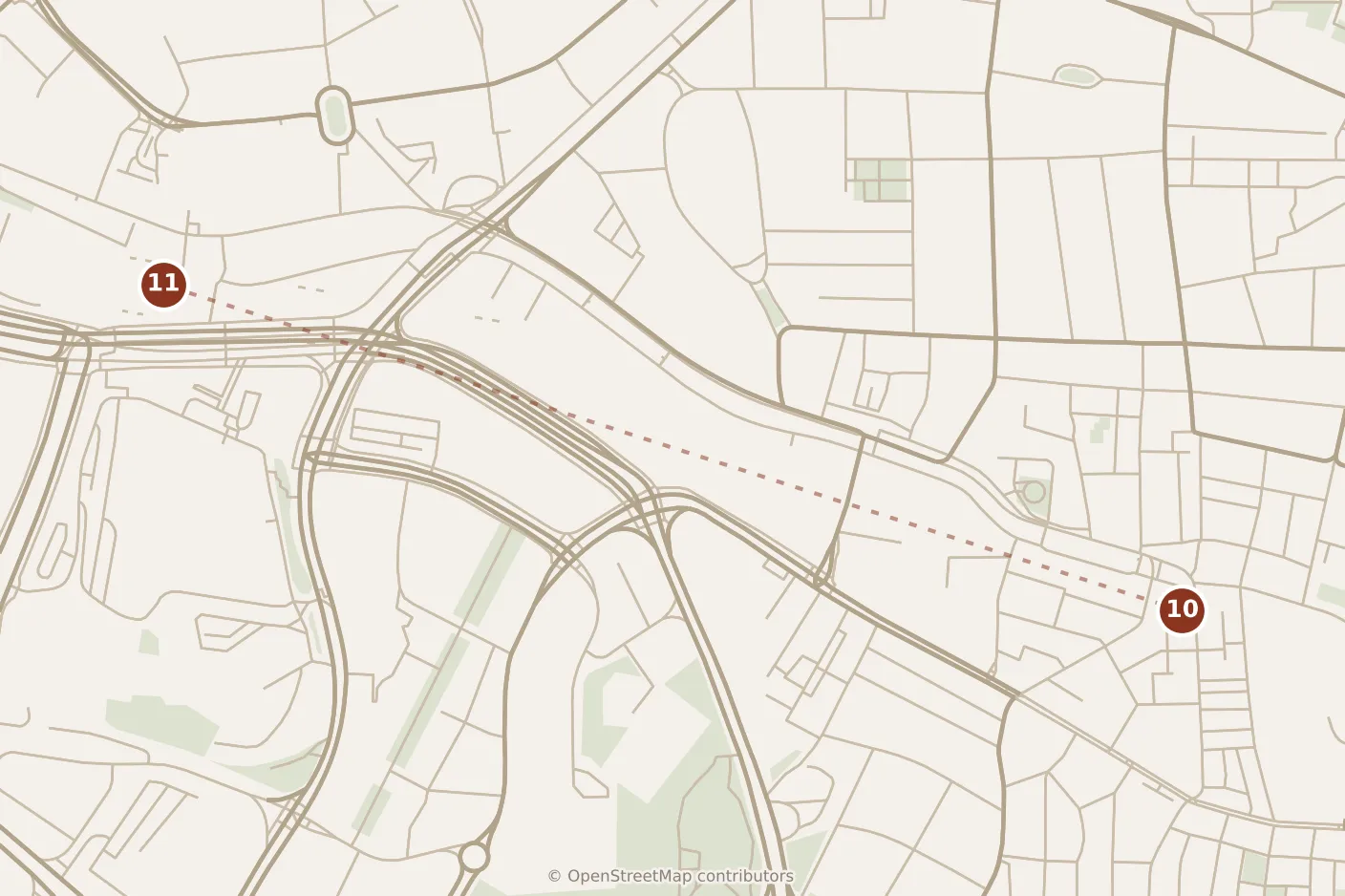
- Evening
- 10Mahane Yehuda Market
- 11Yitzhak Navon
Morning
Damascus Gate is the right way in. Take the Red Line from Central Bus Station to the Damascus Gate stop; the tram leaves you on the road above, and the gate is below you, because here the steps go down to the doorway instead of up to it, which is the opposite of Jaffa Gate at the other end of this day. The stone bowl they make is where the city sits and talks, though at this hour it is traders going in rather than anyone sitting. The gate you are looking at is Suleiman’s, built in 1537; the arch partly visible underneath it is Hadrian’s, raised for the emperor’s visit in 129 or 130, and the Arabic name Bab al-Amud, gate of the column, still remembers the Roman victory column that stood in the plaza inside. Ten minutes, all of it from the outside, and then go in.
Straight down El-Wad Street, which runs from the gate to the Wall and is half market, half street of houses: thirteen minutes of stepped, covered, shop-lined lane that drops you at the security check for the Western Wall plaza. At this hour it is a delivery route — pallets, hand trolleys, shutters going up — and it is worth noticing, because it is the same walk in the afternoon and it is then a crowd you move at the speed of.
The ramp to the Temple Mount climbs from the far side of the plaza. What you buy with the hour is the platform: fourteen hectares of paved terrace, cypress and olive trees and fountains, standing a full story above the surrounding city on retaining walls Herod built. The Dome of the Rock sits in the middle of it, an octagon of tilework under a dome regilded in 1993 with eighty kilograms of gold paid for by King Hussein of Jordan — and you cannot go inside it, nor into Al-Aqsa at the southern end. Know that before you wait in line, because it is the thing that disappoints people. What is worth the time is the space itself: the arcades of slim columns standing at the head of each stair up onto the inner platform, the small Dome of the Chain beside the great one. Leave prayer books and anything resembling one in your pocket; the ban on non-Muslim prayer here is enforced at the door, and an argument about it costs you the day.
Come back down and walk three minutes to the Western Wall, which is the western retaining wall of the terrace you have just been standing on. That adjacency is the thing no photograph conveys and twenty minutes in both places does. The bottom courses are Herod’s — enormous, and each block cut with a shallow recessed border round its face, which is how you tell them apart from everything above, and everything above is smaller and later. You can read the joins from the plaza floor. The prayer area is divided by gender, and paper skullcaps are handed out at the men’s entrance. Give it half an hour and spend some of it watching from the back rather than walking to the stones.
Ten minutes up and west through the Jewish Quarter — rebuilt from rubble after 1967 and, unlike everything around it, visibly new: pale clean stone, wide steps, a quiet the rest of the Old City never has — brings you to Hurva Square. The domed synagogue that gives it its name was dedicated in 1864, blown up in 1948 and rebuilt to the original drawings in 2010, and it is the quarter’s one landmark from any distance. A minute on is the Cardo, the colonnaded main street of the Roman and Byzantine city, sunk well below today’s sidewalk: a stretch of re-erected columns open to the sky, and a covered arcade of shops running along the rest of it. The sixth-century mosaic map at Madaba draws this street with its two rows of columns, so you are standing inside a picture made fifteen hundred years ago. Three quarters of an hour for the quarter and the Cardo together, and it is the calmest stretch of the day.
Afternoon
Eight minutes north-west through the lanes is the Church of the Holy Sepulchre, which most people get wrong by expecting a church. It is a stack of buildings holding two sites under one roof — the rock of Golgotha and the tomb — shared by six denominations, Greek Orthodox, Roman Catholic, Armenian, Coptic, Syriac and Ethiopian, under an arrangement called the Status Quo that was fixed in 1757 and has barely moved since. That is why a wooden ladder has stood on a ledge beneath one of the facade’s upper windows for longer than anyone can remember, and why the iron key to the front door has been held by two Muslim families since Saladin. Inside the entrance: the Stone of Unction, flat and pink and usually ringed by people; a steep stair immediately inside the door up to Calvary; and beyond, under the rotunda, the Aedicule, the small stone house over the tomb, straightened and rebuilt in 2016 and 2017 after decades in an iron cage. The final stations of the Via Dolorosa are all inside this building.
Give it an hour, and here is what to do with the line, because it is the decision the stop turns on. The line to go inside the Aedicule can run to hours for ninety seconds in a chamber the size of a wardrobe. If it is short, take it. If it is not, spend the whole hour on everything else — the rotunda, the Greek and Armenian chapels off the ambulatory, the Ethiopian monastery of small huts on the roof, which is reached from the courtyard rather than from inside — and you will have seen more of the building than most of the people who waited in line.
Local tip. Do not walk the Via Dolorosa. You have already crossed its middle on El-Wad this morning and its final stations are in the church you are standing in, so the part walking it adds is a string of modest markers in a working souk. It is the right thing to cut, and cutting it is what pays for the hour above.
Three minutes downhill is the Muristan, the block below the church: a rectangular grid of streets around a fountain, named from the Persian word for hospital because the Knights of St John had theirs on this ground. It was rebuilt from ruin in the 1890s, which is why it has a plan when nothing near it does, and it now sells leather and souvenirs. Lunch goes here or in the lanes beside it, and it goes sitting down: hummus with the bread still coming is a plate rather than a snack, and eating it standing up is the wrong economy in this city. Give it an hour. If the citadel below does not appeal, the Lutheran Church of the Redeemer beside the Muristan has the bell tower with the closest view on this route to the one from the Mount of Olives — but its opening has been cut back to a single short window on a Saturday morning, which closes before this day reaches the Muristan. The church’s own provost office publishes the times, and it is the only place they appear.
Four minutes west is Jaffa Gate, inaugurated in 1538, its passage turning a right angle inside so that nothing could charge through it straight, with two Ottoman tombs behind an iron grating just inside. The gap in the wall next to it is not a gate at all: it was cut in 1898 so that Wilhelm II could ride in without dismounting, and every car and taxi entering the Old City has used it ever since.
The Tower of David is the citadel immediately beside the gate, and it is the last stop in daylight because it is the high one. It is not David’s and never was: the base is one of Herod’s three great towers, the minaret that gave it the name is Ottoman and seventeenth- century, and the museum inside — reopened in 2023 after a rebuild that ran for years — is the one place in Jerusalem that puts four thousand years into an order you can follow. Give it an hour and a half, and spend the last twenty minutes of that on the ramparts and the roof, where the Dome, the domes of the Sepulchre and the whole walled square lie out below you. It is the only ticket on the main route; everything else this day walks into is free. On a Friday it moves before lunch: the citadel keeps the eve-of-Shabbat hours that everything on the western side of the city keeps, and shuts in the early afternoon rather than at the end of it.
Evening
Out through Jaffa Gate and twelve minutes north-west on foot to City Hall, then three stops on the Red Line — City Hall, Jaffa Center, Ha-Davidka, Mahane Yehuda — and in well under half an hour you are out of the Old City and in the other Jerusalem.
Mahane Yehuda is two parallel markets, the covered Eitz Chaim Street and the open Mahane Yehuda Street, with cross-lanes named after fruit and nuts, and it changes character while you are standing in it. That is the reason to arrive in the late afternoon rather than at either end of the day. You come in while it is still a market — spice, halva, pickles, rugelach warm — and you stay while the stalls shutter and the bars behind them fill, which happens around you over about an hour. As the shutters come down the market’s second layer appears: since 2015 the street artist Solomon Souza has spray-painted portraits on them, hundreds of them, and every one is invisible while the stall in front of it is trading. Eat here, and two hours is not too much.
Yitzhak Navon is two stops back on the Red Line, Mahane Yehuda to Ha-Turim to Central Bus Station, or twenty minutes on foot down Jaffa Road when the tram has stopped. The station is underground and deep, its platforms a long way below the concourse, and the trains to Ben Gurion and Tel Aviv go from there. Allow more time than the walk suggests: the descent is a real part of the journey, and the bag is in the building across the road.
Practicalities
Nothing on this route has to be booked, which is unusual enough to say plainly: the Haram, the Wall, the churches, the Cardo and the market are all walked into, and the citadel at Jaffa Gate is the route’s single ticket, bought at the door. What the route does require is what you are wearing. Shoulders and knees covered, for the whole day rather than for one stop — the ramp onto the Haram is the strictest door in the city and will turn you back at it, and the Sepulchre and the Wall have the same rule. Men are handed a paper skullcap at the Wall; nobody hands out trousers. For everything else — the tram, the train in from the airport, how the city is paid in — the parent city guide is the place to look, and this route needs nothing from it beyond a way to ride the Red Line three times.
Which day you come is most of the planning, and the two stops that close for a whole day are both shut on a Saturday. The Haram admits non-Muslim visitors from Sunday to Thursday only — not on a Friday, not on a Saturday, not on a Muslim holiday — so a Friday or a Saturday morning has to start elsewhere, and the city’s tourism authority is where that calendar is published. The replacement that costs least is the Ramparts Walk from Jaffa Gate, which runs on the walls above the same quarters and is not going anywhere — it charges an admission of its own, so on those two days the route has two tickets rather than one. Mahane Yehuda shuts on Friday afternoon — a bugle is sounded to announce it — and stays shut through Saturday, so a Friday evening or a Saturday needs a different ending: the Christian and Muslim quarters and East Jerusalem keep working, and dinner goes there instead.
Saturday breaks this route hardest, and it is worth knowing exactly what survives. The Old City half of the day holds from Damascus Gate to Jaffa Gate, minus the Haram, and all of it walks — but the Wall is not the same place: from Friday’s sunset to Saturday’s nightfall the foundation that runs the plaza forbids photography, electronic devices and writing there, and photography is the one a visitor breaches without knowing, because the Wall is the stop where everybody lifts a camera. What does not survive is the tram at both ends: there is no light rail and there are no city buses in West Jerusalem from before Friday’s sunset until after dark on Saturday. So a Saturday means a taxi, or the shared taxis the city guide names, out to the Old City and back again, and the day should end where it started rather than in a market with the shutters down. A separate warning that is not about the weekday: access to the platform has been suspended outright during periods of tension, repeatedly and long before 2026, and around the Muslim prayers each day besides. Treat it as the stop to check on the morning itself, not the appointment the rest of the day hangs on. In Ramadan the Old City in the evening becomes the best hours of the day rather than the quietest, which is worth knowing in either direction.
Getting to the start and away at the end are the same two stops in reverse. From Ben Gurion or from Tel Aviv the train comes in to Yitzhak Navon; from the tram stop at Central Bus Station, across the road, it is six stops on the Red Line to Damascus Gate — Ha-Turim, Mahane Yehuda, Ha-Davidka, Jaffa Center, City Hall, then the gate. Coming back at night, Mahane Yehuda is two stops from Central Bus Station on the same line. On a Friday after the trams stop, and all day Saturday, both of those legs are a taxi or the shared taxis the city guide names — or, at the end of the day, the twenty minutes on foot down Jaffa Road.
Two things about the ground catch people out. The Old City is a hill and the route above uses that: El-Wad runs downhill to the Wall in the morning and everything after the Jewish Quarter climbs gently back west, so the one uphill stretch comes when you are freshest. And the lanes are stone, worn smooth by several million feet a year and slick after rain, and the rain here falls between November and March.


