Jakarta in two or three days: the old harbor, the garden district, and the great square if you have a third

Last updated 8 August 2026
Overview
Jakarta rewards the second day far more than the first, and the reason is arithmetic rather than charm. There is no old center to walk out of, so every hour you spend crossing the city is an hour subtracted from the city; a visit that tries to assemble the five best-known places into one route spends most of itself in a car. Two days solve that not by seeing more but by refusing to cross. Each day below stays inside one band of the city and moves along one line of transport, and neither day sets foot on the other’s ground.
Day one is the north, which is the oldest part of anywhere here. It begins on a working quay where wooden freighters are still loaded by hand along a plank, and it ends after dark in the market lanes of the Chinese quarter. Between those two it goes indoors: a warehouse, two banking halls, a puppet collection and a court house, which together are the half of the old Dutch town that a short visit only ever sees from the sidewalk. Day two is the other city and the other century — the garden suburb the colony laid out for itself from 1912, the house in which the republic was declared out of it in 1945, and then the metro south to where several million people actually spend their evenings. The two days share no building, no street and no meal.
One fact about the sky frames both, and it is the least dramatic thing in the tropics: the sun sets here between about twenty past six in the second half of January and about a quarter to six in the third week of May, and that is the whole yearly range — a swing of just over half an hour, six degrees off the equator. There is no long evening to plan around in any month and no short one to fear. So neither day is counted backwards from dusk. Both are counted forwards from their first stop, and the light simply tells you when the evening below starts being what it is described as.
Each day carries its own count. Read it for what it is: it adds up the time this article recommends giving to each place and to the walking between them, and it models nothing else. It does not model the heat, which here is not a condition you walk through but something you stop for, in shade, several times a day, with something cold in your hand. It does not model the formalities at the harbor gate on day one, nor the single road transfer on day two, which is ten minutes at eleven in the morning and forty at five in the afternoon and no arithmetic can tell you which one you will get.
The first thing this route needs that this page has not given you is a rechargeable tap card. Day one opens on a commuter train and uses a bus corridor twice, and day two spends its afternoon on the metro; all three take the same card, and the parent city guide explains how to get one. Sort it out the evening before rather than at a gate with a bag. The second thing is a ride-hailing app: the rides this route tells you to pay for, motorbike or car, are not something you improvise from a curb with a bag, and the parent guide covers those too.
Getting to the start. Day one’s own first leg is a train. From Gondangdia or Juanda, the two Bogor Line stations in the middle of the city, a Commuterline train runs north to the Jakarta Kota terminus in about a quarter of an hour. If you are staying on the metro instead, ride to the northern end of it at Bundaran HI Bank Jakarta and take a Corridor 1 bus up the same axis — it is the slower option, roughly forty minutes, and it also ends inside the old town. From Jakarta Kota the harbor is a further 1.7 kilometers north: about ten minutes in a car or on the back of a motorbike, or a little over half an hour on foot with almost no shade and lorries for company. Take the ride.
Day one

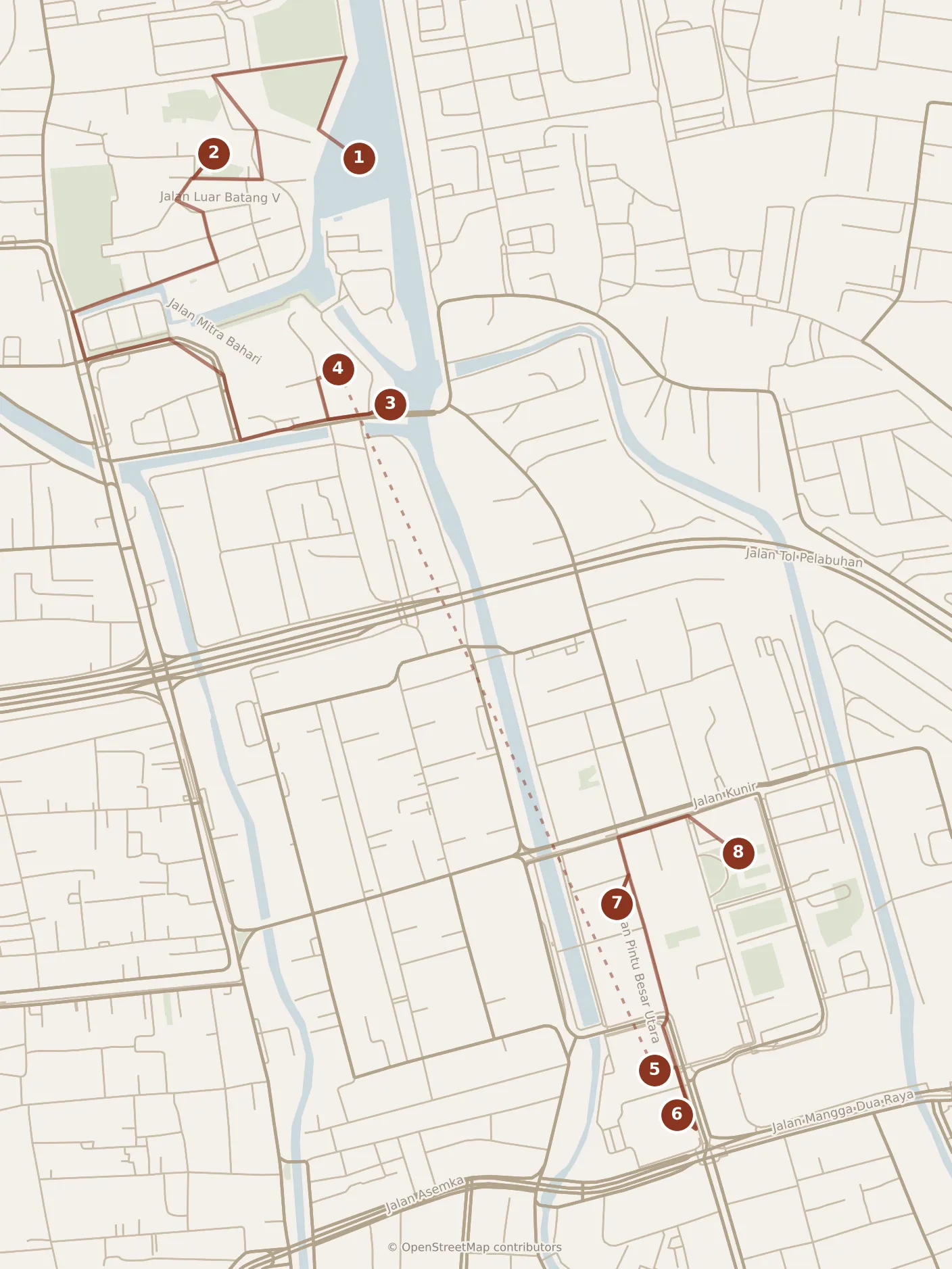
- Morning and afternoon
- 1Sunda Kelapa
- 2Luar Batang Mosque
- 3Menara Syahbandar
- 4Museum Bahari
- 5Museum Bank Indonesia
- 6Museum Bank Mandiri
- 7Wayang Museum
- 8Fine Art and Ceramic Museum
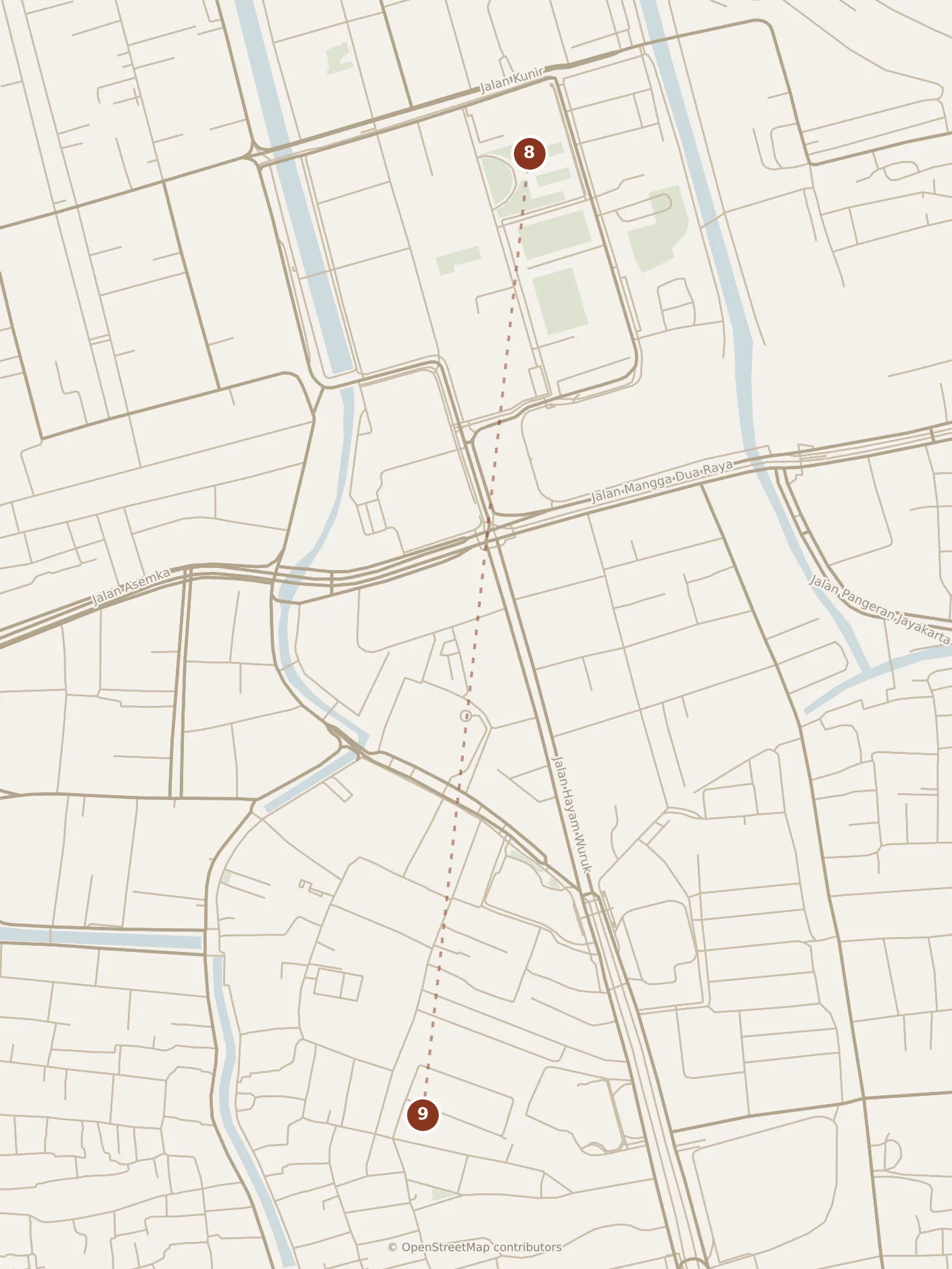
The leg out of the center: from stop 8 by bus, not on foot.
- Evening
- 9Glodok
Today is the water and the warehouses, and it runs in one line from the harbor mouth south into the Chinese quarter, so you never turn round. The looking and eating comes to about nine hours and the walking to about half an hour, because the two long legs are rides rather than walks; add the rides and it is a ten-hour day, which from an eight o’clock start at the quay puts you at dinner as the light goes.
This day rests on one published hour, and it is a Friday one. Museum Bank Indonesia, the best interior on the route, shut at eleven in the morning on Fridays in 2026, where on every other open day it ran to the middle of the afternoon. That single fact decides the order below, because the museum sits in the afternoon and on a Friday there is no afternoon to sit in. If your day one is a Friday, either run day two instead — it has no such door — or invert this one: start at the museum at half past eight, do both banks first, and take the harbor at midday, which costs you the coolest hours of the day and the quay at its busiest but keeps everything. Invert the harbor block as well: on a Friday take the quay, the tower and the warehouses first and leave Luar Batang until about two. The middle of a Friday at a working shrine belongs to the congregation, which is the same rule this article states in bold for Istiqlal on the third day, and the inversion as it stood walked into it at about one o’clock without a word. If you find the hour has moved, the method survives it: read the museum’s own published hours the week before, and put the harbor on whichever side of them has room.
Morning
Start at Sunda Kelapa, the river-mouth harbor the whole city grew out of and the reason there is a city here at all. This is not a preserved dock. It is a small working port for wooden inter-island freighters — the two-masted pinisi, a Bugis type from Sulawesi — moored bow-in along several hundred meters of quay, and their cargo still goes aboard the way it did two centuries ago, on the shoulders of men walking up a single springy plank from the wharf. Give it three-quarters of an hour and walk the line of hulls rather than looking for a viewpoint; the scale of the timber is the thing, and so is the fact that all of this became a backwater in 1885, when the deep-water port went in nine kilometers east and the traffic that followed the opening of the Suez Canal went with it. A working wharf is a poor place for a case or a wheeled bag: there is no sidewalk, no shade and nowhere to put anything down.
Four minutes west, in the dense kampung behind the quay, is Luar Batang Mosque, finished in 1739 and one of the oldest in the city. What matters here is not the architecture, which has been rebuilt many times, but that it holds the tomb of Habib Husein bin Abu Bakr bin Abdillah al-Aydarus, who came from the Hadhramaut as a young man, preached in this village under Company rule, and died on 24 June 1756. The shrine has drawn pilgrims ever since, and on any given morning most of the people in the building are there to pray at it rather than to look at it. Behave accordingly, because nobody will tell you until you have got it wrong: shoes come off outside, shoulders and knees stay covered for both men and women, women should expect to be directed to a separate part of the building, and the tomb chamber is not a place to photograph faces. Twenty-five minutes, and go quietly.
Ten minutes south-east, on the far side of the old canal mouth, is Menara Syahbandar, a squat brick lookout raised on what is left of the Culemborg bastion and working as the harbourmaster’s signal and observation post from 1839. It is a short climb to the observation room at the top, and what it buys you is orientation: from up there you can read the whole morning at once — the quay, the kampung, the mouth of the Ciliwung and the flat gray water beyond. Twenty minutes.
Next door, a hundred meters away, are the warehouses that are now Museum Bahari. The Company built this row on the west bank between 1652 and 1771 to hold the spices, coffee, tea and cloth waiting for the Europe convoy, and the building is the exhibit: enormous teak floors, beams the size of small trees, and window shutters cut for a trade rather than for a view. The collection inside is ship models, charts and lighthouse gear, and an hour is right for it. One caution with a date on it: fire went through the warehouses on 16 January 2018 and took most of the roof, and what has been rebuilt has come back in stages ever since, so what is open when you arrive is not something this page can promise. If it is shut, the tower and the harbor carry the morning between them and you simply reach the afternoon an hour early, which day one can absorb.
Afternoon
The old town is 1.3 kilometers south. On foot that is twenty-five minutes along a road with no shade, and the morning’s own count puts you on it at about eleven, which is late enough to feel it; on the back of a motorbike it is five. This is the leg to pay for rather than to walk, and the later your morning has run, the more that is true.
You arrive beside the railway terminus, and the two buildings that matter are on the same corner. Museum Bank Indonesia occupies the old Javasche Bank — a note-issuing bank founded in 1828, which bought this plot in 1831 and had Eduard Cuypers build it a neo-Renaissance palace, finished in 1913 and refronted in 1936. It has been a museum since 21 July 2009 and it is the most surprising building in Jakarta, because a central bank’s museum has no reason to be good and this one is: marble halls, a vault, and a long, patient, genuinely well-made account of what money did to this archipelago, from the spice trade through the Company’s own currency and the occupation scrip to the collapse of 1997–98. Give it an hour and a quarter. Skip the policy galleries at the end if you are tiring; the numismatic rooms and the trade galleries are what you came for.
Two minutes away, across the road, Museum Bank Mandiri is the quieter and stranger of the pair. It was the Nederlandsche Handel-Maatschappij’s Batavia head office, begun in 1929 and opened on 14 January 1933, and when it became a museum on 22 December 2004 almost nothing was taken out. So you walk through a 1930s trading bank as it was left: the counters, the cash-sorting machines, the strongroom doors, the ledgers, the typewriters, the leather chairs. Three-quarters of an hour, and the pleasure of it is that no curator has intervened.
Lunch here, on or just off the old square — the rice-and-side-dish counters around it are the cheap, fast, entirely local answer, and an hour is enough. Then walk seven minutes north into Fatahillah Square, the brick expanse the Dutch called the Stadhuisplein, and take the two museums on its flanks that a shorter visit is always told to give up. They are exactly what two days buy you.
The Wayang Museum, on the west side, stands where the Dutch church of 1640 stood until an earthquake brought it down in 1808; the plate from Jan Pieterszoon Coen’s tomb is still inside. It became the puppet museum on 23 June 1968 and was opened as one on 13 August 1975, and it holds several hundred puppets — Javanese leather shadow figures, Sundanese wooden rod puppets, Balinese sets, and a handful from elsewhere in Asia. Forty-five minutes. Go for the leather ones and the gamelan instruments set out beside them, and do not try to read every case.
Four minutes east, the Fine Art and Ceramic Museum fills the old court house of 1870 on the opposite flank of the square: a white colonnaded block whose rooms hold Indonesian painting from the nineteenth century to the present on one side and ceramics — local, Chinese, mainland Southeast Asian — on the other. Forty-five minutes, and the painting half is the better half.
Local tip. If the afternoon has slipped, these two are the stops that can go, in this order: the ceramics first, then the puppets. Both are small, both are on the square, and both will still be there. The two banks cannot be cut, because they are the only reason today’s afternoon is indoors at all, and the walk you took at eleven was paid for on their account.
Evening
Glodok is one stop south of the terminus on Corridor 1, or twenty-five minutes on foot down the main road, and after five in the afternoon the bus is the better answer. This is the Chinese quarter — the district the Dutch drove the Chinese population into the year after the massacre of October 1740, in which about five thousand of them were killed inside those walls — and the lattice of lanes behind the main road, Petak Sembilan and the alleys off Pancoran, changes character completely once the wholesale trade shuts and the food comes out. Charcoal smoke, plastic stools, noodles and rice plates and things fried to order, at the smallest prices of the day. Much of what is cooked in these lanes is pork — sek ba, stewed pork offal in soy sauce, is one of the things the quarter is known for — so if that matters to you, ask at the stall before you sit down. Give it two hours and eat twice. You arrive at about four, which is deliberately early: the hour and a half before dark is when the lanes are still open enough to walk and already smell of dinner, and the light goes while you are sitting down.
Getting out is the same corridor, southbound: the buses run down the main axis to Bundaran HI, where the metro takes over, and whatever station you are staying near is south of that. If the day has finished your legs, a motorbike to Bundaran HI does the same job in less time.
Day two

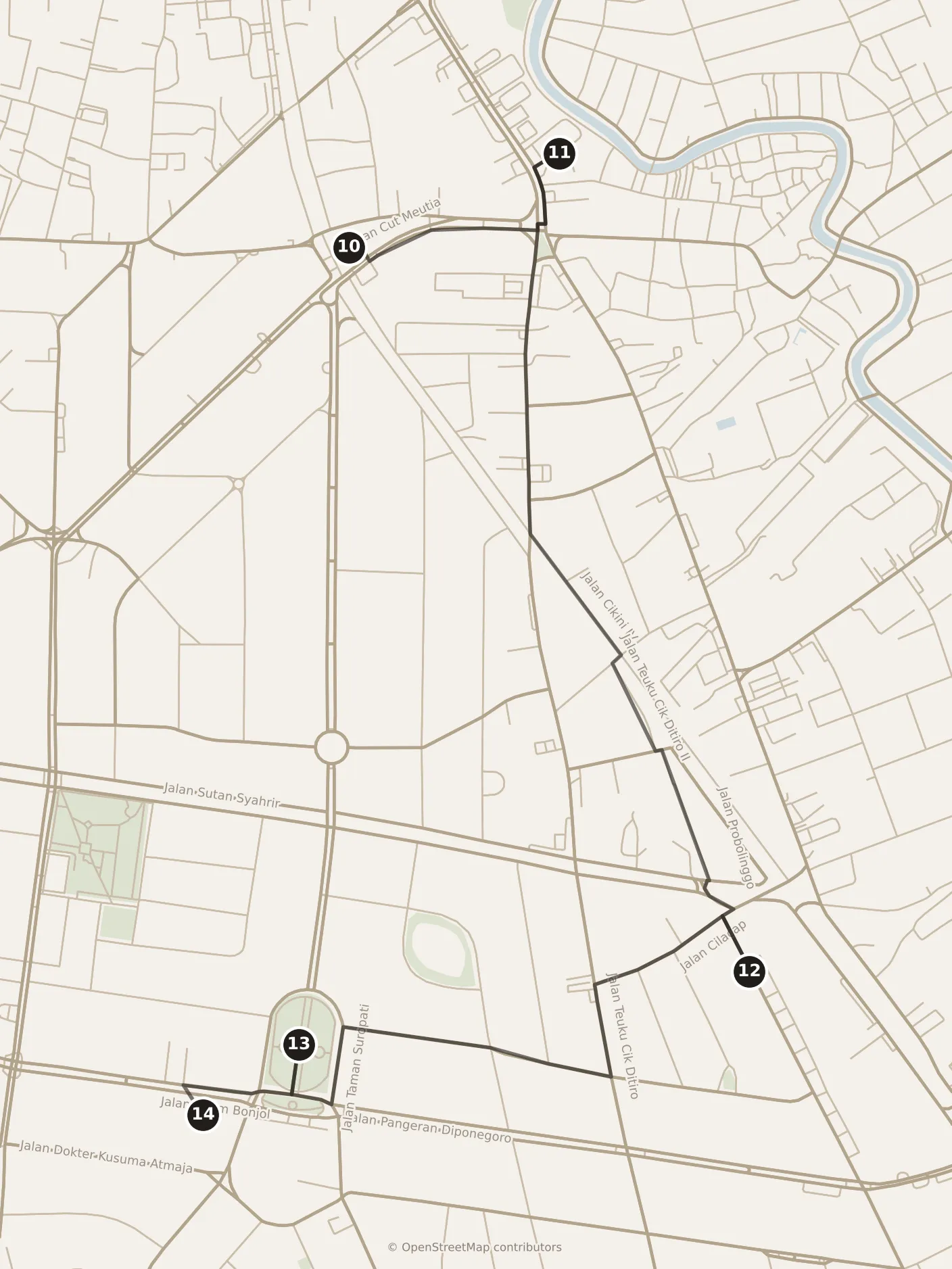
- Morning
- 10Cut Meutia Mosque
- 11Gedung Joang '45
- 12Jalan Surabaya
- 13Taman Suropati
- 14Museum Perumusan Naskah Proklamasi
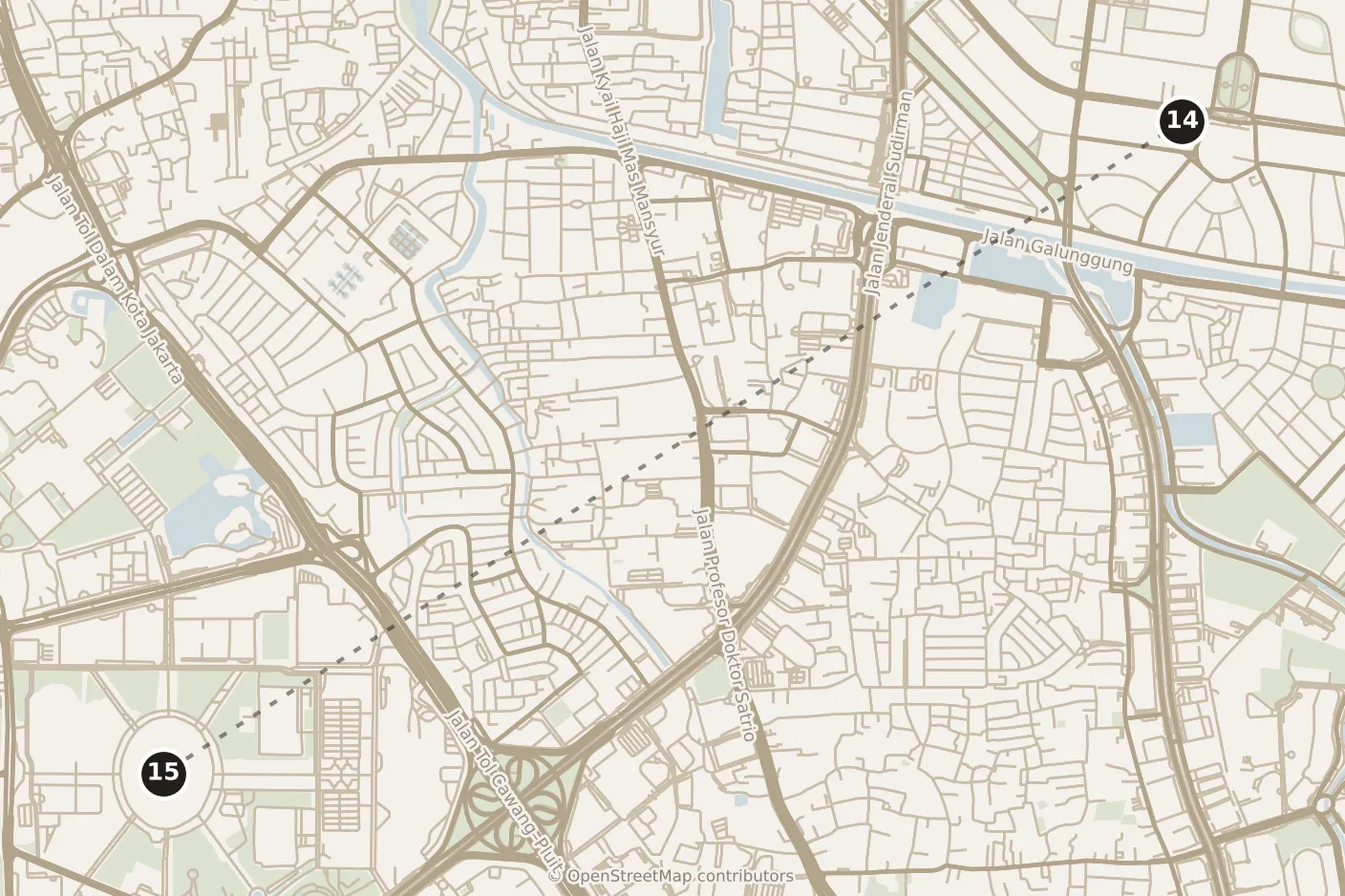
The leg out of the center: from stop 14 by metro, not on foot.
- Afternoon
- 15Gelora Bung Karno Stadium
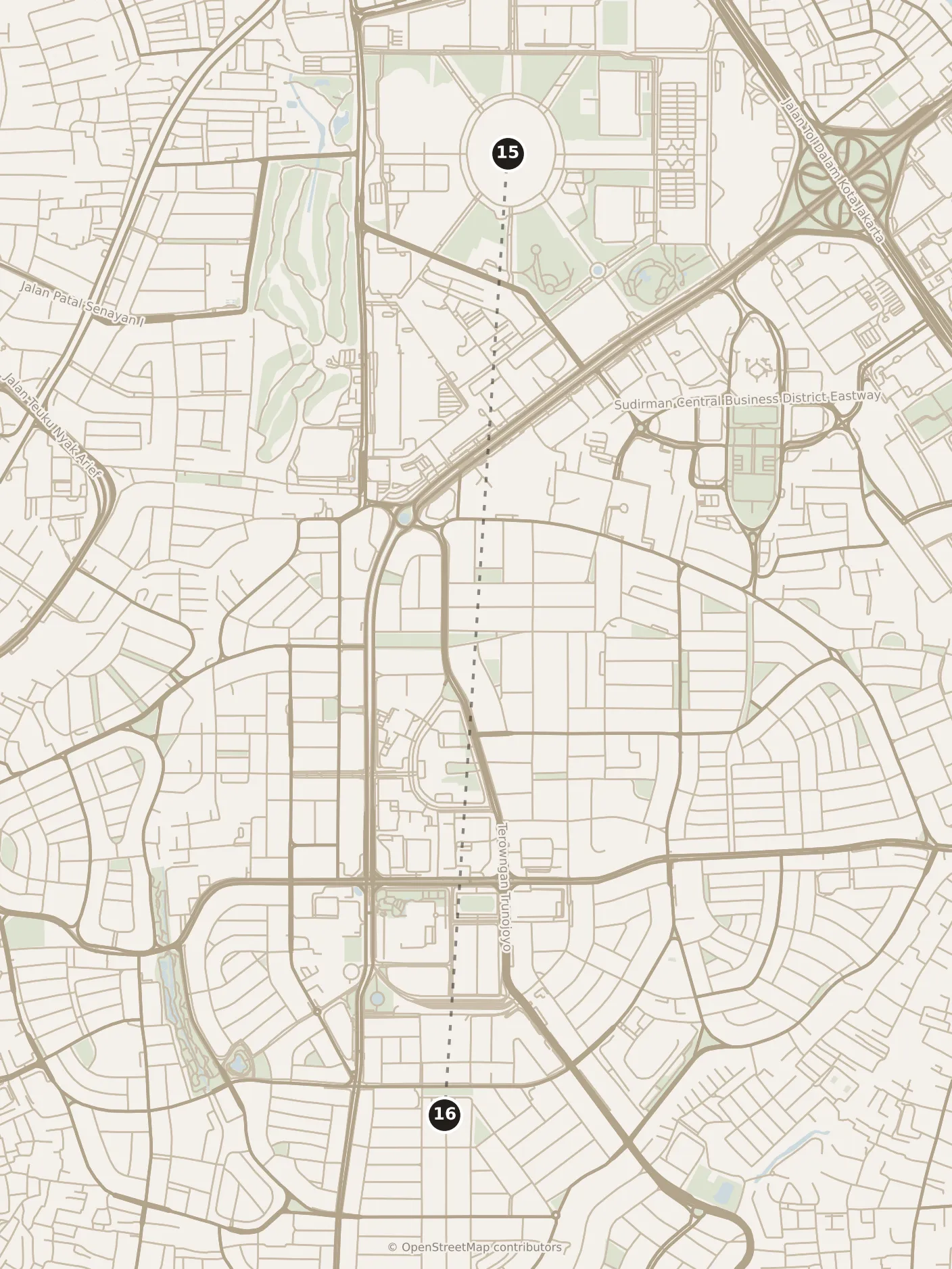
The leg out of the center: from stop 15 by metro, not on foot.
- Evening
- 16Blok M
Today is the making of the country and then the living of it, and it runs north to south: a morning on foot through the garden district, then the metro down the spine to the stadium the republic built to announce itself and the quarter where the city goes out. About eight and a half hours of looking and eating and a little over two of moving, from a half past eight start.
Today has no hinge in a door — every stop but two is a street, a park, a mosque or a complex you can walk into — so it is counted forwards from the start, and the only thing that wants a particular hour is the evening, which improves as it gets dark. The first leg is short: today starts at Gondangdia, the Bogor Line station the garden district was built around, which is one stop south of Juanda and one north of Cikini. From a room on the metro axis that is a five-minute car ride east from Bundaran HI, or twenty-five minutes on foot along the avenue if you would rather walk it than sit in it.
Morning
Five minutes from the station is the Cut Meutia Mosque, and it is worth arriving before nine while it is quiet. Pieter Moojen — the architect who drew the plan for this whole district — designed it in 1922 as the office of a Dutch property firm, and after the colony ended it passed through a water department, a post office, a railway company, the mayor’s office and a ministry before becoming a mosque on 18 August 1987. It has no dome and no minaret because it was never meant to be one. What makes it worth the stop is what conversion did inside: the building faces the street and Mecca does not, so the prayer hall is set at forty-five degrees across the plan, the central staircase was taken out to make room for it, and the mihrab therefore sits in the middle of a room instead of at the end. Twenty-five minutes. It is a working neighborhood mosque: shoes off at the door, shoulders and knees covered, and stay out of the hall itself if a prayer is under way.
Eight minutes east, on Menteng Raya, Gedung Joang ‘45 was the Hotel Schomper, run by its Dutch owner and his wife from 1920 to 1938 and then taken over during the occupation, when the house at number 31 became the meeting place of the young nationalists — Sukarni, Adam Malik and the rest — who in August 1945 drove out to Rengasdengklok, took Sukarno and Hatta out of the city and refused to bring them back until they would declare independence without waiting for anybody’s permission. It has been a museum since 1974. Forty-five minutes: the scale models and the period photographs are the substance, and the recordings of the proclamation being read are worth standing still for.
Then the walk this district exists for. Half an hour south down the wide, tree-shaded avenues, past the villas and the embassies, brings you to Jalan Surabaya, a single kerbside street of antique and junk stalls: brass, lamps, ships’ fittings, records, carved panels, old cameras. Half an hour. Buy nothing on the assumption that it is old — a great deal of it is made to look that way, which everyone here knows and nobody will volunteer — and haggle, because the first price is a question rather than an answer.
Fifteen minutes west is Taman Suropati, the roundabout garden at the center of the district’s plan, with six radiating avenues, big rain trees, a pond, and a scatter of modern sculptures donated by the neighboring countries. Twenty-five minutes on a bench, which is the correct use of it. It is the one piece of this district that belongs to everybody rather than to an embassy, which is most of the reason it is worth the stop.
Four minutes on, at the top of the avenue, is the stop the morning has been building to. Museum Perumusan Naskah Proklamasi — the museum of the drafting of the proclamation text — is an Art Deco house of 1920 that was the British consulate, then the residence of Rear Admiral Tadashi Maeda, the Japanese naval officer who on the night of 16 August 1945 gave his house to the men who had just been brought back from Rengasdengklok. The text of Indonesian independence was written in the dining room, argued over until nearly dawn, typed in a small room off it and read out in another part of the city later that morning. It became a museum on 24 November 1992 and the rooms are laid out as the night went: the meeting table, the piano corner where it was signed, the typewriter. An hour, and take the rooms in order — this is a house where the sequence is the exhibit.
Afternoon
From the museum door, walk twenty-five minutes west along Imam Bonjol and its continuation. It is the shadiest walk on either day and it ends on the main avenue at Bundaran HI, the roundabout at the top of the metro. Eat here — this is the mall-and-tower part of Jakarta and the food courts under it are efficient rather than interesting, but they are cool, and gado-gado, the vegetable plate under peanut sauce, is the thing to order that is not a compromise. An hour. If the walk is too much in the heat, a motorbike does it in eight minutes.
Take the metro south from Bundaran HI Bank Jakarta four stops — Dukuh Atas BNI, Setiabudi Astra, Bendungan Hilir — to Istora Mandiri, and walk a quarter of an hour west into the grounds of Gelora Bung Karno Stadium. Ground was broken on 8 February 1960 and it was finished on 21 July 1962, in time for the Asian Games that August, paid for in part by a special loan from the Soviet Union and built around a ring-shaped roof that the Soviet engineers argued against and Sukarno insisted on: the first circular stadium roof anywhere. It held 110,000 when it opened and 77,193 after the rebuild of 2016 to 2018. You will not normally get inside on a day with no fixture, and you do not need to — the point is the object, and the three hundred hectares of sports complex around it, master-planned by Friedrich Silaban, which on weekends and in the last hour of light fills up with runners, cyclists, football and families and becomes the largest piece of public ground in the city. On a weekday mid-afternoon you will have most of it to yourself, which is the trade this day makes. An hour and a quarter, walking the ring road rather than aiming at anything — it is open ground in the worst hour for it, so carry something cold and take the shade where the ring road offers it.
Evening
Back to Istora Mandiri and three stops further south — Senayan Mastercard, ASEAN Headquarters — to Blok M BCA, which puts you in Blok M. This is the commercial heart of Kebayoran Baru, the garden city laid out from 1948 to a plan of 1938 and finished as a district for a hundred thousand people by 1953, and it is where a great many people in south Jakarta have gone out for forty years. You arrive at about a quarter past four with an hour and a half of daylight, and the right use of it is the second-hand book market inside the shopping center — the square here is a mall and not open ground, whatever the name suggests — and the park beside the station, Martha Tiahahu, which was rebuilt in the early 2020s and is now full of teenagers and skateboards and is the most cheerful thing on either day.
Then dark, and Melawai — the streets that Jakarta calls Little Tokyo because the Japanese community that arrived in the 1980s and 1990s made them theirs, so the signage is bilingual and the restaurants sit above and beside the Indonesian ones rather than instead of them. Much of what opens after dark here serves the expatriate trade rather than dinner — karaoke bars and massage parlors stand among the restaurants — so keep to the eating end of the street and read a door before you go through it. Give dinner an hour and a half. If you want the city’s own dish rather than the archipelago’s or Japan’s, soto Betawi is the one to look for: beef in a broth built on coconut milk, and a full meal rather than a snack. The metro runs from Blok M BCA back up the line late, and everything on it is north of you.
With a third day

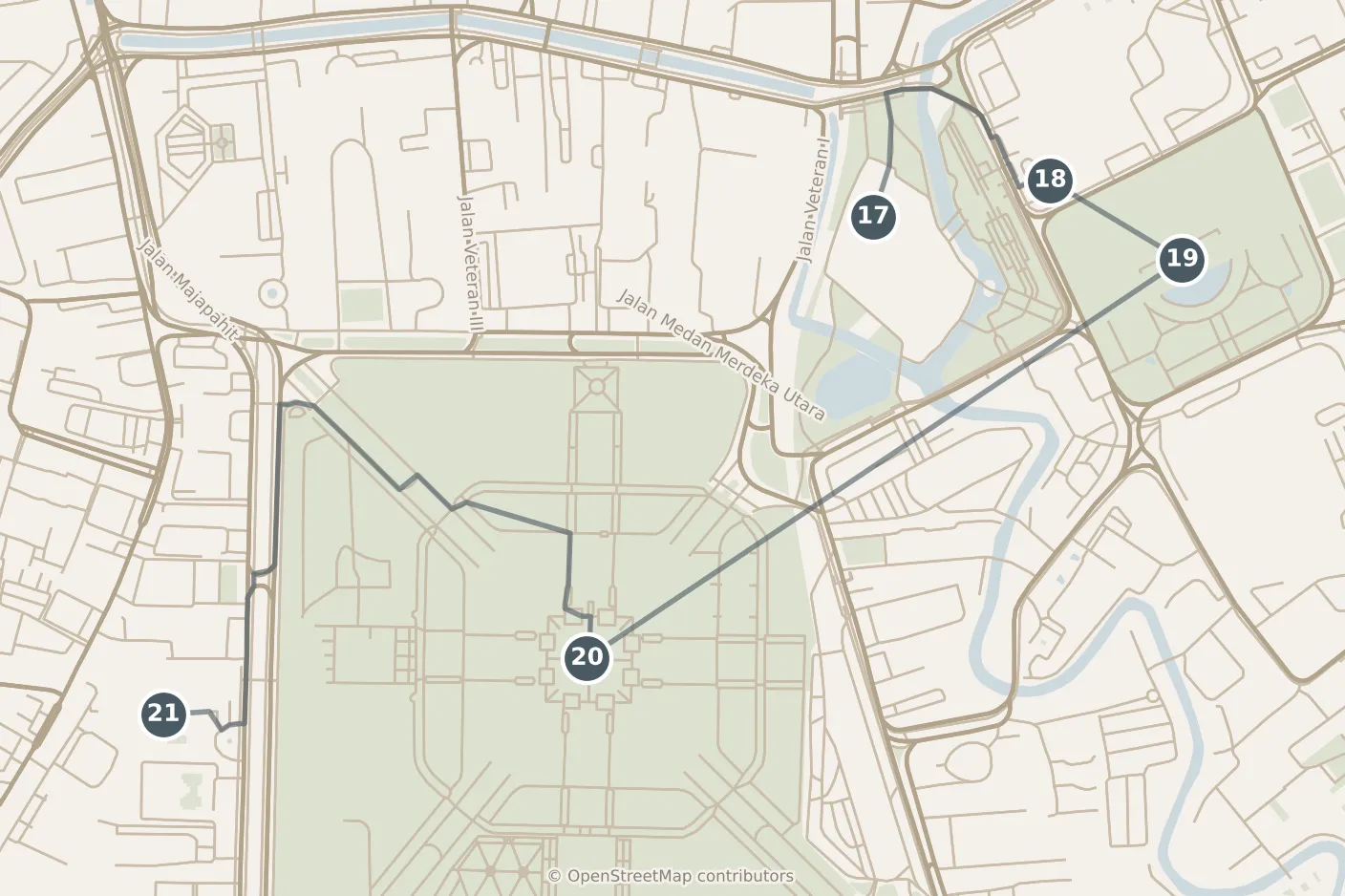
- With a third day
- 17Istiqlal Mosque
- 18Jakarta Cathedral
- 19Lapangan Banteng
- 20National Monument
- 21National Museum of Indonesia
A third day goes in the middle, not on the end. It takes Merdeka Square — the enormous civic space the republic laid out for itself between the old town and the garden district — and inserting it there turns the visit into one continuous march from the harbor to the south, with no day crossing the city and no day doubling back. Appended instead, it would send you north again after day two has already carried you seven kilometers south, which is exactly the mistake the two days above are shaped to avoid.
What moves if you insert it: nothing inside days one and two. They keep their stops, their order and their counts. Day one still ends on Corridor 1 at Glodok; the new middle day starts at Juanda, one stop north of day two’s Gondangdia on the same line. What does change is the weekday arithmetic, and it changes twice — the Practicalities below give both versions, because the two-day rule and the three-day rule are not the same rule.
And if you have only two days but cannot bear to miss the square, this is the honest swap rather than a gesture: drop day one’s afternoon — four buildings and three and a half hours, the two banks and the two museums on the square — keep the harbor morning, eat by the old square, and take the Bogor Line four stops from Jakarta Kota to Juanda at about noon. That reaches the mosque by about half past twelve and the monument by about half past two, which in 2026 was still inside the elevator’s afternoon by an hour and a half; Lapangan Banteng and the national museum are the two stops that go — the museum shuts at four from Tuesday to Friday, and this order puts you at its door as it closes — and you finish under the obelisk instead of in Glodok. Not on a Friday: half past twelve at Istiqlal is the hour that belongs to the congregation, which is the same rule the inserted day is held to below. It is a worse day one and a defensible trip, and it is what most people do.
The day itself: five and a half hours of looking and about an hour of walking, plus lunch, from a half past eight start — the shortest of the three, and it ends in the late afternoon on purpose.
Start at Istiqlal Mosque, seven minutes from Juanda station: the largest mosque in Southeast Asia, holding two hundred thousand, with one minaret where convention asks for two or four, and a dome forty-five meters across for the year of independence. The building is managed for visitors through its own entrance and its own stewards, so this is a stop with a procedure rather than a door — shoulders and knees covered, shoes off, and visits stop and restart around the five prayers. An hour, and much of that is the upper gallery, from which the interior finally reads as the volume it is. The middle of a Friday belongs to the congregation, and that is the one day this day cannot be run as written.
Five minutes east, facing it across the road, is Jakarta Cathedral, consecrated in 1901, neo-Gothic, three spires, and small enough to see in half an hour. A tunnel dug between the two buildings in 2020 and 2021 joins them under the road. On a Sunday there are services through the day and the half hour will not be a quiet one; that is a reason to expect a congregation, not a reason to change the plan.
Four minutes on is Lapangan Banteng, which almost nobody adds and which is the reason this day is better than a two-stop version of itself. The Dutch called it Waterlooplein, and the vast white colonnaded block that fills one whole flank of it was begun in 1809 as a palace for the governor-general; it houses the Ministry of Finance now and you look at it from the grass. In the middle stands the figure of a man snapping his own chains, raised in 1963 for the campaign that brought Irian Jaya into the republic, and it is the most Sukarno object in the city. The square was rebuilt as a park in 2018 with a water feature and a running track. Half an hour. Eat somewhere around here before you go on; the next stop has no shade.
Twenty minutes west is the National Monument, and give the whole thing an hour and a half — which is not a duration for the obelisk but for the fact that it stands in the middle of a park a kilometer square, so the walk in from the edge is a real part of the visit and the line for the elevator is the one thing on these three days that people wait in. In the base, the proclamation room and fifty-one plaster dioramas of the national story are better than that description suggests, and they are what you would keep if you had to choose. Come here before the middle of the afternoon: in 2026 the elevator stopped running at four and did not start again until seven, so the order of this day is set by that gap, and if you find the hour has moved, keep the order anyway — the museum below can absorb a late arrival and the monument cannot.
Twelve minutes west across the avenue is the National Museum of Indonesia, which everyone calls Gedung Gajah after the bronze elephant the king of Siam sent in 1871. Two hours, and on a weekday that is all there is: the museum runs to four from Tuesday to Friday and to five on weekends, and the day above puts you at its door at about a quarter to two. Choose in advance because it is far too much even for the two hours: the Hindu and Buddhist stone galleries, the Prajnaparamita, and the worked gold of the Wonoboyo hoard are the parts of it that exist nowhere else. A fire went through the old wing on 16 September 2023 and the museum reopened on 15 October 2024, and what has come back has come back in stages, so any room list you read beforehand is probably older than the building. You finish here in the late afternoon with an evening free, which is the quiet argument for the third day: it is the only one of the three that gives you a night back. Getting away from the museum door is the day’s one awkward moment, because it stands between two stations and close to neither: Juanda, on the Bogor Line you arrived by, is twenty-eight minutes on foot back across the top of the square, and Gambir — which is the intercity terminus and not a commuter stop — is twenty minutes east. If you are simply going back to a room, take a car.
Practicalities
Nothing on these three days is booked and almost nothing can be — every ticketed thing here sells at its own gate on the day, and a good deal of the route is quay, kampung, street, park and market. The money is worth one sentence because it is so lopsided: the museums on day one each charged somewhere between five and twenty thousand rupiah in 2026, so the whole indoor half of that day costs less than one lunch, and every other admission on these three days is of the same order — the monument’s elevator is the one you wait in line for rather than the one you pay for. What actually adds up is not admission but the motorbike and car rides — the one from the harbor down to the old town, the one out of the garden district if you skip the walk, and whatever the evening needs. Carry cash for all of it: the tap card opens gates and nothing else, and the counters by the old square, the lanes in Glodok and the harbor gate are not where you want to discover what a stall takes.
Monday closes almost every interior on all three days, and this is the one weekday fact worth planning around. Both bank museums on day one publish it plainly: closed Mondays, and Museum Bank Mandiri closed on public holidays too. Every other interior on these days — the tower at the harbor among them, which is a ticketed climb and not open ground — is either a city museum or a national one and should be assumed to keep the same day; check the single one you would most hate to lose rather than all eight. What survives a Monday is the whole of the outdoors: the harbor, the shrine, the old square, Glodok, the garden district, the mosque at Cut Meutia, the stadium grounds and Blok M, and on the third day the mosque, the cathedral, Lapangan Banteng and the park around the monument.
- On two days, run day two on the Monday and swap out its two museums — Gedung Joang ‘45 and the proclamation house, forty-five minutes and an hour — for Istiqlal Mosque and Jakarta Cathedral, which a Monday does not touch. Concretely: get off the same Bogor Line train one stop earlier, at Juanda, do the mosque and the cathedral there, then take the next train one stop south to Gondangdia and pick the morning up at Cut Meutia. From Cut Meutia it is the same half-hour walk south to Jalan Surabaya that the written morning makes from Gedung Joang, and Taman Suropati, the afternoon and the evening are untouched. What you lose is the proclamation house, which is the best thing on day two, so this is the arrangement for a Monday you cannot move rather than a preference.
- On three days that swap is not available, because you are visiting the mosque and the cathedral anyway. So on three days put the Monday on the inserted middle day instead: you lose the monument’s interior and the national museum, you keep the mosque, the cathedral, Lapangan Banteng and the square kilometer of park, and the afternoon you save goes back to Glodok in the evening. That is the one journey back north this shape otherwise refuses, and Glodok is the one stop on these days worth making twice; if you would rather not cross the city again, take the early finish instead, which is the middle day’s own quiet argument.
Friday needs one decision on day one and one on the third day, and none on day two. Museum Bank Indonesia shut at eleven in the morning on a Friday in 2026, and day one’s own count reaches the old town at about ten to eleven — ten minutes of the seventy-five the museum needs — so a Friday day one must either be inverted as described at the top of that day or traded for day two. And the middle of a Friday at Istiqlal belongs to the congregation, so a Friday cannot be the inserted day either. Day two is the Friday day: its one mosque is reached at about nine in the morning and its two museums are morning stops. If your two days happen to be a Friday and a Monday, the two rules do not fight: run day two on the Monday with the swap above, and day one on the Friday inverted as its own section describes. On three days those two rules can genuinely collide, and the calendar settles it rather than you: a Thursday-to-Saturday visit puts the Friday exactly where the square day has to go, and there is no reshuffle that keeps both the order and the rule. So that is the one arrangement in which the square day goes on the end after all — day one on the Thursday, day two on the Friday, the square on the Saturday. It costs one journey back north at the end and nothing else. Sunday touches only two things and neither is a closure: the cathedral has services running through the day, and the Wayang Museum puts on puppet performances twice over on the second and third Sunday of each month, which is a reason to want that Sunday rather than to avoid it. And the month the calendar moves matters more than any weekday. Ramadan and the days around Idul Fitri change the daytime eating this route is built on and the hours at which a visitor is welcome at either mosque, and the interiors keep their own holiday closures on top of the Monday one. If your dates fall there, read each interior’s own hours for those days rather than the rules above.
If it rains, and from November to April it will, in the afternoon and hard. Day one is already built for it: from midday onwards that day is four consecutive interiors, which is not an accident. Day two is the exposed one, and the replacement has the same shape as the thing it replaces. From Bundaran HI, instead of getting off at Istora Mandiri, stay on the metro three stops further to Blok M BCA. You lose the stadium grounds, which is an hour and a quarter and is the one stop on day two that is worthless wet. You gain those hours in Blok M, where the shopping centers and the underground level are joined and dry, and the evening simply starts earlier. Nothing else in the day moves. The corresponding failure on day one is not rain but a shut warehouse: if Museum Bahari has not reopened, do not stand about — the tower and the quay fill the morning and you take the afternoon an hour early, which is an hour more in the two banks.
If you are short of time rather than short of a day, cut in this order. The Fine Art and Ceramic Museum goes first: forty-five minutes, four minutes’ walk, and the only stop on either day whose subject you could meet anywhere. Then the Wayang Museum, on the same square and for the same reason. Then Jalan Surabaya, which is half an hour and a browse rather than a place. Do not cut the harbor morning, do not cut Museum Bank Indonesia, and do not cut the proclamation house: those three are why the two days are shaped as they are, and each of them is something Jakarta has and other cities do not.
The bag. You have a room for two or three nights, so this is only a question about the last morning, and the honest answer starts with a negative: there is no left-luggage arrangement on this route worth sending anyone to, and none of the stations these days use is a place to plan around one. What matters instead is which end of the city your last day finishes at. Day two ends at Blok M BCA, on the metro, twenty-five minutes from Bundaran HI and from Dukuh Atas BNI — beside which is the station the airport train leaves from — so an evening departure after day two works without rearranging anything. Day one ends in Glodok, which is off the metro entirely and an hour from Dukuh Atas in evening traffic; do not put a late flight on the end of it. Inserting the third day does not change this on any shape that keeps the square in the middle, because day two is still the last day. The exception is the Thursday-to-Saturday arrangement above, where the square day goes on the end and the trip finishes at the national museum, which is close to no station: on that one, count on a car to get away and do not put a tight flight behind it. And two stops are genuinely bad with luggage on any arrangement: the harbor quay, which has nowhere flat or shaded to stand, and the walk in across the monument’s park on the third day, which is a kilometer of open ground each way.


_-_img_08.jpg)