Jakarta in one day: Glodok at breakfast, the old Dutch town, and Merdeka Square

Last updated 4 August 2026
Overview
One day is not enough for Jakarta, and the useful thing to do with that sentence is act on it rather than apologize for it. This is a city of ten million people with no center, and the standard mistake is to assemble a day from the five places a list recommends and then spend it in a car between them. The alternative is to pick the one strip where the city that existed before the traffic is still standing, and refuse to leave it. That strip runs about five kilometers north to south: the Chinese market quarter at Glodok, the old Dutch town at the silted river mouth above it, and — after one short train ride — the enormous square the republic laid out for itself once the Dutch had gone.
What a single day costs you is the half of Jakarta that people actually live in: the southern districts where the eating and the drinking have drifted are off this route entirely, and so is the towers-and-malls spine between them, which is no loss. The real sacrifice is Sunda Kelapa, the old harbor where wooden inter-island freighters still tie up and are loaded by hand across a plank. It is half an hour’s walk north of the old town in full sun, with another half hour back, and buying it means giving up either the mosque or the monument. If you get a second day here, that is what its morning is for.
The transport is worth understanding before you start, because it is what makes the day possible at all. The metro stops at Bundaran HI and goes no further north. The bus corridor that opened fifteen years before it — Corridor 1, the first TransJakarta line — carries on up the same axis in its own lane and ends inside the old town. So the plan is: the bus north in the morning, four stops on the Bogor line across the middle of the day, the metro out at night. All three take the same tap card, and getting one is the single thing to sort out before you set off; the city guide says where.
The day has no hinge in the sky, and it is better to say so than to invent one. Six degrees off the equator there is no long summer evening to plan around and no short winter one to fear: the sun goes down between about a quarter to six and twenty past, latest in January and earliest in May, and the whole yearly swing is half an hour. That is a fixed frame rather than a deadline, and it is why this day counts forwards from its start instead of backwards from dusk. Start at eight. Everything above dinner comes to about nine and a half hours, which puts you in the market while it is still a market and at the monument about six and a half hours in — comfortably clear of the one door on this route that shuts in the afternoon.
Those nine and a half hours model the time you spend inside places and walking between them, and two of the things they leave out are large. The monument stands in the middle of a park a kilometer square, so the walk from the edge of it to the base is a real part of the visit and none of the figures below include it; nor do they include the line for the elevator, which is the one thing on this route people wait in. And there is the heat, which is not a condition you walk through here but something you stop for, in shade, several times, with something cold in your hand.
There is no left-luggage arrangement on this route worth sending anyone to, and that is a statement about the route rather than about a locker bank, which can shut in a year. If you have a room, the bag stays in it and the question ends: the day finishes on the metro, and whatever station you are staying near, between Bundaran HI and the southern end of the line, is a short ride from the last stop. If you are between trains you carry it all day, and then two parts of the day below stop being worth their price. The monument is one — a kilometer of open park to cross before you reach the base, then the line for the elevator, which is the one thing on this route people wait in — so with a bag take the base and give the elevator up, or give the monument up altogether and put the hour into the museum. The evening is the other: Jalan Sabang and then Bundaran HI run nineteen and eighteen minutes further south, and a train out is in the opposite direction. Gambir sits on the east side of the same square as the museum, twenty minutes’ walk away, so the museum becomes the last stop of the day and the evening below goes. Decide that before you start rather than when the evening comes: what it changes is the monument, and you reach the monument at half past two.
The day

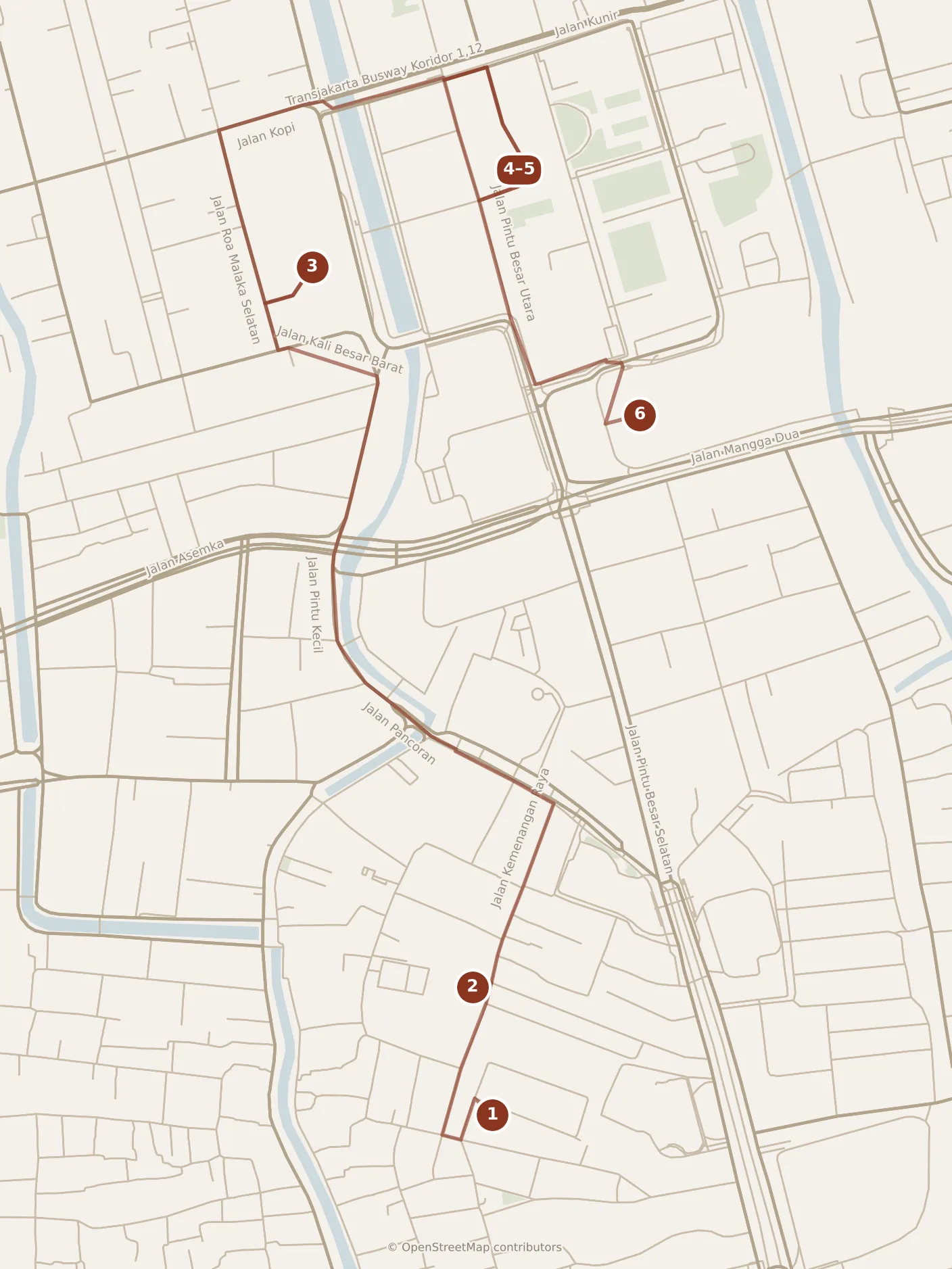
- Morning
- 1Glodok
- 2Vihara Dharma Bhakti
- 3Toko Merah
- 4Fatahillah Square
- 5Jakarta History Museum
- 6Jakarta Kota station
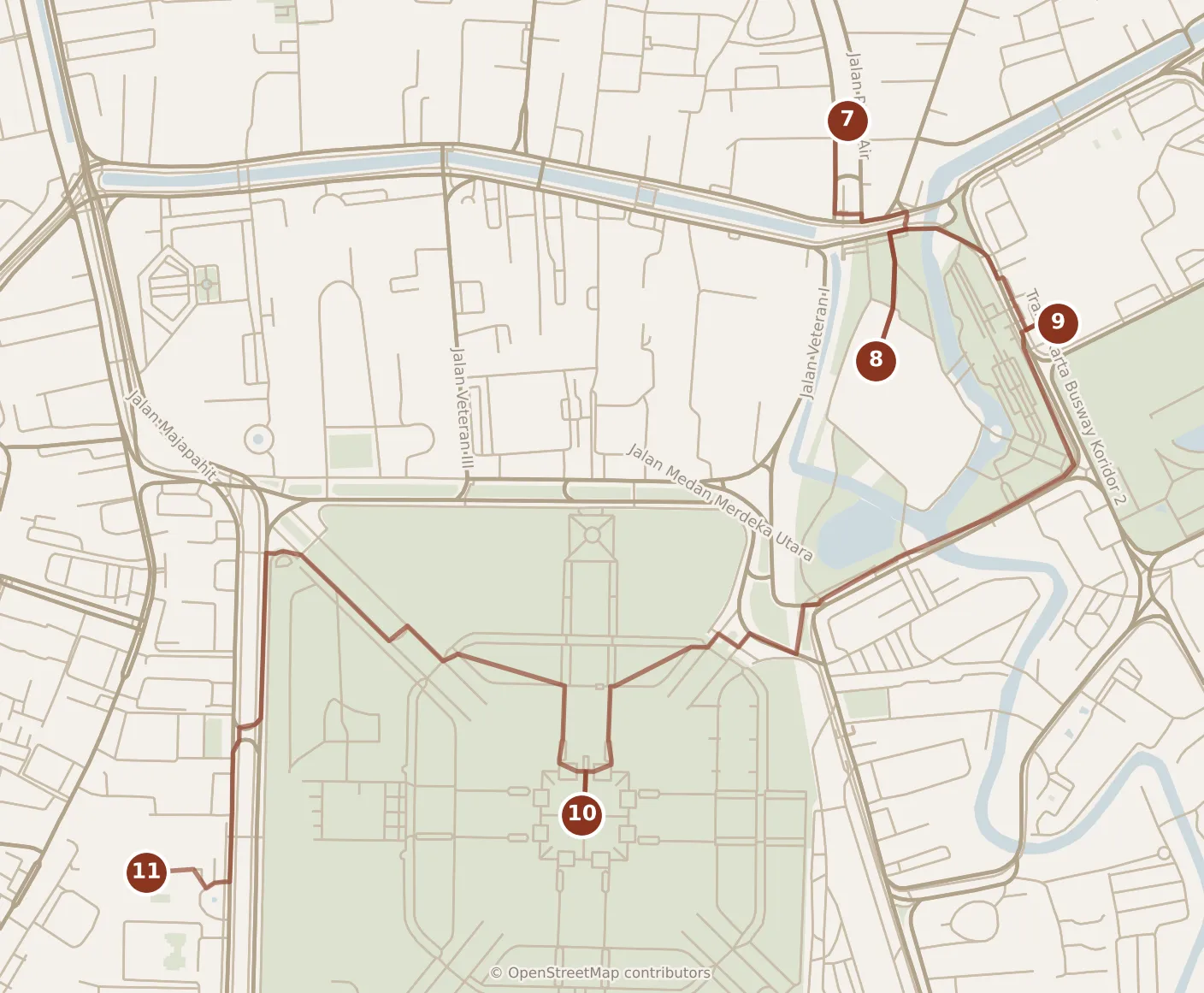
- Afternoon
- 7Juanda station
- 8Istiqlal Mosque
- 9Jakarta Cathedral
- 10National Monument
- 11National Museum of Indonesia
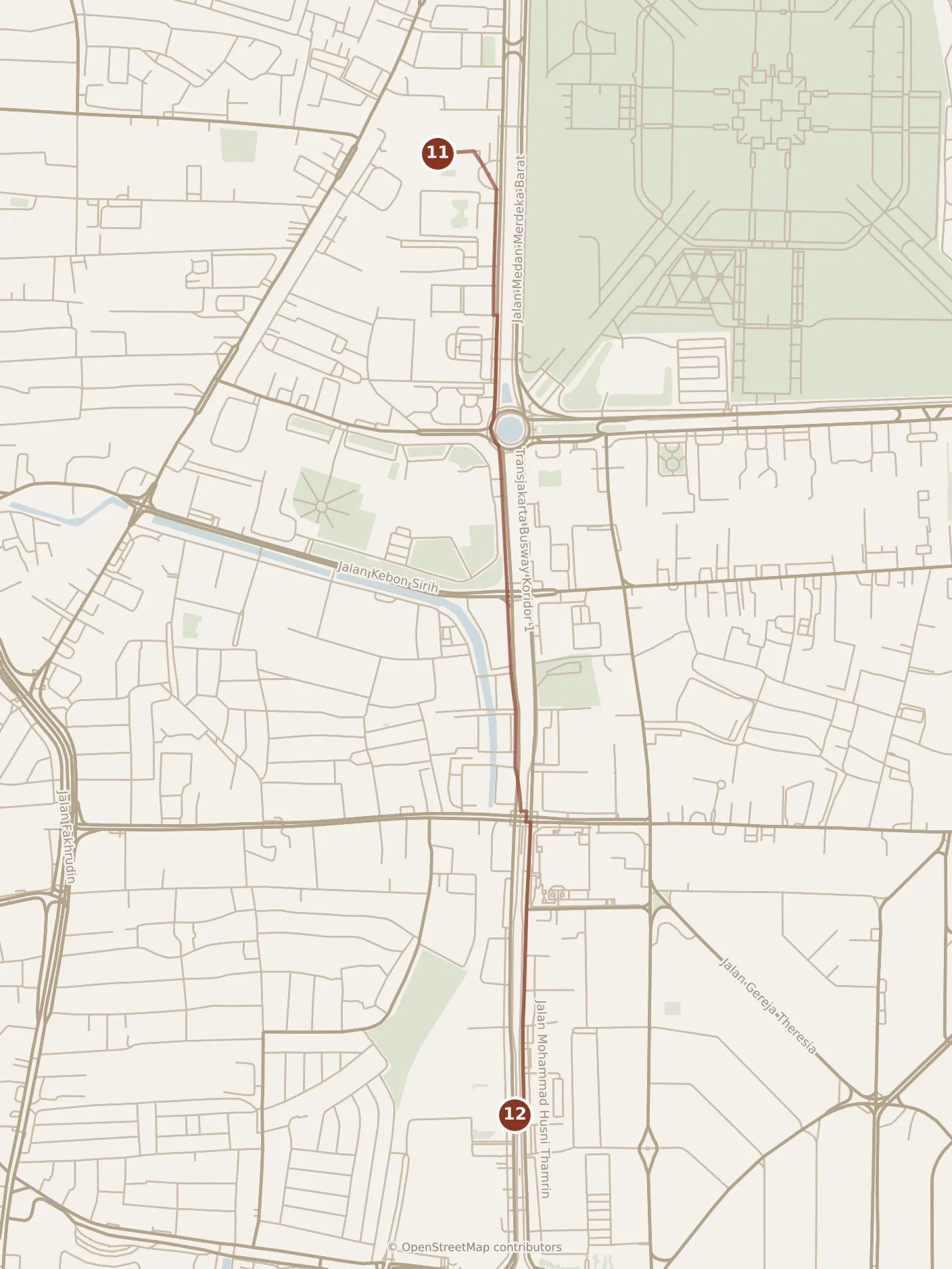
- Evening
- Jalan Sabang — in the prose, not on the map
- 12Bundaran HI MRT station
Morning
Start at the Glodok stop on Corridor 1, and be there at eight. Behind the main road lies Petak Sembilan, the lattice of market lanes at the heart of Jakarta’s Chinatown — the quarter the Dutch pushed the Chinese population into, outside their walls, after the massacre of 1740 — and a market is a market in the morning and a thinning one by eleven. Give it an hour, and eat here: the lanes sell noodles, steamed buns, fried things by the piece and coffee, and this is the best food of the day at the smallest price of the day. Before nine it is also the coolest hour you are going to get.
Three minutes into the lanes is the temple the signs call Vihara Dharma Bhakti and everyone else calls Kim Tek Ie: founded in 1650, before the quarter around it existed, and the oldest Chinese temple in Jakarta. It burned to the ground in that same massacre, was rebuilt, and burned again on 2 March 2015 when a tarpaulin caught from a candle and took the roof frame and some forty of the old figures with it. Rebuilding has gone on in stages since, so what is finished when you arrive is not something this page can tell you — and it does not much matter, because the thing to see is not the fabric. Go in expecting a working temple rather than a monument: spiral incense coils hanging overhead, red candles the size of fence posts, people coming in for ten minutes on the way to somewhere else. Twenty-five minutes.
Then walk north. It is a straight run of a kilometer up the main street, eighteen minutes, and it is the longest single stretch of the morning; the sidewalk gives out in places and the motorbikes use what is left of it, so this is a leg to do before the sun is high rather than after lunch. It brings you to Kali Besar, the last surviving piece of the canal grid the Dutch cut across this swamp in the seventeenth century on the theory that what worked at home would work six degrees off the equator — it did not, and the fevers that followed are part of the reason the colonial town eventually moved inland. On the west bank stands Toko Merah, a house of 1730 built for a Company officer named van Imhoff who went on to run the whole colony, painted red in 1851 by the Chinese merchant who bought it and called the Red Shop ever since. Look at it from the outside and do not plan on getting in: it is used for events rather than run as a museum. Twenty minutes for the house and the canal together.
Six minutes east is Fatahillah Square, the old Stadhuisplein — a wide brick expanse now closed to cars, with men renting out brightly painted old bicycles and the wide-brimmed hats that go with them. Twenty-five minutes to stand in it and work out what you are looking at. Out here in the square rather than inside the museum stands the Si Jagur cannon, a Portuguese gun with a bronze hand cast on its breech, thumb thrust between the fingers in an old fertility sign, which is why people left offerings at it for centuries. The two smaller museums on the square, puppets on the west side and ceramics on the east, are the ones to give up.
The one to go into is the Jakarta History Museum, which is the old Stadhuis itself: Batavia’s city hall, finished in 1710, seat of the Dutch East India Company’s government and then of the colonial city until 1913. Give it an hour and spend it on two things. The cells under the front portico, which were the town’s prison until 1846 and which held Diponegoro in 1830 before he was shipped off into exile. And the rooms of heavy seventeenth- to nineteenth-century furniture, which is where the strangeness of the place actually lands: Dutch, Chinese and Betawi carpentry made for a climate none of it was designed for.
Lunch is on or beside the square, and this is where kerak telor belongs — cooked on a brazier and flipped over the coals, eaten standing up, if you have not already had one this morning. Forty-five minutes, then six minutes south-east to Jakarta Kota station.
Afternoon
Jakarta Kota deserves the two minutes before you go down to the platform. It opened in 1929 to a design by Frans Ghijsels, art deco crossed with local forms, and listed as a heritage building since 1993; everybody calls it Beos, a nickname whose origin nobody quite agrees on. It is a terminus, and the Bogor line starts from it. Take that line four stops to Juanda, about a quarter of an hour with the wait.
Seven minutes from the station is Istiqlal Mosque, the largest in south-east Asia: it holds two hundred thousand people, its dome is forty-five meters across because independence was declared in 1945, and it has a single minaret where the convention is two or four. The thing worth knowing before you go in is who built it. The design was chosen by open competition in the nineteen-fifties and won by Friedrich Silaban, a Protestant from a Batak family — so the largest mosque in the region was drawn by a Christian architect, and the building has been read that way ever since. Forty-five minutes. It is a working mosque and the one stop today that can turn you away for what you are wearing: shoulders and knees covered, shoes off at the door. Visits pause around the prayer times, so it is worth arriving between them rather than on top of one.
Five minutes east is Jakarta Cathedral, which faces the mosque across the road and was consecrated in 1901: neo-Gothic, three spires, two at the front and one over the crossing. Twenty-five minutes. There is a small museum in the upper gallery — vestments, silver, the history of the Catholic church in this country — and it is worth asking about once you are inside rather than counting on. Between the two buildings, dug in 2020 and 2021, runs the Terowongan Silaturahmi, a tunnel thirty-four meters long joining a mosque to a cathedral, which is either the most heavy-handed piece of symbolism in the city or the most necessary, and is probably both.
From the cathedral it is nineteen minutes south-west to the National Monument, plus the walk in across the park, which is not short. The monument is a marble obelisk 132 meters high, begun on independence day in 1961 and finished in 1975, with a bronze flame on top carrying thirty-five kilograms of gold leaf — fifty since the fiftieth anniversary in 1995. In the base is the Hall of Independence, where the typed text of the Proclamation sits in a glass case; the original flag used to be shown beside it and is now too fragile to display. Below that, fifty-one dioramas run round the walls telling the national story from prehistory to the nineteen-sixties in painted plaster, and they are far better than that description makes them sound. An elevator climbs to a platform at 115 meters. Give the whole thing an hour.
Local tip. If the line for the elevator is long when you arrive, give the elevator up and keep the base. The dioramas and the proclamation room are the part of this monument you cannot get from a photograph; the view from the platform is the same city you have been walking through all day, seen through whatever the air is doing that afternoon.
This is the stop the afternoon is ordered around, and what orders it is a door rather than the light. In 2026 the elevator stopped at four in the afternoon and did not run again until seven in the evening. That is why the monument comes before the museum rather than after it: an eight o’clock start puts you at the base at about half past two, an hour and a half clear of the cut-off. If you find the hour has moved, build the afternoon back from whichever hour you find and keep the order — the museum is the stop that can absorb a late arrival and the monument is not.
Twelve minutes west, across the park and the avenue, is the National Museum of Indonesia, which everyone calls Gedung Gajah after the bronze elephant the king of Siam gave it in 1871 and which still stands in the forecourt. It holds the largest collection of Hindu and Buddhist statuary in the country and the largest collection of ceramics in south-east Asia, and it is the stop here that keeps the longest hours — open until six in 2026, and later on the weekend. Give it an hour and a half, which is not enough, so choose in advance: the gallery of temple statuary and the treasure rooms of worked gold are the parts you cannot see anywhere else. A fire went through the old wing on 16 September 2023 and the museum reopened on 15 October 2024 with an exhibition about the fire itself; what has returned has returned in stages, so any room-by-room list you read beforehand is probably older than the building you walk into.
Evening
Nineteen minutes south of the museum, and you will do the last of it as the light goes, is Jalan Sabang: a short street of small eating places a few minutes off the main avenue, and central Jakarta’s standing answer to where to eat after work. Charcoal smoke on the sidewalk, plastic stools, satay and fried rice cooked to order. It is the right ending because it is the opposite of everything above it — nothing to look at, nothing to understand, no ticket. If you want the city’s own dish rather than the archipelago’s greatest hits, soto Betawi is the one: beef soup made with coconut milk, and a proper dinner rather than a snack. Give it an hour and a quarter and do not hurry it.
Then eighteen minutes further south down the avenue, or a few on the back of a motorbike if the day has finished you, is Bundaran HI, the northern end of the metro. Trains run late. Whatever station you are staying at is south of here, which is the small piece of arithmetic this route was built on: you started at the top of the city and you end it pointing home.
Practicalities
Nothing on this route is booked in advance and nothing needs to be — every gate here is a walk-up counter. The shape of the money is worth knowing all the same, because it is lopsided. The national museum’s foreign-visitor ticket was in the hundred-to-two-hundred-thousand-rupiah range in 2026 and is the largest single cost of the day by a wide margin, while the old city hall was a few thousand in the same year and the mosque, the cathedral and the square are free. If the budget has to give somewhere it gives at the museum, and the honest version of that trade is that the museum is the best building on this list.
Monday is the day that breaks this itinerary, and two of its closures are certain enough to name. The monument was shut on Mondays in 2026 unless the Monday fell on a national holiday, and the national museum was shut on Mondays outright. The old city hall is a city-run museum and carries the same risk — check that one before setting out rather than taking it on trust here, because it is the hour the morning is built around. What survives a Monday is the market, the temple, the canal, the square, the mosque, the cathedral and the park around the monument, which is open every day — so a Monday here is a walking and eating day, though the mosque and the cathedral still put an hour of it under a roof. If that is the day you have, plan it that way rather than arriving at three locked doors.
Friday needs one swap, and it is an easy one. The middle of a Friday belongs to the congregation at Istiqlal rather than to visitors, and this route reaches the mosque at about a quarter to one. So on a Friday take the monument first — twenty minutes straight across from Juanda — and come back north for the mosque and the cathedral afterwards, which puts the museum last at around four. That works only while the museum is still open at half past five, which it was in 2026 — so read the closing hour on the door before you commit to the swap, because the swap is what puts the museum last and nothing else in this day can go there. A Sunday needs no swap at the mosque, but the cathedral will have services running through the day: a reason not to count on a quiet twenty-five minutes, rather than a reason to change anything.
There is no transport inside this day except the one train ride, Jakarta Kota to Juanda, four stops on the Bogor line in the middle of the day. Everything else is on foot and it comes to about seven and a half kilometers, a little under two hours of walking, broken into legs of under twenty minutes each. Four legs sit at the top of that range and are worth knowing about in advance: north out of Glodok in the morning, the cathedral across to the monument in the early afternoon, the museum down to dinner at dusk, and dinner down to the metro after it. Two hours on foot six degrees off the equator is not two hours on foot at home.
The route has almost no roof over it, which matters from November to April, when the rain arrives in the afternoon and arrives hard. The sheltered part of this day is its second half — the mosque, the base of the monument, the museum — so the order above is already the order that puts you under cover when the sky opens, and it is worth keeping for that reason alone. If the rain catches you in the old town in the morning instead, the museum in the old bank building beside Jakarta Kota station is air-conditioned, and is the other indoor hour in that quarter worth spending.


_Fatahillah_Square_(2025)_-_img_04.jpg)
.jpg)