Honolulu in two to three days: Diamond Head, Waikīkī and the old capital, with Pearl Harbor for a third

Last updated 10 October 2026
Overview
Honolulu is two cities that share a bus line. One is Waikīkī, the strip of hotels and sand on the south shore where almost every visitor sleeps; the other is the old capital a few kilometers west, where a kingdom was governed from a palace until 1893 and where the state is governed from beside it now. Most visitors see only the first. Two days is enough to do both properly: the first on the crater and the beach, the second downtown. A third day goes to Pearl Harbor, which is the one stop on Oʻahu that needs planning weeks rather than hours ahead.
This itinerary assumes you are staying in Waikīkī, because that is where nearly everyone stays, and that you have no car. Nothing below needs one. Day one is on foot with one short taxi or a long uphill walk; day two is a bus in, a walk through the center and a bus back; the third day is a longer bus ride or a taxi each way. Parking in Waikīkī and downtown is the reason not to rent a car for these days, and a car becomes worth having only when you leave the city for the north and east shores, which these days do not do.
Two things set the order before you read the days. Diamond Head is booked in advance by entry window, and the early windows are the good ones, because the trail has almost no shade and the heat builds through the morning — so day one is built forwards from an early start. And the palace on day two runs its tours from Tuesday to Saturday and is closed on Sunday and Monday, so put day two on a Tuesday to Saturday, moving the days around if you must; day one’s crater, park and beach keep no weekly closures.
Day one

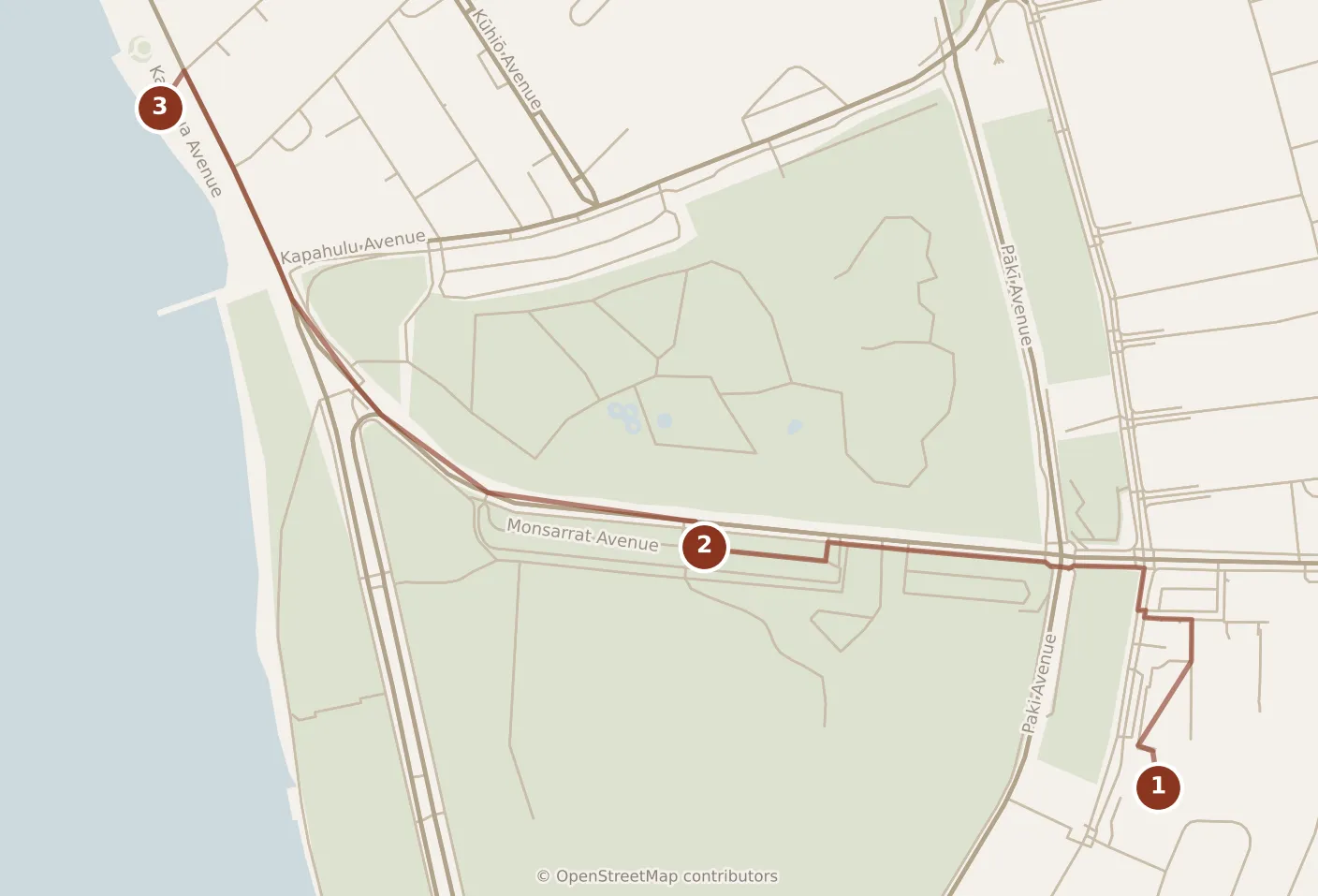
- Day one
- 1Diamond Head State Monument
- 2Kapiʻolani Park
- 3Kūhiō Beach
- Duke Kahanamoku statue — in the prose, not on the map
Today is the edge of Waikīkī and the crater that closes it to the east, and it runs in one direction: up the hill first while the air is cool, then down to the park and back along the sand.
Morning
Diamond Head State Monument is the volcanic tuff cone at the eastern end of Waikīkī’s view, and the walk is up the inside of it. You enter the crater floor through a tunnel in its wall, and the trail climbs from there to the rim: about 1.3 kilometers each way and roughly 170 meters of climb, on a path that starts paved, turns to switchbacks of loose rock, and ends in flights of concrete steps and a short dark tunnel built for the coastal artillery observation post at the summit. At the top you stand on the bunker roof with the whole of Waikīkī and downtown spread out to the west and the open Pacific to the south. Give the trail and the summit about two hours, and do not linger on the switchbacks in full sun.
Since 2022 out-of-state visitors have had to reserve an entry window in advance, on foot or by car, through the state parks reservation site; the entry fee for a walker was a few dollars and parking for a car around ten dollars in 2025. The first windows began at six in the morning in 2025. Take one of them: the trail faces the sun and the summit has no shelter, and an early window is the difference between a climb and an endurance test. If the first window has moved, take whichever is first now.
To get there from Waikīkī, a taxi or ride-hail to the crater’s parking lot is the quick way, around a quarter of an hour in the morning. On foot it is about three kilometers from the Kūhiō end of the beach, close to fifty minutes, mostly uphill along Monsarrat Avenue and then through the road tunnel into the crater — pleasant at dawn, and it doubles the morning. Carry more water than you think you need; there is none to buy on the trail itself. Hawaiʻi banned the sale of sunscreens containing oxybenzone and octinoxate in 2021, to protect the reef, so bring a mineral one or buy one here.
Afternoon
Walk back down the way you came in — Monsarrat Avenue runs downhill from the crater’s road to the park, about two kilometers, half an hour on foot. The stretch of it nearest the crater has a strip of small food places and is where breakfast or an early lunch goes after the climb; a plate lunch or a bowl of poke is what this part of town eats.
Kapiʻolani Park is the large flat green at the foot of the crater, dedicated in 1877 and one of the oldest public parks in the islands. It is where Waikīkī stops being hotels. There is nothing to see in it so much as somewhere to sit under a banyan out of the sun, and that is what it is for after the morning: give it as long as your legs want.
From the park’s western side it is fifteen to twenty minutes along Kalākaua Avenue, with the sea on your left, to Kūhiō Beach, the stretch of Waikīkī where a low sea wall makes two sheltered pools. This is where to swim if the open beach looks rough or you are with children. Do not jump from the wall or stand on it when there is surf. Swim near the lifeguard towers along this shore and nowhere the water is breaking over rock; the reef is shallow in places and the stretch inside the wall is the gentle one.
Above the beach stands the Duke Kahanamoku statue: the Olympic swimmer and surfer who did more than anyone to take surfing from Hawaiian beaches to the rest of the world, in bronze with a surfboard behind him and, most days, fresh lei hung on his outstretched arms. Look for five minutes and go back in the water.
Evening
Stay on the sand. This is the one stop on day one whose value depends on the hour: Waikīkī looks west along its own shore, and the beach at the end of the day — the light going gold on the water, the surfers coming in — is the reason people come back. You are already there, which is the point of ending the day here rather than anywhere else. Dinner is anywhere along Kalākaua Avenue, and the inland streets one block back are cheaper than the beachfront.
Local tip. If the morning ran late and you are short of energy, skip the park rather than the beach: the park is where you rest, and the sand at Kūhiō does that job just as well.
Day two

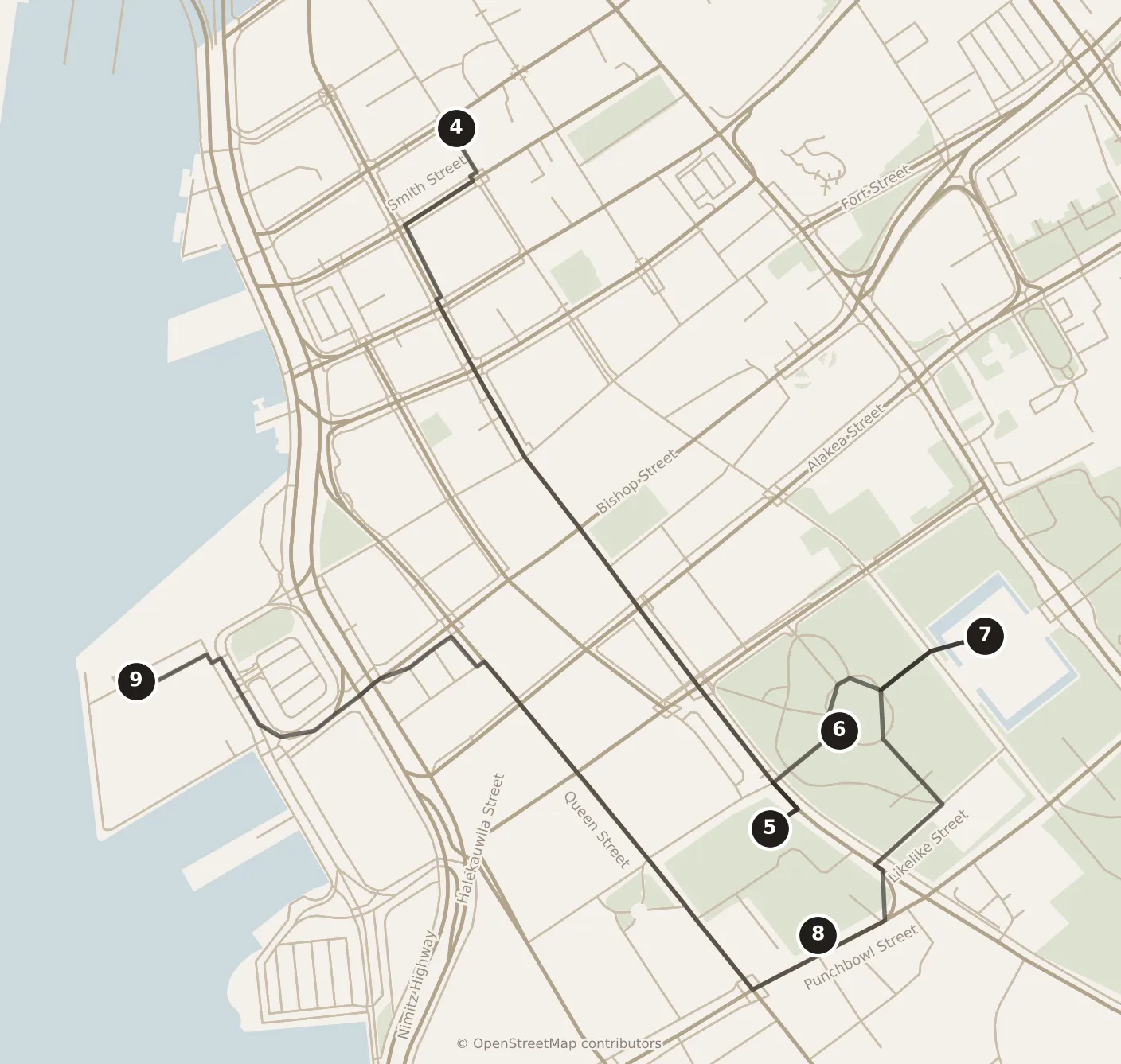
- Morning and afternoon
- 4Chinatown
- 5Kamehameha Statue
- 6ʻIolani Palace
- 7Hawaiʻi State Capitol
- 8Kawaiahaʻo Church
- 9Aloha Tower
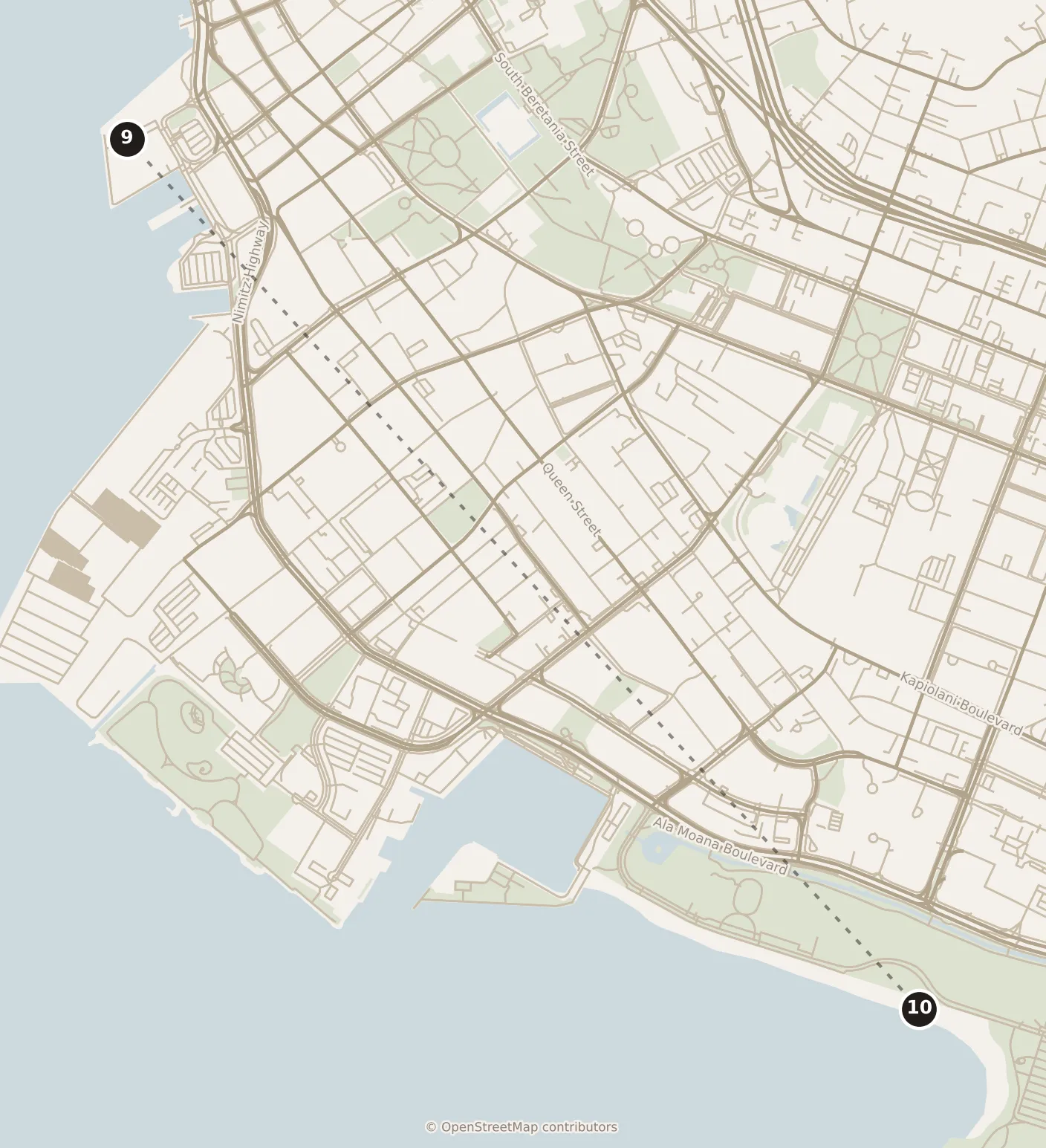
The leg out of the center: from stop 9 by bus, not on foot.
- Evening
- 10Ala Moana Beach Park
Today is the old capital, and it is a different city from yesterday’s: a working downtown with a palace in the middle of it. Everything from the market streets to the harbor lies inside about a kilometer and a half, so after the bus in you walk the whole day.
Morning
From Waikīkī, the city buses known as TheBus run along Kalākaua Avenue and on into downtown along King Street; routes 2 and 13 are the usual ones, and the ride takes around half an hour or more depending on traffic. Pay with a HOLO card, the rechargeable fare card; the parent guide has how the fares work. Get off where King Street meets Maunakea Street, at the edge of Chinatown.
Chinatown is best early, because its open-fronted markets are a morning thing: fish laid on ice, produce, roast meat hanging in shop windows, and along Maunakea Street the lei sellers stringing flowers at their counters. The district grew from Chinese and later Japanese and other immigrants who came to work the sugar plantations, and it burned almost entirely in 1900; most of the low brick and stone buildings date from the rebuilding after it. Give it an hour, and eat here — dim sum or a steamed bun is the breakfast this neighborhood is good at. King and Maunakea Streets, where the markets and the lei stands are, are the ones to walk.
From the market corner, walk east along King Street to the government district, about a kilometer, fifteen minutes. The Kamehameha Statue stands in front of Aliʻiōlani Hale, the former government building that now holds the state Supreme Court: the king who united the islands, gilded, with a spear in one hand and the other held out. Ten minutes is enough.
ʻIolani Palace is across the road, and it is the reason for the morning. It was the royal residence of the last two monarchs of the Hawaiian Kingdom, finished in 1882 and lit by electricity within a few years — before the White House. Inside are the throne room, the state dining room and, upstairs, the room where Queen Liliʻuokalani was held after the overthrow of the monarchy, sewing a quilt that hangs there now. You walk the floors in the cloth covers they hand you at the door. Give it an hour and a half.
Book it, at least the day before. The palace sells its guided tours and its self-guided audio tours online or by phone only, with no walk-up or same-day sales; the window in the barracks building on the grounds only hands over tickets already booked. An adult ticket was in the high twenties for the self-led audio tour and a little under thirty-five dollars for the guided one when this was written. Tours run from Tuesday to Saturday.
Afternoon
Walk round the back of the palace to the Hawaiʻi State Capitol, two or three minutes away. It dates from 1969 and it is a building that explains itself: the two legislative chambers are cone shapes rising like volcanoes, the columns around them are meant as royal palms, and the pool that surrounds it stands for the ocean. The center is open to the sky. Between it and the palace stands a bronze of Queen Liliʻuokalani, and in front of the capitol a statue of Father Damien, the priest who worked among the people exiled to the leprosy settlement on Molokaʻi. Half an hour covers it.
Then south across the road, about seven minutes on foot, to Kawaiahaʻo Church, built between 1836 and 1842 from blocks of coral cut from the reef offshore — a gray, plain building that took years of diving to raise. King Lunalilo, who chose to be buried among his people rather than at the royal mausoleum, lies in his tomb in the churchyard by the gate. It is a working church, so dress and behave as for one. Give it twenty minutes.
From the church, walk west to the waterfront and Aloha Tower, about a kilometer, a quarter of an hour. Built in 1926 as the harbor’s lighthouse and clock tower, ten stories tall, it was the tallest building in the territory for decades, and it was what ship passengers saw first when everyone arrived by sea. There is an observation level at the top, closed for renovation since the pandemic with a reopening aimed at the tower’s centennial in 2026; check whether it is open, and if it is, it gives you the harbor and the downtown towers from above. If the day is running short, this is the stop to drop: everything else on day two is the story of the kingdom, and this is only the view of it.
Evening
Take the bus back east along the shore road and get off at Ala Moana Beach Park, on the way to Waikīkī rather than off it. Its long beach is protected by an offshore reef, so the water is calm enough to swim even when Waikīkī is rough, and it is where Honolulu’s own residents come in the evening. Magic Island, the landscaped peninsula at its eastern end, is where people sit for the last of the light. From here Waikīkī is a short bus ride or up to half an hour on foot.
With a third day

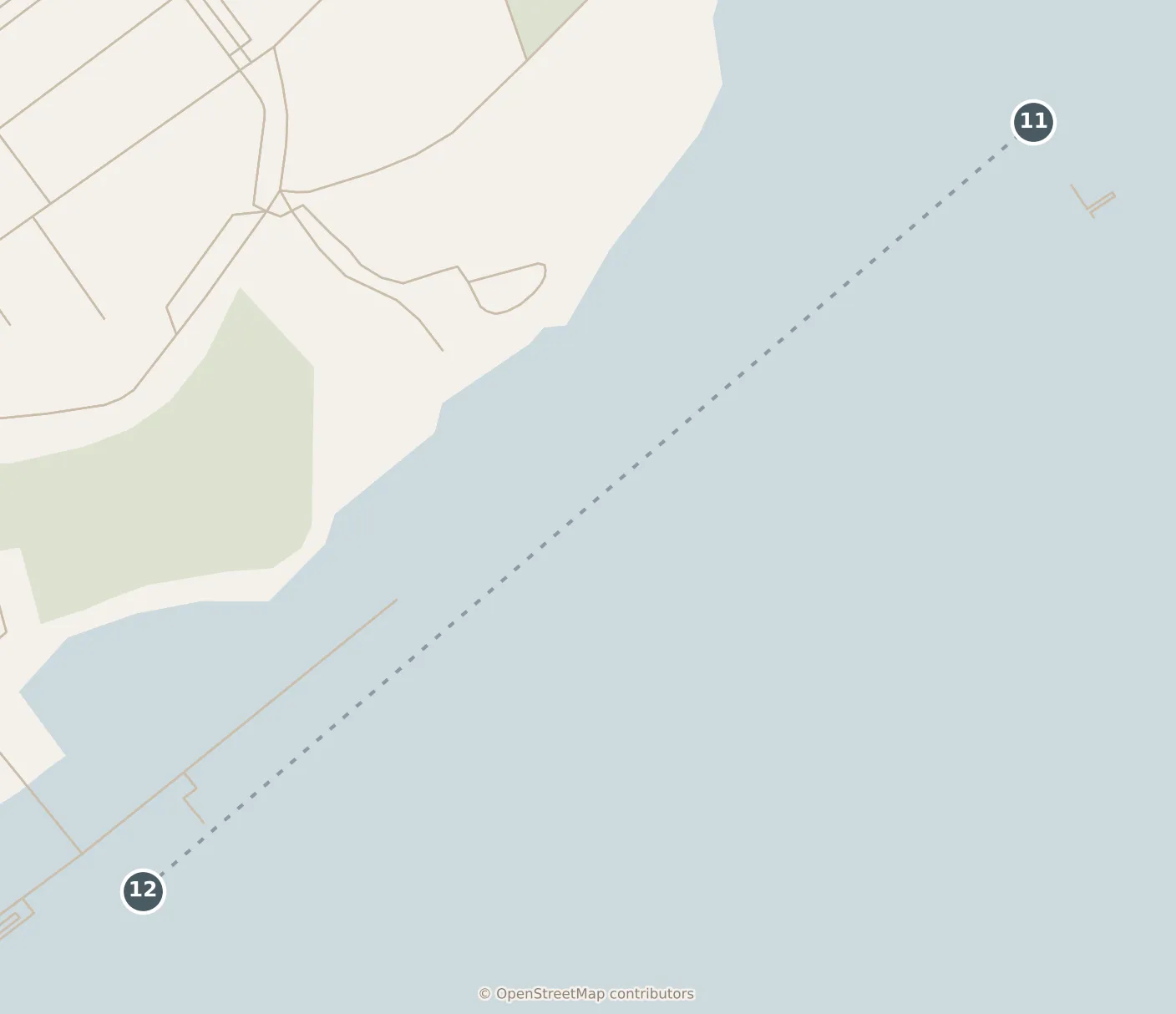
- With a third day · stops 11–12
- Pearl Harbor Visitor Center — in the prose, not on the map
- 11USS Arizona Memorial
- 12Battleship Missouri Memorial
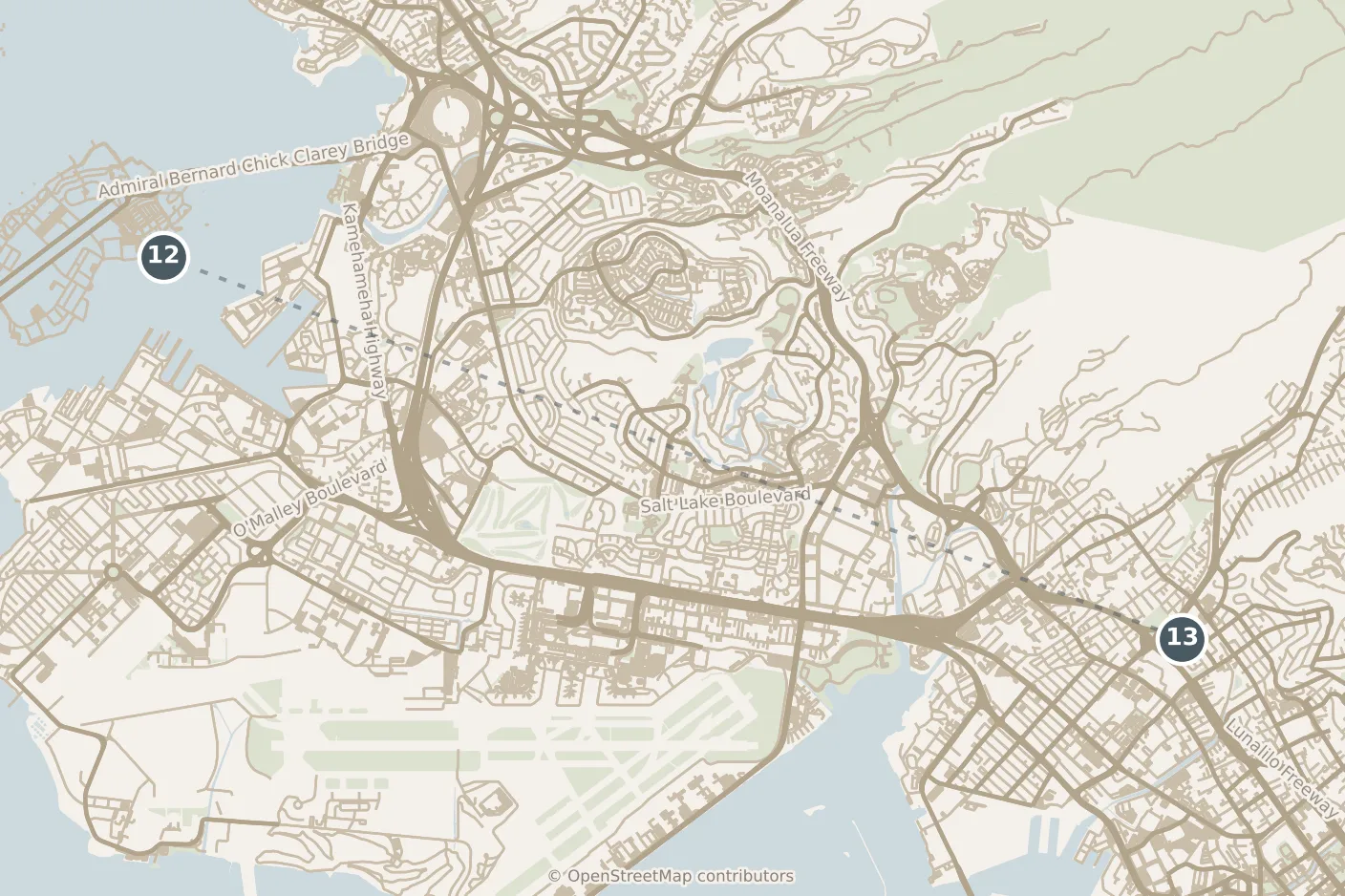
The leg out of the center: from stop 12 by taxi, not on foot.
- With a third day · stop 13
- 13Bishop Museum
Give the third day to Pearl Harbor, and give it the morning.
Pearl Harbor National Memorial is about fifteen kilometers west of Waikīkī, beside the airport. TheBus route 42 reaches it, and from Waikīkī the ride takes around an hour; a taxi is much quicker. The site is run by the National Park Service, and its visitor center opened at seven in the morning in 2026. The memorial day rests on that hour and on the ticket you hold, so build the morning back from your slot: if your program time is early, leave Waikīkī an hour and a quarter before it by bus, and earlier if you want to see the visitor center’s two museum galleries first. If the opening has moved, build it back from the new one.
Leave your bag behind. The memorial allows nothing beyond a small clear bag or a clutch-sized purse; there is a paid bag-storage point by the entrance, and anything larger is left there or not brought.
The USS Arizona Memorial is the reason for the trip: a white bridge-like structure built across the sunken hull of the battleship, where more than nine hundred of its crew are still entombed, and where oil still rises from the wreck to the surface. The program itself takes about forty-five minutes: a Navy boat across the harbor, time on the memorial, and the boat back. The documentary film plays separately in the visitor center’s theater, at quarter past and quarter to the hour, and is worth catching before or after. Admission is free but the program is ticketed: book it through the federal government’s recreation reservation site, under the memorial’s own name, with a reservation fee of a dollar. Tickets are released about eight weeks ahead, and a second batch the day before, both at three in the afternoon Hawaiʻi time; same-day walk-up tickets have ended, so the day-before release is the second chance if you missed the first.
Two other paid sites are on Ford Island, across the harbor, the Battleship Missouri Memorial and the Pearl Harbor Aviation Museum, reached by a shuttle bus from the visitor center with tickets of their own. The Battleship Missouri Memorial is the battleship on whose deck the Japanese surrender ended the Second World War in 1945, and the deck where it was signed is marked. Give it an hour and a half if you go; if one of the Ford Island sites is all your legs have left, this is the one, because it finishes the story the Arizona starts.
That is a full morning and the early part of an afternoon. If you have energy after it, the Bishop Museum in Kalihi lies roughly between Pearl Harbor and Waikīkī and is best reached by taxi. It is the state’s museum of Hawaiian and Pacific culture, and its Hawaiian Hall — three stories around an open center — holds feather cloaks of the chiefs, carved figures and, overhead, the skeleton of a sperm whale. Give it two hours. It is also day one’s rain plan: if the morning is wet and the crater trail is miserable, swap the climb for the museum and take Diamond Head on the third day instead.
Practicalities
Three things are booked before you arrive. The Diamond Head entry window, on the state parks reservation site, which opens bookings thirty days ahead, earlier rather than later for the first windows; the ʻIolani Palace tour, from the palace itself, at least the day before; and the USS Arizona Memorial program, on the federal recreation reservation site, up to eight weeks ahead. None of the three can be bought on the day: without the reservation you are turned away or put on a standby nobody can promise.
ʻIolani Palace is the one stop here that closes on some days of the week: its tours run from Tuesday to Saturday. If day two would fall on a Sunday or a Monday, move the downtown day to a Tuesday to Saturday; nothing on day one keeps weekly hours, and the order inside each day still works.
Day one is on foot from the crater down, and the longest single stretch is the half-hour walk down Monsarrat Avenue. Day two is two bus rides and a walking loop no longer than a kilometer at a time. The third day is a bus or taxi there, a boat to the memorial and a shuttle to Ford Island, all of them part of the visit. The parent guide covers arrival from the airport, the HOLO card and how TheBus fares work.


