Honolulu in one day: Pearl Harbor, the royal center and an afternoon on Waikīkī

Last updated 10 October 2026
Overview
Honolulu in one day is a line drawn from west to east, and the order is the whole plan. Pearl Harbor sits out by the airport, the old royal and civic center is in the middle, and Waikīkī is at the eastern end. Done in that order, nothing is visited twice and the day ends on the beach rather than in traffic on the H-1.
This is a city that has to be ridden between, not walked: the three parts of the day are each compact on foot, but they are kilometers apart, so the route has three rides in it and they are named below. What one day costs you is Diamond Head, the crater hike that most visitors put first. It wants its own booked morning, and Pearl Harbor wants the same morning, so this route chooses the memorial and gives the crater as the alternative further down.
The day has one hinge and it is at the start. The USS Arizona Memorial program runs on timed, reserved slots, and the earliest is the one to have: the visitor center is quietest then, the morning is coolest, and it puts the whole of the rest of the day in order. Everything after it can slide by half an hour without breaking anything.
The day

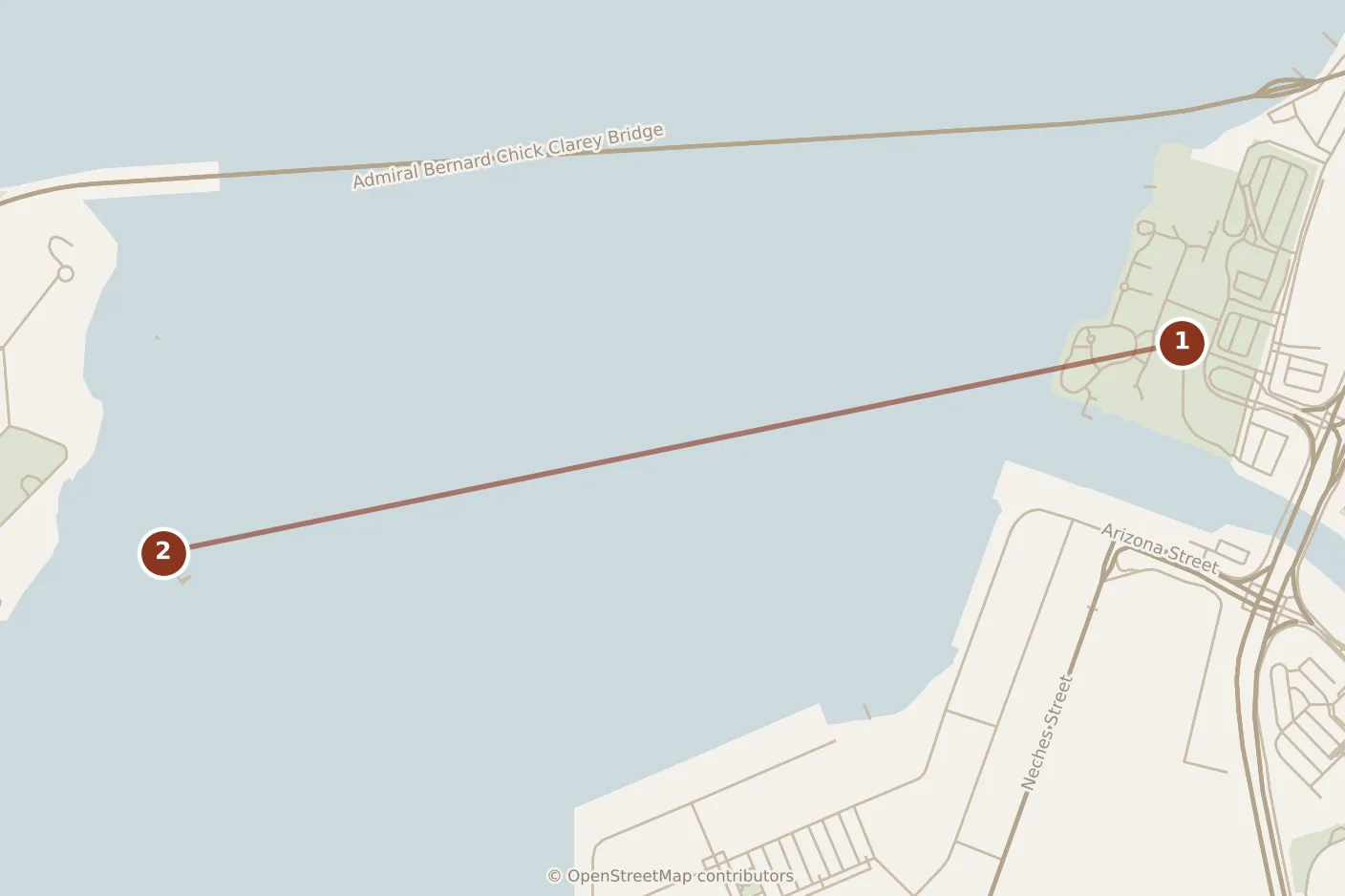
- Morning
- 1Pearl Harbor National Memorial
- 2USS Arizona Memorial
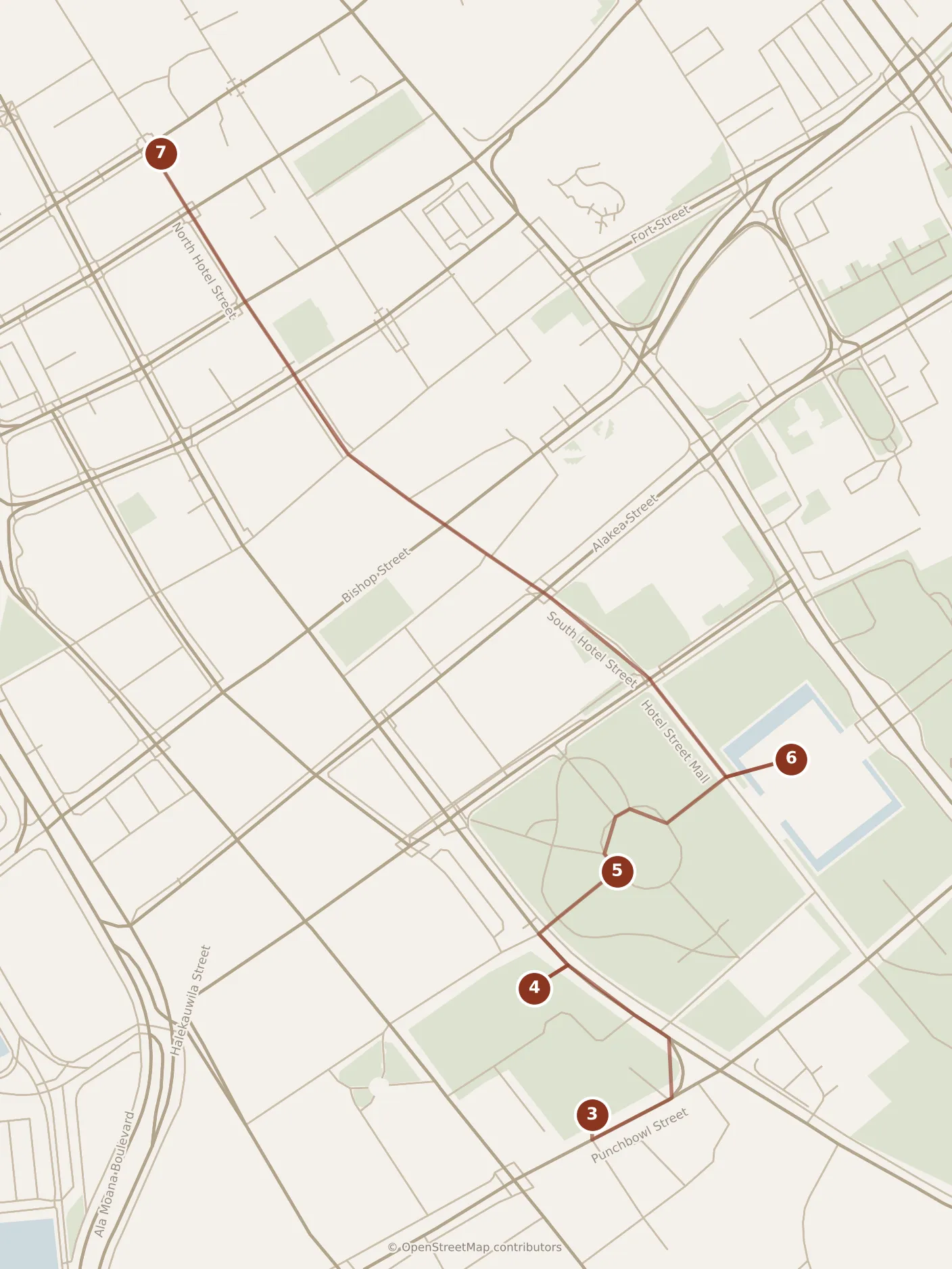
- Afternoon
- 3Kawaiahaʻo Church
- 4King Kamehameha Statue
- 5ʻIolani Palace
- 6Hawaiʻi State Capitol
- 7Chinatown
- Oʻahu Market — in the prose, not on the map
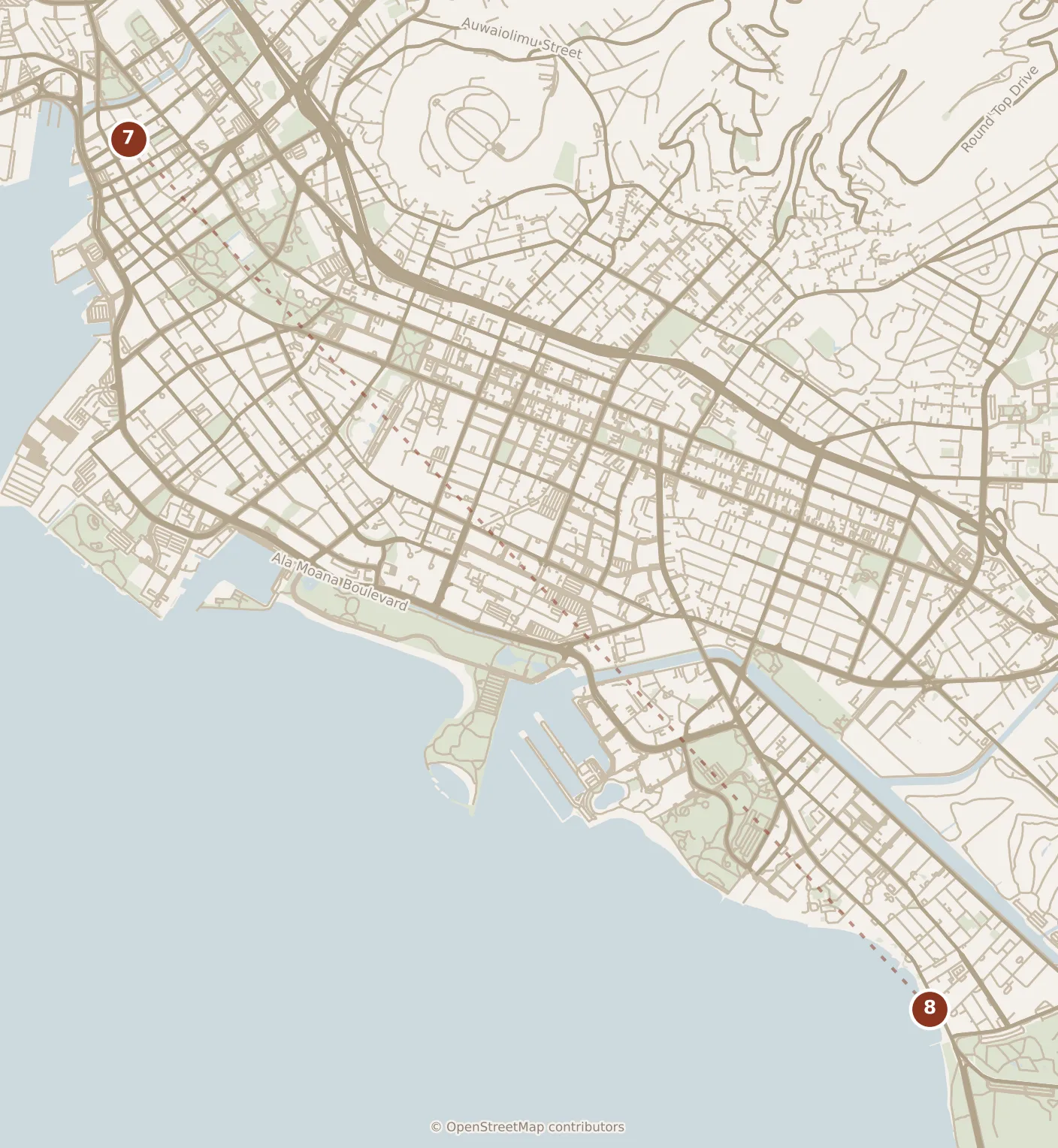
The leg out of the center: from stop 7 by taxi, not on foot.
- Evening
- 8Kūhiō Beach
Morning
The day starts at Pearl Harbor National Memorial, about ten to fifteen minutes by taxi from the arrivals curb at Daniel K. Inouye International Airport — the shortest first leg of any day on this site, and the reason this route suits a reader landing on an early flight. Skyline, the rail line, now stops at the airport too, but for this first leg the taxi is the simpler choice.
The visitor center opened at seven in the morning in 2026, and that is the time to build back from: aim to be through the gate twenty minutes before your reserved slot, because the entrance has a security check and a strict rule on bags, and neither is counted in any of the times below. The memorial does not admit bags beyond a small clear one or a clutch-sized wallet, and there is a paid bag-storage service by the entrance for everything else, open through the day — this is the one place on the route where a bag can be left.
The program itself has a fixed shape: check in at the theater desk ten minutes before your slot, then a Navy boat across the harbor to the USS Arizona Memorial, the white structure built across the sunken battleship’s hull, and back. It takes about forty-five minutes, ten to fifteen of them on the memorial; the park’s documentary film is shown separately, free and without a booking. On the memorial the thing to look at is below the surface: the outline of the ship under the water and the oil that still rises from it, and at the far end the marble wall of the names of the crew killed on 7 December 1941, most of whom are still inside the hull. It is a war grave and the conduct is that of one — quiet voices, and the walk across is not the moment for a call.
Give the two galleries in the visitor center forty-five minutes before or after the boat; they take the attack from the Japanese and the American side and they are free. Skip, on a single day, the paid sites on Ford Island — the Battleship Missouri and the Pearl Harbor Aviation Museum — which are reached by a separate shuttle bus and between them would take the rest of the morning and the early afternoon. They are the right choice for a second day, not this one.
Local tip. If your slot is late in the morning rather than early, do the two galleries first rather than waiting by the theater: they are walk-in and free, and the boat is the only part of the morning that runs to a clock.
Afternoon
From the memorial, take a taxi east into downtown, about twenty minutes with a clear H-1 and up to forty-five in traffic. TheBus route 42 also runs between the memorial and downtown, paid with a HOLO card; it is slower and the parent guide explains the card. Ask to be set down at Kawaiahaʻo Church on King Street.
Kawaiahaʻo is the first stop because everything else in the afternoon lies north and west of it. It was finished in 1842 from blocks of coral cut from the reef, and inside, the portraits of Hawaiian royalty along the upper gallery are the reason to go in. Give it twenty minutes.
Walk three or four minutes west along King Street to Aliʻiōlani Hale and the gilded King Kamehameha Statue in front of it — the king who united the islands, with his arm outstretched. Five minutes is enough; it is a statue to look at from across the lawn, not a visit.
ʻIolani Palace is directly across King Street, and it is the one paid stop of the afternoon. It is the only official royal residence on US soil: built for King Kalākaua and finished in 1882, wired for electric light before the White House, and the place where Queen Liliʻuokalani was held prisoner in an upstairs room in 1895, two years after the monarchy was overthrown. The upstairs room, with the quilt she made during her confinement, is the one thing not to miss. Give the palace an hour and a half including the basement galleries of regalia, and skip the grounds’ smaller buildings if the day is running late.
Directly behind the palace, three minutes on foot, is the Hawaiʻi State Capitol, open to the sky in its central court so that the rain falls through it. Walk through it rather than visiting it; ten minutes covers it.
From the Capitol, walk north-west into Chinatown, about twenty minutes. This is where lunch goes, and late: by now it will be past one. The lanes around Maunakea Street have the lei stands, and Oʻahu Market, the open-fronted fish and produce hall a block away at King and Kekaulike Streets, has been trading since 1904. It is at its fullest in the morning and thinner in the afternoon, which is the price of the order this day is in. Eat at a counter or a noodle shop in the blocks around it, or buy poke by weight and sit down with it. Give Chinatown an hour and a half with lunch.
Evening
From Chinatown take a taxi east to Waikīkī, about fifteen to twenty minutes, and ask for Kūhiō Beach on Kalākaua Avenue, by the bronze statue of Duke Kahanamoku, the surfer and Olympic swimmer. This end of the beach is the one to choose: a low sea wall runs out from the shore and makes two sheltered pools behind it, the calmest water on the strip. Do not jump from the wall or stand on it when there is surf: waves break over it.
This is where the day stops being a list and becomes an afternoon. Swim inside the wall, near the lifeguard towers, and only while they are staffed; on any Hawaiian beach the guarded stretch is the one to swim in, and the lifeguards post flags and signs when the water is not safe. Give it two hours. There is no deadline here: the day’s hinge was its first hour, and arriving around three leaves the beach with light to spare in any month.
If you are flying out tonight, the airport is about forty minutes from Waikīkī by taxi on the H-1 outside the evening rush, and longer in it; that is the one leg of the day with a deadline, so leave on the early side of whatever you planned.
Practicalities
Two things on this day are booked before you travel. The USS Arizona Memorial program is reserved through the National Park Service, on the booking channel its own memorial page links: the ticket is free, with a booking fee of about a dollar in 2026, and slots are released about eight weeks ahead with a further batch the day before, both at three in the afternoon Hawaiʻi time. Same-day walk-up tickets have ended; only a standby line for empty seats remains, with long waits, which is not something to build a single day on. ʻIolani Palace sells its timed tours online or by phone only, with no walk-up or same-day sales, so book before the day; a ticket was in the twenty-five-to-thirty-five-dollar range in 2026, guided costing more than the self-led audio visit. The palace is the one stop on this route that closes on fixed days of the week: its tours run from Tuesday to Saturday, so if your day is a Sunday or a Monday, give the hour to the Capitol and a longer lunch in Chinatown rather than trying to swap in something across town.
The memorial is closed on Thanksgiving, Christmas Day and New Year’s Day. In past years dock repairs have kept the boats from landing, and the program has run as a harbor tour that passes the memorial instead; the National Park Service says on its page when this is the case.
If no Arizona slot is available, the morning becomes Diamond Head, which is booked through the state parks’ own reservation channel, with a timed entry for anyone who is not a resident. Give the climb to the crater rim about two hours, and go at the earliest slot, because the trail is exposed and the heat builds through the morning. Then run the day the other way: lunch near Waikīkī, the palace in the afternoon, Chinatown into the evening — which ends downtown, closer to the airport than the beach is.
If you have less time, the Capitol goes first, then Kawaiahaʻo: both are short and both are skippable without losing the shape. The palace and the memorial are the two the day is built on.
There is no left-luggage office on this route beyond the paid storage at the memorial, and that holds a bag only while you are there. A reader between flights with a case therefore has to keep it in the taxi rides and carry it on foot through downtown and Chinatown, and the beach is the stop it rules out: with a case, finish in Chinatown and take the taxi to the airport from there, which is the shorter ride anyway. Ask at the palace’s ticket window before your tour whether they will hold anything you cannot take inside.


