Hong Kong in two or three days: the north shore and the Peak, Kowloon after dark, and Lantau

Last updated 8 August 2026
Overview
Hong Kong is two shores and one hill, and the problem with a short visit is not distance — the harbor is a mile across and there are trains under it — but that the three things worth your time here want three different kinds of light. The hill wants a clear evening. The markets want the dark. The museums want a whole morning and do not care.
One day makes you choose between them. Two days lets you stop choosing, and that is the entire argument for the second one. Day one stays on Hong Kong Island and runs east to west along the north shore, from a street market with a tram through the middle of it to a lane on the side of the Peak as the light goes. Day two crosses the water in the morning and never comes back: the two big museums out on the West Kowloon reclamation, then a straight line north through Yau Ma Tei and Mong Kok to a market that does not exist before dark. Neither day doubles back on the other, and only one of the two crosses the harbor, which is deliberate — the crossing is better as a morning commute than as an evening event you have to fit in around the light.
The stop the first day is built around is a viewpoint twenty minutes along a lane on the north face of the hill, and what it wants is the last of the daylight. Sunset here barely moves, which is worth saying because it is not what a reader from Europe expects: the earliest of the whole year falls between the last week of November and the first days of December, a couple of minutes short of twenty to six, and the latest from late June into the middle of July, a little past ten past seven. Ninety-odd minutes of variation across a year, because this is nearly the tropics and the clocks never change. But the day is pinned at noon, not at sunset, because the gun fires at twelve. So the morning is fixed and only the afternoon is counted against the light. Before the gun: half an hour in the market, a quarter of an hour on the tram west, half an hour in the park, twenty minutes getting across to the gun and finding the way in — an hour and thirty-five minutes, which is what puts the start a little after ten. After it: ten for the ceremony, an hour for lunch, a quarter of an hour over to Stone Nullah Lane, three quarters of an hour in Wan Chai, twenty-five minutes climbing west to the park, an hour and a quarter for the park and the tea museum inside it, a quarter of an hour at the cathedral, an hour to get down to the funicular and wait and ride it, and twenty minutes out along the lane at the top. Five hours and twenty-five minutes from noon; seven hours in all.
That sum is the time you spend inside places and walking between them, and it models nothing else. What it leaves out is the line at the bottom of the funicular, which on a clear weekend afternoon is not a wait but a decision; the hour allowed above is an ordinary one. Set against a late-November sunset, the afternoon count puts you at the viewpoint with about a quarter of an hour of light in hand, and starting earlier does not add to it — the gun fires at twelve whatever time you got up, so the only cut that buys light is a cut after noon. At midsummer the same afternoon leaves close to two hours spare, and they have an obvious home: walk the whole ring at the top rather than going out and back. Midsummer is also the heat, so that surplus comes with a trade rather than a free hour, and it is stated below rather than left to be worked out.
Two days here means a room somewhere, so the bag is only a problem on the day you arrive and the day you leave. Hong Kong station and Kowloon station are both on the Airport Express, and both check in departing passengers and their hold luggage for participating airlines, which takes the bag off you altogether; there is a left-luggage counter at the airport too. If you only need a bag stored rather than checked in, find out what is open at those two in-town stations before you plan a day around it; if neither answers, the counter at the airport is the fallback and the routing below has nothing to decide. Assuming one of them does, which of the two you use is decided by the route rather than by convenience. Day one begins at North Point and ends on the hill above Central, so a bag at Hong Kong station is on your way. Day two begins at a pier in Central and ends in Kowloon after dark, so on that day the bag belongs at Kowloon station and not across the water — otherwise the last thing you do at the end of a long night is cross the harbor to collect it. Three stops on these days are genuinely bad with luggage: the market lane in North Point, where a tram comes through and everybody has to move; the lane at the top of the hill, which has nowhere to sit for two kilometers; and the 268 steps up to the Buddha on the third day.
Day one

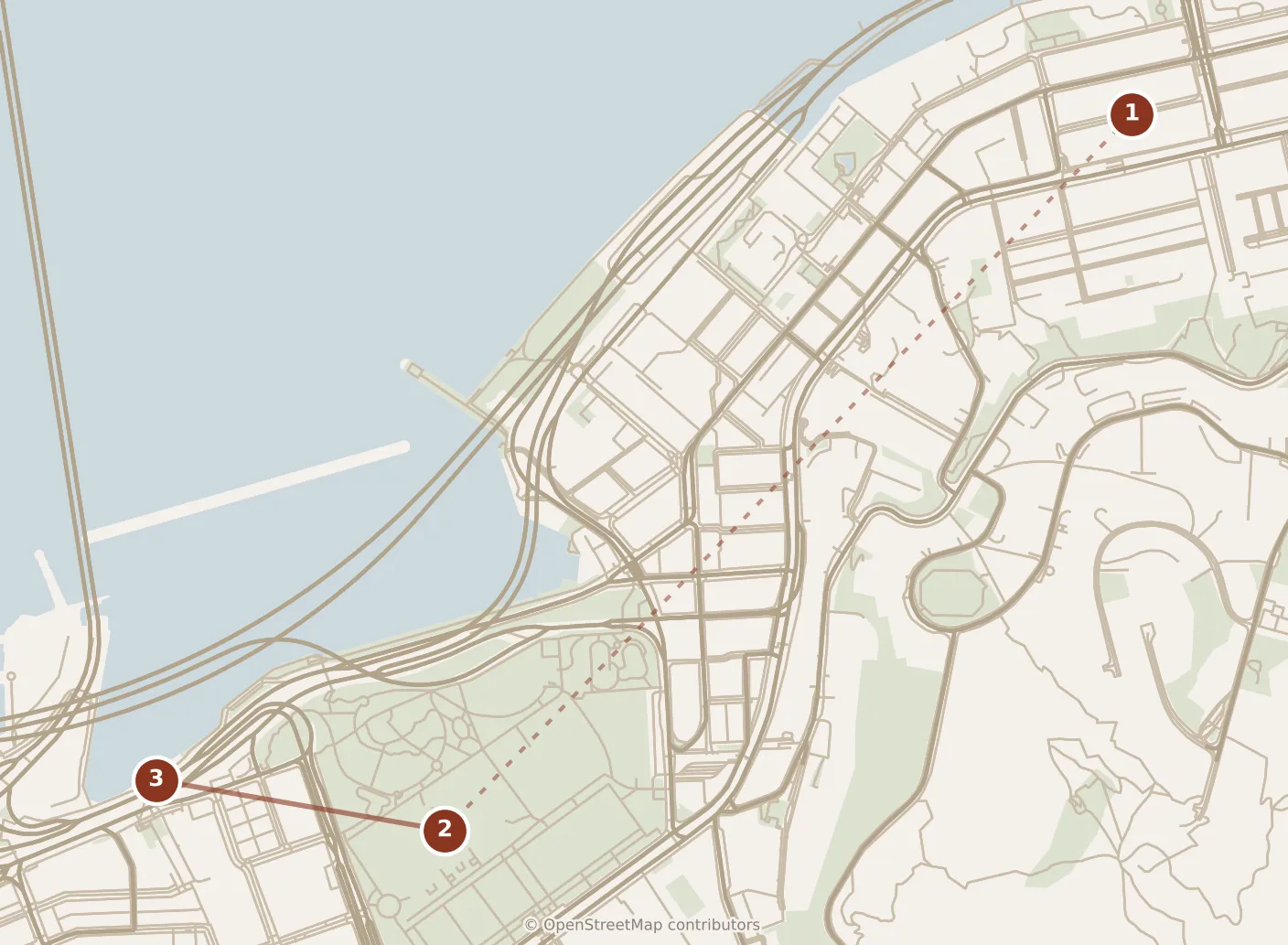
- Morning
- 1Chun Yeung Street
- 2Victoria Park
- 3Noonday Gun
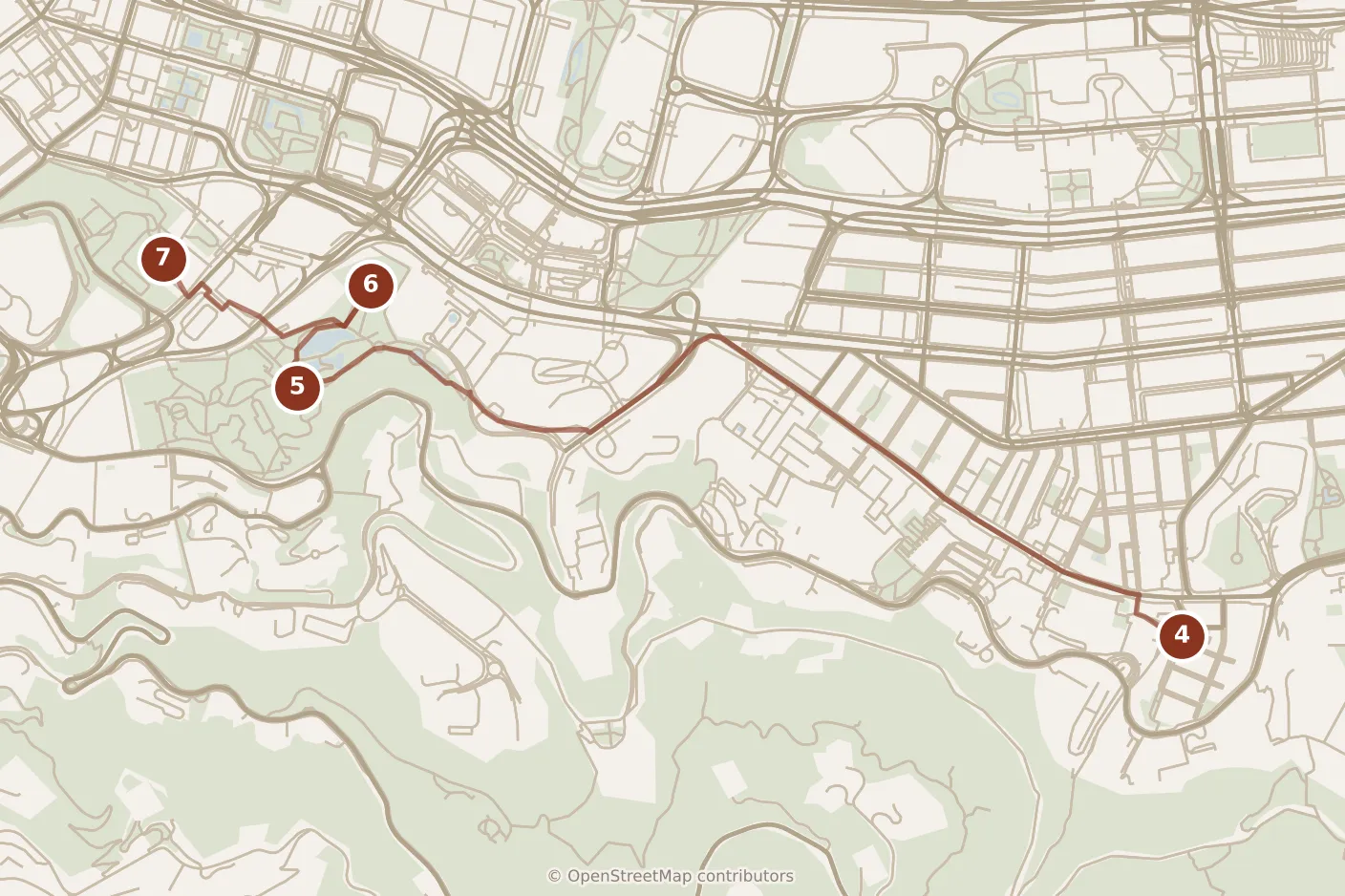
- Afternoon
- 4Blue House
- 5Hong Kong Park
- 6Flagstaff House Museum of Tea Ware
- 7St John's Cathedral
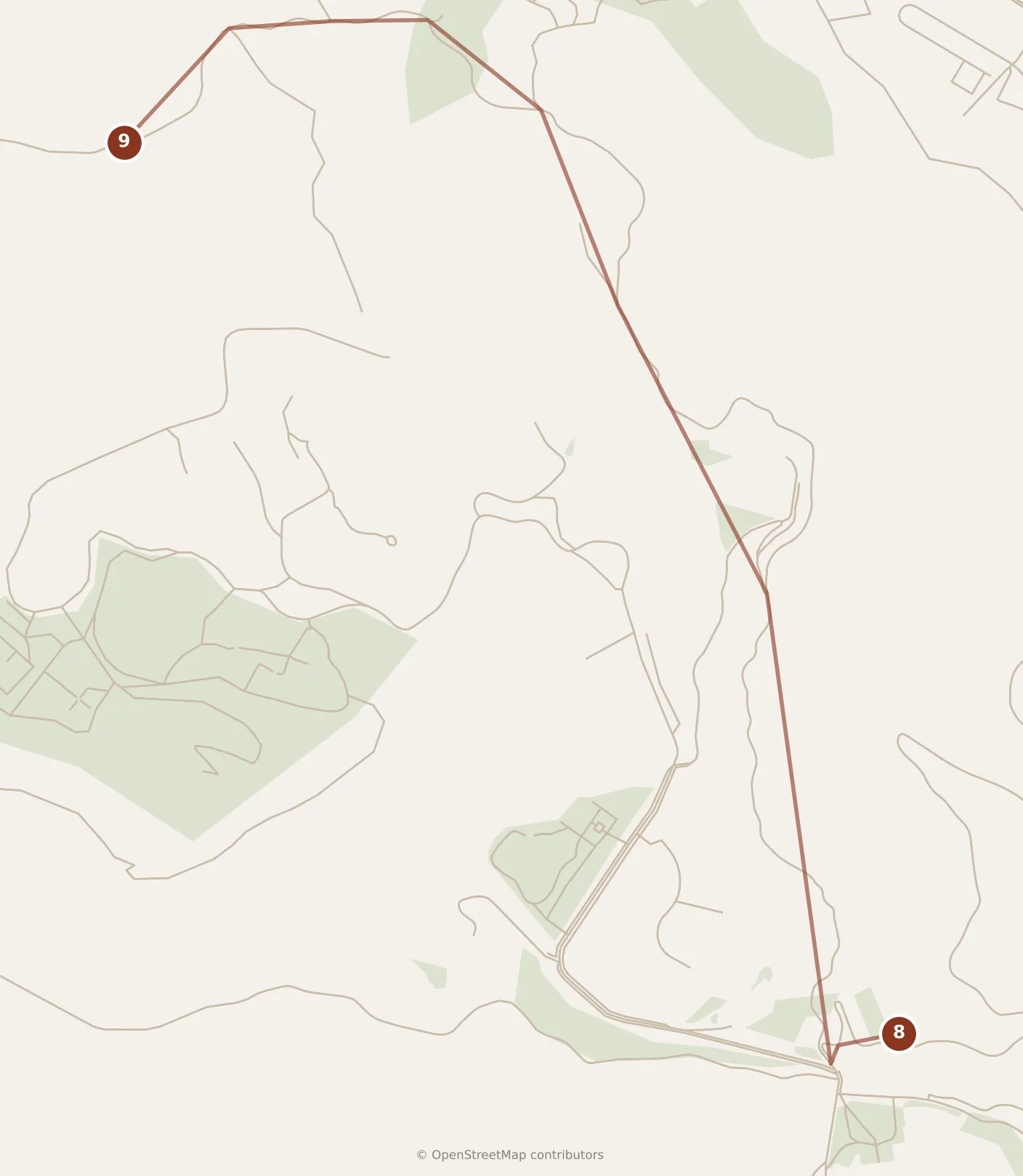
- Evening
- 8Peak Tower
- 9Lugard Road
Today is the island’s north shore read from its working end to its expensive one — a wet market in North Point, a colonial gun in Causeway Bay, a blue tenement in Wan Chai, a park laid over old barracks above Admiralty, and then the hill. It moves in one direction and mostly on the tram.
Morning
Start at North Point station, on the Island line. From Hong Kong station, where the Airport Express ends, walk through to Central station and ride six stops east; reckon on twenty minutes with the walk through at the start. Come out and find Chun Yeung Street, a couple of blocks north: fish, poultry, fruit stacked to shoulder height, canvas awnings, and a tram line running down the middle of it. The trams that finish their run at this end of the island turn off King’s Road into the street and go through the market at walking pace, with stallholders lifting crates off the rails as they come. It is the only place in the city where that happens. Stand out of the way rather than in front of it, and give the street half an hour: the point is not to photograph the tram, it is that this is a working market with a railway in it and nobody here finds that remarkable.
Then take a tram west from the terminus and get off where the line runs along the south edge of Victoria Park — about a quarter of an hour, and if the traffic has stopped the trams, the Island line does the same distance in two stops to Tin Hau. The park is nineteen hectares of flat ground where a typhoon shelter used to be: the sea was pushed north and the park laid on the reclamation, opening in 1957. It has fourteen tennis courts and the bronze Queen Victoria that once stood in the middle of Central, shipped to Japan during the occupation to be melted down, recovered after the war and put here in 1955. Half an hour.
Then the one fixed hour of the day. On the far side of Gloucester Road, on a fenced patch of waterfront facing the typhoon shelter, a small naval gun is fired at noon, every day, and has been since, the story goes, a trading house was ordered to do it in perpetuity in the 1860s as a penalty for saluting its own arriving directors. A uniformed guard walks up, rings a bell, fires the gun, rings the bell again and locks the chain. The firing itself is two minutes and the whole business is ten; the appeal is that a private firm has done this daily for a century and a half and nobody has decided to stop. Getting there is the difficulty. The only way across the road is a tunnel that starts in the basement parking garage of the World Trade Centre, and it is not obvious from the street, so allow twenty minutes to find it. If you miss noon, nothing else in the day moves — everything below this point is elastic.
Lunch is in Causeway Bay or on the walk west into Wan Chai, and an hour is right. This is roast meat country: char siu or roast goose over rice, carved at the front of the shop where the birds are hanging, one plate, no ceremony.
Afternoon
Take a tram west along Hennessy Road into Wan Chai and drop south to Stone Nullah Lane — a quarter of an hour all in, or one stop on the Island line if you would rather. The Blue House is a four-story balcony tenement of 1922, painted blue in 1990 by the government department that then owned it, which is where the name comes from, and it carries the territory’s highest heritage grade. What makes it worth the detour is not the color but that the tenants were never turned out: the government bought the block in the 1970s, and when it was finally restored the residents stayed, which almost never happens here. Look up at the timber balconies and the wooden stairs behind them, then walk the lanes around it and up to Queen’s Road East, which is what this district looked like before the towers arrived. There is a small free exhibition room on the ground floor with its own short hours and one closing day a week; the building is the sight, and the building is a street. Three quarters of an hour.
Now climb west. Twenty-five minutes uphill along Queen’s Road East brings you to Hong Kong Park, which opened in 1991 on the upper ground of the old barracks and is the strangest eight hectares in the district — an artificial waterfall, a glasshouse, and towers close enough on three sides to work as walls. Go straight to the Edward Youde Aviary, a netted valley crossed by a raised walkway that carries you out through the canopy at the height the birds actually use. Then Flagstaff House Museum of Tea Ware, ten minutes down through the park: a white colonial villa of 1846, the oldest Western building left standing in Hong Kong, built for the commander of the British forces and given over in 1984 to tea. Entry is free. The collection is Yixing clay teapots, hundreds of them, and the pleasure is the house as much as the pots — low rooms, deep verandas, the shape of what a colonial officer thought a tropical posting required. An hour and a quarter for the park and the museum together. The tea museum is the one thing on today that shuts a day a week, and that day was a Tuesday in 2026; if it falls on yours, give the hour to the park itself — the aviary, the glasshouse, the waterfall — and nothing else about the afternoon changes.
Five minutes down Garden Road is St John’s Cathedral, in use since 1849 and the oldest surviving Western church building in the territory, now standing at the bottom of a well of glass towers that were not there when it was built. A quarter of an hour, and go in rather than round: the interior is plain colonial Gothic, the roof timbers are worth the neck, and the memorials on the walls are a readable account of who came out here and what killed them.
Evening
The lower station of the Peak Tram is on Garden Road, effectively next door. The funicular has been climbing this hill since 1888, and the reason to take it is a trick of perception partway up, where the towers beside the track appear to lean at forty-five degrees because the only level thing in your field of view is the carriage floor. Public buses climb Peak Road from Central and pick up on Garden Road beside the lower station, so the switch is a step sideways and not a walk back down; they take longer but rarely have a line the way the funicular does, and on a clear Saturday afternoon that is not the worse option — if the wait at the bottom has eaten your margin, take the bus rather than shortening what happens at the top. Reckon an hour from the cathedral door to standing on the road at the summit: the walk down, the wait and the ride.
The funicular puts you inside the Peak Tower, a 1997 building shaped like a wok balanced on a wall, and the first thing to do is walk out of it. Its rooftop terrace charges for a view you can have for nothing a few minutes along the road outside. Lugard Road runs from beside the tower round the north face of the hill: near-level, built between 1913 and 1921, one car wide, and closed to almost all of them. Twenty minutes along, the trees stop and the whole thing is in front of you at once — the towers of the north shore stacked up the slope below, the harbor, the ferries crossing it, Kowloon on the far side, the mainland hills behind that. Stay for the light going. The buildings do not come on together; they arrive over about twenty minutes, and the minute worth waiting for is the one where the sky is still blue and the towers are already lit.
Local tip. With one evening you walk out along the lane and come back the same way in the dark. With two days you need not: Lugard runs into Harlech Road and the two make a level ring of about three and a half kilometers back to the tower. Give it an hour, start it before the light goes rather than after, and you get the harbor face and the open-sea face of the same hill for the price of walking on instead of turning round. From May to September weigh that extra hour against the heat before you commit to it.
If the top is in cloud — which happens often here and worst in spring — this evening is simply not available, and the fix is not a substitute view, it is to swap the two days and take Kowloon today, provided today is not a Monday or a Tuesday. If both your days are gray, then from St John’s Cathedral walk ten minutes down through the elevated walkways to the Central piers and take the Star Ferry across instead: it is covered, it costs almost nothing, and it gives you the same skyline at water level, which rain does not spoil. That replaces the hill outright and ends your evening in Kowloon rather than above Central, so leave the bag accordingly. And if you are simply running short, drop something after noon, because nothing before the gun buys you daylight: the cathedral first, then the tea museum, then the lanes around the Blue House. Never drop the margin in front of the funicular.
Day two

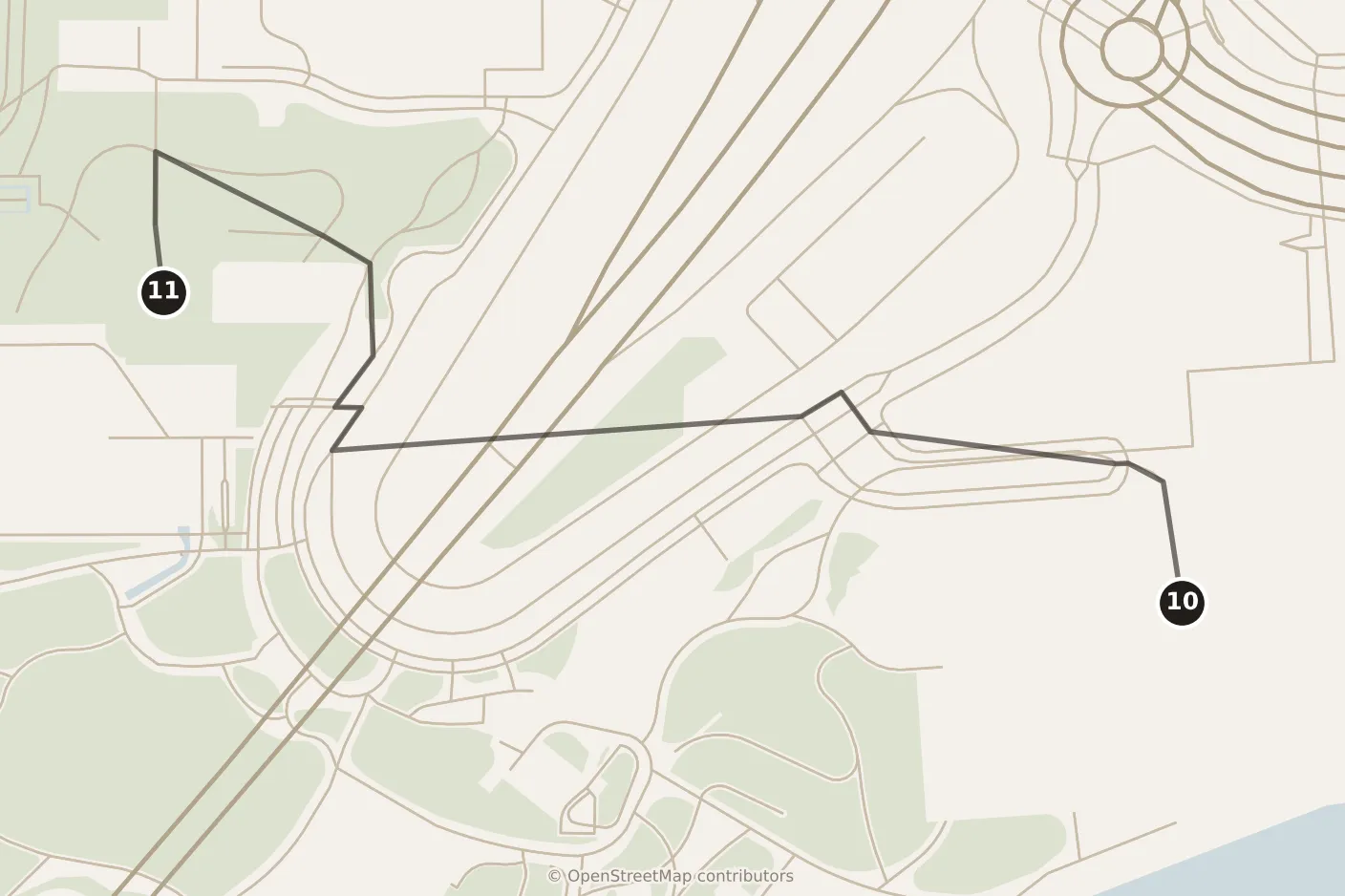
- Morning
- 10M+
- 11Hong Kong Palace Museum
- Afternoon
- 12Tin Hau Temple Complex
- 13Yuen Po Street Bird Garden
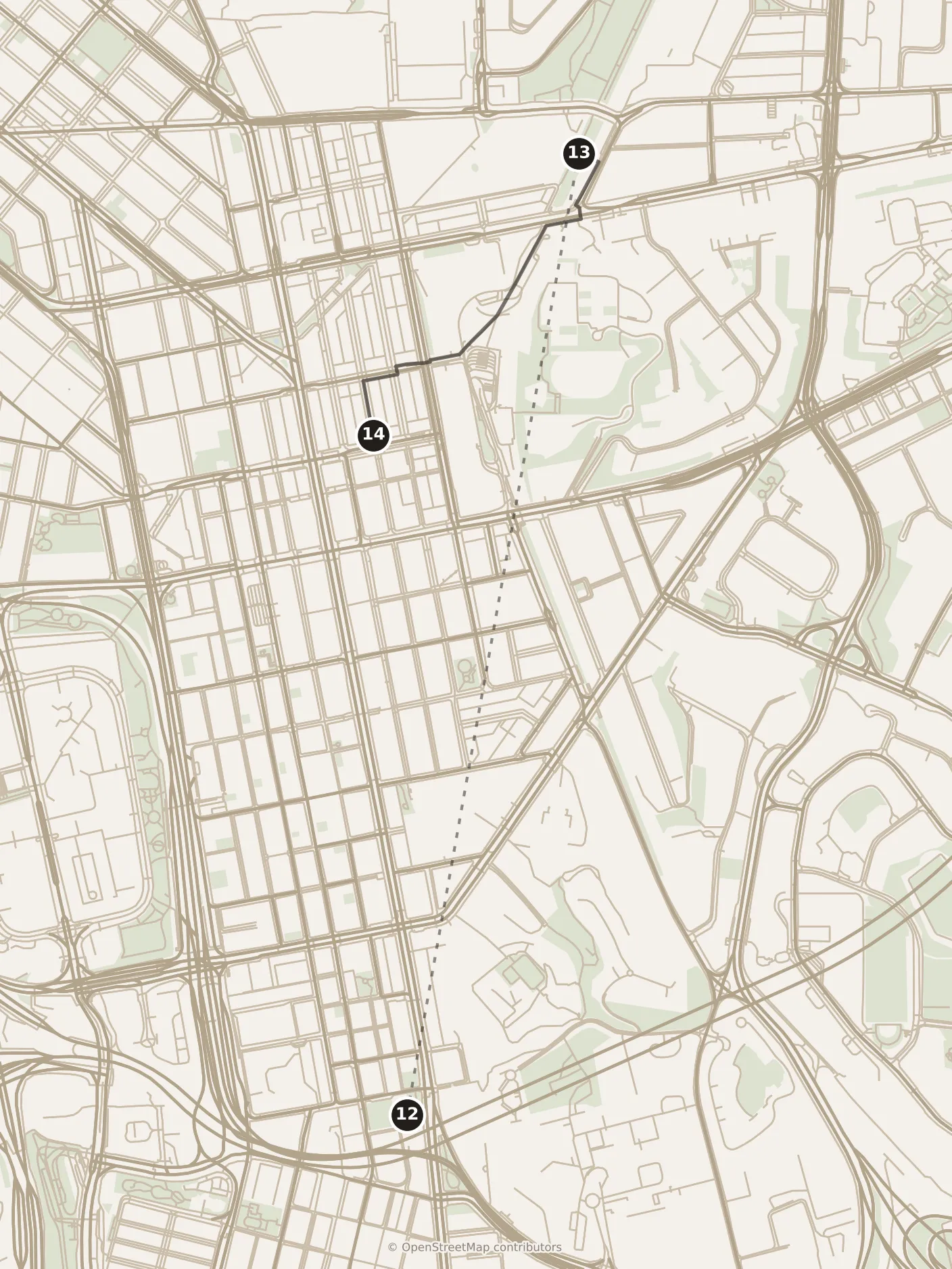
- 14Tung Choi Street
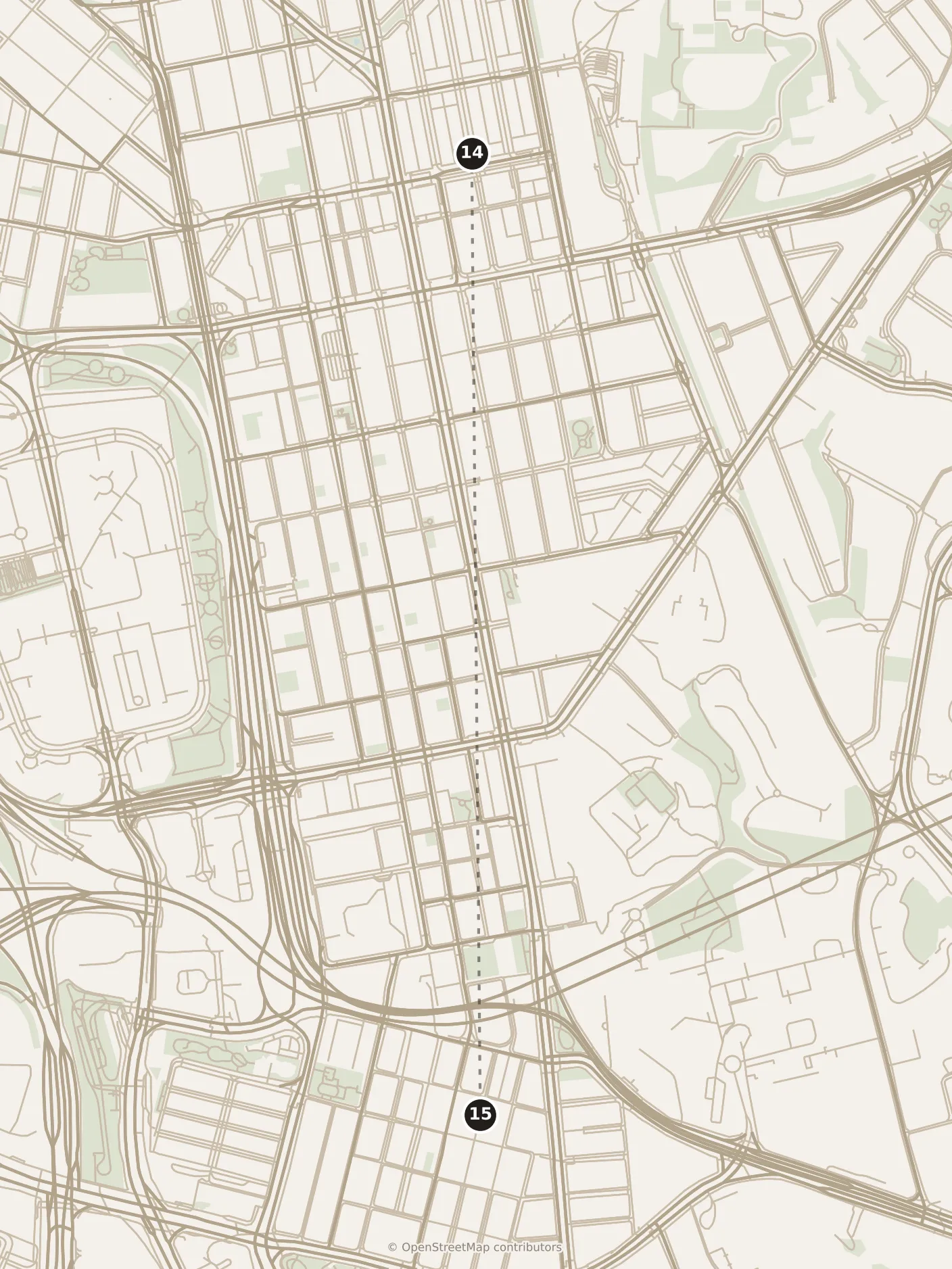
The leg out of the center: from stop 14 by metro, not on foot.
- Evening
- 15Temple Street
Today is Kowloon from its newest edge to its oldest habit: two museums on land that did not exist thirty years ago, then north up the peninsula to a temple, a flower street, a bird garden, a shopping street and a night market. It ends in the dark, on purpose.
Morning
Cross by water, but not on the famous boat. From Central Pier 9 a small ferry has run to WestK Quay since November 2025, every half hour, eight minutes across; you pay on board with a stored-value card or with cash, and no change is given. It lands you at the foot of the cultural district, which nothing else does. It is a trial service rather than a fixture, though, with a review date on it, so check it is still sailing before you build the morning on it. The way in without it is by rail: Austin station on the Tuen Ma line is a fifteen-minute walk from the museums and Kowloon station on the Tung Chung line about the same.
M+ is the reason to be here. It opened in 2021 as a museum of twentieth- and twenty-first century visual culture, which sounds like an evasion and is not: the collection deliberately mixes art with design, architecture and moving image, so a wall of Cantonese film posters, a neon shop sign rescued from a street that has gone, and a whole 1980s sushi bar interior lifted out of Tokyo and rebuilt inside the building are all treated as the same kind of object. The two things not to miss are the galleries given to this city’s own art, which is not shown at this scale anywhere else, and the roof terrace, which faces the north shore you were looking down on yesterday. Do not try to see all of it: two hours taking two floors properly beats four hours of everything. One thing to know before you reach the gallery door — only small bags go in, larger ones go to the cloakroom, and a backpack within the size limit has to be worn on your front. You will be stopped and told; being told in front of a line is the avoidable part.
Ten minutes across the park is the Hong Kong Palace Museum, open since 2022, a building that widens as it rises and is clad in bronze-colored panels. It shows imperial objects lent long-term from the collection in Beijing, rotated through its galleries, alongside special exhibitions of its own, and it is a completely different experience from its neighbor: quieter, denser, more explained. An hour and a half is the right amount unless a special exhibition is what brought you, in which case add an hour. Lunch afterwards, three quarters of an hour, in the district itself or back at street level in Jordan.
Afternoon
Getting off the reclamation is the only awkward move of the day. The museums sit behind an expressway, and the honest answer is to walk it: half an hour east, under the flyovers and across Canton Road, and the walk itself explains how this quarter was made. If you would rather be under cover for most of it, Austin station is fifteen minutes away through the shopping center and Jordan is a short walk beyond that.
You are aiming for the Tin Hau Temple Complex on Public Square Street: five low buildings in a row, separated by four lanes, fronting a paved square with old banyans in it. The temple in the middle is the oldest, put here around 1864 by boat people and villagers, and it faced the water — which is now well over a kilometer away, every meter of it reclaimed since. Beside it stand a city god’s temple of 1878, two shrines of 1894, and a disused study hall of 1897 that taught the children of the boat and land people free until 1955. The row has been run by the Tung Wah Group of Hospitals since 1914 and was declared a monument in 2020. Twenty-five minutes. These are working temples with people praying in them: walk behind anyone bowing rather than across their line, and do not put a camera into a shrine somebody is using.
From Yau Ma Tei station take the Tsuen Wan line two stops north to Prince Edward. Flower Market Road, eight minutes east of the station, is one straight street of nothing but flower shops, wholesale and retail at once, opening onto the sidewalk, cut stems in buckets along the curb and orchids stacked inside. It costs nothing, and twenty minutes is enough. At its far end is Yuen Po Street Bird Garden, a courtyard of stalls where old men bring songbirds in bamboo cages, hang them up and sit. It was built in 1997 to replace a street of bird shops demolished for a shopping mall, so it is a reconstruction, and it is nonetheless the real thing: the birds belong to people who have come to hear them. Twenty-five minutes, and the crickets in the little boxes are bird food.
Walk fifteen minutes south into Tung Choi Street. The northern end is the goldfish trade — walls of fish hanging in bags of water, tanks, pumps, plants — and the southern end is the Ladies’ Market, a canvas-roofed run of stalls selling clothes, phone cases and souvenirs. The goldfish half deserves more of your time than the shopping half, which is the opposite of what the signs suggest. An hour for both.
Evening
Take the Tsuen Wan line two stops back south from Mong Kok to Jordan. That is the single deliberate backtrack in these two days, it costs ten minutes, and it is unavoidable, because Temple Street is only itself after dark. The stalls are up by mid-afternoon; the street is not the thing until the lanterns and the strip lights are on, the food stalls have put tables out on the road, and whatever fortune tellers and Cantonese opera singers have come out that night have set up at the northern end, beside the temple row you saw this afternoon. Eat here — clay-pot rice, or whatever is coming off the burners in front of you. On the merchandise stalls prices are asked rather than fixed and haggling is expected; on the food stalls it is not, and trying reads as rude.
The count for today runs forward rather than back, because nothing in it depends on the light until the end. Both museums admitted from ten in the morning in 2026, and the parts above come to a little under eight hours from that: in the winter half of the year it lands you on Temple Street exactly as the light goes, and at midsummer an hour and a half early. That hour and a half belongs to the museums, not to the market. There is one exception worth having: in 2026 M+ stayed open until ten on a Friday and eight on a Saturday, and the palace museum until eight on both, so either of those two days can be run backwards — the market in the late afternoon, the museum in the evening — with the Friday buying the most evening. If those hours have moved, the test has not changed, which is simply whether the museum outlasts the sunset.
Local tip. If today has to be cut, cut Prince Edward. The flower street and the bird garden are fifty minutes on the ground plus the ride to reach them, and they are the only part of the day with a substitute. What has no substitute is one museum done properly and a market after dark, so at half a day take M+ and go straight to Temple Street.
Jordan station, on the Tsuen Wan line, sits at the southern end of Temple Street and is three stops from Central if you are sleeping on the island.
With a third day

- With a third day
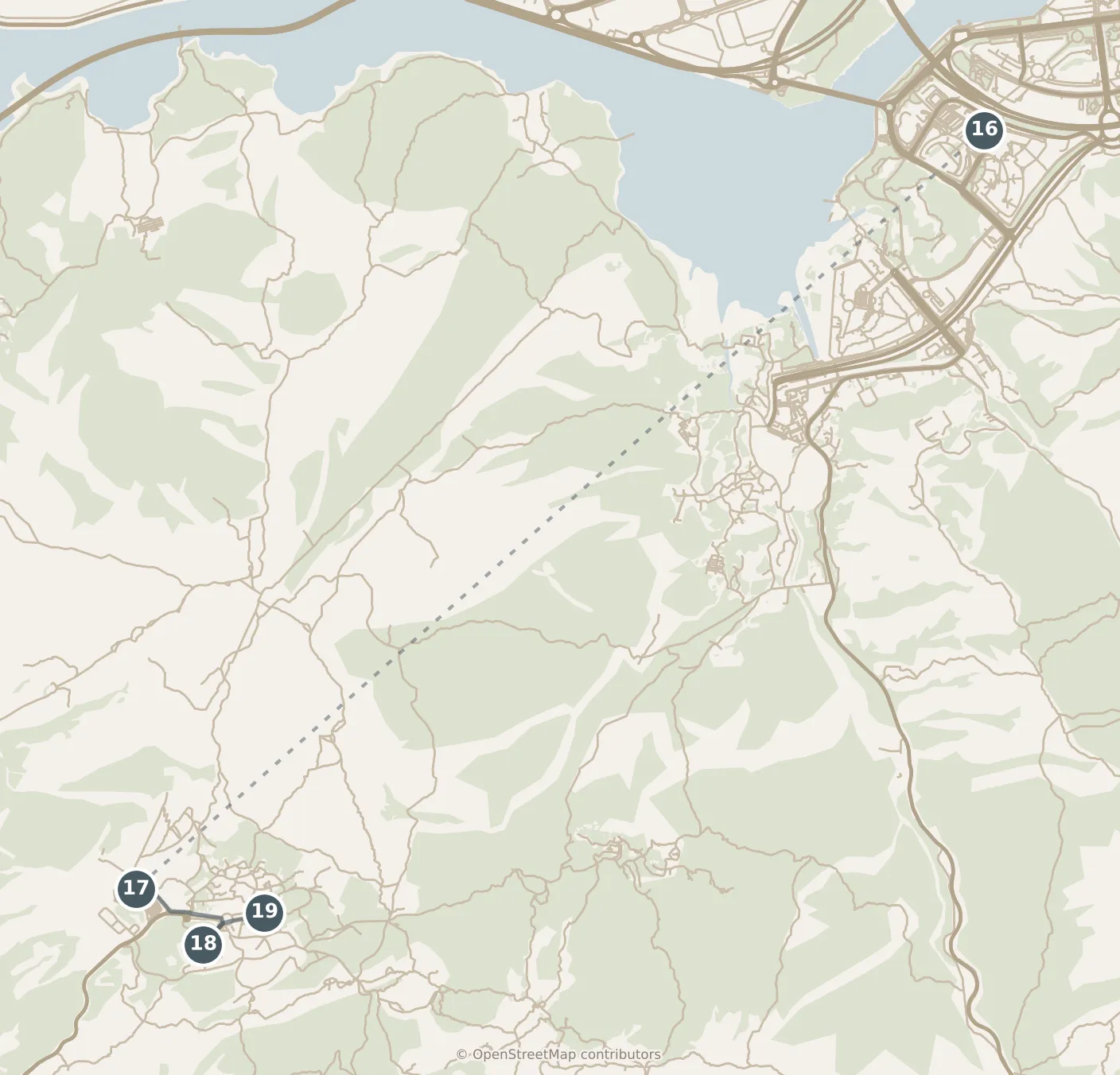
- 16Tung Chung station
- 17Ngong Ping 360
- 18Tian Tan Buddha
- 19Po Lin Monastery
- Tai O — in the prose, not on the map
The third day goes to Lantau, and it is appended rather than inserted. Days one and two are the ones that have to happen; this is the one you would give up to a typhoon signal without much regret, and both city days end where you sleep while this one ends an island away. What it adds is a part of the territory that is not a city: twenty-five minutes of cable car over water and a ridge, a bronze Buddha on a hilltop above a working monastery, and a village of stilt houses on the far shore that has nothing to do with either.
You can insert it between the two instead, and there is a real reason to, because this day is worthless in cloud and taking it on whichever of your three days is clearest is a sound move. What moves with it is the Kowloon day, which becomes the third, and the rule about Monday and Tuesday below travels with it: a trip beginning on a Saturday that inserts Lantau puts Kowloon on the Monday, and M+ does not open on a Monday. One other thing shifts, and it is easy to overlook. Left last, this is the day to fly out on, because you end at Tung Chung and the airport is a short shuttle bus from the same station forecourt, and there is a left-luggage desk at the cable car terminal there. Use that one and not the desk at the village at the top: the way home is by road and never goes back over the ridge. Either counter has to be cleared before the cable car stops running for the day, and on the day you fly that is the deadline to plan against. Insert it, and that advantage goes with it: your last day now ends at Jordan, and the bag goes back to Kowloon station.
From Hong Kong station the Tung Chung line takes about half an hour to Tung Chung station, and the cable car terminal is a five-minute walk from it; reckon an hour there for the line and the twenty-five-minute crossing together. In 2026 the cable car ran from ten to six on a weekday and from nine to half past six on weekends. Read that as the gate on the ride up rather than as the shape of the day: you take it in the morning and, on the plan below, come home by road. The closing time binds two things only — a return ride, if you decide to take one, and anything you left in a left-luggage counter at either cable car terminal, which has to be collected before the cable car stops for the day. If the hours have moved, that test has not. A round-trip ticket in an ordinary cabin was in the two-hundred to three-hundred Hong Kong dollar range in 2026, which is the figure that decides whether this day is worth it to you at all. The operator sells online and at its own ticket office at the terminal, and it publishes its scheduled maintenance closures itself, which is the thing to look at the week before rather than on the morning. If the cable car is suspended for wind — it is a gondola over open water and it does stop — New Lantao Bus route 23 runs to the same place from the bus terminus beside Tung Chung station. It takes longer, it winds, and it costs you the crossing, which is half the reason to come; nothing else in the day changes.
The cable car sets you down at a built approach of shops and a paved avenue. Walk through it without stopping — twenty minutes including the 268 steps — up to the Tian Tan Buddha, thirty-four meters of bronze in 202 pieces, finished at the end of December 1993 on the day reckoned as the anniversary of the enlightenment. He is seated on a lotus above a three-tier altar, right hand raised, left open on the lap, with six smaller bronze figures below offering flowers, incense, a lamp, ointment, fruit and music. Standing at his feet is free; the three exhibition halls underneath and the relic they hold have a ticket. Forty-five minutes with the steps and the platform.
Below him is Po Lin Monastery, which came first: three monks from Jiangsu built a hut up here in 1906 and it took its present name in 1924. The main hall holds three bronze figures of the Buddha — past, present and future — and the precinct is still in use, so incense is being offered while you walk through it. Forty-five minutes, more if you eat, because the monastery’s own vegetarian kitchen is why many people come up and it is a proper sit-down meal rather than a snack. Then the Wisdom Path, half an hour there and back on the low ridge behind: thirty-eight timber columns carrying the Heart Sutra in Chinese characters, set out across the hillside in the line of an infinity sign. It is quiet, and almost nobody walks up to it.
Then leave the plateau. New Lantao Bus route 21 runs from the terminus by the village west and down to Tai O. The ride is short and the service is not: read the departure board when you arrive on the plateau, and fit the monastery and the Wisdom Path around the bus rather than the other way round. Reckon on an hour for the wait and the ride together if you have not, and note that the last departure for Tai O goes in the early evening. Tai O is a fishing village on a creek, and its houses are pang uk, built on stilts over the water with walkways between them, which is why people call it the Venice of Hong Kong and why that is a poor description — it is a working, shabby, salt-smelling place where the shops sell dried fish and shrimp paste in jars and the fishing barely supports anyone now. Two hours: the two footbridges, the declared-monument temple of 1699, the old colonial police station on the headland above, and the small boats that take visitors out into the estuary to look for the Chinese white dolphins. From Hong Kong station to the last of those footbridges the parts above come to about seven hours, with no meal inside them, and the journey home is on top of that.
Which is why the journey home is New Lantao Bus route 11, from Tai O to the terminus beside Tung Chung station, rather than going back over the ridge to the cable car. It runs round the island’s north-west shoulder on a coast road and it has no line, so the way home sets no deadline of its own. Two earlier things do: the last bus 21 out to Tai O, which is what the plateau has to be planned around, and — if your bag is in a left-luggage counter at a cable car terminal — the closing time above, which is what Tai O has to give way to. If the third day is short, cut the Wisdom Path first and the three quarters of an hour in the monastery second — not Tai O. The statue is the postcard; the village is the reason to have come.
Practicalities
This route asks for one thing a reader who has just landed may not be holding: a way to pay small fares on trams, a harbor ferry, the subway and a rural bus without handling coins each time. How that is done in this city is the parent guide’s subject, and it is worth the two minutes before you arrive.
Two things are worth buying before you travel if the trip is two days, and both are on day two: timed tickets for M+ and for the Hong Kong Palace Museum. If you are taking the third day, the cable car is a third. In 2026 a standard adult ticket to one of the museums was somewhere in the seventy to two hundred Hong Kong dollar range, depending on which museum and, at the palace museum, on whether its special galleries were included; the palace museum sits at the bottom of that range and M+, which sells one ticket for everything, at the top. Both sell on their own websites and at their own ticket offices on the day while stocks last, and both publish their opening hours and their closing days themselves, which is where to check them the week before. Everything else across the two days is free to walk into or paid at the gate: the market lanes, the gun, the temples, the park, the tea museum, the cathedral, the flower street, the bird garden, and the funicular, which is paid at its lower station. On the third day the cable car is the ticket, and it is bought from the operator.
The weekday arithmetic is short, and only one of the three days is load-bearing. The Kowloon day must miss both Monday and Tuesday: M+ closes on a Monday and the palace museum on a Tuesday, and those two closures are the whole of it. The island day and the Lantau day take any date and will trade places with each other freely. The island day has one closure of its own and it is not load-bearing — the tea museum inside Flagstaff House shuts on a Tuesday, while the park, the aviary, the glasshouse and everything else on that day do not — and the small exhibition room in the Blue House keeps a closing day of its own, which changes nothing, because the building is a street view. Everything else across the three days is a street, a park, a temple, a market or a monastery, and none of those keeps a weekday closure.
Three consequences worth stating rather than leaving to be worked out. A two-day trip that falls on a Monday and a Tuesday cannot be fully saved: whichever of the two days you give to Kowloon, one of the two museums is shut. Give it the Monday and you get the palace museum; give it the Tuesday and you get M+; what you must not do is arrive expecting both. A two-day trip arriving on a Sunday works only in reverse — Kowloon on the Sunday, the island on the Monday, when everything on the island day is open. And with three days there is always an arrangement that loses nothing: put Kowloon on any day from Wednesday to Sunday, and if one of your remaining days is a Tuesday, make that the Lantau day rather than the island one. A Friday or a Saturday will take the Kowloon day backwards, because those are the evenings the museums stay open, and the Friday is the later of the two.
The distances above are walked except where a ride is named. The longest single stretch on foot is the half hour east from the West Kowloon museums to Yau Ma Tei on day two; the second is the twenty-five-minute climb from Wan Chai up to Hong Kong Park on day one. Everything else is under twenty minutes, and the ring at the top of the Peak is another three and a half kilometers if you take it. The rides are few and all named above: the Island line and the trams along the north shore, the ferry from Central Pier 9, the Tsuen Wan line up and down Kowloon, the Tung Chung line out to the airport island, and two rural bus routes on Lantau.
Two weather cases break days rather than dampen them. The Peak is regularly in cloud when the city beneath it is clear, worst in spring, and that check is free and takes a second: look up at the hill over lunch, and if you cannot see the top of it from where you are standing, swap the days. The other is a typhoon signal in the summer months, which stops the ferries, the cable car and most of the rest of it; the parent guide explains how that works and what the numbers mean.
A third case does not break a day, it shortens one. From roughly May to September the heat and the humidity, and not the distance, are what these days cost you: mean daily maxima run above thirty degrees from June to August, mean humidity sits in the low eighties, and July’s dew point is twenty-five. That is the constraint anyone here would name first on an eight-hour walking day, and only day two answers it by itself, because only day two spends its middle indoors. Day one is pinned to an outdoor gun at noon and climbs from there, and the third day’s middle is the steps, the platform and an open ridge; on those two the adjustment is yours to make. In those months take the museums and the tea museum slowly, drink more than you think you need, and treat a spare hour as a reason to sit down rather than as room for more walking. That collides with the one use this route otherwise has for a spare hour: the surplus that makes the ring at the top of the Peak possible exists only at midsummer, which is the heat. There is no arrangement that avoids both. What can be said for the ring is that it falls at the end of the day rather than in its middle; take it in those months and drop something earlier rather than adding it on top.
Finally, feet. Day one climbs a hillside and finishes on a mountain lane, day two is the better part of eight hours of sidewalk, and the third day has 268 steps in the middle of it. None of the three is a hard walk. All three are long ones, and from May to September the length is the heat rather than the gradient.


.jpg)

