Hong Kong in one day: the old hillside, the Peak at dusk, and the harbor after dark

Last updated 4 August 2026
Overview
One day is enough here in a way it is not enough in most cities of this size, and the reason is that the thing you have come for is a view and a crossing rather than a collection of buildings. Victoria Harbour is the sight. Everything below is arranged to put you above it while the light goes, and on it after dark.
The day runs in one direction and never doubles back: the old hillside quarter above Sheung Wan in the morning, dim sum in the market streets, the funicular up the Peak in the late afternoon, and the ferry across to Kowloon once the towers are lit. The walking comes to about eight kilometers in five separate stretches, and the longest of them is the half hour out and back along the lane at the top of the hill.
What one day costs you is Kowloon and the islands. The street markets north of Tsim Sha Tsui are evening markets, and the evening here is already spoken for; if you get a second day, that is where it goes. The islands are further out — the seated bronze Buddha on Lantau, the seafood villages on Lamma and Cheung Chau — and each of them is most of a day from the piers. Take one and you have given up either the hill or the harbor. The museums go too, and that is the easiest cut of all: an hour indoors is an hour not spent on a street, and in this city the streets are the exhibit.
The stop this day is built around is a quarter of an hour along Lugard Road, at the top of the Peak, and what it wants is the last of the daylight and the half hour after it, when the towers light up underneath you. The sun goes down here between about twenty to six in late November and a little after seven at the end of June — a narrower band than a European city gets, because this is just inside the tropics and there is no daylight saving time to shunt it about. Take your month’s hour and count back six and a half: the morning comes to about three hours with its walking, lunch is an hour, the old police compound is an hour and a quarter, and getting down to the funicular, waiting in line for it, riding it and walking out along the lane is another hour and twenty minutes.
That puts the start of the day between about eleven and half past twelve, which is later than anyone wants to begin. So begin at nine or ten instead and know in advance where the surplus goes, because it has an obvious home: Lugard Road runs into Harlech Road and the two make a level ring round the summit that takes about an hour, and walking the whole ring rather than going out and back is the best hour available anywhere on this route. At the end of June the surplus runs to more than the ring will absorb, and then the answer is to give it to the morning instead — the market lanes and the antiques street will take another hour between them without strain — and go up later. What the six and a half hours counts is time spent inside the places and walking between them. What it does not count is the line at the bottom of the funicular, which is the one genuinely unpredictable thing in the day — the wait allowed for above is an ordinary one, not a clear Saturday in the hour before sunset, when several thousand other people have had the same idea.
One more thing to settle before you pick up a bag: this day is a line and not a loop, and it ends across the water from where it starts. If you fly out that evening it solves itself — the airport rail line touches both ends of the route, its city terminus is a quarter of an hour on foot from the first stop of the morning and ten minutes from where the ferry lands you back at the end of the night, and it checks in that day’s departing passengers and their luggage, so the bag goes on ahead of you. If you are not flying out, assume you are carrying it all day, because this route has nowhere to put it down: neither the tram stations nor the Peak Tower keeps luggage, and what lies beyond them is an hour on a narrow lane on the side of a mountain, with nowhere to put a bag and nowhere to leave it. So a bag does not slow the Peak down, it takes it out of the day — and what goes with it is the reason the afternoon is shaped the way it is. With one, walk the hillside slowly and give the morning the hours the afternoon was going to use, cross the harbor before the light goes rather than after it, and take the lit north shore from the promenade on the far side, at eye level rather than from above.
The day

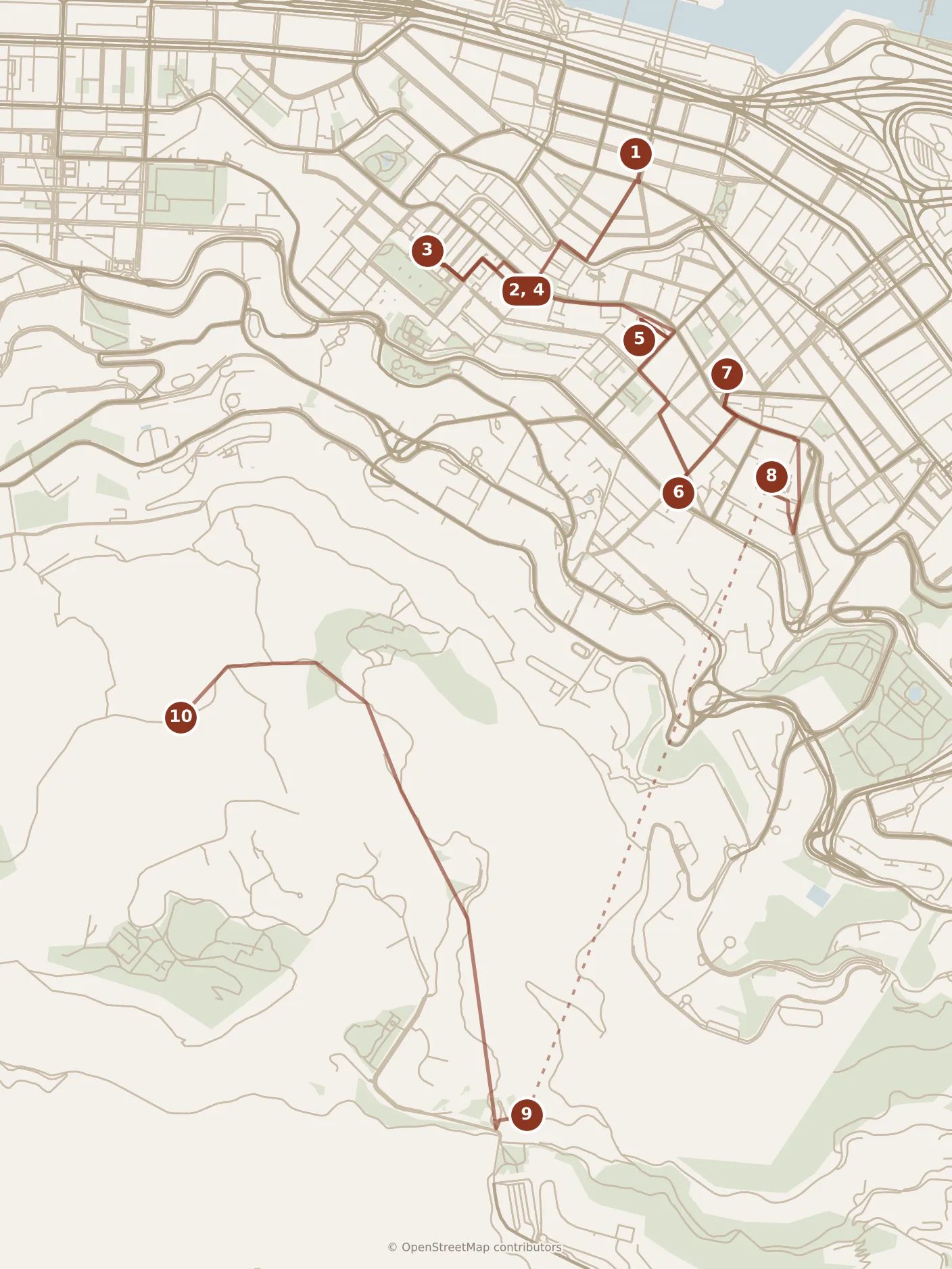
- Morning and afternoon
- 1Sheung Wan station
- 2Man Mo Temple
- 3Tai Ping Shan Street
- 4Hollywood Road
- 5PMQ
- 6Mid-Levels escalator
- 7Graham Street
- 8Tai Kwun
- 9Peak Tower
- 10Lugard Road
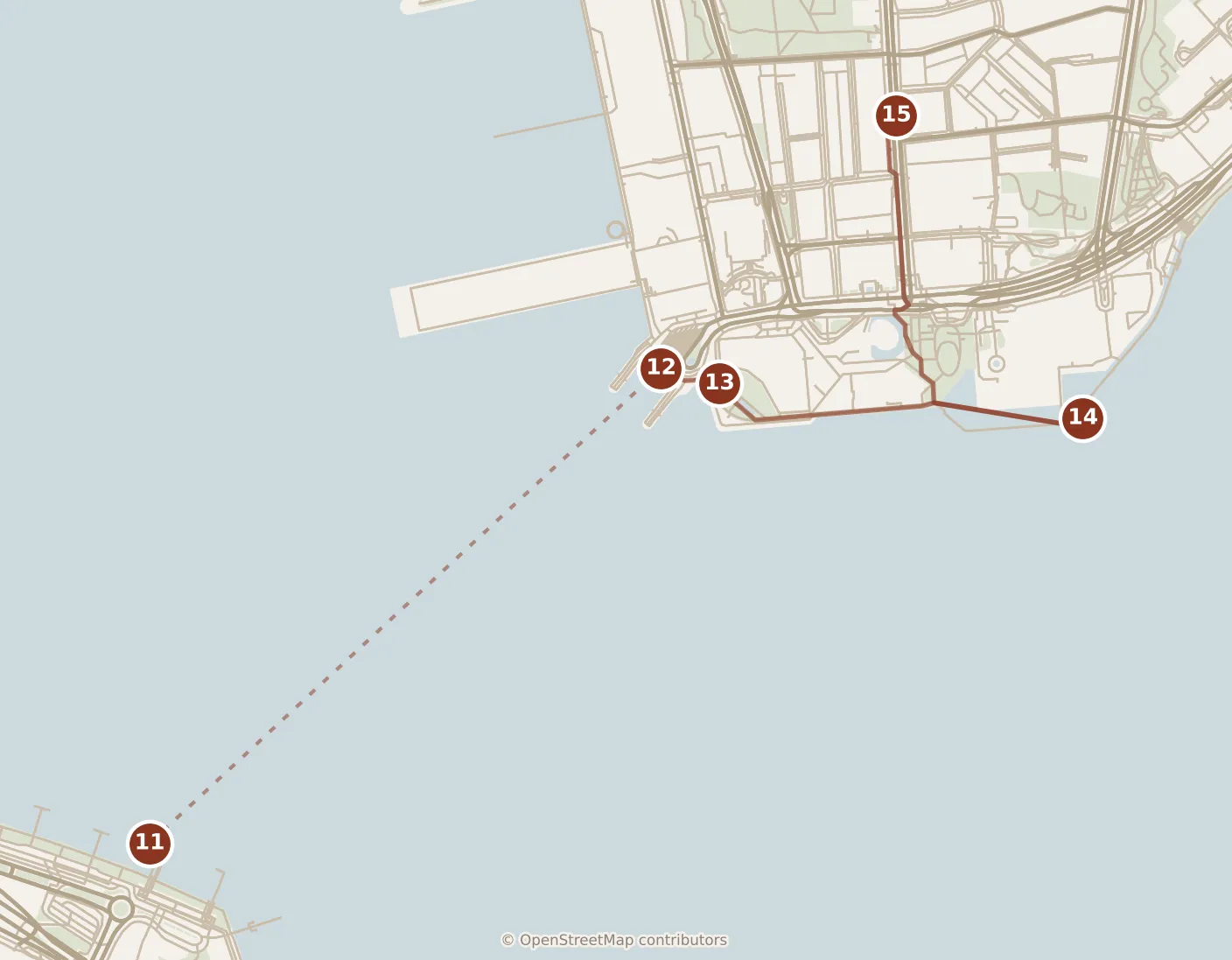
- Evening
- 11Central Star Ferry Pier
- 12Tsim Sha Tsui Ferry Pier
- 13Clock Tower
- 14Avenue of Stars
- 15Tsim Sha Tsui Station
Morning
Start at Sheung Wan station, one stop west of Central on the Island line. If you are already in Central, walk the fifteen minutes west along Des Voeux Road instead, or take one of the double-decker trams that run down the middle of it. The tram will not save you a minute; the front seat of its upper deck is the cheapest sightseeing in Hong Kong, and this route has no other place to put it, so take it on the way in rather than not at all.
Eat before you climb, and eat where the neighborhood does. The cha chaan teng is the local diner — formica, strip lights, no ceremony — and breakfast in one is milk tea, brewed strong and pulled through a cloth strainer until it is the color of a brick, with a pineapple bun beside it that has never contained any pineapple. The name is the crackled sugar crust on the top. Fifteen minutes, and it is the right fifteen minutes because everything for the next hour is uphill.
Then climb. Ten minutes of steps and slopes brings you to Man Mo Temple on Hollywood Road, and the climb is itself the introduction: this quarter sits on a gradient steep enough that several of its streets are staircases. The temple was built in 1847 and handed to a charitable hospital board in 1908, which still runs it, and it is dark inside in a way no photograph prepares you for. Coils of incense the size of cartwheels hang from the ceiling burning slowly, and the smoke does not clear; it just sits there in the light from the door. It belongs to two gods, one of literature and one of war, and that pairing is worth a moment — candidates for the imperial examinations came here, and so did everyone with a quarrel to settle. Give it twenty minutes and let your eyes adjust before you decide it is small.
Three minutes further west and uphill is Tai Ping Shan Street, which is the reason to be up here rather than down on the flat. This was the first Chinese quarter of the colony and it was also the worst of it: bubonic plague broke out in these lanes in May 1894, and the government’s answer was to clear and demolish most of the district afterwards. What was rebuilt is what you are standing in. Four small shrines survive on the one short street — one to the goddess of mercy, one to the god who governs the year you were born — and they are shallow, dark and thick with smoke, and you can see the whole of each from the sidewalk. The rest of the street is galleries and coffee now, which is an honest fact about Hong Kong rather than a betrayal of it. Give it half an hour and take it slowly.
Come back down onto Hollywood Road and walk east along it. It was one of the first roads the British cut on this island, in the 1840s, and it has long been the antiques street: window after window of Buddhas, temple carvings, opium pipes, ancestor portraits and blackwood furniture, a good deal of it excellent and a good deal of it made last year. Nothing here needs buying. Fifteen minutes of walking takes you the length of the interesting part.
Halfway along, on the uphill side, is PMQ — two seven-story slabs of police married quarters finished in 1951, empty for fourteen years, and reopened in 2014 as studios and shops for designers. The apartments are the units and most of the doors stand open, so the building still reads as what it was: walk the external balconies rather than the ground floor. In the basement a free walk-in display shows granite steps and a rubble retaining wall, which is all that survives of the school that stood on this site from 1889 until the war. Twenty minutes.
From beside it, get on the Mid-Levels escalator. It opened in 1993, it is eight hundred meters of covered moving staircase climbing the hillside in flights, and it exists because the people who live above Central would otherwise have to walk up. It runs downhill for the morning commute and uphill for the rest of the day, which is exactly why it sits here in the itinerary and not at the start of it — early enough in the morning it will only take you the wrong way. You are joining it two thirds of the way up, so the stretch that matters is the one directly above you: ride it through SoHo, where it passes at first-floor height over a street of bars and restaurants and you find yourself looking in at the windows. What is left above that is the residential climb, and that is a commute, not a sight.
Get off and drop back down to Graham Street, where a wet market has traded since the 1840s: stacked greens, live fish, whole birds, butchers’ blocks under canvas awnings pitched on a slope. It is smaller than it was. An urban renewal scheme has been buying and demolishing the blocks around it since 2007, so what you find is a couple of streets rather than the district that stood here, and it is the sort of thing worth seeing in the year you are actually in. Fifteen minutes.
Lunch is dim sum and it belongs here rather than later, because that is when it is eaten: the meal is called yum cha, it is a morning and midday thing, and anywhere serving it late in the evening is serving it to visitors. The old tea houses are in the streets between this market and Sheung Wan, they are loud, and the etiquette is short — you share everything, you order in rounds as they occur to you, and when somebody fills your cup you tap two fingers on the table instead of thanking them out loud. Give it an hour and order more than looks sensible.
Afternoon
From the top of the market it is five minutes uphill and east along Hollywood Road to Tai Kwun, rather more if lunch took you west. Until 2006 this was the Central Police Station, the Central Magistracy and Victoria Prison, all inside one walled block, built and rebuilt between 1841 and 1925. It reopened in 2018 after an eight-year conservation project: sixteen restored buildings around two parade grounds, with two new ones set among them behind a perforated cast-aluminum skin. Going in is free. What is worth the time is the prison side — the yards, a cell block you walk through, the courtroom — and whichever exhibition is in the two new galleries. Give it an hour and a quarter and do not try to see all sixteen buildings. The compound is the exhibit; the buildings are its walls.
Then leave for the Peak, and leave earlier than feels necessary. It is fifteen minutes downhill and east on foot to the lower station of the Peak Tram, on Garden Road beside the cathedral, and the line there is the one thing in this day you cannot plan around. The tram has been running since 1888 and climbs a kilometer and a third at up to a one-in-two gradient; the reason to take it rather than a bus is the illusion partway up, where the towers alongside the track appear to lean over at forty-five degrees because the only level thing in your field of view is the floor of the carriage. A round-trip ticket was in the region of a hundred Hong Kong dollars in 2026, after a sharp rise in December 2024, and buying it before you arrive saves you the ticket counter and nothing else: the ticket is booked for a date and a time slot, and the operator is explicit that it carries no priority at the gate, where everybody boards in the order they arrived. Public buses and green minibuses also climb Peak Road from Central and set you down across the road at the top — slower, but with no line — and if the wait is absurd and the weather is kind, Old Peak Road is a walk of about an hour, steeply, on tarmac.
The tram delivers you inside the Peak Tower, a 1997 building shaped like a wok balanced on a wall, and the first thing to do at the top is walk out of it. Its rooftop terrace has a ticket of its own, and what it shows you is the same harbor you can have for nothing a quarter of an hour along Lugard Road, which is what you actually came up for.
Lugard Road starts beside the tower and runs round the north face of the hill. It was built between 1913 and 1921, it is two and a half kilometers of near-level paved lane wide enough for a single car, and almost no cars are allowed on it. A quarter of an hour along, the trees open and the entire thing is in front of you at once: the towers of the north shore stacked up the slope directly below, the harbor, the ferries crossing it, Kowloon on the far side and the hills of the mainland behind that. Stand there for the light going. The buildings do not come on all together — they come on over about twenty minutes — and the moment worth waiting for is the one where the sky is still blue and the towers are already lit.
Then decide in advance how you are getting back, because this is a narrow lane on the side of a mountain rather than a promenade, and the return is another quarter of an hour during which the light will finish going. Either walk out with enough margin to be back before it does, or accept a dim walk with a phone in your hand. If you started early and have the hour, the better answer is neither: carry on round instead, where Lugard runs into Harlech Road and the ring brings you back to the tower.
Local tip. There are two things to pay for at the top of this hill and you only need one of them. Pay for the tram, which is a ride you cannot get anywhere else, and skip the rooftop terrace, because the free road outside shows you the same water. And if the line at the bottom has eaten your margin, shorten the walk rather than dropping it: turning round where the trees open is the whole of what you came up for.
Evening
Coming down is not simply the reverse of going up. There is a second line at the top after dark, made of everybody who watched the same sunset; the buses and minibuses run down as well, so take whichever is moving — but they are not the same journey. The road route sets you down beside the ferry piers themselves, which is where you are going anyway. The tram puts you back on Garden Road, and from there it is twenty minutes north on foot to the Central Star Ferry Pier, most of it on the elevated walkways that thread between the office towers a floor above the traffic. That is worth doing once for itself: this city has a whole second street level, and nobody down at the first one ever looks up at it.
From Pier 7, take the Star Ferry across to Tsim Sha Tsui. The company has been making this crossing since 1888, the boats are green and white and much older than they look, and it takes under ten minutes. Sit on the upper deck, facing back the way you came: the island is behind the boat for the whole crossing, and the seat backs swing over so you can choose. You have just spent an hour looking down on this skyline from four hundred meters up; the ferry hands it back to you from the waterline, with the towers going up in front of you rather than down below, and the two are not the same view at all. This is the best ten minutes of the day and it costs less than a cup of tea.
You land beside the Clock Tower — forty-four meters of red brick and granite, finished in 1915, and the only surviving piece of the railway terminus that stood on this spot until it was demolished in 1977. Trains left from here for the mainland, and, with changes, for Europe. Five minutes and a look up is enough.
Then walk east along the water to the Avenue of Stars: ten minutes, flat, with the harbor rail beside you the whole way. The handprints and the film statues are the theme rather than the reason. The reason is that this is the one place in the city where you can stand still and have the entire north shore of the island in front of you, lit, at eye level — every photograph of Hong Kong you have ever seen was taken within a few hundred meters of where you are standing.
A light and sound show, the Symphony of Lights, has run across the harbor at eight nightly since 2004 and still did in 2026, weather permitting: about ten minutes of lasers and floodlighting off the towers on both shores, with the soundtrack broadcast along this promenade. It is modest, and the skyline was already doing the work, so go if you are there and do not rearrange the evening for it. Whether you can be there at all is the one real calculation this day contains, and it is a subtraction: from the viewpoint on Lugard Road it is a good hour and a half back down the hill, across the water and along here. In the winter half of the year that leaves time in hand. At midsummer the sun is not down until after seven and it simply does not fit — so take the skyline, which was the better thing anyway. If the show has moved off eight, do the same subtraction against whatever hour it has moved to.
Eat here before you go. The thing to have late in Tsim Sha Tsui is a bowl of wonton noodles — thin egg noodles held above the broth so they stay firm, prawn dumplings under them, strip lighting overhead and a line at the door — and the streets a block or two inland from the promenade are full of places doing it. Then Tsim Sha Tsui Station, on the Tsuen Wan line, is ten minutes north on foot up Nathan Road, and East Tsim Sha Tsui, on the Tuen Ma line, sits at the far end of the promenade you have just walked. If you are going on to the airport, the rail link to it starts from Hong Kong Station in Central — so the ferry back across and a ten-minute walk on the other side is the pleasant way to reach it, and there is something to be said for ending the day with the crossing in the other direction.
Practicalities
This route needs one thing a reader landing here may not be holding: a way to pay two small fares, the ferry across the harbor and the tram up the hill. How fares are paid in this city is the parent guide’s subject rather than this article’s, and it is worth the two minutes before you arrive.
Beyond that there is one thing worth buying before you set out, and it is the tram ticket itself: a round-trip ticket was in the region of a hundred Hong Kong dollars in 2026, after the fare rose sharply in December 2024. What having it already saves you is the ticket counter, not the line — it is booked for a date and a time slot and carries no priority at the gate, where boarding is in order of arrival — so it also commits you to an hour that the rest of this day is deliberately leaving loose. Everything else on the day is free to walk into — the temple and the shrines, the antiques street, the police compound, the market, the escalator, the promenade.
The one stop on this route with anything to check is Tai Kwun, and what needs checking is not the compound but what is inside it. The site itself stands open from early morning until late at night, so the yards and the lanes between the buildings are there whenever you walk in; the galleries keep gallery hours, and the contemporary art gallery closes on Mondays. Check those before you set out, because they are what carries the middle of the afternoon. If they are shut on your day the compound still holds an hour on its own, and if you would rather spend it elsewhere, PMQ and the Hollywood Road windows absorb that hour without strain and you arrive at the funicular earlier, which on this particular route is not a punishment. Nothing else in the day depends on a museum, and the temples and the market keep long ordinary hours.
Order matters more here than contents. Everything above the tram can be shortened, reordered or dropped; nothing below it can, because the light does not wait and the line is not yours to control. The one exception is the bag, and it is not a reordering but a subtraction: carrying luggage takes the tram and the lane out of the day altogether, and what is left crosses the harbor before the light goes rather than after it. If you are running late, cut Graham Street first and the escalator second, and never cut the margin in front of the line for the tram.
Two weather cases break this day rather than merely dampen it. The Peak is often in cloud when the city underneath it is clear, worst in spring, and then the view you came for is simply not there. That is one of the few things on this route you can check before you commit to it: look up at the hill over lunch, and if the top of it is not visible from where you are standing, this is the afternoon to spend riding the tram east through Wan Chai and Causeway Bay instead, or in the museums the route otherwise gives up. The other case is a typhoon signal in the summer months, which shuts the funicular, the ferry and most of the rest of it; the city guide explains how that works.
Finally, shoes. The morning is a hillside where some of the streets are stairs and the afternoon is a lane cut into a mountain. This is the wrong day for anything new on your feet, and the wrong day to be carrying something you would rather have put down.


_20170807-1.jpg)
