Ho Chi Minh City in two or three days: two palaces, Chợ Lớn, and Củ Chi if you have a third

Last updated 8 August 2026
Overview
Two days in Saigon are not one day taken slowly. One day gets you the square kilometer of colonial administration in the center and nothing else, because the traffic makes anything beyond it cost the better part of an hour each way, sitting still. The second day is what buys that hour, and what it buys with it is Chợ Lớn — the Chinese quarter five kilometers south-west, which was a separate town until the French joined the two in 1931 and still reads like one.
So the shape is: one day for the state and the war, laid out inside a twenty-minute walk; one day for the other city, which is a ride out and a ride back. Day one has two palaces in it rather than the famous one, and the second palace is the argument for having two days at all — it is where the president was actually living when the coup came for him, and where he built a bunker under the garden that he finished a month before he was killed. Day two ends where a city of fourteen million ought to be looked at from, which is not the tower in the middle of it.
Nothing on either day has to be booked. There is no pass, no timed slot and no line worth pre-empting, and every ticket on these two days is sold at its own gate; what the parent guide covers — the fares, the money, the road in from the airport — this article assumes and does not repeat. The third day adds exactly one thing that does want arranging the day before, and it is described where it belongs, below.
The other useful thing about days one and two is a negative: there is no day of the week either of them has to avoid. Independence Palace opens seven days including public holidays and Tết, the second palace says the same on its own site, and a market, two congregation halls, a parish church and a tower do not keep museum hours. That is unusual enough to say out loud, because the weekly closure is normally the thing that decides which day goes first, and here it decides nothing. Two stops are worth checking rather than assuming. The war museum’s own site gives seven days a week; if that has changed, day one absorbs it without strain, because the palace beside it will take another hour and the pagoda below is free. The fine-arts museum on day two is the other, and this article could not confirm the week it publishes at all; if it turns out to keep a closing day, that museum is already the first thing the cut list below tells you to drop, and the Chợ Lớn day survives losing it.
Eleven degrees north of the equator, this city has no seasons of light to speak of. The earliest sunset of the year falls in the second week of November, a little before half past five; the latest, in the first week of July, comes at about twenty past six. Fifty-three minutes covers the whole calendar. What shapes a day here is not the light but the heat and, from May to November, the hour of rain that lands in the middle of the afternoon — which is why day two below puts its outdoor walking before eleven and its interiors after it. Day one cannot be built that way — it is walked end to end, and its longest stretch falls after lunch — which is why the practical note below names that stretch as the first to put in a cab.
Getting to the start. Almost everyone arrives by air and the road in from the terminal is the parent guide’s subject. If you come by train, note that Saigon railway station sits about two kilometers west-north-west of everything on day one and is on no metro line; it is a short ride into the center and nothing more. Wherever you have slept, day one is written to begin at Bến Thành station, because Line 1 ends there and so does most of the bus network, and because it is a landmark you can name to anybody. A quarter of an hour on foot separates its exits from the first door of the day, straight up through the center. Do that stretch at seven and you will understand, by ten, why it is written into the plan rather than left to a car. Eat before you set off: breakfast is the meal in this city, and none of the three days below leaves room for one.
The bag. You are here two or three nights, so you have a room and the only real question is the last morning — and the answer is different depending on whether you are staying two nights or three, which is worth working out before you fix the order. On two days it is a non-issue. Day one never leaves the central kilometer and finishes a twenty-minute walk from the metro terminus it began at; day two finishes at a station four stops from the same terminus. Either can be your last. On three days it is not, because the Chợ Lớn day becomes the last one, and Chợ Lớn ends five kilometers out on the wrong side of town with no metro to it. If you have a flight or a train before the evening, take its morning as written and come back after the temples rather than after the noodles. What you must not do is solve it by moving Củ Chi to the end: that day cannot be done holding a bag at all, because you go underground on it, on your hands and knees, and there is nowhere out there that will hold one for you. Củ Chi is never the departure day.
Củ Chi tunnels — not on the walking map.
- With a third day · stop 13
- 13Củ Chi tunnels
Day one

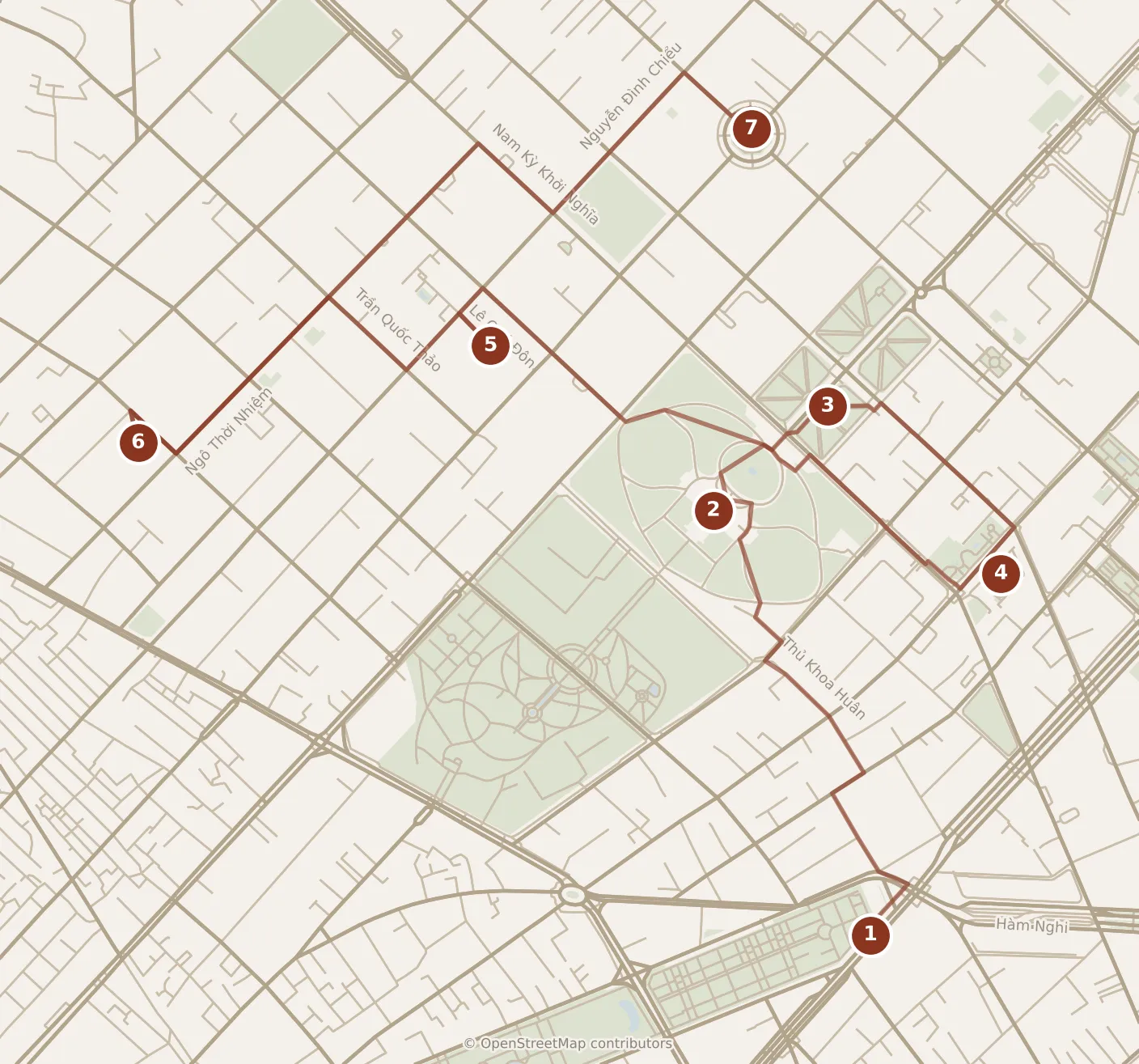
- Day one
- 1Bến Thành station
- 2Independence Palace
- 3April 30 Park
- 4Museum of Ho Chi Minh City
- 5War Remnants Museum
- 6Xá Lợi Pagoda
- 7Hồ Con Rùa
Everything today sits inside a rectangle you could walk across in twenty minutes, and it is the same rectangle three times over: a palace built for a president, a palace built for a governor and used by that same president, and a museum about what the two of them were doing. The stops below come to about nine and a half hours and the walking between them to an hour and twenty minutes. Added to a seven o’clock start those numbers put you at the last stop at about half past four, and the last stop is the one that does not work before six — so this day has an hour and a half of slack in the middle of it, and it is better spent than pretended away. Part of it goes on what the count leaves out: the ticket desk and the bag check at the palace gate at opening, and the roads, which here are a slow deliberate business to cross rather than a twenty-second event, and which you will cross perhaps thirty times today. The rest belongs to the war museum, which absorbs three hours as easily as the two and a half it is given below, and to a longer lunch. What it must not buy is a later start, for the reason in the next paragraph.
One published hour sets the morning. In 2026 the palace’s gate opened at seven, and its own site put no closed day against that at all — not a weekday, not a public holiday, not Tết. Two days do not need a seven o’clock start the way a single day does, and this is the place to say plainly that you may ignore it. Take it anyway. Everything you do outdoors before nine is easier than the same thing at eleven, the whole morning below is built forward from that gate, and if the hour has moved, rebuild it forward from the new one.
Morning
From Bến Thành station walk fifteen minutes north to Independence Palace. Give it two hours, which is half an hour more than one day can spare, and spend the extra half hour upstairs rather than down. The basement deserves its hour and is the famous half — a concrete command bunker of map rooms, radio sets and rotary telephones left where they stood — but the floors above it are a complete 1966 government building preserved in its own taste, and a hurried visit takes them as scenery: a banqueting room, a card room, a cinema, a president’s private chapel, and a helipad on the roof. It was finished on 31 October 1966 to a design by Ngô Viết Thụ, and hold on to that name for an hour, because it comes back.
Twenty minutes in April 30 Park, which begins where the palace grounds end and runs down to the cathedral, with the central post office across the square from it. Neither of those two is a stop on this day and that is deliberate: the cathedral has been under restoration since 2017 and is still behind its scaffolding, and the post office is a five-minute look from inside the same twenty minutes. The park itself is less a stop than the shade between two. Then eight minutes south-east to the Museum of Ho Chi Minh City, which is the old Gia Long Palace and is neither the fine-arts museum of the Chợ Lớn day nor the history museum of the Củ Chi day — the museum names in this city are nearly identical and a maps app will not disambiguate them for you. This is the one a single day gives up. Alfred Foulhoux — the architect of the central post office, whatever the guidebooks tell you about Eiffel — began it in 1885 as a commercial museum for displaying the produce of the colony. It was finished in 1890 and taken over at once as the lieutenant-governor’s residence instead, which is why the front still carries the leftovers of a purpose it never served: two plinths flanking the main door where statues of Commerce and Industry stood until a governor knocked them off in 1943 to build a porch, a cockerel for day and an owl for night in the corners of the pediment, garlands, a coiled snake, and lizards and long-legged birds worked in among the Greek motifs.
Bảo Đại renamed it Gia Long Palace in 1954. When Independence Palace was bombed by two of the south’s own pilots on 27 February 1962, Ngô Đình Diệm moved the presidency into this building and lived here until the coup of November 1963 — and had a secret bunker dug beneath it, built between May 1962 and October 1963 to a design by Ngô Viết Thụ, the same man who was at that moment drawing the palace up the road. He finished the bunker a month before he lost the country. From 31 October 1966, when the new palace was done, this became the Supreme Court of the Republic of Vietnam, and it has been a museum since 1978. An hour and a half, and go downstairs.
Local tip. If a morning only stretches to one of the two palaces, take this one. The first is the building every other page sends you to and you will already have seen photographs of its lawn; this is the one where the thing actually happened, and it is a fraction as crowded.
Afternoon
Lunch first, an hour and a quarter of it, sitting down under a fan in the lanes rather than on the wide streets. Bánh xèo suits this hour: a folded rice-flour crêpe the size of a dinner plate, fried hard, torn up and wrapped in leaves at the table, and the eating of it takes long enough to be the rest you need. Sitting down for it is not indulgence. Between eleven and two the sidewalks are unusable and a body that has been on them since seven needs to be out of the sun and off its feet, and an hour spent that way is bought back with interest between two and six.
Then just under twenty minutes west to the War Remnants Museum, and give it two and a half hours. Three floors, a yard of captured aircraft and armor, and a reconstruction of the island prison cages in a building of its own. The photography is what you are here for, and the display on the aftermath of the chemical defoliants is the hardest part of it. Whose museum this is, and how it addresses you, is one of the exhibits: it is a state museum and the wall texts are written in the state’s voice, which is one of the things there is to look at here. Do not try to read every caption; you will not last. It is also full of Vietnamese school parties on most weekdays, which changes the rooms more than you would expect and is a reason to be early rather than late.
If the day has run to time you will come out with an hour spare, because one is built in deliberately. Spend it twelve minutes west at Xá Lợi Pagoda, which is architecturally plain and historically enormous: this is the pagoda that special forces under Ngô Đình Nhu’s orders raided on 21 August 1963, an act that lost the family what was left of American patience and set the coup running ten weeks later. Half an hour. Shoes come off at the door of the hall and shoulders and knees are covered here as at the church and the two halls on day two, it is a working pagoda and not a monument, and you come back east the way you came, past the museum.
Evening
Hồ Con Rùa is a little over twenty minutes north-east of the pagoda, or ten from the war museum if you skipped it: a concrete pavilion over a pool at a five-way junction, put up in the 1960s and finished in the form you see in 1974, and called the turtle lake after a sculpture that is no longer there. Nothing about it is beautiful and that is not the point. From about six in the evening the sidewalks around it fill with people on plastic stools eating from carts, and it is the nearest thing the center has to a square where this city is off duty. An hour and a half: eat two or three small things rather than a meal, and drink cà phê sữa đá far later in the day than you think you should. The streets running north-west from here are where the good small kitchens are, and none of them is more than ten minutes away.
Day two

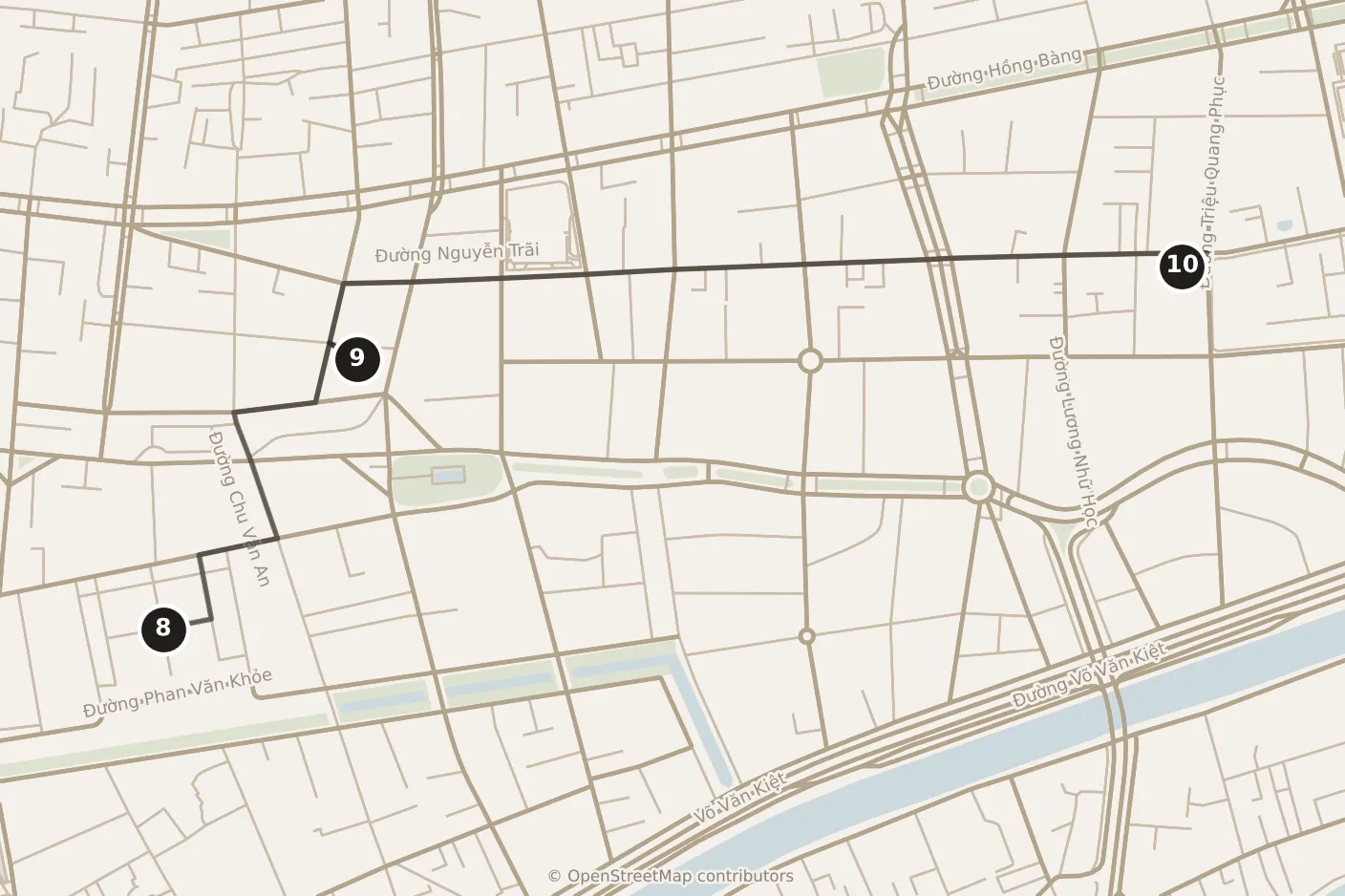
- Morning
- 8Bình Tây Market
- 9Cha Tam Church
- Hải Thượng Lãn Ông — in the prose, not on the map
- 10Thiên Hậu Temple
- Nghĩa An Hội Quán — in the prose, not on the map
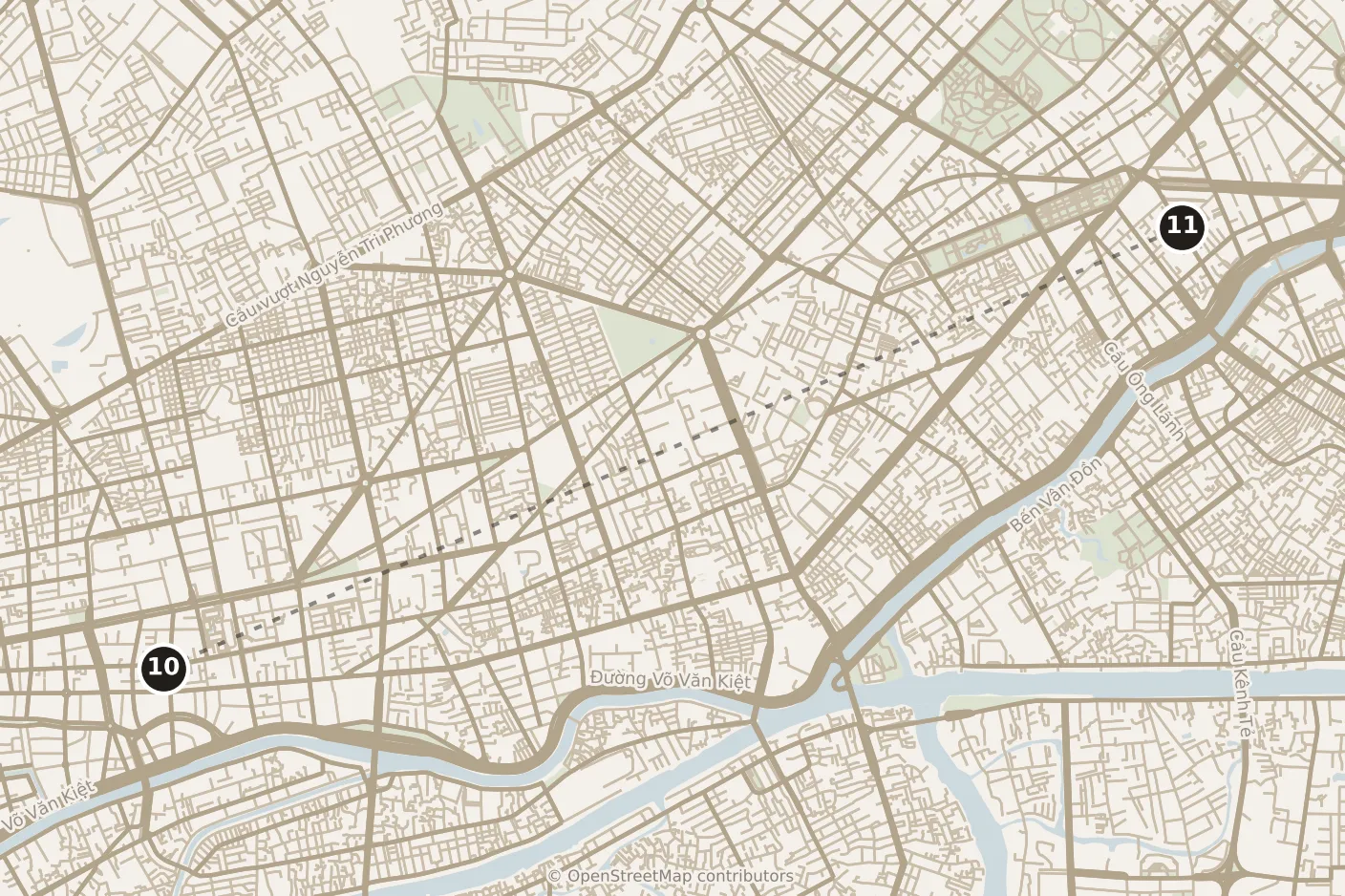
The leg out of the center: from stop 10 by taxi, not on foot.
- Afternoon
- 11Ho Chi Minh City Museum of Fine Arts
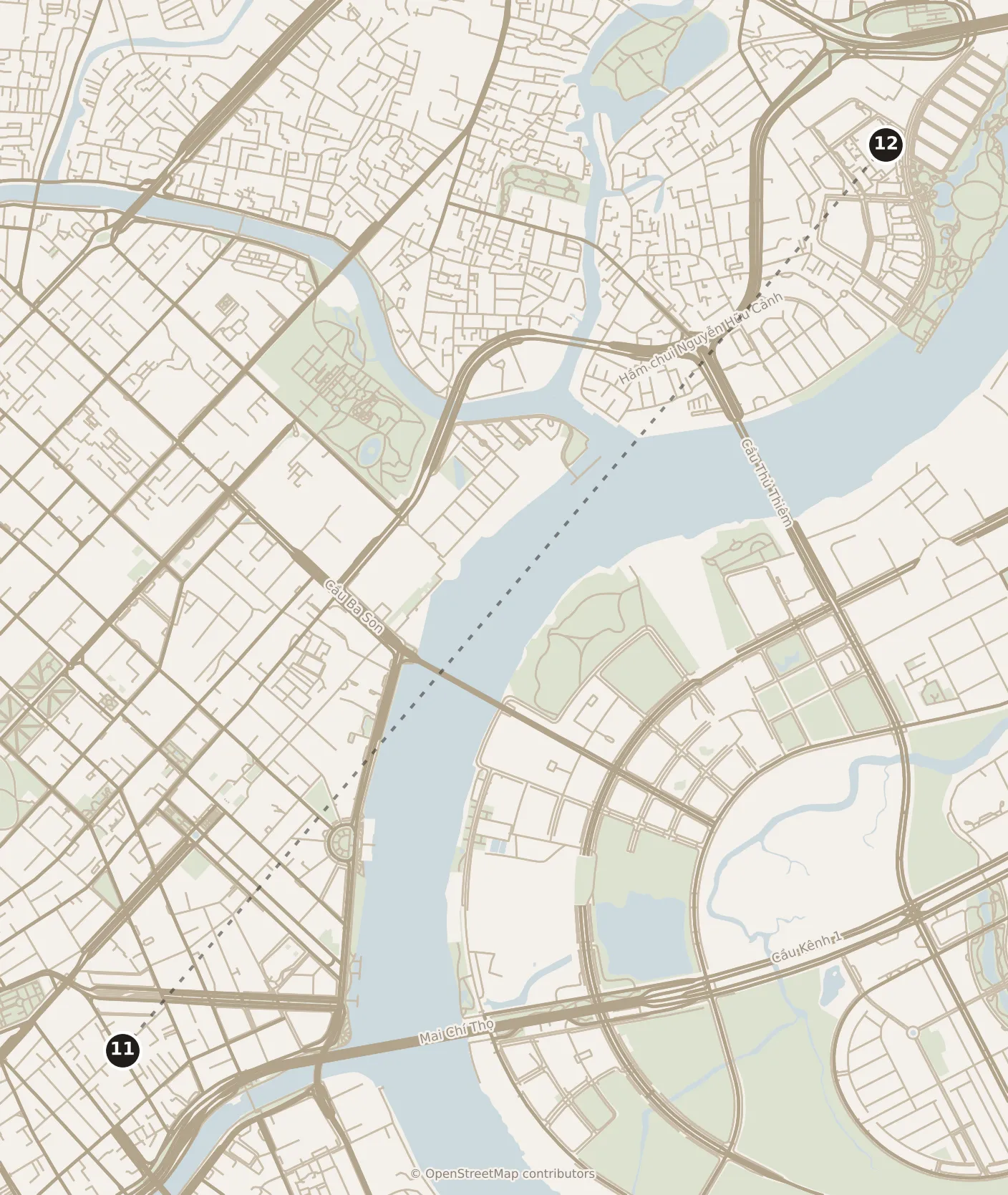
The leg out of the center: from stop 11 by metro, not on foot.
- Evening
- 12Landmark 81
Today is Chợ Lớn, which means big market. It is not a quarter of Saigon that happens to be Chinese; it is a Cantonese and Teochew town that Saigon grew into, and the congregation halls in it are older than anything you saw yesterday. The day runs from its western edge eastwards on foot, comes back into the center, and finishes above the river.
The stops come to about seven and a quarter hours, and the moving between them — two road journeys, a metro ride and a little under two kilometers of walking in Chợ Lớn — to a little over two. Nine and a half hours, and the road times inside it are a guess by construction: a leg that takes twenty minutes at eight in the morning takes forty at six in the evening, and no arithmetic in an article can tell you which one you are about to get.
On two days this is the day the light matters. Everything above the last stop comes to about eight hours, and the last stop wants the hour before dark, so subtract nine from your month’s sunset and you have the latest you can start: a little before half past eight in November, a little after nine in July. Start at eight in any month anyway, because the market at the beginning of the day is a wholesale market and is a different place by eleven, and give what you gain to the fine-arts museum, which is the stop that stretches. On three days none of that arithmetic applies, and the third-day section below says what replaces it.
Morning
Get out to Bình Tây Market by road. The cheap and legible way is bus route 1, which runs from Bến Thành out to Chợ Lớn and sets you down beside the market; you board it at the bus interchange beside Bến Thành. A ride-hailing car does the same trip in twenty-five to forty minutes depending on the hour.
An hour here. A Chinese merchant called Quách Đàm paid for the market in 1928 and gave it to the city on two conditions: that he could build the rows of shophouses around it, and that his own statue would stand in the middle of it after his death. It opened in 1930 — a rectangle with twelve gates around a courtyard, a big clock on the roof and dragons along the ridge — and it shut for two years of restoration before reopening on 15 November 2018 with something over fourteen hundred stalls. It is wholesale and not a souvenir hall: things here are sold by the sack and the carton, and the pleasure of it is watching a supply chain rather than shopping. Keep out of the aisles when a handcart is coming, and once you are back on the street keep your bag on the side away from the traffic, because that is the side a passing bike can reach; the parent guide gives the fuller version.
Seven minutes north-east is Cha Tam Church, the strangest building on these three days. A priest born in Macao in 1855, Pierre d’Assou — whose Chinese name Vietnamese speakers rendered as Cha Tam — bought the ground and laid the first stone on 3 December 1900, and the church was consecrated in January 1902. The shape is Gothic and the detail is not: a three-arched gate of the kind that fronts a temple, the church’s name over the door in Chinese characters, a yin-yang tile roof with upturned eaves, two carp flanking the cross, a lotus on the ridge, red lacquer columns in the sanctuary, and gilded parallel scrolls in Chinese either side of the crucifix. Half an hour. It is a working parish and on a Sunday morning the building belongs to its congregation — sit at the back and wait, and do not walk the aisles during a service; or run the day in the other order, market last, so this stop falls in the afternoon. The second has a price the first does not: by the afternoon the market has stopped being the wholesale market the eight o’clock start is for. There is no order that avoids both.
There is one more thing here, and no plaque makes much of it. On the night of 1 November 1963, Ngô Đình Diệm and his brother left the building you stood in yesterday, crossed the city and spent the night in Chợ Lớn; on the morning of the 2nd they gave themselves up in this church and were killed in the armoured carrier that was taking them back. The two halves of that story are the two days of this itinerary, in order.
A few minutes north brings you onto Hải Thượng Lãn Ông; walk it east, half an hour of it. It was a creek until the French filled it in during the 1920s to make two boulevards, and the city’s heritage department recognized it in 2010 as the oldest surviving street quarter in Saigon. It and the two lanes crossing it are the traditional-medicine trade: hundreds of shops in a row, sacks and drawers and glass jars of dried root, bark and fungus, and the whole street smelling of it. You are not buying anything. You are walking through the one stretch of this city that still looks like its own old photographs.
At the top of it, on Nguyễn Trãi, are the two congregation halls. Thiên Hậu Temple — the Tuệ Thành hall, raised by immigrants from Guangzhou, and nobody can date it exactly: 1760 is the usual figure, the great bell inside is dated to 1830, and a gazetteer of the region compiled around 1820 already lists it. Forty minutes. Four buildings closed around a light well, so that the smoke from the hanging incense coils goes up through the middle of the roof and the daylight comes down through the same hole, and the friezes along the roof ridges are rows of small glazed figures acting out whole stories. Step over the raised threshold rather than on it, keep to the edges of the court where the coils are dropping ash, and do not walk between someone and the altar they are standing at. On the first and the fifteenth of the lunar month, and at Tết, this building is not a place to look at anything.
Two hundred meters east, Nghĩa An Hội Quán is the Teochew hall, founded around the end of the eighteenth century and dedicated to Quan Vũ; it has been restored five times, most recently over five years to 2014. Twenty minutes. Its courtyard runs to nearly two thousand square meters and takes up more than half the site, which is what makes it different from its neighbor: the one you have just left is a warren, and this is an open square with five pairs of stone qilin walking you towards the door.
Local tip. These two are two hundred meters apart and the temptation is to do both quickly. Do one of them slowly instead — they are the same kind of building, and the second teaches you nothing the first did not unless you sit down in it. If you are choosing, take the older and denser one for the smoke and the roofs, and the newer one only for its courtyard.
Lunch is here, an hour and a quarter. Hủ tiếu is what Chợ Lớn is for: a clear pork broth with flat or round rice noodles, and the local question is whether you want the soup in the bowl or alongside. In the bowl is hủ tiếu nước; the noodles dressed with the broth served separately is hủ tiếu khô, and that is the one to ask for.
Afternoon
A car back into the center, half an hour, to the Ho Chi Minh City Museum of Fine Arts on Phó Đức Chính, six minutes’ walk from Bến Thành station. The building came first. A French architect drew it in 1929 and finished it in 1934 for Hui Bon Hoa, the magnate who put up a good share of the landmarks of colonial Saigon, and it is an Asian and European hybrid of three floors built around a stairwell. It became a museum in 1987 and opened properly in the early 1990s. An hour and a half. What to give it: the lacquer, which is the medium this country made its own and where Nguyễn Gia Trí’s enormous multi-panel spring garden is the thing to stand in front of, and the wartime drawings, which are small and quick and made on the spot, and which after yesterday afternoon will land differently than they would on any other day. What to walk past without guilt: the ceramics and the antiquities, which are a consolation prize for a collection that has better rooms.
Evening
Back to Bến Thành station and four stops on Line 1 towards Suối Tiên — Opera House, Ba Son, Văn Thánh, then Tân Cảng, which is the stop for Landmark 81 and under ten minutes’ walk from its foot. This is the tower one day cannot reach, and the reason to reach it is arithmetic: at 461 meters it is close to twice the height of the one in the center, it is the tallest building in the country, and the observation floors that opened in April 2019 are the highest in Vietnam. It stands on the west bank of the Saigon River just south of Saigon Bridge, so you are looking back down the water at the whole center instead of standing in the middle of it. An hour and a half, and the shape of it is that you want to be up there while it is still light enough to read the river, stay through the half hour when the towers come on one by one, and leave once the view has stopped changing.
The deck has its own ticket, and the floors between the hotel and the deck sell a very similar view to anyone buying something there instead; that is the choice, and making it at the foot of the elevator costs you the light. But the real alternative is not another view. It is not coming back at all: stay in Chợ Lớn through the evening, eat there after dark when the noodle streets are at their best, and take a car back to Bến Thành late. That costs you the fine-arts museum and the height, and it gives you the one part of this city that two days otherwise never see in the dark. If you have three days, the next section spends this evening that way in any case.
With a third day

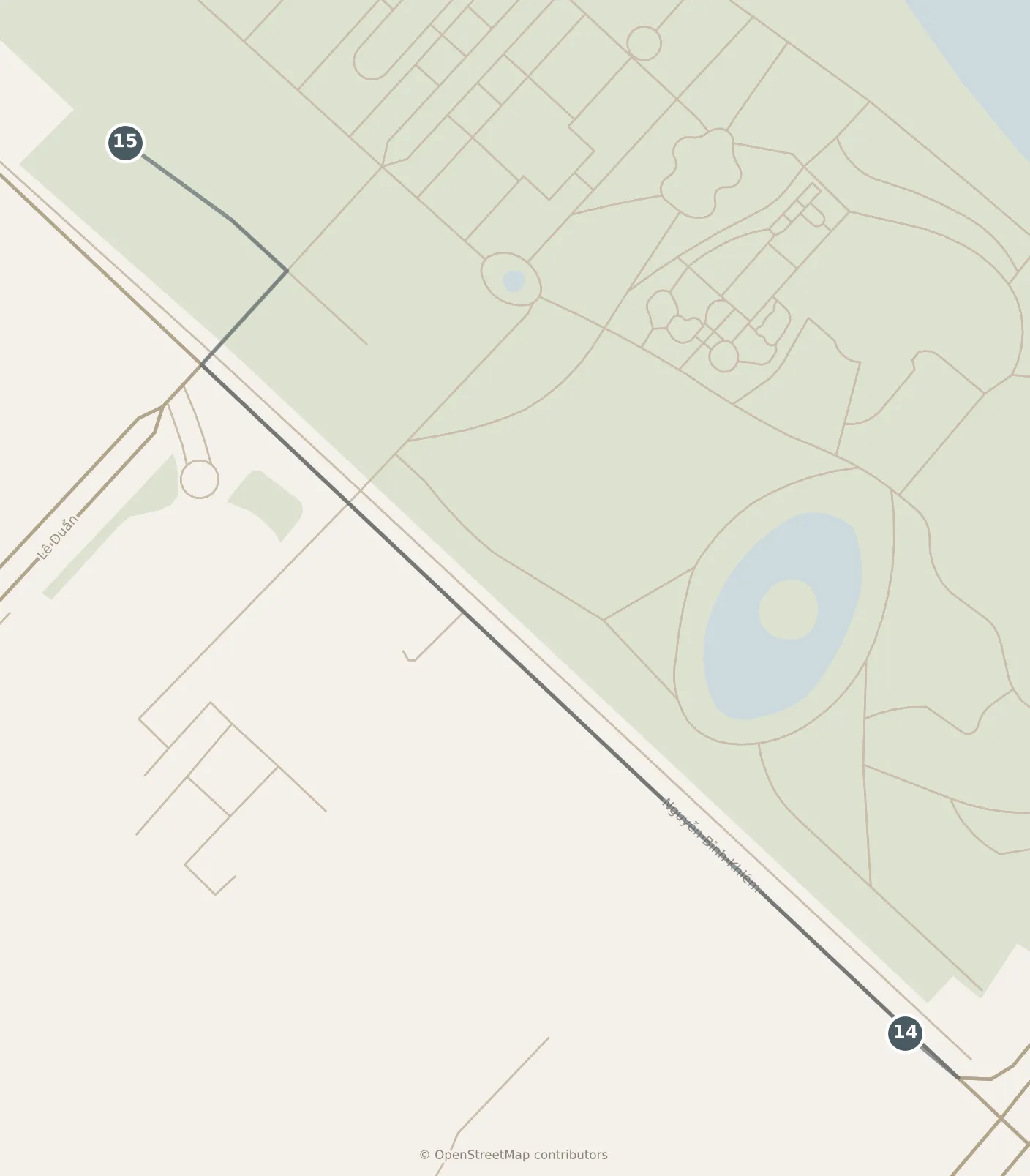
- With a third day · stops 14–15
- 14Ho Chi Minh City Museum of History
- 15Saigon Zoo and Botanical Gardens
A third day goes in the middle rather than on the end, and it goes to the Củ Chi tunnels — thirty-five kilometers and more out of the center, still inside the city’s own boundaries, which is a fact about how large this municipality is and not about how near the tunnels are.
Three reasons for the middle. The tunnels answer the war museum and the palace bunker while both are still in your head, and putting a market day between them interrupts an argument that has already been made. A day mostly spent sitting in a vehicle is easier on the second day than on the third. And it lets the Chợ Lớn day be your last, which means it can end where it stands, at night, instead of crossing the city for a tower.
What moves. Nothing inside day one changes. Chợ Lớn becomes day three, and two things change inside it. It loses its evening at Landmark 81, which comes here instead, and gains the evening in Chợ Lớn described at the end of day two above. And it loses the fine-arts museum along with it, because the afternoon that carried that museum was the afternoon spent coming back into the center, and on three days you are not coming back: the temples run into a longer lunch, the herb streets take a second pass on the way back through, and the day finishes after dark where it stands. That is a real loss and it is the right one — the museum is ninety minutes indoors that would work on any trip to this city, and an evening in Chợ Lớn is ninety minutes that would not. Nothing else in the day is reordered, but its clock is. With the tower and the museum both gone from it, the sunset arithmetic in day two above does not apply here and nothing on this version of the day has to happen before dark; its stops finish in the middle of the afternoon, and the hours between them and the noodle streets are the point rather than a hole. Start at eight for the market anyway, and let the lunch and the second pass at the herb streets run long.
One rule also appears that the two-day version does not have, and it is the whole reason to re-read the planning below rather than assume it survived the swap: this middle day is the only one of the three that cannot be a Monday.
Leave the center by half past seven, and that is arithmetic rather than an adverb: the museum that fixes this afternoon reopens at one, the tunnels take two hours, and the road is an hour and a half each way at best. Half-day trips are sold from every travel desk in the center and are what most people take; the independent version is a city bus from the same interchange beside Bến Thành out to Củ Chi bus station, and a local service on from there to the gate. Either way reckon that hour and a half each way, and understand that the road is the one figure in this article that nothing can predict — so if you are booking an organized trip, ask what time it sets you down before you book it, because the afternoon below is built on the museum’s one o’clock.
There are two entrances and they are not the same visit. Bến Đình is nearer the city and its tunnels are reconstructions, widened so that visitors can get through them; it is where the coaches go. Bến Dược is further out, is part of the original system, and has the memorial temple beside it — which is a memorial and not an exhibit, so hats off and voices down, and it is the better half of that site. Take Bến Đình if you are on an organized trip and want the crawl to be possible; take Bến Dược if you are going under your own steam and would rather have the real bore and fewer people. Two hours at either. In 2026 foreign visitors paid two tickets at the gate, an entry fee and a compulsory guiding fee, and the two together came to somewhere in the hundred-to-hundred-and-fifty-thousand-đồng range; the site publishes both figures itself, and it opens seven days a week.
Two warnings, both earned. There is a live firing range on the site and you will hear it through the whole visit, which some people find intolerable. And the crawl is genuinely claustrophobic even in the widened sections — you can decline it at the mouth and walk on above ground, and a good number of people do.
Back in the city at about half past twelve if the road behaves, eat near the gardens, and give the afternoon to the Ho Chi Minh City Museum of History on Nguyễn Bỉnh Khiêm. Auguste Delaval designed it and it opened on 1 January 1929. Two hours, spent narrowly: the Champa stone sculpture is the reason to come — the Hindu and Buddhist kingdom that held the coast of this country for a thousand years and that nothing else on this trip so much as mentions — and the Đông Sơn bronze drums and the Óc Eo material from the delta are the two rooms beside it that deserve the same attention. The dynastic galleries after those are chronology rather than objects, and walking them briskly costs nothing.
This is the stop that fixes the shape of the day, in two ways. In 2026 it shut between half past eleven and one, closed for the day at five, and took Mondays off. The midday break is convenient rather than awkward — it falls exactly when your vehicle is coming back from Củ Chi — but the five o’clock is not negotiable and neither is the Monday. Build the afternoon back from whatever the museum publishes on its own site, and if the hours have moved, build it back from the new ones.
Coming out you are at the gate of the Saigon Zoo and Botanical Gardens, which the French admiral La Grandière commissioned in 1864 and which opened to the public in 1869, making it one of the oldest continuously working zoos anywhere. Jean Baptiste Louis Pierre laid out the botanical half and ran it until 1877, and the botanical half is the half to walk: enormous old trees, an orchid house, and the temple to the Hùng kings that began life as a monument to Indochinese soldiers killed fighting for France. The animal enclosures are old-fashioned and you are under no obligation to look at them. Three-quarters of an hour.
Then fifteen minutes’ walk south-east to Ba Son station and two stops to Tân Cảng for Landmark 81, as described at the end of day two. Going in at the museum’s one o’clock and taking the gardens as well puts you at the foot of the tower at about twenty past four, which is an hour and ten minutes of light in November and two hours in July. If the road back from Củ Chi ate the afternoon, the gardens are what you give up — they are the only stop on this day that nothing else depends on, and both the museum and the tower have doors that shut.
Practicalities
Nothing on the two city days needs booking, and there is no city pass to buy for any of it: every ticket is sold at its own gate, and the palace also sells its own online, which saves a line rather than a place. The Củ Chi day is the single exception — if you want the organized version of it, arrange it the day before rather than on the morning, because the departures are early and they fill.
The days of the week come to one rule and one qualification. The Củ Chi day must miss Monday, because the museum in the gardens keeps a weekly closing day and Monday is the day it keeps; it is the one closure across these three days that the stop publishes on its own site. Day one, the Chợ Lớn day and the Củ Chi day otherwise take any date and may trade places — that permission is the sentence that makes this paragraph usable, and it is the one normally left out. The single thing it does not cover is the fine-arts museum’s own week, which this article could not confirm, and which the Chợ Lớn day survives losing because that museum is first on the cut list below. So if a Monday falls inside a three-day visit, put day one or the Chợ Lớn day on it and run Củ Chi on either side of it. If the Monday lands on your middle day, the choice is between two imperfect orders rather than between a fix and a cost. Move Củ Chi to the first day and you keep the Chợ Lớn evening and free hands on your last morning, and you give up the sequence the middle slot was for — the tunnels arriving after the war museum and the palace bunker rather than before them. Move it to the last day and you keep that sequence and lose everything else: the vehicle day lands at the end of the trip, the Chợ Lớn night goes, and if you are leaving that evening you are thirty-five kilometers out with a bag you cannot take underground. Of the two, take the first. On a two-day visit there is no rule at all — the Monday problem arrives with the third day and leaves with it.
The qualification is Sunday, which changes the Chợ Lớn day rather than breaking it. Cha Tam is a working parish and its mornings belong to its congregation, so on a Sunday either sit out a service at the back or run the day in the other order — market last, church in the afternoon — which is the same reversal the next lines ask for. The two halls are unaffected by either, and are busier, which is a gain rather than a loss; the market is not, because by the afternoon it is no longer the wholesale market the early start is for. One date that is not a weekday belongs in the same paragraph, because nothing else in this article can carry it: the halls fill on the first and the fifteenth of the lunar month, and at Tết they are impassable. Neither hall shuts and neither date can be planned around by choosing a weekday — but if the Chợ Lớn day lands on one and you wanted the temples quiet, the whole day works just as well run in the other order, market last. Tết is different in kind, though, and the halls are the exception in it rather than the rule: the market and the medicine street are trades and not monuments, and family businesses here do not work through the new year. Of the three days it is the Chợ Lớn one that should not be planned inside that week at all.
Moving between the stops. Day one is walked end to end — about five and a quarter kilometers — and its longest single stretch is the just-under-twenty minutes west from the second palace to the war museum, which the day’s own order puts after lunch and therefore in the worst hour of the afternoon: it is the first stretch to put in a cab, and doing so costs the day nothing; the optional pagoda adds a longer one, a little over twenty minutes back north-east to the evening stop, and that is the price of taking it. Day two needs two road journeys, out to Bình Tây and back to the center, and one metro ride, which is Bến Thành to Tân Cảng on Line 1 in the direction of Suối Tiên — on three days that ride is not made, because the Chợ Lớn day stays where it is and comes back by car after dark. The third day is a vehicle out and back, and then about a kilometer and a half on foot from the museum through the gardens to the metro at the end of it, which is Ba Son to Tân Cảng on the same line. None of that is compulsory: every stretch named above has an app cab or a bike behind it if the heat or the legs have won, and taking one costs the day nothing except the street you would have walked through.
If you are short of time rather than short of a day, cut in this order. The fine-arts museum goes first — it is ninety minutes, it is indoors, and it is the one stop here that would work just as well bolted onto some other trip to this city, so losing it costs the days nothing structurally; on a three-day visit it has already gone, for the reason given above, and the list starts at the next line. Then Xá Lợi, which is half an hour plus a bit over twenty minutes of extra walking and is history rather than a building. Then Nghĩa An, on the argument in the callout above. Do not cut the basement of either palace, do not cut Bình Tây in order to keep the temples, and do not cut the last hour and a half at Hồ Con Rùa; those three are why the days are shaped as they are.
Weather is the other plan, and between May and November it is not optional. The afternoon downpour is usually one hard hour rather than a settled gray day, and it lands on the half of day two that has no roof over it — the walk along Hải Thượng Lãn Ông and the open ground at the foot of the tower. The honest adjustment is not to walk better but to walk less: put the medicine street into a car, give the extra hour to the fine-arts museum rather than to the market, and remember that Bình Tây, both temple courtyards and every museum on these three days are under cover. Day one’s middle is under cover through the hours the rain falls — two palaces, a lunch sat down, the war museum — and what it leaves exposed is the walking between them — the twenty minutes after lunch and, if you take the pagoda, the two legs either side of it, all of which a cab removes — and the evening at the lake, which a heavy shower simply ends. That is the day to run against the worst forecast if the dates let you choose, and if the sky opens at six the only thing you lose is its last stop.


