Ho Chi Minh City in one day: the palace at opening, the war museum, the tower at sunset

Last updated 4 August 2026
Overview
Saigon has no old town. What it has is a square kilometer of colonial administration — a palace, a cathedral, a post office, a theater, a city hall — laid out by the French within a fifteen-minute walk of each other, and then the rest of the city living around it in every direction for as far as you can see. One day means that square kilometer and nothing else, and the reason is not snobbery about the rest. It is the traffic: anything you add from outside the center can cost the better part of an hour each way, sitting still.
So the subtractions are large and worth naming. Cho Lon, the Chinese quarter, is five kilometers south-west and is a genuine half-day. The Cu Chi tunnels are a half-day tour at best and usually a whole one. The Mekong Delta is a full day and belongs to a different trip entirely. Give all three up cleanly rather than bolting one onto an afternoon: a day that tries to hold the center and one thing beyond it spends its middle in a car.
What is left is unusually good value for a single day, because it can be walked. The route below is about five and a half kilometers of sidewalk end to end and does not use a vehicle once, which in this city is close to a novelty. Do not plan on the metro either. Line 1 opened in December 2024 and runs from Bến Thành north-east to Suoi Tien, and its first three stations — Bến Thành, Opera House and Ba Son — all sit inside this day’s walking radius. It is how you arrive and how you leave, not how you get around.
Two hours fix the shape before you plan anything else, and the first is a door. Independence Palace admitted visitors from seven in the morning in 2026, every day of the week including Tết, and nothing else on this route opens anywhere near that early. Build the morning forward from it — and if the hour has moved, build it forward from the new one, because the reason it goes first is not the number but what the number buys: two museums and the day’s longest walking all finished before the heat arrives.
The second is the light, and it belongs to the last stop. From the palace gate, everything below comes to about nine hours before you reach the foot of the tower — lunch, the coffee hour, all the walking and all the standing about included. The sun goes down in Saigon between about half past five in early November and around twenty past six in early July; eleven degrees off the equator, the whole year fits inside fifty-three minutes. So take your month’s hour, subtract those nine hours, then three quarters of an hour more for the elevator line and for the twenty minutes of daylight the tower stop is built on, and you have the latest you can start: a quarter to eight in early November, twenty-five to nine in early July. Seven o’clock is never the wrong answer here. It simply buys you a longer lunch.
Two things that nine-hour figure does not contain, because they are not durations of anything. One is the elevator at the tower, which serves a single observation floor and has a line at exactly the hour everybody wants. The other is the roads. This route crosses a great many of them, crossing one here is a slow deliberate business rather than a twenty-second event, and across a whole day that is a real subtraction from your margin.
You are probably carrying a bag. This is not a station day — Saigon railway station is a couple of kilometers north-west of everything below and nothing here goes near it — and the route runs from a metro terminus to a night market by way of a palace, a war museum and a tower, so assume nothing on it will hold a bag for you. With a room to go back to, that is the end of the matter. Between trains it decides the day, because the bag rules out three things: the line and the hour on the observation floor at the tower, the market’s night lanes at the end, and the middle of the afternoon on the open boulevard and the riverfront, which is the stretch a strap on your shoulder makes genuinely miserable. Cut those three and what is left is the part that suits a bag anyway — the palace, the war museum and the colonial half-kilometer, indoors, cool and taken slowly in the morning — with the coffee hour above the boulevard to sit out the heat, where a bag under the table costs nothing. The route helps at both ends: it starts at the metro terminus and ends two hundred meters from it, so if you do find somewhere to leave it you pass that point twice and nothing needs reordering.
The day

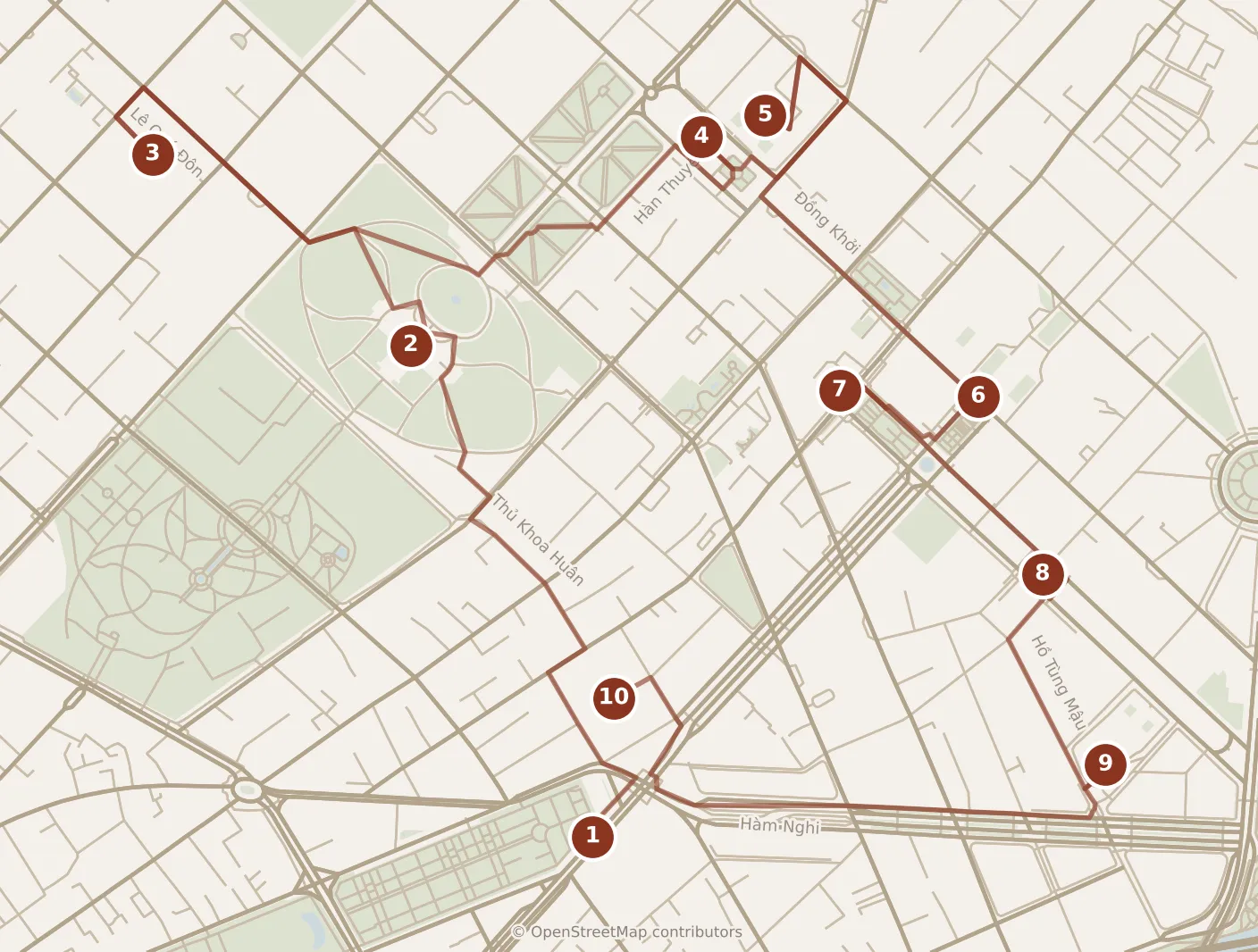
- The day
- 1Bến Thành station
- 2Independence Palace
- 3War Remnants Museum
- 4Saigon Notre-Dame Basilica
- 5Saigon Central Post Office
- 6Saigon Opera House
- 7Ho Chi Minh City Hall
- 8Nguyen Hue Boulevard
- 9Bitexco Financial Tower
- 10Bến Thành Market
Morning
Start at Bến Thành station, the southern terminus of Line 1 and the address every driver in the city knows. Independence Palace is fifteen minutes north on foot, and at that hour that walk is the most comfortable one you will get. Eat on the way rather than before: a bánh mì from a sidewalk cart is a standard local breakfast, it costs four minutes, and there is nowhere on this route where a sit-down breakfast improves the day.
The palace — half the signage and most guidebooks call it the Reunification Palace, and both names are in use — was finished on 31 October 1966 to a design by Ngo Viet Thu, on the footprint of Norodom Palace, which the French began in 1868 and which two of the south’s own air force pilots bombed in 1962. Give it an hour and a half, and give half of that to the basement. The state rooms upstairs are a preserved 1960s office suite and they photograph better than they reward; downstairs is a concrete command bunker of map rooms, radio sets and rotary telephones left exactly as they were, and that is what the ticket is for. On the roof there is a helipad: on 8 April 1975 a pilot of the southern air force who had been working for the other side the whole time flew his fighter back over this building and bombed it, without doing much damage. Twenty-two days later, at a quarter to eleven on the morning of 30 April, a tank came through the main gate and the war was over. Tanks of that type stand on the lawn now.
Nine minutes north-west is the War Remnants Museum. It opened in September 1975 as the Exhibition House for US and Puppet Crimes, was renamed in 1990, and became the War Remnants Museum in 1995 when relations with the United States were normalised; the sequence of names is part of what you are looking at. There are nine permanent displays over three floors and a yard. The yard is the quick part — a Huey, a Skyraider, an M48 Patton tank, a defused daisy-cutter bomb the size of a small car — and fifteen minutes covers it. Inside, the photography is the museum: a long collection of pictures made by war photographers, a great many of whom did not come home. The floor on the aftermath of Agent Orange is the hardest thing here and it is why people come out of this building silent. A separate building reproduces the tiger cages in which the southern government held political prisoners on Con Dao. Two hours. The one room to walk through rather than read is the international solidarity display; and know going in that this is the war told by the side that won, in the city that lost, which is worth knowing rather than worth complaining about.
Then fifteen minutes east to Saigon Notre-Dame Basilica — as long as any walk this day asks for, and the reason it is taken before noon. It went up between 1877 and 1880 out of materials shipped from France, and the brick came from Toulouse and was never rendered, which is why it is still that color; the two bell towers were added in 1895. It has been under restoration since 29 June 2017, the completion date has moved more than once, and the interior has been shut to visitors for most of that. Check what has reopened before you set out, and arrange the morning so that the answer does not change it: twenty minutes in the square in front, with the statue that was placed there in 1959, is what this stop is worth either way.
A hundred meters on is Saigon Central Post Office, and thirty minutes is right. You will be told Gustave Eiffel designed it. He did not — the building is Alfred Foulhoux’s, put up between 1886 and 1891, and the credit to Eiffel is a very old misreading of the iron roof that guidebooks have copied from each other ever since. One barrel-vaulted hall on iron ribs, a portrait of Ho Chi Minh at the far end, and — the thing most people walk straight past — two maps painted directly onto the plaster shortly after it was built: the telegraph lines of southern Vietnam and Cambodia, and Saigon with its surroundings, both dated 1892.
Afternoon
Lunch goes here, in the lanes one street back from Dong Khoi rather than on it, where the frontages are hotels and brands. Cơm tấm is the plate to order: broken rice under a grilled pork chop, eaten with a fork and spoon rather than chopsticks, and more particularly of this city than anything else you will be offered. Give it an hour and a quarter, sitting down under a fan. The instinct with one day is to eat standing and keep moving, and in this heat that is the wrong economy — the hour indoors is what buys you the afternoon.
Ten minutes down Dong Khoi stands the Saigon Opera House, finished in 1900: a small French provincial opera house, garlands and caryatids and all, dropped into the tropics. It spent twenty years not being a theater at all — from 1956 it housed the National Assembly of the south — and went back to its original job in 1976. Fifteen minutes from the outside is enough, and the modern footnote is underneath you: the metro’s second station sits below it and is named after it.
Four minutes west is Ho Chi Minh City Hall, built between 1898 and 1908 and opened in 1909. It is the working seat of the city’s government rather than a museum, and although it has been opened to visitors on occasions since 2023, that is a thing to check on the day and not a thing to plan around. Fifteen minutes in front of it. It stands at the head of the boulevard, so you are already where you need to be next.
Nguyen Hue Boulevard runs 670 meters from Le Thanh Ton, directly in front of the city hall, down to Ton Duc Thang and the river. It is unnaturally wide and dead straight because it was a canal until the French filled it in, and its middle lanes were turned into a paved pedestrian strip on 29 April 2015. There is a statue of Ho Chi Minh at the top of it.
What you do here at two in the afternoon is get out of the sun. Part of the way down stands a nine-story apartment block from the 1960s whose apartments have nearly all become small cafés and shops, one per balcony, their signs stacked up the whole front of the building. There is one small elevator, and stairs beside it. Pick a floor high enough to look down the length of the boulevard, order cà phê sữa đá — strong coffee dripped over ice and condensed milk — and give it an hour. This is the ritual the city actually runs on, and it falls at the worst hour of the day to be outdoors, which is convenient rather than accidental.
Then walk the rest of the boulevard down to the water. The riverfront at the bottom is a wide modern promenade and it is the only place on this route with a breeze; half an hour is the right amount of not very much before the last hour of the day.
Evening
Four minutes south-west, a street back from the water, is the Bitexco Financial Tower: 262 meters, 68 floors, finished in October 2010, and shaped around one gesture — a helipad cantilevered out of the fifty-second floor like a leaf off a stem. The observation floor is the forty-ninth, about 178 meters up, and it has a ticket. Three floors above it are a café, a restaurant and a bar built around that helipad, where you pay for a drink instead. Same building, same bend of the river, same new towers on the far bank.
This is the stop the whole end of the day is built around, and the only thing that matters about it is arriving before the light goes rather than after. An hour covers it: twenty minutes of daylight, the change, and twenty minutes of a city that turns out to be far better lit than it looked from the street.
Local tip. The forty-ninth floor sells a ticket and the floors above it sell a drink, and the view is the same view. If you would rather sit for the twenty minutes when the light is actually changing, go up the extra floors; if you would rather know the cost before you commit, take the deck. What you should not do is arrive undecided at the elevator and lose the light choosing.
A quarter of an hour west, the last of it along Le Loi, brings you to Bến Thành Market, and the timing is the point. The covered market shut at six in 2026, and as it did, stalls came out along the two streets down either side of it, Phan Boi Chau and Phan Chu Trinh, and traded into the night — the same trade as the day market but weighted far more heavily towards food. That changeover is why this stop is last rather than an afternoon errand, and if the hour has moved, the changeover is still what you are aiming at. Inside, the four gates each have their own trade: cloth and shoes at one end, fresh fish and fruit and the cooked-food counters at the other, dried seafood and spices along one flank, ceramics along the other. If you get there before the shutters come down, the food counters are the half to walk into and the souvenir aisles are the half to walk past. Eat dinner standing and moving. Bến Thành station is two hundred meters away across the roundabout, which is where the day started and where it ends.
Practicalities
Nothing on this route has to be booked before you travel, which for a city this heavily visited is worth saying plainly rather than leaving a reader to wonder. The one ticket worth buying online is the palace’s, and only to skip the desk rather than to secure a place: the adult ticket was under a hundred thousand đồng in 2026 and the site sells it directly. The tower’s observation floor is bought at the foot of the elevator on the day.
The palace opens every day of the week, public holidays and Tết included, and that single fact is why this route survives a Monday when a museum-heavy day in most cities would not. The war museum has no weekly closing day either — its own site gives seven days a week, public holidays included — so there is no day of the week this route has to avoid. If it is shut anyway on the day you come, the palace absorbs an extra hour without strain, and the fine-arts museum a few streets south of Ben Thanh, open every day of the week too, is the substitute that keeps the morning intact. The cathedral is the other thing to check, for the different reason given above.
From May to November the afternoon downpour is what will rearrange this day, and it lands squarely on the half of the route with no roof — the boulevard, the riverfront, the walk to the market. It is usually one hard hour rather than a settled afternoon. That is the real argument for the coffee hour where it sits: it can absorb an extra hour costing nothing, and it is indoors at the hour the downpour lands.
The whole day is walked, about five and a half kilometers, and no leg of it is longer than a quarter of an hour; the one east from the war museum to the cathedral is taken in the morning for that reason. If any leg of it defeats you, a ride-hailing car or a motorbike taxi covers any distance on this route in a few minutes; that is the safety valve and using it does not break anything. The one skill the day genuinely requires is crossing the road, which happens far more often than you will like and is learned rather than obvious — the city guide explains how, along with how the city is paid for and got around, and this article assumes all of it rather than repeating any.
One last thing, for anyone awake before the palace opens. Tao Dan Park is two streets west of it — ten hectares of city garden the French laid out — and at first light it fills with people practicing tai chi, which is a version of this city you will not meet again at any other hour of the day. The outdoor bird café that drew songbird owners with their cages, and that older accounts of the park are still full of, was cleared from the western edge for the metro works and moved out to the traffic beside the park, where far fewer of them now come. Twenty minutes, free, and the only part of this day that has to be taken early or not at all.


