Helsinki in two or three days: the national gallery, Töölö and a whole day on Suomenlinna

Last updated 8 August 2026
Overview
What a second day in Helsinki buys is not more sights. The center is small — you can walk across the peninsula in half an hour — so a single day already gets you past most of the famous outsides, and this article assumes them rather than repeating them: the cathedrals and the granite center are what the one-day route for this city walks. What it does not get you is the insides: the national collection, the fortress at the pace it was built for, an evening in a district where nobody is visiting. Two days is enough to stop skimming. Day one below is the art and the set pieces north of the station; day two is the whole of the sea fortress and the harbor quarter it comes back to. A third day, if you have it, goes south to the design streets, the shore and a sauna.
You will almost certainly arrive at Helsinki Airport, and the way in is the ring rail: the I and P trains leave from the station directly beneath the terminal and reach the Central Railway Station in about half an hour. Day one begins at that station and its first real stop is three minutes’ walk from the door — though that door does not open before ten, and not until eleven on a Monday, so an early landing buys you a locker for the bag and an hour or two to fill rather than a head start. If you are coming by train instead of flying, you are already standing in the right place.
There is one ticket that carries the whole route, and it is not a sightseeing pass. It is an ordinary day or multi-day ticket on the city transport system covering the central zones, which carries the trams, the metro and — this is the part that decides the shape of day two — the ferry to the fortress, which is a scheduled public service and not a tour boat. If you have not read the city guide, the zones and where the ticket is sold are explained there. Nothing on days one and two has to be booked before you travel. The third day does have one thing: the public sauna it ends at takes bookings and fills, and a two-hour slot was in the twenty-five-to-thirty-euro range in 2026, towel included.
The other thing to know before the days themselves is the light, because here it is not a detail but a variable. The sun goes down over Helsinki at a quarter past three in the middle of December and not until ten minutes to eleven at night at the June solstice: the two ends of the year are nearly eight hours apart, and around the winter solstice the whole day gives under six hours between sunrise and sunset. Three stretches on these days are decided by that — the stadium tower on day one, the southern ramparts of the fortress on day two and the shore walk on the third — and each of them says below how to count backwards from your own month’s sunset hour.
The sums. Day one comes to about six and a quarter hours from the station to the first drink in Kallio: roughly four hours inside buildings, an hour and a half of walking, and three quarters of an hour for lunch. Day two is close to six hours from the Market Square and back to it. Both figures model time spent in places and on sidewalks between them, and nothing else. The largest thing they leave out is the wait at the ferry pier: the boat runs on a schedule rather than as a shuttle, and no arithmetic in this article can close that gap for you.
Left luggage on this route is easiest at the Central Railway Station, and the useful part is the shape of the days around it. Day one starts there, so arriving before you can check in costs nothing — leave the bag, and pick it up on the way out to wherever you are sleeping; Kallio, where day one ends, is a short ride back on tram 3 or 9. The day that is genuinely bad with a bag is the island one: the fortress is a kilometer and a half of cobbles, rampart steps and open rock, and a boat is the only way off. The sauna day is bad in a different way, since you cannot take a case into a sauna and the changing-room lockers there hold a coat rather than luggage. So if your last day is the island one, plan on coming back for the bag from the Market Square, about seventeen minutes on foot or one ride on tram 2; if your last day is the sauna one, it ends a short walk from the Central Railway Station anyway and the bag can sit in the locker from breakfast to train.
Day one

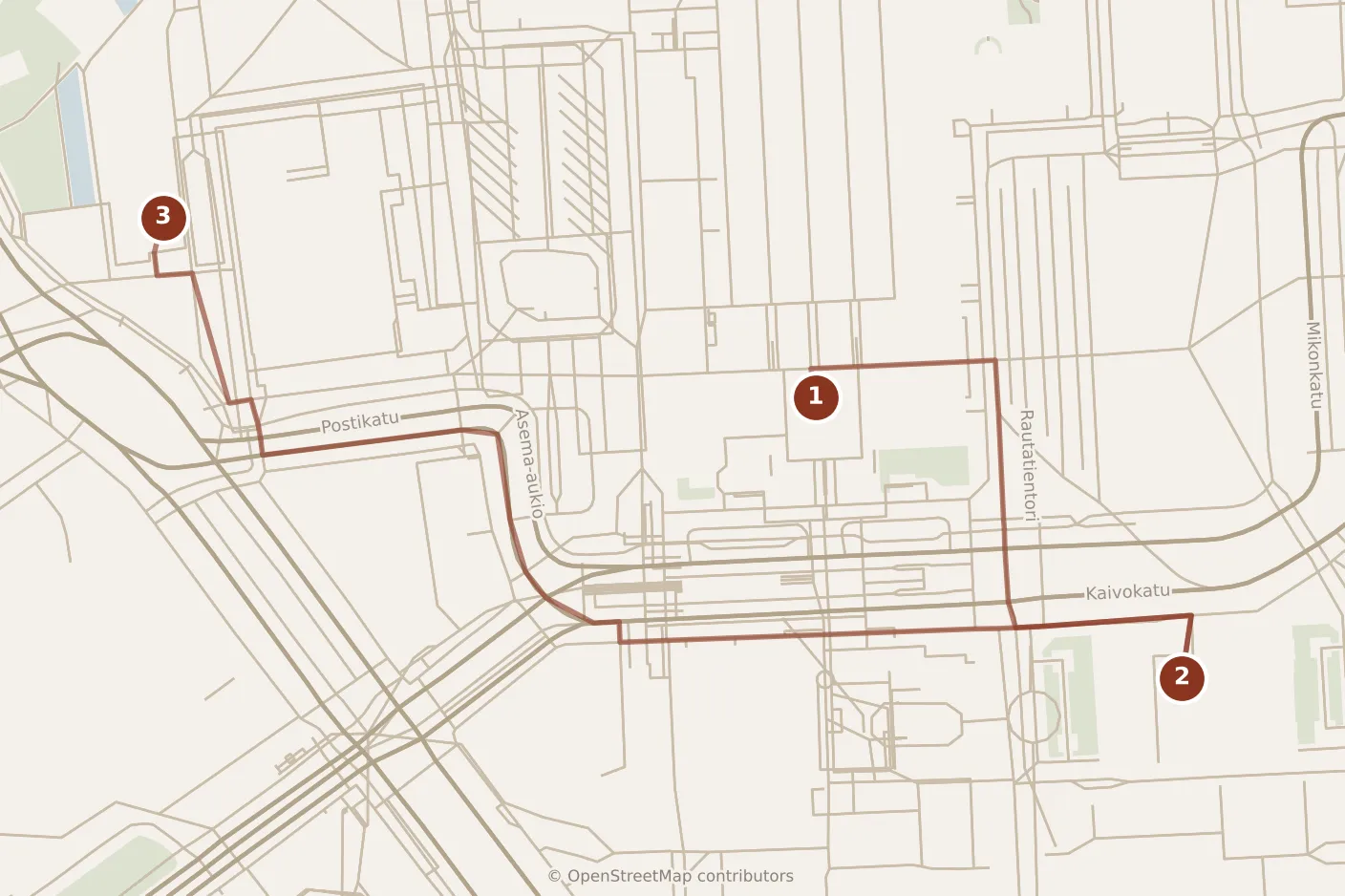
- Morning
- 1Helsinki Central Railway Station
- 2Ateneum
- 3Kiasma
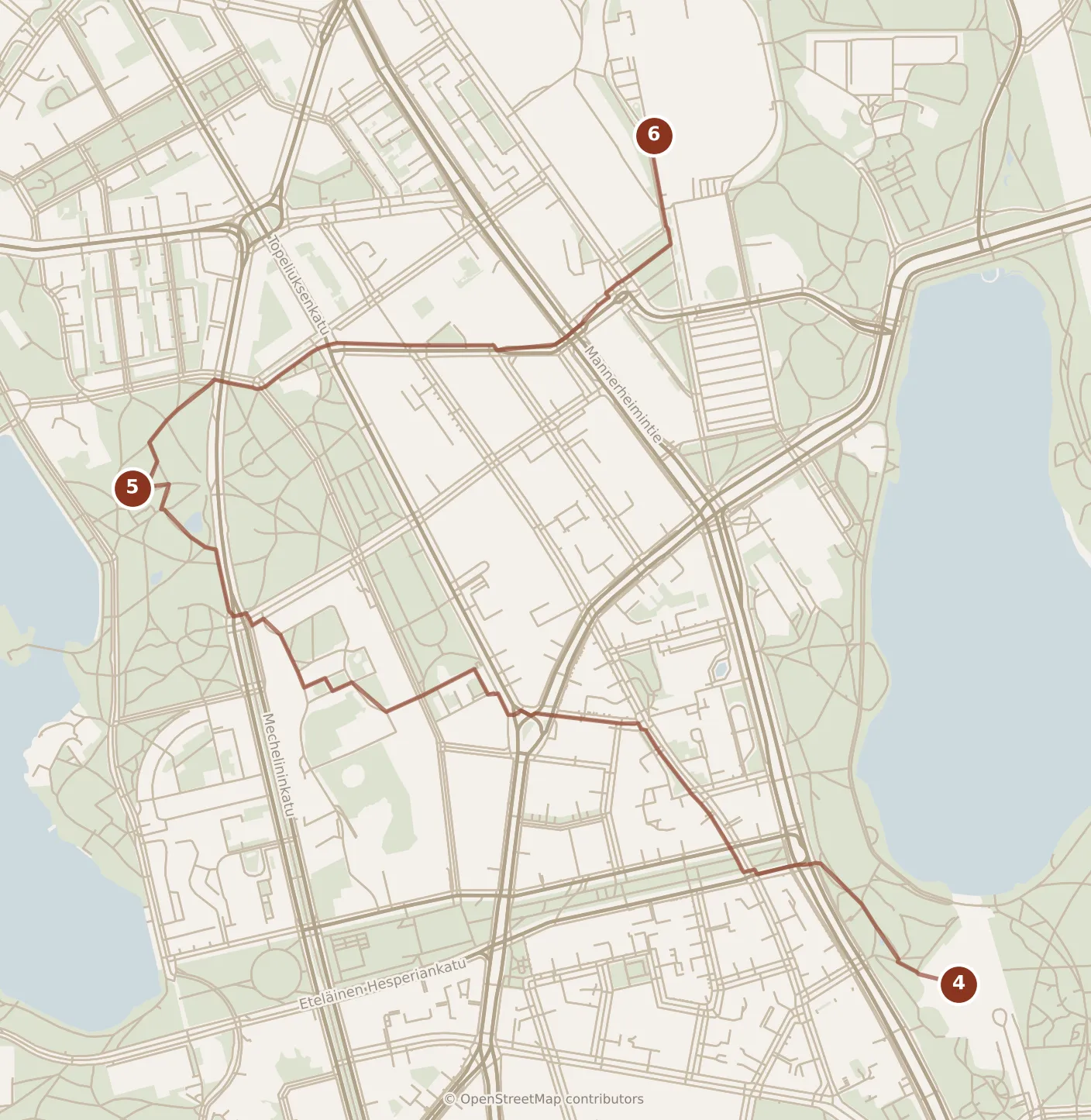
- Afternoon
- 4Finlandia Hall
- 5Sibelius Monument
- 6Helsinki Olympic Stadium tower
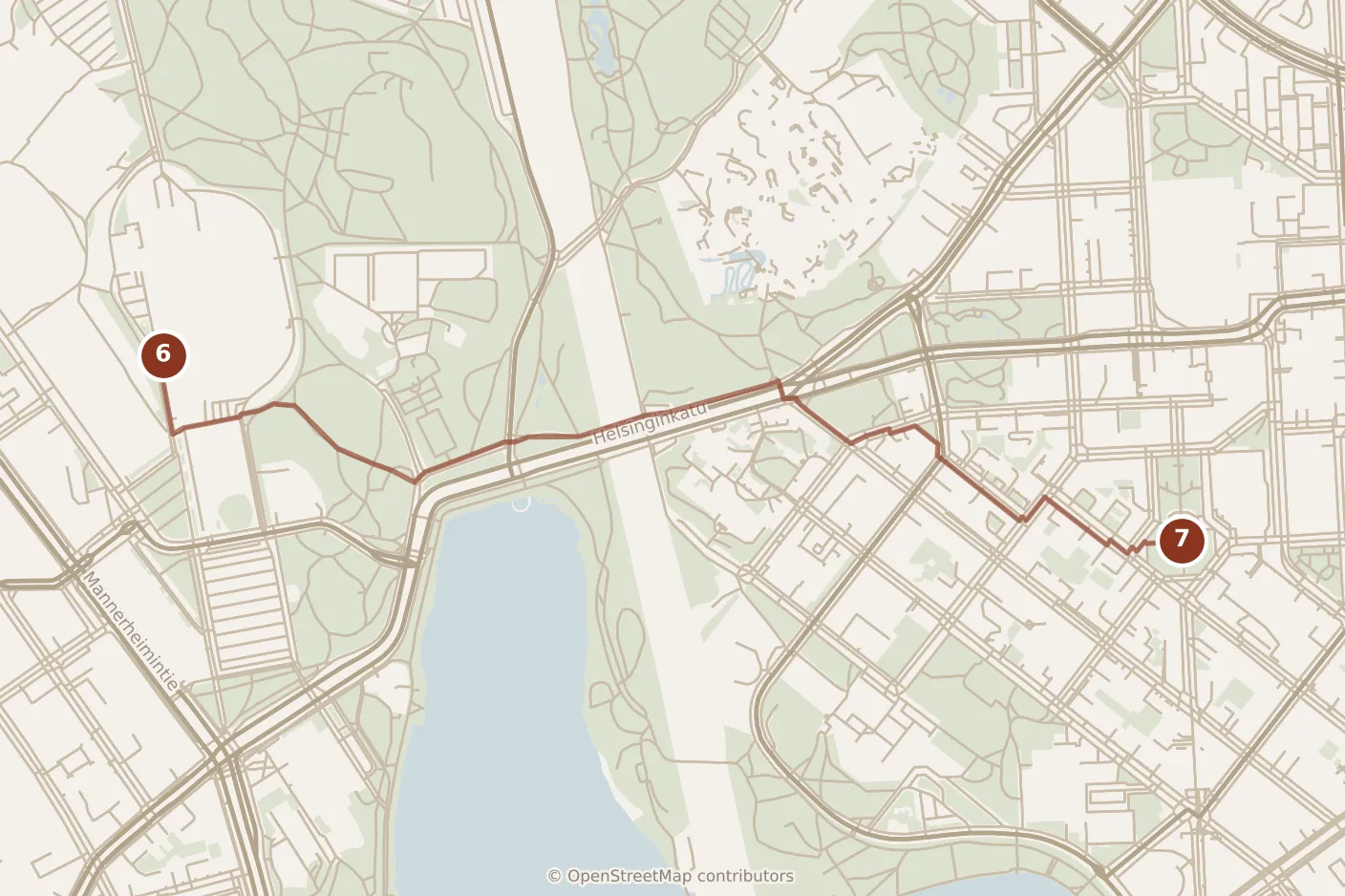
- Evening
- 7Kallio Church
Today runs south to north up the western side of the center, from the station to the top of the Kallio hill, and it has one backtrack in it, which is deliberate and small.
Morning
Start at the Central Railway Station — Eliel Saarinen’s granite terminus of 1919, with the four stone men holding their lamps at the door — and walk three minutes east across Rautatientori. The Ateneum is the pale ornamented block on the far side of the square, Theodor Höijer’s building of 1887, and it holds the country’s art from before the modern period: Hugo Simberg’s The Wounded Angel, Akseli Gallen-Kallela’s Aino triptych, Eero Järnefelt’s Under the Yoke, Helene Schjerfbeck’s self-portraits thinning down to almost nothing over forty years, Albert Edelfelt’s Paris pictures. The fact worth carrying out of the building is smaller and stranger: its Vincent van Gogh, Street in Auvers-sur-Oise, arrived here in 1903 and made this one of the first public collections anywhere in the world to hold one. Give the museum two hours. The international rooms are the part to give up if you are short — they are good, and they are not what you came to Finland for.
Eight minutes west is Kiasma, Steven Holl’s curved, top-lit contemporary gallery of 1998, which looks like a ship’s hull that has been shouldered in between the parliament and the avenue. Three quarters of an hour. Be honest with yourself about it: this is the one stop on these two days whose subject you can meet in any capital in Europe, and it is the first thing to cut, for reasons the afternoon will make arithmetical.
Eat early and lightly today, from a counter rather than at a table — a karjalanpiirakka and a coffee standing up is the local version of not stopping — because the real meal is in Kallio tonight and the afternoon has a deadline in it.
Afternoon
Ten minutes north, on the water, is Finlandia Hall: Alvar Aalto’s concert house, finished in 1971 and clad in white marble, which is the whole story of the building. Aalto’s Carrara slabs bowed and cupped in the freeze and thaw of a Finnish winter, were patched through the 1990s, and were finally replaced altogether — the façade was rebuilt in 2022 and 2023 in Lasa marble from South Tyrol, and the building reopened on 4 January 2025. Twenty minutes is right. Walk in and out of the foyers, then go round the water side, because the massing against Töölönlahti is what Aalto was drawing.
Twenty-five minutes north-west, along the bay and then out through the streets of Töölö, is the Sibelius Monument. Eila Hiltunen welded it from 569 hollow steel pipes — twenty-four tonnes of them — and it was unveiled in September 1967 to a public that called it a heap of tin cans; the committee made her add a portrait of the composer’s head on a rock beside it to quiet the objectors. The portrait is the part that has dated. Give it twenty minutes, and walk in among the pipes rather than photographing them from the path.
Then seventeen minutes north-east to the Olympic Stadium, Yrjö Lindegren and Toivo Jäntti’s white functionalist bowl of 1938, built for a games the war canceled and used in 1952 instead; it closed for a rebuild in 2016 and reopened in August 2020. The tower is why you have come this far. It is 72.71 meters high, and that number is not an accident: it is the distance Matti Järvinen threw the javelin to win gold in 1932. An elevator and a few steps take you up, the viewing deck is outdoors and exposed, and half an hour on it is plenty. Tickets are sold at the visitor center by the tower entrance rather than online.
This is the stop the day is built around, and which constraint binds depends on the month. In 2026 the tower was open until nine on weekdays and only until six on weekends. From roughly March to October the sun is still up when it shuts, so the door decides — and on a weekend that door closes three hours earlier, which puts the tower before dinner rather than after it. From November to February the door is generous and the light is not. Everything above the tower comes to about five and three quarter hours from the Ateneum’s opening with a proper lunch and the contemporary gallery in it, and about four and a quarter without them; take your month’s sunset hour and count back one of those two figures. A December day, in other words, starts at the museum door, skips Kiasma and eats standing up. If the hours have moved since, the method has not: whichever of the two — the closing or the dark — comes first is the one to build the day back from.
Local tip. When the day runs short, the cut is Kiasma and not the tower. The gallery is three quarters of an hour plus the walking that hangs off it, and its subject exists in every capital; the tower is the only stop here that stops being possible when the light goes or the door shuts. Cutting the cheap thing first is the wrong instinct in a city this far north.
Evening
From the stadium, walk east along Helsinginkatu for about twenty-five minutes and you are in Kallio, which is where this day was always going. On the crown of the hill is Kallio Church, Lars Sonck’s gray granite tower of 1912, sixty-five meters of it, National Romantic and much closer in spirit to a fortress than to a parish church. Jean Sibelius wrote a short chorale for its consecration and four of its seven bells have played it at midday and again in the early evening ever since. Ten minutes outside it is enough; the interior is plainer than the tower promises.
Then go downhill and stay. Kallio was the working-class quarter and is now the cheapest and least ceremonious eating and drinking in the city proper, which in Helsinki is a category that matters — this is where the same evening costs noticeably less than it does south of the station. Little here needs booking and nothing here is trying to impress you. If the twenty-five-minute walk from the stadium is more than your legs have left, trams run into the district from the center, and tram 3 or 9 will take you back to Päärautatieasema afterwards for the bag.
Day two

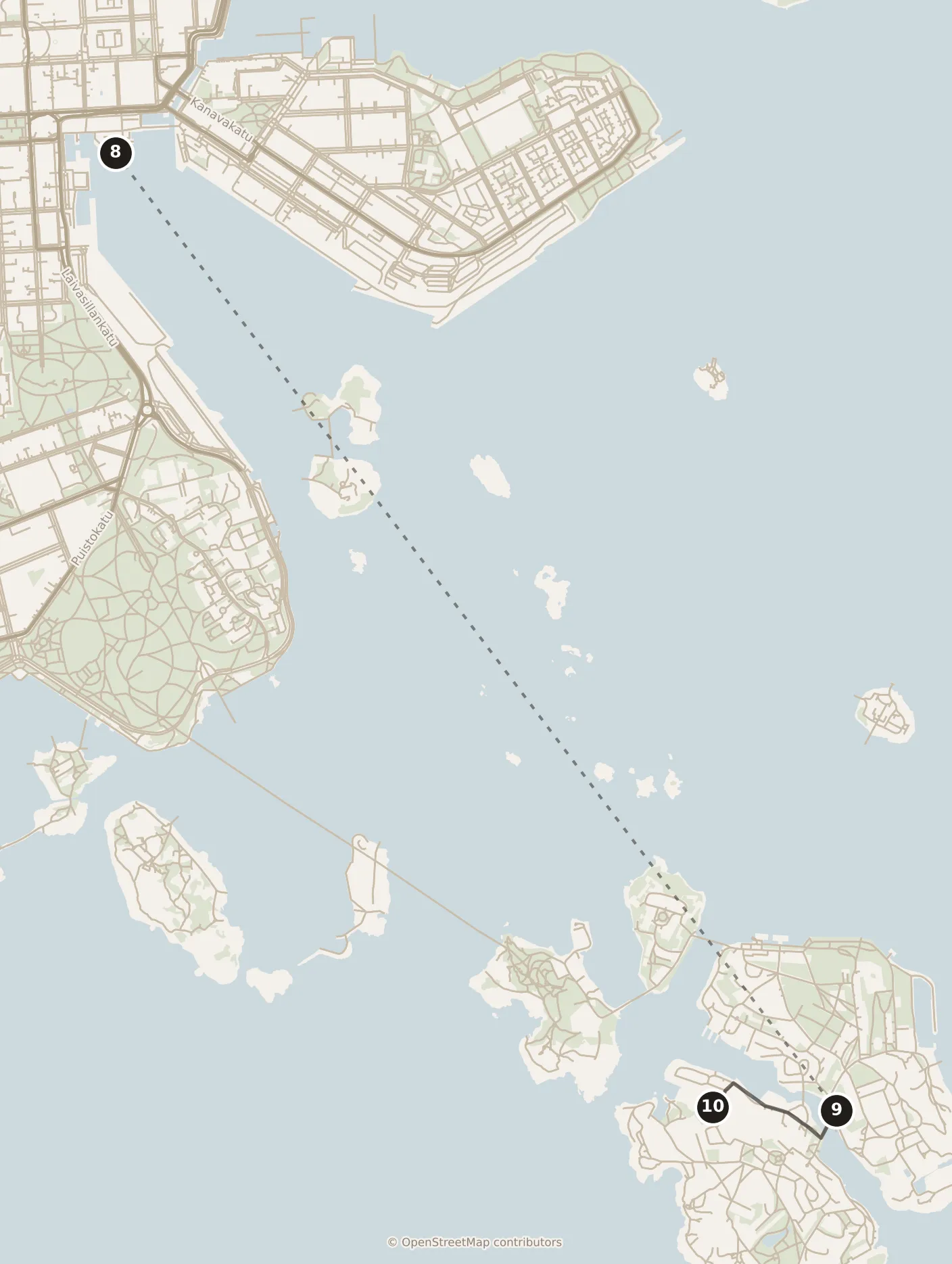
- Morning
- 8Market Square
- 9Suomenlinna Museum
- 10Suomenlinna dry dock
- Afternoon
- 11Ehrensvärd Museum
- 12Vesikko
- 13Kustaanmiekka
- Evening
- 14Katajanokka
- 15Kruununhaka
Today is Suomenlinna, and the point of putting a whole day into it is that almost nobody does. The fortress gets an afternoon from most visitors, which is enough to walk its spine and to go inside none of it. It is a UNESCO World Heritage site spread over eight islands, it has about eight hundred residents, and it takes a day without padding.
Morning
From the Central Railway Station the Market Square is about seventeen minutes on foot down through the Esplanadi, or a ride on tram 2 or 3 towards Olympiaterminaali, getting off at Kauppatori. The ferry leaves from the eastern end of the quay. The crossing is about a quarter of an hour, it runs all year round, and it stops only for a few hours before dawn — so nothing about the end of this day is urgent, which is unusual and worth knowing in advance.
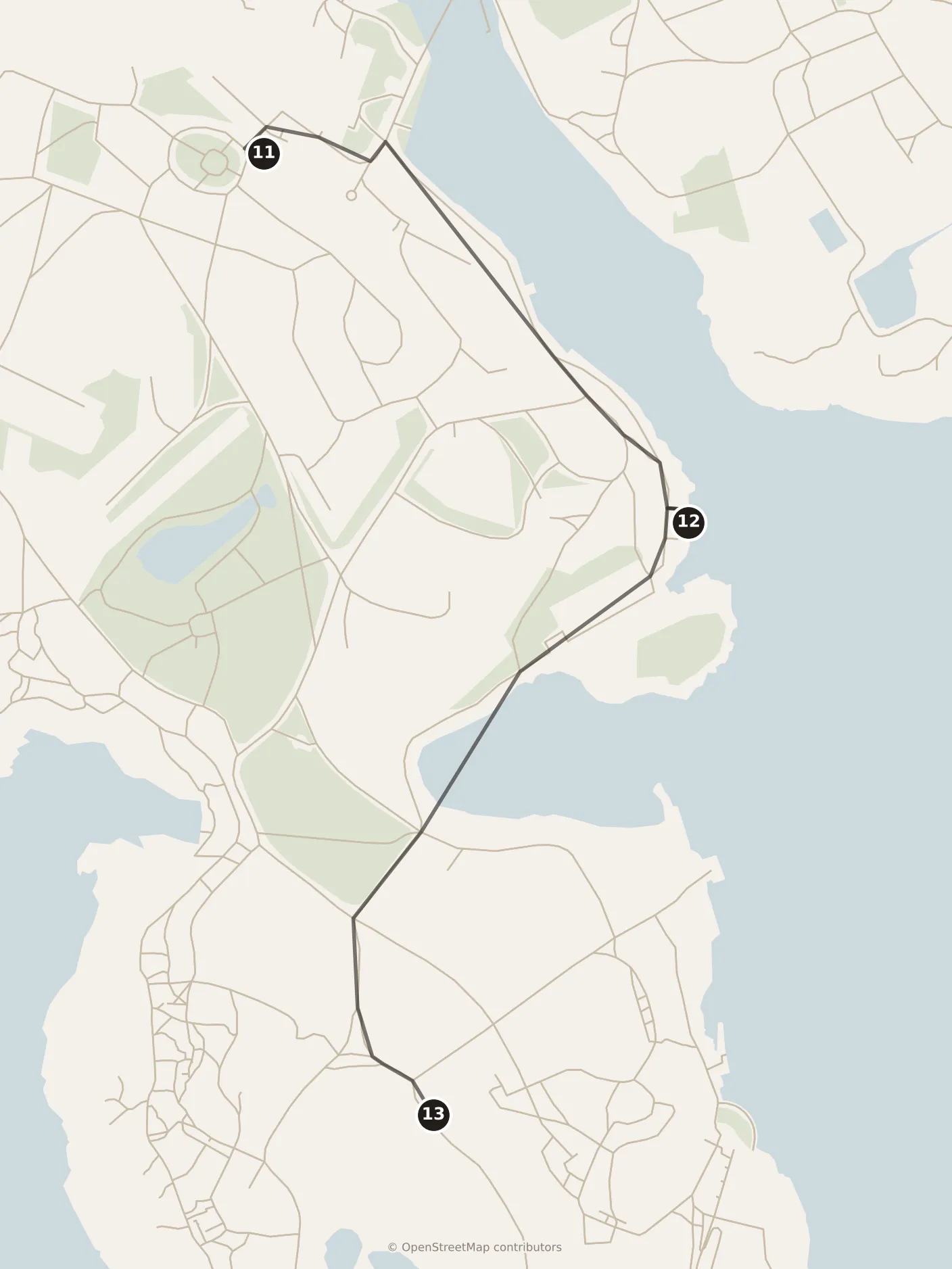
You land at the main pier in front of the Jetty Barracks, the long pink Russian gate block built between 1868 and 1870; the visitor center is the first door on the left as you come off the boat, and the marked walking route — blue signs, and a blue line on every map on the island — starts there and runs a kilometer and a half south to the King’s Gate. Everything today is on or just off that line.
Eight minutes along it is the Suomenlinna Museum, which is the right first stop rather than the dutiful one. The place was built by Sweden, held by Russia for over a century, and became Finnish only when the country did, and the exhibition is what turns those three tenancies from a muddle into a sequence. A twenty-five-minute film runs on the half hour, in English among other languages, and the rooms around it hold what has been dug out of the islands. An hour and a quarter, film included.
Six minutes west of the museum, on Susisaari, is the dry dock, and it is the thing on this island most people walk past. Construction began in 1750; it is the oldest dock in Finland and one of the oldest basin docks still working anywhere, and it is still working — wooden vessels come in and out of it. You look at it from the viewing platform and the boards beside it, and you do not go down: this is an operating yard and the fence is not decorative. Ten minutes.
Lunch is on the island, and the choice is genuinely small — half a dozen cafés strung along the marked route and a shop. That is not a hardship, but it is a reason not to arrive starving at three.
Afternoon
Four minutes on is the Great Courtyard, finished in the 1760s as the administrative center of the whole fortress, its curved façades set out as a deliberate false perspective to make the square look grander than it is. Augustin Ehrensvärd, who designed the place, is buried in the middle of it under a monument drawn by Gustav III of Sweden and completed by Ehrensvärd’s son with Johan Tobias Sergel. The Commandant’s House on the square lost its entire southern half to the Crimean War bombardment of 1855 and now holds the Ehrensvärd Museum — an eighteenth-century noble interior with portraits and ship models, and the only place here where the fortress feels domestic. Three quarters of an hour for the square and the house together. Note that the low buildings along this stretch are people’s homes and the gardens behind the fences are private, which the signposting does not say and the volume of visitors makes easy to forget.
Six minutes south-east, in Artillery Bay, is Vesikko, a submarine of 1933 built in Turku for a German customer, bought by Finland in 1936, and the only one of the country’s five not scrapped after the war. You climb down inside it, which is the entire point and also the reason it is not for everybody. Half an hour.
Then seven minutes on to Kustaanmiekka, the southern cape, where the fortress stops being a village and becomes a work of engineering: banked earth ramparts over stone, gun positions facing open water, and the strait so narrow that the big ferries pass a few hundred meters off and look absurd. The King’s Gate, the ceremonial water stair at the end of the marked route, is here. Give it an hour, and give it the wind — there is no shelter on this end of the island and the Gulf of Finland does not moderate itself. From here it is about twenty minutes back to the pier.
Two of the interiors above are seasonal, and that changes the day rather than trimming it. The Ehrensvärd Museum opens daily from early May to the end of August, on weekends only in April and September, and not at all from October to March; the submarine opens from the second week of May to the end of September and is shut for the rest of the year. So from October to March a day here is the walls, the dock, the Great Courtyard, the museum by the pier and the military exhibition in the two riding halls — a good day, a different one, and about an hour shorter for the two interiors you lose, before the riding halls put some of that back. April is the odd month in which the commandant’s house is open on a weekend and nothing else has started yet.
The other winter change is the order, and it turns on which boat you take. Sunset comes at a quarter past three in December. The stops above, less the two that are shut for the season, come to about four and a quarter hours with lunch in them, and the ramparts are the last hour of that — so the method for any month is to count back four and a quarter hours from your own sunset and take the crossing before that hour. In December it puts you on the island by about eleven: a morning boat works exactly as written and an afternoon one does not, because if you land after midday you will reach the ramparts as the light goes, and they are the one part of this island that is worthless without it. If the morning has already gone, take the loop backwards. Walk straight down the marked route to Kustaanmiekka, about twenty minutes from the pier, do the ramparts first while you can see them, then work back north through the courtyard and the dock and finish at the museum by the boat, which is the one part of the day that reads as well in the dark as in daylight.
Evening
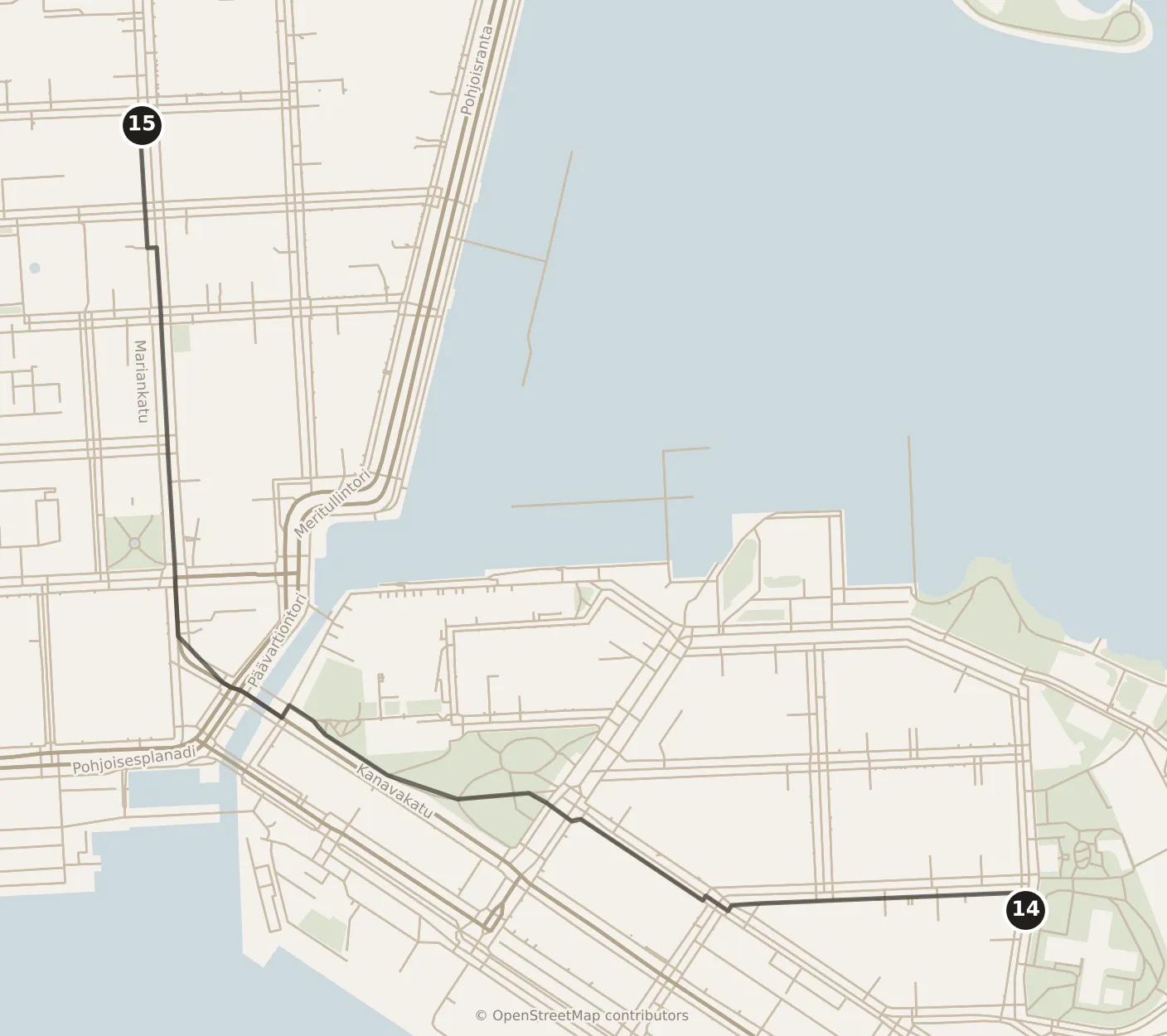
The boat lands you back at the Market Square. Katajanokka is fifteen minutes east over the canal, and it is the quarter to walk at this hour: an island by virtue of a nineteenth-century cutting, and its western half is one of the most complete Jugend districts anywhere, almost all of it built between 1902 and 1912, with three houses by Gesellius, Lindgren and Saarinen among them. At the far end stands Aalto’s white marble office block of 1962, arguing with everything around it. The old district prison, in use from 1837 until 2002, is a hotel now, and its wall and central corridor survived the conversion.
The thing here that catches people out is the icebreakers. The national icebreaking fleet ties up along this quay in summer and is at sea in winter, which is precisely the opposite of what anyone expects: the most photographed line of hulls in Helsinki is there in July and gone in February. Three quarters of an hour covers the quarter properly.
Then eat somewhere else. Katajanokka is residential and closes early, so cross back over the canal into Kruununhaka, about seventeen minutes: the oldest quarter of the city, Empire-period blocks on a grid behind the cathedral, quiet, and with enough small kitchens that a table is usually easy without booking. This is the opposite end of the scale from the Kallio evening, and the two of them together are most of what there is to learn about how this city eats.
With a third day

- With a third day
- 16Architecture and Design Museum
- 17Punavuori
- 18Ullanlinna
- 19Kaivopuisto
- 20Hernesaari
Give the third day to the southern half of the peninsula, and append it as day three rather than inserting it — with one exception, at the end of this section. It is the flat day, the day with the fewest fixed doors, and the one that ends in a sauna, which is the right way round.
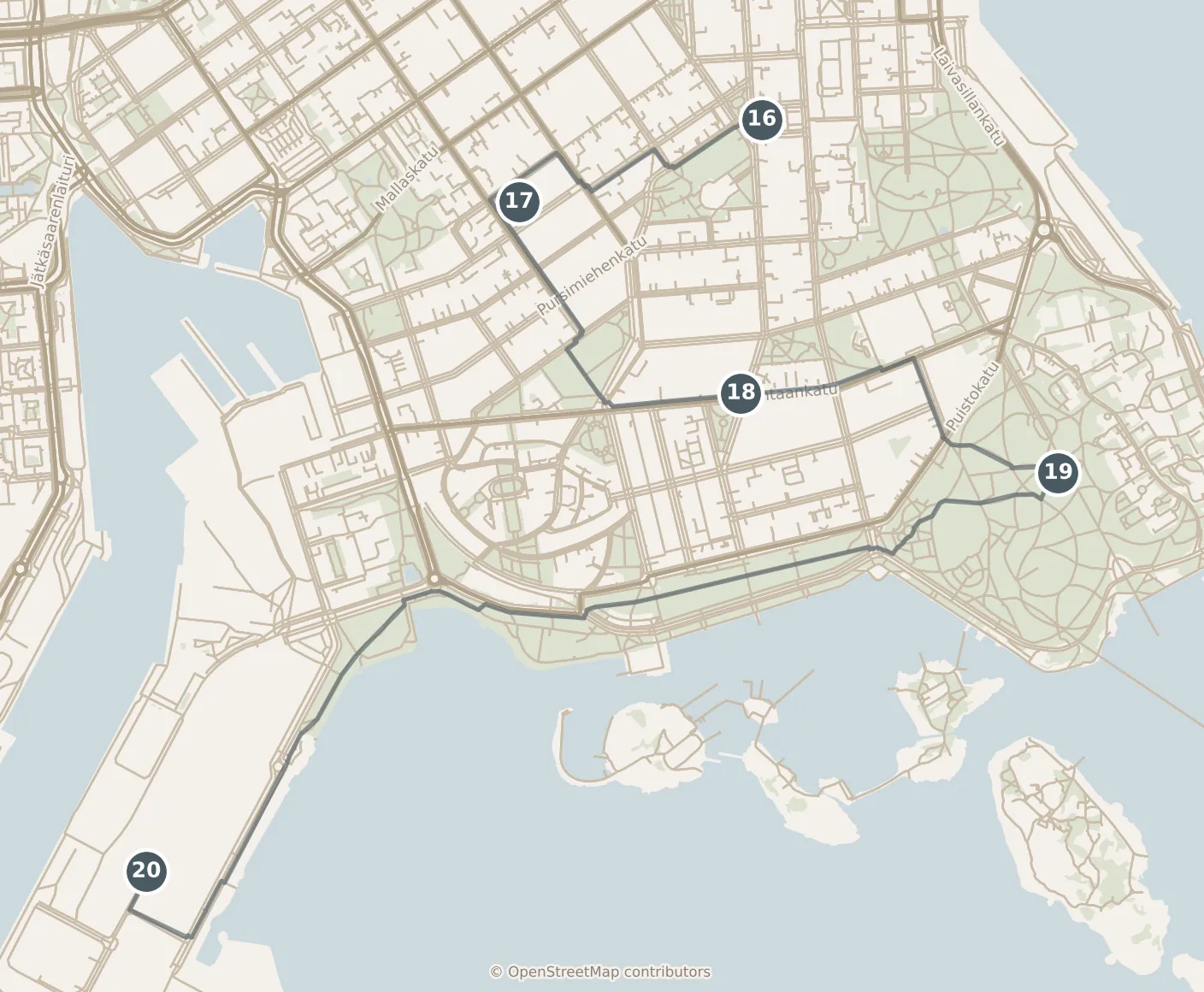
Start at the Architecture and Design Museum on Korkeavuorenkatu, the red-brick former school that the design collection has occupied for decades and that now houses the merged architecture and design institution. In 2026 it opened at eleven, every day of the week — the latest first door of the three days, and the reason this one starts unhurriedly. What is in it is the twentieth-century Finnish object: the chairs, the glass, the household things that turned into a national export identity, shown as design history rather than as a shop window. An hour and a half. Note that a new building on the South Harbour has planning permission and a target around 2030, so check the address rather than the name before you set out.
Ten minutes west is Punavuori, the design district in fact as well as in name — independent shops, small galleries, coffee roasters and printers, at a scale you cover on foot in an hour without a plan. Lunch goes here, and it is three quarters of an hour of its own on top of that hour, counted the way day one counts its lunch. Punavuori is also the reason to do the museum first: the same subject continues out here at street level, for nothing, and it is better after you have seen the collection than before.
Eleven minutes south-east takes you into Ullanlinna, and into Eira within it, which is some of the quietest architecture in the city: curved Jugend apartment houses, embassies, streets with almost nobody on them. Half an hour, and it is a walk rather than a stop. Twelve minutes further east is Kaivopuisto, the park on the southern shore, with its observatory hill and its promenade along the water. Three quarters of an hour.
Then the walk this day exists for. From Kaivopuisto the shore path runs west for about forty minutes to Hernesaari, past moored boats and the last of the villas, with open water on your left the whole way. It is the longest single stretch in this article, it is flat, and it is the third of the light-decided stretches, so here is its count-back. The walk wants its forty minutes of daylight, and Punavuori onwards — the shops, lunch, Eira, Kaivopuisto — takes about three and a half hours, so begin there four and a quarter hours before your month’s sunset; put the museum in front of it and the figure is five and three quarters. From March to October both are comfortable at any hour. In the dark months the second is not: with an eleven o’clock opening in front of it the walk cannot begin before four, and the December sun has been down since a quarter past three. So the winter version of this day drops the museum and starts in Punavuori — the same cut the paragraph below offers for being short of time, made here for light instead, and the one thing that brings the walk back inside the day.
At the end of it, on the Hernesaari shore, is the public sauna — a smoke sauna and a wood-fired one, a deck, and steps down into the sea that people use in every month of the year. Two hours, booked in advance, and the conduct here is not what a visitor guesses: this is a mixed sauna, so a swimming costume is worn throughout, which is the reverse of the rule in an ordinary Finnish sauna and the mistake foreigners actually make. You shower before you go in, you sit on the liner you are handed, and costumes can be rented at the desk if you have arrived without one. Afterwards it is a quarter of an hour back along the shore to Eiranranta, where tram 6 has its terminus; it runs north through the center, and the Central Railway Station is a short walk from where it puts you down. Reckon on about eight hours from the museum door to the tram, two of which are the sauna.
Where it goes, and what moves if you insert it. Append it, as day three, unless the forecast puts real wind on your second day — the fortress in a Gulf gale is an endurance test, whereas rain alone is carried by the island’s own interiors and is not on its own a reason to move anything. If you do swap them, the island moves to day three and its rules travel with it rather than staying on the number: the military exhibition shut on Tuesdays between October and April, the Ehrensvärd Museum’s weekends-only April and September, and the two interiors that are shut for the winter. One other thing moves with it, and it is the reason to check the swap rather than just make it: the island becomes your last day, so the bag comes back from the Market Square rather than from Eiranranta — the seventeen minutes on foot, or the one ride on tram 2, described above. The sauna booking does not move, which is the awkward part of this paragraph and worth saying plainly: it is the one thing on the trip that can sell out, it was booked before you left, and a slot on a different day at a day’s notice is exactly what will not be there. So take the trade knowingly — either book for the evening you actually mean to swim and accept that the swap then costs you the slot, or book late, keep the swap open, and accept that the sauna may be full. Day one does not move and is not affected either way.
What to cut, if you are short. The museum goes first, and it goes without much loss, because Punavuori outside it is the same argument at street level and free; that removes an hour and a half and lets the day start at whatever hour suits, since nothing in Punavuori has a door to wait for. The next thing to go is not a stop but the walking: from Kaivopuisto, tram 3 runs back into the center, which removes the forty-minute shore leg — and with it the sauna, so make that trade knowingly.
If the sauna is booked out, some days carry a morning session as well as the afternoon one, and taking it turns the whole day round: tram 6 to its Eiranranta terminus and the same quarter of an hour along the shore walked the other way, for the sauna first; then the shore walk east instead of west into Kaivopuisto, then Eira and Ullanlinna, and finish in Punavuori’s shops in the late afternoon. That version drops the museum, which then belongs in day one’s afternoon if the weather has already spoiled it — Korkeavuorenkatu is about twenty minutes’ walk south-east of Kiasma.
Practicalities
One thing on these three days can sell out, and it is the only thing you must book before you travel: the sauna slot at the end of the third day, which takes bookings directly and does fill. Two more are worth buying online, which is a different matter — nothing fails if you leave them, they are simply cheaper or quicker bought ahead. The Ateneum’s ticket is the first: a couple of euros less on the museum’s own website than at the desk, and the desk is where the line is. The fortress sells a combined ticket covering its museums and its church, bought ahead through its own site; whether it saves you anything depends on how many of them you actually go into, and from October to March it usually does not, because two of them are shut.
The days of the week, and how to work them out. No day on this route is lost to a weekday closure — which is unusual, and is why it survives a Monday where a museum-led route would not — but two of day two’s interiors do keep weekday rules, and they are set out below with the rest. What mostly moves is the hour. There are four rules and it is worth having them rather than an answer, because the answer changes with your month.
The first belongs to day one: in 2026 the Ateneum and the gallery beside it opened at ten from Tuesday to Sunday and not until eleven on a Monday, so a Monday day one simply runs an hour late. The second also belongs to day one: the stadium tower shut at nine on weekdays and at six on Saturdays and Sundays, so a weekend day one puts the tower before dinner rather than after it. Put those two together and exactly one combination fails — a Monday between November and February, when an eleven o’clock museum opening leaves you reaching the tower with minutes of daylight and no margin at all. The fix is to run that day backwards. The tower opened at eight on weekdays, but there is no point being there that early in midwinter — with under six hours of light and sunset at a quarter past three, dawn does not come until well after nine — so go up at about ten, do Töölö on the way back down, and give the afternoon to the museums, which on a Monday were open until five. Everything then happens inside the light, and nothing has to be cut. The reversal is a midwinter technique rather than a Monday one, though: it works on any dark day, and on any dark day it is what keeps the gallery in. Day one’s December note — start at the museum door, skip the gallery, eat standing up — is the version for anyone who would rather not walk the day the wrong way round.
The third and fourth belong to day two, and they are the only weekday closures in the article. The military exhibition in the two riding halls was shut on Tuesdays from October to April, and open every day from May to September. And the Ehrensvärd Museum opens at weekends only in April and September, which means a weekday in September costs you that one interior and nothing else, while a weekday in April costs you both it and the submarine, since the submarine has not opened for the season by then. From October to March neither is open on any day, which is a season rather than a weekday and is described in day two above.
Nothing on the third day has a closed day at all — museum, park and sauna were all open seven days a week in 2026. The one weekday combination that actually fails, the midwinter Monday above, is solved by running day one backwards rather than by moving anything.
Moving between the stops this article names. All of it is on the one transport ticket. Tram 2 or 3 from Päärautatieasema to Kauppatori for the ferry, and back; tram 3 or 9 between Kallio and Päärautatieasema; tram 6 from its terminus at Eiranranta into the center, which leaves you a short walk from the Central Railway Station. Everything else on days one and two is on foot, and the two long walks are honest ones — about twenty-five minutes from the stadium to Kallio, and about twenty minutes each way along the fortress’s marked route. The third day’s shore leg is forty minutes and is the only stretch where the alternative is a tram rather than a shorter walk.
Weather, and the one stop that has no indoor version. If day one is wet, the tower is the casualty, since its deck is outdoors and a view of cloud is not a view; the replacement that costs the least is the Architecture and Design Museum pulled forward from the third day, twenty minutes’ walk south-east of Kiasma on Korkeavuorenkatu, opening at eleven. It is an hour and a half plus the walk each way, so the gallery and the Sibelius Monument come out to pay for it; on a Monday between November and February it does not fit at all, and there the honest answer is the two museums at their own pace and no substitution. The third day then starts in Punavuori instead and gains ninety minutes. If day two is wet, the island’s own interiors carry it — the museum by the pier and the military exhibition in the riding halls, subject to that Tuesday — and Kustaanmiekka becomes a twenty-minute look rather than an hour. From October to March that fallback is those two rooms and nothing else, and on a Tuesday in that window it is one, which is worth knowing before you decide the rain is bearable. Wind, not rain, is what makes the swap in the third-day section worth making. If the third day is wet, the covered market hall at Hietalahti, at the western end of Bulevardi and ten minutes from Punavuori, is open every day and is the warm version of the shopping streets outside it.


.jpg)
