Helsinki in one day: the granite center in the morning, the sea fortress after lunch

Last updated 4 August 2026
Overview
Helsinki is a small capital on a knuckle of granite, and the useful consequence for one day is that almost all of the center is walkable. The mainland stops below are strung along about two kilometers of peninsula, west to east, and no walk between them runs much past a quarter of an hour. Three legs are the exceptions and all of them are deliberate: the rock church sits a kilometer west of everything else and this route rides a tram back in from it, dinner is a little over twenty minutes’ walk west of the ferry pier, and the walk back from dinner to the station at the end is about the same again. The day starts and finishes at the Central Railway Station, which is where the left luggage is: leave the bag there before you begin, because the second half of this day is a fortress of cobbles, ramparts and steps, and it is the worst place in the city to be carrying one.
What a single day costs you here is the museums, and Helsinki has good ones. Give them up without regret. An hour in a gallery is the hour that would have bought you the crossing to Suomenlinna, and the fortress is the thing this city has that nowhere else does — eight islands of eighteenth-century bastions fifteen minutes off the market quay, still inhabited, and reached on the same ticket as the tram.
That is the one real decision in a Helsinki day, so it is worth stating plainly: this route puts about four hours into the mainland and the rest into the water. A day that never leaves the peninsula sees more buildings and misses the point of the place.
The island is also the part that will not wait, because it is outdoors and it is only worth walking in daylight — and daylight here is not a constant. The sun goes down over Helsinki at a little after three in the afternoon in the middle of December and not until just before eleven at night at midsummer: a swing of nearly eight hours between the two ends of the year. Around the winter solstice the whole of the daylight comes to under six hours, and barely five of it is of any use, with the sun never climbing far above the rooftops. So take your own month’s sunset hour and count back three hours from it — the crossing out, the walk to the King’s Gate and back, and time on the ramparts — and that is the last outward boat worth taking. From May to August nothing forces the issue and you can go over after lunch as written. From November to February it forces itself, and the answer is to reverse the day: cross in the morning, come back as the light goes, and spend the dark afternoon on the mainland, where the library, the chapel and the market hall are indoors, warm and open past dark. The Orthodox cathedral is the exception, and it decides the order: from September to April in 2026 it closed at four, and at three on a Saturday, so in those months it goes before the crossing rather than after. A Sunday is the one day that rule cannot be honored, because the cathedral opened only in the afternoon: take it straight off the returning boat instead, and be there well before four. If that hour has moved, the rule has not — whatever shuts earliest goes first.
Reckon on about seven hours from the station to stepping back off the return boat, the walking and the one tram ride included. That number is time spent inside the places and on the sidewalk between them, and it models nothing else — in particular it does not include waiting at the pier. The ferry is a scheduled service rather than a shuttle you step onto, and that gap is the one the count cannot close for you.
The day

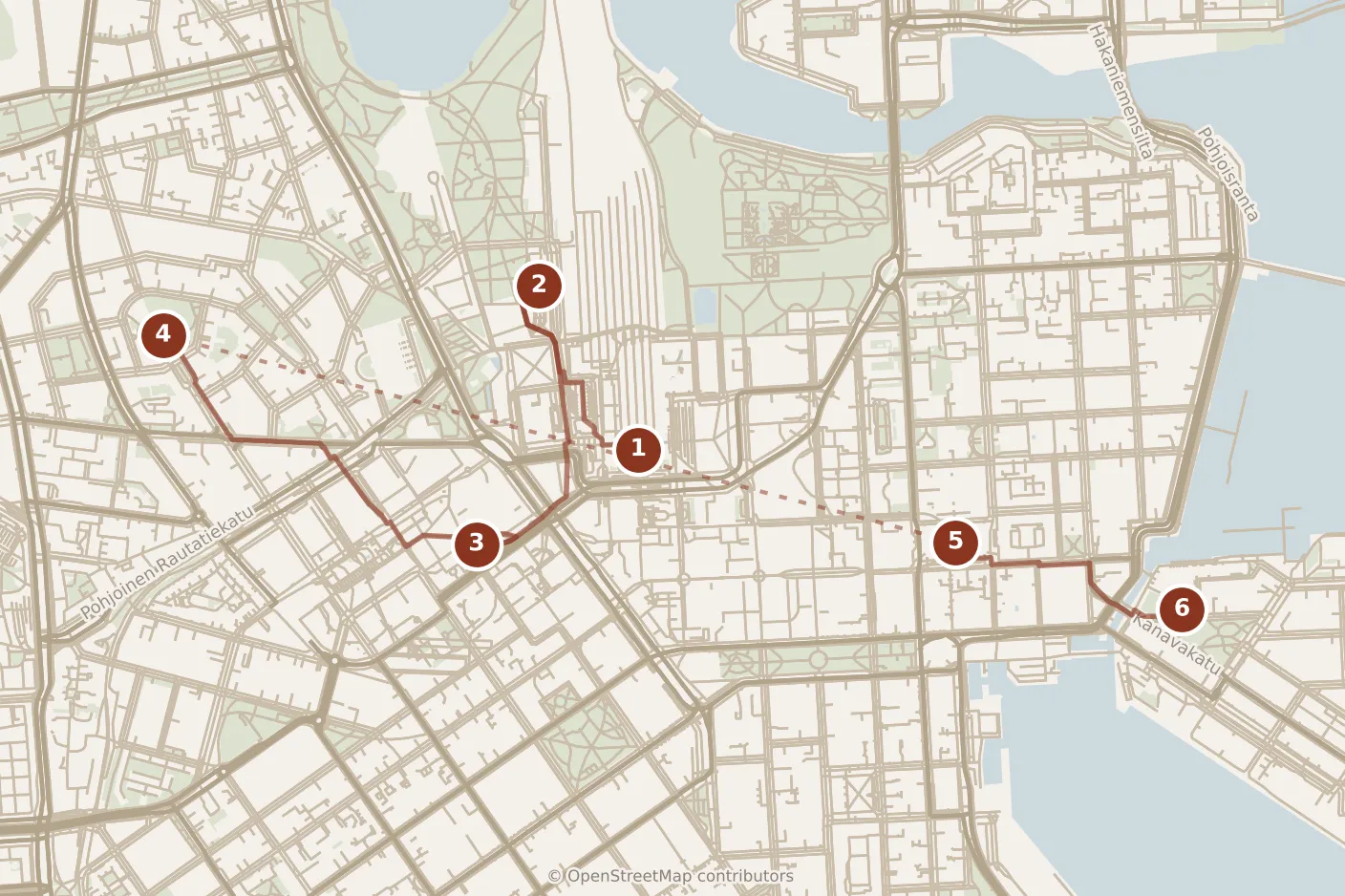
- Morning
- 1Helsinki Central Railway Station
- 2Helsinki Central Library Oodi
- 3Kamppi Chapel
- 4Temppeliaukio Church
- 5Senate Square
- 6Uspenski Cathedral
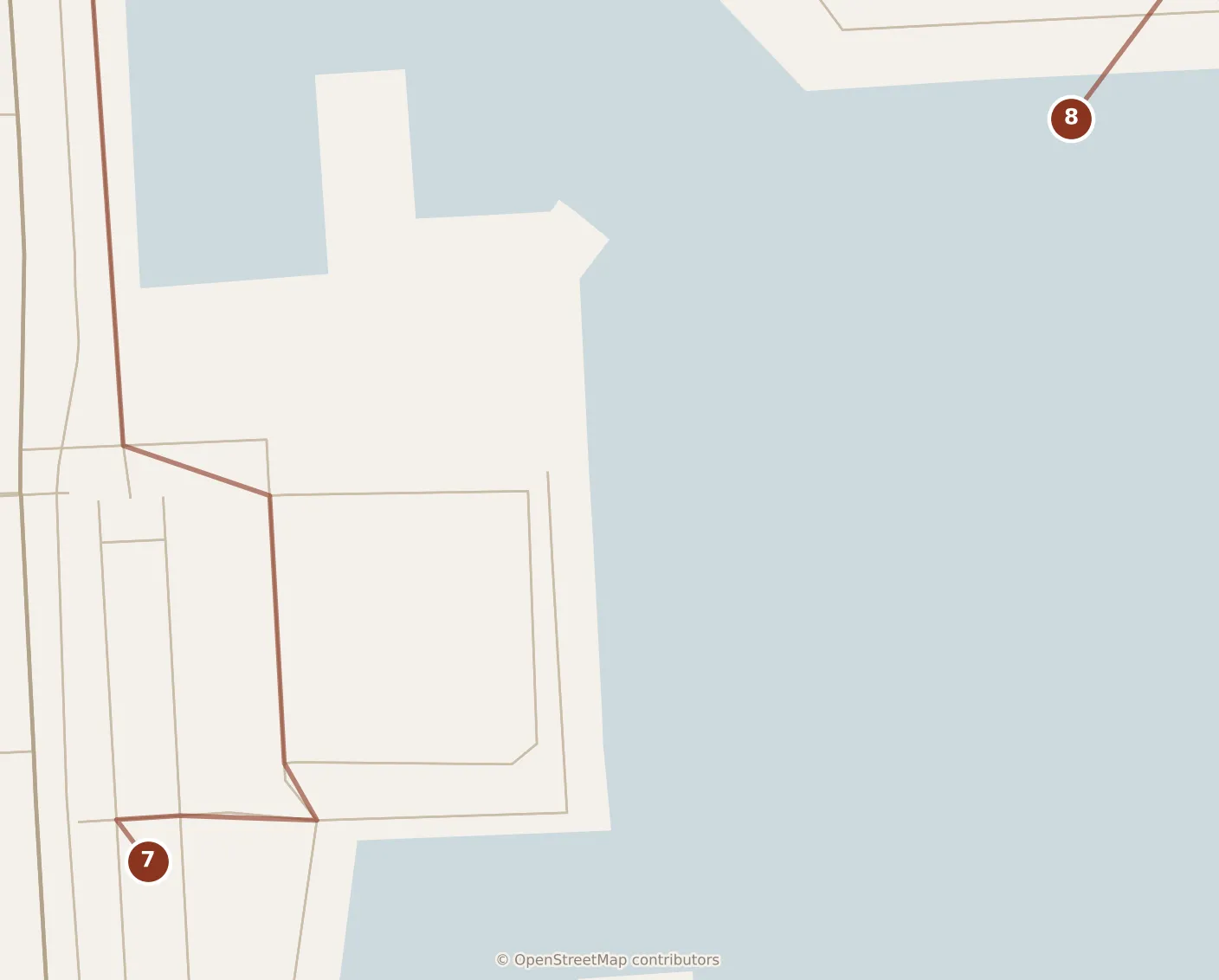
- Afternoon
- 7Old Market Hall
- 8Market Square
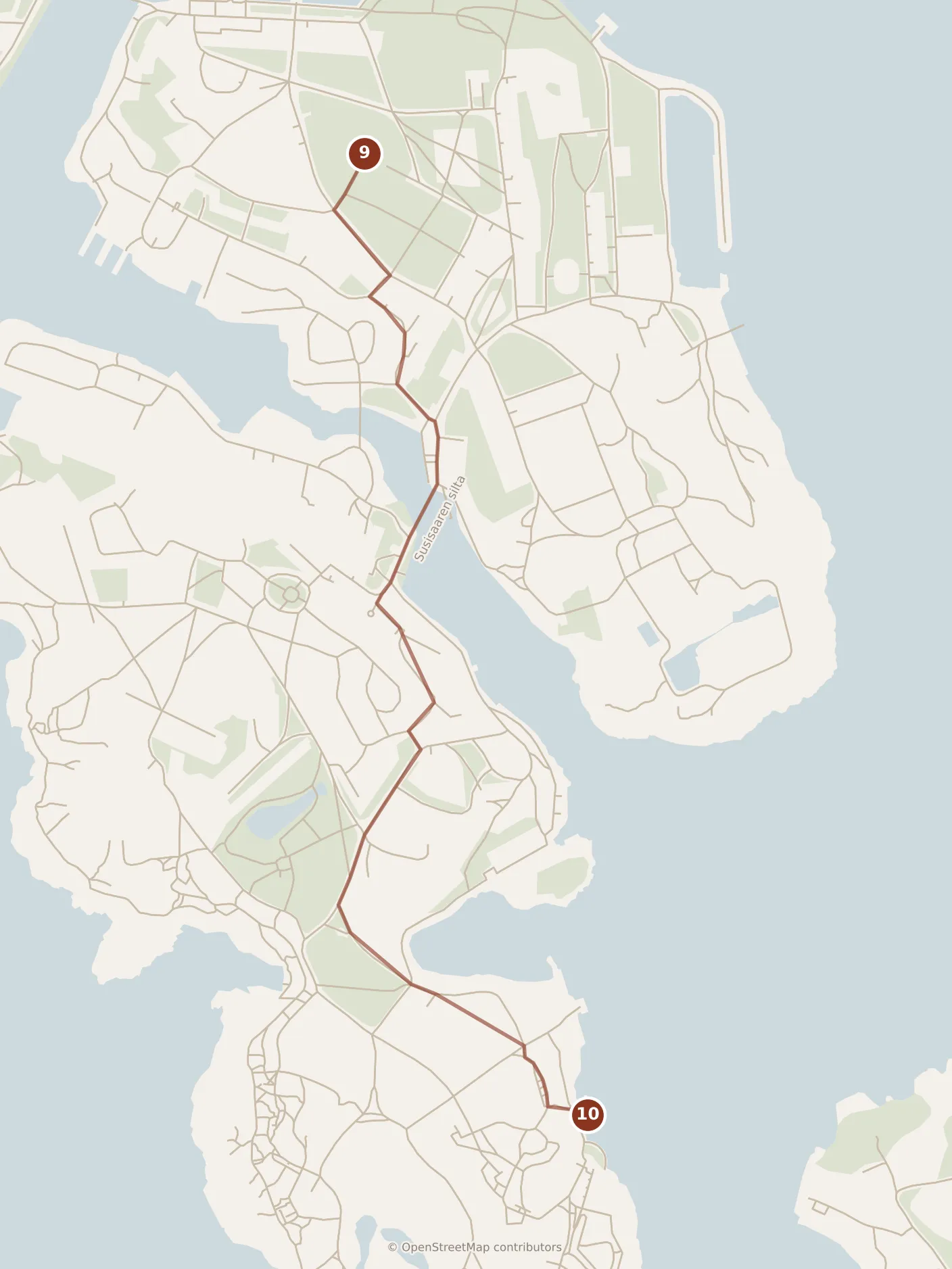
- Afternoon
- 9Suomenlinna Church
- 10King's Gate
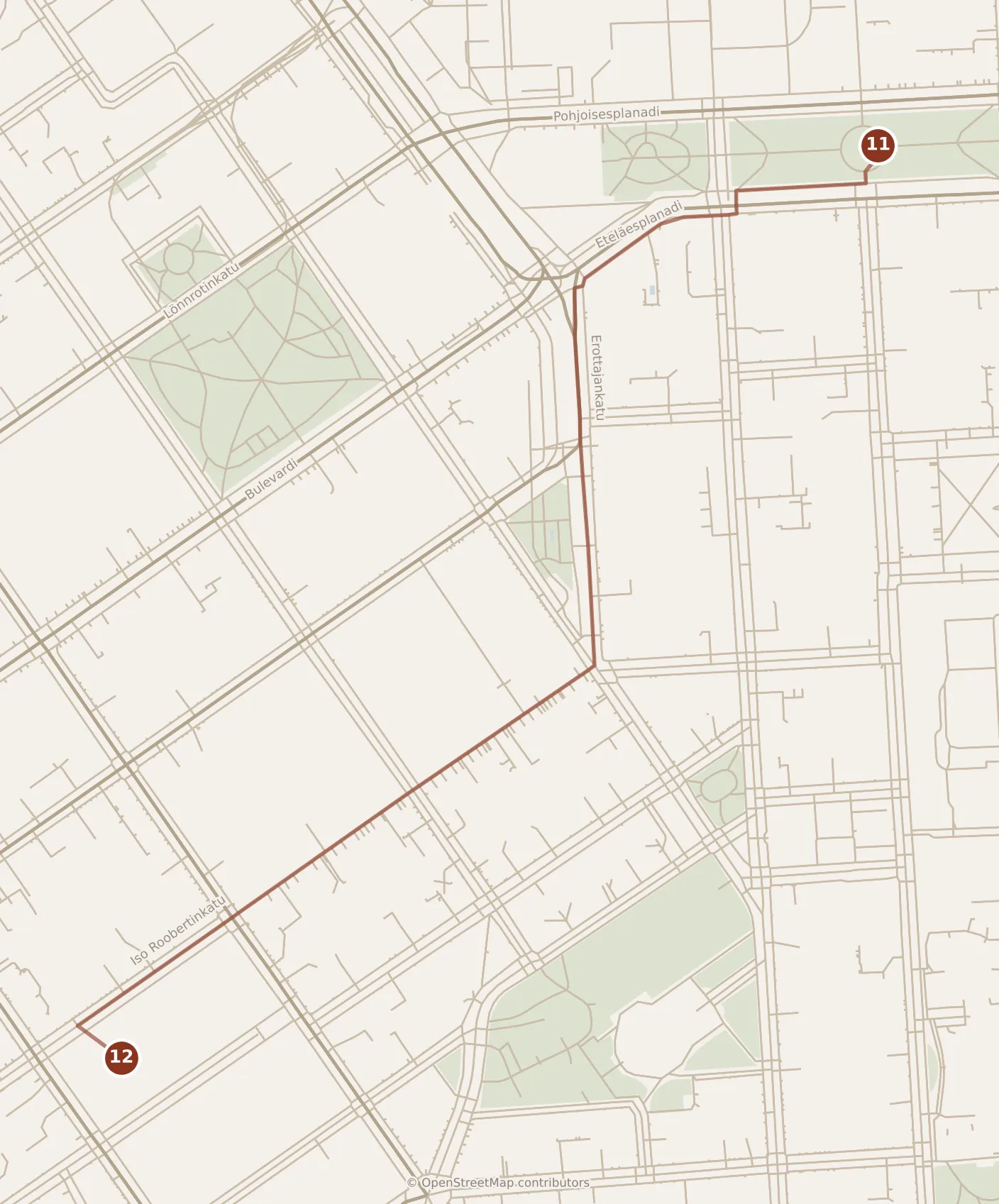
- Evening
- 11Esplanadi
- 12Punavuori
Morning
Start at the Central Railway Station and walk seven minutes north across the open square to Oodi, the central library. It opened in 2018 as the country’s present to itself for the centenary of Finnish independence, which is why it faces the parliament building across the square rather than hiding on a side street: the two of them look at each other on purpose. The ground floor is a public living room with a café in it — a coffee and a korvapuusti there is a legitimate way to begin. The middle floor is the strange one: sewing machines, studios and workshop kit that any resident can book. The top floor is what you came for, a single white undulating ceiling over an open reading room walled in glass, with a balcony above the trees. Give it three quarters of an hour.
Oodi is also the hinge of the whole morning, for a dull reason. In 2026 it opened at eight on weekdays and not until ten on weekends, and it is the only thing on this route that opens early — so from Monday to Friday it is what lets you start before the rest of the city does, and the morning below is built backwards from that door. On a Saturday or a Sunday there is nothing to arrive early for, because there is nowhere on this route to arrive at: the Kamppi Chapel, the obvious substitute seven minutes from the station, opened at ten on weekends too in 2026. So the weekend day starts at ten, in the order below, and everything after it runs two hours later than a weekday would have it — two hours that come out of the afternoon, which is the half of this day the light decides. If either hour has moved by the time you read this, build the morning back from whichever door opens first.
Ten minutes south is the Kamppi Chapel, standing on its own in the middle of the busiest shopping district in the country: a curved shell of spruce planks about eleven meters high, finished in 2012, with no altar and no services in the ordinary sense. It is a room for being quiet in, staffed, free, and open to anyone who walks up. Five minutes inside is the whole of it, and the contrast with the traffic outside the door is the point.
A quarter of an hour north-west, and slightly uphill, is Temppeliaukio Church, finished in 1969 and dug straight down into the bedrock of a small square. The walls are the quarried rock face, left raw; the roof is a shallow copper disc wound with a spiral of copper strip and floated above a ring of skylights, so the only daylight arrives round the edge of it. It is a working Lutheran church with a reputation for acoustics, which means it is also a concert hall, which is why its visiting hours move about. Twenty minutes is enough, and the thing to do with them is sit down and look up.
The church is the one thing on this route that is not within a walk of the rest. Senate Square is half an hour away on foot, east across the whole width of the peninsula, and that half hour is the largest single thing you can take out of this day. Take it out. Three minutes downhill from the church door is the Sammonkatu tram stop, and tram 2 towards the Olympia Terminal runs from there to Senaatintori in seven stops and about ten minutes, setting you down on the square itself — on the same day ticket that carries the ferry later.
Senate Square is Carl Ludvig Engel’s neoclassical ensemble of the 1820s and after, with Helsinki Cathedral raised on a flight of steps above it. For decades western films needing a Soviet city shot here instead, which tells you exactly what Engel had been copying. Half an hour covers the steps, the view back down them and the plain white interior, which is worth four minutes rather than forty. The outside is the better half of this stop and you have already paid for it by climbing.
Eight or nine minutes east, across the canal and up its own rock, is Uspenski Cathedral: red brick and gold onion domes, finished in 1868, and the largest Orthodox church in western Europe. Inside it is dark, gilded and heavily iconed, the opposite of the Lutheran box you have just left, and the two of them within ten minutes of each other are the clearest statement Helsinki makes about which empires it has belonged to. Give it fifteen minutes.
Afternoon
Nine minutes back round the water is the Old Market Hall — the Vanha kauppahalli, the city’s first indoor market, open since 1889 and restored into a long timber-lined hall of small counters. Lunch goes here, sitting down, and it should be lohikeitto: salmon soup, cream, potato, dill, a slab of butter melting into it and rye bread beside. Give it an hour. The temptation with one day in an expensive city is to buy something to carry and keep walking, and this is the wrong day for it — you are about to spend two and a half hours outdoors on an island where the eating is limited.
Three minutes north is the Market Square, an open-air market on the quayside with the bronze mermaid of the Havis Amanda fountain at its landward end, and the ferry pier for Suomenlinna at its seaward one. The boat is ordinary public transport, not a tour: it runs all year and practically all night, stopping only for a few hours before dawn, and the crossing takes about fifteen minutes.
Suomenlinna was begun in 1748, when this was Sweden and the fortress was Sveaborg, built by Augustin Ehrensvärd on the French star-fort principles of the age and bent to fit a scatter of rocky islands. It surrendered to Russia in 1808 without much of a fight, which is the fact the place has never quite lived down. It is a UNESCO World Heritage Site, and something like eight hundred people live on it — you walk past their front doors, their nursery and their shop, which is what stops it feeling like a ruin.
The ferry ties up beside the church, and the visit is one walk: follow the signposted route across the bridge and out along the ramparts to the King’s Gate at the far end, a little under twenty minutes each way, then come back the way you came. The gate is a ceremonial stair down to the water on the seaward side, and the ramparts around it are the part worth slowing down for — grass, cannon, granite and open sea. Two and a half hours on the island covers the walk both ways with real time at the far end.
Local tip. The several small museums on Suomenlinna, and the submarine you can climb down into in the summer half of the year, are the things to skip on a single day. The fortress is the walk and the walls, not the display cases, and an hour spent indoors here is the hour that makes you rush the ramparts and catch the boat back in the dark.
Evening
Back off the ferry at the Market Square and walk west to dinner along the Esplanadi, which begins at the far side of the market: a double avenue with a strip of park down the middle, running inland from the harbor. Walk its length rather than round it — ten minutes, and it is the one stretch of this day that is purely pleasant. At its far end carry straight on south-west into Punavuori, another quarter of an hour. That is a little over twenty minutes in all, it is the longest single stretch of the day, and it is worth it: the center north of the Esplanadi is offices and chain shops and goes flat once they shut, while Punavuori is where people actually live and eat — small independent kitchens, coffee roasters and the design shops the quarter is known for, at a walkable scale. Dinner goes here, and it will cost less than the same meal a few streets north.
From Punavuori the Central Railway Station is about twenty minutes back on foot, north through the streets rather than round by the harbor, and that is where the bag is. If the day ends with a train, or with the airport train, allow the twenty minutes and then some for collecting it: this route deliberately finishes within walking distance of where it started, and the only part of the day that ever takes you away from the station is the fortress, which brings you back to the same pier it left from.
Practicalities
There is one ticket to think about and one thing to buy. The ferry to Suomenlinna is not a boat tour and has no separate fare — it runs on the city’s ordinary public-transport system, so a single day ticket covering the central zones carries the crossing and the one tram ride this route uses, from Sammonkatu to Senaatintori, on the same fare. Nothing else on the day needs any transport at all. If you have not read the city guide, that is where the fare system, the airport train and the rest of it are explained; this route needs no more than the day ticket. The one paid entry is Temppeliaukio Church, which is walk-up rather than booked ahead and was in the eight-to-ten-euro range for adults in 2026. Everything else here is free: the library, the chapel, the squares, the market hall, the island and its walls.
Free is not the same as open, and paid is no guarantee either: four stops on this route keep hours of their own. Two of them decide when the day starts — Oodi and the Kamppi Chapel, both at ten on weekends, which is why the morning is built backwards from whichever door opens first. The other two decide whether it holds together. Uspenski Cathedral is the one most likely to break the day as written — it was shut on Mondays in 2026 and opened only in the afternoon on a Sunday, which on a Sunday means swapping it with lunch: go down to the market hall from the Senate Square, eat, and come back up to the cathedral afterwards, on the way to the pier — or straight off the returning boat on a reversed winter day. Check that single thing before you set out, and if it is closed altogether, take it calmly: the brick and the domes on the rock above the harbor are most of the effect, the interior is fifteen minutes, and the day loses a quarter of an hour and nothing else. Temppeliaukio is the other. It is a functioning church and a concert venue, so its visiting hours are set week by week around services and rehearsals and published only a short way ahead; they are not a fixed schedule you can plan around months in advance. Look them up the day before and, if the morning slot has gone, drop the church rather than rebuild the morning around it: the tram into the center is the same line 2, boarded at the Kamppi stop five minutes from the chapel door instead of at Sammonkatu, and nothing else about the day changes.
The island needs nothing booked, in any season. It is open ground with a ferry to it, and going in February is a different and in some ways better visit than going in July — fewer people, ice in the sound, the walls doing what they were built to look like. What it does need is footwear and a coat with a hood: it is bare rock in open water, there is no shelter along the ramparts, and the wind off the Gulf of Finland is a category of its own. Nothing on the mainland half of the day demands the same; it is the fortress that decides what you wear.
If your one day is a Monday, this route survives it in a way a museum-led day would not — the library, the churches, the market hall and the island are all open, and the only casualty is the Orthodox cathedral above. That is a reason to take the day roughly as written rather than substituting a gallery into it.


