Hangzhou in two or three days: the lake, its causeways, and the hills at its edge

Last updated 15 August 2026
Overview
Hangzhou is built around a lake, and the lake is small enough to think of as a single afternoon’s walk and large enough to spend three days doing exactly that without repeating a view. Two causeways cross it lengthways, splitting the water into distinct rooms rather than one open sheet, and that division is what makes two full days here different rather than the same walk twice. A third day leaves the water for the hills at its western edge, where the city’s oldest working temple sits half-carved into the rock above it.
For the best part of a hundred and fifty years this was the capital of the Southern Song, then called Lin’an, and Marco Polo, passing through a century after the court had gone, still called it one of the finest and noblest cities in the world. Two of the causeways carry the names of the poets who governed the city and had them built — Bai Juyi in the Tang, Su Shi three centuries later, in the Song — and the classical list of the lake’s finest views, the Ten Scenes of West Lake, still names the exact spots this route uses to open and close two of its three days.
One thing decides which day is which before you read them: day two holds the Zhejiang Provincial Museum, on Solitary Hill, and Chinese state museums close as a rule on Mondays. If your second day would land on one, swap it with the first — day one’s old town, pagoda and causeway are either free or open daily, and none of them cares what day it is. The swap costs something: day one is arranged to give you the shape of the old town and the south shore before day two takes you around the north, and starting on the north shore blind still works, it is simply a colder introduction to the city than the pharmacy and the market street give you.
This covers the lake and the hills that belong to it. It does not cover the old Grand Canal quarter on the north side of the city, which is a different day and not a short one.
Quyuan Fenghe — not on the walking map.
- Day one · Evening
- Quyuan Fenghe — in the prose, not on the map
Pinghu Qiuyue — not on the walking map.
- Day two · Evening
- Pinghu Qiuyue — in the prose, not on the map
Day one

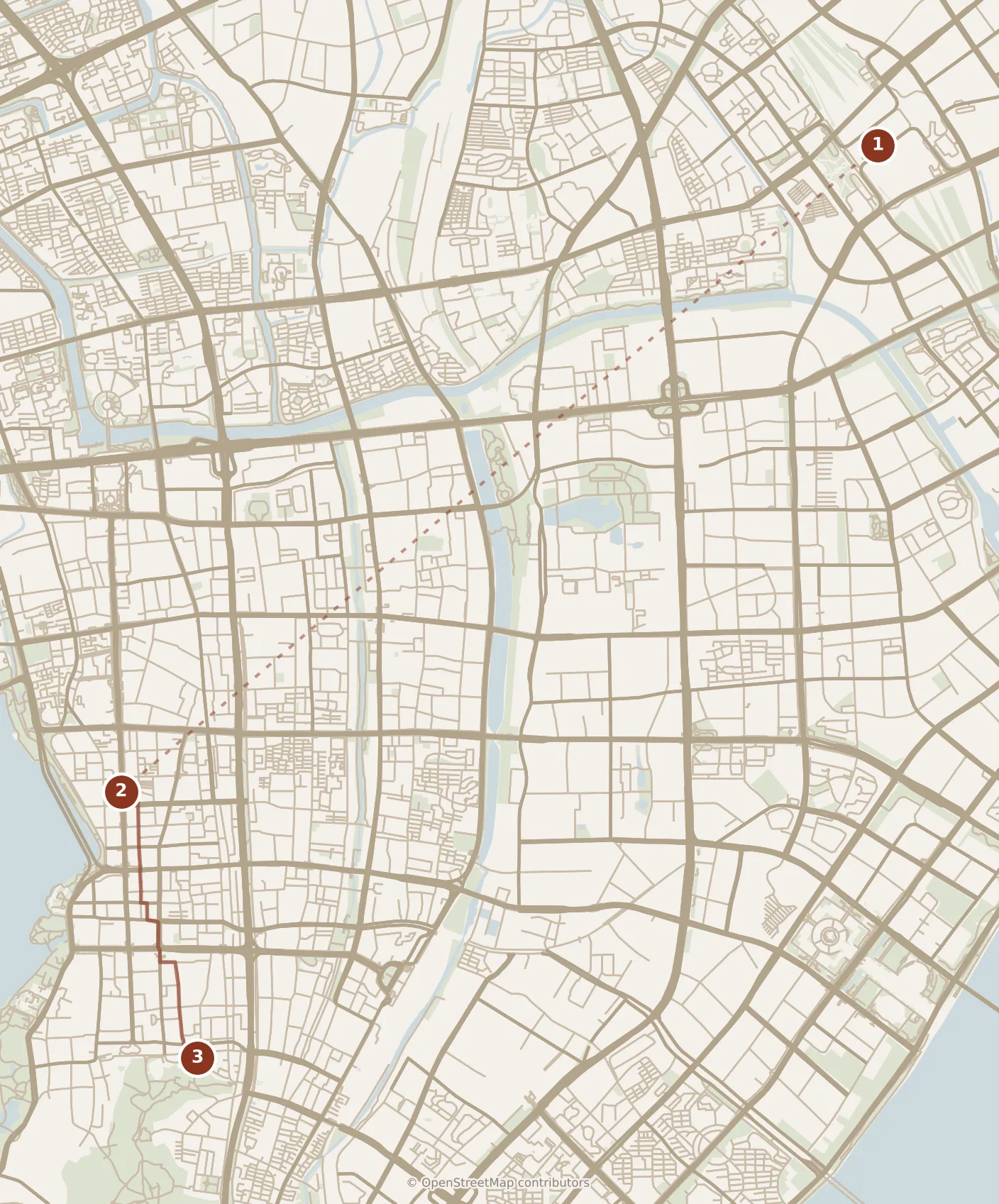
- Morning
- 1Hangzhou East Railway Station
- 2Longxiangqiao
- City God Pavilion — in the prose, not on the map
- Hefang Street — in the prose, not on the map
- 3Huqingyu Tang
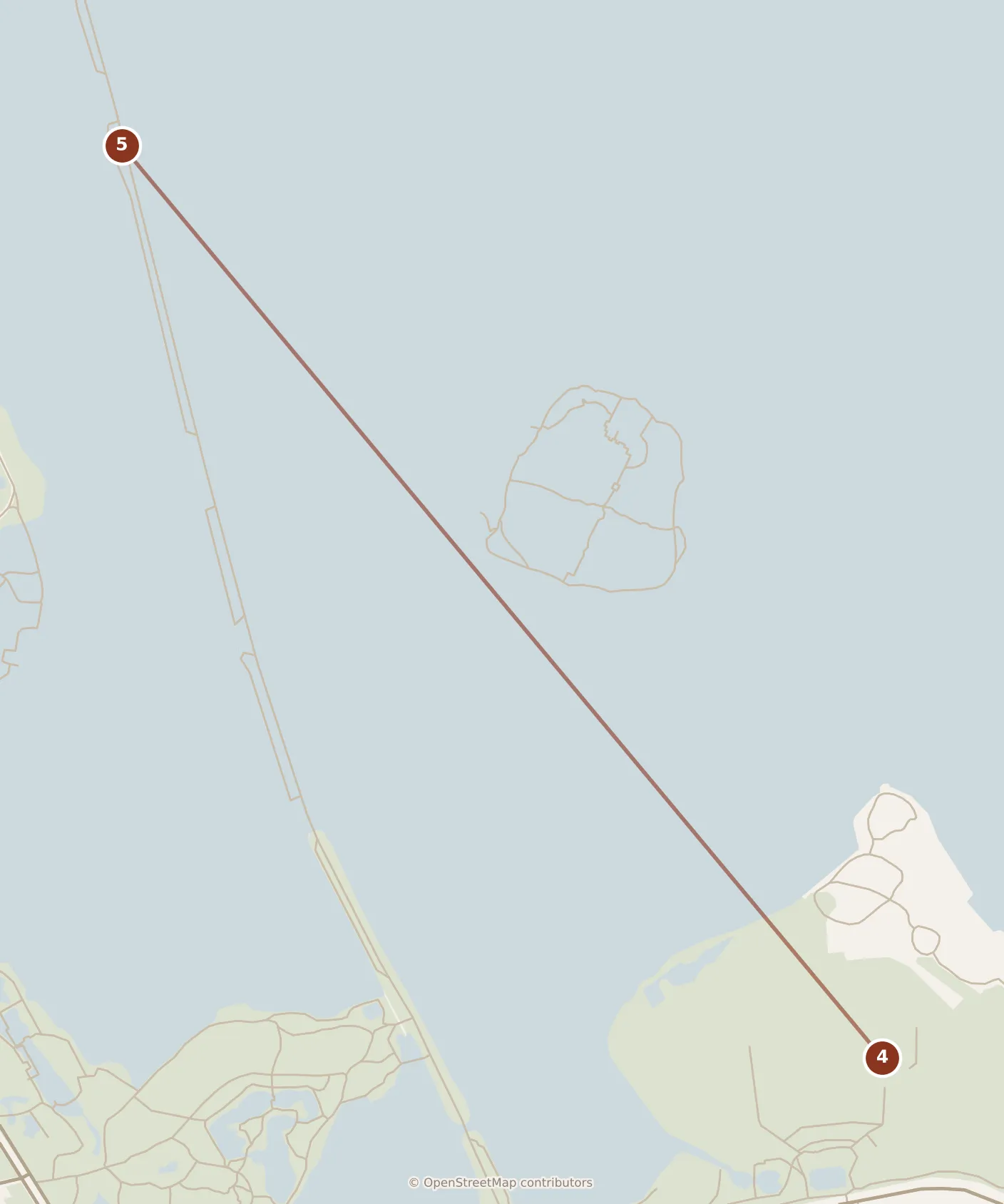
- Afternoon
- 4Leifeng Pagoda
- 5Su Causeway
Everything before the evening stays within the old town and the lake’s south and west shore, which is why it goes first: it gives you the shape of the center before day two takes you around the far side of the water.
Morning
Arrive, if you are coming by high-speed rail as most visitors do, into Hangzhou East Railway Station, and take the metro on Line 1 into the center — the best part of forty minutes, more if you are coming straight off a long-distance service and need to find the platform. Get off at Longxiangqiao: the exit puts you within a few minutes of both today’s first stop and Hefang Street, so nothing about the start of the day is spent getting oriented. Arriving by air instead simply adds a longer ride onto the same line; the walk from the station exit is the same either way.
Climb Wu Hill first, to the City God Pavilion at its top, before the old town’s lanes swallow you. It is not a long climb and the reward is out of proportion to it: the whole huddle of tiled roofs below you, and the lake beginning past them. Give it twenty minutes at the top, no more — it is a viewpoint, not a museum, and its value is entirely in what it shows you before you go down and lose the overview.
Down into Hefang Street, the old town’s spine, rebuilt in a nineteenth-century style and busy with it — silk, fans, tea, and the kind of dense foot traffic that says this was a market street once and still behaves like one. Walk its length rather than diving into the first shop; the street is short enough that ten unhurried minutes covers it, and the lanes off it reward more time than the street itself does.
Turn off partway along for Huqingyu Tang, a nineteenth-century pharmacy built by the merchant Hu Xueyan and kept as it operated, apothecary drawers and all: hundreds of labeled compartments of traditional Chinese medicine, a working dispensary at the back, and none of the polish of a purpose-built museum. Twenty minutes is enough unless you read Chinese and want to work through the labels.
Afternoon
Leifeng Pagoda is a twenty-minute walk south, on the lake’s edge, and it is a rebuilt tower standing on the ruins of a much older one — the original was raised in 975, when this was still the independent Wuyue Kingdom under its king Qian Chu, and it collapsed in 1924 after decades of people chipping bricks from its base, which folk belief held brought protection. The modern tower is a shell over that history: a glass floor near the entrance looks straight down onto the actual foundations, and an elevator carries you up through the new structure for the view the old one gave. The White Snake legend claims this pagoda imprisoned its serpent-spirit heroine beneath it, which is why every retelling of the story ends here. Forty-five minutes covers the climb and the ruins without hurrying either.
From the pagoda it is a short walk to the southern end of Su Causeway, and the causeway is the rest of the afternoon: 2.8 kilometers of raised path along the lake’s western side, built at Su Shi’s order in the eleventh century from silt dredged out of the water he was trying to save from choking up entirely, and carried on six arched bridges that give the walk its rhythm. Willows, and depending on the season peach blossom, line it on both sides. At an unhurried pace, stopping on the bridges rather than just crossing them, give it the better part of an hour — more if the light is good and you keep stopping.
Local tip. Walk the causeway in one direction only, pagoda end to Solitary Hill end. There is nothing at either terminus worth doubling back for, and starting here means the six bridges arrive in the order this account gives them.
Evening
Su Causeway ends near Quyuan Fenghe, one of the Ten Scenes of West Lake — in summer the pools here fill with lotus right up to the path’s edge; out of season it is simply a quiet garden at the causeway’s end, which is not nothing after an afternoon of walking. This is where day one lets go rather than closes: there is no further stop to reach, and the western shore around here has enough places to sit down and eat that naming one would only be picking for you. Stay on this side of the lake for dinner rather than crossing back towards the old town — you have already seen that side today, and the point of ending here is that you do not have to retrace the afternoon to do it.
Day two

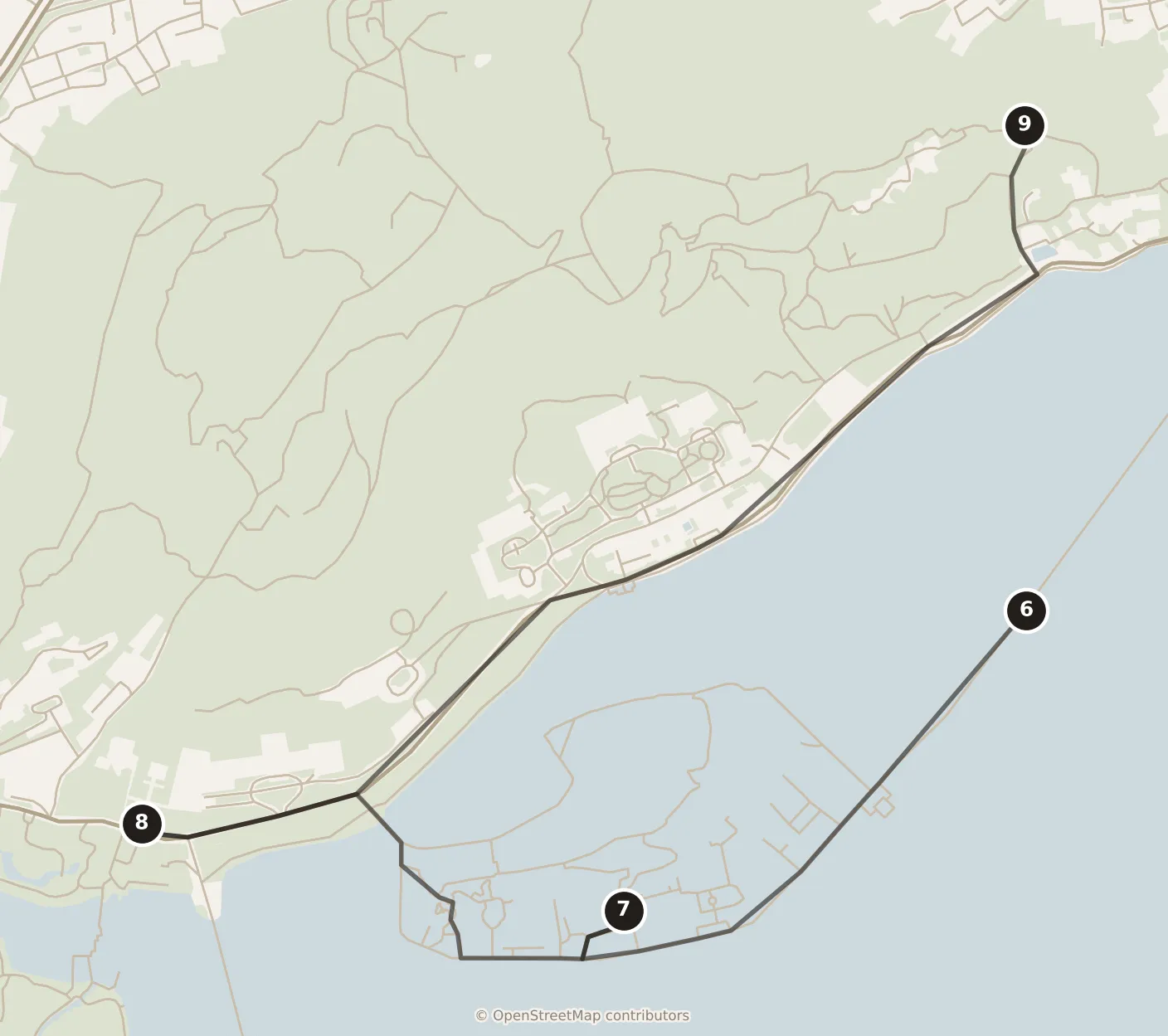
- Morning and afternoon
- Broken Bridge — in the prose, not on the map
- 6Bai Causeway
- 7Solitary Hill
- 8Yue Fei Temple
- 9Baochu Pagoda
Today runs the far side of the water: everything sits on the north shore or just off it, so you never cross back to yesterday’s side until the day is over.
Morning
Cross to the lake’s northeast corner and start at Broken Bridge — not broken at all, just a bridge where snow melts unevenly enough in winter that from a distance the bare patches look like a gap in the span, which is the observation the Ten Scenes of West Lake preserved as one of its named views. It is also where the White Snake legend has its two lovers first meet, which is why it is among the most photographed spots on the lake and why you should not expect it to be quiet. Ten minutes is enough; it is a bridge, not a destination, and its interest is entirely the story attached to it.
Bai Causeway runs west from here, a kilometer of raised path — shorter, more modest and considerably less built-up than Su Causeway on the other side of the lake — to Solitary Hill, the only natural island the lake has. Fifteen minutes at a walking pace, no stops needed on the way.
Solitary Hill is worth the rest of the morning. The Zhejiang Provincial Museum sits on it, free to enter, with the region’s own archaeology and painting collection inside — closed on Mondays, which is the fact the overview above already flagged. Beside it, the Xiling Seal Art Society occupies garden pavilions up the hill’s slope: China’s oldest society of seal-carvers, founded in 1904 and still active, with workshops and a small collection of stone seals open to walk through rather than a formal exhibition to tour. In February the hill’s plum trees are in bloom and the whole slope smells of it; the rest of the year it is simply a quiet garden island in the middle of a busy lake. An hour and a half here, more if the museum holds you, covers the hill properly.
Afternoon
West along the north shore, twenty-five minutes’ walk, to Yue Fei Temple: the tomb and shrine of the Song general executed on a fabricated charge of treason in 1142, one of the more genuinely mourned figures in the country’s history rather than a manufactured one. Kneeling in iron in front of the tomb are the statues of the officials blamed for his death, Qin Hui foremost among them — visitors have spat at them for centuries, and the bronze is worn smooth at the knees from it. Give the temple complex forty minutes; it is not large, and the story is the reason to be there rather than the architecture.
From the temple, the path up Bao Shi Hill starts within a few minutes’ walk, behind the temple grounds, and it is a genuine climb rather than a stroll — reckon on twenty-five minutes, steadily uphill on a paved path, no scrambling required but real effort all the same. Baochu Pagoda stands at the top, slender and much rebuilt over the centuries, and the view beside it is the best free vantage the lake has: the whole water laid out below, both causeways visible at once dividing it, and the old town’s roofs beyond that, where yesterday started. Coming down is faster, fifteen minutes or so, and considerably easier on the legs.
Evening
Walk back east along the shore, the better part of twenty minutes, to where Bai Causeway meets Solitary Hill — you were here this morning, and the point of returning is the hour rather than the place. This corner carries the second of the lake’s classical named views, Pinghu Qiuyue: a broad stone terrace built for exactly this, looking east across open water as the light goes and the lake turns still enough to hold a reflection whole. There is no fixed hour that makes this work and nothing here that closes — it rewards whatever the last hour of light happens to be on the day you are there, and it costs nothing to wait for it.
With a third day

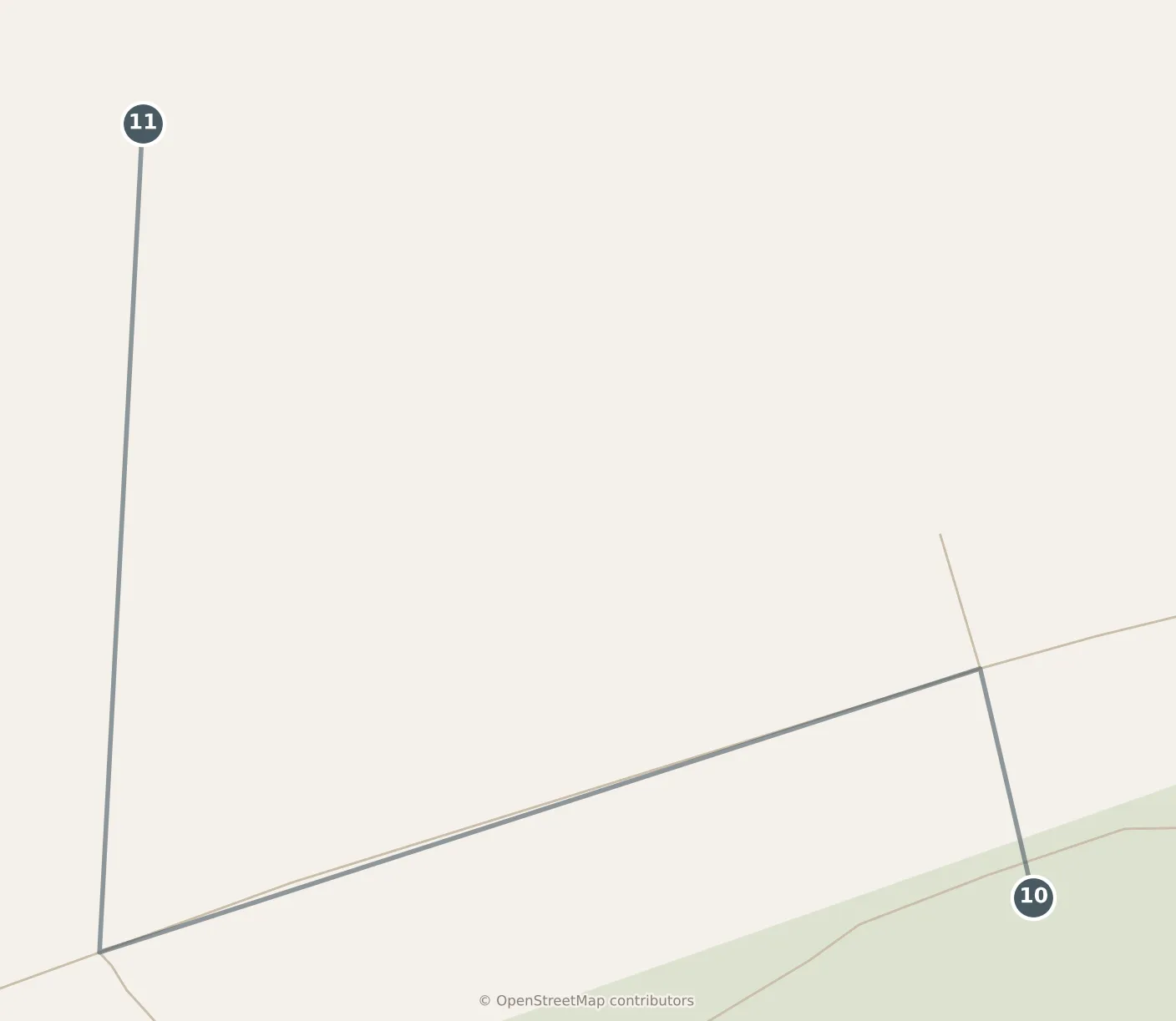
- With a third day
- 10Feilai Feng
- 11Lingyin Temple
- Longjing Village — in the prose, not on the map
Give the third day to the hills west of the lake, where Hangzhou’s oldest working temple sits, and where the terraces that grow the tea named after the city begin. Neither is reachable on foot from the lake in reasonable time — a bus from the center takes you out in twenty minutes or so — so this day starts with a ride rather than a walk, and that is the honest difference between it and the first two.
Feilai Feng is the limestone outcrop you reach first, before the temple proper: several hundred Buddhist carvings cut directly into the rock face and into the small caves running through it, made across roughly four centuries from the tenth onward, so the style visibly changes as you walk the path through them. The best known is a fat, seated, laughing figure carved into an open rock face near the stream — easy to miss if you are looking up rather than at eye level. Give the path through the carvings the best part of an hour; they reward slow looking more than any other stop on this route does, and there is no set order to walk them in.
Lingyin Temple is immediately beyond, one of the country’s most significant working Buddhist temples, founded in the fourth century and said to have been named, on the spot, for the soul’s retreat. Incense smoke fills the courtyards on any day of the year — the temple does not allow incense brought in from outside, so what burns here is bought at the entrance, worth knowing before you arrive with your own. Inside the main hall a single camphor-wood Buddha rises through the full height of the building; dress modestly and keep the halls quiet, as you would at any working place of worship rather than a museum. There is no single hour this day turns on — no closing time worth building around, just the ordinary rhythm of incense crowds building steadily from mid-morning, which is the real reason to be here on the early side rather than late. The combined ticket for the carvings and the temple ran to somewhere in the thirty-to-fifty-yuan range in 2026.
Local tip. Short on time, or the weather has turned: skip Longjing below and spend the saved bus ride on a second, slower pass through Feilai Feng instead — the carvings are the one thing on this day worth a return look, and you already know the way.
Longjing Village is a bus or short taxi ride further into the hills — fifteen to twenty minutes — or, if you would rather walk it, a marked trail through pine forest connects the two areas directly, the better part of two hours on foot and considerably steeper than anything else on this route. Either way, what you arrive at is terraced tea plantation rather than a village in the ordinary sense: rows of low bushes stepping down the hillsides, and, depending on the season, pickers working them by hand. The tea is Longjing, sold and drunk everywhere in the city but grown only here, and the picking that matters most happens in the two weeks before Qingming in early spring, when the first and most prized leaves come off. Sit at any of the terraces offering tastings and you are shown the whole process rather than sold a shortcut through it; an hour is enough to walk the slopes and sit for a cup, longer if you want to.
Coming back down, the same bus returns you to the lake by the middle of the afternoon, in good time to close the day with nothing more strenuous than a walk along whichever shore you have not yet worn out.
Practicalities
Book, or at least check, the combined Lingyin Temple and Feilai Feng ticket a day or two ahead: sights across China increasingly require an online reservation even where entry is free or cheap, and the city guide has the practical detail on arranging that from outside the country. Everything else on this route — the causeways, the bridges, the two hilltop pavilions — is free and unticketed.
If your second day lands on a Monday, swap it with the first: the Zhejiang Provincial Museum on Solitary Hill closes that day, as Chinese state museums do as a rule, and nothing else on day two depends on an opening hour at all. The swap is not quite free — day one is built to give you the old town and the south shore before day two takes the north, and starting on the unfamiliar side first is a colder way into the city, even if every stop still works.
Days one and two are entirely walkable and the distances above are real: the longest single stretch is Su Causeway itself, the better part of an hour if you take it slowly. The third day is different in kind rather than degree — it needs a bus both ways, and there is no walking substitute for the outward leg, though the forest trail between Lingyin and Longjing is there for anyone who would rather climb than ride.


_20250505.jpg)
