Hamburg in two to three days: the brick city, the harbor, and the walk west along the Elbe

Last updated 12 October 2026
Overview
Hamburg is a port with a city attached, and the part of it worth walking runs about fifteen kilometers along one bank of a river. That is why a single day here has to be a line rather than a loop, and it is why two days is the first honest length: the second day is not more of the first, it is the half of the city the first one cannot physically reach.
What the extra time buys is interiors and distance. Two days lets you go up a tower instead of photographing it, give an afternoon to the inside of the warehouse district instead of walking through it on the way somewhere, and get far enough west along the Elbe to reach the part where the city stops performing and starts sunbathing. Day one below stays inside the square kilometer between the main station and the water, and it is mostly indoors: brick offices, three churches that are three different arguments about what to do with a bombed city, and a warehouse quarter at the end of it. Day two begins on a hill above the harbor, goes under the river and back, then works four kilometers west along the same bank, one leg of it on a scheduled ferry, and ends on sand. They overlap in almost nothing.
You walk throughout. Hamburg is flat apart from the low ridge the old town sits on and the bluff at Altona, and neither is a climb so much as a set of steps. Nothing below needs a car and nothing below needs a tour: the ferry that carries half of day two is an ordinary line on the city network, so a day pass bought on that day covers both its legs. That is the only day of the three that needs a ticket for the route itself — the other two are walked end to end, and anything else is only getting to your bed. It is the only ticket this route needs you to think about; the parent city guide has the rest.
The sun sets here anywhere from just after four in the middle of December to a few minutes before ten at midsummer, and the two days want opposite things from that. Day one wants the dark: the warehouse district is floodlit after dark, so in December it is already lit while you are still walking and in June you will be strolling back to it after dinner — either way it looks after itself, which is why day one is counted forwards from its first open door rather than backwards from anything. Day two wants the light, because its last two hours are on an exposed shore, and between November and February it has to be run in reverse. That version of the day is set out at the end of this article.
One warning that is earned rather than offered: this is a wet, windy, changeable city, and day two carries all its shelter at the front — an hour and a quarter in the Michel, forty minutes under the river — with nothing over you afterwards but lunch. A genuinely bad forecast is a reason to swap the days round or to take the wet-weather version below, not a reason to walk it anyway.
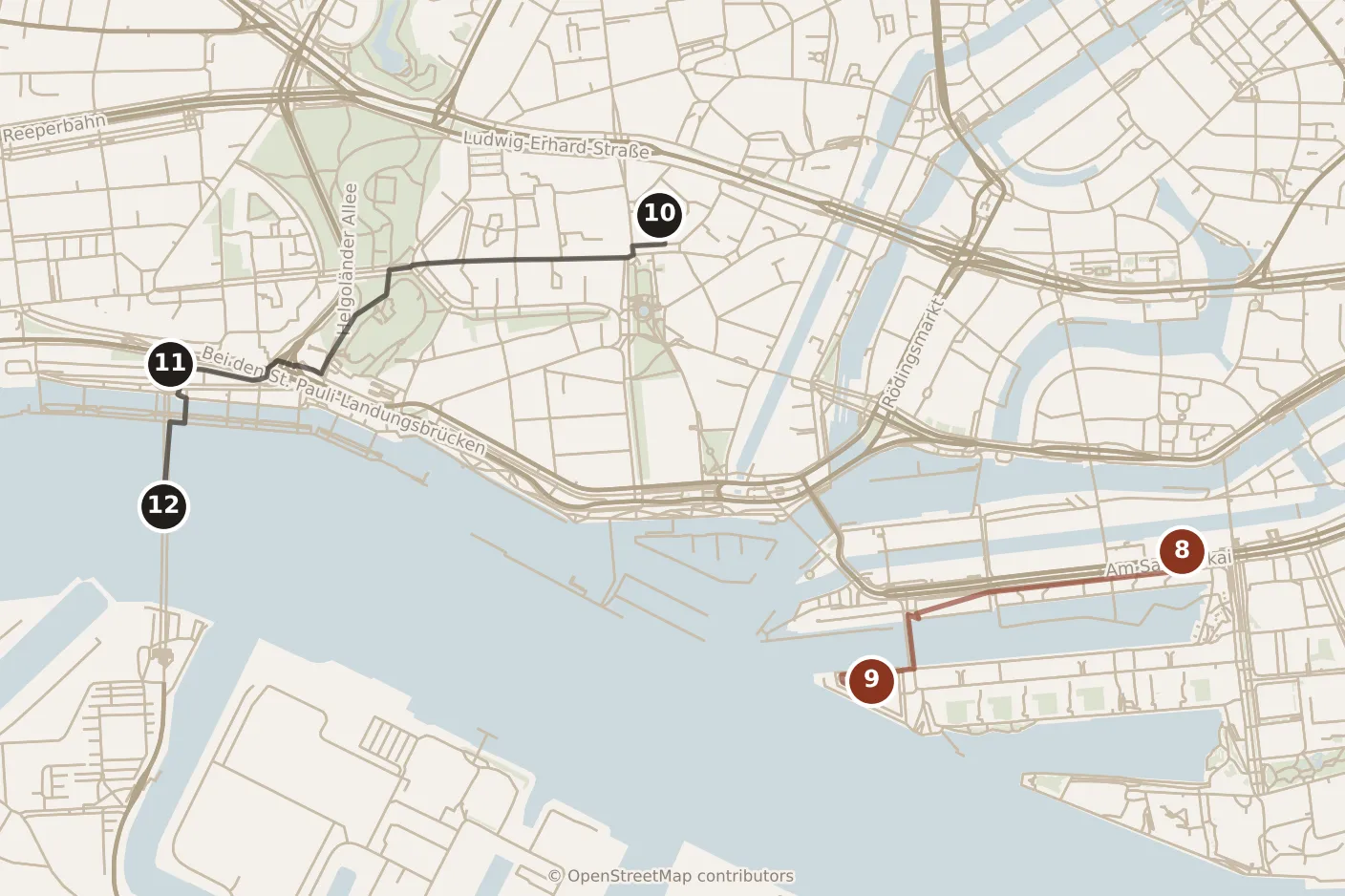
- Day one
- 8Speicherstadt
- 9Elbphilharmonie
- Day two
- 10St. Michaelis
- 11Landungsbrücken
- 12Old Elbe Tunnel
Day one

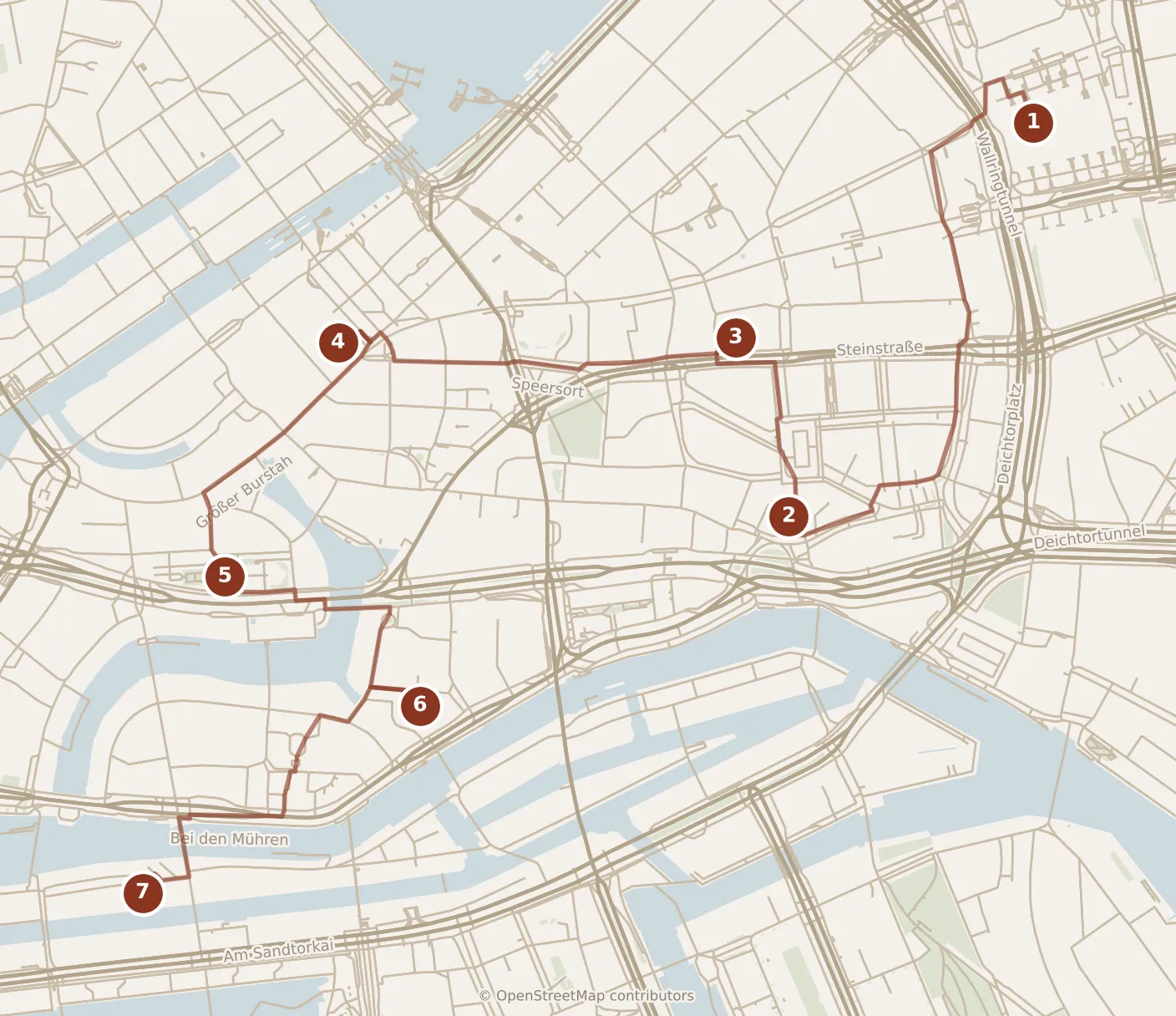
- Morning and afternoon
- 1Hamburg Hauptbahnhof
- 2Chilehaus
- 3St. Jacobi
- 4Hamburg Rathaus
- 5St. Nikolai
- 6St. Katharinen
- 7Miniatur Wunderland
Today is a square kilometer and about six kilometers of walking inside it, and the sequence runs from the hardest brick in the city to the softest thing in it. Nothing on this morning opens before eleven except the streets, so there is no reason to be out before about half past ten.
Morning
Most readers arrive at the Hauptbahnhof, either off a long-distance train or off the S1, which runs from the airport terminals and takes about twenty-five minutes. The station is where day one starts, and it is worth two minutes of looking up before you leave it: the 1906 roof crosses every platform in one span with nothing under it in the middle. If you cannot check in anywhere yet, the bag goes here — the railway’s own lockers, not a staffed office, in two rooms on the Nordsteg above the tracks (one opposite platform 14, one opposite platform 6) and more in the Wandelhalle near the Kirchenallee exit. Day one ends three kilometers away and does not come back, so if your room is anywhere central it is quicker to drop the bag there first.
Twelve minutes south-west is the Kontorhausviertel, a quarter of nothing but office blocks built in the 1920s for shipping firms and insurers, and the reason it carries a UNESCO listing together with the warehouse district is that the two were the same idea in two materials. The Chilehaus is the one to stand under. Finished in 1924 for Henry B. Sloman, who had made his money out of saltpetre in Chile, it is ten stories of dark Oldenburg brick — nearly five million of them — and Fritz Höger drew its eastern corner as a ship’s prow, so two long walls run at each other and finish in an edge you can sight along, with the upper floors stepping back like decks. Walk to the point, then walk the length of one flank and watch the wall bend. The Sprinkenhof beside it is larger and duller, and useful mainly for showing you that the Chilehaus was an advertisement. Twenty-five minutes for the pair.
Five minutes north, St. Jacobi does not open until eleven, which is late for a church and is the one hour this morning is built around: it was eleven daily in 2026, and if you find a different one, put the Kontorhaus quarter before it either way, because a street needs no door. What you have come in for is at the west end — an organ built by Arp Schnitger and finished in 1693, sixty stops and around four thousand pipes, the largest surviving baroque instrument in northern Europe. The church around it was destroyed by bombing in 1944 and the fittings, organ included, had been taken out and stored before that happened, which is why the case in front of you is older than every wall holding it up. Johann Sebastian Bach came to Hamburg in 1720 to be a candidate for the organist’s job here and withdrew before the audition. Fifteen minutes, and longer if anyone is playing.
Ten minutes west, the Rathaus is a working building rather than a monument: Hamburg is a city and one of Germany’s federal states at the same time, and this single building houses both governments, which is exactly why its state rooms cannot be visited on any dependable schedule. Tours run in German through the day and in English several times a day from the desk in the entrance hall, and they stop without notice whenever the rooms are in use. So treat it as a decision at the door: if one is going when you arrive, take it and eat afterwards; if not, the entrance hall, the courtyard behind it with its fountain, and the square in front are twenty minutes and cost nothing. Lunch is in the streets and arcades immediately behind the building.
Afternoon
Seven minutes south, St. Nikolai is the answer the city gave to the same question St. Jacobi answered by rebuilding: it did not. The neo-Gothic church here was the tallest building in the world from 1874 to 1876; in the firestorm raids of July 1943 the tower was used as a marker by the crews overhead and it is the tower that came through while everything under it burned. What stands now is a memorial, with a carillon of fifty-one bells hung in the surviving spire in 1993 and an elevator running up inside it to a platform at seventy-five meters.
Give this stop a full hour, and — unlike a reader with only one day — give a real half of that hour to the crypt underneath, which is a documentation center on the bombing and on what the city did about it afterwards. The ruin above is the exhibit; the crypt is the argument. Doing both is the clearest single thing two days buys you here.
Local tip. Book the model railway below for a mid-afternoon slot rather than a morning one. It is the only stop on this day that is completely indifferent to weather and to light, and everything either side of it — the ruin, the canals, the terrace — is not. If the forecast is foul, that ordering is what saves the day rather than the ticket.
Six minutes on, St. Katharinen is the third answer: rebuilt, quietly, between 1950 and 1957 on walls and a spire base that survived the raid of 30 July 1943. That base is from the thirteenth century and is the second-oldest structure standing in Hamburg. The organ is new — finished in 2013 and built deliberately in the tradition of the instrument Johann Adam Reincken played here for nearly sixty years, and which Bach traveled to hear on that same 1720 visit. Fifteen minutes, and the case for them is that after two ruined churches this is what the inside of a whole one looks like: the set is not complete without it. The parish sometimes puts on organ music at half past twelve and publishes which days, but this route has you here in the early afternoon, so treat that as a reason to come back rather than a slot to hit. It is a working parish church: services close it, and they are the reason to look at the notice by the door rather than the guidebook.
Eight minutes south-west, at the western end of the warehouse district, Miniatur Wunderland is the stop a one-day visitor is right to skip and a two-day visitor is wrong to. It is the largest model railway in the world and one of the most visited sights in Germany, it is a solid two hours, and it is far better than that description makes it sound — the operating logic runs a whole day-and-night cycle, and the airport section lands and takes off aircraft. Tickets are timed, they were in the low twenties of euros for an adult in 2026, and this is the one thing on either day to buy before you travel: walk-up waits on a weekend or in a school holiday are the reason people end up doing half of it.
Evening
Come out and walk east along the canals into the Speicherstadt itself. It went up from 1883, in preparation for the customs union Hamburg entered in 1888, which meant it needed somewhere goods could sit untaxed, and more than twenty thousand people were cleared off the islands of Kehrwieder and Wandrahm to make room for it — twenty-six hectares of red brick on oak piles, still the largest warehouse complex of its kind anywhere. Walk the canal edges rather than the middle: the whole effect is the reflection, and the tide moves the water a couple of meters so the same stretch is a different picture at seven than it was at four. Fifteen minutes east brings you to the Poggenmühlenbrücke, where two canals meet around a small turreted brick building stranded on its own island, and that is the view. Three quarters of an hour.
Then twenty-five minutes back west along the far bank to the Elbphilharmonie, and take it at night on purpose. The public terrace where the glass sits down on the old quayside warehouse is open until midnight, long after the museums have shut, it runs the whole way round, and after dark you get the two things this building is actually for: the harbor cranes lit on one side and the city on the other, with the warehouse district you have just walked glowing between them. Tickets are handed out at the pavilion on the forecourt while they last — free until October 2026 and a few euros a head after that — and a timed one can be reserved online in advance for a booking fee of the same order, which on a wet Saturday is the difference between walking in and waiting in line. Three quarters of an hour. In December the dark is there before you arrive; between May and July it is not, so eat first — better back up in the old town than in the new blocks around you — and come back to the terrace afterwards.
If the day is running long, the stop to drop is the model railway — two hours indoors, and the only stop here that could be anywhere. Cut it and you get the canals in daylight and the terrace without hurrying.
Day two

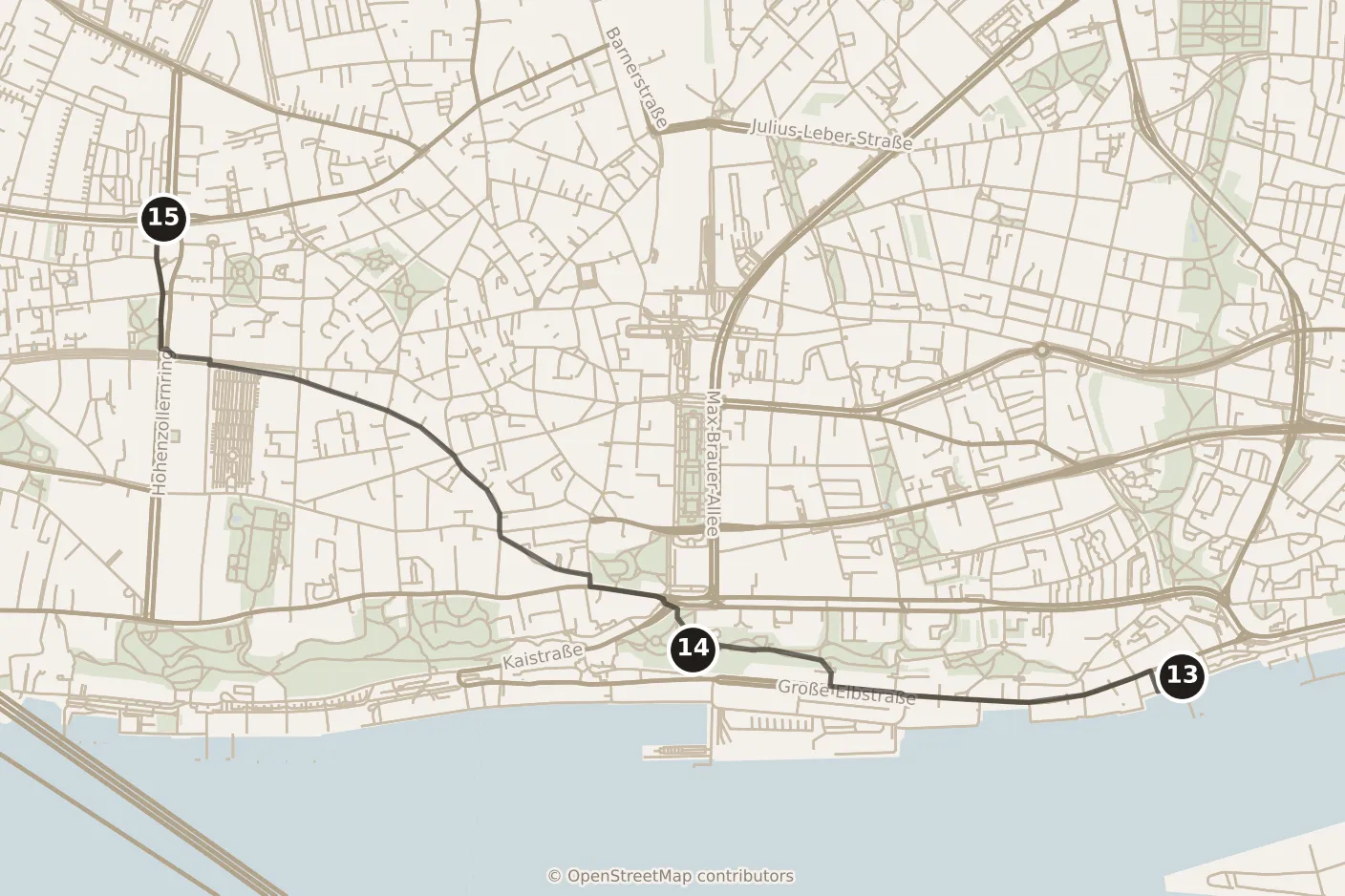
- Afternoon
- 13Fischauktionshalle
- 14Altonaer Balkon
- 15Ottensen
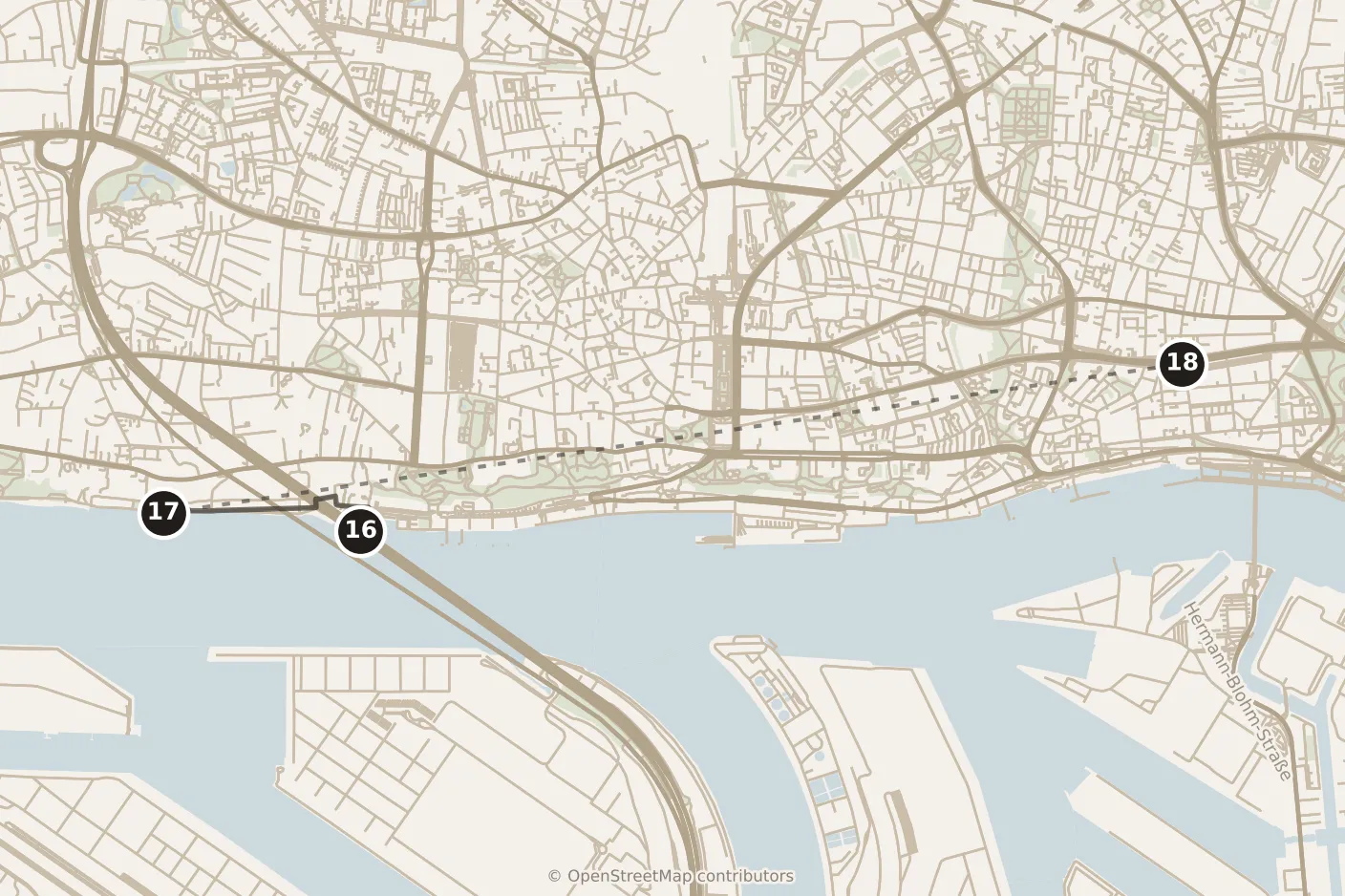
- Evening
- 16Museumshafen Oevelgönne
- 17Övelgönne
- 18Reeperbahn
Today is the harbor, and it moves in one direction only: from a hill above the river, down to it, under it, across it and then four kilometers west along it. About eight kilometers on foot, one ferry ride out and one back.
Morning
Start at St. Michaelis, which everyone here calls the Michel. It has no station of its own; it is about ten minutes on foot from Stadthausbrücke on the S-Bahn or from Rödingsmarkt or Baumwall on the U3, and about fifteen uphill from the piers if you would rather come at it from below. The church begun in 1751 and finished in 1762, tower and all by 1786, burned in 1906; what stands is the replica rebuilt by 1912. The copper spire carries the largest clock faces in Germany at eight meters across, and the platform is at eighty-three meters of a hundred and thirty-two. Take the tower and the crypt both — a combined ticket is sold at the visitor center — and give the pair an hour and a quarter. The crypt holds two and a half thousand burials, Carl Philipp Emanuel Bach among them, which closes the thread day one opened.
The Michel is a working Lutheran church and there is nothing to dress for, but two things are enforced and neither is guessable: the church and the crypt close during services and events, and there is a short devotion every day at midday. So do not make the crypt the first thing you try around noon, and check the board inside the door before you buy. In 2026 the building opened at nine from April to October and at ten from November to March, and that door is what day two is counted from — if the hour has moved, everything below simply starts from the new one.
Fifteen minutes downhill brings you to Landungsbrücken, the long floating pontoon where the harbor becomes a public place. Twenty minutes is enough: walk out along it, watch a boat come alongside, and eat a Fischbrötchen standing up, because lunch today is late and moveable.
Then go underneath the river. The old Elbe tunnel, opened in 1911, runs four hundred and twenty-six meters from a domed entrance hall behind the pontoon to the far bank, twenty-four meters down, in two tiled tubes lined with ceramic reliefs of the things the river carries; the elevators at either end were built big enough to take a car, and did until 2019; the tunnel has been car-free since. The western tube came back into use in 2026 after a rebuild that remade the tiles by the original method, so what is open when you arrive is worth a glance at the notice board and no more than that — walking one tube is the same experience as walking two. It is free. Go through, come up on the Steinwerder side and turn round: the reason to do this is the view back, the whole city front seen across open water from a working shipyard bank, and it is usually almost empty. There is nothing to walk to over there. Forty minutes for the round trip, and come back up the way you went down.
Afternoon
The ferry leaves from bridge three at the pontoon. Take line 62 one stop, six or seven minutes, to the pier at the Fischmarkt. This is a scheduled commuter service and not an excursion, which is the whole point of it.
You land beside the Fischauktionshalle, an iron and glass fish auction hall built in 1896 and now used for events, and beside the open ground of the Fischmarkt itself. On a weekday at lunchtime that ground is an empty apron and the hall is the thing to look at, which takes twenty minutes. On a Sunday it is something else entirely, and that version of this day is set out at the end of this article, because it begins before dawn.
Local tip. Ride the 62 once each way and not twice in the same direction. The temptation is to take it out and straight back for the view; but the leg out is one stop and the leg home is the long one from Neumühlen, and doing it this way you get the whole river and an afternoon in Altona in between rather than instead.
Twenty minutes west along Große Elbstraße, past the fish market sheds and the newer glass on the quay, a flight of steps takes you up onto the Altonaer Balkon. Altona was a Danish town until 1864 and a separate city until 1938, and this small park on the edge of its bluff is where that still makes sense: you are above the container terminals with the whole working port laid out south of you, and it is the best free view of day two. Fifteen minutes.
Then fifteen minutes inland and uphill into Ottensen, which is where lunch belongs and where the day changes character. Ottensen was industrial and is now the most comfortably lived-in quarter on this route: market squares, converted factory yards, and off Ottenser Hauptstraße the sort of eating that has nothing to do with visitors. Give it an hour and a quarter, sitting down. If you want the old sailors’ dish of the port rather than something photogenic, Labskaus — beef, potato and beetroot hashed together under a fried egg — is the one to try if you see it.
If day two is running short, this is the stop that goes. Skip Ottensen, eat at the pier instead, and walk straight west along the water from the Altonaer Balkon: you lose the one part of the day that is not on the river, and the river is what you came for.
Evening
Half an hour downhill and west brings you back to the water at Neumühlen and the Museumshafen Oevelgönne, a line of working craft — steam tugs, lightships, sailing barges, most of them built between the 1880s and the 1960s — moored at pontoons you walk out along. They are kept in running order by the association that owns them rather than preserved as exhibits, which is why some of them are missing on a good day. Forty minutes.
From there the shore path runs west, and fifteen minutes of it brings you to Övelgönne: sand, a row of pilots’ and captains’ cottages set back behind the path, and kiosks. Container ships pass close enough to read the names off the hulls. This is the hour the whole day has been arranged to reach, so take a drink down to the water and stay put; in midsummer the northern light holds here long after you expect it to give up. Count it backwards if you like: between the Michel’s door and this beach the day above comes to about six and a half hours of walking and looking, and what that figure does not include is the wait for a boat. Check the last 62 out of Neumühlen before you settle on the sand; miss it and the shore path back east into Altona is a walk rather than a stranding.
The boat home leaves from the pier at Neumühlen, so the last fifteen minutes of the day are the first fifteen in reverse, and the ride back east to Landungsbrücken is twenty minutes past the dry docks and the terminals with the city coming up in front of you. From the pontoon the S1 and S3 will take you anywhere you are sleeping. If your evening has more in it than that, the Reeperbahn is ten minutes uphill from the pier — a straight, bright, loud nine hundred meters of theaters, music venues, cheap food and the sex trade sharing one sidewalk. Walk it once, end to end, and then eat somewhere else.
With a third day

- With a third day
- 19Hamburger Kunsthalle
- 20Außenalster
- 21Planten un Blomen
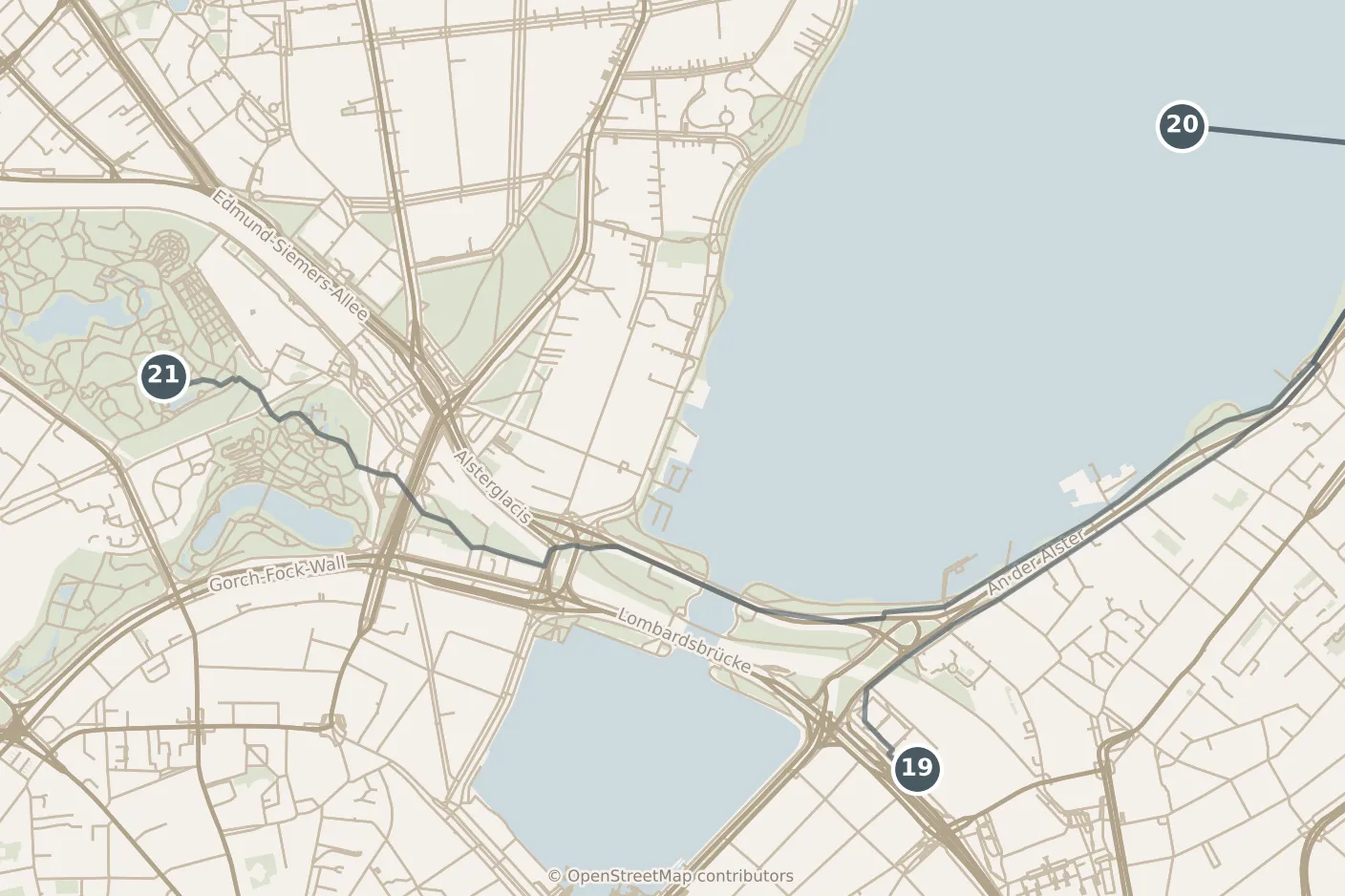
A third day in Hamburg should not be a fourth quarter of the harbor. It should be the lakes and the one great museum both days above deliberately walk past, and it goes in between them rather than after: it becomes the new day two, and the harbor day slides to day three, evening and all. The rest of this article still calls them day one and day two as printed, whichever order you walk them in. Three reasons, and the first is not aesthetic. It is the only day of the three with a weekly closure in it, so it needs to be the day you can move; putting it in the middle gives it a neighbor on each side to trade with. It is also the day with two hours of roof in it, which makes it the one to slide onto the worst forecast of your three — though be clear what that buys: the museum survives rain and the lake circuit does not, so the wet version of this day is the pictures and a shortened walk. And two consecutive days on the waterfront is the arrangement that makes the second one feel like the first.
Start at the Hamburger Kunsthalle, six minutes from the Hauptbahnhof and the largest thing either other day gives up. It is three linked buildings and four collections, and the mistake is to try all of them. The two that justify the ticket are the medieval altarpieces — Master Bertram’s Grabow Altarpiece of 1383, painted for a Hamburg high altar and named after the town it was later exiled to — and the nineteenth-century rooms, which hold Caspar David Friedrich’s Wanderer above the Sea of Fog and The Sea of Ice. Two hours does those two properly. The Galerie der Gegenwart, the 1997 cube at the far end, is a separate building and a separate appetite; go in only if contemporary art is why you came. The museum closed on Mondays in 2026, which is the single fact that decides where this day lands in your three; and it stayed open until nine on Thursdays, which is the one day of the week you can invert the order below and walk the lake first.
Then walk north to the water. The Binnenalster is the small formal basin behind Jungfernstieg, and it is not the point; cross the Lombardsbrücke and the Außenalster opens out — a hundred and sixty-four hectares of it, with sailing dinghies and rowing eights on it in any weather that allows them. The path round it is continuous, marked with half-kilometer stones for the runners, and 7.4 kilometers end to end, which is a little under two hours at a walking pace with stops. Do the whole circuit if the day is fine: the western shore runs through the Alsterpark, laid out for a garden show in 1953 and still the best lawn in the city, and the eastern side is where you see how much of Hamburg’s money lives with a boat at the end of the garden. If you would rather not, walk the western half to the top of the lake and come back down the middle through the streets — but the honest advice is that the circuit is the reason this day exists, and a Franzbrötchen from any bakery before you set off is what it is for.
Finish at Planten un Blomen, fifteen minutes west of the bottom of the lake. It is the old city rampart ground turned into a park, and from May to September there is a free water-and-light show on its lake in the evening — ten o’clock through high summer, an hour earlier in September, as of 2026. That makes it the last thing of the day rather than a stop in the middle of it, with dinner in the gap. Out of that season the park closes the day earlier and more quietly, which after 7.4 kilometers of shoreline is not a loss.
If the museum is not why you came, this is the day that survives losing its first stop. Drop the Kunsthalle and what is left is the whole circuit walked slowly, a long lunch somewhere on it and the park at the end — and, because the weekly closure goes with the museum, a day that can then fall on a Monday, which frees the other two to sit wherever your dates want them.
Practicalities
Book one thing. The timed slot at Miniatur Wunderland, a few days ahead in normal weeks and further in school holidays; it was in the low twenties of euros for an adult in 2026. Settle the Sunday question below before you buy it: the Sunday arrangement is the one that drops that stop. The Elbphilharmonie terrace was free until October 2026 and is a few euros a head after that; reserving a time online costs a booking fee of the same order and skips the line at the pavilion. Everything else on all three days is a street, a pier, a church or a walk-up ticket bought at the door.
The days that are load-bearing, and the ones that are not. Only the third day has a weekly closure that breaks it: the Kunsthalle shuts on Mondays, so that day must miss a Monday, and it is the day to move if your dates are awkward. Day one survives a Monday intact — the model railway opens daily, the churches keep church hours, and the ruin and the warehouses have no hours at all. Day two survives anything, being almost entirely outdoors. So the rule is: put the museum day on any day but Monday, and days one and two in either order around it. The arrival that quietly breaks a three-day trip is a Sunday one, which lands the museum day on the Monday if you take the days in the order written. Put the harbor day on the Sunday instead, day one on the Monday, which it survives, and the museum on the Tuesday: that clears the closure, and it is the one arrangement here that pays for it. The museum day cannot sit in the middle on a Sunday arrival, because the middle day is the Monday, so it goes last and day one and the harbor day fall back to back; there is no order that avoids both. The Fischmarkt, which is the one thing on this route that exists only on a Sunday, finishes at half past nine, so it comes with this only if you were already in the city the night before. And if the Sunday is the day you land, put the bag in the station lockers before you start: the harbor day is the one this route asks you not to carry a case on.
If your days include a Sunday, day two starts at the fish market instead of the Michel. The Fischmarkt has been held on Sunday mornings at the eastern end of Große Elbstraße since 1703, and it finishes at half past nine — five in the morning until then from April to October, seven in the morning until then from November to March, as of 2026. It cannot be fitted into day two as written at any point, so on a Sunday it replaces the morning: go straight there, then the fish auction hall, then walk west exactly as the afternoon above describes, and put the Michel and the tunnel at the front of your other day — the Michel opens before anything on day one does, so they go on the start of it rather than into the middle, and the stop that gives way is the model railway, not the Chilehaus. This is the only version of this itinerary that asks you to get up in the dark, and it is worth it once.
From November to February, day two has to be reversed. Six and a half hours from a ten o’clock opening does not reach a beach before a four o’clock sunset. On a winter Sunday it does not have to be: the Sunday version above starts at the Fischmarkt from seven and has already lost the Michel and the tunnel, so it reaches the shore in the light without being turned round. On any other winter day, instead: take line 62 from bridge three straight out to Neumühlen first thing, walk the shore and then Ottensen and Altona eastward with the light on the water, take the boat or the S-Bahn back into town, and give the Michel the late afternoon — the tower is the one stop on that day that is arguably better after dark, because what you are looking at from it is a lit harbor. The tunnel is free and has no hours, so it moves to whichever end you like.
If it rains hard on day two, the walk west is the part to abandon, and the substitute has to be picked while you are standing at the pontoon. Stay on the 62 past the Fischmarkt all the way to Finkenwerder and back — an hour on the river, indoors on the lower deck, and the same working port at the same fare — then take the S1 or S3 from Landungsbrücken three stops to the Hauptbahnhof and spend the afternoon in the Kunsthalle. That displaces the whole western half of day two, so if you only have two days you are trading Altona and the beach for the pictures. Not on a Monday, when the museum is shut: then the swap is to run day one instead — the churches, the crypt under the ruin and the model railway — which only works if you can still get a slot for that afternoon. That makes it a decision for the night before rather than one to take standing at the pontoon in the rain. Both of those substitutes belong to the two-day reader. On three days the forecast is handled before you start, by putting the museum day on the worst of the three — and in the order printed above the harbor day comes last, with the museum and day one behind it, so by then there is nothing left to swap it for. If your dates put the harbor day first instead, as the Sunday arrival does, the museum day is still ahead of you and swapping the two is the move.
Getting between the stops. Everything inside each day is on foot except the two ferry legs, which are ordinary network services and included in a day pass along with the U-Bahn and S-Bahn; the parent city guide covers how the HVV network and its tickets work. The longest single walk on either day is the twenty-five minutes from the Poggenmühlenbrücke back west to the Elbphilharmonie on day one, and the longest on day two is the half hour down from Ottensen to the water. Neither is hilly.
The bag. There is no staffed left-luggage office at the Hauptbahnhof, only the railway’s own lockers, in two rooms on the Nordsteg above the tracks and more in the Wandelhalle by the Kirchenallee exit. That matters mainly on your first morning, because day one ends about three kilometers from the station and does not pass it again: if you cannot check in before you set out, either use the lockers and collect the bag on your way to bed, or leave it wherever you are staying and start there. Do not carry a case on day two — the tunnel elevators, the ferry gangways and the shingle at Övelgönne are each a good enough reason on their own.


-L1000197.jpg)


