Hamburg in one day: the old town, the warehouse city, and the harbor by ferry

Last updated 27 July 2026
Overview
Hamburg does not reward the usual one-day method, which is to find the old town and walk round it. There is not much old town left to find: the great fire of 1842 took a third of it, and the bombing of 1943 took most of what the fire had spared. What the city has instead is a working port that begins in the middle of it, so the honest shape for a single day here is not a loop but a line — from the station, down through the center to the water, and then west along the water until the light goes.
That line runs eight or nine kilometers, nearly all of it flat, with one ferry near the end which is the best twenty minutes of the day and is an ordinary scheduled service rather than an excursion. Nothing below doubles back except the twenty-minute detour to the lake and the forty-minute walk under the river and back, both signposted as such.
What a single day costs you is the museums, the lakes and the Michel. The Kunsthalle sits at the top of this route and the harbor museums sit at the bottom of it, and the day walks past all of them; it also gives up the Alster almost entirely, keeping only the small basin in the center and leaving the large one, with its sailing boats and its shore circuit, as the thing to come back for. And it gives up St. Michaelis, the tower most people picture when they picture this city — twenty minutes off the line, and it would cost you the other tower, which is the one this day is built around. Every one of those swaps buys an hour indoors and pays for it with the end of the day, which here means arriving at the harbor after dark. On this route that is the one thing you cannot afford, because the last two hours are the point of it.
Two things to know before you start. This day is outdoors from beginning to end, with three ticketed stops and two of them in the morning, so a genuinely bad forecast is a reason to reshuffle rather than to push through. And the walking is front-loaded on purpose: by mid-afternoon you are at the piers, and everything the route itself does after that happens on the water.
Work backwards from the boat. From the station to the ferry is about six hours at the pace below, and the crossing is another twenty minutes, so start early enough that the last two hours still have light in them. And this is a warm-months ending: between November and February the light is gone by mid-afternoon and most of the kiosks along the shore are shut or open on weekends only, so out of season either start at first light or finish the day at the harbor instead.
The day

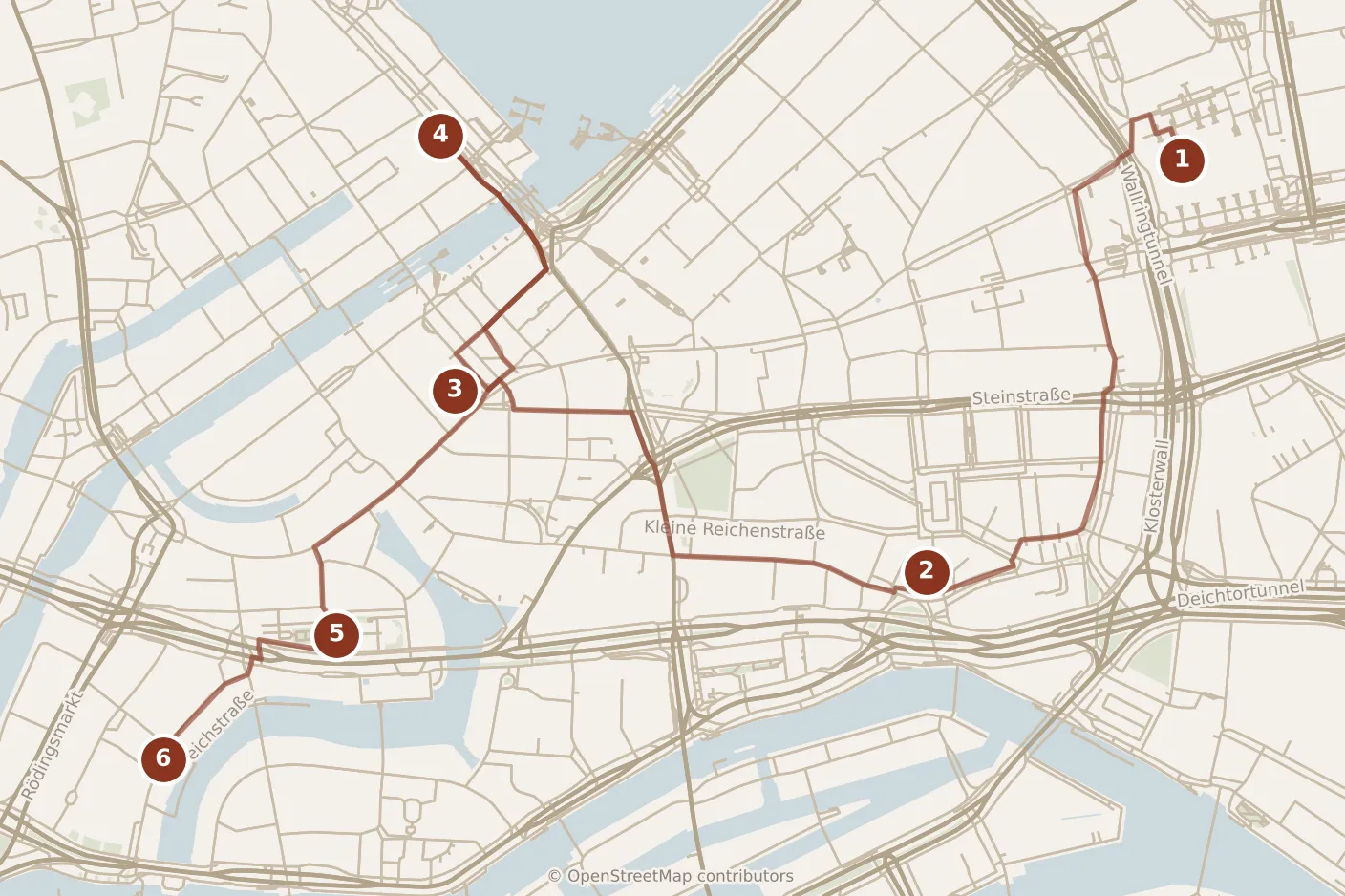
- Morning
- 1Hamburg Hauptbahnhof
- 2Chilehaus
- 3Hamburg Rathaus
- 4Jungfernstieg
- 5St. Nikolai
- 6Deichstraße
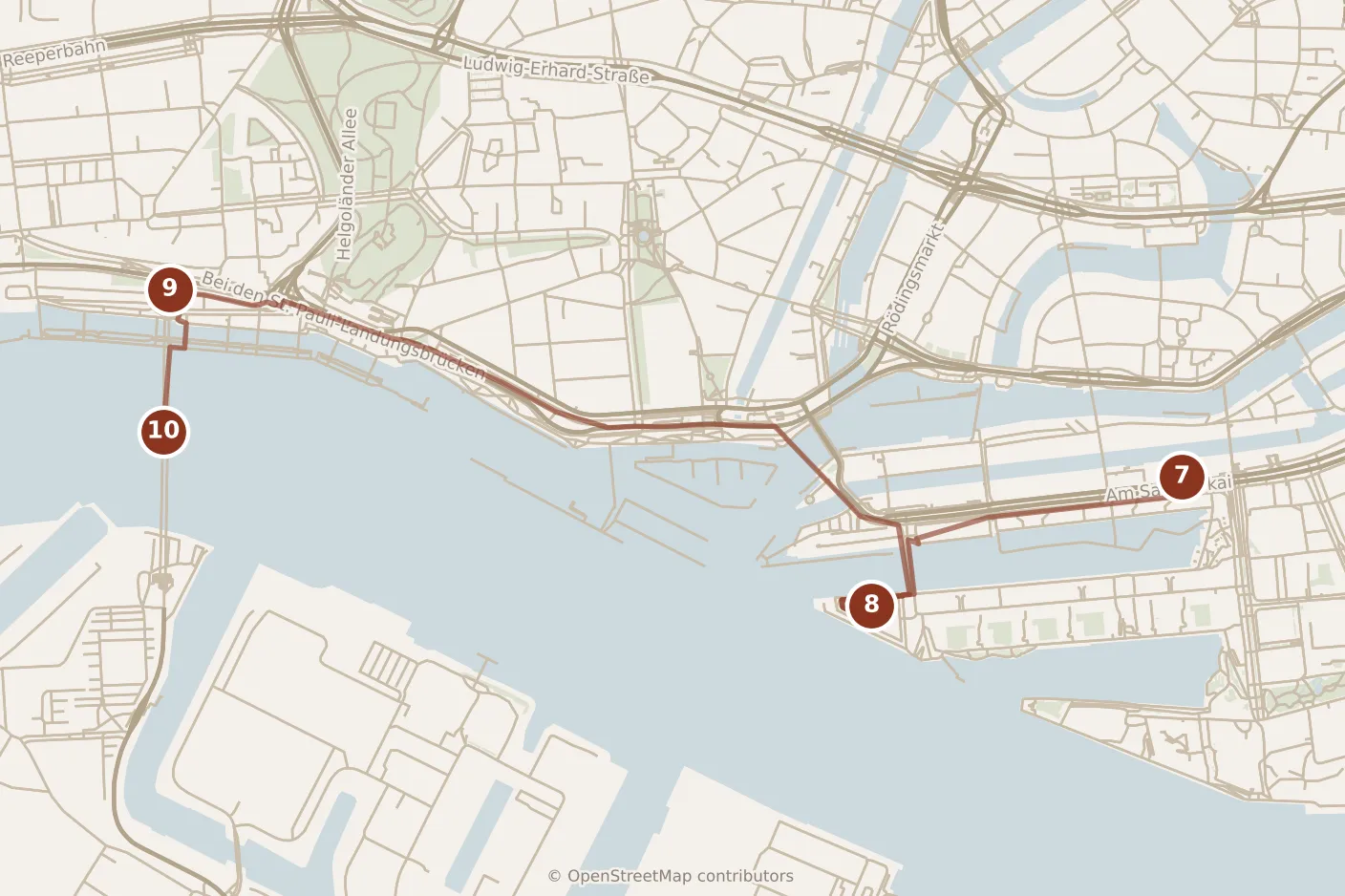
- Afternoon
- 7Speicherstadt
- 8Elbphilharmonie
- 9Landungsbrücken
- 10Old Elbe Tunnel
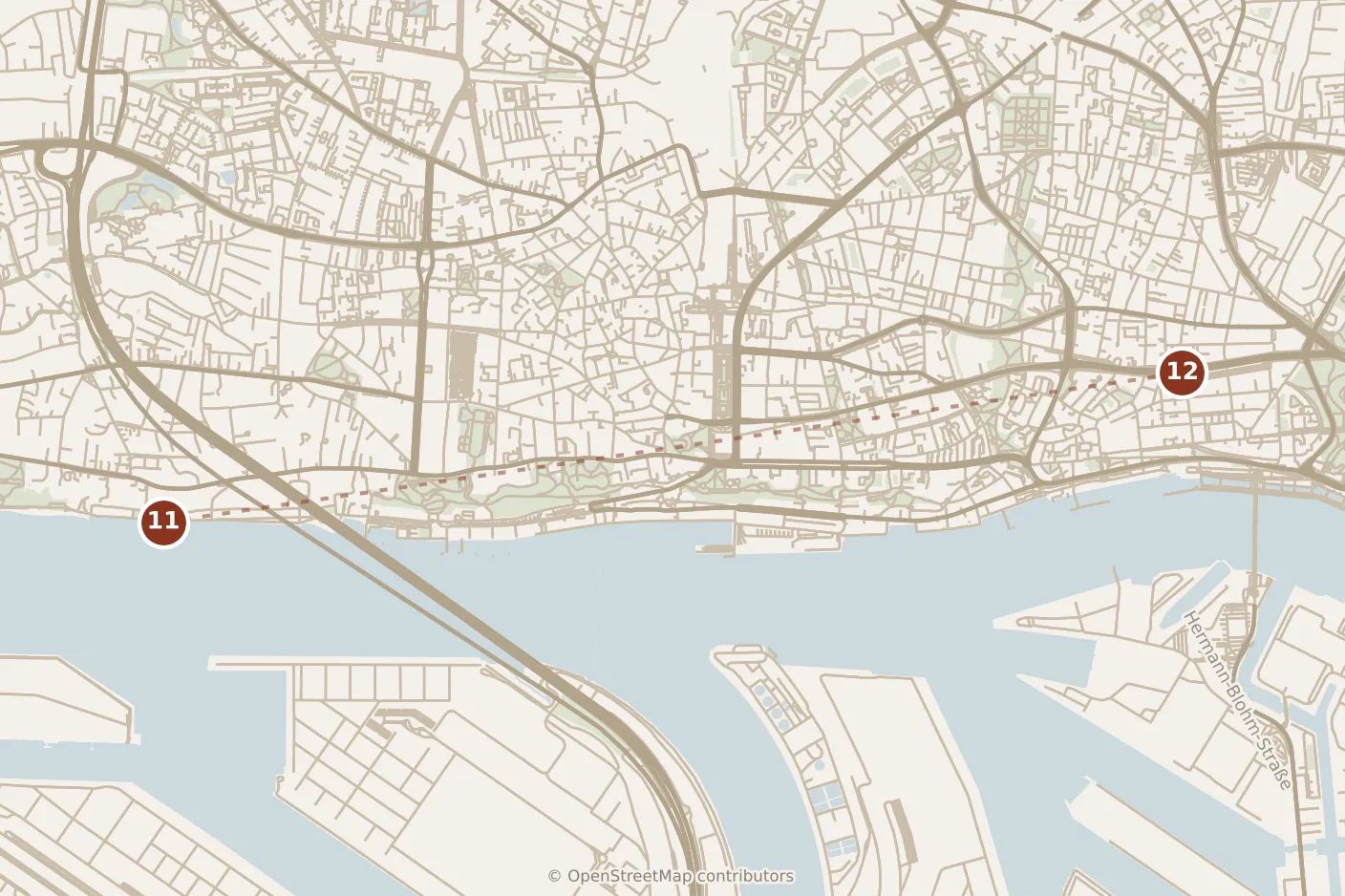
- Evening
- 11Övelgönne
- 12Reeperbahn
Morning
Start at the Hauptbahnhof, which is worth two minutes before you leave it. It opened in 1906, and its iron and glass roof crosses every platform in a single span of seventy-three meters with nothing holding it up in the middle — the largest unsupported station hall in Germany, and best seen from one of the bridges over the tracks rather than from the platforms themselves. Buy a Franzbrötchen on the way out; the bakeries here sell them and you have a walk ahead.
Ten minutes south-west, in the Kontorhausviertel, the Chilehaus is the first proper stop. It is a ten-story office block of dark brick, built between 1922 and 1924 by Fritz Höger for a merchant whose fortune came out of the nitrate trade, and its eastern corner is drawn as a ship’s prow: two long facades converging to an edge you can stand under and sight along, with the stories stepping back above you like decks. Walk to the point, look up, then walk the length of one side to watch the wall curve. It shares a UNESCO listing with the warehouse district you will reach this afternoon, and the two of them make more sense seen on the same day than either does alone. Fifteen minutes.
Ten minutes west brings you to the Rathaus. It was finished in 1897, fifty-five years after the fire had destroyed its predecessor, and it was built to say something: 647 rooms and a larger footprint than Buckingham Palace, on a foundation of more than four thousand oak piles driven into the marsh. The state rooms inside can be seen only on a guided tour, which is short and ticketed and runs through the day in German, and several times a day in English, from a desk inside the main hall; it is also canceled without notice when the building is holding a state occasion, which is why this is a decision to make at the door. Take it if the timing lands as you arrive and let it go if it does not — the courtyard and the front are most of this building, and they are free.
Five minutes north the city opens onto water at Jungfernstieg, and this is the detour worth making. The basin in front of you is the small one, the Binnenalster, squared off and framed by banks and department stores; the far bigger lake behind it is the one this day is giving up. Five minutes at the railing is enough to understand why people here talk about the water before they talk about the port. Come back along the white arcade on the little canal beside the town hall.
Then ten minutes south-west to St. Nikolai, the arcade included, which is the reason this morning is arranged as it is. The neo-Gothic church that stood here was completed in 1874 to a design by George Gilbert Scott, and its spire of a hundred and forty-seven meters was briefly the tallest building in the world. In the firestorm raids of July 1943 — Operation Gomorrah — the tower was used as an aiming point by the crews above, and it is the tower that survived while the church below it burned. The ruin was never rebuilt. A glass elevator installed in 2005 runs up inside the surviving spire to a platform at seventy-six meters, where photographs taken from that same height in 1943 are hung against the view they used to be; there is a museum in the crypt underneath. Give it forty-five minutes, and give the platform more of that than the crypt if you are choosing.
Local tip. The town hall tour and the elevator up the ruined spire are the morning’s two tickets and they take about the same slice of it. If you only want one, take the spire: the town hall’s outside is most of the town hall, while the spire’s inside is the whole of the spire.
Four minutes further, Deichstraße is a single surviving row of merchants’ houses along a canal, narrow gabled brick fronts with the warehouse floors above the living ones, and it is where the fire of 1842 started before the wind carried it away from this end of the street. It takes ten minutes and it is the only place on this route where you can see what the whole city looked like before everything else in this paragraph happened.
Afternoon
Cross the bridge at the end of the street and you are in the Speicherstadt, which is the largest warehouse complex in the world and reads as a small city of its own: red brick with stepped gables and iron hoists still bolted to the fronts, built from 1883 on oak piles into the river so that the free port could store goods untaxed. Walk it along the canals rather than through the middle of it — the whole effect is the reflection, and the water rises and falls a couple of meters with the tide, so the same stretch is a different picture in the afternoon than it was at breakfast. The view everyone stops for is from the bridge where two canals meet around a small turreted brick building marooned on its own island; you will know it when you are standing on it. Forty minutes of wandering is right.
One block of these warehouses holds Miniatur Wunderland, the largest model railway in the world and the most visited attraction in the city. Decide about it before you travel rather than on the day. It sells timed tickets, it is the one stop here where arriving without one can mean a long wait, and it is a solid two hours indoors — which on this itinerary is the harbor, the tunnel and the ferry. It is a genuinely good thing that does not fit in a single day, and pretending otherwise is how people end up doing half of both.
Ten minutes west along the quay stands the Elbphilharmonie, a concert hall of folded glass set on top of a 1960s brick warehouse and opened in 2017. You do not need a concert: the plaza where the glass meets the brick is a public terrace at thirty-seven meters, and it runs right round the building so you can walk from the city side to the river side and watch the port arrive. Getting up is half of it — one curved escalator of eighty-two meters that bends away so you never see the top from the bottom. A ticket is needed; they are handed out at the pavilion on the forecourt while they last, and a timed one can be booked in advance on the concert hall’s own site, for a small fee, if you would rather not wait in line. Forty-five minutes.
Fifteen minutes further west along the water, the Landungsbrücken is the long floating pontoon where the harbor becomes public: ferries on one side, the city behind, and lunch, which is late by now and should be a Fischbrötchen eaten standing up at the pier.
Then go underneath the river. The old Elbe tunnel, opened in 1911, runs 426 meters from a domed hall behind the pontoon to the far bank, twenty-four meters down: two tiled tubes, the walls set with ceramic reliefs of the things the river carries, and elevators at either end large enough to lower a car. Both tubes are open, and you go down and up in an elevator — free, at any hour. Walk through, come up on the Steinwerder side, and turn round — the reason to do this is the view back, which is the entire city front seen across open water from a working shipyard bank, free and usually almost empty. There is nothing to walk to along the bank; the musical theaters a few hundred meters east have their own ferry and are an evening, not a detour. Come back the way you came; the round trip is about forty minutes.
Evening
From the pontoon, take the ferry west. It is line 62, a scheduled service rather than a tour; it leaves from bridge three at the pier and you want the third stop, fifteen to twenty minutes out, signed as Neumühlen and Övelgönne. The boat back berths at bridge one. Sit outside at the back. The route runs past the container terminals, the dry docks and whatever is being repaired that week, and it is the closest a person gets to the working port without a hard hat.
Övelgönne is where the day should end, and it is two things ten minutes apart. The museum harbor is at the pontoon where the boat puts you down: working boats — steam tugs, lightships, sailing barges, most of them built between the 1880s and the 1960s — moored where you can walk along them. Then walk west along the shore, and ten minutes brings you to the sand, the kiosks and the row of small pilots’ and captains’ cottages along the path behind the beach. Container ships pass close enough to read the names off their sides, which sounds like an exaggeration until one does it. Take a drink to the water and sit down. In midsummer the northern light holds here until very late, and this is the hour the whole route was arranged to reach. Give the two of them ninety minutes together.
Then take the ferry back and, if this is your kind of evening, walk up from the pier to the Reeperbahn — ten minutes uphill. It is a straight, bright, loud street of about nine hundred meters, and it is honest about what it is: theaters and music venues and cheap food along the same sidewalk as the sex trade, all of it lit like a fairground. Off it runs Große Freiheit, the side street that held most of the clubs the Beatles worked in between 1960 and 1962 — something over two hundred nights in this city, before anyone outside it had heard of them — and which is now mostly nightclubs and neon. Walk it once end to end. For dinner, the better ground is Sternschanze — twenty minutes uphill on foot, or one stop on the train from the Reeperbahn — which keeps the same hours with none of the lights and is where the eating actually is; the trains home run from both.
Practicalities
Two things on this route are worth arranging in advance. One is Miniatur Wunderland, which this itinerary advises against anyway. The other is the plaza at the concert hall, which is ticketed, and reserving a time there in advance is the difference between walking in and standing in line on a wet Saturday. Everything else here is a street, a pier or a walk-up.
All of it — the ferry, the elevated line if the weather turns, the bus into Altona and the train home — runs on one city ticket, and a day pass is worth it over singles.
This day survives a Monday, which is worth knowing if your one day falls on one: the two stops it is built around are a ruin and a warehouse district, and the museums that close on Mondays are the ones the route already gives up. Sunday is the day that changes things, because the Fischmarkt happens at the western end of the harbor front and is finished by mid-morning — it will not fit inside this route at any point, so it is either the thing you get up before dawn for, ahead of everything below, or it is not part of this day at all.
The only leg here that is not walking is the ferry, and it is the one thing to check a schedule for: the line runs to a seasonal schedule, with a summer schedule and a winter one, so look up the last few crossings back before you settle on the beach rather than after — the beach is a long way west of anywhere you are sleeping. If you would rather not come back by water, buses run from the same waterfront into Altona and the S-Bahn takes you on from there.
If the weather turns, the U3 shadows the second half of this route almost exactly: it comes up out of the ground near the warehouse district and runs on an elevated viaduct above the water past the concert hall and the piers and on towards the Reeperbahn, which makes it both the wet-weather substitute for that stretch and, in its own right, one of the better views in the city for the price of an ordinary fare. Walking, the longest single stretch on the way to the ferry is the fifteen minutes from the concert hall along the quay to the piers, and the whole day comes to eight or nine kilometers including the tunnel and the walk along the shore.


.jpg)
