Guangzhou in one day: the arcade streets of the old west, and the river at dusk

Last updated 4 August 2026
Overview
Guangzhou is two cities seven kilometers apart on the same bank of the same river, and one day here is the business of walking one of them and watching the other get dark. The old west is Xiguan, the quarter that grew up outside the vanished western gates: arcaded shopping streets, a market of dried medicine, an ancestral hall roofed in ceramic figures, and a concession island of banyans and stone banks. The new city is Zhujiang New Town, which was farmland within living memory and now holds the tower you will spend the evening looking at. The metro joins them in half an hour. This route travels in one direction only, west to east and morning to night, and the only ground covered twice is the way back to a metro station at the end of the afternoon and at the end of the night.
What a single day costs you is the middle. Yuexiu Park with its Ming watchtower, the tomb of the second king of Nanyue and its jade burial suit, and the old Buddhist foundations of Guangxiao and the Temple of the Six Banyan Trees all sit in the two kilometers between the morning and the evening, and each of them is a metro ride and an hour. Take one and you either arrive at the river in the dark or you cut the arcades, which are the reason to be in the west at all. Give them up cleanly. Naming a fourth temple is easy and useless.
The moment the day is built around is the river at dusk, from the island in the middle of it, with the towers of the new city behind you and the Canton Tower across the water in front. You want to be standing there about half an hour before the sun goes. Everything above it comes to roughly seven and a half hours, so take your own month’s sunset, subtract eight hours, and that is the latest you can begin. The sun sets here between about twenty to six in the last week of November and a little after a quarter past seven at midsummer — an hour and a half of swing across the whole year, which is far less than a European city gives you and is why this day works in any month. In the short half of the year that sum puts the start at about twenty to ten in the morning. At midsummer it says a quarter past eleven, and you should ignore it, for reasons at the end of this article that have nothing to do with the light.
Seven and a half hours is time spent inside the places and walking between them, and it is not the length of your day. It leaves out the bag scanner at the entrance to every metro station, which is universal here and costs a couple of minutes each time; it leaves out the wait for a table at half past twelve, which is the longest you will stand still on this route; and it takes no account of the heat, which for much of the year is the single thing most likely to slow the morning down.
One door’s hour shapes this day, and only one. There are exactly two interiors on the route — the ancestral hall at the start and the cathedral in the middle of the afternoon — and the cathedral’s published hours shut it between half past eleven and half past two on a weekday, and end it half an hour earlier on weekends. From a nine o’clock start the count above puts you at its door at about the moment it reopens, which is closer than it sounds: if the morning has run fast, spend the difference on Shamian rather than stand outside a locked door. Nothing else on the route has a closing time to build backwards from. What the day is built around is the light; what constrains it besides is the heat, and the fact that a market is a morning business.
You are also, on a one-day visit, carrying a bag. Luggage storage is at the main railway stations, and the shape that matters is that this route does not come back for it: it starts at Chen Clan Academy in the west and ends seven kilometers east at Zhujiang New Town. That is a convenience rather than a problem, because the eastern end is the better connected of the two — Line 5 runs west from Zhujiang New Town to Guangzhou Railway Station with no change, and Line 3 runs north from it towards Guangzhou East Railway Station and the airport. Leave the case at whichever station you arrived into and collect it on the way out. That works if you came in by rail to one of those two; it does not if you flew, and it does not if you came through Guangzhou South, because the one is not a station you pass and the other is the better part of an hour and a change back after dark. Get the bag off your hands before you start either way, because nothing on this route will take it. Do not attempt the morning holding one: it is three and a half kilometers on foot, most of it on crowded sidewalk, and there is nowhere between the two ends of this route to put a case down.
The day

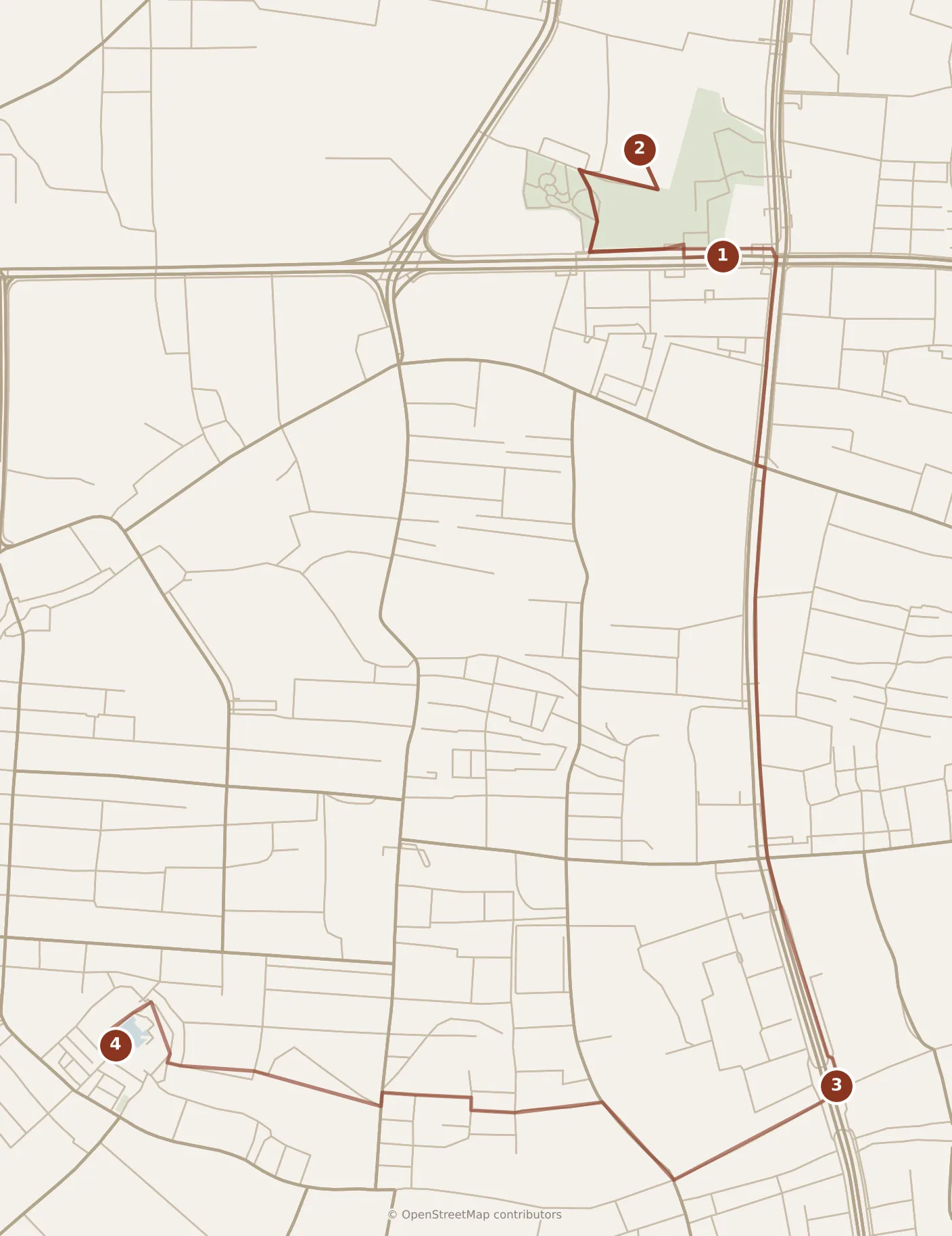
- Morning
- 1Chen Clan Academy station
- 2Chen Clan Ancestral Hall
- 3Shangxiajiu Pedestrian Street
- 4Yongqingfang
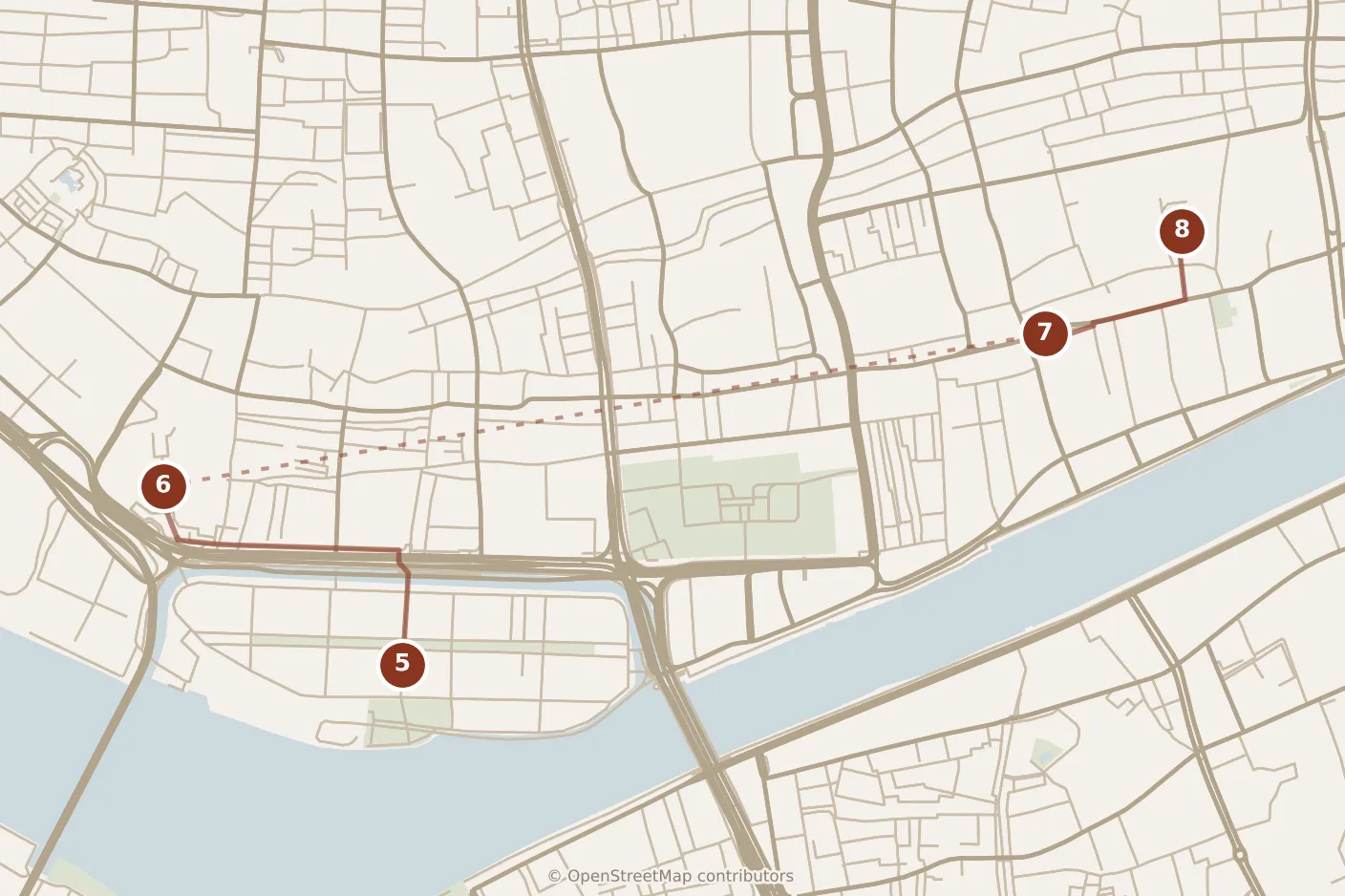
- Afternoon
- Qingping Market — in the prose, not on the map
- 5Shamian Island
- 6Huangsha station
- 7Yide Lu station
- 8Sacred Heart Cathedral
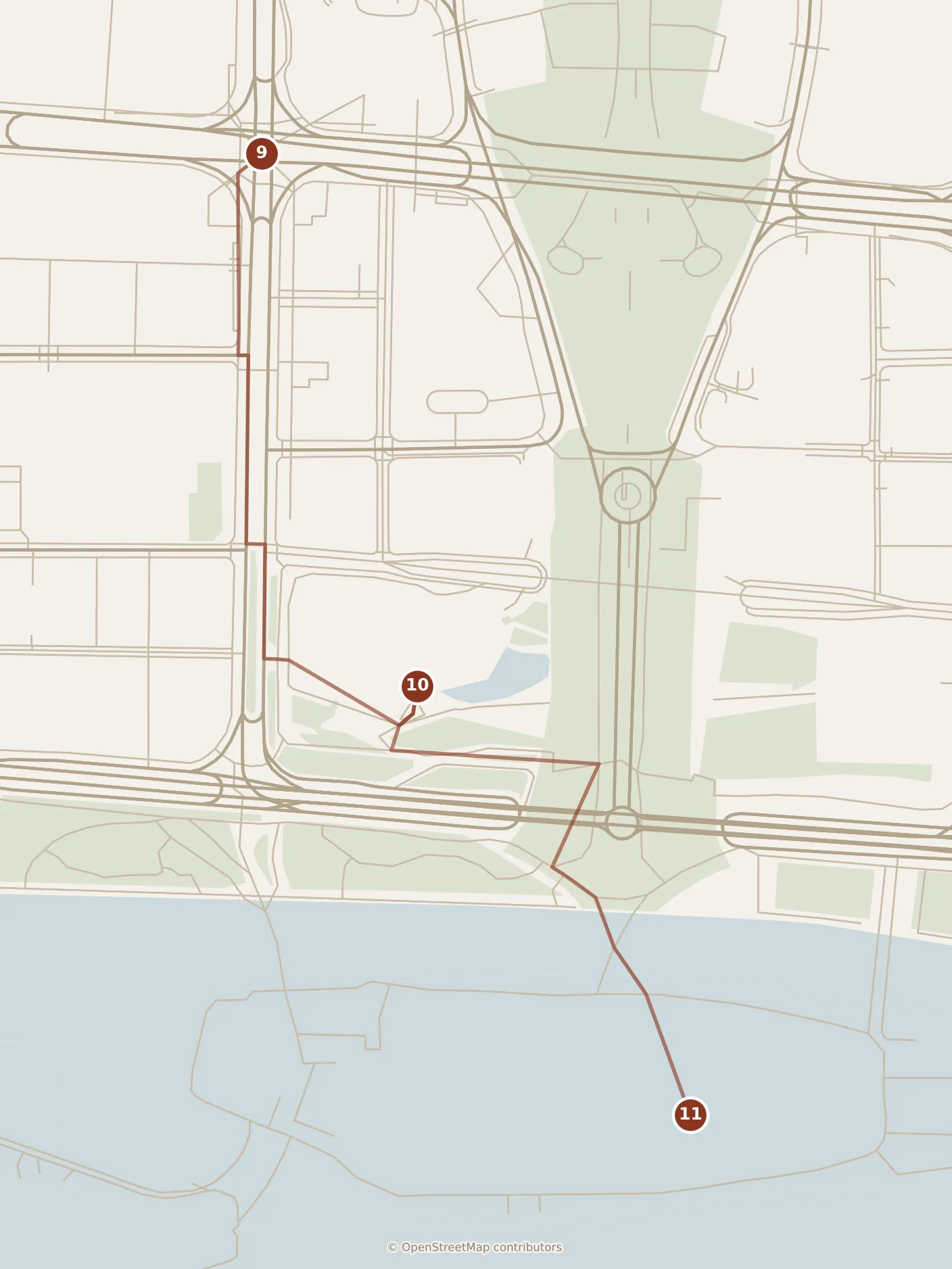
- Evening
- 9Zhujiang New Town station
- 10Guangzhou Opera House
- 11Haixinsha Island
Morning
Getting to the start is the one leg of this day that is not on the route. From Guangzhou South, the high-speed station, it is Line 2 north to Gongyuanqian, twelve stops, and a change there to Line 1 westbound for two more: the better part of an hour, and the arrival to leave the earliest for. From Guangzhou Railway Station it is the same change and much shorter, three stops south on Line 2 and two west on Line 1, call it twenty minutes. From the airport it is Line 3 to Tiyu Xilu and Line 1 west from there, one change and over an hour.
Come up at Chen Clan Academy, on Lines 1 and 8, named after the thing you have come to see; the hall is four minutes from the exit on Zhongshan Seventh Road.
The Chen Clan Ancestral Hall was finished in 1894, paid for by seventy-two branches of the Chen surname across Guangdong and by emigrants who had left it, and it was not built as a temple. It was an academy and a hostel — somewhere for the clan’s young men to lodge and study while they sat the imperial examinations, put up in the last decade before those examinations were abolished altogether. It covers thirteen thousand square meters: nineteen buildings, nine halls and six courtyards, laid out symmetrically along one north-to-south line.
The instruction here is to look up. Eleven ceramic ridges run along the roofs, and they are not ornament in the European sense but populated scenes. The one over the main hall is twenty-seven meters long and nearly three meters high and carries two hundred and twenty-four figures, acting out episode after episode of Cantonese opera on a roof nobody standing in the courtyard below can read without stepping back to the far wall. Then come down and look at the sixteen carved wooden screen doors behind that hall, cut through on both faces so the scenes work from either side. Give the whole building an hour and a quarter, and skip the modern craft displays in the side halls: the hall is the collection.
Then go south into Xiguan. It is twenty-five minutes on foot through ordinary streets, or one stop on Line 1 from Chen Clan Academy to Changshou Lu, which surfaces at the head of Shangxiajiu Pedestrian Street. Walk it if the weather allows and take the metro if it does not; this is the longest uninterrupted stretch of the day and the one worth trading away.
Shangxiajiu was pedestrianized in 1995 and is now a street of chain shops and dense crowds, which is not what you are there for. You are there for the qilou — the arcade house, literally the riding building, whose upper stories are carried on columns out over the sidewalk so that the ground floor becomes a covered colonnade. The form entered Canton’s building regulations in 1912 and most of what stands here went up in the 1930s. Walk west. Over about a kilometer the street changes its name twice, to Dishifu Road and then Enning Road, and gets steadily quieter, older and less renovated as it goes, which is the entire argument for walking it in that direction rather than the other. Forty minutes, twenty of them moving.
Local tip. The arcade is a roof over the sidewalk, and that is the practical thing about it rather than the pretty one: the kilometer from Shangxiajiu to Yongqingfang can be walked in heavy rain without an umbrella, and no other stretch of this day can. If the sky opens, this is the part of the route to be in, and Shamian is the part to drop rather than postpone: it is forty-five minutes of walking in the open with nothing to go inside. Eat at the market end as written, then go straight to Huangsha without crossing the bridge, and the arcades and the cathedral get the three quarters of an hour.
Yongqingfang is the far end of that walk: a block of Enning Road restored rather than rebuilt, with the lanes behind it opened up and the shopfronts under the arcade let to small businesses. Half an hour. The honest thing to say is that it has been tidied, and that the interest is in the roofline, the width of the lanes and the doorways rather than in anything sold underneath. It is still the one place on this route where you can see what the whole quarter looked like before the 1990s took it apart.
Afternoon
Twenty minutes south-east brings you to Qingping Market, which is a market in traditional Chinese medicine and looks like nothing else on this itinerary: sacks and jars of dried tangerine peel, ginseng, bark, fungus, seahorses and a great many things you will not identify, weighed out to people who have come to brew them or to cook with them. Fifteen minutes is plenty and the fifteen are well spent. Look rather than buy: some of what is on these counters, the seahorses among it, is controlled under international trade rules and cannot be carried across a border without a permit. It is also a daytime trade that thins as the afternoon goes on, so it is the one stop on the route that punishes a late start.
Lunch goes here, on the north bank by the market and before you cross to Shamian, and in this city it means yum cha — the long mid-day meal of tea and small dishes that Guangzhou invented and that the rest of the world took away under the name dim sum. Sit down for it and give it an hour. Look for har gow, the prawn dumpling under a skin you can see through; siu mai; cheung fun, rice sheets rolled round prawn or beef and dressed with soy; and char siu if there is a roasting counter.
Then cross onto Shamian Island, which is a sandbank the British and the French cut off from the city in 1859 by digging a canal along its northern side — the reason it is an island at all. They divided it between them and held it until 1943. It is nine hundred meters long and three hundred wide, there are no buses on it, and it is planted end to end with banyans and figs, so it is noticeably cooler than the street you have come from. Walk the long axis out and the waterfront back: trading houses and consulates in stone, two churches, one of 1865 and one finished in 1892, and a great deal of shade. Forty-five minutes. This is the stop where the day slows down, and it is placed after lunch deliberately.
From the island’s north-east corner it is twelve minutes to Huangsha, on Lines 1 and 6. Take Line 6 east two stops to Yide Lu; the cathedral is five minutes from the exit and you will see the towers before you find the street they stand on.
Sacred Heart Cathedral is built entirely of granite — walls, piers and both towers — quarried in Kowloon, shipped up the estuary under sail, and cut and set by hand between 1863 and 1888. The twin spires stand just under fifty-three meters. It is Gothic Revival, designed by French architects, and it occupies the ground where the Qing viceroy had his residence until the Second Opium War destroyed it, which is a great deal of what this building is about. Half an hour inside. It is a working parish church rather than a monument, and its published hours shut it between half past eleven and half past two on a weekday; see the end of this article for what to do if you find it closed anyway.
Evening
Walk the five minutes back to Yide Lu and stay on Line 6 heading east to Ouzhuang, then change there to Line 5 and take it four stops to Zhujiang New Town. About half an hour and one change. It puts you at the north end of Huacheng Square.
Huacheng Square is fifty-six hectares of paved axis, water and planting running south from the station to the river, and it is the exact opposite of everything you have walked through since breakfast: no arcade, no shade, no street. The Guangdong Museum and the city library stand along it, and the whole composition is aimed at the water.
The Guangzhou Opera House is the one to walk round, and only round. Zaha Hadid won the competition for it in 2002 with a scheme she called the double pebble — two boulders left by the river — and it opened in May 2010. What it is up close is a free-standing concrete auditorium of eighteen hundred seats inside a steel frame clad in granite and glass, with almost no right angles at ground level and hardly two panels the same. Twenty minutes outside it is well spent; going inside means a performance and a whole evening.
Ten minutes further south the footbridges take you onto Haixinsha, the island in the middle of the river. It was built up to hold the opening ceremony of the 2010 Asian Games, kept afterwards as a park with a gate and a ticket, and made free in September 2012. It is where this day ends, and the reason is half a kilometer due south across the water: the Canton Tower, six hundred meters of twisted steel lattice, which lights after dark along with the towers behind you. Give it an hour, and spend part of that hour with your back to it, because the skyline on your own bank is the other half of the view. If the island is closed for an event — it is a venue as well as a park, and has been since the day it was built — the promenade on the near bank gives you the same water and the same tower from fifty meters further back.
Do not go up the tower. The decks are a line, an elevator and a price, and the view from the top of the Canton Tower is the one view of Guangzhou with the Canton Tower missing from it. You are already standing in the better place, and it is free.
When you leave, Zhujiang New Town station is twenty minutes back up the square, on Lines 3 and 5. Line 5 runs west to Guangzhou Railway Station without a change. Line 3 runs north towards Guangzhou East Railway Station and on to the airport, but it splits at Tiyu Xilu, so read the destination on the front of the train rather than trusting the platform. For Guangzhou South, the high-speed station, allow the better part of an hour and a change.
Practicalities
One door on this route charges to enter, and it is the ancestral hall: the ticket was in the ten-yuan range in 2026, which makes it the whole paid content of the day, and nothing here needs booking in advance. Carry your passport for it, though: foreign visitors are asked for it at the ticket window. What does need arranging before you land is a way to pay for anything at all, because most counters, most food and most ticket windows in this city expect a code scanned from a phone. That is a job for before the flight rather than for a line on Zhongshan Seventh Road. The city guide covers the payment apps and how the metro is paid for, and this article assumes you have read it or will.
Two doors can be shut, and they fail differently. The ancestral hall opens by nine on every published account of it and runs to the late afternoon, so a nine or ten o’clock start walks straight in; what it does not do is close one day a week, and the closure to look for instead is the last Monday of the month, when the listings have it shut for maintenance. Check that one date rather than a weekday, because it is the first stop and the best one, and if it lands on your day the answer is to reorder rather than to squeeze: start at Changshou Lu instead of Chen Clan Academy, walk Shangxiajiu from its head, and give the arcades, Yongqingfang and Shamian the hour and a quarter you have just been handed back. The cathedral is the other, and its published hours shut it across the middle of a weekday, with services able to close it besides; if you find it locked you lose half an hour and nothing else, and the right response is to walk back to Yide Lu, take Line 6 east an hour ahead of the plan, and give Huacheng Square and the island the extra time.
Start in the morning whatever the arithmetic in the overview says. That count gives you the latest hour at which you can begin and still reach the water in daylight — at midsummer, a quarter past eleven — and beginning that late would be a mistake for two reasons that have nothing to do with the sun. The first is the market, which thins through the afternoon and is worth catching busy. The second is that the morning half of this day is three and a half kilometers on foot with the sun overhead, in a city whose summer is long and humid; the same walk at nine is a different walk. Nine is right in every month of the year, and in the short half of it the surplus at the end belongs on Shamian and nowhere else.
The walking comes to about eight kilometers in all, a little over two hours of it, and it is spread unevenly: three and a half kilometers before lunch in one long stretch and one covered one, then short pieces all afternoon, then a level twenty minutes down Huacheng Square in the evening. The longest single walk with nothing to stop for is the first, from the ancestral hall down to Shangxiajiu, and it is the one to replace with the single stop on Line 1 to Changshou Lu if the day is hot or you have started late. Every walk between the afternoon’s stops is twelve minutes or less, which is what makes the afternoon the flexible half of this day and the morning the part to keep as written.
If you have seven hours rather than eight and a half, the order in which things go is not the order you would guess. Shamian goes first: it is forty-five minutes with nothing inside it, it is the stop this article otherwise tells you to spend a surplus on, and dropping it costs you only a walk, since from lunch you go straight to Huangsha without crossing the bridge. The cathedral goes second, at half an hour, and it is the door most likely to be shut when you get there in any case. Yongqingfang goes third, at another half hour, because the arcade walk that leads to it has already made its argument by then. What does not go, at any length of day, is the ancestral hall, the walk west from Shangxiajiu, and the last hour on the island: cut into those three and you have not shortened this day, you have replaced it with a different one.


.jpg)
