Granada in two or three days: the whole Alhambra hill, the Realejo under it, and the Albaicín from the inside

Last updated 15 August 2026
Overview
A single day in Granada walks the shape of the place: up the Alhambra hill, down into the center, along the river, up the far slope for the light. It is the right single day, and what it cannot do is go inside much: one monument, two churches and a courtyard, with everything else read off the street. What a second day buys is not more ground — the two days below fit inside a square a kilometer and a half on a side — it buys the inside of things, and specifically the inside of the surviving Nasrid city, which is scattered in small pieces across two hillsides and takes a whole day to collect.
So these two days are arranged the other way round from a single one. Day one gives the Alhambra hill the whole morning it actually wants, adds the two things a compressed visit always loses — the Partal and the monument’s own museum — and then comes off the hill on its southern side into the Realejo, which a one-day route never reaches at all. Day two takes the center in the morning and then spends the entire afternoon going into the Albaicín’s houses rather than walking under them: a bath house, two Nasrid courtyards, a Morisco pair with gardens, and the palace of the last emir’s mother, ending on the terrace everyone comes for. Nothing in either day is ridden. Between the first stop of day one and the last of day two there is no transport at all.
One booking covers both days, and it has a name you can type. It is the Dobla de Oro, sold by the Patronato de la Alhambra y Generalife on its own site rather than by the resellers a search puts above it. It carries the Alhambra with a printed Nasrid Palaces slot and five Albaicín doors, four of which day two goes into — El Bañuelo, the Casa de Zafra, the Casa del Chapiz and the Palacio de Dar al-Horra. The fifth is the Casa Morisca Horno de Oro, a small Nasrid house on the lane dropping from San Juan de los Reyes to the Paseo de los Tristes, twenty minutes and on day two’s own line; it is left out of the afternoon below only because that afternoon is already full against the hours it has to fit inside, but you have paid for it either way. In 2026 the ticket was in the thirty-euro range. The plain Alhambra ticket costs less and opens none of the four. Book weeks ahead in season; the Alhambra’s daily cap is the thing that runs out, not the price, and the rest of this trip is walk-up. A third day, if you take one, adds exactly one booking of its own and nothing else.
That ticket is valid for three days — the day before your Alhambra slot, the day of it, and the day after — and that single line is the only scheduling rule here you cannot bend. It chains day two to day one. Everything else about the calendar is negotiable; this is not.
On the buses, the card is the Credibús: a couple of euros from the driver, then a minimum top-up, and the detail that matters to two people traveling together is that it may be shared on a shared journey, which none of the other passes may. Fares are the most perishable thing on this page, so take the shape and not the figures. A one-way ticket is sold on board, cash or card — and on this itinerary that is what to do: everything on days one and two is walked, what is left is the leg in from the station, perhaps the C30, and the C34 home on the third night, and at that count two people pay the driver rather than buy a card. There is no app to install for any of this — the Alhambra ticket is a code you print or keep on a screen, and every other door on these two days is bought at it. But the code is not all you carry. Alhambra tickets are nominative: each traveler’s name goes on the booking, each carries their own ticket, and each shows at the Nasrid Palaces control the passport or identity card that matches it. One ticket in one name does not admit a party. This is the only rule on the page that ends a trip at the gate rather than costing it a stop. How the fares work beyond that is the city guide’s.
The calendar that governs Granada is not a week, it is Easter. Two things move the whole city and both are pinned to a date that changes every year. Semana Santa is the week ending on Easter Sunday, and its processions cross the center, the Albaicín and Sacromonte for eight days: streets shut for hours at a time, and the routes are published in advance by the city’s own mobility office, which is where to read them rather than guessing. Corpus is the city’s fair, and Corpus Thursday falls sixty days after Easter Sunday — in 2026 that put the fair from the thirtieth of May to the sixth of June, with the Thursday a municipal holiday on which most shops did not open. So the method is: find Easter Sunday for your year, mark the week before it and the week around the sixtieth day after it, and if your dates fall in either, expect the center to be full and the ordinary weekday rules below to be suspended. Two fixed dates matter too. The third of May is the Día de la Cruz, and in Granada it belongs to the Albaicín and the Realejo — which is to say to both of the squares these two days end in, so on that date arrive expecting a festival rather than a dinner. The second of January, the anniversary of the 1492 surrender, is a holiday in this city and in no other; it brings a civic ceremony and a counter-demonstration into the streets round the town hall, which is not where either of these evenings goes.
The light. The sun goes down here no earlier than a few minutes before six — the first days of December, the year’s floor — and no later than twenty to ten, in the third week of June. You need the number because day two ends on a terrace and nothing else on that day tells you how long you will be standing on it. What you do not do here is count backwards from it, and day two explains why: an earlier constraint wins.
On the bag. This is a two-night trip, so a case is a problem on two mornings only, the one you arrive on and the one you leave on. Granada station is on Avenida de Andaluces, twenty-five minutes’ walk north-west of Plaza Nueva and flat the whole way; the Estación de Autobuses is on Avenida Juan Pablo II, three kilometers north, and nothing from it is walkable. Where you sleep matters more than which day you do first: the Albaicín and the upper Realejo are cobbles and steps, and a wheeled case there is a mistake rather than an inconvenience. Whether the train station’s luggage storage has room on the morning you want it is exactly the fact this page cannot check, so plan as though it has not — and then the consequence is specific and it falls on day two. The Albaicín afternoon is the one half-day here with nowhere to set a bag down and no flat ground to drag one over. A reader leaving that evening does the center in the morning as written, takes lunch, and goes back down to Plaza Nueva rather than up: what that costs is the four houses and the terrace, and nothing at all before them. The Alhambra has a published rule of its own — nothing larger than forty centimeters square goes into the visitable spaces, and the cloakrooms at the entrance have a limit on big bags — so an arrival-day Alhambra works only with a small case.
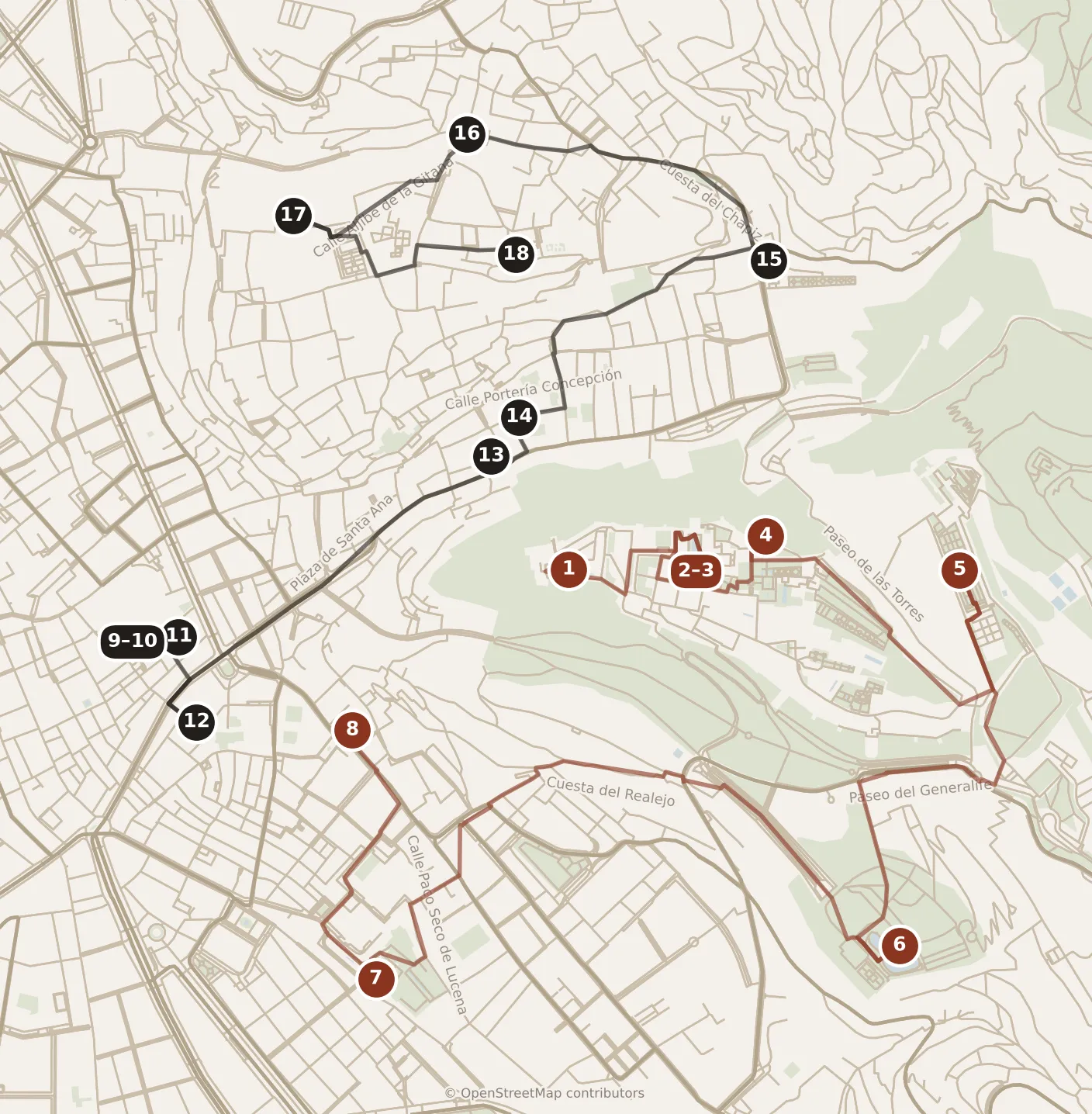
- Day one
- 1Alcazaba
- 2Palacio de Carlos V
- 3Nasrid Palaces
- 4Partal
- 5Generalife
- 6Carmen de los Mártires
- 7Cuarto Real de Santo Domingo
- 8Casa de los Tiros
- Day two
- 9Royal Chapel
- 10Granada Cathedral
- 11Madraza de Granada
- 12Corral del Carbón
- 13El Bañuelo
- 14Casa de Zafra
- 15Casa del Chapiz
- 16Plaza Larga
- 17Palacio de Dar al-Horra
- 18Mirador de San Nicolás
Day one

The hill, all of it, and then down its southern flank into the quarter below. Day one has no moment in it that depends on the light; it has an appointment, and the appointment is the half-hour printed on the ticket for the Nasrid Palaces. It does depend on the heat, and from May to September that is the day’s second constraint — the morning says where it lands. Everything else today moves. Build the morning forward from the gate rather than backward from anything.
Morning
First, the leg nobody describes. From Granada station the center is twenty-five flat minutes on foot along Avenida de la Constitución and Gran Vía, or three or four stops on line 4 from the stop outside the station; from the Estación de Autobuses, lines 5, 21 and 33 leave the square in front of the pedestrian entrance and reach Gran Vía in about a quarter of an hour, and all three meet line 4 in the center if you need to change. The Metropolitano tram has a stop beside the train station and another at the bus station and it is no help to you at all: its nearest stop to the old town is Recogidas, still twenty minutes’ walk from Plaza Nueva. From Plaza Nueva the walk up the Cuesta de Gomérez to the Puerta de la Justicia is ten minutes by the arithmetic and fifteen in the legs, uphill on cobbles under trees. The C30 is the minibus that saves the climb, from Plaza Isabel la Católica. It serves more than one point on the hill, so check which of its stops matches the gate printed on your ticket before you board, and check that it runs early enough for the departure below — the operator’s route pages are not readable from here, and neither question is one this page can settle for you.
In 2026 the monument opened at half past eight all year, and shut at six from the middle of October to the end of March and at eight for the rest of the year. The opening is what this day counts forward from. The closing only bites if the latest slot you could get is an afternoon one, and then the fix is to take the Generalife and the Partal before your slot rather than after it, accept six minutes of doubling back at the end, and be sure the gardens are behind you — they are the one thing up here you cannot do quickly and the one the gates take away first. If either hour has moved, do the same two sums against the new ones. Ask for a Nasrid Palaces slot about two hours after opening. That is not the same advice a one-day visit needs. It is what lets this route run in one direction, west to east, with the palaces in the middle of the line instead of at the start of it: three-quarters of an hour in the fortress, three-quarters in the museum, five minutes of walking, and twenty in hand.
That count starts at the gate, so everything before the gate has to happen before the monument opens — and that is the one clock time this day needs. The ticket offices open an hour ahead of the monument, so the rule survives any change to the hours: leave Plaza Nueva fifty minutes before opening, which in 2026 meant twenty to eight against a half-past-eight opening, climb, clear the ticket check, and start the Alcazaba as the gates go. There is no version in which the entry happens after opening instead: the whole of it lands you at the palace door a quarter of an hour after your half-hour has closed, and that is the one thing on this hill that cannot be recovered.
Read your ticket before you leave, though, because the hill has more than one way in and the main pavilion is at the far eastern end. If that is where you are sent, run the morning backwards — Generalife, then round to the palace entrance, then out through the Partal, then west past the Palacio de Carlos V and its museum, which stand on that walk, and on the last four hundred meters to the Alcazaba, six minutes — and leave by the Puerta de la Justicia. What that version costs is the Torre de la Vela at the end of four hours of walking instead of the start of them, which is the price of entering from the east. Either way the hill puts you out within a quarter of an hour of the afternoon’s first stop.
Start at the Alcazaba, three minutes inside the gate. It is the fortress at the western point of the ridge and the oldest part of the hill — begun in the thirteenth century, a hundred years before the palaces you will be inside at midday — and what survives is the ground plan of a garrison town: the barracks reduced to their footings, the cisterns, the walls, and a line of towers still standing to full height. Give it forty-five minutes and spend a good part of them on the Torre de la Vela at the tip, which looks down the whole city at once. Take it first for a reason that is not about crowds: it is the only climb on the hill, and doing it before four hours of walking rather than after is the whole difference.
Four minutes east, the Palacio de Carlos V is a perfect square with a perfect circle cut out of the middle, begun in 1527 and left unroofed until the twentieth century, and it holds two museums. The one to go into is the Museo de la Alhambra on the first floor — seven rooms of what was taken off these walls, carved plaster, lustre tiles, inlaid doors, and the Jarrón de las Gacelas, well over a meter of blue and gold with a gazelle painted on each side of it. It is free, and it is the one door on this hill with a week of its own: shut on Mondays, and shut at half past two on Sundays and Tuesdays, while the Alhambra around it opens every day. The Museo de Bellas Artes above it is the province’s painting collection and it is the thing to skip today. Forty-five minutes for the courtyard and the museum together — and on a Monday the courtyard alone is still worth walking into, with the three-quarters of an hour going to the Partal or the Generalife instead.
Then your slot, a minute away. The Nasrid Palaces are three palaces run into one another and the route through is one-way, so nothing can be saved for the way back. Give them an hour. What to slow down for is a list the monument itself supplies: it forbids guides to lecture in the Cuarto Dorado, the Sala de Dos Hermanas and the Sala de los Abencerrajes because they are too small to hold a talking group — which makes them the three rooms where you can actually stand still. Look up in the last two: both are covered by honeycombs of plaster cells, thousands of them, hung so that the dome dissolves rather than closes.
Out at the east end into the Partal, and this is the piece a hurried visit loses. It is the oldest surviving palace on the hill, early fourteenth century, and it is now a portico of five arches with the square Torre de las Damas behind it, standing at the edge of a long still pool that takes the whole thing upside down. Thirty minutes, and most of that sitting.
The Generalife is six minutes on by the arithmetic and nearer ten in the legs, because you drop to the road and climb the other side. On a slot two hours after opening it falls between about ten past twelve and ten past one, which from May to September is the hottest hour of the day spent in the least shaded place on the hill — and there is nowhere up here to refill a bottle. The machines are at the entrance pavilion and at the Puerta del Vino, with nothing between them, so carry the whole morning’s water up from the start. This was the emirs’ farm — the point of it was to be somewhere that was not the palace — and it is a sequence of walled gardens and terraces rather than a building. An hour. The one thing to find is the Escalera del Agua, a stair in the upper garden whose handrails are open channels with water running down them.
That is four hours and forty minutes from the gate to the far end of the Generalife: four of them inside the places, a quarter of an hour walking between them at the in-the-legs figures, and the twenty minutes held in hand before your slot, which is part of the count and not slack on top of it. Starting as the gates open, that puts you at the far end of the Generalife at about ten past one. The monument’s own estimate for a general visit is around three hours; the extra hour and forty minutes is the museum, the wait, and the two gardens taken at a walk rather than a march. What the count leaves out is the entry — the climb up from the city, the line at the ticket check, and the distance from whichever gate your ticket names to whichever end you are starting at, which on this hill is not a formality. Allow the better part of an hour for it.
Local tip. If the earliest slot you can get is at the opening half-hour, invert the morning rather than fighting it: palaces first, then the Partal, then back west for the museum and the Alcazaba, then east again to the Generalife. You still cross the hill once. What you lose is the climb to the Torre de la Vela on fresh legs, which is the smaller of the two losses — the larger one is arriving at your slot late, which cannot be recovered at all.
Afternoon
Out of the hill’s eastern pavilion and down Avenida de los Alixares, which skirts the south of the ridge, to the Carmen de los Mártires — ten minutes by the arithmetic and call it fifteen, because the road bends round the hill rather than cutting across it. It is a Carmelite convent’s grounds — San Juan de la Cruz was prior here — rebuilt in the nineteenth century as a private estate and now three gardens in one: a clipped formal parterre, a wooded English half, and a small lake with a folly on it. It is free, it is almost always emptier than anything you have seen this morning, and forty-five minutes is right. It belongs to the city rather than to the monument, which means its hours are the council’s and shorter than the Alhambra’s; read them the day before on the council’s own parks pages. If it is shut when you come off the hill nothing moves — you go straight down and lunch happens an hour earlier. This is day one’s only spare hour and it can only be spent once: on a longer lunch, or, if the two interiors below turn out to shut early in the afternoon, on taking them before lunch instead of after.
Then the descent into the Realejo, a quarter of an hour and all of it down, on lanes that drop off the back of the hill into the old Jewish quarter. Lunch is at the bottom of that descent, in the streets around Calle Molinos, and take the long version: this is the one afternoon of the two with slack in it. In Granada a drink still arrives with a plate you did not order, and in the better bars around Calle Molinos two rounds standing will do as a lunch — though what lands on the plate runs from an olive to a plate of migas, so see one before you plan a meal round it; sitting down to plato alpujarreño is two hours and a decision about the shape of the day rather than about food.
Cuarto Real de Santo Domingo stands two minutes from those tables, and it is the oldest thing of its kind in the city: a single square tower room from the thirteenth century, built as the summer pavilion of a Nasrid estate outside the walls, with its carved plaster and painted wooden ceiling still in place, now standing in a modern garden with a glass pavilion beside it. It is older than every palace you were inside this morning, though not older than the fortress, and seeing it in that order is the argument for putting it here. Thirty minutes.
Seven minutes north is the Casa de los Tiros, a squat sixteenth-century tower house named for the musket barrels sticking out of its front. Inside, the room to see is the Cuadra Dorada, whose carved and painted ceiling is a row of Castilian kings and heroes staring down at you. The museum it now holds is about how Granada was sold to the nineteenth century — the romantic travelers, the early photographers, the invention of the Alhambra as a destination — which is a strange and useful thing to look at on the day you have just been up there. Forty-five minutes. With the walk, the afternoon’s two interiors come to an hour and a half.
Evening
Six minutes from the Casa de los Tiros is the Campo del Príncipe, a wide sloping square opened up in the 1490s as the new Christian city’s parade ground and party space. It is now the Realejo’s dining room and it is where this day ends: bars round three sides of it and a crucifix, the Cristo de los Favores, at the top. That crucifix is not decoration — at three on Good Friday afternoon the square fills with people who come to ask it for three things, in silence, and if your dates fall in Semana Santa this is a place to arrive quietly or not at all. On any ordinary evening it is where the Realejo eats, and berenjenas con miel is what to have if it is offered.
Day two

The center in the morning and the Albaicín all afternoon, which sounds like an ordinary day and is not, because today is built entirely around one published schedule. In 2026 the Patronato published a single set of hours for the Andalusian monuments: from the middle of September to the end of April, ten until five; from the start of May to the middle of September, nine until half past two and then five until half past eight. El Bañuelo and the Palacio de Dar al-Horra are the two stops below that sit on that schedule, and they are the first and the last door of the afternoon, so the whole thing has to fit inside it. The Casa de Zafra and the Casa del Chapiz keep hours of their own; read all four together, from the same body, the week before. If the hours have moved the method has not: find the block those doors are open in, put the entire afternoon inside it, and let the light fall where it falls.
Which is why this day is counted forwards, not backwards. The afternoon from the bath house to the terrace comes to a little over two and a half hours. In the cold half of the year, counting that back from a sunset just before six would have you starting at half past three and standing at the last door after it had shut: the two rules genuinely cannot both hold, and the doors win, because a locked door costs a stop and an early arrival costs nothing. So start the afternoon at two, be through the last house by about half past four, and reach the terrace with the better part of an hour and a half of daylight still to come. In the hot half you cannot start before five, you reach the terrace at about half past seven, and the wait runs from about an hour in mid-September to a little over two in June — which is dinner, eaten up in the Albaicín before the terrace rather than down in the center after it, and in June that is precisely when Granada eats. Either way there is a gap between the last door and the light, and in the Albaicín that gap is not a hole in the day; it is the day.
Morning
Start at the Royal Chapel, five minutes down Calle Reyes Católicos from Plaza Nueva. It was built between 1505 and 1517 for Isabella and Ferdinand, who took the city in 1492, and it is squat and dense because it was meant to be a mausoleum and not a cathedral. Nothing in it may be photographed, anywhere, which is better known before the camera is out than after. Two things here that a fast visit misses: the retablo behind the screen, carved by Bigarny, whose lower panels show the surrender of the city on one side and the mass baptisms that followed it on the other — the whole official story of 1492, put up within twenty years of the event by the people who won — and the sacristy, which holds Isabella’s crown and sceptre, Ferdinand’s sword, and her own collection of Flemish painting. Forty-five minutes, fifteen of them in the sacristy.
Granada Cathedral is attached to the back of it and going between the two takes a minute. It was begun in 1523 on the site of the main mosque and redesigned from Gothic to Renaissance a few years in, by Siloé, which is why the plan under your feet is one thing and everything above you is another. Its center is a circular sanctuary the full height of the building, white and gold, lit from windows set very high up. Forty minutes, and skip the side chapels entirely — they are dim, they repeat, and they will eat the hour the Albaicín needs.
Two minutes east, on the lane behind the cathedral, the Madraza de Granada hides behind a painted eighteenth-century front. It was the city’s Muslim university, founded by Yusuf I in 1349, and one room of it survived being turned into the town hall: a small square oratory with a horseshoe mihrab and a honeycombed dome, the last piece of a building the rest of which is gone. Twenty minutes, and it is the cheapest surprise in the center.
Between here and the next stop, walk rather than navigate. The Alcaicería, four narrow lanes of horseshoe arches, is a nineteenth-century rebuilding of the burnt silk market and is worth ten minutes as a passage and none as a shop; the Plaza de Bib-Rambla beyond it is the one wide square in the center with shade in it. Three minutes on stands the Corral del Carbón, a fourteenth-century merchants’ inn and warehouse, the only Nasrid building of its kind left in Spain: a bare courtyard with three tiers of galleries, entered under a tall horseshoe arch off a side street, and the noise of the city stops at that arch. It is also the practical center of this whole trip, because the Alhambra’s own information office is inside it. Fifteen minutes.
With the walking and the ten minutes in the Alcaicería, the morning comes to about two hours and twenty minutes. What it does not count is the line at the first door, which on this route is the Royal Chapel and is the only real one of the day.
Lunch after that, and in the hot months make it long on purpose, because the afternoon cannot start before five: that is a meal and then two hours somewhere cool, which is not a hole in the plan but the plan the city itself follows. Remojón — salt cod, orange and olives — is the dish that exists for exactly this weather.
Afternoon
Eleven minutes from the Corral del Carbón, through Plaza Nueva and along the Carrera del Darro, brings you to El Bañuelo, an eleventh-century bath house older than the Alhambra by two centuries. Three brick-vaulted rooms, star-shaped holes cut in the ceilings, and columns scavenged from Roman and Visigothic buildings, which you can tell because no two of them match. Twenty minutes. The point of today is that you go in.
Two minutes up the same lane is the Casa de Zafra, a fourteenth-century Nasrid house built round a courtyard with a pool and a portico at each end, later swallowed by a convent, which is why it is still standing. It is now the Albaicín’s interpretation center and the basement holds the quarter’s archaeology. Half an hour.
Nine minutes east and then up, the last of them on the Cuesta del Chapiz, is the Casa del Chapiz: two Morisco houses of the sixteenth century joined into one, with courtyards, a water channel and a garden looking across the Darro at the Alhambra. Half an hour. It is a working research institute as well as a monument, which is the first reason to check its hours with the other three and the second reason it is the one to sacrifice if the morning overran — see the tip below.
Ten minutes west along the ridge to Plaza Larga, which is the Albaicín’s own square rather than a visitor’s: a morning market, ordinary bars, and at its corner the Arco de las Pesas, a gate in the old Moorish wall with iron weights hanging under the arch — confiscated, the story goes, from traders who cheated. Fifteen minutes, and this is where the quarter stops being a monument — with the caveat that the market is a morning one, so neither of these afternoons sees it: the cold half reaches this square at about twenty to four and finds it quiet, the hot half at about twenty to seven and finds the bars rather than the stalls.
Five minutes on is the Palacio de Dar al-Horra, the house of Boabdil’s mother Aixa, built in the fifteenth century and preserved because a convent was put on top of it. It is the Alhambra in miniature and it is a better teacher for being small: a courtyard with a pool, plasterwork you can stand a hand’s width from, and an upper gallery whose windows look out over a valley of walls and gardens with almost nothing modern in the frame. Half an hour, and it is the one of the four not to drop.
Then the last of the light: under ten minutes up to the terrace. But there is an hour and a bit between that last door and the sun, and this is where it goes, all of it within four hundred meters of where you are standing. The Placeta de San Miguel Bajo is two minutes below Dar al-Horra and is the other square the Albaicín drinks in — and in the hot half of the year it is where this day’s dinner goes: you stand two minutes from it at half past seven with two hours of light still to come, and the alternative is eating at ten o’clock back down in the center. The lane between it and the terrace runs along the top of the quarter with the old wall on one side. The Iglesia de San Nicolás stands beside the terrace itself and faces the same view — as a facade, not as an interior: whether it can be entered in the hour before sunset is not something this page has established. That hour is what the afternoon’s arithmetic hands you, and it is not a consolation prize — it is the only part of the day when you are in the Albaicín rather than in its monuments.
Local tip. The four houses on this line are one ticket and they are not equal. If you are running late, drop the Casa del Chapiz: the detour east and the half hour inside come to the best part of forty minutes, and it is the only one of the four that is not already on the line you are walking. Drop Dar al-Horra instead and you have climbed to the top of the Albaicín for the view alone.
Evening
The Mirador de San Nicolás is a stone terrace in front of a small church with the entire Alhambra across the ravine at eye level and the Sierra Nevada behind it. It is a public square with no gate, so nothing but the sky decides anything here, and it is crowded before sunset — which is the argument for the early arrival the afternoon gives you anyway, because the front of the wall is taken half an hour beforehand. A small terrace packed at a fixed hour every day of the year is also somewhere people work: expect to be sold to on the approach lanes and in the square itself, and carry nothing in a back pocket while you are standing in that press. Stay ten minutes past the sun: the red goes off the walls and the fortress changes shape again against a sky that is still bright.
Go down to the river rather than plunging west through the upper lanes: about twenty minutes, dropping to the Paseo de los Tristes and then back along the Carrera del Darro, against eleven for the direct line. The upper Albaicín is unlit and forks constantly, and this is not the hour to learn it. Dinner, if you have not already eaten it up in the Albaicín — which in the hot half of the year you will have — is Plaza Nueva and Plaza de Santa Ana, or Calle Calderería Nueva if you went up it earlier and want to go back.
With a third day

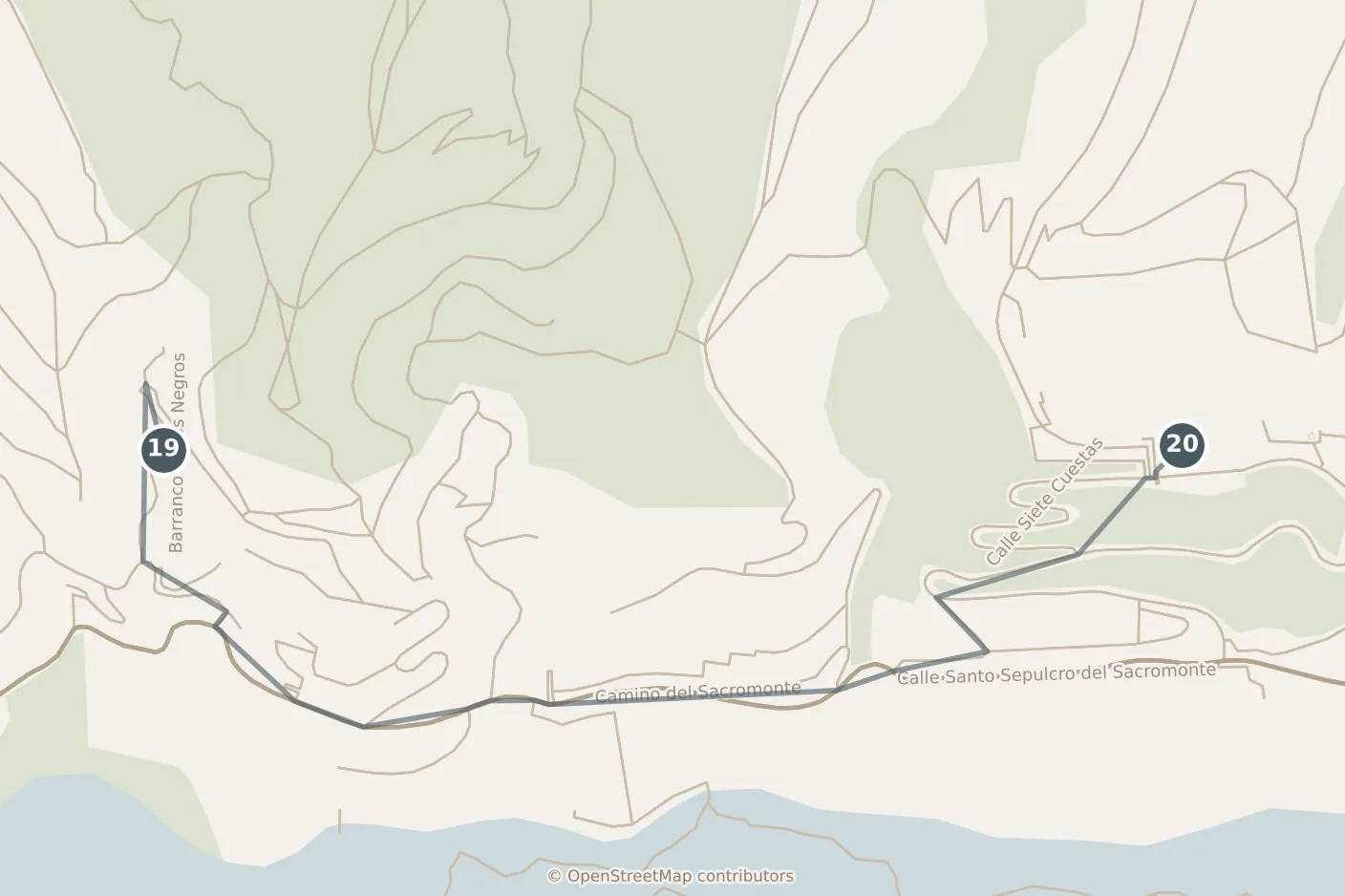
- With a third day
- 19Museo Cuevas del Sacromonte
- 20Abadía del Sacromonte
The third day is Sacromonte, and it goes on the end, not in the middle. That is not a preference: the Dobla de Oro is valid the day before your Alhambra slot, the day of it and the day after, so days one and two have to be consecutive. Insert Sacromonte between them and the four Nasrid houses fall outside the window and have to be bought again — the Patronato sells the Andalusian monuments as a separate, cheaper ticket precisely for that, so it is recoverable, but it is money spent to reorder a trip for no reason. If something forces the insertion, buy the monuments ticket for the third day and let the Alhambra sit on day one.
Sacromonte is the ridge beyond the Albaicín, above the Darro, where the city’s Roma community settled from the fifteenth century onward and cut houses into the soft rock. The walk to it is the point of the morning: up the Camino del Sacromonte from the Paseo de los Tristes, twenty minutes with the last of them steeper than the map admits, and the road narrowing as the cave fronts start. Those fronts are somebody’s front door — the caves along this road are lived in now, not only in the museum’s past tense — so walk it, and photograph it, as the street of houses it is. Doing it on foot is what makes the place legible; the C34 is the minibus that runs Sacromonte to the center, and it is the right way home in the dark rather than the right way up in the morning.
The Museo Cuevas del Sacromonte sits in the Barranco de los Negros and is eleven original caves left as dwellings and workshops — a kitchen, a stable, a basket-maker’s, a forge, a weaver’s — with an interpretation center on the valley itself attached. Give it an hour. It answers the question the postcards do not: what living in one of these was actually like, which was cool, dark, damp in winter, and not remotely picturesque.
Twelve minutes further along the same road is the Abadía del Sacromonte, and this is the reason a third day is worth spending here rather than on a fourth church in the center. In the 1590s, lead tablets in Arabic and bones were dug out of the caves under this hill and read as proof that San Cecilio, the city’s first bishop, had been martyred here — a discovery that arrived with convenient timing for a Muslim population under pressure to prove it had been Christian all along. An abbey and a college were built on the spot. Rome examined the Libros Plúmbeos for eighty years and condemned them as forgeries in 1682, and the abbey stayed anyway. The visit is a guided hour and takes in the museum, the church and the catacombs where the tablets were found. It runs in two blocks with the middle of the day closed, late morning and mid-afternoon, so build the walk up backwards from whichever block you can get; the abbey publishes its own times and there is no other source worth reading. It is a working monastery, so you go where the guide goes, and on Sunday the midday mass takes the church out of the visit — before it or well after it, not across it.
Come back down for a late lunch on the Paseo de los Tristes — which is also the answer to the bag, if you are leaving at the end of this day: the third day starts and ends within a few minutes of Plaza Nueva, so a case left in the center is collected on the way through at lunch rather than carried up a cave road. What a train out that evening costs is the zambra, not the morning. The evening is the zambra: the Sacromonte flamenco form, a wedding sequence turned into a performance and danced in a line along the wall because the caves are long and narrow. It is the third day’s one booking and it is made directly with the cave that stages it rather than through anybody’s site; do it the same week, not on the night. Booking direct is also the only way to ask what separates a family room from a coach-party one: a room laid out for a coach party, a fixed dinner-and-show price and a hotel pickup included are the three signals, and all three are answers you get on the telephone rather than at the door.
If caves and flamenco are not your trip, the other third day is the Baroque one, and it is a complete plan. Start at the Monasterio de San Jerónimo, twelve minutes west of the cathedral, where the Gran Capitán is buried under the high altar beneath a retablo that runs the full height of the church; give it forty-five minutes and take the two cloisters as well as the nave. Three minutes north is the Basílica de San Juan de Dios, the most concentrated gold interior in the city, half an hour, with the camarín behind its altar — a room you walk up into. Then the Cartuja, a steady half hour on foot northward through ordinary modern streets, gently uphill, and no bus line worth naming for it: go for one room, the sacristy, whose marquetry doors and plasterwork are the far edge of what Spanish Baroque did to a wall. An hour there. Three hours inside the three buildings and an hour on foot between them and back, all of it in the flat north-west, and not one booking in it.
Practicalities
Book one thing, and let its date pin everything. The Dobla de Oro is the ticket, it is sold by the Patronato de la Alhambra y Generalife on its own site, and it was in the thirty-euro range in 2026. Buy it as far ahead as you can: the Alhambra caps how many people go through the Nasrid Palaces each day and that cap, not the price, is what sells out. Ask for a palace slot about two hours after the monument opens. You are admitted to those palaces only inside the half-hour printed on the ticket and there is no negotiating it. Everything else on all three days is free, or bought at its own door, or — the zambra alone — arranged directly with the cave.
The scheduling rules, in the order they bind. Day one is pinned by the Alhambra slot you managed to get. Day two is chained to it by the ticket’s three-day validity and must sit immediately before or immediately after. The third day floats and is best placed last. The Alhambra itself closes on exactly two dates in the year, the twenty-fifth of December and the first of January, so the pin can go on any other date — but note that the second of January is a Granada holiday, which makes the first three days of the year a poor window for a trip built on this ticket: the Royal Chapel, for one, publishes an opening of four to half past six in the afternoon on that day alone.
The weekday that bends day two is Sunday, and the fix is inside the day. In 2026 Granada Cathedral did not open until the middle of the afternoon on a Sunday, and this route reaches it before eleven. If day two lands on one, take the Royal Chapel, the Madraza, the Alcaicería and the Corral del Carbón in the morning as written, and move the cathedral off day two rather than later into it. There is nowhere later to put it: day two’s afternoon belongs to the Albaicín, which in the cold half starts at two and has its last door shut at five, so forty minutes in the cathedral and the walk back down come straight out of the four houses. Spend day one’s spare hour on it instead — the Realejo afternoon passes within a few minutes of its door — or, if you are taking a third day, put it there, since that day begins and ends a few minutes from it. The one version that holds inside day two is a hot-half Sunday, where the long lunch is dead time anyway and the cathedral stands two hundred meters from where you are eating: that works only if its Sunday opening leaves you at El Bañuelo by five, which is a question for the telephone call below rather than for this page. But do not read that as the whole of the rule. Neither the cathedral nor the Royal Chapel publishes a standing weekly table; what both publish is that visits stop during services and other religious celebrations — on any day, not only Sunday — with an instruction to telephone and confirm, which is what to do with both of them the week before rather than trusting a weekday. On the third day, Sunday touches the abbey instead — the midday mass, as above.
The weekday risk on day one is the two Realejo interiors. The Cuarto Real de Santo Domingo and the Casa de los Tiros are the kind of institution that keeps a weekly closing day and a short Sunday, and they are the only two doors of the three days whose day off this article will not guess at. Check them together before you set out. The third thing to look up on day one is the Carmen de los Mártires, and there the question is the hour rather than the weekday: it is the council’s garden, not the monument’s. If one or both are shut, day one loses an hour and a half and nothing structural: the Realejo is a quarter rather than a museum, and the Campo del Príncipe below them is where the afternoon was going anyway. Note that the Alhambra, the Corral del Carbón and the Albaicín doors on the published Andalusian-monuments schedule all open every day of the week, which is why the Sunday and the weekday questions land where they do and not on the afternoon that matters most. The exception is inside the Alhambra rather than outside it: the Museo de la Alhambra shuts on Mondays and at half past two on Sundays and Tuesdays. Only the Monday closure costs anything: three-quarters of an hour off day one’s morning, which that day spends in the Partal or the Generalife instead. The half-past-two close does not reach this route at all, in either direction round the hill and whatever hour your slot is — the morning is built forward from the gate, and the fix for an afternoon slot moves the gardens earlier rather than the museum later. And any of the Easter-anchored dates named at the top of this article overrides every rule in this paragraph.
When you are short of time, this is what goes, and in this order. Day one: the Carmen de los Mártires, which is three-quarters of an hour plus the walk, and cutting it puts you at lunch in the Realejo an hour earlier — take that hour rather than adding a stop with it. Day two: the Casa del Chapiz, for the reason given in its own paragraph. If a whole half-day has to go, cut day two’s morning rather than its afternoon: the center’s interiors are open long hours and can be picked up on any day of the trip, while the four houses need a whole clear afternoon inside the Andalusian-monuments block, and day two’s is the only one this trip has — the ticket covers them on day one as well, but day one’s afternoon is spoken for by the hill it comes off.
Getting between the stops. Everything on days one and two is walked, and there are two real climbs: the fifteen minutes up the Cuesta de Gomérez on day one, and the short pull from Dar al-Horra up to the terrace on day two. The C30 saves the first of those and starts from Plaza Isabel la Católica, with the caveat about its stops given on day one; the C31 runs into the Albaicín and the C32 links the Alhambra to it, so neither is any use for getting into the center. Nothing replaces the second climb, and nothing needs to — it is short. The third day is the only one with a ride in it, the C34 between Sacromonte and the center, and it is worth taking downhill after dark rather than uphill in the morning.


.jpg)
.jpg)

