Granada in one day: the Alhambra first, the center after lunch, and the Albaicín at sunset

Last updated 4 August 2026
Overview
Granada is two hills with a river between them, and one day here is exactly the length of that shape. The Alhambra stands on one side, the Albaicín climbs the other, the flat center sits below both, and the route below is a loop rather than a line: up the hill in the morning, down into the center for the afternoon, along the river and up the far slope for the light, and back to where it started for dinner. Every leg of it is walked. There is no transport in this itinerary at all except the ride that brings you in and the one that takes you away.
What a single day costs you is everything outside that loop. The two great monastic churches north-west of the center, the Monasterio de San Jerónimo and the Cartuja, are twenty minutes’ walk off the route and they are gone, both of them, and they are the loss a returning visitor would feel most. Sacromonte and its cave flamenco go for a different reason: the zambra is an evening, and this day’s evening is already spoken for by the sky. The Alhambra’s own night visit is the same argument with a different ticket. And the Realejo, on the Alhambra’s southern flank, is where a second day would start — this one never crosses to that side of the hill.
The day has one moment that will not wait, and it is the last one. The Mirador de San Nicolás is a stone terrace at the top of the Albaicín facing the Alhambra across the ravine, with the Sierra Nevada standing behind it, and for the half hour around sunset the fortress goes from ochre to red. It is a public square with no gate on it, so nothing but the sky decides the hour. So count backwards. The sun goes down here from just before six at the start of December to almost twenty to ten in the last week of June — take your month’s hour, and the stops above the mirador come to about eight hours with lunch taken standing up, nine if you sit down to it.
Two things about that number, because it is the sentence readers act on. It counts the time inside the places and the walking between them and nothing else, and what it leaves out here is nearly all one thing: the Alhambra is not a building but a walled town, and everything that happens between reaching its gate and being inside it — the line at the ticket check, the sheer distance from the gate to the first courtyard — sits outside the eight hours. Allow the better part of an hour for it.
The other thing is that the count fails in summer, and the arithmetic will not warn you. Eight hours before a late-June sunset is half past one in the afternoon, which puts you on an unshaded hill at the worst hour of a Granada July and, worse, at the cathedral door after it has stopped letting anyone in — a quarter past six, in 2026. So from May to September do not run the count at all. Start in the morning, take the hill and the center in the order below, and you will be through both by about five with four hours of light still to come. That gap is not a hole in the day, it is what this city does with its own afternoon: the long lunch is already inside that five o’clock, and what comes after it is a couple of hours somewhere shaded while the streets are empty, which is what puts the river walk in the early evening rather than in the middle of the afternoon. The backward count is for the short half of the year, when the light runs out before the day does. In the long half the day runs out before the light, and the answer is to slow the middle of it down rather than to start later.
One thing to have before you arrive, since a reader who lands on this page has not necessarily read anything else: an Alhambra ticket with a Nasrid Palaces slot on it, bought from the monument’s own site. It is the only thing on this route that must be booked, it was in the twenty-to-twenty-five-euro range in 2026, and it sells out weeks ahead in season. It is bought in a name and it stays in that name: the tickets are personal and non-transferable, and each person carries their own along with a photo identity document, which can be asked for at the entrance and again anywhere inside. Take the passport or identity card the booking was made with; if you are booking for other people, get their names right first time, because the monument allows a change or two and only up to the day before. Which half-hour you ask for is not a detail — it is the hinge of the day, and the morning below says which one. Everything else here is free or walked into.
The loop also settles the bag, in the only way this page honestly can. Granada train station is about twenty-five minutes’ walk north-west of Plaza Nueva, flat the whole way, and the day begins and ends within five minutes of that square, so whatever you do with a case you do it once and the route brings you back past it. A bus arrival is a different shape: the bus station sits three kilometers north of the center, and city lines 5, 33 and 21 take about a quarter of an hour to bring you in — a ride rather than a walk, in both directions. The hill takes less of this than it looks. The Alhambra does not admit a suitcase or a large backpack through its gate at all — a small bag, or a backpack of about forty centimeters square, is the exception — and it runs free lockers for that reason, at the entrance pavilion and at the building beside the Puerta del Vino, subject to there being room. So what a case costs you in the morning is the walk up rather than the monument, which is the one good argument for taking the minibus from Plaza Isabel la Católica instead of the Cuesta de Gomérez.
What this article cannot promise you is a locker at the station itself: whether it has left luggage, and whether it still has space by the middle of the morning, is exactly the fact that changes without notice. Plan for the answer being no, and then be clear about what that costs, which is the end of the day rather than the day. The climb into the Albaicín is the one stretch of this route with nowhere to leave a case and no sane way to carry one, and it is the last third. Everything below it stands, in this order: the Alhambra all morning with the case in a locker on the hill, then the Royal Chapel, the cathedral, the market lanes and the Corral del Carbón, which sit within four hundred meters of each other on level ground and are a good two hours you can walk with luggage in your hand, then lunch, then the Carrera del Darro and the Paseo de los Tristes, flat the whole way from Plaza Nueva and the best hour of the day to walk them, and dinner in the streets off that square. On a Sunday the two churches move to the far side of lunch, for the reason given below, and the case goes with them. What you give up is the mirador and the half hour of red light on the walls, and nothing before it.
The day

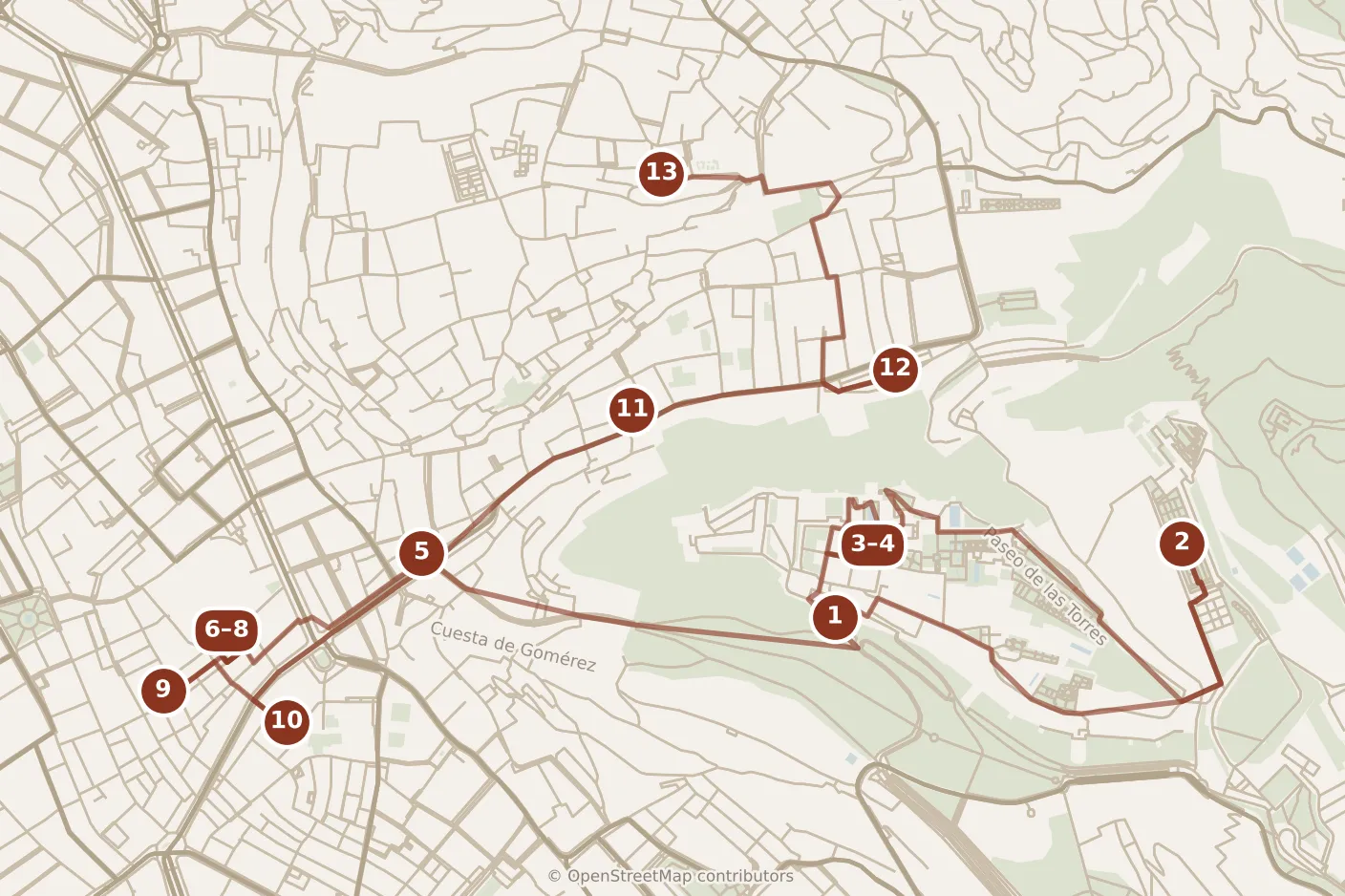
- The day
- 1Puerta de la Justicia
- 2Generalife
- 3Palacio de Carlos V
- 4Nasrid Palaces
- Alcazaba — in the prose, not on the map
- 5Plaza Nueva
- 6Royal Chapel
- 7Granada Cathedral
- 8Alcaicería
- 9Plaza de Bib-Rambla
- 10Corral del Carbón
- 11El Bañuelo
- 12Paseo de los Tristes
- 13Mirador de San Nicolás
Morning
The hill opened at half past eight in 2026, winter and summer alike, and that is the earliest this day can begin. In the short months the backward count will tell you to start later than that, which is a gift; in the long ones it is the opening you build forward from, and if you find a different hour, build forward from the new one.
Whatever time you start, ask for a Nasrid Palaces slot about ninety minutes later, and the reason is geography rather than crowds. The palaces sit in the middle of the hill; the gardens are at its eastern end and the way back down into the city leaves from the west. Ninety minutes is about what it takes to walk to the far end, see the gardens, come back to the middle and look into the Palacio de Carlos V on the way past, which means you cross the hill once instead of twice. A slot at the opening half-hour makes you start in the middle, and the rest of the morning is spent undoing it.
Walk up from Plaza Nueva by the Cuesta de Gomérez — ten minutes by the map, fifteen in the legs, uphill on cobbles and under trees the whole way — to the Puerta de la Justicia, the enormous horseshoe gate on the south-west side. Read your ticket before you set out, though: the hill has more than one way in, and the main pavilion is at the far eastern end, a good fifteen minutes further round. If that is where you are sent, allow the extra time and take everything below in the same order — you will simply be starting at the gardens instead of walking to them.
Take the gardens first, since the walk east puts you at them: the Generalife, the summer estate the emirs kept up the slope, which is not a building but a sequence of walled gardens, water stairs and terraces, with a long narrow courtyard down the center of which a double row of jets crosses over a channel. The thing to know is that this was farmland — the court came up here to be somewhere other than the palace. Give it an hour. On a July morning it is also the coolest ground on the hill, which is a reason to take it at the start of the morning rather than at the end of it.
Back west along the ridge, seven or eight minutes, to the Palacio de Carlos V: a perfect square building with a perfect circle cut out of the middle of it, begun in 1527 for the emperor whose grandparents had taken the city, abandoned unfinished in the seventeenth century and only roofed in the twentieth. It is free, and fifteen minutes is enough, because there is one thing to see in it and that thing is the shape.
Then your slot. The Nasrid Palaces are three palaces run together — the Mexuar, where the business of government was done; the Comares palace, built round a long still pool with the throne hall at the end of it; and the Patio de los Leones, a courtyard of slender columns around a fountain carried on twelve stone lions. The single most useful thing to know before going in is that the walls are not decorated, they are written: the plaster is covered in Arabic, most of it poetry, and one short phrase repeated thousands of times. The second most useful thing is that the route through is one-way and you cannot double back, so do not save a room for the way out. Give it an hour, and spend the first ten minutes of that hour standing still at the end of the long pool, looking at the reflection rather than at the building.
Out at the western end and up into the Alcazaba, the fortress at the point of the hill and the oldest part of it. What survives is the outline of a garrison town — the barracks reduced to their foundations, the walls, and a line of towers that are still whole — and it is worth forty minutes for one of them: the Torre de la Vela at the tip looks out over the whole city, the Albaicín opposite, the plain to the west and the mountains behind. It is the reverse of the view you will be standing in at sunset, and nothing else today shows you the whole of Granada at once.
Local tip. The half-hour printed on your ticket is the only appointment in this day. Everything above it and below it will move; that will not. So if you are running late on the hill, take the loss out of the gardens at the beginning rather than out of the Alcazaba at the end. The Generalife is a there-and-back before your slot and can simply be dropped; the Alcazaba stands between the palaces and the gate you leave by, so cutting that one means walking past it on your way out anyway.
Come back down the way you came, through the gate and down the Cuesta de Gomérez to Plaza Nueva. Ten minutes by the arithmetic, and quicker than that with gravity behind you.
Afternoon
Plaza Nueva is where the hill hands you back to the city, and the whole of this half-day sits inside four hundred meters of it. Walk down Calle Reyes Católicos, five minutes, to the Royal Chapel.
This is the one interior in the center a single day should not give up. It was built between 1505 and 1517 as a burial church for Isabella and Ferdinand, who took the city in 1492 and meant to lie in it, and it is a dense, low, obstinate building for that reason — a chapel with the ambitions of a cathedral. Two carved marble tombs stand in the middle behind an iron screen the height of a house, with two more beside them for their daughter and her husband; then you go down a short flight of steps and find the plain lead coffins the four of them are actually in. The distance between the marble above and the boxes below is what people remember about this room. Nothing in here may be photographed or filmed, in the chapel or down in the crypt, which is better learned before the camera is up than after. Forty minutes, and keep ten of them for the sacristy, which holds Isabella’s own collection of Flemish painting and is far better than a side room has any need to be.
Granada Cathedral is attached to the back of it, and going from one to the other takes a minute and two hundred years. The cathedral was begun in 1523 on the site of the city’s main mosque and then redesigned, a few years in, from Gothic into Renaissance — which is why the plan underfoot is a Gothic cathedral’s and nothing you look up at is. Its center is a circular sanctuary the full height of the building, white and gold, lit from windows set very high. Forty minutes, and what to skip is the side chapels, all of them: they are dim, repetitive, and they will take the second hour you have not got.
Come out of the cathedral and you are a minute from the Alcaicería, four narrow lanes of horseshoe arches and shops selling lamps and inlaid boxes. Be clear about what it is before you are disappointed by it: the original was the Moorish silk exchange, it burned down in 1843, and what stands is a nineteenth-century rebuilding on a smaller footprint. Ten minutes, and walk it rather than shop it.
It comes out into the Plaza de Bib-Rambla, three minutes on, a wide square with a fountain of stone giants in the middle, flower stalls round the edge and — the thing the center is short of in the heat of the day — shade. Ten minutes, sitting down.
Three minutes east of it, set back off the main street, is the Corral del Carbón, which is the quietest thing in the center and the one most people walk past. It is a fourteenth-century merchants’ inn and warehouse, the only Nasrid building of its kind left standing in Spain: a square courtyard with three galleries of rooms above it, entered through a tall horseshoe arch off a lane, and the noise of the city stops at that arch. Fifteen minutes.
Lunch goes here, and in Granada lunch is a decision about time before it is a decision about food. The lanes around Calle Navas, two minutes south, are a solid run of bars. The short version is a drink standing at one of them and whatever arrives alongside it: Granada is one of the handful of cities in the country where a tapa still comes free with the drink instead of being ordered, and what turns up is the bar’s choice rather than yours. Forty-five minutes, and on to the river. The long version is sitting down to a plato alpujarreño, the plate of mountain ham, black pudding, chorizo, fried potatoes and egg that comes down from the villages on the far side of the Sierra Nevada, and that is two hours, because that is what the dish is. In July the long version is not an indulgence, it is the plan: it is the two hours you would otherwise spend walking in the sun.
Evening
Back up to Plaza Nueva, five minutes, and out of its far corner into the Carrera del Darro. In the short months you come straight here from lunch; in the long ones this is where the gap ends, and the street is a better thing in the early evening than in the flat light of the afternoon, so there is no loss in having waited. This is the best street in the city and it needs no stop on it to justify the walk: the Darro runs below you in a stone channel on the right, old houses stand on both banks, four bridges cross it, and the Alhambra’s outer wall rides above the trees on the far side the whole way. Six minutes to walk it as far as the baths, twenty if you keep stopping, and you will keep stopping.
Part-way along, a door on the left leads into El Bañuelo, an eleventh-century bath house that is older than the Alhambra by a couple of hundred years. It is three brick-vaulted rooms with star-shaped holes cut in the ceilings, which put shafts of light on the floor and move them across it as the afternoon goes; the columns holding the vaults up were taken from Roman and Visigothic buildings, which you can tell because they do not match one another. Twenty minutes. It is sold on a joint ticket that runs to two more small Moorish houses up in the Albaicín and, down in the center, to the Corral del Carbón you stood in this afternoon; the ticket office for all four is the Corral itself, which is where to buy it if you want this door open on the way past. If you only do one of them, this is the one.
It is also the one stop on this route whose hours can take it away from you, and the way they do it flips with the season: in the cold half of the year it shuts in the late afternoon, which is roughly when this day reaches it, and in the hot half it closes over the middle of the day and opens again for the evening. Check that one door before you set out, and if it is shut when you pass, nothing else in the day moves. The street it stands on is the stop, the bath house is the bonus, and you keep walking.
Seven minutes further and the street opens into the Paseo de los Tristes, a broad terrace on the riverbank where the road gives up and the Alhambra stands directly overhead — the closest the city ever gets to being under it. The name comes from the funeral processions that used to pass along here on their way up to the cemetery. Twenty minutes sitting here is the right way to spend the wait before the light, and it is the last flat ground of the day.
Then the climb. It is under five hundred meters from the Paseo de los Tristes up to the Mirador de San Nicolás and the arithmetic says seven minutes: give it fifteen, and they are the hardest fifteen of the day. It is all ascent, on cobbles and then on steps, and it is the reason the Albaicín goes at the end of this route and not in the middle of it — you do this climb once, with the day behind you, rather than twice.
What is at the top is a stone terrace in front of a small church, usually full of people, with the entire Alhambra laid out across the ravine at eye level and the mountains behind it. It is the view on every postcard of this city and it earns the walk. Stay through sunset and for ten minutes after it, when the red has gone off the walls and the shape of the fortress changes again against a sky that is still light.
Come down the way you came up. There are shorter descents straight through the Albaicín — the arithmetic puts the direct line at eleven minutes against the twenty of the retrace — and this is not the hour for them: the upper lanes are unlit, they fork constantly, and you have already walked the other one once in daylight. Twenty minutes down, most of it back beside the river, and Plaza Nueva is under your feet again.
Dinner is the streets immediately around it — Calle Elvira running west from the square, and Calle Calderería Nueva climbing off it, which is the lane of Moroccan tea houses and is worth walking up whether or not you eat there. Two or three bars is a dinner in this city rather than a warm-up to one. If nobody puts berenjenas con miel in front of you, ask for them: fried eggplant under cane syrup.
And if you have a train to catch, Granada train station is twenty-five minutes north-west of Plaza Nueva on foot, along Gran Vía and then on, flat the whole way — the same twenty-five minutes you walked in, and the only stretch of this day not worth doing at a stroll. A bus is the other thing: that station is out of walking range, and the city bus that brought you in is the one that takes you back out.
Practicalities
One booking, and it decides everything: the Alhambra, with a Nasrid Palaces slot on it. Buy it from the monument’s own site rather than from the resellers a search puts above it; the general daytime ticket was in the twenty-to-twenty-five-euro range in 2026. Ask for a slot about ninety minutes after the hour you mean to start, for the reason given above — it lets you cross the hill once instead of twice. You are admitted to the palaces only inside the half-hour printed on the ticket, and there is no arguing with that: miss the window and you have bought a very expensive garden.
The Alhambra itself takes only two days off in the year, the twenty-fifth of December and the first of January, so this route survives any weekday — which is not true of most one-day itineraries and is worth knowing if your one day is a Monday. The stops that need checking are the two in the center, and one down on the river. Granada Cathedral stopped admitting at a quarter past six in 2026 and the Royal Chapel half an hour after it, and on a Sunday in that same year the cathedral did not open at all until the middle of the afternoon. That last is the single fact that breaks this day as written, because the route reaches the center shortly after midday. The fix is to swap the two halves of the afternoon — come off the hill, go straight to lunch, and take the chapel and the cathedral from the hour the cathedral opens. The chapel opens earlier than the cathedral on a Sunday and shuts at about the same time, so it absorbs the swap and no stop is lost. In the long half of the year it costs nothing at all, because the two-hour lunch is already the plan and it is very nearly the length of the wait. In the short half it costs an hour you have not got: the wait still has to be spent at the table, which turns the eight-hour day into the nine-hour one at the point where the backward count was already using every hour of light. On a December Sunday, then, something goes, and it is the cathedral rather than the mirador — the chapel is the interior this day should not lose, and the light is the one thing that will not wait. If you find different hours on the door, the method still holds. Whatever time those two shut, it is earlier than sunset for most of the year, so they go before the climb and never after it.
Everything else on the route is either free, or bought on the spot, or outdoors and open, and only one of them keeps hours that this day has to work around: the bath house on the Carrera del Darro, for the reason set out above. It is also the one ticket here not sold at its own door — the office is the Corral del Carbón, which this route stands in some hours earlier, so buy it there if you want that door open on the way past. Look that one up the night before: its hours are published by the body that runs the Alhambra, on the page it keeps for the four monuments that share that joint ticket. The route absorbs its being shut without any rearrangement at all, which is why it is a check and not a risk.
The walking comes to about six kilometers, of which something over a kilometer is uphill and all of that is in two places: the climb to the hill in the morning and the climb into the Albaicín at the end. If you want the first of those without walking it, the C30 is the minibus between the Alhambra and the center, and in the center it starts from Plaza Isabel la Católica. The other line on the hill, the C32, runs to the Albaicín rather than to the center, so it is no use for this. What the bus replaces is ten minutes on the map and fifteen in practice, through woods, so take it if you are short of time and not if you are short of energy — this route spends its legs late, and the evening climb is where they matter. In July and August the middle of the day here is genuinely hostile, with almost no shade on the hill and not much more in the center, which is the argument for the two-hour lunch rather than the standing one.


