Gdańsk in two or three days: the Main Town, the shipyard, and a day out along the coast to Oliwa and Sopot

Last updated 1 October 2026
Overview
Gdańsk splits cleanly into two days, and the split is by century rather than by neighborhood. Day one is the Main Town: the merchant city of the Hanseatic centuries, rebuilt almost brick by brick after 1945, walked in one line from gate to river. Day two is the twentieth century, which in this city means the first shots of the Second World War and the shipyard strikes that produced Solidarity. Both stories are told in two large modern museums a short walk apart. A third day leaves the city on the local train, north along the coast to the cathedral at Oliwa and the pier at Sopot. Sopot is a separate town, which is why the title says so.
Everything on the first two days is on foot from Gdańsk Główny, the main railway station, and the article starts and ends there each day. Nothing on these days needs a tram, though the third needs the SKM, the suburban railway that runs up the coast.
Neither of the first two days has an hour that the light decides. Both are anchored to the morning instead. Day one is anchored to the Royal Route, which is best walked before it fills. Day two is anchored to the Museum of the Second World War, which deserves the freshest three hours you have. The time totals for each day are given in its first paragraph. They count only what you do inside the places. They do not count lines, which on summer days are longest at the St Mary’s tower stair and the security check at the war museum.
What this article leaves out on purpose is Westerplatte, the peninsula where the war began. It is a pilgrimage rather than a visit, it sits at the harbor mouth well outside the center, and on two or three days it would take a whole morning from what the center holds. A reader with a fourth day should give it the morning.
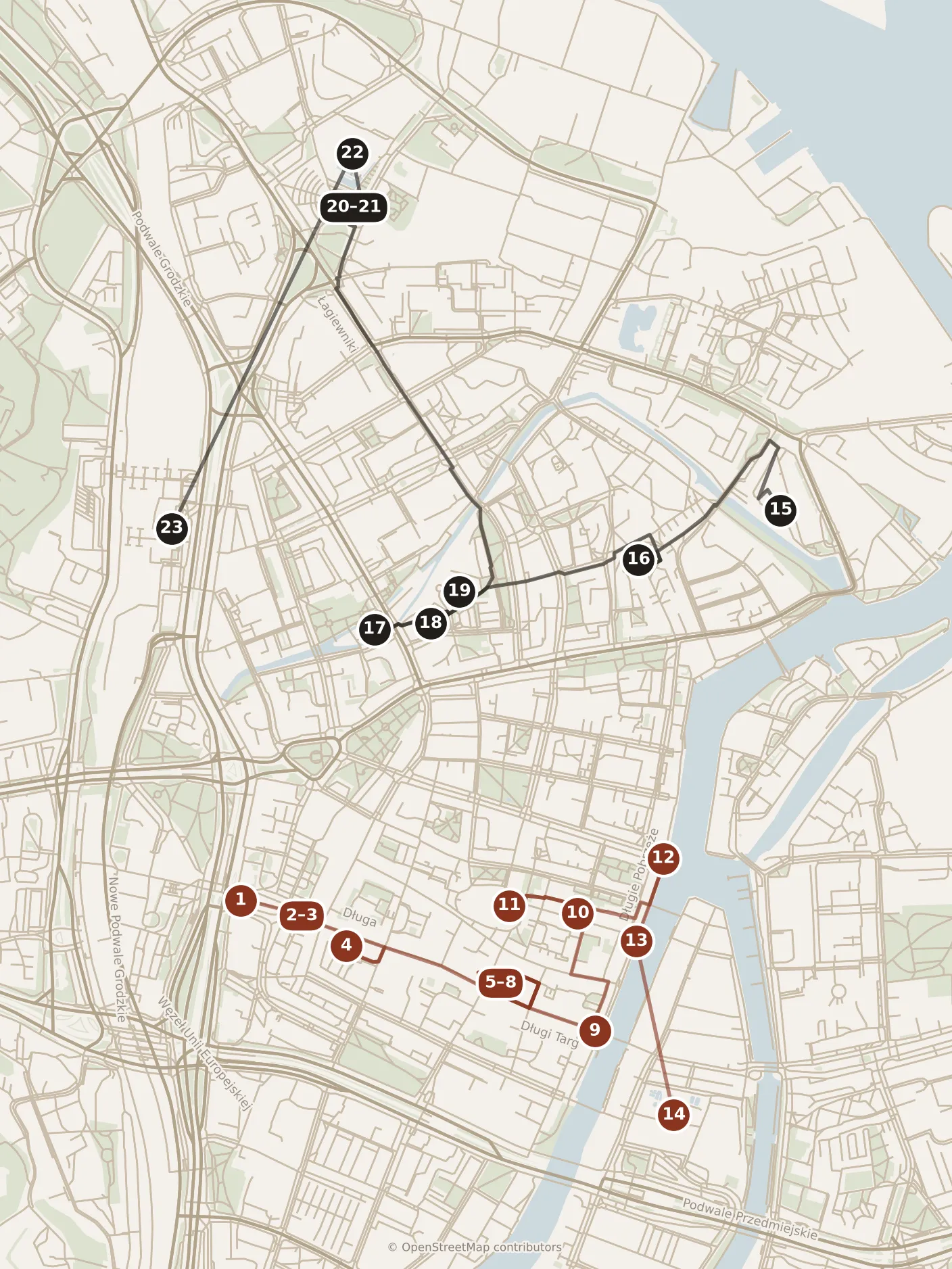
- Day one
- 1Upland Gate
- 2Golden Gate
- 3Long Street
- 4Uphagen House
- 5Main Town Hall
- 6Long Market
- 7Neptune's Fountain
- 8Artus Court
- 9Green Gate
- 10Mariacka Street
- 11St Mary's Church
- 12Crane
- 13Long Embankment
- 14Granary Island
- Day two
- 15Museum of the Second World War
- 16Polish Post Office
- 17Great Mill
- 18St Catherine's Church
- 19St Bridget's Church
- 20Monument to the Fallen Shipyard Workers
- 21Gate No. 2
- 22European Solidarity Centre
- 23Gdańsk Główny
Day one

Today runs in a single line from the inland gates to the river. The inside time adds up to roughly six and a half hours: three in the morning, two and a half in the afternoon, an hour for lunch. With walking that comes to about seven. Start as early as the first doors allow, because the Royal Route is a corridor, and by late morning in summer it is one you share.
Morning
The first leg starts at Gdańsk Główny, the red-brick main station. If you are carrying a bag, leave it there: left luggage is at the main station. The day ends on the river about twenty-five minutes’ walk from it, so you will be coming back. Do not plan to carry a case up the St Mary’s tower this afternoon.
From the station, cross the wide road in front of it by the underpass and walk south through the green strip along the old moat. It is about twelve minutes to the Upland Gate, a squat stone gateway that marks the start of the Royal Route. That is the processional way by which kings entered the city. Behind the gate stands the brick Prison Tower, and beyond it the Golden Gate opens straight onto Long Street (Długa). From here the whole morning is one street, gently downhill, lined with tall narrow merchant houses whose gables are each painted differently. Most of what you are looking at was rebuilt from rubble after 1945, to old drawings and photographs. Knowing that makes the street more remarkable, not less.
Near the top of the street is Uphagen House, an eighteenth-century merchant’s house kept as it was lived in. Its narrow front rooms are for receiving, there is a staircase hall, and a long wing runs back from the street with the family’s private rooms. It is the only place on the route where you see the inside of one of these façades. Give it forty-five minutes. If you are short of time, it is the first stop that goes.
At the bottom of Long Street the Main Town Hall rises over the corner with its tall, thin, gilded spire. Inside, the Museum of Gdańsk keeps the council chambers. The one to see is the Red Room, with a ceiling of inset paintings, the richest room in the building. Give the interiors an hour. The tower is opened for climbing in the warmer months. If it is open on your day, add half an hour; if not, St Mary’s this afternoon gives you the better view anyway.
The street then widens into Long Market (Długi Targ), with Neptune’s Fountain in the middle, a bronze sea god from the seventeenth century. Spend fifteen minutes standing still here, because this is the square on the city’s postcards. Then go into Artus Court on the left-hand side of the square as you come from the Town Hall. It was the merchants’ hall: one vaulted room with model ships hanging from the ceiling, and in a corner a tiled stove that rises higher than a house. Forty-five minutes is enough.
Afternoon
Lunch is first. The streets off Long Market are lined with places to eat pierogi, and herring, śledź, is the order to try here alongside them; the places a street back from the square are calmer than the ones on it. Give it an hour.
At the river end of Long Market the Green Gate closes the square. You will pass through it again this evening. For now, turn left before it and walk north two short streets to Mariacka Street, about five minutes. Raised stone terraces stand in front of each house, stone gargoyles shaped as water spouts, and amber sellers in most of the ground floors. The terraces are a Gdańsk peculiarity, and Mariacka is the street where they line every door.
At the far end of Mariacka stands St Mary’s Church, one of the largest brick churches anywhere. Its scale is the point. The interior is whitewashed and enormous, and it swallows a tour group without noticing. Find the astronomical clock by Hans Düringer, a fifteenth-century dial of the sun, moon and zodiac. Look also for the Last Judgment by Hans Memling, which is a copy; the original is in the National Museum, which the third day can reach. St Mary’s is a working parish church. Dress for a church, keep your voice down, and on a Sunday morning expect services to restrict where you can walk. Give the interior forty-five minutes.
The tower is the climb of the day, four hundred-odd steps of narrow stair, and it is honest to say it is hard work. The reward is the whole Main Town from above: the roofs, the river, and the shipyard cranes to the north. Give it half an hour, plus whatever the line costs in summer.
Then walk back down Mariacka to the river and turn left. The Crane (Żuraw) is about five minutes along the bank. It is a medieval port crane built into a city gate, a timber hoist between two brick towers, once worked by men walking inside giant treadwheels. It belongs to the National Maritime Museum. Give the inside forty-five minutes, or give the outside five minutes and the waterfront the rest.
Local tip. If the afternoon is running short, cut the Crane’s interior rather than the St Mary’s tower. The Crane is half its value from the bank, which you walk past anyway; the tower is the one view of the whole Main Town the day can count on.
Evening
The riverside walk under the Crane is the Long Embankment (Długie Pobrzeże), the old quay, lined with gabled houses and boats moored along it. Walk it back south towards the Green Gate, which takes about five minutes. Then cross the footbridge over the Motława to Granary Island, where the ruined warehouses have been rebuilt into a new quarter of restaurants and apartments. Dinner is here or on the quay, with the old town’s river front lit across the water. That view is the one the day has been arranging.
To get back to Gdańsk Główny, recross to the Green Gate, walk the length of Long Market and Long Street back to the Upland Gate, then north through the moat park. It is about twenty-five minutes on foot. Allow thirty minutes if a bag is waiting for you or a train is.
Day two

Today is the twentieth century, and it runs north from the river to the shipyard. You end beside the main station. The inside time adds up to about eight hours: three at the war museum, an hour for lunch, an hour and a half among the Old Town buildings, two at the European Solidarity Centre. Add about forty minutes of walking. That is a full day, and it is why the first door matters: the day hinges on getting to the war museum early, not on any light.
Morning
From the Main Town, walk north along the river past the Crane to the Museum of the Second World War. It is the building with a huge red tower leaning out of the ground, about fifteen minutes’ walk from the Green Gate. From Gdańsk Główny, it is about twenty minutes east through the Old Town.
Almost all of the museum is underground, in one long chronological exhibition. It begins with the inter-war years, and the war itself is told from the side of the people it fell on: occupation, deportation, the camps, the destroyed cities. Among them is a full reconstruction of a street before and after. It is dense and it is not gentle. Give it three hours and no more, then leave. The exhibition is long enough that the last third is where most visitors stop reading, so go faster through the opening rooms on the pre-war years and slower through the occupation. Expect a security check and a cloakroom at the entrance, and the three hours do not include them.
The museum is closed on Mondays, and in July and August it stays open later into the evening; check the hours before you set out. If it is shut on the day you have given it, this whole day swaps with the third: Oliwa and Sopot do not care what day it is.
Afternoon
Eat near the museum or on the way into the Old Town. Then walk about five minutes west to the Polish Post Office. On 1 September 1939 its postal workers held out for most of a day against the attack. Most of those who surrendered were sentenced by a German court-martial and shot that October. It is a small museum, a branch of the Museum of Gdańsk, in the actual building. Günter Grass put it into The Tin Drum. Forty-five minutes is enough, and after the war museum it is the more personal of the two.
From the Post Office walk into the Old Town, the older and more spread-out quarter north of the Main Town. Pass the Great Mill, a huge brick mill with a steep roof from the Teutonic centuries, which now houses the Amber Museum; on this day it is worth five minutes from the outside. Then cross to St Catherine’s Church, which is next to it. It is the oldest parish church in the city, and the astronomer Johannes Hevelius is buried there. Its tower holds a carillon. Give it twenty minutes.
Behind it is St Bridget’s Church, which during the 1980s became the parish of the shipyard strikers and of Lech Wałęsa. Inside, the thing to find is a monumental altar built of amber, a project that has run for years. Both are working churches, so the same conduct as St Mary’s applies. Give St Bridget’s half an hour.
From St Bridget’s walk north to the shipyard, about twelve minutes. You arrive at the Monument to the Fallen Shipyard Workers: three tall steel crosses, each with an anchor nailed to it, for the workers killed in the strikes of December 1970. Put up in 1980, it was the first monument to victims of the regime to stand in a communist country. Behind it is Gate No. 2 of the shipyard, where the strikers hung their demands in August 1980. Give the two of them fifteen minutes.
Beside the gate is the European Solidarity Centre, the rust-colored building made to look like a ship’s hull under construction. Its permanent exhibition runs from the 1970 strikes through August 1980 to the fall of communism. It includes the original boards on which the strikers’ twenty-one demands were written. Give it two hours. If you are flagging, go straight to the rooms on August 1980 and skip the closing rooms on the years after.
If you are short of time today, the Old Town churches are what goes. From the Post Office, walk straight north to the shipyard, about fifteen minutes, which saves you about an hour.
Evening
Gdańsk Główny is about ten minutes’ walk south of the European Solidarity Centre, which makes the station the natural end of the day and an easy start for a train the next morning. For dinner, either eat near the station, or walk back into the Main Town, twenty-five minutes, and end on the river. Day one has already shown you that.
With a third day

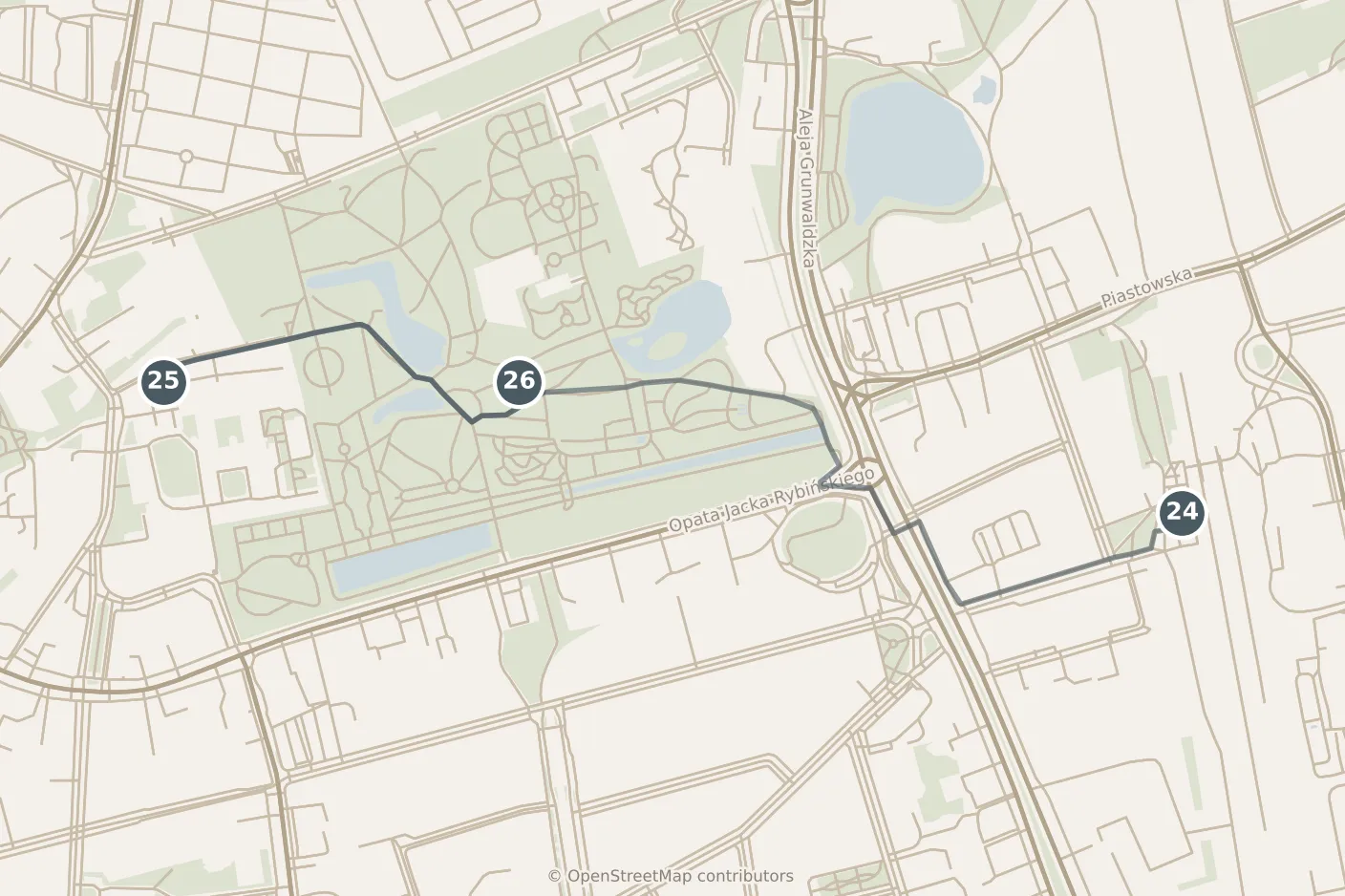
- Morning
- 24Gdańsk Oliwa
- 25Oliwa Cathedral
- 26Oliwa Park
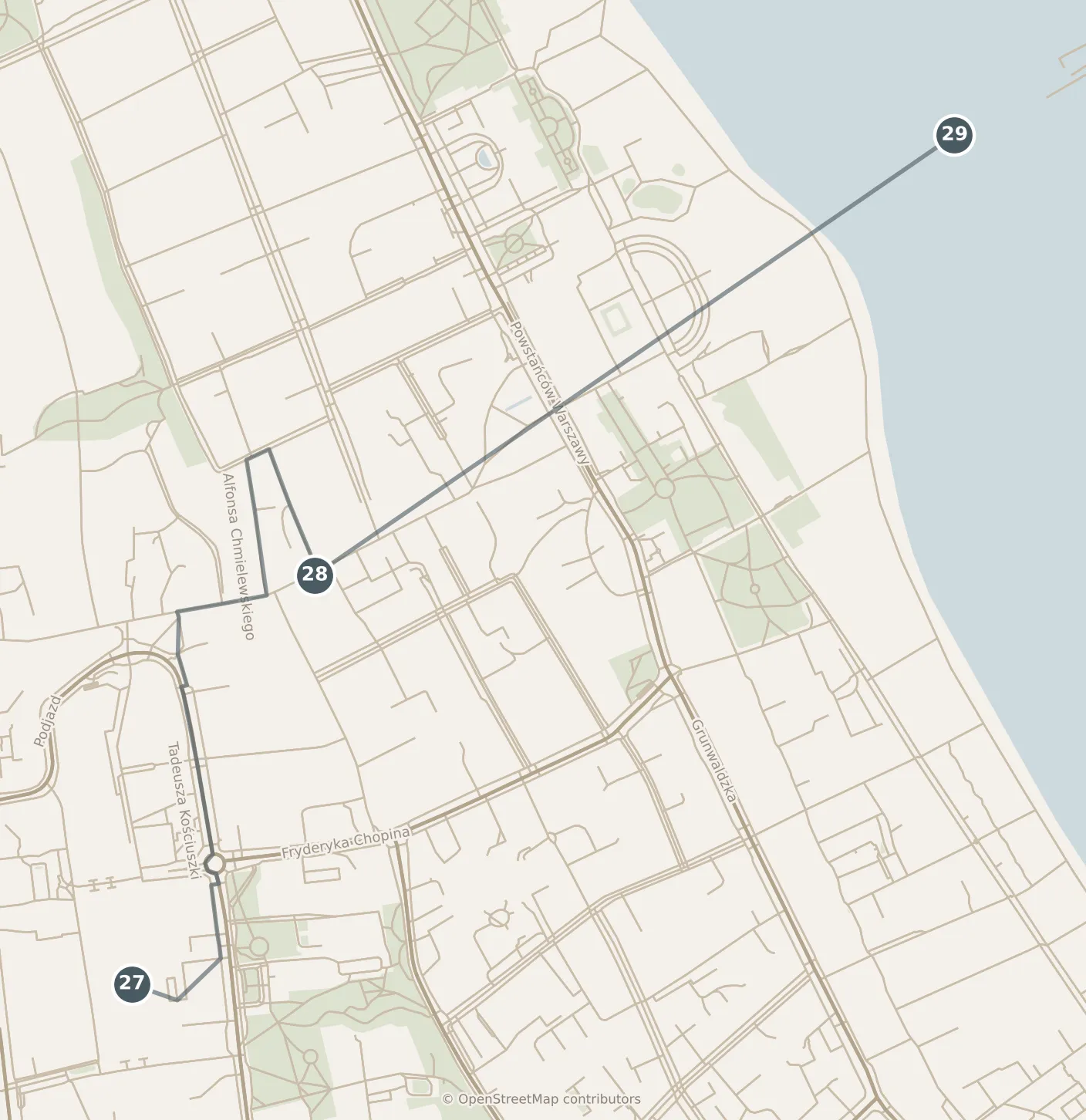
- Afternoon
- 27Sopot station
- 28Monte Cassino Street
- 29Sopot Pier
The third day leaves the city by train, north along the coast. The morning is at Oliwa, a quiet district with a cathedral and a formal park. The afternoon is in Sopot, the resort town with the pier. It is the slower day, deliberately: the inside time adds up to about four hours, plus three train journeys of under half an hour each. There is no hour it has to be timed to.
Morning
From Gdańsk Główny, take the SKM northbound to Gdańsk Oliwa. Buy a ticket to Gdańsk Oliwa from the machine on the platform; the parent guide covers how the fares work. The ride takes under twenty minutes. From the station, the cathedral is about twenty minutes on foot, walking away from the tracks and uphill.
Oliwa Cathedral was the church of a Cistercian abbey. It is long, narrow and white inside, and almost everything about it is quiet except the organ. The organ is a Rococo instrument filling the west end, with carved angels that move and gilded stars that turn while it plays. In season the cathedral holds short organ recitals at set times. It publishes the times itself, and they are the reason to come here rather than to another church, so read them the week before and build the morning around the one that fits. Give the cathedral forty-five minutes including a recital.
Next to it is Oliwa Park, a formal park of hedged walks and avenues that was once the abbots’ garden. It has a glasshouse with palms and the abbots’ palace at one edge. Give it forty-five minutes and walk it slowly. Then walk back to Gdańsk Oliwa station, about twenty minutes, and catch the SKM northbound again.
Afternoon
It is a few stops on to Sopot, under ten minutes. From Sopot station walk downhill to the sea along Bohaterów Monte Cassino Street (Monciak to everyone in Sopot), the town’s pedestrian main street, which takes about twenty minutes. It is loud and fun in summer and half-shut in winter, and it is a better street to walk down than to stop in.
At its end is Sopot Pier, a wooden pier more than half a kilometer long, most of it out over the Baltic. Walk to the end and back, about half an hour, for the open sea and the coast running away in both directions towards Gdańsk and Gdynia. In the summer season a ticket is sold at the entrance to walk the pier, at the gate itself.
Then the beach. If you swim, do it only at a guarded bathing area, which is marked and staffed in the summer season. Read the flag: white means swimming is allowed, red means it is not. The Baltic here is cold and shallow for a long way out, and the flags exist because people still drown off these beaches.
Walk back up Monte Cassino Street to Sopot station, twenty minutes, and take the SKM southbound to Gdańsk Główny, which takes about twenty-five minutes.
If it is raining, Sopot is the half you drop. From Oliwa, take the SKM straight back to Gdańsk Główny. Then walk about twenty-five minutes south, past the Upland Gate, to the National Museum, which is in a former Franciscan monastery on the southern edge of the Main Town. The reason to go is the original Last Judgment by Hans Memling, whose copy you saw in St Mary’s: a great Flemish triptych of heaven and hell, which was on its way to Florence when Gdańsk privateers captured the ship carrying it. Give the triptych half an hour on its own, and the rest of the collection an hour at most. The museum publishes its own weekly closing day, so check it if you are counting on it as the rainy option. From there it is the same twenty-five minutes back to the station.
Practicalities
Nothing on this route has to be booked before you arrive. The Museum of the Second World War and the European Solidarity Centre both sell tickets at the door and online, and in summer the line at the war museum’s door is the reason to buy online the evening before.
The two large museums on day two, and the Museum of Gdańsk branches (Uphagen House, the Main Town Hall and Artus Court on day one, the Polish Post Office on day two), have closing days: the war museum on Mondays, the Solidarity Centre’s exhibition on Tuesdays from October to April, and each Museum of Gdańsk branch on a weekly day of its own. Check which day before you fix your dates. These are the load-bearing days. Day two cannot fall on a Monday, because there is no morning without the war museum, and from October to April it cannot fall on a Tuesday either, when the Solidarity Centre’s exhibition is shut. Day one can survive a closure of the Museum of Gdańsk, since its streets, churches and river do not close. The third day takes any date, because nothing on it is a museum except the rainy-day option. So if a closure lands on day one or day two, swap that day with the third. That is the only trade the article needs. The case to watch is a three-day trip whose second day lands on a Monday. There the fix is to do the coast second and the museums third, except from October to April, when the third day would then be a Tuesday: in those months put the museums on the first day instead, and the Main Town on the third.
Moving between stops: days one and two are on foot throughout, and the longest single walk is the twenty-five minutes from Granary Island back to Gdańsk Główny. The third day uses three SKM rides: Gdańsk Główny to Gdańsk Oliwa, Gdańsk Oliwa to Sopot, and Sopot back to Gdańsk Główny. From the airport, the PKM train runs from Gdańsk Port Lotniczy to Gdańsk Wrzeszcz, where you change to the SKM for Gdańsk Główny. The parent guide covers how the train and tram tickets differ.


