Gdańsk in one day: from the shipyard gate to the river, on foot

Last updated 1 October 2026
Overview
Gdańsk tells two stories, and one day can hold both if they come in the right order. The first is the twentieth century: the shipyard where the strikes of August 1980 began and Solidarity was founded. The second is the merchant city on the Motława, which was rebuilt brick by brick after 1945 so convincingly that it is easy to take it for the original. Do the shipyard first. It needs a clear head and two uninterrupted hours, and it sits on the north edge of the center. The rebuilt Main Town is the part of the day that runs best on a full stomach and loose time.
The whole route is on foot and needs no ticket for public transport. None of the stops is more than a twenty-minute walk from the last. It starts at Gdańsk Główny, the main railway station, and ends about seventeen minutes’ walk from it.
What one day gives up is everything outside the center. Westerplatte, where the war began, is a boat or bus ride out. Oliwa’s cathedral and Sopot’s pier each deserve half a day of their own. The museums of the Main Town, apart from the one hall chosen below, are the first thing to go, and so is the Amber Museum, which now fills the Great Mill you will look at from outside, and the Polish Post Office a few minutes east of it.
This day has no hinge: no view that needs the dusk, no market that is only a market at dawn. The river is good at any hour. So anchor the day to its start instead. The European Solidarity Centre is the stop that most rewards arriving fresh and early, before the school groups, so make its opening your start. The center publishes its own hours; read them the week before. From there, the recommendations below come to roughly six hours inside places and over lunch, plus about an hour and a quarter on foot. Call it seven and a half hours from the center’s door to the station. That count covers time at the stops and nothing else. It leaves out the summer line at the foot of St Mary’s tower, which is the largest thing it omits, and the minutes lost at ticket desks.
Most readers of a single day arrive by train with a bag. Leave it in the lockers at Gdańsk Główny before you set out; if you cannot see them, ask at the information point in the main hall. Do not take it up St Mary’s tower, which is a long, narrow climb.
The day

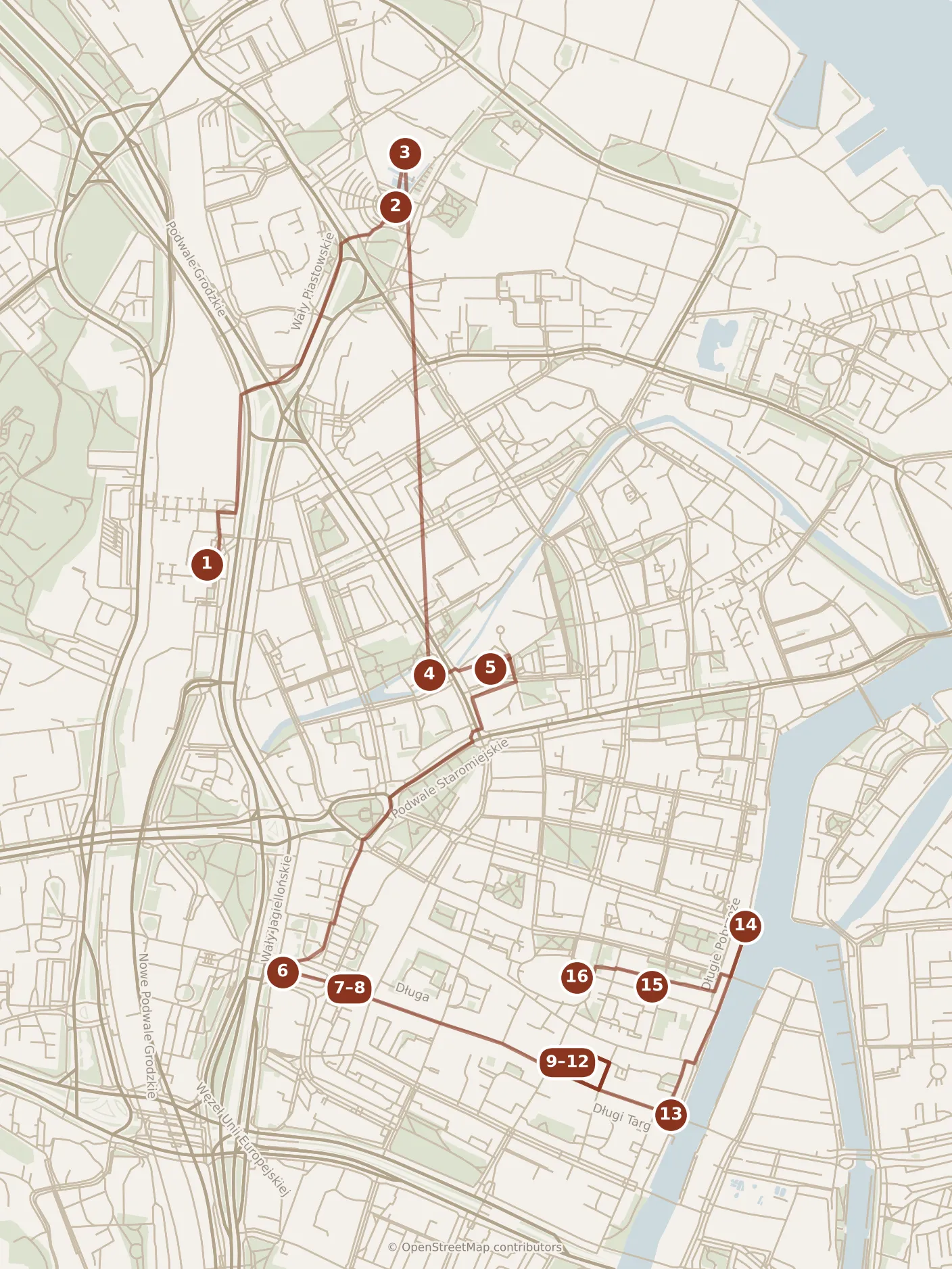
- The day
- 1Gdańsk Główny
- 2Monument to the Fallen Shipyard Workers
- 3European Solidarity Centre
- 4Great Mill
- 5St Catherine's Church
- 6Upland Gate
- 7Golden Gate
- 8Long Street
- 9Main Town Hall
- 10Long Market
- 11Neptune's Fountain
- 12Artus Court
- 13Green Gate
- 14Crane
- 15Mariacka Street
- 16St Mary's Church
Morning
The first leg is the walk from Gdańsk Główny, and it is short. Leave the station by the main entrance and head north along the line of the old fortifications, with the Old Town on your right. It takes about eleven minutes to reach Plac Solidarności and the Monument to the Fallen Shipyard Workers. If you have come in from the airport, the PKM train takes you to Gdańsk Wrzeszcz, where you change to the SKM for the three stops into Gdańsk Główny.
The monument is three steel crosses forty-two meters tall, each carrying an anchor. It commemorates the workers killed in the strikes of December 1970. It was put up in 1980, as one of the demands of the strike that founded Solidarity, which makes it a monument the strikers won from the communist government at the negotiating table. Give it ten minutes. Then look across at Gate No. 2 of the shipyard, the gate Lech Wałęsa addressed the strikers from, before walking the two minutes to the building behind it.
The European Solidarity Centre opened in 2014. Its walls are rust-colored steel plates set at angles, like the hull sections of a ship under construction, and that is the intent. The permanent exhibition is the reason for the whole morning. It runs in chronological rooms from the strikes of 1970 to the fall of communism, and it is walked with an audioguide. The object to stop at is the pair of wooden boards on which the strikers wrote their twenty-one demands in August 1980 and hung them on the shipyard gate. Give the exhibition two hours. The first half, from the strikes to martial law, is the part to take slowly. If you are flagging by the rooms after 1989, move through them faster: they explain events you probably know better than the earlier ones. Before you leave, go up to the roof terrace for the view over the cranes of the shipyard, which is the closest look today at the industrial city.
Local tip. If the morning has started late, keep the two hours for the exhibition and drop the roof. The view is a good postscript; the boards with the demands are the reason you came.
Walk south from the center into the Old Town, about seventeen minutes, to the Great Mill. It is a long brick building with an enormous pitched roof, built by the Teutonic Knights in the fourteenth century and for centuries one of the largest mills in Europe. It now houses the Amber Museum, which this day gives up: look at it from outside and move on. Directly behind it stands St Catherine’s Church, the oldest parish church in the city. Johannes Hevelius, the astronomer who mapped the moon from the rooftops of Gdańsk, is buried inside. Ten minutes in the nave is plenty, unless the carillon in the tower is playing, in which case stay outside for it.
Afternoon
From St Catherine’s, walk about nine minutes south to the start of the Royal Route, the procession way that kings entering the city followed. It begins at the Upland Gate, a heavy stone gate of 1588 carved with the arms of Prussia, Poland and Gdańsk. Behind it is the brick bulk of the Prison Tower. Walk past it. The Golden Gate comes next. It is an early seventeenth-century triumphal arch topped with statues standing for the civic virtues, and the moment you pass through it you are on Długa, Long Street.
Long Street is the postcard. Tall, narrow merchant houses with painted and gilded façades line it, each one a little different, and nearly every one is a post-war reconstruction. Walk it slowly and look up rather than at the shop windows; ten minutes is enough. At its eastern end stands the Main Town Hall. Its Gothic tower carries a gilded statue of King Sigismund Augustus at the very top, and it is the landmark you will keep orienting by for the rest of the day.
Past the town hall, the street widens into the Long Market, Długi Targ. In the middle stands Neptune’s Fountain, a bronze sea god from 1633 that the city treats as its emblem. Behind Neptune is Artus Court, the one interior this afternoon spends a ticket on. This was the great hall where the city’s merchants met, drank and did business. It is a single tall Gothic room with star vaulting on slender columns, hung with ship models and paintings. In one corner stands a Renaissance tiled stove over ten meters high, the thing to stand under. Give it forty minutes and no more. It is one room, and its whole effect is visible in the first five.
Lunch goes here, on or just off the Long Market. Sit down for an hour. The streets running north off the square, towards St Mary’s, are usually less crowded than the square itself, and you are walking that way next.
The Long Market ends at the Green Gate. It was built as a residence for visiting Polish kings, who in the event never used it. Walk through its arches and you are suddenly on the river: the Motława, with the brick warehouses of Granary Island on the far bank.
Evening
Turn left and walk north along the embankment, about five minutes, to the Crane, Żuraw. It is a fifteenth-century port crane built into a city gate, two squat brick towers with a timber housing jutting out over the water. Men walking inside giant wooden treadwheels powered it, lifting cargo and setting masts into ships. It is the outside that matters here: look at it from the embankment and then from a few steps back, with the river beside it. Going inside is part of the National Maritime Museum’s ticket and not part of this day.
Just before the Crane, a gate leads off the embankment into Mariacka Street. Every house has a raised stone terrace in front of its door, and stone gutter-spouts carved as animal heads jut out above the sidewalk. Many of the shops sell amber, which you can look at without buying. Walk it slowly, five or ten minutes, and the street delivers you to the east end of St Mary’s Church.
St Mary’s is one of the largest brick churches in the world, and inside it feels more like a covered square than a nave: white walls, white vaults, almost nothing between you and the roof. The two things to find are the astronomical clock of the 1460s, a tall painted face with the zodiac around it, and the copy of Hans Memling’s Last Judgment. The original is in the National Museum, which is the museum this day does not reach. St Mary’s is a working church, so if Mass is being said, stay at the back and keep quiet until it ends. Then climb the tower: over four hundred steps to a platform above every roof in the city, with the town hall spire below you, the cranes of the shipyard you started at to the north, and the river to the east. Give the church and the climb an hour together. In high summer, add the line at the foot of the stairs, which the overall count does not include.
From St Mary’s, Gdańsk Główny is about seventeen minutes on foot, north-west through the streets of the Main Town and past the Upland Gate side of the old walls. That is where the lockers are and where the day closes. If your train is close, this is the leg not to compress: leave the tower with twenty-five minutes in hand.
Practicalities
Nothing on this route has to be booked in advance. The one time to check is the last climb of St Mary’s tower: the day reaches it about seven hours after the Solidarity Centre’s opening, so look it up the week before and move the start earlier if the two do not fit. The European Solidarity Centre, Artus Court and the tower of St Mary’s all sell tickets at the door. The center also sells its exhibition tickets online, which is worth doing if you are arriving at its opening, so that the desk does not eat into the morning. Artus Court belongs to the Museum of Gdańsk, which publishes its own hours and closing days. The European Solidarity Centre’s exhibition closes on Tuesdays from October to April and opens daily from May to September.
Two interiors could break this day if your day is their closing day: Artus Court and the Solidarity exhibition. Check both the week before. If Artus Court is shut, nothing moves: the Main Town Hall stands on the same square, also belongs to the Museum of Gdańsk, and is the natural replacement for the same forty minutes, unless both are closed on the same day. If the Solidarity exhibition is shut, that is the bigger loss. Take the morning more slowly through the Old Town instead, and give the freed hour to the Main Town Hall and to a longer stretch on the river. The monument and the shipyard gate stand outside and are there every day.
If it rains, the climb is the stop that loses its point. Skip the tower and give that hour to the Main Town Hall on the Long Market, which you will already have passed. Its painted council chamber is the one that sits above the street you just walked.
If the day is shorter than seven and a half hours, cut Artus Court first. It is the most replaceable interior, and the Long Market can be enjoyed entirely from outside. Cut the tower second. Do not cut the European Solidarity Centre: without it, this becomes a day of handsome façades, and the reason Gdańsk matters to the century you live in goes unseen.
Every leg is on foot. The longest stretches are the seventeen minutes south from the European Solidarity Centre to the Great Mill and the seventeen minutes from St Mary’s back to Gdańsk Główny. Everything between them is a few minutes apart.


