Florence in 2–3 days: the interiors one day cannot hold, and a third across the river

Last updated 8 August 2026
Overview
One day in Florence is a subtraction problem. The center is a kilometer across, so nothing is far; what the day is really spent on is deciding which of the great interiors to give up. Two days do not solve that problem so much as change it. What the second day buys is not more places — it is the insides of places a single day can only look at from the sidewalk. You climb into the dome instead of standing under it. You see the originals of the bronze doors instead of the casts bolted to the building. You meet the marble that the copies in the squares are copies of, and you meet it in the right order.
So the shape below is deliberate. Day one is the cathedral complex and the quarter immediately north of it — five interiors inside a seven-hundred-meter stretch, four of them within four hundred meters of the same square. Day two runs west to east along the civic city — bridge, gallery, square, palace, the museum in the old police headquarters, one basilica — and then crosses the river and climbs. Neither day crosses its own path, and the second day answers the first: the trial panel that lost the competition for the doors is in a room you reach on day two, and it only means anything if you saw the doors on day one.
It is still not the whole city. Two days do not hold the Oltrarno, and they do not hold Palazzo Pitti at all. That is what the third day is for: the south bank, and the air two days of interiors leave you short of, with the palace’s own gallery there as the swap if you would rather have more paintings than a hillside. It is a third day rather than a stretched second one.
Everything below is walked. Once you have arrived there is no ride in these three days except the optional bus off the hill at the end, so what this route asks of you before you arrive is not a transport pass but bookings. Three of them for the two days: the timed reservation for the dome climb on day one, the Galleria dell’Accademia on day one, and the Uffizi Gallery on day two. A third day adds a fourth, the Brancacci Chapel. In 2026 the Uffizi asked something under thirty euro, a few euro less at the desk on the day than for a slot fixed in advance — pay the difference anyway, because day two is built on getting the earliest slot there is; the Accademia sat in the twenty-to-twenty-five-euro range once its booking fee was in it; the Brancacci Chapel was in the ten-euro range. The cathedral’s own foundation sells one combined pass for the whole Duomo complex and publishes its tiers itself. How the buses and the trams are paid for belongs to the city guide, and that is worth reading before you arrive holding nothing.
Day two is the day that ends on the light — or the third day, if you take one, because the climb moves onto it. The light is the only thing here nobody can reschedule. The sun goes down somewhere between twenty to five, in the second week of December, and a couple of minutes past nine, in the last week of June. On a two-day trip, take your own month’s hour and count back the nine and a half hours day two comes to, which is worked out at the end of that day. On a three-day trip, in the ordinary case, do not count back at all: the last day is pinned at the front by an opening hour and at the back by a closing one, so it is run forwards from the morning, and its own count is at the end of it. In the two arrangements that leave the climb on day two — the third day’s Palatine Gallery swap, and a Tuesday reordering — count back as on a two-day trip. Day one has no hinge in the sky and I have not invented one for it. Its fixed point is at the start instead — the dome slot, and everything falls in behind it as far as the Accademia, which is booked at the far end of the same day and is the one thing a late dome slot can run into.
One weekday decides more here than anywhere, and it is not one you can dodge by shuffling. The Uffizi, the Accademia, the Bargello and the Medici Chapels all close on Mondays, which puts a closure inside both days below, so swapping them saves nothing. The Practicalities give the rules rather than a start date, because your flight lands when it lands.
Left luggage is at Santa Maria Novella, where day one begins, and day one begins there partly for that reason. Do not carry a case into the first afternoon: the Accademia has no cloakroom and turns large bags and backpacks away at the door, which is a bad thing to learn after waiting in line. The last evening has a bag problem of its own, and it is in the Practicalities.
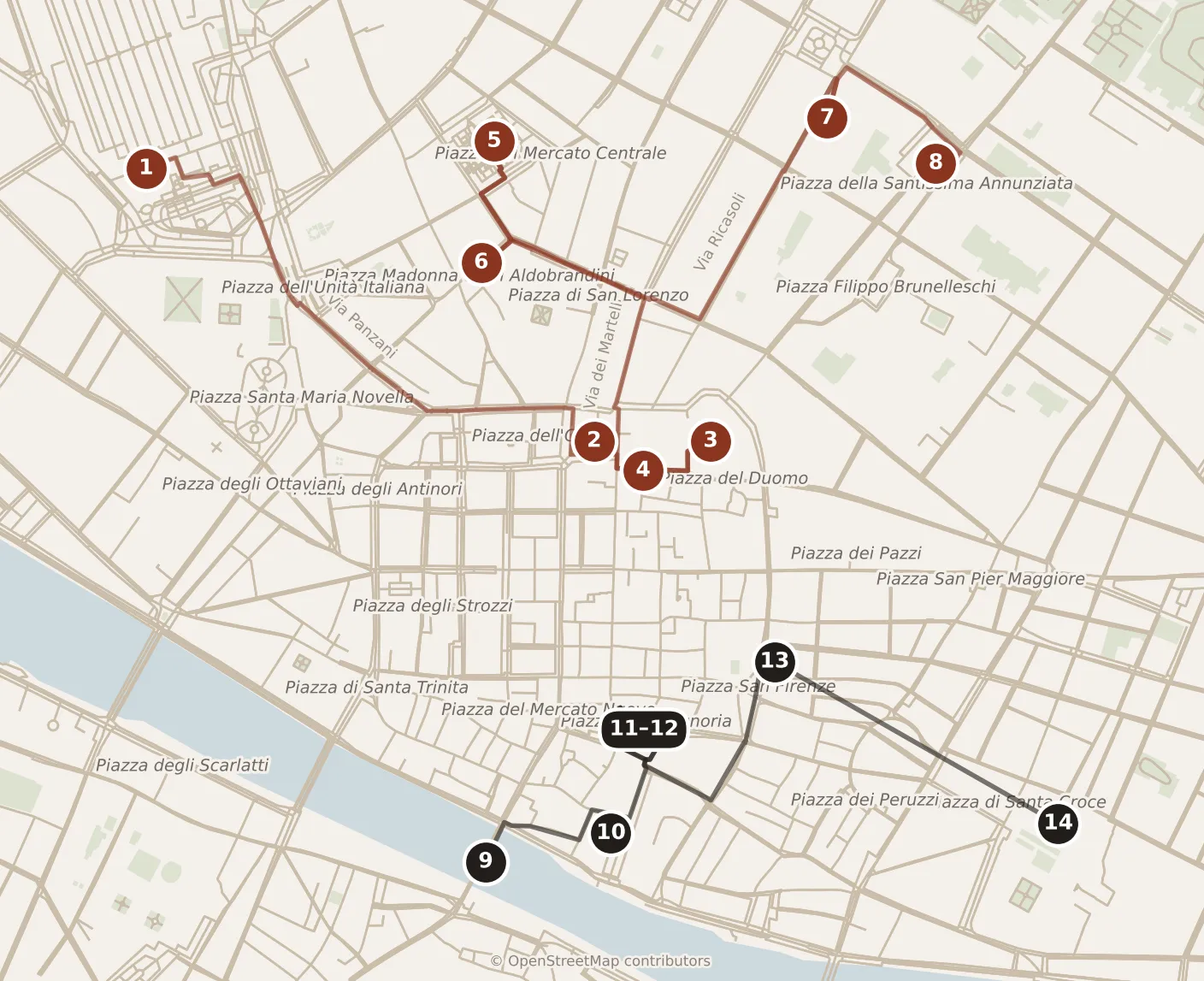
- Day one
- 1Firenze Santa Maria Novella
- 2Florence Baptistery
- 3Florence Cathedral
- 4Museo dell'Opera del Duomo
- 5Mercato Centrale
- 6Medici Chapels
- 7Galleria dell'Accademia
- 8Piazza della Santissima Annunziata
- Day two
- 9Ponte Vecchio
- 10Uffizi Gallery
- 11Piazza della Signoria
- 12Palazzo Vecchio
- 13Bargello National Museum
- 14Basilica of Santa Croce
Day one

Today takes the heaviest interiors of the trip, and the compactness the Overview measured is exactly why it can: you are never more than ten minutes from the next door, so the hours go into rooms rather than into streets.
Morning
Come out of the front of Firenze Santa Maria Novella and walk east through the lanes — about a quarter of an hour to the cathedral square, and walking it is not a preference: the trams serve the station and the airport and do not reach the old center at all. If you have flown in, the T2 sets you down at the Unità stop beside the station and you start from the same paving as everyone off a train.
Begin with the Florence Baptistery, because it is the oldest thing on the square and everything around it was built as an answer to it. The green and white marble outside is Romanesque geometry of the eleventh and twelfth centuries. What is fixed to its three doorways today is casts; the originals were taken down between 1990 and 2009 and are indoors two minutes away, which is the logic of this whole morning — outside is the copy, inside is the thing. Ten minutes on the outside, then go in, and go in for the ceiling: a dome lined with gold-ground mosaic, a Last Judgment running across it, the whole surface glinting in a way no photograph reproduces. Restoration of those mosaics began in 2023 and the building has stayed open through the works rather than shutting for them; read what stage it has reached before you come, and build the morning so that the answer does not change it. Half an hour inside.
Three minutes east is Florence Cathedral. The striped front looks medieval and is not. The church stood with a bare brick face for five hundred years, and the marble on it now was chosen by competition in 1864 and built between 1876 and 1887 — a Victorian facade on a fourteenth-century building, which is the sort of thing the most photographed square in the city never tells you.
The nave is free to walk into and there is startlingly little in it, because almost everything made for this church has gone to the museum you will finish the morning in. Twenty minutes, and spend them looking up: 3,600 square meters of Last Judgment across the inside of the dome, begun by Vasari in 1572 and finished by Zuccari in 1579. This is a working cathedral, and covered shoulders and knees are enforced at the door in August as firmly as in February — a scarf in the bag settles it, and it is a cheaper solution than the one being sold outside.
Then the climb, which is why day one has a fixed start. It is 463 steps with a timed reservation of its own inside the Duomo pass, the entrance is not the cathedral’s front door, and your slot names it. What it gives that no other view of this city gives is the middle of the building: the staircase runs between the two shells of the dome, so you come out on a walkway at the base of the frescoes you were craning at from the floor half an hour before and look at that Last Judgment from a few feet rather than from ninety, and then keep going to the lantern above everything. Give it an hour. There is no elevator, no shortcut down, and nowhere on the way up to change your mind, so it is a poor idea for anyone unhappy in a narrow stair.
If the stairs are wrong for you, or the slots have gone, the swap is Giotto’s bell tower on the same square, and it is a real swap rather than a consolation. It is on the same combined pass, it takes about the same hour, it is 414 steps against the dome’s 463 with open landings instead of a tunnel, and it gives you the one thing the dome cannot: a view of Florence with the dome in it. What it is not is an easier climb: forty-nine steps is eleven per cent, and there is no elevator in either. What it gives is the air, the landings, and being able to stop or turn back partway, which is the whole difference for a reader who dislikes the tunnel and no difference at all for legs the dome would defeat. Nothing else below moves.
Finish the morning at the Museo dell’Opera del Duomo, two minutes round the far end of the cathedral, and it is the best museum in Florence that nobody plans for. All three sets of Baptistery doors are in here — Andrea Pisano’s of 1330–36, Ghiberti’s north doors of 1403–24, and his Gates of Paradise, ten Old Testament panels begun in 1425 and not finished until 1447. So is Donatello’s wooden Mary Magdalene, gaunt, gilded and unlike anything else he made, and the late Pietà Michelangelo cut for his own tomb between 1547 and 1555 and then broke. The largest room reconstructs the cathedral’s demolished medieval front at full size with the original statues set back into their places, so you stand in front of the facade that was there before the one you were looking at ten minutes ago. An hour and a half.
Local tip. Every original sculpture that once stood on the outsides of these buildings is now indoors on this square, and what is out there is a copy or a Victorian replacement. If the morning runs short, keep the museum and let the outsides go: the copies are free, they are in the open air, and you can stand a foot from them, which is more than the originals allow.
Afternoon
Nine minutes north-west is the Mercato Centrale, and lunch. It is two buildings stacked. The ground floor is a cast-iron and glass market hall of the 1870s that still works as a market — butchers, cheese, vegetables, people buying dinner — and the floor above is a food hall that keeps far longer hours than the market beneath it, which means the upstairs is open at times the downstairs is not. Eat on the upper floor, which is the one that serves rather than sells, and walk the market below on the way in — that half of the building is the reason to arrive early enough to see it. Ribollita, the thick bread-and-vegetable soup that is the everyday Florentine dish rather than the expensive one, is what to look for from October onwards and costs a fraction of what the beef does. Three quarters of an hour.
Three minutes on are the Medici Chapels. You go in from Piazza Madonna degli Aldobrandini at the back of the Basilica of San Lorenzo rather than through the church, and the two are ticketed separately. Inside are two chapels that could not be less alike. The Cappella dei Principi is an octagon lined in inlaid marble and semi-precious stone under a dome fifty-nine meters high, built across the turn of the seventeenth century, and it is the most expensive room in the city and possibly the coldest. Then a door, and Michelangelo’s New Sacristy: his first work as an architect, 1519 to 1524, a small gray and white room with two tombs facing each other and four figures lying on their sloping lids — Night, Day, Dawn and Dusk, for two minor Medici nobody would otherwise remember. Three quarters of an hour, and the second room is where all of it is.
The basilica in front is Brunelleschi’s, with his Old Sacristy at the far end of the same building and the Laurentian Library’s staircase upstairs, and on a trip with a spare hour it is worth one. This afternoon does not have one: the dome is in the morning and the Accademia slot is fixed at the end of it. Walk past the front, which is bare brown stone because the marble facing was designed and never paid for, and know what you are declining rather than missing it by accident. Two more go the same way. Santa Maria Novella stands on the square this morning walked out of, and Orsanmichele two minutes off day two’s line between the square and the Bargello; both are real interiors, and two days hold neither. Walking past a thing you have decided about is a different act from not knowing it was there.
Ten minutes north-east, the last of it up Via Ricasoli, is the Galleria dell’Accademia, on the slot you booked. Nearly everyone comes for one statue, and the domed room built for it earns the ticket on its own: Michelangelo’s David has been indoors since 1873, after three hundred and sixty-nine years standing out in the weather in front of Palazzo Vecchio. But the reason to give this gallery an hour and a quarter rather than twenty minutes is the corridor you walk up to reach it. Four unfinished Prisoners stand along it, cut for a papal tomb that was never built — each one a body half out of its block with the chisel work still raw around it, and the clearest demonstration anywhere of how this man actually worked. They come before the finished figure rather than after it, which is the right order and is the gallery’s one piece of genius. There is an unfinished Saint Matthew, rooms of Florentine panel painting beyond, and a collection of early keyboard and stringed instruments downstairs that most visitors walk straight past. There is a security scan at the door and no cloakroom, and large bags and backpacks are refused; a small day bag is fine.
Evening
Three minutes further and Piazza della Santissima Annunziata is a square with no ticket on it and nothing to wait in line for, and the place to stop moving. Along one side runs the loggia of the Ospedale degli Innocenti — Brunelleschi’s, begun in 1419 and generally called the first Renaissance building — arches on slender columns with a blue and white della Robbia roundel of a swaddled baby in the space above each one, because the building was a foundling hospital and said so in its decoration. Stand in the middle of the square and the day’s argument is in front of you: this arithmetic of column and arch is what the man who solved the dome did when he was handed a flat wall. Twenty minutes.
Eat around here. The streets running between this square and the market are the university and market quarter, so the eating is unceremonious, and this is the night for the bistecca alla fiorentina — a shared kilo of rare beef ordered by weight, a proper dinner and not a lunch, before the day with the most walking in it. It is priced by the kilo and it is the largest bill of the trip: ask that price before it goes on the fire, wherever you sit.
The whole of day one comes to a little over seven hours from the station door with the walking in it. The dome slot is the one that sets its shape: take an early one and everything above falls in behind it, take a late one and the museum gets squeezed against the afternoon. Note what an early one does at the far end, because it is the piece of arithmetic this day hides: begun at eight it puts you in the last square by the middle of the afternoon, hours before dinner. That gap is the day’s only loose stretch and it is yours — go back for San Lorenzo, if its own hours allow it, or take the hours off your feet. Only a late slot carries this day into the evening its last section is named for.
Day two

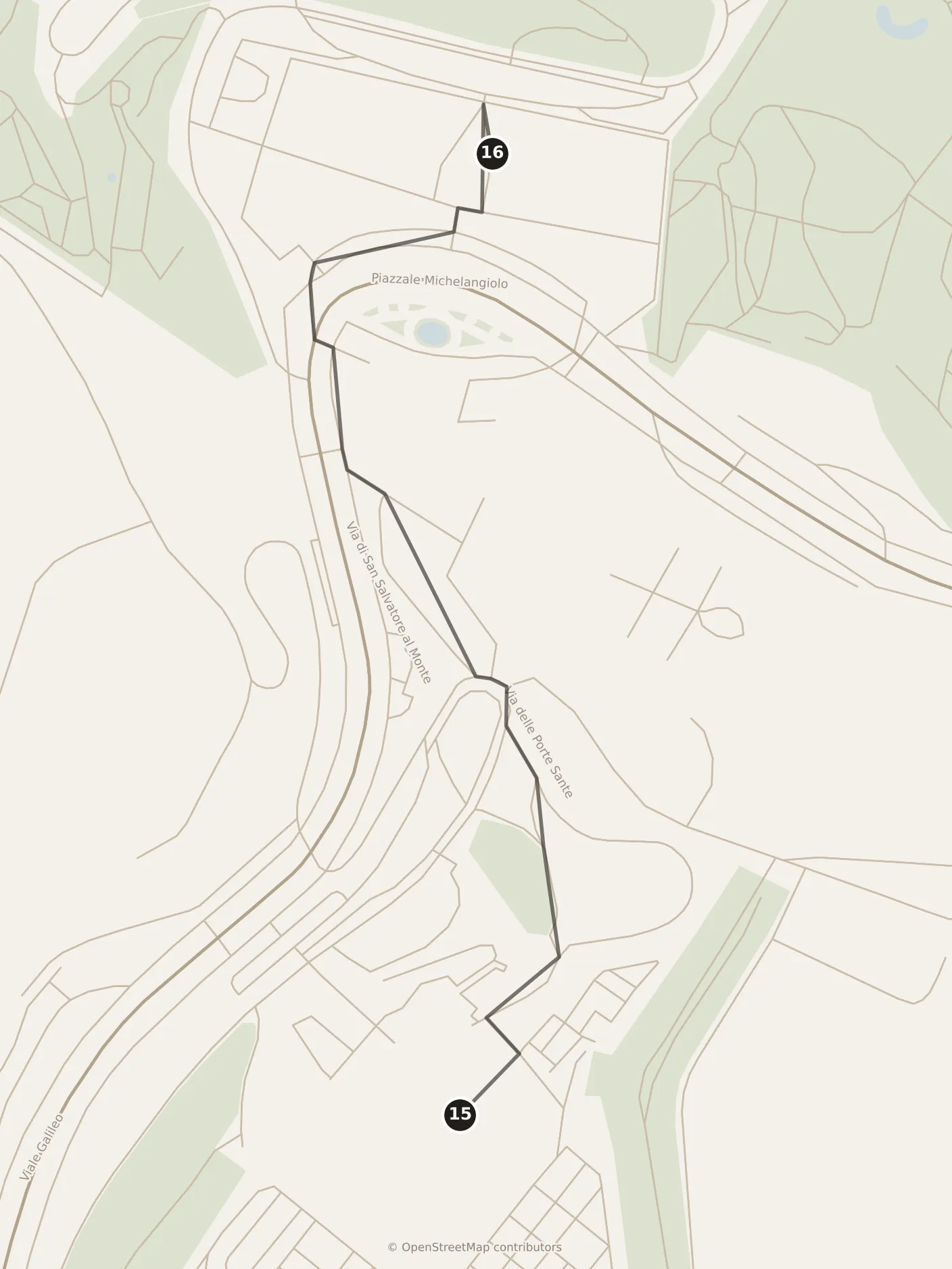
- Evening
- 15San Miniato al Monte
- 16Piazzale Michelangelo
Today is one long movement west to east — bridge, gallery, square, palace, Bargello, basilica — and then across the river and up a hill. You never turn back on yourself. From any base in the center the first stop is under a quarter of an hour on foot, and from the Oltrarno side it is less.
Morning
Start on the Ponte Vecchio before the gallery opens, and start there because of the hour. By late morning it is shoulder to shoulder; at eight it is a street with shuttered shops on it and a fraction of the people it will hold by ten, and you can see the shape of the thing. It has stood in its present form since 1345, and in August 1944 it was the only bridge in Florence not blown up — every other one went, including the one this route crosses on a third day. Running along the top of the shops is the Vasari Corridor, put across in 1565 so that the ruling family could go from the palace to the gallery and on over the river without setting foot in the street: a private half-kilometer above a public one. It is worth twenty minutes to walk the bridge and look at the corridor from below, because the rest of today is spent inside the two buildings it joins.
Three minutes back along the river is the Uffizi Gallery, on the earliest slot you can get, and that early slot is the single largest thing a second day buys. A one-day route has to reach this building in the middle of the afternoon; the difference between the first hour in here and the fourth is not a matter of taste.
What holds the collection together is one family and one document. Nearly everything in the middle of this gallery was bought or commissioned by the Medici, and in 1737 the last of them, Anna Maria Luisa, left the whole of it to the state on the single condition that none of it ever leave Florence. So the rooms are not a survey — they are what one dynasty thought worth owning, in the order it came to think it, and the argument runs forwards. Go forwards with it. Give the gallery two and a half hours. Botticelli and Leonardo are in the middle of the sequence and are where the crowd is; Michelangelo’s round Holy Family, his one certain finished panel painting, is a few doors on; Caravaggio comes near the end and is worth arriving with legs. What to give up is the sculpture along the corridors — Roman marble, most of it good, and bought in Rome by the same family that assembled everything else in here, so what you are cutting is time and not a digression. The short corridor at the river end has windows looking down at the bridge you were standing on before it opened.
Local tip. You will meet the same three or four hands all day, and the sequence is the point: Michelangelo’s David yesterday afternoon, his panel in here, his Bacchus after lunch; Donatello’s lion in copy on the plinth outside, his original an hour later. So if the day runs long, cut a whole building rather than shaving each one. Half an hour taken off four visits buys nothing and spoils all four.
Three minutes north and Piazza della Signoria opens out. Yesterday was originals indoors; this square is the reverse, and it is worth a deliberate quarter of an hour rather than a glance crossing it. The David on the plinth by the palace door is a copy, standing on the spot the real one occupied until it went indoors to the room you were in yesterday. The lion beside it, the Marzocco, is a copy of Donatello’s, and you will be standing in front of the original within the hour. Under the Loggia dei Lanzi — a roofed public platform of the 1380s, with no door, no ticket and no closing time — the bronze Perseus is Cellini’s own, and it is not a copy of anything. And set into the paving in front of the Neptune fountain there is a round marble plaque marking the spot where Savonarola was hanged and burned on 23 May 1498, which is the one thing in this square that most people walk over without seeing.
One minute on is Palazzo Vecchio, and here the interior is the whole point. The Salone dei Cinquecento is fifty-four meters of hall raised for a republican council of five hundred and then painted over, by Vasari, for the duke who had abolished it: battle scenes down the length of both walls, thirty-nine coffered panels overhead, and Michelangelo’s Victory standing in the middle of it. Off that hall, behind a panel, is the Studiolo of Francesco I — a windowless barrel-vaulted closet no wider than a corridor, lined floor to ceiling with small paintings and bronzes, built so that one man could be alone with his things. Beyond are Eleonora’s apartments and the map room, where fifty-three painted maps of the world as it was understood in the 1560s are set into cupboard doors. An hour and a half. The tower is a separate ticket and another three quarters of an hour; take it only if the day is running long, which in the summer half of the year it will be.
Afternoon
Eat near here and eat standing up. Lampredotto — the tripe sandwich, the roll dipped in its own broth, handed over with salsa verde — is sold from carts around the old market squares a few minutes from this one, and it is genuinely the city’s working lunch. Three quarters of an hour.
Four minutes east is the Bargello National Museum, and if you did day one it is the best-argued hour and a half in Florence. The building went up from 1255 as the seat of the city’s chief magistrate, which makes it the oldest public building here; it took its name from the police chief who moved in during 1574, and it is a fortified courtyard with an outside stair, so the sculpture stands in rooms rather than behind glass. Donatello’s marble David is here, made young and still half Gothic, and in the same building his bronze one, the first free-standing male nude cast since antiquity. So are Michelangelo’s unsteady, drunk Bacchus, his Brutus, and the unfinished Pitti Tondo. And in one room, on one wall, hang the two trial panels of the Sacrifice of Isaac that Ghiberti and Brunelleschi submitted in 1401 for the Baptistery door commission — the competition Ghiberti won, which produced the doors you were standing in front of yesterday morning, and which sent the loser away to think about domes instead. Seeing those two panels after the doors and after the climb, rather than before them, is the second day compressed into one wall.
Nine minutes east is the Basilica of Santa Croce, the last interior of the trip and the largest Franciscan church in the world. Its floor and walls are a national pantheon: Michelangelo, Machiavelli and Galileo are buried here, and Dante has a monument but not a grave, because Ravenna has never given the body back. In the first cloister is Brunelleschi’s Pazzi Chapel, a small domed gray and white room and the calmest thing in the city. The Bardi chapel, which holds Giotto’s Stories of Saint Francis, was closed for restoration through 2026; the Opera di Santa Croce publishes the state of the works itself, and the Peruzzi chapel next to it is Giotto too. An hour and a quarter. Shoulders and knees again, and enforced here as firmly as at the cathedral.
Santa Croce is also the stop that goes when the day is short, and it is the only one that can: everything before it is either booked, or the thing a booking was for, or lunch. Cut it and, on a two-day trip, the climb starts from the Bargello instead, which costs about five minutes more and nothing else; the arithmetic is at the end of the evening below. On a three-day trip the climb has usually already moved to the last day, so this day ends when Santa Croce shuts and cutting it buys nothing you need — unless your third day takes the Palatine Gallery rather than the garden, which leaves the climb here and this cut doing the two-day version’s job.
Evening
From the basilica the hill is nearer than it is from the Ponte Vecchio, which is the quiet advantage of finishing the day out here. Cross by Ponte alle Grazie, the nearest bridge to the basilica, and go up: about twenty-five minutes to San Miniato al Monte, most of it climbing, the last part ramps and stairs rather than street. It is the one stretch of these three days that is genuinely bad with anything heavy.
San Miniato was begun in 1013, and its marble front is doing the same thing the Baptistery does — green and white geometry, two centuries earlier than the cathedral — which is a connection two days can show you and one cannot. Inside, the choir is lifted on a platform above an open crypt, so the far end of the church is a stage, and there is an inlaid marble floor of 1207 under your feet with the zodiac worked into it. Behind the church, inside the fortified wall, terraces of nineteenth-century tombs climb the slope: the cemetery of the Porte Sante. The wall itself is why Michelangelo is in this story again: he was put in charge of fortifying this hill during the siege of 1529, and Vasari records that he had the bell tower hung with wool mattresses to soak up the cannon fire. Half an hour for all of it.
This is a working Benedictine monastery first and a monument second. When the community is singing, the church is not yours: sit at the back and be quiet, or wait on the terrace until they have finished. The abbey shuts from one until half past three and closes at seven — earlier than a June sunset, which settles the order for you in the long half of the year instead of leaving it to taste, and earlier than a slow lunch, which is why no version of these days should reach this door before mid-afternoon. Go in when you arrive, and take the view afterwards, for as long as the evening takes.
Eight minutes downhill, Piazzale Michelangelo is where the trip ends, and it is worth knowing that the view is composed because it was built to be. The terrace, the ramps, the boulevards along the old wall line and the bronze David standing in the middle with his back to it are all Poggi’s, laid out in the 1860s while Florence was briefly the capital of Italy. He designed a viewing platform, and it does what it was designed to do: the center lies flat below across the Arno with the dome and the bell tower you climbed this time yesterday standing over it, the bridge you walked at eight this morning among the others, and hills behind. Stay past the sunset rather than for it — what most people leave before is the half hour afterwards, when the dome is floodlit and the sky has not finished.
Counting backwards, whenever this day is the one that ends on the parapet. The durations above — twenty minutes on the bridge, two and a half hours in the gallery, a quarter of an hour in the square, an hour and a half in the palace, three quarters for lunch, an hour and a half in the Bargello, an hour and a quarter in Santa Croce, half an hour on the hilltop — plus fifty minutes of walking and climbing between them, come to about nine and a half hours from the bridge to the parapet. Take your month’s sunset from the Overview and count back that much. In the second week of December it does not fit: twenty to five minus nine and a half hours lands before anything is open. So the December version is the one with Santa Croce cut, which brings it to a little over eight hours: begin at eight with one of the gallery’s earliest slots and you reach the parapet about a quarter of an hour before the sun goes, which in December is the whole of the margin. Half past eight is fifteen minutes too late.
In June the same day begun at eight puts you on the parapet around half past five with three and a half hours of light still to come, and the answer there is to spread rather than to wait — but spread against a ceiling, because Santa Croce shuts at five and the unspread day is already inside it by a quarter past three. There is about half an hour to give away and no more, because an hour and a quarter inside Santa Croce from a quarter past three already leaves at half past four. Spend it on one thing: a slightly later gallery slot, or half an hour more in the Bargello, or a lunch you sit down for — not on all three. The palace tower’s three quarters of an hour will not fit against that ceiling; it belongs to the version below that cuts Santa Croce. And not on the gallery slot at all on a Thursday, when Palazzo Vecchio shuts at two and sells its last ticket an hour before that. The alternative is December’s move: cut Santa Croce, and the whole gap is yours.
That count is time inside places and walking between them, and nothing else. The biggest thing it leaves out is the Uffizi’s entrance. Your slot decides which of two lines you join; it does not carry you past the bag scan behind them. Put a quarter of an hour aside for that and put it at the front of the day, because the far end of the day is the part with a deadline in it.
With a third day

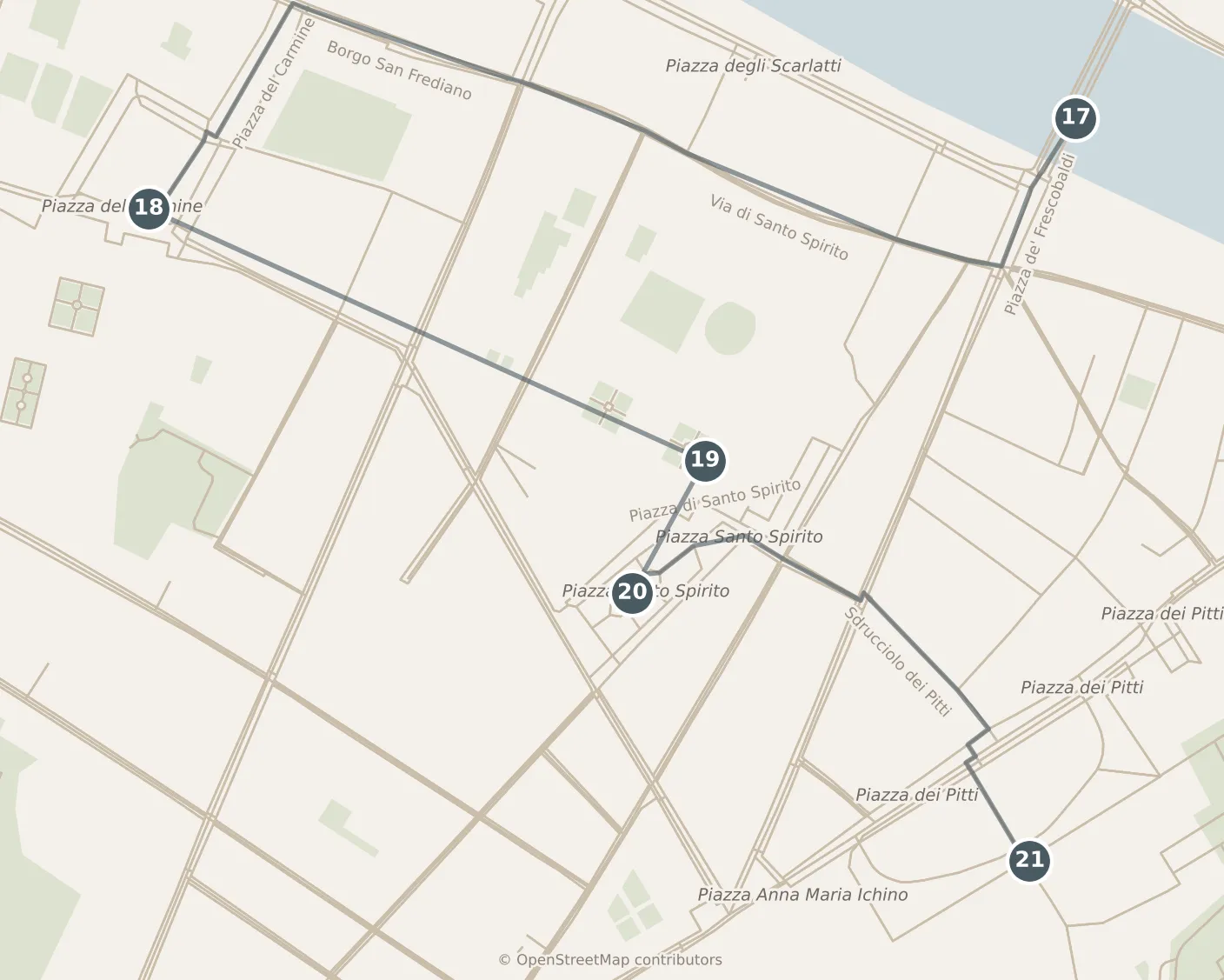
- With a third day
- 17Ponte Santa Trinita
- 18Brancacci Chapel
- 19Basilica of Santo Spirito
- 20Piazza Santo Spirito
- 21Boboli Gardens
The third day is the Oltrarno, the south bank, and it is appended rather than inserted. Days one and two are one argument told in sequence — outside then inside, copy then original, the doors and then the panel that lost to them — and dropping a day of Augustinian churches and a garden into the middle of that breaks it for no gain.
It changes exactly one thing about day two: the climb moves to the end of the third day — unless you take the Palatine Gallery swap below, which leaves it where the two-day plan had it. Day two then finishes in the streets around Santa Croce rather than on the parapet, which costs nothing, because Santa Croce and the Boboli Gardens stand at the foot of the same hill and either one hands you to it. Two things follow. Day two loses its anchor in the light — without the climb and the half hour at the top it comes to a little over eight hours and ends when Santa Croce shuts — so on a three-day trip the light belongs to this day rather than the second. It is not what you count back from, though: this day is pinned at the front by the chapel’s opening and at the back by the abbey’s closing, so it has to be run forwards, and the count is at the end of it. And since the parapet above the abbey takes no ticket and keeps no hours, the evening can still move: if the light on your last evening does not suit, put the climb on any other evening at no cost, carrying the abbey’s hours with it.
The one reason to insert the day rather than append it is a Tuesday — see the Practicalities. If the Tuesday falls where your third day would, move the Oltrarno day to whichever of the three is not a Tuesday and push the day it displaces to the end. The climb goes with whichever day is last, exactly as above.
This is also the loosest day, which is not the same as a day with no clock in it. One booking, and a deadline at each end — the chapel does not open before ten, the abbey shuts at seven — with everything between them taken at your own pace. After two days of timed slots that is most of its value.
Cross by Ponte Santa Trinita rather than the Ponte Vecchio: under ten minutes west from the Piazza della Signoria end of the center, and it is both the better bridge and the better view of the other one. This is the bridge that did not survive 1944. The 1567 design — three flattened arches so shallow they look unable to stand — was dynamited with all the rest, and rebuilt in the 1950s using its own stones dredged back out of the Arno, which is why the parapet is a patchwork of old and new if you look at it rather than through it. Ten minutes.
Eleven minutes west along the south bank is Santa Maria del Carmine, a plain barn of a church that burned in 1771 and lost nearly everything it had, and the Brancacci Chapel off the far end of it, which did not burn. Masolino and Masaccio began the frescoes in 1424; Masaccio was twenty-one, took the commission over, left for Rome in 1427 and died there the year after, and Filippino Lippi finished the walls about fifty years later. What survives is the room where Renaissance painting starts. The Tribute Money puts three moments of one story into a single landscape with every figure standing at real weight on real ground. The Expulsion, on the pier by the entrance, has Adam with his face in his hands and Eve howling with her head thrown back — the first time in a thousand years that painted people are visibly in pain, and every Florentine painter for a century came here to copy it. It is one small room, entry is timed and the number inside at once is limited, and bookings are taken; the city’s civic-museum foundation runs it and publishes both. Three quarters of an hour, and take all of it — there is nothing here to walk past.
Seven minutes east is the Basilica of Santo Spirito, the last building Brunelleschi designed and one he never saw. He died in 1446 with almost nothing of it standing and it was built to his plan afterwards, which makes it the purest room he produced. The front is blank plastered wall, because the facade was never made. Inside is a forest of gray stone columns in even bays with a continuous ring of thirty-eight semicircular chapels running round the whole outer wall, so the building has no corners and no dead ends anywhere in it — stand at the door before walking in and the proportions do the work on their own. Behind the church, the sacristy holds a wooden crucifix Michelangelo carved at about seventeen for the convent that had let him dissect bodies in its hospital: a thin, pale, entirely unheroic Christ, unlike anything he made afterwards. Three quarters of an hour for both halves.
Local tip. The basilica is free to walk into; the rooms behind it are a ticket and a separate route. If you take only one, take the ticketed half. Brunelleschi’s proportions can be read from the doorway in two minutes and cost nothing, and the crucifix cannot be seen anywhere else at all.
Two minutes on is Piazza Santo Spirito, which is the point of the Oltrarno rather than something passed through on the way somewhere. A small produce and bric-a-brac market on most mornings, plane trees, a step to sit on, and no monument whatsoever. Lunch happens here and it should be an hour, sitting down, on the square, with a market on it and nothing at all to tick off — which is the whole reason it is in the route.
Four minutes south the Boboli Gardens climb the hill behind Palazzo Pitti, and this day takes the garden rather than the palace. That is a real choice and worth the reason: after two days of galleries what this trip is short of is air. Boboli is a whole hillside of it, laid out for the Medici from the 1550s — an amphitheatre cut into the slope directly behind the palace with an Egyptian obelisk planted in the middle of it, Buontalenti’s grotto near the entrance with its dripping fake stalactites and stone shepherds, and the Viottolone, a broad cypress avenue running steeply down to a moated oval island of lemon trees. An hour and a half, and all of it is slope.
If you would rather have the paintings, the Palatine Gallery inside Palazzo Pitti is the swap, and it is a proper one: Raphael and Titian hung frame to frame up the walls of the rooms they were bought for, two hours rather than an hour and a half, and two minutes from where you are standing; it takes no timed slot, so the swap adds no fifth booking to the four above. It replaces the garden and nothing else, and it ends the day at the palace gate rather than on the hill, because you will have no legs left for the hill — so if you take it, the climb stays where the two-day plan had it, at the end of day two, and that evening reads exactly as written.
The two of them do not fail on the same Mondays, which is worth having straight before you choose. The gallery shuts on every Monday; the garden shuts only on the first and last Monday of the month. So a middle Monday takes the choice away and hands you the garden, and the first or last Monday of the month — twice a month — shuts both, which is the only arrangement in which this day has no large interior in it at all. It is still a day. The chapel, the basilica, the square and the hill are all open, and the walking simply gets the hours the garden would have had.
If you keep the garden, leave by the high gate at the top rather than the way you came in — the one under the walls of the Forte di Belvedere, the fortress visible above the trees — and follow the hill road east. About half an hour along it, with the city dropping away on your left, and you arrive at San Miniato al Monte and the Piazzale from above rather than up from the river. That approach is better than the climb out of the center, and it is the reason this day has earned the hill. Read day two’s evening for what the abbey and the parapet hold; only the way you arrive changes.
From the bridge to the top of the hill road the third day comes to about five hours, walking included, and then the abbey and the parapet at the end of it. Counting forwards. The chapel does not open before ten, which by the twenty-one minutes of bridge and riverside walk above would put the earliest useful start at twenty to; but the earliest that works is half past ten, because five hours from anything earlier delivers you to the abbey inside the closure between one and half past three. Leave the bridge later than about half past one and the abbey’s seven o’clock takes it from you at the other end instead. Start anywhere between those two and the door is open when you reach it. The parapet is eight minutes further on and keeps no hours at all, so it takes whatever the evening has left, in any month.
Practicalities
Four things are booked before you travel and nothing else on these days is — three of them on the two days, and the fourth only if you take a third. The dome climb carries its own timed reservation inside the Duomo complex’s combined pass, which the cathedral’s foundation sells and which also covers the bell tower, the Baptistery, the museum and the Santa Reparata excavations under the nave. The Galleria dell’Accademia and the Uffizi Gallery both sell timed entry and both are worth fixing weeks ahead in any month of the year; book the Uffizi first, because day two’s whole order hangs off which slot you are given. The Brancacci Chapel, on a third day, takes bookings through the city’s civic-museum foundation. Everything else is free or bought where you stand: the cathedral nave, both squares, the Loggia dei Lanzi, Santo Spirito’s church, San Miniato and the Piazzale cost nothing at all.
The weekday rules, which matter more here than the order does.
The big one: the state museums close on Mondays and the city’s own do not. In 2026 the Uffizi, the Accademia, the Bargello, the Medici Chapels and Palazzo Pitti were all shut on a Monday. Palazzo Vecchio, the Brancacci Chapel, Santa Croce, the Duomo complex and the Boboli Gardens were open. Read that against the days above and the trap shows: day one loses the Accademia and the Medici Chapels, day two loses the Uffizi and the Bargello. Swapping the two days does not save a Monday, because both of them contain one. A Monday inside your dates has to be absorbed rather than dodged, and the way to absorb it is to build that day out of the Monday-proof list — the Duomo complex and the climb in the morning, Palazzo Vecchio and Piazza della Signoria after lunch, Santa Croce, and the Oltrarno if you have a third day, with the garden’s own rule below — leaving the Accademia, the Medici Chapels, the Bargello and the Uffizi to your other days. That is four tickets. On a three-day trip they fit into the other two days without strain. On a two-day trip there is only one day left to take all four, and six hours of ticketed interiors will not go into it: something has to give, and day two’s rule applies — cut a whole building rather than shaving each one. Either way the hill still works, because the rebuilt Monday day ends at Santa Croce, at the foot of it.
Boboli is the exception inside the exception. In 2026 it closed on the first and last Monday of the month and on no other Monday, which is the reverse of everything around it. On a middle Monday the garden is open while the palace beside it is shut, which is precisely the Monday to take the garden rather than the Palatine Gallery. On the first or last Monday of the month neither is open, and that is the only date on which a third day loses both of its options at once — see the third day itself for what it becomes.
Three smaller rules. The first bears on the order of a day, the other two on which date a day can take:
- Palazzo Vecchio shut at two in the afternoon on Thursdays in 2026 and stayed open into the evening every other day. Day two above reaches it before noon, which is why a Thursday costs it nothing — provided the gallery slot stays early, which is the one thing June’s spreading may not move on a Thursday — and it is also why day two is the one day here that must not be run backwards on a Thursday. If the hour has moved since, the method has not: put the palace before lunch and the day survives whatever Thursday turns out to be.
- The Brancacci Chapel was closed on Tuesdays in 2026. Only the third day contains it, so a Tuesday is irrelevant to a two-day trip. If your third day can move, move it — and if all three dates are fixed, the order is not. What moves is which day’s plan falls on which date, and the Oltrarno fits on any day but the arrival morning: put it where the Tuesday is not, push the day it displaces to the end, exactly as the third day itself says, and the chapel survives every Tuesday there is. The only reader who has to give it up is one crossing the river on a single fixed Tuesday, which this route never asks of anyone.
- Sunday is a late start rather than a closure. In 2026 Santa Croce opened at two in the afternoon on Sundays and religious holidays, and the Brancacci Chapel at one. The cathedral is a working cathedral whose nave keeps liturgical hours rather than museum ones, so read the complex’s own hours for a Sunday before you build the morning. A Sunday pushes day two’s afternoon and a third day’s morning; day one minds it least.
Wednesday, Friday and Saturday put nothing in the way of any of the three days. Neither San Miniato nor the Piazzale has a weekday rule at all — but the abbey keeps an hour rule that matters more here than most weekday rules do, because it is the last stop of whichever day is last: it shuts from one until half past three, and it closes at seven. So the last evening has a wall at both ends rather than only at the far one, and both days that finish up there are built against it above. The single thing this list does not settle is the ground floor of the Mercato Centrale, which keeps a market’s week rather than a museum’s — but the food hall above it keeps far longer hours, so day one’s lunch survives whichever day you are there.
The one-line answer these rules compress into is: arrange it so that day one falls on a Tuesday. Day two is then a Wednesday, a third day a Thursday, and every rule above is satisfied without thinking about it. Days one and two will otherwise trade places freely, with one caveat that is easy to miss — day one is written for the morning you arrive, because it starts at the station where the bag goes, while day two assumes you are already in the city at eight. Swap them only if you got in the night before. The arrival that quietly breaks the week is a Sunday, and it is worth naming because nothing about it feels wrong at the time: it puts day one on the Sunday, which day one survives, and day two on the Monday, which shuts the Uffizi and the Bargello. On three days the rule above undoes it — give the Monday to the Oltrarno and the Tuesday to day two’s plan, and the late start is the whole of the cost. On two days there is nowhere to move it to, and the Monday has to be absorbed from the Monday-proof list.
Getting between the stops is walking, all of it. Day one is about three kilometers across the whole day, including the walk in from the station; day two is a little over three to the parapet, of which nearly two are the crossing, the climb and the walk over from the abbey — with about two and a half more if you walk down to the station at the end instead of taking the bus; a third day is a kilometer and a half of Oltrarno streets from the bridge and then a little over two of hill road and the drop off the far side. Nothing between two consecutive stops on days one and two is more than ten minutes on foot, apart from the quarter of an hour in from the station and the climbs at the end. The only ride in these three days is the optional one down off the hill: buses 12 and 13 both link Piazzale Michelangelo with the streets beside Santa Maria Novella, they work the hill in opposite senses, and the destination on the front of the bus is what tells you which of them is going down rather than up — read it before you board. Walking down instead takes about three quarters of an hour and is downhill the whole way.
The bag, at both ends of the trip. Left luggage is at Santa Maria Novella and the first morning starts there. Do not take a case into day one: the Accademia will refuse it at the door for want of a cloakroom, and 463 steps inside a dome is not the place to find out you are carrying too much. If your room is not ready when you land, the detour is small — the station is nine minutes from the Mercato Centrale, which day one walks through anyway — and it is a quarter of an hour spent once.
The other end is harder — unless you took the paintings rather than the garden, because that version ends the last day at the palace gate, on the flat and about twenty minutes from the platforms, with the climb already spent on the evening before; none of what follows is your problem. Otherwise whichever day is your last finishes on the hill, two and a half kilometers from the platforms and well above them, and there is nowhere up there to leave anything. If you travel out that evening the bag comes off the hill with you, on the bus or on your own legs. Read the left-luggage counter’s closing hour when you drop the bag rather than when you come back for it: it ends before the station’s own day does, and a sunset and a late train in the same evening is the one combination on this trip that can go wrong quietly. If the sums will not meet, take the climb on the evening before you leave and give the last afternoon to the streets. The parapet needs no ticket and keeps no hours, which is exactly why it is the piece that can move; only the abbey’s seven o’clock travels with it.


