Florence in one day: the core on foot, one gallery, and the hill at sunset

Last updated 3 August 2026
Overview
Florence gives up more to a single day than most cities do, because the part everyone comes for is barely a kilometer across. The route below is about four and a half kilometers of walking in total. It runs east from the station to the cathedral, turns south to the river, crosses it once and then climbs. It never doubles back.
What one day costs you is two of the three things every list puts at the top, and it is better to name them now than to discover them at four in the afternoon.
The Accademia goes. It is a booked slot, a line and a corridor, for one statue — and you will have stood on that statue’s own ground an hour earlier. The marble in front of Palazzo Vecchio is a copy, but it stands where Michelangelo’s David stood from 1504 until it was carted indoors in 1873. If seeing the original is the reason you are coming to Florence at all, then take it and give up the gallery below instead. That is a coherent day. It is simply not this one.
The dome climb goes for a better reason than time. It is 463 steps and its own timed reservation, and what it delivers is the only view of Florence with the dome missing from it. This day ends instead on the hill across the river, which costs nothing, needs nothing booked, and puts the dome, the bell tower and the bridges in one frame.
That leaves a single appointment, and the whole day is built around it: a timed slot at the Uffizi, in the afternoon. It is the one thing here that cannot be decided on the morning, and it is the only thing on this route you should buy before you travel. The standard ticket was in the twenty-five-to-thirty-euro range in 2026, the lower end of that being the price at the desk and the upper end what you pay to fix a slot online in advance. Booking is what the money buys; except on the free first Sunday of the month, when there is no slot to buy, it is not optional in practice.
The other fixed point is the end of the day, and it is fixed by the sky rather than by anyone’s schedule. Piazzale Michelangelo is, in daylight, a parking lot with a parapet. What makes it worth the climb is the last hour of light, when the city opposite goes from stone to gold and then to lit. So plan backwards from it. The sun sets here from about twenty to five in December to a little after nine at the end of June: take your own month’s hour, and everything above comes to roughly seven and a half hours from the station door, which is when to start. In December that means beginning at about nine, and the day has no slack in it. In June it means three or four spare hours, and they cannot all be pushed onto the end of it: San Miniato closed at seven in the evening in 2026, whatever the sky was doing, so in June the church comes well before the light and the wait happens up on the hill. Take whatever closing hour you find: the rule it produces does not move — when the sun sets after the abbey shuts, the church is seen first and the sky is waited for outside. Put the spare hours into a second church, a longer lunch and an hour in the Oltrarno between the bridge and the climb.
That seven and a half hours is a sum of the time you spend inside places and walking between them, and it counts nothing else. The omission that will bite is the Uffizi’s front door: a timed slot puts you in the shorter of two lines, not past the security check, so allow a quarter of an hour there and do not borrow it from the morning.
Left luggage is at Santa Maria Novella station, which is where this day starts — and the day does not come back for it on foot. It finishes two and a half kilometers away and well above the river, and getting down to the bag is a bus. That is in the Practicalities, and it is worth reading before you leave the platforms.
The day

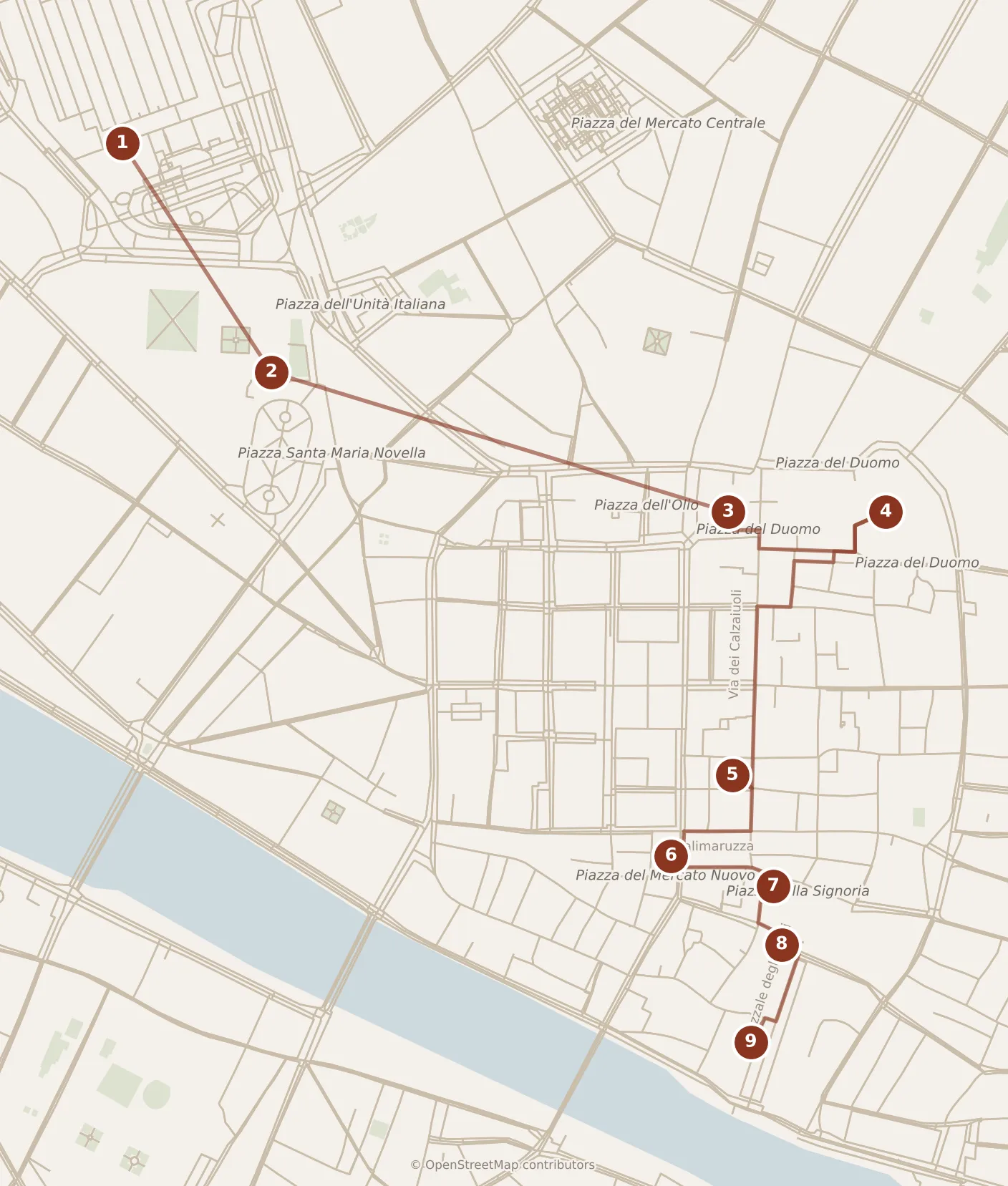
- Morning and afternoon
- 1Santa Maria Novella station
- 2Basilica of Santa Maria Novella
- 3Florence Baptistery
- 4Florence Cathedral
- 5Orsanmichele
- 6Loggia del Mercato Nuovo
- 7Piazza della Signoria
- 8Loggia dei Lanzi
- 9Uffizi Gallery
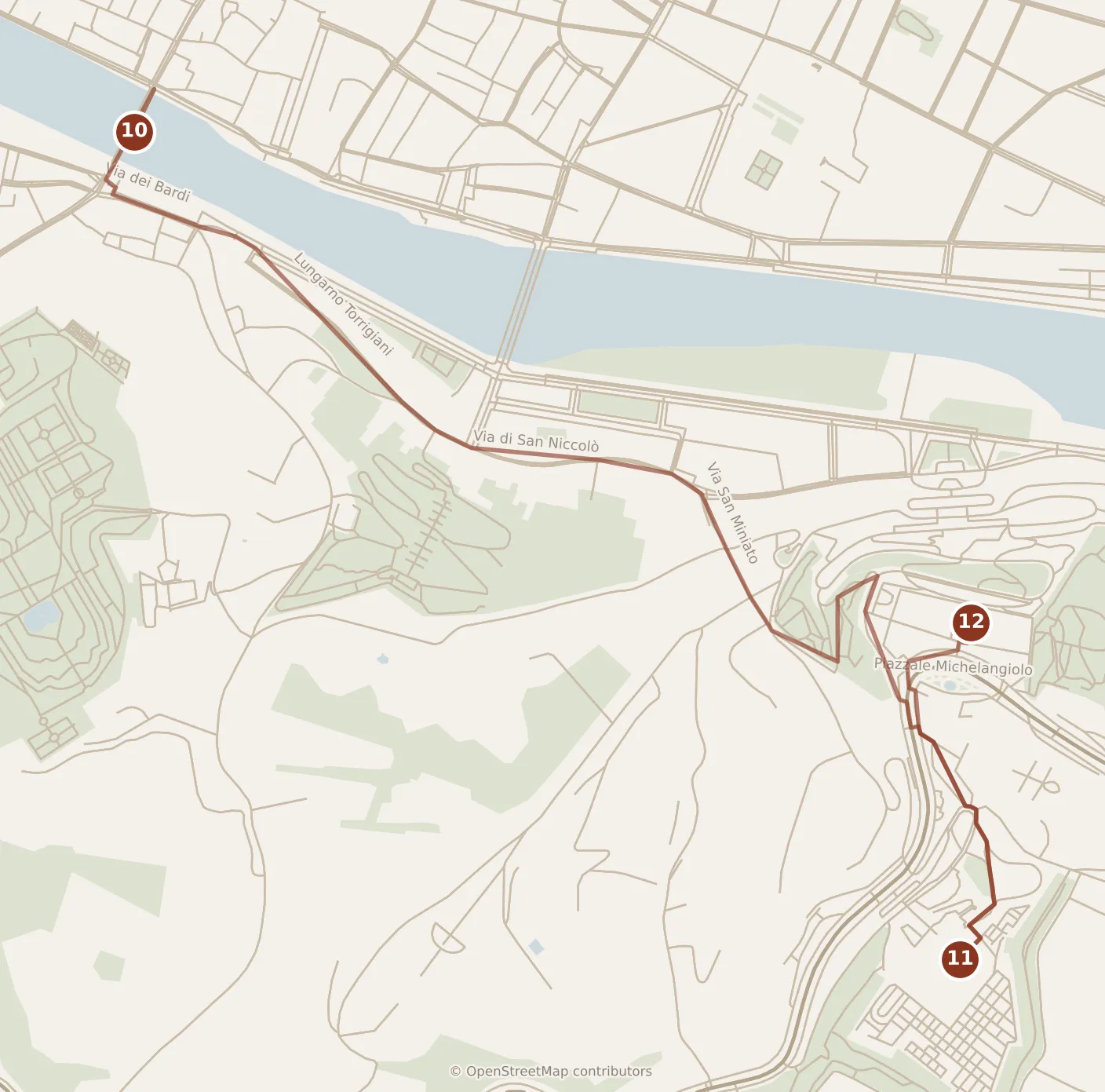
- Evening
- 10Ponte Vecchio
- 11San Miniato al Monte
- 12Piazzale Michelangelo
Morning
Begin at Santa Maria Novella station, and not only because the bag is there. The basilica the station is named after stands five minutes from the platforms on its own wide square, and it is the quietest of the great churches on this route by a long way, which on a day like this buys you more than another famous thing would. The front is two buildings at once: a striped Gothic lower half, and above it the facade Alberti finished around 1470, with the enormous scrolled volutes that Renaissance church fronts copied for the next two centuries. Inside, on an aisle wall about halfway down, Masaccio painted a Trinity around 1427 — a chapel that appears to be cut back into the masonry, with a coffered barrel vault receding away from you, except that the wall is flat. It is usually called the first painting in which one-point perspective is fully worked out, and finding the distance it was designed for is the whole of the experience. Giotto’s crucifix hangs in the nave. Give the church three quarters of an hour. There is a small ticket at the door and nothing to book.
Ten minutes east through the lanes brings you to the cathedral square, and this day looks at it from the outside. That is the decision made above, not a shortage of hours, and standing here is where you will feel it: the Florence Baptistery, the bell tower and Florence Cathedral are three separate buildings in three different centuries of striped marble, packed so tightly that no photograph gets more than two of them. The bronze doors facing the cathedral front are Ghiberti’s Gates of Paradise, ten panels of gilded relief that took him twenty-seven years; what is bolted to the building is a cast, and the originals are indoors in the Museo dell’Opera del Duomo on this same square. Get close to the cast anyway — you can put your face a foot from it, which is more than the glass in the museum allows.
The nave of the cathedral is free to walk into and it is one of the emptiest great interiors in Italy: almost everything made for it now sits in that museum, and what is left is the size of the thing and the Last Judgment that Vasari and his successor painted across the inside of the dome between 1572 and 1579, which is best looked at from directly underneath. It is an interior that belongs to its congregation rather than to visitors on Sundays, and it keeps shorter hours than the square around it — worth a look before you set out, because the square is the point and the nave is a bonus.
Six minutes south down Via dei Calzaiuoli, Orsanmichele looks like a church that has been built inside a warehouse, because it is one. It went up in 1337 as an open loggia for the grain trade with the city’s emergency granary on the floors above, and the arcades were later walled in around the altar. The statues standing in the niches outside were commissioned one by one by the guilds, each paying for its own patron saint in its own taste, which is why they argue with each other so visibly. Every one you see out there now is a copy, the originals having gone indoors; Donatello’s St George is in the Bargello. Fifteen minutes walking around the outside of the building is the right visit.
Afternoon
Two minutes on, the Loggia del Mercato Nuovo of 1547 is a straw and leather market under a roof, and the reason it is in this itinerary is lunch. Florence’s street lunch is lampredotto, the tripe sandwich sold from carts that stand around the old market squares and the covered market, dipped in its own broth and handed over with salsa verde. It is cheap and it is eaten standing at the counter. If you would rather sit, the everyday Florentine plates are the ones to look for — ribollita in the cold months above all. Do not take the bistecca alla fiorentina at lunch: it is a shared kilo of rare beef, it is a proper dinner and it ends the walking. Three quarters of an hour, and sit down for it if you have the choice.
Two minutes further and Piazza della Signoria opens out. Ammannati’s Neptune stands over his fountain at the corner of the palace; the David copy is on the plinth by the door; and along one side the Loggia dei Lanzi, a roofed civic platform of the 1380s, holds Cellini’s bronze Perseus of 1554 with Medusa’s head held out at arm’s length, and Giambologna’s Rape of the Sabine Women, three bodies spiralling upward out of a single block of marble. It is a room of first-rank sculpture with no ticket, no door and no closing time. Half an hour.
Then the Uffizi, two minutes south, on the slot you booked. It was never built as a gallery: Vasari laid it out from 1560 as the offices of the Florentine state for Cosimo I, two long wings facing each other across a narrow courtyard and joined at the river end by a short third, which is why the whole museum is a walk down one side and back up the other. Give it two and a half hours and go forward through it in order, because it is hung chronologically and the order is the argument. The rooms that justify the ticket come in the middle: Botticelli’s Primavera and Birth of Venus in the same room, Leonardo’s Annunciation and his unfinished Adoration of the Magi a few doors on, Michelangelo’s Doni Tondo in its carved round frame, and later Caravaggio’s Medusa painted on a shield and his adolescent Bacchus. What to skip is easy to name and hard to do: the antique marbles lining the corridors, which are good and are not what you came for, and the last galleries, which are where people run out of legs and stop looking. The short corridor at the river end has windows straight down onto the Ponte Vecchio, and that is where you go next.
Local tip. The Uffizi is the only stop on this day you can leave early and the only one you cannot leave late. If you are still inside when your two and a half hours are up, walk out: what is left after it is a bridge, a climb and a view, and the view is the thing the whole day was arranged around. The paintings will take whatever you give them. The light will not.
Evening
Three minutes west and you are on the Ponte Vecchio, which has stood in its present form since 1345 and has carried shops the whole time. They were butchers and tanners until 1593, when Ferdinando I threw them off and installed goldsmiths instead, because his family’s private passage ran over the top of the bridge and the smell came up through the floor. That passage is still there: the enclosed gallery above the shops, the Vasari Corridor, which links Palazzo Vecchio and the Uffizi to Palazzo Pitti on the far bank without ever touching the street. Fifteen minutes. Look at the bridge and the river from it, and buy nothing.
Now the climb, which is the only long stretch of the day. Cross to the south bank, turn east with the river on your left, and walk through San Niccolò to where the lanes turn into ramps and stairs going up the hill. It is about half an hour to San Miniato al Monte and it goes up the whole way, so it is the one part of this route that is genuinely bad with a bag — another reason the bag stays at the station.
San Miniato is worth the thirty minutes it takes to see, and worth more than that. It was begun in 1013 and its front is the same green and white marble geometry as the Baptistery, two centuries before the cathedral existed; inside, the choir is raised on a platform over an open crypt, so the far end of the church is a stage, and the nave floor is an inlaid marble carpet of 1207 with zodiac signs set into it. It is a working Benedictine abbey and it keeps an abbey’s hours rather than a monument’s: a long closed middle to the day, an evening close that falls well before the summer light this day is built around, and the doors shut to visitors while the community sings. So from late spring to early autumn the half hour inside happens before the sky does anything, not after it — read the abbey’s own hours for the day you are going, and let them set the order. The terrace in front of it is open air whatever the church is doing, and what you came up for is a few minutes below anyway.
Under ten minutes downhill from it, Piazzale Michelangelo is where the day ends. The whole center lies out in front of you across the Arno — the dome and the bell tower together, the line of bridges with the Ponte Vecchio among them, and the hills closing it behind. Another bronze David stands in the middle of the square with his back to it. Stay through the light and a little past it: the thing worth waiting for is the twenty minutes after the sun has gone, when the dome is lit and the sky behind it has not gone black yet.
Practicalities
One thing on this day is booked before you travel and it is the only one: the timed slot at the Uffizi. Buy it as far ahead as you reasonably can — it is the pivot the day turns on, and an afternoon slot is what makes the shape above work. Take an early-afternoon one rather than a late one, because a late slot walks you out of the building with the hill still to climb. Everything else is bought where you stand or is free: a small ticket at the door of Santa Maria Novella, nothing at all for the cathedral nave, Orsanmichele, the two squares, San Miniato or the Piazzale. The Duomo complex does sell one combined pass covering the dome climb, the bell tower, the Baptistery and the museum with Ghiberti’s original doors in it, and if you decide against the route above and climb after all, that is the Brunelleschi Pass and the climb inside it needs its own timed reservation. This day does not use it. How the buses, the trams and the tickets for them are paid for belongs to the city guide, and is worth reading before you arrive with nothing in your hand.
A note on the Baptistery, because it is unusual and it will not stay true: restoration of the mosaics inside its dome began in 2023, and rather than close the building the works have been opened to visitors on a platform built up inside it, putting people within reach of gilded ceiling mosaics normally thirty meters over their heads. That is on the Duomo pass, not on this route, and the six-year campaign is expected to finish in 2028, so it should still be standing when you go — check before you decide, and plan the day so that the answer does not change it.
Local tip. If your one day falls on a Monday, this route does not survive as written, and it is worth knowing which way to bend it. The Uffizi closes on Mondays, and that is the one closure worth checking before you book anything. It is not the only stop here with a calendar: the basilica of Santa Maria Novella opens late on Fridays and later again on Sunday mornings, and the cathedral nave is closed to visitors on Sundays altogether, so a Sunday bends the morning much as a Monday bends the afternoon. On those days the start of the day is the basilica’s door and not the platforms: read its opening hour for the date you are going and build the morning out from it. On a Monday, take the day above and put the dome climb where the gallery was — it is on the square you spent the morning in, ten minutes back north, and it is the one swap that leaves you with a great interior instead of none, though that climb has a timed reservation of its own and is therefore something to book before you travel rather than on the morning. The first Sunday of the month is the other date to watch, when the Uffizi is free, cannot be booked, and has a line in place of a slot.
Getting between the stops is walking, all of it: about four and a half kilometers over the whole day, with nothing between the station and the bridge longer than ten minutes. The exception is the last leg, the half hour up from the river to San Miniato, and it is the only part of this itinerary where a reader with tired legs might reasonably ride up instead: the same buses 12 and 13 that come down the hill go up it.
The bag is the one thing this route handles badly, so handle it deliberately. Left luggage is at Santa Maria Novella station, where the day begins, and the day ends at Piazzale Michelangelo, two and a half kilometers away and up a hill. The counter there closed at nine at night in 2026, seven days a week, and the long-daylight months put the end of this day behind that close. Take whatever closing hour you find and check it against your own month’s sunset: this day ends twenty minutes past the light, and getting down off the hill to the counter is about forty minutes. If that sum lands after it shuts, the bag has to be collected before the climb and carried up — that walk back to the station and out again is the one doubling back this day is otherwise built to avoid, and the climb is the one stretch where a bag is genuinely in the way. Buses 12 and 13 work that hill in opposite directions and both run down to the stops beside the station: 12 terminates at Piazzale San Miniato at the top of the hill, 13 at Piazzale il David on the Piazzale itself. A 13 caught on the Piazzale is therefore going down; a 12 passing on the avenue below may still be climbing to its own terminus above you, so read the front of it before you board. On foot it is about forty minutes back down to the station, downhill the whole way and pleasant enough if you have the evening. If you are flying rather than taking a train, the T2 tram runs from the Unità stop by the station to the airport, and the city guide has the detail.


