Dubrovnik in two or three days: the walls and the town, the island and the ridge, and a third day up the coast

Last updated 15 August 2026
Overview
A single day in Dubrovnik is spent on the stone: the ring of walls, the polished street beneath them, and as many of the interiors off it as the light allows. It is a good day and it gives up one thing entirely, which is the water. The second day is the one that buys it back. It goes out to the island lying a quarter of an hour off the harbor, and then up to the ridge that stands over the whole peninsula — the two views the walls cannot give you, because on the walls you are inside the thing you are looking at. Day one is the town. Day two is the town seen from off it and from above it. A third day leaves the city altogether and goes up the coast.
Once you are through the Pile Gate, day one contains no transport of any kind: the walled town is about three hundred meters across and five hundred meters end to end, and everything after the arrival bus is a walk. Day two has exactly two rides in it, a boat out and back and a cable car up and down, and both start within a few minutes of the harbor where day one finished. A third day has one bus out and one bus back, and that is the only long journey in the trip.
Two published hours decide the shape of this trip, one on each day, and a third matters only on a winter date. The walls admitted nobody before eight in the summer of 2026 and before nine in the winter period the walls’ own management defines as the first of November to the thirty-first of March, when they also shut in the middle of the afternoon; build day one forward from whichever hour applies to your date, and if the hour has moved, build it forward from the new one. On day two it is the island’s last boat back: the reserve runs its crossings to a published schedule rather than on demand, and that sailing is the hour the whole day is timed against. The ticket is sold at the Luža point beside the harbor and online from the reserve, so the counter’s own hours constrain nothing if you have bought ahead; the timetable does. The third is the Rector’s Palace’s winter closing, which changes the order of a winter afternoon and nothing else; it is at the end of this article with the rest of the cold-weather arrangement.
Day two is also the one anchored to the light, because the ridge is worth nothing in the dark and is worth the whole trip in the last hour before it. The sun goes down here as early as a quarter past four in the first days of December and as late as half past eight in the final week of June, so take your own month’s hour and count backwards from it. From the moment you step onto the boat back from the island to the moment you are standing free at the top comes to about an hour and twenty — a quarter of an hour on the water, ten minutes up to the lower station, ten for the ride and the boarding, and three quarters of an hour for the exhibition in the fort. So leave the island an hour and a half before your date’s sunset. Everything earlier in the day is yours to spend as slowly as you like, which is the point of an island.
Add the durations below and day one comes to about seven and a half hours from the walls to the end of the afternoon, and day two to about five and a half from the first boat to the end of the exhibition, before the ridge itself. Those totals model the time you spend inside things and on your feet between them, and nothing else. The one omission large enough to name is the line at the walls’ ticket booth, which in high season is a serious half hour before you have climbed a step and is not in the seven and a half hours at all. Note what the day-one figure implies at either end of the year: starting at the summer opening you are done with the afternoon in the middle of it, with five hours of light in hand, and that is not slack — the evening below is written to be taken at exactly that speed. Starting at the winter opening the same list runs past the light, which is why the winter version of day one is a shorter list, set out in the last section.
The one thing worth buying before you travel is the Dubrovnik Pass, and the reason is arithmetic rather than enthusiasm. It is the city’s own card; it covers the walls, Lovrijenac and the municipal museums, and it carries the city-zone buses with it — the Pile and Gruž network, not the county lines that carry this trip out of the city, so the fare to Ston on a third day and the fare to Cavtat on a winter one are paid separately whatever you are holding. Buy it on the pass’s own site before you come, or at the city’s tourist information offices when you arrive. Be clear about what it is not: the island is not in it — the reserve gives pass holders a discount on its own ticket and nothing more — and the cable car is not in it at any level, and is paid for at the desk and the machines at the lower station. The comparison that settles it is the three-day pass against a wall ticket alone, and both prices are in front of you at the point of purchase, so make that comparison on the day you book rather than on a figure printed in an article. On two days rather than three, do the same sum before assuming the pass wins.
Then the bag, which on a trip of this length is a problem on two mornings and no others. There is left luggage inside the walls and more of it just outside the Ploče Gate at the eastern end, and a staffed office at the main bus station out at Gruž that keeps station hours rather than shop hours. None of them requires you to be anyone’s guest, which matters because a reader who lands early and cannot get into a room until the afternoon is exactly who day one is written for. The shape to hold onto is that the walls come first and you cannot take a case up them: two kilometers of steps, one entry, no way back. So the bag goes down before Pile, not after it, and on the last morning the same rule applies in reverse — leave it at Gruž if your bus or shuttle goes from there, and inside the walls if it does not.
Gruž, Walls of Ston, Mali Ston — not on the walking map; you get there by bus.
- With a third day
- 14Gruž
Day one

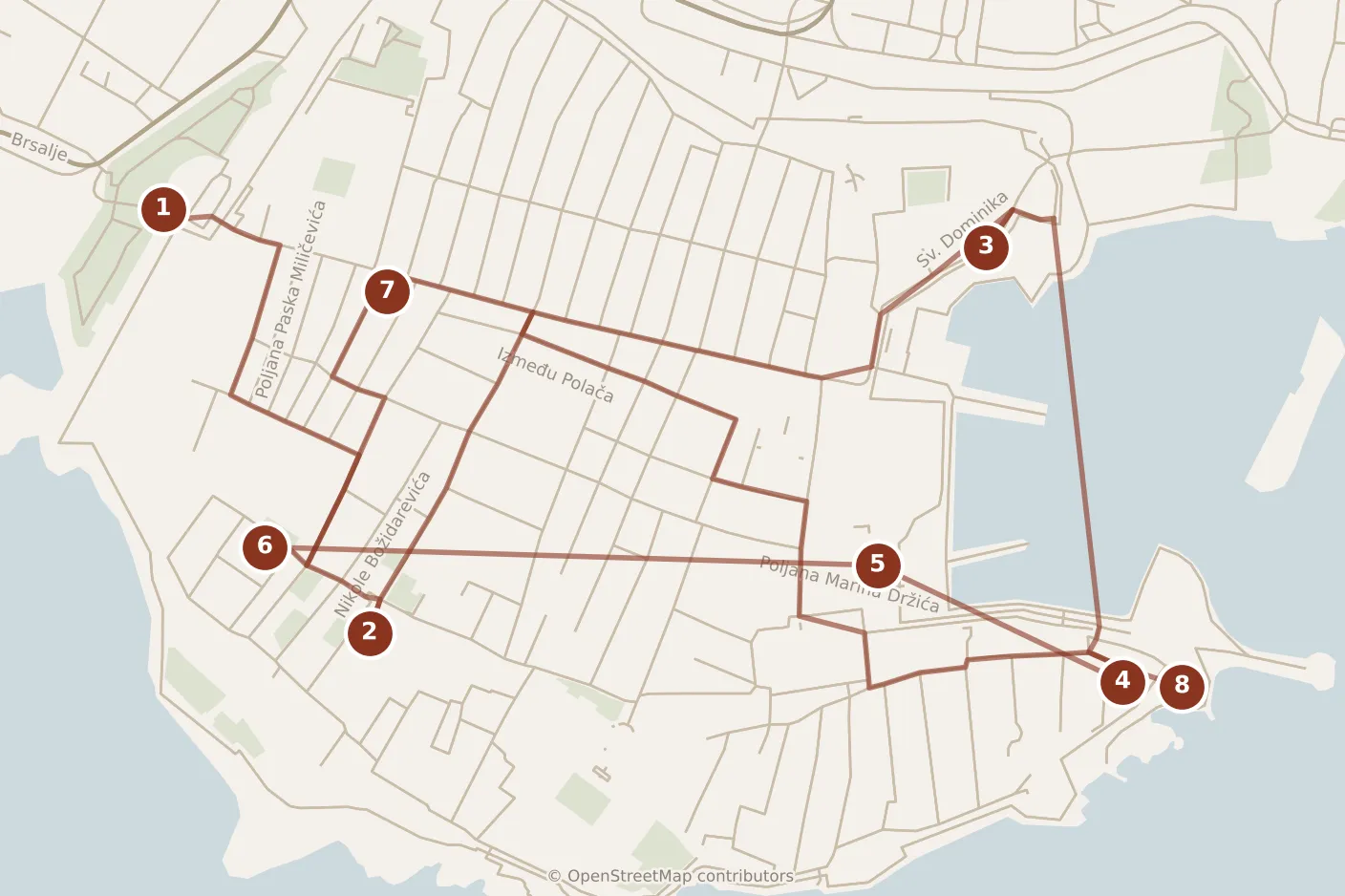
- Day one
- 1Pile Gate
- 2Walls of Dubrovnik
- 3Dominican friary
- 4Maritime Museum
- 5Rector's Palace
- Dubrovnik Synagogue — in the prose, not on the map
- 6Rupe granary
- 7Stradun
- 8Porporela
Today is the walled town at the depth a second day allows. Everything is inside three hundred meters of the same street, so the walking barely registers; what fills the day is five interiors a single visit here would have to choose between, and the evening that a day-tripper never gets.
Morning
Start outside the Pile Gate, the western entrance, where every bus in the city turns round. From Autobusni kolodvor, the stop at the main bus station and the name on its signage, lines 1A, 1B and 3 all come out here in a few minutes; walking it is two and a half kilometers of main road and is not the way to begin a trip. If you have come in from the airport, the shuttle passes the eastern side of the town before it reaches Gruž, so the sensible move is to get off early, leave the bag near the Ploče Gate and walk the ten minutes through the town to Pile.
Go straight up onto the Walls of Dubrovnik at the opening hour. The circuit is a shade under two kilometers, it stands as much as twenty-five meters over the lanes, and there is no shade worth the name on any of it — which is an argument for the first hour of the day in every month and an unanswerable one in August. Give it two hours and do not hurry. The thing to notice, and it takes the whole circuit to see, is that this is not one wall but two different ones welded together: on the landward side, facing the hill, it is monstrously thick and studded with towers and gun platforms, and on the seaward side it thins to something that is really a parapet on a cliff. The Republic knew precisely which direction the danger came from, and the wall is the argument written in stone. The ring has more than one stair down and you may leave it at any of them, which is worth knowing before you start rather than after.
Local tip. The ticket admits one circuit and there is no going back on it, so treat the climb as a commitment rather than a look: fill a bottle and settle anything you need to settle before the first step, because whatever you come down for you pay to go back up for. As for which stair, this day continues at the eastern end of the town, so take the eastern one if it is open — and if the only way down is the one you came up, it is seven minutes along the main street to where the morning goes next. Nothing in the afternoon depends on the choice.
From the eastern end of the walls it is a few minutes to the Dominican friary, which is the morning’s one interior and is where the city keeps its own painters. Forty minutes, and give most of them to two rooms rather than the church. The cloister is a square of slender columns with orange trees in the middle of it and is the quietest space inside the walls at any hour. The gallery off it holds the surviving work of Nikola Božidarević, a Ragusan painter of whom seventeen commissions are recorded in the city archives and four paintings survive, three of them here: a triptych in the Bonda chapel, the Annunciation in the gallery itself, and the Giorgi family’s altarpiece in the chapter house. Standing in front of four survivors of seventeen is a different experience from standing in front of a complete collection, and it is the honest condition of almost everything in this town.
Two of today’s stops are working religious houses rather than museums with old fittings, and both enforce something at the door rather than mentioning it in a leaflet: the friary wants shoulders and knees covered, and the synagogue this afternoon expects men to cover their heads. Neither is a matter of tone, and both are found out the hard way by people who did not know.
Afternoon
Lunch first, off the main street rather than on it, and sit down for it: an hour and a half, and this is the meal to spend on black risotto or on pašticada rather than on something carried. Then the afternoon runs east to west across the town and never doubles back.
Furthest east is the Maritime Museum, on the upper floors of the fortress that closes the mouth of the old harbor. Forty-five minutes. It is the collection of a state that had no army worth the name and a merchant fleet out of all proportion to its size, and the objects that make the point are not the ship models, good as they are, but the paperwork: a consular diploma of the Republic, a document issued by its consul in Lisbon, a ship’s medicine chest off one of its sailing vessels, the figurehead of a ship called the Abraham. A city of this size kept consuls in Portugal. The aquarium on the first floor of the same fortress is a separate ticket and a separate proposition; skip it unless you have children with you.
Two minutes west is the Rector’s Palace, and this is the paid hour of the day. Read the building before the museum inside it: it was begun after a fire by Onofrio della Cava, who had built the city’s aqueduct, blown up by its own gunpowder store in 1463, offered to Michelozzo, whose plans were rejected in 1464 for being too Renaissance for the taste of the council, and then shaken by earthquakes twice more — so Gothic, Renaissance and Baroque stand in one courtyard and none of it is a style choice. In that courtyard stands a bust of Miho Pracat, a shipowner from Lopud who left the state his money, raised by the Senate in 1638 and cut by Pietro Giacometti. Give it a minute, because of what it sits next to: the head of this state served for one month at a time and left no monument of his own, and the man the Senate did put up in stone was a merchant from a small island who had paid for it. An hour.
Four minutes north-west, up a stepped lane called Žudioska off the main street, is the Dubrovnik Synagogue. Twenty minutes, and it is a small room. It is the oldest Sephardic synagogue anywhere still in use and the second oldest synagogue in Europe: a community was here before 1492 and grew with the expulsion from Spain, the street was made the ghetto in 1546, and the building has been damaged and repaired by the earthquake of 1667, again in the Second World War, and again in 1992 when a shell came through the roof. It reopened in 1997. It is a museum most of the time and a place of worship on the High Holy Days, which means its closed days follow a Jewish calendar and not a weekday one — the one stop on this trip whose shut dates move around the year.
Ten minutes away and a long stair up to the southern side of the town, the Rupe granary ends the afternoon. Forty-five minutes. Above ground it is the ethnographic collection, costume and tools and the domestic apparatus of the coast; below ground it is the reason the building exists, a floor of great pits cut down into the living rock, dry-lined and sealed, in which the state kept the grain that let a city with no farmland behind it survive a blockade. Go down before you go up. The exhibition upstairs is pleasant and the hole in the floor is the argument.
Evening
Come down to the Stradun and walk it slowly, which is not what you did in the morning. This is the one thing two days buys that one cannot: the afternoon boats take the day visitors off, the town empties from the outside in, and the same three hundred meters of limestone that was a line at noon becomes a street people walk up and down slowly, for no reason but the walk. Look at the first floors while it is quiet — after 1667 the whole street was rebuilt to a single pattern, door and window under one arch, shop after shop, which is easier to see without a crowd in front of it.
Then eight minutes east and out to the Porporela, the breakwater beyond the old harbor, and walk to the end of it. It is where the town goes in the evening, it costs nothing, it has the eastern flank of the walls on one side and open water on the other, and it is where you will first properly see the island you are going to tomorrow. Dinner is behind you in the lanes; the harbor you come back past is where day two starts, which is not an accident.
Day two

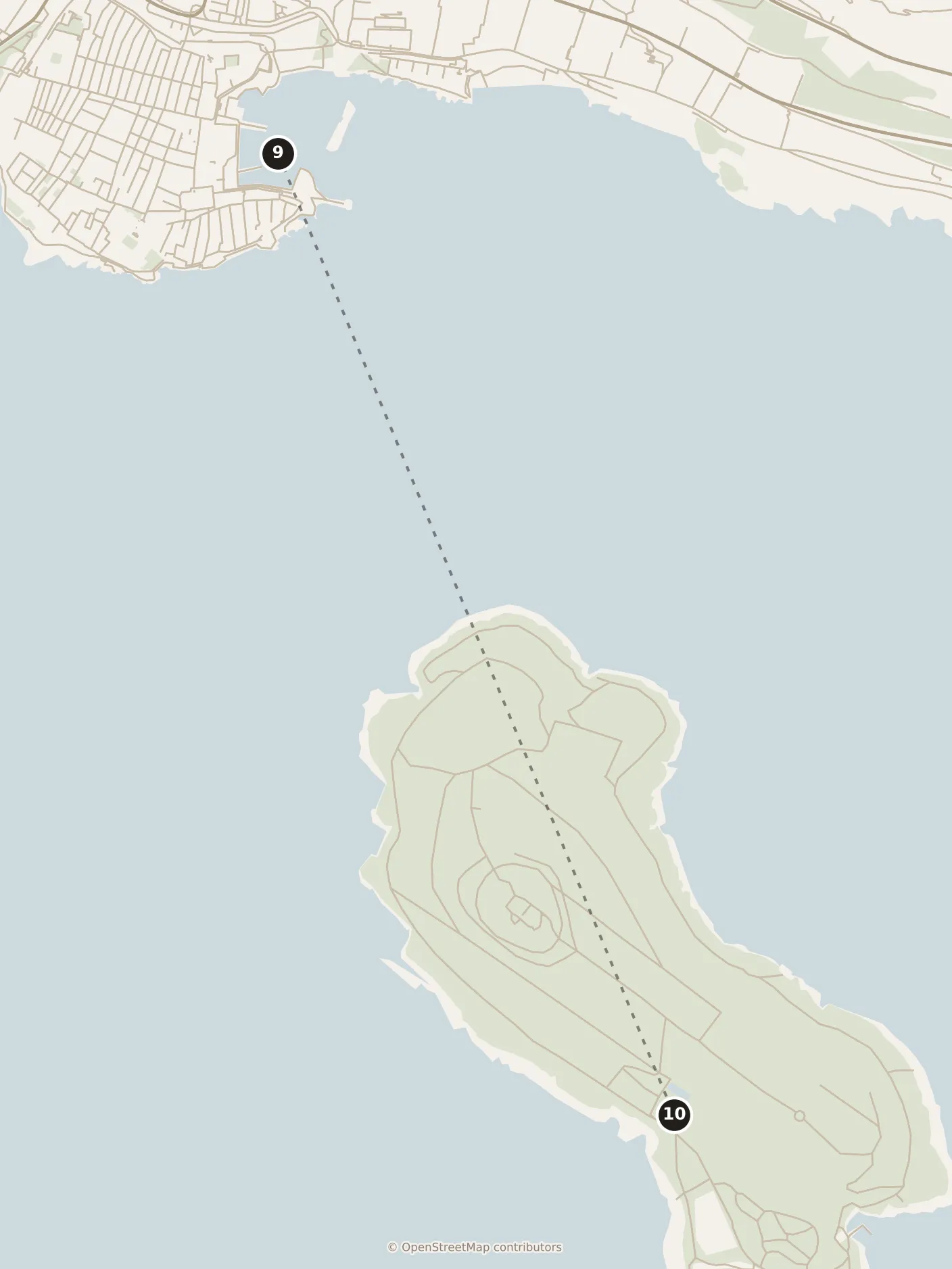
- Morning
- 9Old Port
- 10Lokrum
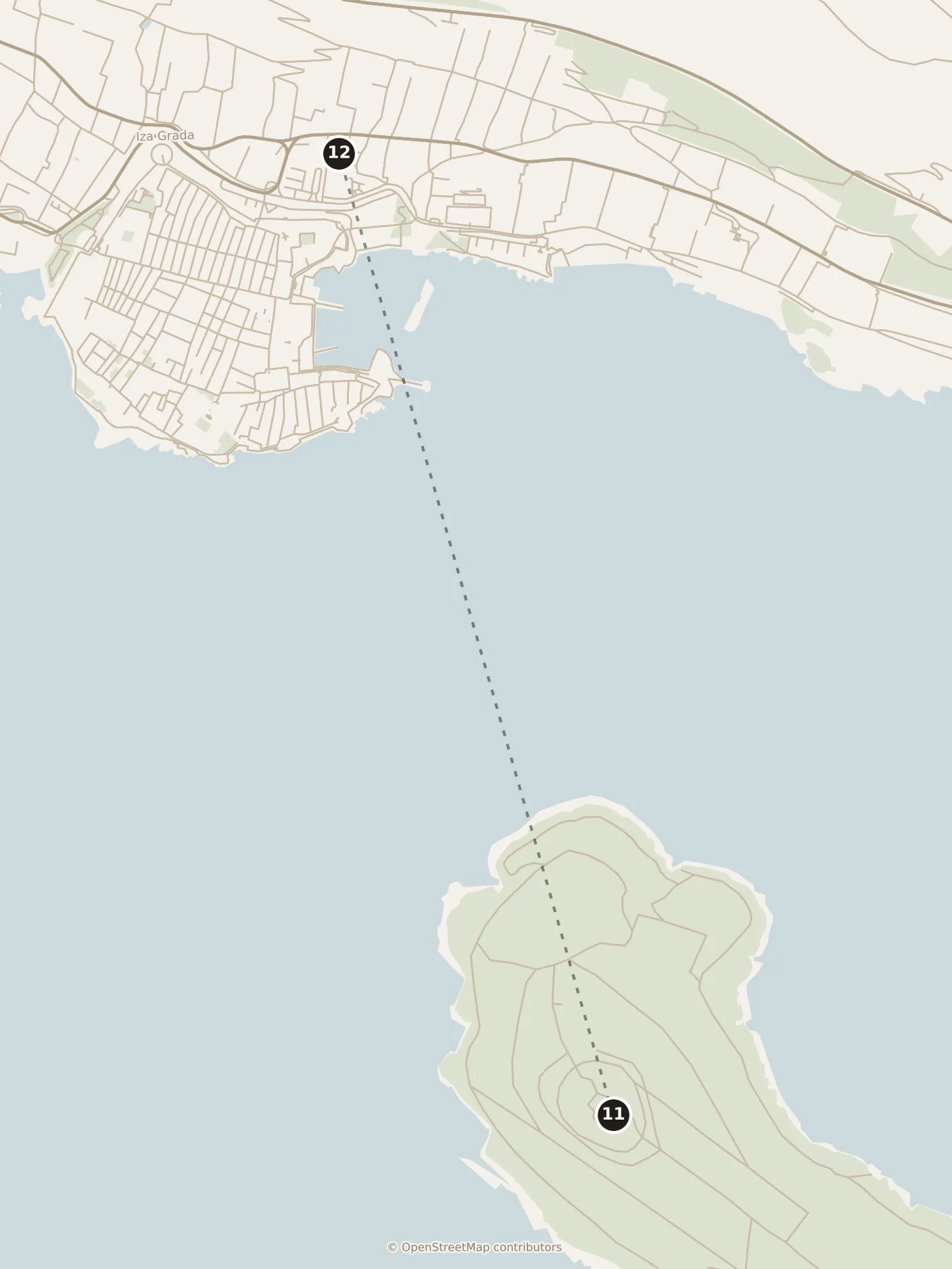
- Afternoon
- 11Fort Royal
- 12Dubrovnik Cable Car
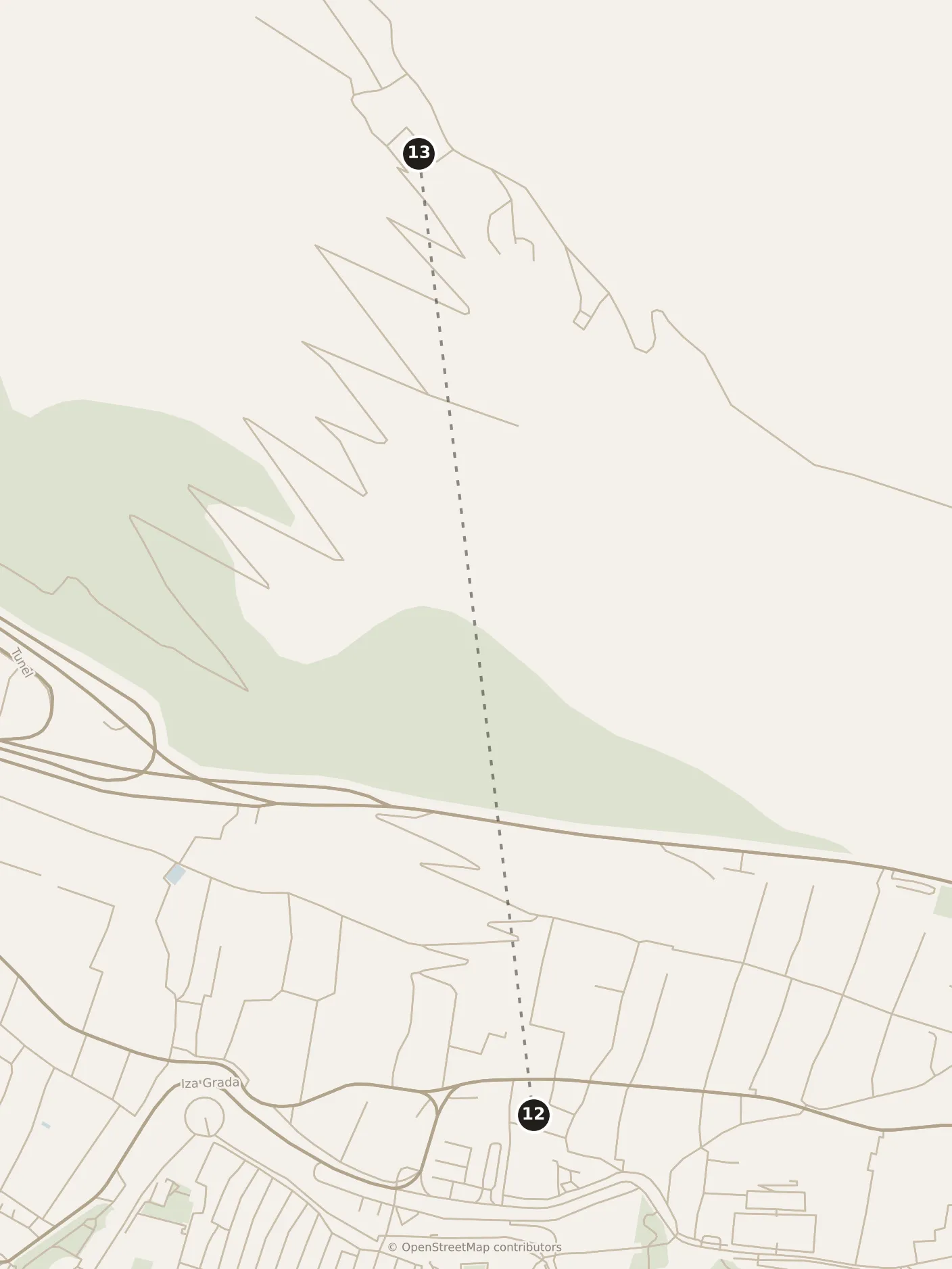
The leg out of the center: from stop 12 by train, not on foot.
- Evening
- 13Fort Imperial
Today is the sea and the height, and it is the day the trip exists for. It is also the day that is genuinely seasonal: through the middle of the winter the reserve runs no boats at all, and when it starts again in February it carries visitors on weekends only until the end of March. The cable car was shut from December to March in 2026. If your dates fall there, read the last paragraph of this section before you plan anything.
Morning
Walk two minutes from where last night ended to the Old Port. Tickets for the island are sold at the Luža point beside the harbor and online from the reserve, and the ticket is a single purchase covering the crossing both ways and entry to the reserve. Take an early boat. The crossing is about a quarter of an hour and the island is emptiest and shadiest before the middle of the day. The boats run to a published schedule rather than on demand, so read the day’s last sailing back when you buy the ticket: it is the one figure the whole afternoon is timed against, and the only thing on this island you cannot renegotiate once you are on it.
Lokrum is a wooded island of seventy-odd hectares, protected since 1948, and it is not a beach with a boat service — it is a nature reserve with a monastery in it, and roughly nine tenths of it is forest. Give it four hours and treat that as a floor rather than a target — and carry water and something to eat across with you rather than counting on what is trading, because this is a reserve and not a resort and what is open on it moves with the season. The Benedictines were here by 1023 and stayed until the Republic sold the island in 1800; what is left is two cloisters from different centuries standing beside each other, a Romanesque one whose church came down in the 1667 earthquake and a Gothic-Renaissance one that took over its functions, and grafted onto the end of them the residence Maximilian of Habsburg made for himself after buying the place in 1859. The gardens are the oldest continuously kept in this region and Maximilian’s exotics are still growing in them. Beyond the monastery is the salt lake the island calls the Dead Sea, which is warm, shallow, connected to the open water and the only calm swimming here. Peacocks walk about the paths as though they own them; they are an introduced species under management rather than tame birds, and feeding them is against the reserve’s rules, which also restrict fire and smoking on an island that is nine tenths tinder and are posted where you land. Nobody stays the night. When the last boat goes, everyone is on it.
Afternoon
Somewhere in the four hours, walk up to Fort Royal, the fort on the island’s high point, and allow twenty minutes up if you are not hurrying. It is a marked path and a real climb. What it is for is the one view nothing else on this trip provides: the walled town seen small and whole across a strip of water, with the ridge behind it, which is the shape a ship’s crew saw and the shape no photograph taken from inside the walls can contain.
Leave the island an hour and a half before your date’s sunset — that is the pivot the whole day turns on, and the count above is where the figure comes from. Back at the Old Port, walk up to the Dubrovnik Cable Car, whose lower station is about ten minutes away and most of that up steps. It is a short walk and a genuinely steep one; if you have swum and eaten it will feel longer than it is.
Evening
The ride is a few minutes. At the top is Fort Imperial, the squat fortress on the ridge, and inside it the Homeland War exhibition — the fort was the first line of the city’s defense in the early 1990s and held the command post of its own brigade, and the exhibition is documents, photographs, weapons and unit flags in the rooms where that happened. Forty-five minutes, and take it before the view rather than after, both because the light is the perishable half of the evening and because doing it in the other order makes three quarters of an hour on the siege the last thing in your day.
Then the ridge. What you get is the entire peninsula at once from outside and above it — the walls closing a shape you spent yesterday inside, the island offshore, and on a clear evening the line of the Elaphiti running away up the coast. Stay for the light to go: the terrace at the top is built for exactly that, and through the long-light months the cable car is still running well after the last of it. One caveat, and it lands at one end of the season rather than in the middle of it. As the operating year winds down the closing hour comes in faster than the sunset does, and there is a stretch in late autumn where the last car down leaves at about the hour you would otherwise be watching the light. The operator publishes each month’s hours; read your month’s before you build the evening on the ridge, and if the last car down comes before the light goes, move the ridge to the middle of the afternoon and give the evening to the town instead — the Stradun and the breakwater from day one are a good deal better in the dark than a ridge you had to leave early.
One thing genuinely stops this evening, and it is not the season. The operator suspends the cable car above a set wind speed and for lightning, and that is not a delay you stand at the bottom and wait out. There are two replacements and they are different sizes. If you want the ridge anyway, line 17 climbs from Pile to Bosanka, the village behind it, and from there it is about half an hour on foot west along the ridge road to the fort. Be clear that this is a weekday plan and nothing more: in 2026 line 17 ran nine times each way from Monday to Friday, once each way on a Saturday — with that single descent leaving before that single ascent — and not at all on a Sunday or a public holiday. Even on a weekday it buys you the ridge rather than the light on it, because the last bus down from Bosanka went at eight in the evening, which in June is before the sun sets. Read the current schedule at the Libertas counter at Pile before you commit an evening to it, because walking down in the dark is not a plan either. If you would rather keep the evening simple, the substitute that costs nothing is Lovrijenac, the free-standing fortress five minutes beyond the Pile Gate on the other side of town: it looks straight back at the walls from outside them, day one’s ticket or the pass already admits you, and it keeps the walls’ hours rather than the cable car’s, which in the shoulder months is the difference between open and not.
Local tip. The one decision on this day you cannot take back is when you get on the boat home. Everything before it is yours to stretch — the cloisters, the swim, whether you climb to the fort at all — and that one is not, because everything after it is timed against a light nobody can move. Fix the hour while you are still on the island and treat it as the end of the island rather than the beginning of a rush.
Between December and March this day does not exist as written, and no reordering fixes it: for most of that stretch the island’s boats do not run at all, and the cable car does not run at any point in it. The replacement is a day out to Cavtat, which is line 10 from Pile and well under an hour down the coast — the Greek settlement of Epidaurus, whose refugees founded Dubrovnik after it was destroyed in the seventh century, and which now holds Vlaho Bukovac’s house and, on the hill above the harbor, the Račić family mausoleum cut by Ivan Meštrović. It is a half day and it swims in summer, which is why it belongs to winter here: it is the one substitute that is better in the cold months than the thing it replaces.
With a third day

A third day goes out of the city, and it goes at the end rather than in the middle. Days one and two are ordered by an argument — the walls teach you the town, and the second day looks back at what the first one taught you — and a day up the coast breaks nothing if it comes last. What it also does is give you a spare: days two and three will trade places freely, with one restriction — the coast day cannot fall on a Sunday or a public holiday, for the reason the last section gives. So if the forecast puts the wind or the rain on your second morning and that morning is not one of those, take the coast then and keep the island and the ridge for the third day. Day one moves for one thing only, and it is not weather: the walls are single-entry, unshaded and busiest when the ships are in, so they want the first clear morning you have, and if the trip collapses to one day they are the day. The exceptions are the three dates in the year when the municipal museums all shut together — Christmas, New Year and the third of February — and on any of the three day one’s afternoon shuts with them; those cases are at the end of this article.
Give it to Ston, at the neck of the Pelješac peninsula, about forty kilometers away as the crow flies and a good deal further by the coast road. Line 15 runs there from the main bus station at Gruž, and what shapes this day is its schedule rather than its distance: three departures each way, none on a Sunday or a public holiday, and in 2026 only one pair of them made a day of it — out at a quarter to eleven, and back in Dubrovnik at seven in the evening. The road is well over an hour each way, so that is about nine and a half hours door to door for something over five on the ground, and there is no early bus, so Ston cannot be reached before midday. The one figure that pair does not give you is the hour the bus leaves Ston, and the day turns on it exactly as day two turns on the last boat. Read the current schedule before you choose this day at all, and if it still offers one workable pair, that pair is the day rather than a suggestion.
What is at the end of it is the Walls of Ston, and they are the reason to come. The Republic bought this peninsula in 1333 and from 1358 walled its neck shut, from Ston on one sea to Mali Ston on the other, because behind that wall were the salt pans that made a large part of the city’s money. Something over seven kilometers were built and five and a half survive, with twenty of forty towers and the fortresses at either end — Veliki kaštio at Ston, Koruna at Mali Ston — and the one on the hill of Podzvizd between them at 224 meters. You can walk it. Give it two hours to go over the top and down the other side, take water, and understand what you are agreeing to: it is a stone staircase over a hill in full sun, with no shade and no way off it in the middle. The Field Gate at Ston carries an inscription of 1506 and is where most people start.
The salt pans are still worked, in the same rectangular basins, and half an hour walking their edges after the wall is the right way round: you have just spent two hours looking at the fortification and this is the thing it was defending. Then Mali Ston at the far end, which is a small harbor with a fortress on it and the oyster beds of the bay in front, and where lunch takes an hour and a half and is the reason to walk the wall in this direction rather than the other. Before you set off over the hill, check at the stop where you got down which of the two towns your bus back leaves from: it is under two kilometers by road between them, twenty-five minutes you would rather not discover you owe at the end of the day.
Two things people will offer you instead of this, and both deserve a straight answer. The boat trips around the Elaphiti are a genuine pleasure and the right choice if what you want from the third day is more swimming; they are a full day and they will not give you the walls at Ston, so choose on that basis rather than on the brochure. And the coach excursions across the border — Mostar one way, Kotor the other into Montenegro — are long days with two frontier crossings in them and several hours of coach at each end. They are real places and worth going to; they are not a third day in Dubrovnik, and buying one is deciding to spend your third day somewhere else.
If the trip is shorter than you planned rather than longer, cut in this order and no other. The Rupe granary goes first — it is the furthest stop from everything else and the one whose absence you will not feel — and the synagogue second. Together they return about an hour and a quarter, all of it to the end of day one’s afternoon, which is where the pressure actually sits: on a December date, keeping both ends the day at the moment the light goes and leaves no evening at all, and cutting them gives day one an evening. They do nothing for the Rector’s Palace, which comes before them — the palace is dealt with by moving it rather than by cutting anything, and the last section says how. The Maritime Museum goes third. The walls never go, and neither does the island: if you have two days and one of them is broken, spend the broken one in the town and keep the boat.
Practicalities
Book the pass or the wall ticket before you travel — that is the whole of the advance booking for the sights on this trip, and a week ahead is plenty. It is not the whole of the advance booking: the two long sit-down meals in this trip, the lunch on day one and the oysters at the far end of day three, are the things to reserve a table for in July and August, and no ticket office will do it for you. The walls sell through their own webshop as well as at the booths at their entrances, and the reason to buy ahead is the line rather than the price. The island’s ticket is sold at Luža on the morning you go or online from the reserve before you come, the cable car at its lower station, and the bus tickets at the Libertas counters at Pile or from the driver. Install the Libertas app for its real-time arrivals, which is what the city lines are worth having; but a line that runs three times a day is made plannable by its printed schedule and not by knowing where the bus is now, so read the schedules for lines 15 and 10 before you plan a day out of the city.
The season decides day two and the weekday decides day three, and telling those two apart is the single most useful thing to know before choosing dates. Day two rests on two seasonal institutions rather than daily ones: the island reserve ran its last boat of 2025 on the fourteenth of December and carried no visitors again until the Feast of St Blaise at the start of February, then weekends only to the end of March, and the cable car was closed from December to March in that same winter. So one trap is arriving in January, when day two as written does not exist at all and there is nothing to swap it with. The reserve publishes its own last sailing day each December; read that one notice before you book flights, and if it has moved, the shape of the trip moves with it.
The other trap is a Sunday. Line 15 to Ston does not run on Sundays or on public holidays, so neither a Sunday nor a holiday can be your third day. Line 17 up to Bosanka keeps the same rule, and that one costs day two rather than day three: on a Sunday with the wind up there is no cable car and no walk to the ridge either. In 2026 the holidays falling inside the season were the thirtieth of May, the fourth and the twenty-second of June and the fifth and fifteenth of August; one of them follows Easter and so moves every year, and a country can add a date to that list, so check the current one against your own dates. The fix is free — days two and three trade places — but only if you notice before you are standing at Gruž.
Day one’s own weekday risk is real and small, and the reason it is small is worth having. Three of day one’s five interiors are municipal, run by Dubrovnik Museums: the Rector’s Palace, the Maritime Museum and the granary. They keep one set of hours between them but three different closing days — the Maritime Museum shuts on a Wednesday, the granary on a Tuesday, and the Rector’s Palace not at all in summer and on a Monday in the winter period — so no weekday takes more than one of the three out of the afternoon. In summer the two it can take are the granary and the Maritime Museum, which are the two the cut list in the previous section drops first and third anyway. In the winter period a Monday takes the palace instead, and that is the one the cut list will not drop; the winter paragraph below says what to do with it, which is to move it rather than lose it. Dubrovnik Museums publishes those hours and those days itself; check them against your dates rather than trusting a day named in any article, this one included. The walls do not keep a weekly closing day, the friary does not belong to the group, and the synagogue keeps the calendar described above.
So day one keeps its place in every case, and there is no whole-trip reordering to weigh. The walls-first argument — single entry, no shade, and worse when the ships are in — is not traded away against anything, and the three dates that do empty day one’s afternoon are not weekdays at all; they are in the paragraph below.
Two fixed points on the year are worth planning around rather than against. The Feast of St Blaise, on the third of February, is the city’s own day, and the island opens for it in a month when it is otherwise shut — but Dubrovnik Museums closes on exactly three dates in the year, Christmas and New Year and this one, so on that morning all three municipal interiors are shut together. Take the walls and the island and leave day one’s afternoon for another date. It is a holiday in the city too, so line 15 does not run: the third of February cannot be your Ston day either. And through July and August the Dubrovnik Summer Festival puts performances into the open spaces of the town, including Lovrijenac, which on performance days can close to visitors in the afternoon — which matters here only if you take the cable car alternative, since that is the only place Lovrijenac appears in this trip.
In the winter period day one will not hold everything above, and the fix is two moves rather than one. The walls open an hour later and shut in the middle of the afternoon, and the Rector’s Palace shut at four in 2026. So take the palace straight after the friary, before lunch instead of after it — that costs a two-minute backtrack eastwards afterwards and nothing else, and it puts the one timed thing in the day a clear three hours before it shuts, however late the walls let you off. The winter palace also closes on Mondays, so this rearrangement assumes a date that is not one; if yours is, move the palace onto your second day, which in winter is the half day at Cavtat and has the room for it. Then make the cut from the third-day section: the granary and the synagogue come out. The first move saves the palace; the second is what stops the afternoon ending after dark, and neither does the other’s job. What you lose is two small interiors, and what you keep is the paid hour of the day.
The other thing worth checking the night before each day is how many cruise ships are in port. It is a day-by-day fact and not a weekly one, the port publishes its own list of ship calls, and it changes exactly two decisions: whether the walls at opening are merely busy or genuinely slow, and whether the morning boat to the island is worth catching an hour earlier than you meant to. Everything else about arriving in this city, paying for its buses and eating in it belongs to the Dubrovnik guide, and none of it changes between one day here and three.


.jpg)