Dubrovnik in one day: the walls at opening, the Old Town after them, the shore at the end

Last updated 4 August 2026
Overview
Dubrovnik hands a single day one very easy problem and one hard one. The easy problem is distance. The walled Old Town is about three hundred meters across, and from the Pile Gate at its western end to the Old Port at its eastern one is a walk of some five hundred meters — eight minutes, not hurrying. Everything below except Lovrijenac and the last stop is inside that, and the whole day comes to under three kilometers of walking, plus the walls themselves. There is not a single bus, boat or taxi in it once you are in the town.
The hard problem is that the thing you came for is a two-kilometer circuit of unshaded limestone twenty-five meters above the roofs, sold on a ticket that admits you once and does not let you back on. It is worth more of the day than everything else put together, and it is the one stop where arriving at the wrong hour ruins it rather than merely delays it. So the day is counted forward from one door. The walls admitted their first visitors at eight in the summer of 2026 and not until nine in that same year’s winter period, which the walls’ own management defines as the first of November to the thirty-first of March. In that period they also close in the middle of the afternoon, which is why the circuit cannot simply be shifted to the end of the day when it is cooler. Build the morning forward from whichever hour applies to your date; if the hour has moved, build it forward from the new one. Nothing else in the order below depends on a clock.
The stops that follow, as far as the Old Port, with a sit-down lunch and the twenty minutes of walking that join them, come to about eight and a half hours; the evening after that is as long or as short as the light and the season allow. That figure counts the time you spend inside things and on your feet between them and nothing else: in particular it does not include the line at the walls’ ticket booth, which in high summer can be a half-hour of its own before you have climbed a step. The sun sets here from a quarter past four in early December to half past eight at midsummer, so add eight and a half hours to your date’s opening and set the answer against your date’s sunset — seven and a half in the winter period, when War Photo Limited is shut and its hour comes out. At midsummer you are finished in the middle of the afternoon with four hours of light still to spend. In December you finish the last stop after dark — which is not a disaster, because it is a harbor, but it is a different day from the one the photographs show, and it is worth knowing which one you have booked.
What one day costs you here is the sea. Dubrovnik’s real luxury is the water: Lokrum ten minutes off the Old Port, the Elaphiti islands up the coast, a whole afternoon of swimming from a boat. None of it fits beside the walls without gutting them, so give it up cleanly rather than half-doing it and arriving back sunburnt with the circuit unwalked. The consolation is real — the walls are themselves two kilometers of sea view, and the day ends on a shore.
Then the bag, which is a smaller problem here than the shape of the day suggests. There is left luggage inside the walls, at the Church of St Ignatius, and more of it immediately outside the Ploče Gate on Frana Supila, at the eastern end of the town; the staffed office at the main bus station out at Gruž is the third, and it is the one that keeps station hours rather than shop hours, so it is the answer if you arrive before the town has opened. None of them asks you to be a guest anywhere. What matters is only that you leave the bag before you go up: do not take a case onto the walls. It is two kilometers of steps with no re-entry, and the last stop is a beach. Where you leave it decides where the day ends, not whether the day happens.
The day

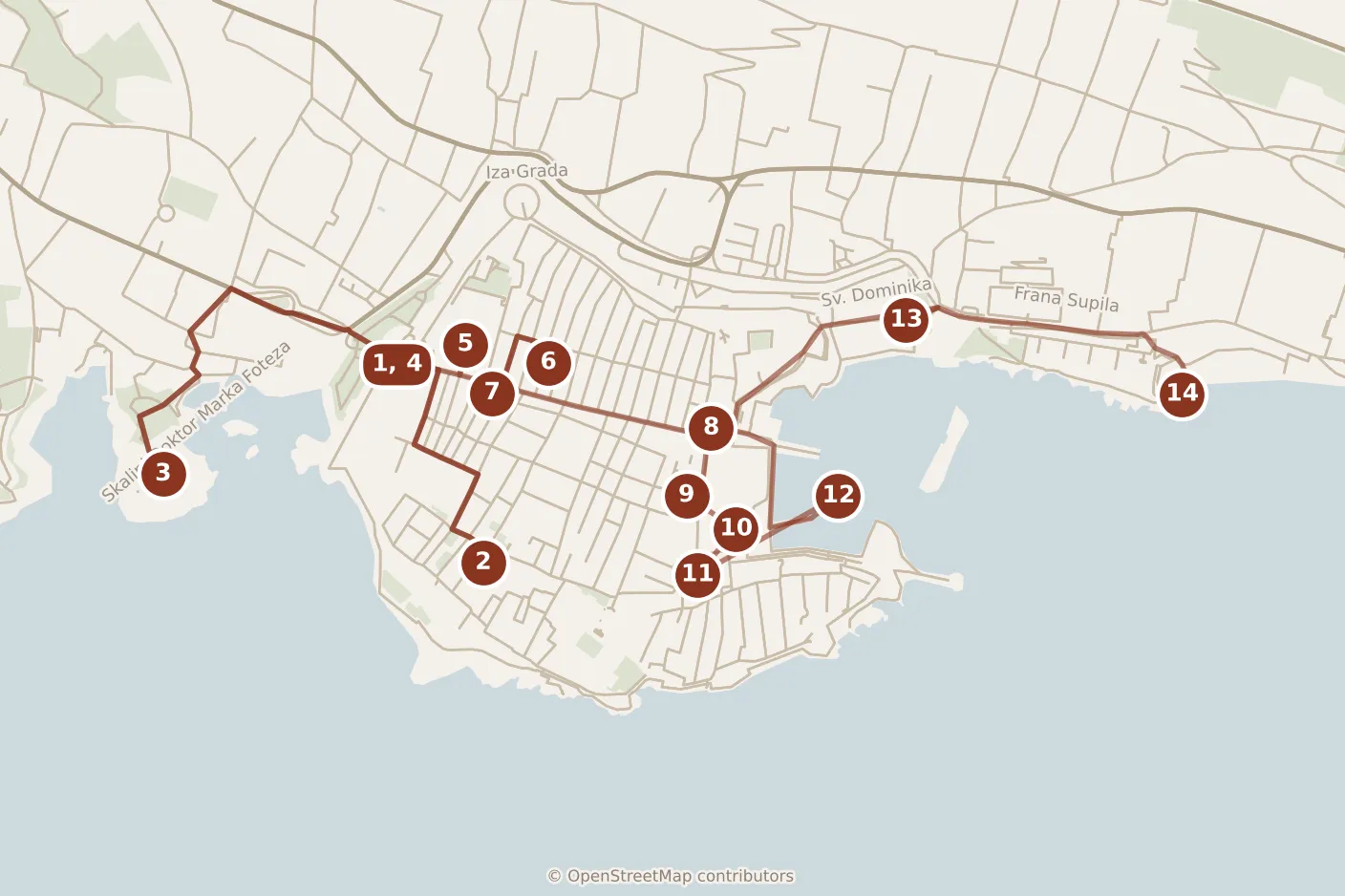
- The day
- 1Pile Gate
- 2Walls of Dubrovnik
- 3Lovrijenac
- 4Onofrio's Great Fountain
- 5Franciscan friary
- 6War Photo Limited
- 7Stradun
- 8Sponza Palace
- 9St Blaise's Church
- 10Rector's Palace
- 11Dubrovnik Cathedral
- 12Old Port
- 13Ploče Gate
- 14Banje Beach
Morning
Start outside the Pile Gate, at the western end of the walled town, where the city buses turn round and where every version of this day begins. From Kantafig, the stop at the main bus station, lines 1A, 1B and 3 all run out here; on foot it is four kilometers and the better part of an hour, so take the bus.
Go straight up onto the walls, before the town and before the ships. The circuit is 1,940 meters, it stands up to twenty-five meters above the lanes, and there is almost no shade on any of it — which is the whole argument for the opening hour rather than midday, and a stronger argument in August than any crowd. Give it two hours and walk it slowly. For the first stretch look down at the roofs rather than out to sea: the town was shelled from the first of October 1991, UNESCO counted 55.9 per cent of the Old Town’s buildings damaged, and the roofs were relaid afterwards. You are looking at the record of that, tile by tile, and there is nothing up there to tell you so — the marker is down at the Pile Gate, where you came in. The three set pieces on the ring are Minčeta, the round tower at the high northern corner, finished in 1464; Bokar, the two-story gun fort thrown out below the wall in the 1460s to cover the very bridge you crossed at Pile; and St John’s Fortress, the squat mass closing the mouth of the old harbor.
Local tip. The wall ticket is good for one circuit and there is no re-entry, so this is not something to dip into and come back to. Fill a bottle, use whatever facilities you can find before you climb, and decide at the foot of the steps that you are walking the whole ring — because anything you come down for, you pay to go back up for.
Off the walls at Pile, cross to Lovrijenac: three hundred meters, five minutes, and then a flight of steps up the rock. It is the free-standing fortress on the crag beyond the gate, and the reason to go now rather than later is the ticket. A wall ticket admits you to Lovrijenac; a Lovrijenac ticket does not admit you to the walls. Half an hour, most of it for the view back at the city from outside it, which is the one angle the circuit cannot give you.
Back through the gate. Just inside stands Onofrio’s Great Fountain, a sixteen-sided drum with a spout carved into each face, built in 1438 by Onofrio della Cava as the town end of an aqueduct that brought water twelve kilometers from a spring inland. It looks plain because it is: the earthquake of 1667 took the decoration off it and nobody put it back.
Next to it is the Franciscan friary, where the thing to see is not the church. The pharmacy inside has been dispensing since 1317 and is the oldest still working in Europe; behind it lies a late Romanesque cloister of 1360, double columns with a different carved capital on every pair, and a library of some twenty thousand volumes including 137 incunabula. Three quarters of an hour, and spend most of it in the cloister rather than the museum cases. Going in, look up at the portal facing the main street: a life-sized Pietà carved in 1498 by a local workshop, and one of the few pieces of the pre-earthquake city still standing exactly where it was put.
A minute further on, up one of the stepped lanes off the main street, is War Photo Limited, whose permanent exhibition is photojournalism from the break-up of Yugoslavia — Croatia, Bosnia, Kosovo. Give it an hour. It opens from April to October and not in winter, which is tidy, because winter is precisely when this day has no spare hour for it.
Afternoon
Come down onto the Stradun and walk its length east, which takes four minutes and is the only level ground in the Old Town: every lane off its northern side climbs away in steps. It is limestone, three hundred meters, finished in 1468, and it is not a street that was built but a channel that was filled — marshy water once separated the island the city began on from the mainland settlement of Dubrava behind it. Look at the ground floors as you go. After 1667 the Republic rebuilt the whole street to one pattern, and every shop still has its door and window set in a single frame under one semicircular arch.
Lunch goes somewhere in this quarter, and eat it sitting down. The temptation with one day is to buy something to carry, and this is the wrong city for that economy: black risotto, or pašticada, or the oysters they farm up the coast at Ston, eaten at a table, are as much the point of the place as any facade, and rožata afterwards. An hour and a half.
At the far end of the street the Sponza Palace, Gothic below and Renaissance above, built between 1516 and 1522 by Paskoje Miličević. It was the customs house, and then the mint, the treasury, the armoury and a school; it is now the state archive, which holds documents back to 1022. Its distinction is negative and it is the one to know: of the great buildings on this square, Sponza is the one the 1667 earthquake left standing. Twenty minutes, and the courtyard is free to walk into.
Round the corner, St Blaise’s Church, for the patron the city has kept since it was a republic. The council voted the first church in February 1349, one month after the plague reached Dubrovnik and partly out of the estates of people who had died without heirs to leave them to; the building you walk into is the replacement, put up in 1715 by the Venetian Marino Gropelli after a fire took the medieval one. Ten minutes is enough, and it is for one object: in the niche above the altar, a gilt-silver figure of the saint from the fifteenth century, the only thing in the building that came through the fire of 1706, holding a scale model of what the 1667 earthquake took away.
A minute on is the Rector’s Palace, and this is the hour of the afternoon worth paying for. The head of the Republic served for one month and was not eligible again for two years, and the Latin the Republic cut into this building — Obliti privatorum publica curate, forget private affairs and attend to public ones — reads as an instruction to a man who would be nobody again in four weeks. The building has been blown up by its own gunpowder store in 1463 and shaken twice by earthquakes, and is Gothic, Renaissance and Baroque in the same courtyard as a result. It holds the city history museum. Give it an hour.
Then the cathedral, a minute further, rebuilt from 1671 on the ruin of the church the earthquake brought down. The nave is quick; give the time to the treasury, which is a small room of reliquaries assembled from every port the Republic traded with, and among them the head, arm and leg of the patron in gold-plated cases, the head made in the form of a Byzantine crown. Titian’s Assumption is on the high altar, painted around 1552. Half an hour for both.
Finish the afternoon at the Old Port, three minutes away, the sheltered basin behind St John’s Fortress where the Republic built and repaired its ships. Walk out along the breakwater and look back at the arsenal arches on the quay. Half an hour. It goes last because it is the one stop inside the walls where you sit down and stop reading things off a wall.
Evening
Go out through the Ploče Gate, past Revelin, and follow the road down to the shore at Banje — under ten minutes from the harbor, and the swimming this route reaches. From there you have the whole eastern flank of the walls in one view, with Lokrum lying offshore. If it is warm, swim; if it is not, the view is the reason to walk out and it costs nothing. It is also the one stop a suitcase makes impossible, which is the other reason the bag is not with you.
In the long-light months this is where the spare hours go, and there is a second option for them. The cable car up Srđ, the ridge behind the town, ran from April to November in 2026 and not at all from December to March; its lower station is two hundred meters from the Ploče Gate and a good deal higher than it, so getting there is a short climb rather than a walk, and the ride itself is a few minutes. It is a separate ticket and a separate line, and it buys you the one view the walls cannot: the whole peninsula at once, from above and outside. At midsummer the day above finishes in the middle of the afternoon with hours of light left, which is enough for the shore and the ridge both. In the winter period there is no spare afternoon, and from December to March no cable car either, so the shore is what you get.
Where the day ends depends on where the bag is. If it went out to Gruž, walk back west along the main street to Pile — about a quarter of an hour from the shore, and the longest single stretch in this itinerary — and take 1A, 1B or 3 back out to Kantafig. If you left it at the Ploče Gate, you do not make that walk at all: the shore is minutes from where it is waiting. If it is inside the walls, go back in through that gate to collect it and then on to Pile — the same walk west, with the bag picked up in the middle of it.
Practicalities
The one thing to buy before you travel is the wall ticket. It was in the thirty-five to forty-euro range for an adult in high season in 2026 — a serious price for a walk, and the reason to know it in advance is that it decides whether this is your day at all. In the winter period it is markedly lower, so price your own date rather than the summer one. It is sold through the walls’ own webshop as well as at the entrance booths, and buying ahead is worth it for the line rather than the price. Two things come with it that are easy to miss: it admits you to Lovrijenac as well, which is why Lovrijenac comes immediately after the circuit and not later; and it is valid for one entry, so the circuit is a commitment, not a series of visits. One more thing to check against your own date: in July and August Lovrijenac is a stage for the summer festival, whose program publishes the performance dates, and on those days the fort can shut to visitors in the afternoon. Putting it in the morning survives either way, which is the point of putting it there.
The walls themselves are open every day of the year except the twenty-fifth of December, which removes the usual worry. The stop on this route that does close a day a week is the Rector’s Palace, and only in the winter period, when it shuts on Mondays. In that same period it also closed at four in the afternoon in 2026 — Dubrovnik Museums publishes the palace’s own hours — and that is the one closing time a winter day, counted forward from the walls’ own later winter opening, has to clear: on a winter date take the palace before the two churches rather than after them. Check both before you set out, because it is the paid hour of the afternoon; if it falls on your day, the cathedral treasury is what carries the end of the afternoon, and the day loses an hour rather than a shape.
The looser risk is the two church interiors, St Blaise’s and the cathedral treasury, which keep their own hours and can close for a stretch in the middle of the day and during services. They are the two stops in the afternoon that can be moved without disturbing anything else: the order Sponza, palace, church, treasury reads exactly as well as the order given, and the whole quartet stands inside a hundred and fifty meters. If you find a church shut on the way past, go on to the palace and come back — that is a one-minute walk, not a detour. All three religious interiors on this day — the friary, St Blaise’s and the cathedral — ask for shoulders and knees covered.
The other thing worth checking the night before is which cruise ships are in port. On a heavy day the main street and the walls both turn into a slow line, and the whole reason the walls sit at the opening hour in this itinerary is to be off them before that happens. It is the single decision in the day that a crowded morning can undo.
If you are flying in for the day, leave the bag before you go into the town rather than after. The airport shuttle comes in from the east and stops at the Ploče Gate before it reaches the cable car station and Gruž, so the storage just outside that gate is the first thing on its run and the one that costs you no doubling back at all. Everything else about arriving, paying for buses and eating in this city belongs to the Dubrovnik guide, and it is the same in this day as in any other.


.jpg)
